Showing posts with label Roddy Dunlop. Show all posts

Wednesday, August 26, 2020

COURT ON AUDIO, M’LORD: Clients should be given SAME DAY access to Court of Session audio recordings - as ongoing probe reveals QC’s admissions in case linked to Lord Malcolm, Lord Carloway & concealed judicial conflicts of interest

Court recordings should be available same day to clients. AN ONGOING media investigation into hearings in Scotland’s top court – the Court of Session – has received evidence which casts doubt on the integrity of witnesses and  counsel’s actions – which could be remedied if unedited digital audio recordings were required to be provided to clients involved in cases – upon the conclusion of a hearing.

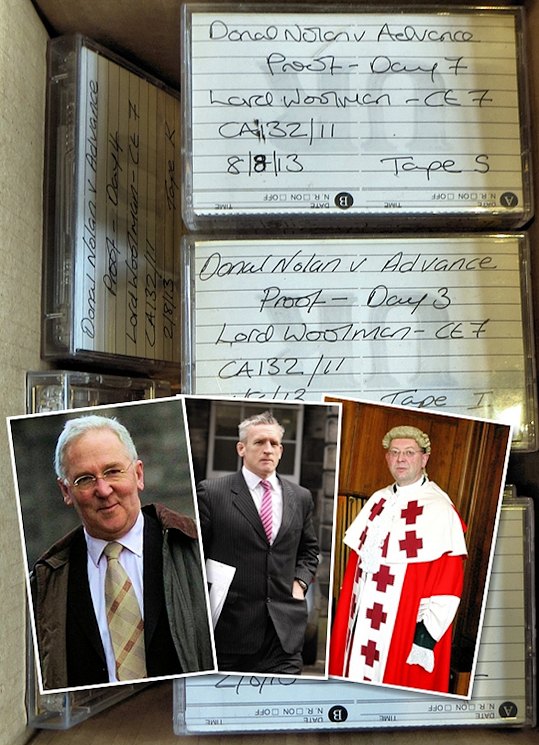
Audio recordings of hearings in a £6million land case Nolan v Advance Construction (Scotland) Ltd provided by a court source – and a study of their content have led to calls for clients who already pay tens of thousands of pounds for their claims to be hard by the Court of Session - to be given unrestricted access to audio records of proceedings in court – without obstruction or prohibitive cost being used to block access to proceedings in their case.

In the case which features in the released audio -  extraordinary exchanges between counsel, witnesses and the judge – Lord Woolman - can be clearly heard and further exchanges were counsel take an unrealistic, if combative approach with local planning officials in attempts to conceal or contradict legislation relating to the dumping of toxic, hazardous waste from the court.

In the cassette tapes of the Court of Session hearings – obtained by journalists from court sources – the audio recordings of interactions between witnesses, John Campbell QC, and the current Dean of the Faculty of Advocates – Roddy Dunlop QC – has since led to a separate investigation which has discovered one of the chief witnesses in Nolan v Advance held compromising interests linked to the defenders – which were concealed from the court and the judge – Lord Woolman.

In one exchange, Dunlop questions a North Lanarkshire Council planning officer – Mr Fraser Miller – on the conditions and legislation which are required for the removal of hazardous material including asbestos. From the recordings and what happened in court, it becomes clear the planning officer says planning permission would be required to remove the asbestos from the site, and the same permission would be required fo the asbestos to be dumped on the site.

As the case proceeds over a number of days in August 2013 before Lord Woolman - Dunlop’s client – Advance Construction (Scotland) Ltd – are ultimately forced to admit to Lord Woolman they were responsible for illegally dumping the toxic material on Mr Nolan’s property.

The audio tapes of the Nolan v Advance hearings go on to reveal many discrepancies between the accounts of what John Campbell QC said to his own client, and what actually transpired in court – including the as yet unexplained reasons why Campbell QC removed much of his own client’s financial claims – and critically the claim for legal expenses – without receiving any instruction to do so.

While it is important to note this case was initially won by Mr Nolan - the pursuer –  the failure of counsel to return to court for legal expenses against the defender led to financial loss & disaster after counsel for the pursuer turned on his own client by inexplicably stripping out much of the financial claim – an act which Lord Woolman said he had never seen in such a case.

A full report on how John Campbell QC reduced his own client’s financial claim almost to zero and without any instruction or consultation - can be found here: CASHBACK QC: Legal regulator’s files reveal senior QC reduced claim without instructions, withheld key evidence & witnesses including Cabinet Secretary from Court of Session case

Readers may be familiar with Nolan v Advance - one of the most extraordinary cases in recent times - which has since led to the discovery of carefully concealed interests of Court of Session judge Lord Malcolm (Colin Campbell QC) and Scotland’s current top judge – Lord Carloway (Colin Sutherland).

During a consultation between journalists currently engaged in the probe and court sources, further issues in the Nolan v Advance case have now come to light including a source which identified a comment between counsel to the effect of an unreferenced instruction with some degree of motivation - which states “you have got to four o’clock to get this sorted”.

And now – further audio recordings have been provided to journalists which lay down in crystal clear terms an extraordinary attitude on payment of fees on the part of the pursuer’s legal team – which included John Campbell QC, advocate Craig Murray and solicitor Gregor McPhail.

The legal team for Mr Nolan had previously signed up to a no win no fee agreement – which Campbell admits to in the recordings.

However, and without hesitation Campbell then appears to turn against the fee deal and demands his team all be paid – this coming after further material and already published emails revealed John Campbell demanded, and insisted on collecting  in person – cash sums of up to five thousand pounds at a time from his client Mr Nolan.

In one exchange – Campbell QC says “As fond as I am of you, none of us are doing this for love and neither is Craig [Murray]”

Campbell is then challenged over his already agreed position of working on the case via a no win no fee deal

John Campbell agrees he was working on a no win no fee deal but then replies: “That is correct, hmmm but we just have to see whether that actually holds up because hmm you know…”

A number of further recordings are now being studied where it is acknowledged by counsel Lord Woolman states he is  concerned about counsel’s lack of provision to the judge of evidence given by certain witnesses for the pursuer, Mr Nolan.

In an additional audio provided to journalists, John Campbell QC - who now heads the Edinburgh based Quaich Project – clearly admits responsibility for key failures in his presentation of evidence to the court.

Journalists and technical experts are now considering the content of the court recordings for futher publication and potential inclusion in reports to the Scottish Parliament’s Justice Committee of events in the Nolan v Advance case which identify a pattern of deliberate and concealed conflicts of interest by judges in the Court of Session.

And - in another court case where recordings have also come to light, it is also very clear what happens in court is very loosely transcribed to parties when there are requests by court participants for transcripts – some costing clients tens of thousands of pounds over hearing after hearing.

In a further case presented to the media team looking into Court of Session audio recordings - a court source has come forward with claims that a transcribing firm who were given court recordings as part of an order for transcripts - were told in a phone call to go easy on certain dates across hearings in one major case - and pay less emphasis to one side’s counsel in their provision of a final transcript ordered by the other side’s legal team.

A legal insider who has been given access to some of the audio material handed over to journalists now believes clients should be given unfettered access to recordings of their cases in court.

He said: “Clients pay a lot of money for their legal representatives to take a case through to the Court of Session and should be provided with audio recordings of each day’s proceedings at the end of that day”

He added: “The equipment to record court hearings has been installed for some time, and this should be properly used to ensure clients on both sides of the court have access to these recordings, without any attempt by court staff or the sitting judge to use unsatisfactory excuses or prohibitive costs as a reason for withholding audio access to those who are paying for the hearings.”

Currently, clients can request a copy of recordings from the Court of Session to be transcribed by an external private company, however – seldom if ever do the actual audio recordings pass into the hands of clients or either side’s legal team.

Clients must pay for the transcribing of the court recordings in what can run into bills of tens of thousands of pounds, however – there are notes of many cases where court staff, and the judge have blocked a client’s request to obtain transcripts of proceedings – and even when the court has agreed to transcription in some cases – clients and legal teams have identified multiple omissions in transcripts which suggest a motivated approach was taken to omit particular evidence from print.

For the media, a different approach to recording and broadcasting from the Court of Session & High Court of Justiciary currently exists in the following format:

Protocol on Recording and Broadcasting of Proceedings in the High Court of Justiciary and the Court of Session, and the Use of Live Text Based Communications from Court

Broadcast: Except where the context otherwise requires, for the purposes of the Protocol, "broadcast" means the transmission to members of the public of a video and/or audio recording; or live streaming. For the purposes of the Protocol, a recording refers to a video and/or audio recording. Broadcast may be for live streaming, news broadcast or documentary production. Individual sections within the Protocol identify the extent to which broadcasting may be permitted for a particular type of case.

Guiding Principle: The guiding principle is that broadcast of court proceedings is in the interests of open justice and for the information and education of the public.

Judicial Control: Subject to the guiding principle, whether a hearing should be recorded must remain under judicial control. The court may rule that, in any given case, recording a hearing would not be in the interests of justice.

Fair and Accurate Reporting: A report or presentation of proceedings that includes a broadcast of a hearing must be fair and accurate, having regard to the overall content of the report or presentation and the context in which the broadcast is presented. It must not be used for: the purposes of a party political broadcast; advertisement or promotion (except where such advertisement or promotion relates to a report or presentation that includes the broadcast); light entertainment; comedy or satirical purposes.

For the purposes of the Protocol, a media party means a journalist registered with the Scottish Courts and Tribunals Service (SCTS), or a party who can provide sufficient, appropriate evidence of relevant journalistic or documentary work. Any media party wishing to record a hearing is required to submit an application using one of the prescribed forms

Applications must be submitted to Judicial Communications for consideration by the Broadcast Working Group well in advance of the date of commencement of proceedings. On receipt of an application, the Broadcast Working Group must notify the presiding/chairing judge and ask him, or her, to provide to the Broadcast Working Group any comment or response which he, or she, may have on the application within an agreed time. Once the Broadcast Working Group has considered any such comment or response, it must make a recommendation to the Lord Justice General (or Lord Justice Clerk) as to whether the application ought to be approved. The final decision lies with the Lord Justice General or, in the absence of the Lord Justice General, with the Lord Justice Clerk. Approval may permit recording to take place in accordance with sections 2 to 5, or in accordance with any additional conditions as may be specified.

A decision on the application must be intimated to the media party within an agreed time. In the event of an application being refused, in whole or part, written reasons must be provided by the Broadcast Working Group.

In the event of an application being refused, in whole or part, the media party may submit an amended application taking into account the reasons for refusal.

If permission to record is granted, the Broadcast Working Group must appoint an SCTS staff member as a liaison officer. That officer is the point of contact between the media party and the court for all purposes connected with the recording.

If permission to record proceedings is granted, the presiding/chairing judge retains responsibility for ensuring that: the grant of permission remains appropriate; the recording is carried out on the terms approved by the Broadcast Working Group; and the recording is carried out in a way which does not disrupt court business. If, at any stage in the proceedings, the judge forms the view that to proceed with the recording would constitute a threat to the administration of justice, or that such a risk is present, or that the media party has breached the Protocol or any condition imposed, the presiding/chairing judge may withdraw the permission. If the presiding/chairing judge is considering withdrawing permission, an opportunity should be afforded to the media party to make representations to the judge before a final decision is reached.

Despite the progress of technology in the world outside of Scotland’s creaky Victorian courts and justice system, recording and broadcasting of what goes on in Scotland’s courts has not yet had the full impact on increasing transparency and accountability in the justice system which the same application of audio and video technology have had in courts in other jurisdictions.

Currently, the media must rely on a ‘judge-led’ review chaired by Lady Dorrian – who was appointed to chair it by Lord Brian Gill, Scotland’s former Lord President and Lord Justice General who famously liked to go after the media and block access to courts and documents during his short three year term as Lord President in which he continually held the media, and transparency in disdain.

Report of the Review of Policy on Recording and Broadcasting of Proceedings in Court, and Use of Live Text-Based Communications

A judge-led group which was appointed by the Lord President to review the current policy on the recording and broadcasting of proceedings and the use of live text-based communications from Scottish courts has published its report.

The review group, chaired by Lady Dorrian, has made a series of recommendations following a public consultation exercise, to which 17 individuals and organisations responded.

The review, which examined the existing practice in Scotland and other jurisdictions, was carried out in the context of a complete acceptance of the importance of the principle of open justice, recognising however that any steps taken in support of this principle must not pose any risk to the administration of justice.

In summary, the report recommends the following:

  • Filming of civil and criminal appeals, and legal debates in civil first instance proceedings, such as judicial review or procedure roll hearings, should be allowed for live transmission. Subsequent news broadcasting and documentary film-making should be allowed subject to clear and comprehensive guidelines.
  • The court should allow criminal trials to be filmed for documentary purposes in certain circumstances, subject to the safeguards referred to in the report. Cases involving children, sexual offences and vulnerable witnesses should not be filmed.  
  • No live transmission or filming for subsequent news broadcast should be allowed for criminal first instance business or for civil proceedings involving witnesses.  
  • For subsequent news broadcasts, the delivery of sentencing remarks of the judge should be permissible, with filming focused only on the sentencing judge. 
  • Filming of criminal trials for live transmission should not be allowed. 
  • In civil cases at first instance, filming for documentary purposes only should be allowed, but should exclude certain groups such as family cases and those involving asylum seekers.   
  • A structured approach to considering applications to film. 
  • All filming should be subject to robust, clear and comprehensive guidelines.   
  • Journalists who register in advance with the Scottish Court Service should be permitted the use of live text-based communications such as Twitter from court, subject to guidelines which will be issued in due course.  

The Lord President, Lord Gill said: I am grateful to Lady Dorrian and her group for having carried out this exercise so thoroughly. These well-considered recommendations have the support of the judges. I accept all of the recommendations. They are entirely appropriate in the contemporary world. My office will now prepare guidance on the implementation of Lady Dorrian’s report.”

On 18 October 2012, the Lord President, Lord Gill, appointed a judicially led media review group, whose remit was to review policy on the recording and broadcasting of proceedings in court. This was later extended to include consideration of the use of live, text-based communications (LTBC) from court.

Guidance on the conditions under which cameras could be allowed in court was previously contained in a practice note issued by Lord President Hope in 1992. These conditions were revised by Lord President Hamilton in 2012. The revised conditions allowed filming to take place without the consent of all parties involved. The production company and broadcaster had to provide an undertaking to the presiding judge that the final broadcast would not identify those who had not consented to the filming.

The passage of time since guidance was issued, together with the development of social media, the use of instant text-based communication and the broadcasting of proceedings before the UK Supreme Court have all contributed towards a need to review this matter. When filming for documentary purposes has taken place in Scotland, the guidelines have had to be complemented by detailed negotiations as to the precise terms in each case. In appointing this review group, the Lord President considered that a more structured approach was desirable, not least in the interests of consistency.

The review was chaired by Lady Dorrian. The other members were: Lord Bracadale, Lord Woolman, Sheriff Principal Stephen, and Sheriff Drummond. The group was supported by: Christopher Nicholson, Deputy Legal Secretary to the Lord President; Elizabeth Cutting, Head of Judicial Communications; Steven D’Arcy, Head of Strategy and Governance, Judicial Office for Scotland.

Friday, July 17, 2020

ADVANCE, QC: From Big Invoice to Cash Register – New Dean of Faculty of Advocates stood silent in court while Lord Malcolm concealed his son was on same legal team representing asbestos dumping construction company who lost case - then used law firm linked to top judge to hunt down couple for legal fees

Lord Carloway & Lord Malcolm welcome new Dean R.Dunlop TO WATCH and listen to members of the Faculty of Advocates who strut around Scotland’s courts as if they have a starring role in a grand pantomime or musical overseen by a figure dressed in fiery red and white robes – you may be forgiven for thinking you just entered the world of fantasy and cosplay.

However - what you are actually witnessing is Scotland’s ‘Victorian’ justice system – where lies spoken in court by a figure in a black gown & wig can become an accepted ‘truth’, prosecutors can intimidate defence counsel by adding the dead to witness lists, deals can be done in-chambers to avoid the press & public in open court, and evidence can be lost down the back of a filing cabinet.

And, if you are looking for shameless, outright dishonesty - try the time where Scotland’s top prosecutor James Wolffe QC – himself a former Dean of the Faculty of Advocates -  was being sued in the Rangers admin case of wrongful arrest.

The stakes in that case were so high that Scotland’s ‘world leading’ courts system then neatly engineered a scenario so that Sarah Wolffe QC – the wife of that same top prosecutor James Wolffe QC – could hear and rule on the £9 million claim against her husband and Scotland’s Chief Constable.

You all know the story – A real howler: WOLFFE COURT: Lord Advocate James Wolffe and his judge wife at centre of £9million damages claim - Questions remain why Lady Wolffe avoided recusal during emergency judge swap on court case against her own husband

It gets better: ‘World famous’ (really, not) Scots QCs taking millions in publicly funded legal aid - can literally dream up an entirely false line of defence (commonly known as a lie) - for their child murdering clients and get away with trolling it out to a sceptical judge, jury and entire court room - and then bill the Scottish Legal Aid Board (Taxpayer) for their time spent doing so.

Going further up the tree - Scotland’s top prosecutor - the Lord Advocate – on an instruction to cover up for top cops with shady pasts – can ram-raid a Tribunal hearing and intimidate Tribunal judges into blocking claims of corruption and evidence tampering in the most senior ranks of Police Scotland - from becoming public.

Want to see examples of what most in the real world call corruption and money laundering? – try case after case where Advocates and QCs quietly demand with menaces – sums of cash in envelopes from their criminal or civil case clients. The ‘whisper’ goes like this - Pay up – or the desired court outcome will not be achieved.

And, don’t forget the ranks of slick, overcharging QCs who represent newspapers and the media – you know the type – all smooth talking on telly in between demanding appearance fees for doing so, hair gel to deflect from the botox injections, slick suits, a brown envelope on the way to the court, and a seat on a local rugby club along with a property grabbing, grubby, dishonest local high street solicitor who happens to sit on several Tribunals where he and his brethren live out their squalid existence extorting millions more from taxpayers.

Yet, for those in the know - behind the backs of their very own fee paying media clients, the same QCs with media scorecards find a quiet corner in the Court of Session to contact a colleague to get a message to opposing counsel on what and what not to say – to prolong the case for fees, or do the dirty on the case before them, for a favour on another.

You do for us today, we do for you tomorrow. And, tell you what mate – there is an opening in the Faculty for the son of that judge -  even though he only worked as a trainee lawyer for a few weeks.

But of course, these same legal legends in their own minds jealously guard their profession and self-created reputations – even on social media – where a critical article - or realistic tweet on the legal world can draw the ire of a grubby QC who actually lives on defending the worst filth in society and makes the taxpayer pay him staggering amounts of legal aid millions for doing so.

If anyone dares to question these weird legal people with double lives and multiple personas who market themselves as more valuable to society than doctors and nurses – in their legalistic, legal aid funded view of the world - that critic, person, politician or even a journalist - is not fit to live.

It’s all good though – as they say – because when such public exchanges take place – inevitably someone in an office comes forward with a bundle of papers to show the same high and mighty advocate or QC was actually knocked back by the Legal Aid Board for submitting false claims for public cash – so let’s call that attempted fraud, for the purposes of reality.

To complete the picture of what is in actuality - the Faculty of Fantasy – remember those envelopes full of cash - collected in person by a ‘leading light’ or ‘top’ Advocate or QC - of the same Faculty of Advocates whose members are money laundering and tax dodging all the way to the bank.

Take it from people who write of reality in the justice system - when you enter the eerie world of Scotland’s legal mafia and fall prey to that business known as the Scottish Courts and Tribunals Service – you are witnessing a cash grabbing, case fiddling, double dealing world of avarice and greed, rather than the work of robbed figures who would have you believe they are the saviours of humanity, or anyone’s Human Rights.

Clients - mean nothing. Cash collecting and Big Invoice are king. Take them to task and they will see you suffer. And, they do exactly that.

The last Dean of the Faculty of Advocates – Gordon Jackson QC – stood down on 30 June after being filmed talking about the Alex Salmond trial in a train.

The video footage published by the Sunday Times revealed remarks Mr Jackson made about his client Alex Salmond - and his accusers.

In a statement published by the Faculty of Advocates on their Twitter feed, Mr Jackson said in April: “I have intimated my decision to resign as dean of the Faculty of Advocates, with effect from 30 June, at the latest.”

“It would not, however, be appropriate for me to remain as Dean at a time when the Faculty was considering disciplinary proceedings regarding my conduct.”

“Accordingly, if, before that date, the Scottish Legal Complaints Commission remits the recent complaint for consideration by the Faculty’s Complaints Committee, I will stand down as Dean immediately. I do not intend to make any further comment.”

Since that announcement in April, Gordon Jackson has been less conspicuous on twitter - with much of the Faculty’s usual posturing on all things, law, legal and ‘other’ taken up by Roddy Dunlop QC – who was handed Jackson’s job in a lower than usual fanfare of the Court of waffling Session earlier this week.

Albeit  Dunlop only gained the position by default – he was the only candidate to put forward his name for the role - after Gordon Jackson ended his own run as dean in a blaze of careless comments in a train, filmed for posterity.

Dunlop – who - earlier this year gained the position of Vice Dean after Angela Grahame resigned her role – was welcomed in as Dean of the Faculty by Lord Carloway (Colin Sutherland), Lord Malcolm (Colin Campbell QC) and Lord Woolman.

However - the three judges who welcomed Mr Dunlop into the poisoned position of dean – have their own story to tell.

Two of those judges – Carloway & Malcolm - concealed conflicts of interest to a case which Dunlop lost, but was then used to go after the people who won it for the legal fees generated by Dunlop and his colleagues – including Lord Malcolm’s son. This case is currently at the heart of an ongoing media investigation and ticks all the right boxes for dishonesty, greed and conflict of interest.

The probe has so far linked Dunlop’s client (Advance Construction Scotland Ltd) to an ex-sheriff Peter Watson who resigned from the judiciary after he was suspended to protect public confidence in the judiciary

Then, there was the law firm – Levy and MCrae - who escaped a £28m writ over a £400m collapsed hedge fund.

The judge – Lord Malcolm - who concealed the fact his own son was linked to the same case he heard eight times

And, Scotland’s top judge himself – Lord Carloway – who concealed from MSPs that the law firm where his son worked was employed by Dunlop’s client to go after, and seize the properties of the party who actually won the case which Dunlop lost – courtesy of a ruling by the third judge – Lord Woolman.

Only in Scotland’s justice system will you ever find such a gang loaded with conflict of interests who use their seemingly unquestionable status in society to welcome another to their safe-house.

The investigation which reported on Lord Malcolm’s failure to declare serious conflicts of interest, is reported in further detail here: CONFLICT OF INTEREST: Papers lodged at Holyrood judicial interests register probe reveal Court of Session judge heard case eight times - where his son acted as solicitor for the defenders.

When Lord Malcolm’s son bailed out of the court case – but only after the secret his own father was hearing the same case in the same court - came to light – Ewen Campbell ended up in the same Advocate stables as the new Dean of Faculty - Roderick William Dunlop QC of Axiom Advocates.

Nicely done - as some may say.

A recent development in the ongoing media probe of this case saw publication of a witness statement from Advocate Ewen Campbell – Lord Malcolm’s son –  which directly contradicts evidence given by  Lord Carloway - to the Public Petitions Committee and MSP Alex Neil in a hearing on 29 June 2017.

A further development saw a court-sourced witness statement of solicitor and ex-Sheriff Peter Black Watson to the Court of Session – which confirmed Watson employed the son of Lord Malcolm in the case to represent the client – Advance Construction Scotland Ltd – which ended up being heard by Lord Malcolm - who concealed his link to his son during multiple court hearings.

Lord Carloway’s son - Alexander Sutherland - then bailed out of a law firm linked to the same case heard by Lord Malcolm – after the Judicial Office were asked for comment on why his father – Scotland’s current top judge concealed this conflict of interest from evidence in the Scottish Parliament.

Carloway’s son – Alexander Sutherland then spectacularly ended up in the Faculty of Advocates - after only a few months working as a trainee solicitor.

Everything happens for a reason, right?

An earlier investigation revealed Lord Carloway failed to declare his son was linked to the same case: JUDGE OF CONFLICT: Top judge who attacked MSPs over judicial interests probe – failed to declare relative’s role at law firm targeting MSP’s constituents’ home & farm in £6M court case linked to Lord Malcolm conflict of interest scandal

A full report on the publication of evidence contradicting Lord Carloway’s testimony at the Scottish Parliament can be found here: DISHONESTY, LORD: Files reveal Lord Carloway misled Holyrood Committee on involvement of judges’ relative in Court of Session claim – witness statement exposes direct role of Ewen Campbell in £6M land case heard by his father - judge & privy councillor Lord Malcolm

Another turn of luck in the ongoing investigation of the Nolan v Advance case – was the discovery of methods employed by QCs and Advocates to get round signed up fee agreements – by demanding substantial sums in cash payments – which the QC or Advocate then insists on collecting in person from their clients.

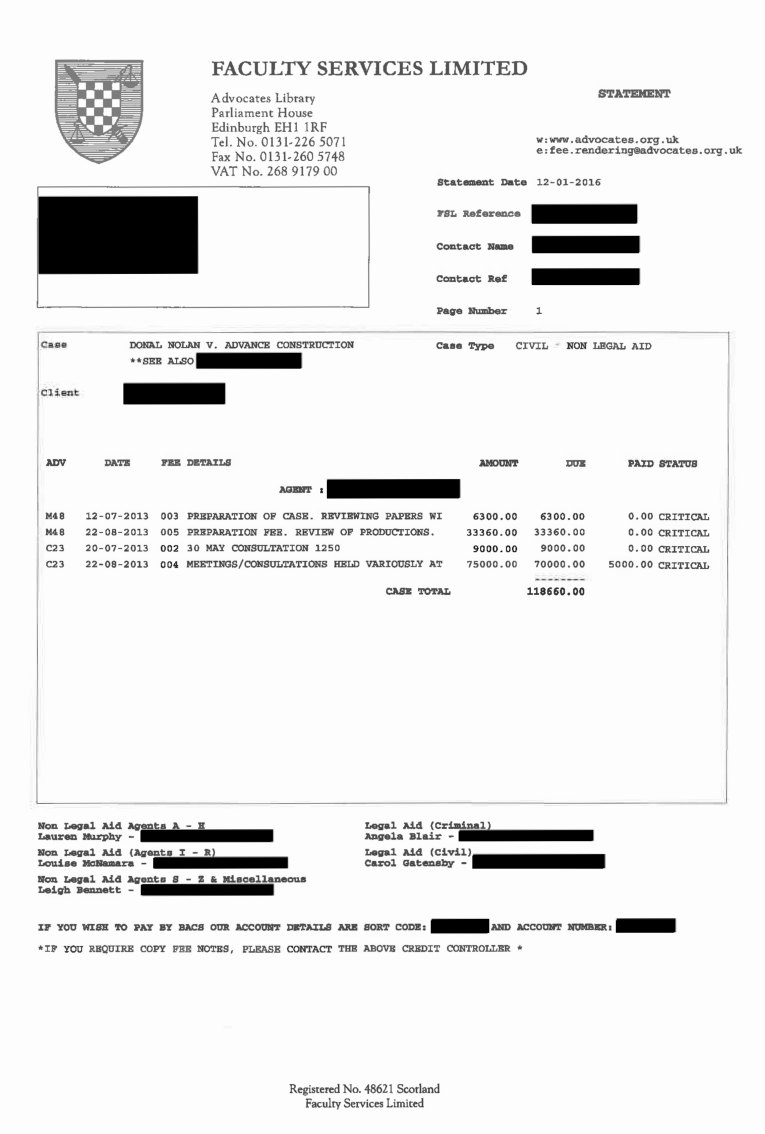
But – trawling the court files and fee notes took on an even darker tone when evidence emerged that the Faculty of Advocates itself were attempting to issue fee note credits to cover undeclared payments of cash collected by QCs – when the Faculty feared discovery, and the worrying prospect of an investigation by UK tax authorities.

In one such document - a study of a statement from Faculty Services Ltd in the Nolan v Advance  – noted references to ‘undated’ sums, and credit notes for payments which were in fact – never made.

In one credit note from Faculty Services Ltd - the sum of £5000 - without any date reference is stated as paid.

However, a solicitor dealing directly with the case DENIED the undated £5,000 amount had been paid to Faculty Services Ltd - and a review of the accounts confirm NO such payment was ever made.

The undated £5K credit note listed in the documents – and other unexplained entries - appear to have been created by Faculty Services Ltd with a deliberate intention to conceal tens of thousands of pounds in undeclared cash payments Campbell demanded from his clients.

The fee statements & accounts from Faculty Services Ltd now raise serious questions of how far up the involvement of figures in the Faculty of Advocates in this case stretches - after an earlier investigation established Campbell was pocketing large payments he personally insisted on collecting in cash filled envelopes from his clients in £5,000 bundles.

Written evidence recovered from files held by legal regulators revealed Campbell himself sent emails to his clients - demanding large payments in cash to pay himself and junior counsel Craig Murray.

A full report on Craig Murray’s involvement in the case, and his role in writing two versions of evidence to legal regulators can be found here: ADVOCATE PROBE: How legal regulators covered up for top QC - Files show Scots Advocate now working as Barrister in London – authored two versions of SAME letter for Faculty probe of cash scandal QC who failed clients in £6M Court of Session case

An email from John Campbell to his clients revealed Campbell demanded £5,000 in cash - while he was on the way to a meeting at Airdrie Sheriff Court followed by a dinner with the Law Society of Scotland.

The email from Campbell states: “A little better information about timing. I am due in Airdrie at 4.30. The meeting is in the Sheriff Court, which closes at 6.30. The Law Society is taking me and a colleague for dinner, but I have no idea where. There isn't a huge number of restaurants in Airdrie, but we'll find somewhere. This means I won't be at Bonkle Road until about 8. Is that OK?”

“I have asked JC [John Carruthers] for a breakdown of the £5000. I will explain to you how a spec case works. I have checked; both John and I are willing to take on a spec case for Donal, but only if he signs up to it. There will be two conditions; one is that you keep the Edinburgh agent fed and watered, and the second is the size of the uplift at the end of the day, as I explained to you.”

A Sunday Mail investigation into the case established John Campbell sent multiple emails to clients – in some cases, demanding cash “in any form except beads” to pay for legal services.

An additional email from John Campbell QC to his client stated: “I'm writing to confirm that we agreed at our meeting on Friday that we will meet in Dalkeith on TUESDAY morning, when you will give me £5000 towards the fees of your legal team” … “Please let me know if it's OK to meet at the Mulsanne Garage, which is at 137 High Street, and what time would suit you?”

If you were wondering why Mr Dunlop’s name keeps cropping up in Nolan v Advance – well – it was Roddy Dunlop’s legal fees – and others - which prompted Levy and Mcrae & Begbies Traynor to use Lord Carloway’s son’s law firm to evict the pursuer out of his house to pay for it all.

You can read all about what happened next, here: FIRE SALE: AIB face sequestration probe as files reveal Trustee was paid £20K by vulture fund to sell home & firebombed farm five days after targeted attack on couple at centre of land case linked to top Scots judges, an ex-Sheriff, an asbestos dumping building company & law firm Levy and Mcrae

If you want to know why Lord Carloway decided to keep quiet about his own link to this case, read more here: JUDGE OF CONFLICT: Top judge who attacked MSPs over judicial interests probe – failed to declare relative’s role at law firm targeting MSP’s constituents’ home & farm in £6M court case linked to Lord Malcolm conflict of interest scandal

THE GANG’S ALL HERE: New Dean welcomed by judges who concealed conflicts of interest in same case

THE newly-elected Dean of Faculty, Roddy Dunlop, QC, has been introduced formally to the Court of Session in a short ceremony.

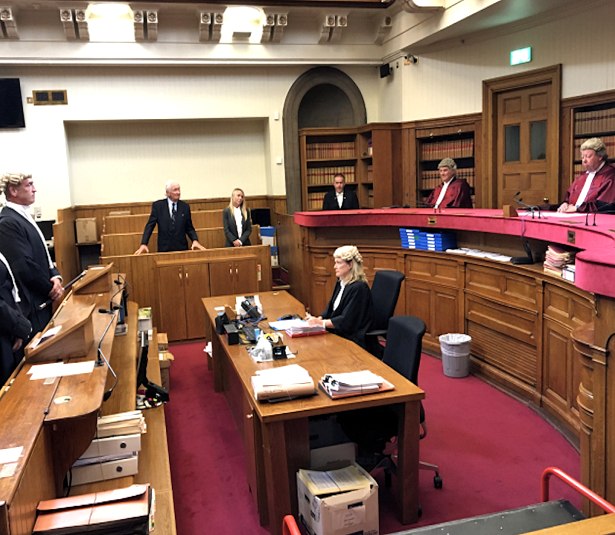
Mr Dunlop was presented to the Lord President, Lord Carloway, sitting with Lords Malcolm and Woolman, in the First Division courtroom.

Lord Carloway said it was not only his duty but his particular pleasure to congratulate Mr Dunlop on the high honour conferred on him by the Faculty.

Lord Carloway said: “It is an honour which is amply justified by your professional attainments and your personal character,” added the Lord President.

“It is a mark of my own age that I can not only say ‘kent his faither’ – whom I am pleased to see is present today – but even ‘kent his grandfaither’, whom I remember as an agent practising in Glasgow High Court.

“These are difficult times for the Court, the Bar, the wider profession and the public. We have learned a lot in the past four months, and will learn even more over the next four. There are many issues which need to be resolved if the courts are to continue to deliver justice for the people of Scotland. They will require discussion and careful consideration, but at the end of the day difficult decisions about the future will have to be made.

“The Court is confident that you will maintain the high traditions of the office of Dean. I can assure you that any representations which you make to the Court on behalf of the Faculty will always receive our closest attention.”

Mr Dunlop was the sole nomination to succeed Gordon Jackson, QC, who stepped down after four years in office.

Mr Dunlop said: “It is a huge honour to have been appointed Dean of Faculty. This high office extends back to the very origins of the College of Justice in the 16th Century. It has been held by many of the foremost legal minds in Scottish history, and I am humbled, and a little awed, to find myself in their company.

“I take office at an extremely challenging time for Faculty, and for the legal profession as a whole. I will endeavour to meet these challenges in a way that respects the efforts of those who have gone before me.”

Admitted to Faculty in 1998, Mr Dunlop took Silk in 2010. He has a broad-based, mainly civil practice, but with a keen interest in media law, he has been regularly instructed in the criminal courts in contempt matters.

Mr Dunlop served as Treasurer of Faculty from April 2017 until February this year when he was elected as Vice-Dean of Faculty. An election for a new Vice-Dean will follow.

Further material sourced from the Court of Session, including digital evidence & recordings from Neal transcribing machines in relation to proceedings in court where Dunlop and his opposite number John Campbell QC ‘sparred’ during hearings of Nolan v Advance - will be published in further articles.