Showing posts with label consumer protection. Show all posts

Thursday, November 10, 2016

LEGAL COSTS: Ask your solicitor ten questions about costs before your legal expenses run up thousands in unnecessary work & bills – or result in your lawyer taking your home & savings to pay for it

Questions to ask your solicitor – walk if you don't like the replies. IN SCOTLAND, there are few, if any non lawyer controlled sources of advice to legal services consumers on how to manage client relationships with solicitors, how to control legal costs, and what to do when something goes wrong and your lawyer rips you off.

Client protection - is a myth. Given three decades of evidence that thousands of clients have been ripped off every year by their once trusted solicitors, the only people who believe a complaints system run by lawyers, managed by lawyers and protected by lawyers -  are fantasists, and the Law Society of Scotland.

There are no background record checks available on Scottish solicitors, and the only ‘help’ on offer to clients when their relationship with their solicitor breaks down – is provided by the pro-lawyer Scottish Legal Complaints Commission (SLCC), a regulator backed by the Law Society of Scotland, staffed by members of the Law Society of Scotland. You get the picture.

However, in England & Wales, the landscape is a little more consumer friendly, with the Legal Ombudsman (LeO) and Solicitors Regulation Authority (SRA) providing a more independent form of advice and help to consumers.

The Solicitors Regulation Authority also publish complaints and regulatory data on solicitors and law firms – a must have service for anyone considering using a solicitor which does not currently exist in Scotland.

As things currently stand in Scotland – if you are unable to check up on your solicitor’s regulatory history via an independent source, the best advice is to walk away - or what happens next is your own fault.

Self regulation by lawyers, pleas to the Scottish Government and Scottish Parliament for help will not put right your legal problems or what your solicitor did to you.

A handy guide published by the Legal Ombudsman, reprinted by DOI in this article, gives a list of ten questions consumers and clients of solicitors should ask their legal representatives before taking on representation and expensive legal services. 

There are further tips in the full LeO leaflet, so please download it and read thoroughly before engaging legal representation.

This guide was written for the English legal services market, and you may be an English reader, so go right ahead and ask you solicitor these ten basic questions on costs.

However, the same questions apply as much in Scotland as anywhere else -  and anyone using a Scottish solicitor should consider asking these same questions.

If you don't like the answers you receive, or don't get any answers at all - then the best consumer advice possible is to protect yourself and walk away.

At the very least, you will have saved yourself hundreds, or thousands or tens of thousands of pounds for something involving a lawyer which may well have ended up going wrong anyway.

Why put yourselves through a five year heartache losing your savings to a lawyer, when ten little questions and answers may save you a whole lot of trouble.

The introduction to the leaflet from the Legal Ombudsman states: “If you use a lawyer, he or she should talk to you about the cost of their services. But you should also understand their charges. We have come up with ten questions to ask your lawyer about the cost of your service. We've also included some top tips and explained the terms used to help you get the most from conversations with lawyers about costs.

As a consumer, you have the right to expect your lawyer to be clear about how much they are likely to charge you, and for the final bill to be clearly explained and in the range you expected.

Legal services can be complex and the final cost can depend on things such as the type of service, individual details of the case, and how events develop. The expertise and experience of the lawyer may affect things too. However, most services are straightforward and your lawyer should give you a clear idea of what you will be charged from the start. Even if things do get complicated, your lawyer should warn you when this happens, so there shouldn't be any surprises in your final bill.

A lawyer who values good service will happily answer your cost-related questions. Lawyers also have a duty to provide you with a client care letter when you appoint them. This letter should clearly explain the costs for the service and any terms and conditions that may affect the final price.”

Question 1  Will I be charged for a consultation?

Finding the lawyer who is right for you and the service you need is important. A consultation by phone, face-to-face, letter or online can help you make your decision. A lawyer can charge you for a consultation but they should tell you before you book and explain any conditions. For example, they may offer the first 30 minutes free but charge for time above that.

A lawyer should speak to you about costs and provide the best possible information so you can make an informed choice.

If you have a consultation, make the most of the opportunity. Do your research to find the right lawyer - you can check online, talk to friends and family, or speak to consumer organisations to help you make your choice.

Question 2  "How do you cost your service?"

This question can help you shop around to get best value for money. Two lawyers may provide very different estimates for the same service. Understanding why the quotes differ can help you make the right decision. For example, one lawyer may be more experienced or an expert in the area of law your case involves. If you have a complex case, you might think it's better to pay more as it may improve the outcome and cost you less in the long run. With a fairly simple case you might decide you don't need that level of expertise, so it may be better value to go with the cheaper estimate.

Experience and skill are just two reasons why costs may differ. There are now more ways than ever to provide a legal service which can have an impact on what you pay. For example, you can now buy services that are phone or web based rather than face-to-face. Providers who offer this type of service may save on rent and backroom costs and might therefore offer a cheaper price to customers. Understanding if this type of service works for you will help you decide if it is, or isn't, value for money.

Estimates may vary for a whole host of reasons. Ask questions until you understand enough about the services on offer so you can pick one that suits you.

Question 3 "Can you tell me more about the way you charge?"

Lawyers have different ways of charging and their charging method may also vary according to the service. For example, they may offer a fixed fee for writing a will, but an hourly rate for a probate service (the administration of a will when someone has died). Find out what charging method the lawyer will use and ask them to explain it to you in detail. Questions 4 and 5 help with understanding fixed fee and hourly rate charges.

Conditional fee arrangements (CFAs) are also known as 'no win, no fee' arrangements. If you lose, you won't, in general, have to pay your lawyer's fees, but may need to pay some out of pocket expenses such as barrister's fees or court fees. You may also be liable to pay some of the other side's costs but it is possible to get insurance to protect against this. If you win, you will have to pay your lawyer's fees and in addition there is usually a success fee which is intended to cover the risk that the firm are entering into with this type of agreement. You should in most cases, however, be able to recover your fees (including any success fee) from the other side. If you are thinking about entering into one of these arrangements, make sure you ask detailed questions so that you fully understand the terms and conditions.

Contingency fee agreements are also a type of 'no win no fee' agreement. If your lawyer agrees to represent you under a contingency fee agreement -- which should not be confused with a conditional fee arrangement - they will be able to claim a percentage of any money they win on your behalf plus expenses. If you lose the case, you won't be charged a fee, but you might still have to pay other costs (which could include the other side's legal costs too).

The contingency fee percentage must be agreed in advance. You should also check whether the lawyer will deduct any expenses before they take their contingency fee or after as this can make a significant difference to the amount you finally receive. If the percentage you are asked to pay is very high, you could end up with very little - even if you win.

Question 4 "What is a fixed fee and what does it cover?  Will I be charged for any other costs?

The term 'fixed fee' can be used in different ways. It can be easy to assume that it covers all costs for the service you need. In some cases that may be true, but it may also just refer to the lawyer's fees. For example, a 'fixed fee' in a property case may, or may not, include charges related to searches. Sometimes a lawyer may offer a 'fixed fee' for a stage of the case, so don't feel embarrassed about asking your lawyer exactly what they mean by 'fixed fee'. It's not a silly question; the term isn't self-explanatory.

Lawyers will sometimes give you an estimate of the costs. This isn't the same as a 'fixed fee', so check what your lawyer means. This can be important as sometimes a lawyer may charge a fixed fee for a particular stage but give an estimate for the next stage. If that happens, or you aren't sure, check what your lawyer means and ask for an estimate for the total cost of the case.

Question 5  "You charge an hourly rate but I'd like an estimate for the cost of the whole service. What will my final bill look like?"

If your lawyer charges an hourly rate, they must give you an estimate of how much the overall service will be. This should compare reasonably with your final bill. If you aren't sure, then ask your lawyer to give you an estimate for the whole service. Sometimes it can be hard to predict how much it will all cost. Ask so you know how certain the estimate is. Having a range of costs might be more helpful than a single number, which could shift up or down. The important thing is to understand how much the total bill could be.

You are entitled to ask the lawyer to set a limit on the costs. This means your lawyer has to check that you are happy to continue if the spend approaches the agreed threshold. Setting a limit can help you make sure you don't spend more than you can afford.

Ask questions to understand exactly when the clock starts. For example, if you call your lawyer for an update on your case will you be charged for the call? Ask if, and how, your lawyer rounds up their charges. Many lawyers charge in six minute blocks - check if that's how your lawyer works. Make sure you feel comfortable with the way they charge.

As with 'fixed fees', ask if there are any other costs that won't be covered in the hourly rate.

Question 6 "Could my costs change? How will you let me know if they do?"

There may be circumstances where costs do change. This is most likely if new information or developments make a case more difficult. For example, in a divorce case much is dependent on the other person's cooperation to resolve it quickly. Even if both people intend to behave amicably, sometimes that resolve breaks down. If your costs look like they are changing, ask your lawyer about it. In general, your lawyer should tell you as soon as they are aware of any changes, but you don't have to wait to ask for an explanation. Another option is to ask, when you choose your lawyer, if their original estimate is likely to be breached. If you have agreed a spending limit (see question 5), then your lawyer should stop work until you confirm that you want to continue.

If a case gets complicated even a 'fixed fee' arrangement can change. Your lawyer should explain when this might happen and also set out the terms and conditions in your client care letter. Make sure you understand and ask if there is a 'get out' clause to say if additional costs can be charged.

Remember, you always have options, even in the middle of a legal transaction. If there is a big hike in the costs of using a lawyer, then your lawyer should tell you about them and let you know what your options are. You could use a different specialist who might cost less but take longer, or only use email to contact your lawyer. There might also be some stages in the process that can be missed out. Ask your lawyer how you can work with them to reduce costs.

Question 7 Are there any extra costs?

This really is a catch-all question to help you budget for your service. You are basically asking your lawyer if they have given you all the information they reasonably can to make sure there aren't any nasty surprises in the future. Examples of the sort of information this question might raise are additional costs for things like expert reports (such as from a doctor), or photocopying. Some firms use premium rate phone numbers, which could add unexpected costs to the final amount you spend for your service. Use these examples as a prompt to discuss this issue. Your lawyer should also tell you if you are likely to incur any bank charges. For example, you might need to make a CHAPs payment (same day electronic transfer) which can cost over £20 in a property transaction.

Finally, don't forget to check if your estimate is inclusive of VAT. Your lawyer should tell you, but check so that you don't get a higher bill than you're expecting.

Question 8 "Can I get help with the cost of my legal service?"

A lawyer should always talk to you about how the service will be paid for and discuss options such as insurance or membership of a union that might help cover the costs. There can be some fine-print with different insurance options that you need to understand, so ask lots of questions to make sure you know what you are signing up to. Some insurances, like 'after the event' or 'before the event' insurance, could cover you for some things but not for others. Ask your lawyer for more information.

If you receive benefits or are on a low income you might qualify for help that may reduce or cover all of your costs. There are different programmes for different types of help but the best known is legal aid, which provides free legal advice from lawyers who are registered with the service. Even if your lawyer isn't registered to provide legal aid they should tell you about it so you have the option of going to a lawyer who can.

Question 9 "When will I be billed and how long will I have to pay? Do you offer payment options?"

A lawyer should give you clear information on their billing process and offer reasonable time for you to make payments. They should also let you know if there are penalty charges if you don't pay on time. You may be asked to pay some money at the start either to cover certain expenses or as an advance payment of fees. Lawyers aren't obliged to offer you payment options, but some may be willing to negotiate. Asking the question might help you find a lawyer whose service fits your personal circumstances.

Question 10 "What happens if I disagree with the amount I've been charged?"

Your lawyer should tell you their approach to resolving billing disagreements. Every lawyer should have a complaints handling system in place, so find out how their system works. You should not be charged by a lawyer for looking at your complaint - it is very poor service if they do. When you appoint a lawyer they are also obliged to let you know about the Legal Ombudsman who can help you to resolve your complaint if you and your lawyer can't reach an agreement.

Note – if you disagree with legal bills in Scotland, cases have revealed solicitors often employ threats and legal action for demands to be met within seven days. In some cases solicitors have applied to sequestrate their clients for disagreements on legal bills, and willing, compliant local sheriff courts staffed by familiar clerks and members of the judiciary often grant such orders with little regard for the facts or any representations from clients who question the integrity of legal fees.

SCOTLAND – Consumer protection against rogue solicitors and law firms does not exist.

How bad is the Law Society of Scotland when it comes to protecting consumers? The answer is  very bad. The Law Society of Scotland is a lobby group for the legal profession which puts lawyers interests first, before clients, the public, or anyone else. Do not expect client protection from a system where lawyers regulate themselves.

Read previous articles on the Law Society of Scotland here: Law Society of Scotland - A history of control of the legal profession, and no client protection.

Previous reports on the Scottish Solicitors Discipline Tribunal – The pro-lawyer tribunal which determines ‘punishments’ for solicitors after complaints have endured an eternity at the Law Society & SLCC, can be found here: Scottish Solicitors Discipline Tribunal - Pro-lawyer protection against client complaints

Previous media investigations, reports and coverage of issues relating to the pro-lawyer Scottish Legal Complaints Commission (SLCC) can be found here: Scottish Legal Complaints Commission - A history of pro-lawyer regulation.

Friday, November 04, 2016

NAME & SHAME: Scots consumers denied records checks on lawyers - as Solicitors Regulation Authority propose detailed public register of lawyers in England & Wales

UK Solicitors regulator plans to publish more data on lawyers. A PROPOSAL to publish more detailed information about law firms and solicitors in a public register has been launched by the Solicitors Regulation Authority (SRA) – the body charged with investigating solicitors in England & Wales.

The move to advance consumer protection south of the border by the English legal regulator could help consumers make more informed choices on the use of legal services, and result in a more competitive legal sector with higher standards of service and client care.

However, this is in stark contrast to Scotland, where DOI recently reported on the Scottish Legal Complaints Commission (SLCC) who refuse to publish any useable information to Scots consumers which could help clients steer clear from corrupt lawyers and law firms.

The report, available here: FROM ROGUES TO RICHES: SLCC refuse to identify corrupt solicitors in case findings revealed SLCC determination decisions are heavily redacted and only published after being approved by the Law Society of Scotland, leaving Scots consumers at a considerable disadvantage to consumers in England & Wales.

However, and with the advantage of not being held back in the middle ages by the Law Society of Scotland, the England based Solicitors Regulation Authority has launched a discussion paper, "Regulatory data and consumer choice in legal services” exploring what information the SRA could publish through a public register.

The proposed public register already allows consumers to check up on lawyers via the SRA’s Check your solicitor’s record service reported earlier here:  INSPECT YOUR ROGUE: Check your solicitors’ record in England.

The SRA suggests that consumers could benefit from information such as a solicitor’s qualifications or practice restrictions, and complaints data and insurance claims. The SRA also considers what information law firms might want to publish voluntarily, such as quality marks and service prices.

The proposals echo recent calls by the Competition and Markets Authority's (CMA), in its interim report on its market study, as well as from the Legal Services Consumers Panel (LSCP), to improve the level of information available for consumers. The SRA agrees that a lack of clear, targeted information means it is difficult for consumers to compare providers and make informed choices. This is dampening competition in the sector.

Better information could help tackle the problem that the legal needs of individuals and small businesses are not being met.

Only one in ten people use a solicitor when they have a legal problem. And legal problems are estimated to cause small businesses almost £10 billion of losses a year, yet 83 percent of the population see legal services as unaffordable.

Greater transparency would also bring legal services more in line with other sectors, such as financial services and energy, where regulators are already making sure consumer-focused information, such as complaints data, is available.

The SRA recognises that there needs to be careful consideration of the implications of publishing more information. Risks to consider include increased burdens on firms and a one-size-fits-all approach working well for some and not others. For example, the needs of corporate clients will be different to those of an individual consumer.

Paul Philip, SRA Chief Executive, said: "Most people and small businesses are still not accessing legal services. When they do, they are not shopping around. It is unsurprising when the information out there is so limited.

"We want to help consumers, so they are not left making blind choices. Information such as enforcement action, complaints and claims data are exactly the type of things I would want to know when choosing a solicitor.

"We know that the public look to the regulators to provide credible, authoritative, objective information.

"If we get this right, we could help create a more competitive market, where consumers can make better choices and forward-thinking firms thrive. It will also help small businesses access the legal services that could help them succeed and grow.

"Yet we need to think carefully about what we publish and how. More information will not benefit consumers if they find it confusing, hard to access, or it is unhelpful. We have also made good progress on getting rid of unnecessary burdens on firms. We will not ask firms to do more in this area, unless there is a clear benefit.

"This is just the start of a discussion, so we are keen to hear what everyone thinks."

The SRA has already taken steps to improve the information available to consumers by publishing its law firm search in April. And it already publishes details of enforcement action. Publishing useful data in one place would not only help consumers directly, but indirectly as data re-publishers could use it to develop comparison tools that could help make the market more competitive.

The SRA plans to consult on proposals in this area next year. Its discussion paper can be found at: www.sra.org.uk/choice. Closing date for submissions to the consultation is 26 January 2017 submissions.

SRA law firm search can be found here: www.sra.org.uk/consumers/using-solicitor/law-firm-search/about-search.page

The CMA's interim report looking at ways to improve competition in legal services by increasing information for consumers is available at: www.gov.uk/government/news/cma-seeks-views-on-ways-to-help-legal-services-customers.

The Legal Services Consumer Panel's research, "Opening up data in legal services (PDF 36 pages, 625K)"

SCOTLAND: Legal Services Consumers held back by Law Society of Scotland & self regulation.

Away from the fantastical claims of the Law Society of Scotland, the oh-so-easy free pr and spin of how the Law Society protects access to justice while offering client protection, the fact is, consumers of legal services in Scotland have no chance whatsoever of selecting a legal representative based on their regulatory history – because the Law Society of Scotland refuse to publish any detailed regulation histories of their members.

Just how bad is the Law Society of Scotland when it comes to protecting consumers? The answer is very bad. Read previous articles on the Law Society of Scotland here: Law Society of Scotland - A history of control of the legal profession, and no client protection.

A BBC Scotland investigation “Lawyers Behaving Badly” exposed further weaknesses in the Law Society of Scotland’s system of control freakery self regulation. The BBC programme lifted the lid once more on lawyers investigating their own, how dishonesty plays out at the Scottish Solicitors Discipline Tribunal, and legal aid fraud.

A recent DOI investigation into the Scottish Legal Complaints Commission revealed most of the SLCC’s key staff and investigators are in-fact families, friends & business associates of solicitors, reported here: 'Independent' Scots legal watchdog consists of solicitors’ husbands, wives, sons, daughters, cousins, friends, & employers.

Previous media investigations, reports and coverage of issues relating to the SLCC can be found here: Scottish Legal Complaints Commission - A history of pro-lawyer regulation.

Previous reports on the Scottish Solicitors Discipline Tribunal – The pro-lawyer tribunal which determines ‘punishments’ for solicitors after complaints have endured an eternity at the Law Society & SLCC, can be found here: Scottish Solicitors Discipline Tribunal - Pro-lawyer protection against client complaints

Wednesday, November 02, 2016

DISHONESTY RULES: Rogue solicitors guilty of fraud, embezzlement and theft from wills receive soft censures from pro-lawyer Scottish Solicitors Discipline Tribunal and courts

Consumers are not protected by lawyers regulating lawyers. SCOTLAND’S legal profession and anyone connected to it – including the judiciary -  often praise the system of self regulation where lawyers look after their own – to the point of taking over and closing any public debate on creating independent regulation of solicitors.

And, of course lawyers will continue to regulate themselves in Scotland - because self regulation is too protected by vested legal interests, because it allows a solicitor to rip off their client, to be judged by his colleagues and to walk away from it, no matter what was done to the client.

Time and again, lawyers look after their own, investigate themselves, appear in front of their friends at the Scottish Legal Complaints Commission (SLCC), and, at most, receive a censure, or slap on the wrist from the Scottish Solicitors Discipline Tribunal (SSDT).

Diary of Injustice recently reported on how the SLCC refuses to identify corrupt lawyers within determination decisions which are only published after being approved by the Law Society of Scotland, featured here: FROM ROGUES TO RICHES: SLCC refuse to identify corrupt solicitors in case findings.

The SLCC print lists of doctored histories of complaints against lawyers, and then refuse to identify the solicitors who ripped off their clients – how corrupt is that!

Compare this to England & Wales, where decisions made by the Solicitors Regulation Authority in relation to identified law firms and names of solicitors can easily be found here Recent Decisions - Solicitors Regulation Authority.

Striking's off rarely occur, only as a last resort for the members of Scotland’s legal profession must protect their own.

The slick SSDT website invites you, the public – to have confidence in the ways lawyers look after their own.

Yet in decision after decision, the extent of dishonesty during proceedings renders much of what is published in Tribunal ‘interlocutors’ as clever forgeries of the acts of wilful, determined and well practiced thieves - far more determined than will ever be told in public.

The noticeable lack of action by the SSDT to report solicitors to the Police & Crown Office for prosecution, does, as the years go by, verify the position that the SSDT seeks to protect solicitors from the full weight of criminal law – which applies to everyone else.

However, on that rare occasion where solicitors do appear in court, you just know they are not going to jail.

In a prime example of the above, earlier this week Scotland was meant to weep like a child after the Law Society sought to publicise the fact Paul O’Donnell – a solicitor from the law firm of Thorley Stephenson, in South Bridge – had sold his house to repay more than £21,000 he pled guilty to embezzling from the Edinburgh law firm Thorley Stephenson, in South Bridge .

O’Donnell, 35, had previously been warned he was facing jail for the embezzlement but the judge – Sheriff Frank Crowe - allowed him to remain free as he had repaid the £21,485 he had obtained dishonestly.

In court -  O’Donnell’s defence lawyer -  Murray Robertson told Sheriff Crowe that his client had sold his house, moved in with relatives, and the money had been repaid to Thorley Stephenson.

Sheriff Crowe was also told O’Donnell had been sequestrated, was declared bankrupt and is no longer practising as a solicitor.

In response, Sheriff Crowe told O’Donnell that cases of this nature usually involved a sentence of imprisonment but, as  O’Donnell had co-operated and admitted his guilt, arranged the sale of his house and returned the money to Thorley Stephenson, Sheriff Crowe avoided sending O’Donnell to jail and instead confined him to his current address from 9pm to 6am for six months.

You may be forgiven for thinking how amazing a lawyer who stole, avoided jail.

However, in the rare occurrences when solicitors do come before our courts, jail is always a last resort for the judge – who are themselves, lawyers.

So, with facts in hand that our courts take a shine to lawyers with tears in their eyes, it should be of little surprise the latest rulings by the Scottish Solicitors Discipline Tribunal offer mere censures and fines for executry and will fraud, theft and embezzlement - which are crimes to ordinary people in the real world.

Law Society-v-Euan Maxwell Terras

This case involved a solicitor in his writing and executing a Will in which his family were the Primary Beneficiaries. An amazing story, yet only punishment is a fine.

Read the ‘published’ details of the hearing here Council of the Law Society of Scotland v Euan Maxwell Terras

Edinburgh 29 August 2016.  The Tribunal having considered the Complaint at the instance of the Council of the Law Society of Scotland against Euan Maxwell Terras, Sprang Terras, 64 Kyle Street, Ayr; Find the Respondent guilty of professional misconduct in respect of his acting in the purchase of a property with the ancillary execution of a Minute of Agreement and the drafting of a Will where his son was the residuary beneficiary and found that in doing so (1) he acted in an actual conflict of interest situation in the purchase of the property and the execution of the Minute of Agreement where he had a personal and/or financial interest in both; (2) he did not insist that Miss MM consult other solicitors either in the purchase of the property or the execution of the Minute of Agreement when both were actual conflicts of interests; (3) he could not discharge his professional obligations to solely look after the interests of Miss MM both in the purchase of the property and the execution of the Minute of Agreement given the actual conflict of interest in both between him and Miss MM; (4) he called into question his personal integrity/independence in taking instructions and/or drafting the second Will which benefitted members of his family and in terms of which they would derive significant benefit; and (5) his advice, given the terms of the draft second Will, was not free from external influence and placed him in a conflict of interest; Censure the Respondent; Fine the Respondent the sum of £8,000 to be forfeit to Her Majesty; Find the Respondent liable in the expenses of the Complainers and of the Tribunal.

Law Society-v-Philip Simon Hogg

Philip Hogg was one of a two-partner Kirkintilloch firm - Alder Hogg. His co-partner was his twin sister Alison Hazel Margaret Greer. The case relates to massive overcharging of clients. – usually defined as fraud if not involving a solicitor.

The following is for one client: The Interlocutor final amount is that for £129K of legal work they charged £219K for £90K more than they should have. So, for this one client, in relation to Mr A's executry, it is accepted that £90K was overcharged, however the Tribunal does not explain why a staggering £129K of executry fees was deemed acceptable.

Read the full ‘published’ version of events in this shocking case here: Council of the Law Society of Scotland v Philip Simon Hogg

Edinburgh 25 August 2016.  The Tribunal having considered the Complaint dated 22 April 2016 as substituted by the Complaint dated 25 August 2016 at the instance of the Council of the Law Society of Scotland against Philip Simon Hogg, residing at 9 Crossdykes, Kirkintilloch, as amended; Find the Respondent guilty of professional misconduct in respect of his failure in his obligation to see that the firm in which he was a partner complied with the accounts rules, his failure in his duty to supervise the firm’s office manager and cashier, his failure in his duty to take steps to satisfy himself that fees being charged to executries were properly so charged, his failure to see that at all times the sums at credit of the client account exceeded the sums due to the clients and his continuing to draw from the firm while it was being financed by the overcharges to clients; Suspend the Respondent from practice for a period of five years and Direct in terms of Section 53(6) of the Solicitors (Scotland) Act 1980 that the suspension shall take effect on the date on which these findings are intimated to the Respondent;

Law Society-v-Jane Elizabeth Steer

Elizabeth Steer worked for a Falkirk firm RMS Law. She previously worked for Russell & Aitken and now works for Allan McDougall & Co.

Ms Steer was accused of falsifying an Affidavit. 

Affidavits MUST adhere to the following: 1. both parties must be physically present at the signing i.e. the solicitor (notary public) and their client 2.it must be signed at the locus specified in the Affidavit

The affidavit complied with neither of these tests, instead Ms Steer sent it to her client in England to sign and return.

Problems with the affidavit only came to light when the client gave evidence stating that she had not been in Scotland for a while - but when at Avizandum the Sheriff realised that the Affidavit was signed in Scotland at a time when the client swore she was in England.

To make matter worse, Miss Steer also tried to mislead the Law Society during the Investigation. Read the full published Interlocutor here: Council of the Law Society of Scotland v Jane Elizabeth Steer

Edinburgh 16 August 2016.  The Tribunal having considered the Complaint dated 31 May 2016 at the instance of the Council of the Law Society of Scotland against Jane Elizabeth Steer, Messrs Allan McDougall, 3 Coates Crescent, Edinburgh as amended; Find the Respondent guilty of professional misconduct in respect of her failure to act with trust and personal integrity in connection with the preparation of an affidavit which she purported to notarise on 29 October 2012, submission to the court for lodging an affidavit which contained false or misleading information on 5 November 2012 and subsequent failure on 29 June 2014 to provide a full and candid explanation to the Law Society in connection with the preparation of the affidavit and its sending to the Secondary Complainer; Censure the Respondent;

And remember, readers - wherever there is dishonesty, there is a Scottish solicitor, and the Scottish Solicitors Discipline Tribunal.

THE DISHONESTY FACTOR:

An investigation by BBC Panorama -  Lawyers Behaving Badly - featured the case of John O’Donnell, and went on to reveal the startling differences in how dishonesty in the Scottish legal profession is treated lightly compared to England & Wales – where dishonesty is automatically a striking off offence.

Alistair Cockburn, Chair, Scottish Solicitors Discipline Tribunal. Featured in the investigation was the Scottish Solicitors Discipline Tribunal (SSDT) Chairman’s attitude towards solicitors accused of dishonesty in their representation of clients legal affairs. During the programme, it became clear that dishonesty among lawyers in Scotland is treated less severely, compared to how English regulators treat dishonesty.

Sam Poling asks: The Scottish Solicitors’ Discipline Tribunal hears all serious conduct cases against solicitors. Last year they struck off nine of them. But is this robust enough?

Alistair Cockburn Chairman, Scottish solicitors discipline tribunal replies: It is robust in the sense that it doesn’t just give convictions on the basis that somebody’s brought before us charged by the Law Society.  We are mindful, particularly when reminded of the lay members, of a duty to the public.

One is always concerned when there is deception but you can have a situation where solicitors simply lose their place. They make false representations in order to improve their client’s position, not necessarily their own. And you would take that into account in deciding what the penalty was but there’s no suggestion that such conduct wasn’t deemed to be professional as conduct. 

Sam Poling: So there are levels of dishonesty which sit comfortably with you, satisfactorily with you?

Alistair Cockburn: No it’s not a question of saying sitting comfortably with me.  I’ve told you…

Sam Poling: OK that you would accept?

Alistair Cockburn: No I’d be concerned on any occasion that a solicitor was guilty of any form of dishonesty.  One has to assess the extent to which anyone suffered in consequence of that dishonesty.  You have to take into consideration the likelihood of re-offending and then take a decision.  But you make it sound as if it’s commonplace.  It isn’t.  Normally dishonesty will result in striking-off.

English QC’s agree ‘dishonesty’ is a striking off offence. The SSDT Chairman’s comments on dishonesty compared starkly with the comments of the English QC’s - who said dishonesty was undoubtedly a striking off offence.

Andrew Hopper QC: “I cant get my head round borrowing in this context. Somebody explain to me how you can borrow something without anyone knowing about it. That’s just taking.”

Andrew Boon Professor of Law, City University, London: “They actually say in the judgement they would have struck him off but the client hadn't complained.”

Andrew Hopper QC “We’re dealing with a case of dishonesty and that affects the reputation of the profession. I would have expected this to result in striking off.”

Andrew Boon, Professor of Law: “The critical thing is the risk factor. If somebody has been dishonest once the likelihood is that they are going to be dishonest again unless they’re stopped.”

As Sam Poling went on to report: “but he [O’Donnell] wasn't stopped. The tribunal simply restricted his license so that he had to work under the supervision of another solicitor.”

Previous reports on the Scottish Solicitors Discipline Tribunal can be found here: Scottish Solicitors Discipline Tribunal - Pro-lawyer protection against client complaints

Thursday, May 12, 2016

Master Scam: Law Society switch brokers of Master Policy - insurance scheme dubbed ‘corrupt & manipulative’ provides little protection for consumers against negligent, rogue lawyers

Law Society switch brokers on dodgy insurance scheme. AN INSURANCE scheme operated by the Law Society of Scotland - which covers all Scottish solicitors - and is designed to ‘protect’ consumers when lawyers walk off with their cash and other assets - has announced a change of brokers from Marsh to Lockton.

The switch was announced last week by the Law Society – who said brokers Lockton will administer and broker the Master Policy of Professional Indemnity Insurance from 1 January 2017.

The move comes after Marsh – who managed the policy for nearly 40 years - lost the five yearly tender process in April 2016 to Lockton.

The Master Insurance Policy is a compulsory Professional Indemnity Insurance arrangement enforced by the Law Society upon all solicitors in Scotland.

The scheme includes all in-house solicitors who work for the Scottish Government and lawyers from the Government Legal Service for Scotland (GLSS) seconded around public bodies and other branches of the Executive such as the Scottish Parliament and justice bodies.

The Master Policy claims to provide cover of up to £2 million for any one claim where the solicitor is ‘established’ to have been negligent.

However, the process of establishing whether a solicitor is negligent or not – is controlled by the legal profession and the courts.

In a statement issued by the Law Society, Chief Executive Lorna Jack claimed “The Master Policy provides an important protection for solicitors’ clients when things go wrong. The insurance means that any valid claim against a Scottish solicitor will be paid - even if the solicitor is no longer in practice, no longer solvent or cannot be traced.”

However, the claims – echoed from Jack’s predecessor – Douglas Mill – were previously & spectacularly taken apart by Deputy First Minister & Finance Secretary John Swinney, during a Scottish Parliament investigation into self regulation of the legal profession in 2006.

Mr Swinney branded the Law Society & Master Policy as manipulative after Mill claimed the Law Society kept a distance from the client compensation insurance arrangements.

Mr Swinney produced an internal memo from Mill himself – who had requested a “summit meeting how to dispose of several valid claims.”

Mill went onto “swear on his granny’s grave” he and the Law Society had never intervened in a compensation claim.

However, the memo - produced by Swinney during the Holyrood hearing - came to illustrate the significant level of dishonesty and  manipulation with regard to the ‘consumer protection policy’ – which despite Mill’s claims to the contrary – rarely pays full compensation after lawyers swipe clients assets.

The Master Policy was more recently linked in a Research Report to deaths and suicides of clients who attempted to claim back hundreds of thousands of pounds taken by legal agents engaged in corrupt practices not covered by an alternative Scottish Solicitors Guarantee Fund run by the legal profession.

The independent report, compiled by legal academics Professor Frank Stephen & Dr Angela Melville from the University of Manchester School of Law - concluded the Master Policy “is simply designed to allow lawyers to sleep at night.” rather than protect consumers from rogue elements within the legal profession.

According to the report "claimants described being intimidated, being forced to settle rather than try to run a hearing without legal support, and all felt that their claims’ outcomes were not fair. Some claimants felt that they should have received more support, and that this lack was further evidence of actors within the legal system being “against” Master Policy claimants. Judges were described as being “former solicitors”, members of the Law Society – and thus, against claimants. Some described judges and other judicial officers as being very hostile to party litigants."

Cases referred to in the report describe scenarios where consumers are commonly forced to become party litigants after the Law Society intervene in the claims process, forcing claimants legal representatives to withdraw from acting in financial damages claims against  against other solicitors.

The Research Report sourced comments from claimants: "I keep fighting cases, and they keep coming at me, and now I have become ill. But they still keep coming at me. They threw me out onto the street, I couldn’t get my medication, I’ve got nothing, I was homeless, ill, sleeping in the car. Now I am appealing. But I can’t get a solicitor. They are just shutting me down…. My health has been damaged, they kill you off. It's a proven fact. All of us have stress related problems after years and years of stress."

The report also linked the Law Society’s insurance scheme to suicides of clients who attempted to claim back funds appropriated by corrupt solicitors.

The report stated:  "Several claimants said that they had been diagnosed with depression; that they had high blood pressure; and several had their marriages fail due to their claim. Some had lost a lot of money, their homes, and we were told that one party litigant had committed suicide."

The report concluded: “What has clearly come through these interviews has been the very divergent views of solicitors and claimants/consumer groups as to the primary function of the Master Policy. The former tend to see it as simply a professional negligence insurance designed to protect individual members of the profession. The latter see that its primary purpose should be to protect the public against incompetent members of the profession. Whilst these are not incompatible aims we have come to the view that the rhetoric of the Law Society of Scotland encourages the latter perception but practice is more inclined to the former. In other jurisdictions there is a more explicit statement that it is the former.”

“It is clear that establishing a valid claim under the Master Policy requires either an admission of liability on the part of the solicitor or an action to be taken by the claimant to establish liability. It is our view that the Law Society of Scotland raises the expectations of potential claimants by emphasising the Master Policy's public protection role. It is perhaps more accurate to say that policy ensures that those with a proven claim will be able to recover.”

“Those claimants to whom we spoke were very much of the opinion that it was difficult to establish liability of a solicitor for professional negligence. It would be desirable to test this claim by looking at the record of the Master Policy in terms of claims and compensation paid. Data which would have allowed us to do this was requested from the Law Society of Scotland but was only made available the day before this Report was due to be submitted. Furthermore the Law Society of Scotland and Marsh put conditions on the use of the data in this Report which were unacceptable to us and to the Chief Executive of SLCC.”

“The limited data which we have seen on the Guarantee Fund suggests that there is a considerable difference between the value of claims and the sums paid out by the Fund. We have not been able to establish whether this is a result of the discretionary nature of the fund or simply a large divergence between parties in assessing the sums lost.”

“We would recommend that the Scottish Legal Complaints Commission undertake a longer term research project which will allow researchers to examine the experiences of a representative sample of claimants and solicitors as well as analyse data on claims provided by the Master Policy's broker under reasonable conditions of use.”

Dr Angela Melville - who interviewed many clients for her final report, confirmed the research team did not receive a copy of the Master Policy itself after Marsh director Alistair J Sim, demanded strict conditions for the disclosure of the insurance policy’s terms.

Sim wrote in a letter to the University research team - which appears in full on the last page of the report: “Please note that the consent of Marsh and Royal & Sun Alliance plc to the production of the enclosed documents is condition on the research team agreeing not to quote from the documents, or any part of them, whether text or figures, in the report to the Scottish Legal Complaints Commission.”

Sim’s letter continued: “The documents which are produced are confidential and are commercially sensitive. They are provided to the research team only and neither the documents nor copies should be provided to any other party nor should the content of the documents be disclosed to anyone outside the research team. At the conclusion of the research project, the documents should be returned with confirmation that foregoing conditions have been complied with and that no copies have been retained. If the research team is unable to agree to the foregoing conditions, the documents should be returned along with confirmation that no copies have been retained.”

No further research has been commissioned by the Scottish Legal Complaints Commission since the report was published in 2009, and with the SLCC now under substantive control of the Law Society of Scotland, much of what it produces by way of research and statistics is widely recognised as having little honest value in terms of consumer protection.

The Master Policy started in November 1978 under brokers Sedgwick Forbes UK Limited, which later became part of the Marsh Group. Given the highly specialist nature of professional indemnity insurance, the brokers play a vital role in arranging and securing the insurance cover as well as providing administration, advice, as well as risk management training.

Along the years, law firms acting for the Master Policy included Simpson & Marwick – now merged with Clyde & Co, Balfour & Manson and other ‘big name’ law firms brought in to demolish consumers attempts to reclaim millions of pounds lost, misappropriated or embezzled by Scottish solicitors.

While the Master Policy is tasked with dealing with claims for negligence, the Law Society has been known to manipulate claims on a serial basis. Unsurprisingly, even claims which do succeed against the Master Policy bear little return to clients who are forced to go through lengthy court processes in front of a judiciary who have also previously paid into the same Master Policy arrangement while serving as solicitors in their earlier years prior to the bench.

Thursday, May 31, 2012

Consumer Focus Scotland supports publication of solicitors complaints outcomes as law regulator SLCC ‘launders’ survey data out of FOI reach

Consumer Focus Scotland logoConsumer Focus Scotland support publication of complaints against Scottish solicitors. OUTCOMES of complaints against Scottish solicitors should be published, says Glasgow based consumer protection body Consumer Focus Scotland in response to a new study being undertaken by the Scottish Legal Complaints Commission (SLCC) of law firms' complaints handling, reported by Diary of Injustice at the beginning of May, Consumers ‘locked out of debate’ as Scottish Legal Complaints Commission carries out yet more research on how solicitors handle complaints

The SLCC’s latest study which is seeking disclosure of information from individual law firms on how solicitors deal with complaints has drawn sharp criticism from the legal profession itself and provoked calls by lawyers lobby groups to boycott the survey after fears were raised that actual complaints data would end up being published by the media as a result of Freedom of Information requests to the SLCC.

SLCCLawyer’s so-called ‘independent’ regulator said it would avoid Freedom of Information laws by stashing data out of reach of media. Proving the SLCC has little interest in public opinion or confidence in it’s alleged role as an ‘independent’ regulator of solicitors, the law complaints quango responded to lawyers concerns by saying they would dodge Freedom of Information legislation by refusing to look at the actual complaints data gathered up by research company TNS Research International TNS-BMRB who are under contract to carry out the survey. The FOI dodge was reported by Diary of Injustice earlier in the month, here : Law regulator SLCC responds to lawyers call to boycott complaints research : ‘We will AVOID Freedom of Information by stashing data with researchers'

Responding to questions over the SLCC’s latest complaints survey which effectively shuts out consumers, a spokesperson for Consumer Focus Scotland said : We are pleased that the SLCC is undertaking research to improve its knowledge of the ways in which firms of solicitors deal with complaints. Ideally, consumer complaints about legal services should be dealt with quickly and effectively at a local level, by the business or professional involved, so far as possible. Many complaints can be resolved by way of an apology or informal agreement at this stage, and only where local resolution fails, should the complaint then go to a higher complaints handling body.”

The spokesperson continued : “We know consumers find it important to see complaints data so wider consideration of how this might be best achieved for legal services in Scotland would be helpful. The SLCC currently produces some complaints data within their annual report. This includes information on the number of complaints it received, the areas of law to which these relate and the stage of the SLCC’s process at which these complaints were resolved.”

“In its ‘Complaints about solicitors’ research, the Scottish Consumer Council, one of our predecessor bodies recommended that performance targets for each stage of the complaints process be published. Case study examples are published routinely by ombudsmen in the public sector, and used to be published by the Scottish Legal Services Ombudsman in its annual report. In 2010, a survey of our consumer network of volunteers to inform the Scottish Public Services Ombudsman’s model complaints handling process found that the publication of the outcomes of complaints was a particularly important principle for these consumers”

Consumer Focus Scotland in their previous incarnation as the Scottish Consumer Council conducted several studies & investigations into the notorious difficulties encountered by members of the public who are forced by circumstances to file complaints about their solicitors to the self regulating Law Society of Scotland and ‘independent’ Scottish Legal Complaints Commission. In what is now well over two decades of surveys & investigations by consumer groups & bodies into the complaints processes of Scotland’s legal profession, very little has changed from the 1999 SCC report “Complaints About Solicitors”, with most clients encountering a significant anti-consumer prejudice when making complaints about their solicitors to the legal profession’s in-house closed shop regulators.

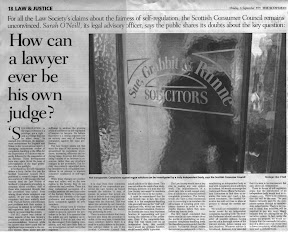
Scottish Consumer Council recommended independent regulation of legal profession in 1999. Writing in the Scotsman newspaper in September 1999, the Scottish Consumer Council’s Sarah O’Neill went some way to explaining the conclusions of the SCC’s “Complaints About Solicitors” report, going onto recommend the Scottish Parliament’s then Justice & Home Affairs Committee study the issue, saying : “The SCC report concluded that there must be an open debate about the merits of establishing an independent complaints-handling body. We therefore recommend that the Scottish Parliament should review the current procedure with a view to establishing an independent body to deal with complaints about solicitors in Scotland. We would encourage the Justice and Home Affairs Parliamentary Committee to find time to examine this issue and reach a balanced conclusion. The Scottish Executive has told us it has no plans at present to change the current system.”

Ms O’Neill went onto say : “We would not recommend a particular model for an independent complaints-handling body. The Scottish Parliament should carefully consider all possible options, having carried out a thorough review of the current system, before making any firm decisions. Whatever scheme is introduced, however, it is essential that it is seen to be transparent, fair and above all, independent.”

The Scottish Consumer Council’s 1999 report “Complaints About Solicitors” stated in its conclusion : “This report provides considerable evidence of consumer dissatisfaction with the way in which complaints against solicitors are presently handled in Scotland, both by solicitors and by the Law Society. We believe that there is an urgent need for both to adopt a more client-oriented approach to dealing with complaints. Solicitors must embrace the concept of client care, which would help to reduce complaints, while at the same time ensuring a better deal for clients. The Law Society’s procedure contains many major flaws, and we have suggested a number of ways in which these could be remedied. Were these changes to be carried out, this would go some way towards improving the lot of consumers who complain about solicitors.”

The SCC report continued : “However, such changes would not go far enough. It is essential that complaints are dealt with by a body which is seen to be independent and impartial. Those who complain must be able to feel that their complaint has been fairly dealt with. It is clear that the fundamental root of the problem from the consumer’s point of view is that the Law Society is seen as being on the side of the solicitor. The only effective solution to the problem is the establishment of an independent review body to deal with complaints against solicitors in Scotland”

An earlier research project commissioned by the SLCC in 2009 & carried out by the University of Manchester’s Law School in to the Law Society of Scotland's Master Insurance Policy revealed clients had committed suicide because of the way they had been treated over claims made against negligent or corrupt solicitors. Diary of Injustice reported on the Master Policy research revelations here : Suicides, illness, broken families and ruined clients reveal true cost of Law Society's Master Policy which 'allows solicitors to sleep at night'

However, the SLCC has steadfastly refused to monitor individual claims to the Master Policy in spite of being asked by members of the public to do so, and no detectable changes have been made to how the SLCC deals with complaints made against negligent solicitors.

The Scottish Legal Complaints Commission has not released any further statements on the progress of the survey or any response to criticisms it is avoiding Freedom of Information laws by refusing to look at complaints data gathered by it’s contract researchers.

Meanwhile in England & Wales, the Legal Ombudsman is pressing ahead with full identification of solicitors & law firms who fail their clients, reported by Diary of Injustice in April, here : Clients of Scots solicitors miss out on ‘right to know’ as UK Legal Ombudsman moves to name & shame ‘crooked lawyers’ in England & Wales

As of 1 April 2012 the Legal Ombudsman began collating names of lawyers and law firms subject to complaints resolved by an ombudsman's decision. Any data collected will be made publicly available by the Legal Ombudsman at the end of July 2012 and then subsequently every quarter.

Saturday, March 03, 2012

Law Society’s database on solicitors “Too Toxic” to publish, public access to complaints info, horrific treatment of clients ‘may bankrupt’ law firms

LSWould consumers still trust lawyers if they were able to access full information on solicitors & law firms ? CALLS for the Law Society of England & Wales to share its database on solicitors with comparison websites have been resoundingly rejected by the legal profession, almost certainly on the basis of fears that clients & consumers will quickly desert law firms & solicitors across the country if consumers were to have access to the true scale of complaints against the legal profession. The claims made by campaigners & information access reformers come after it was reported last month Des Hudson, the £400K-A-YEAR Chief Executive of the Law Society of England & Wales swiftly rejected calls from the Legal Services Consumer Panel for regulators to opening up their professional registers so that the websites can provide basic information to consumers about the different services offered by law firms.

A report carried out by the Legal Services Consumer Panel looked at the barriers facing the emergence of comparison websites based on interviews with the industry. One practical barrier identified was a lack of access to professional registers held by approved regulators, meaning that comparison websites cannot obtain, in a usable form, even the basic information about lawyers, such as their contact details and areas of specialism. The report, which can be downloaded here : Legal Services Consumer Panel's report on comparison websites in legal services (pdf) recommended that approved regulators open up their professional registers for this and other purposes.

Elisabeth Davies, Chair of the Legal Services Consumer Panel, said: “Comparison websites are a welcome new feature in legal services as they could make it easier for consumers to choose lawyers and boost competition. But experience in other sectors has shown there are also risks – we are calling on website operators to demonstrate their commitment to consumer protection by signing up to some common sense good practice standards.”

She continued : “It’s staggering that so many lawyers are refusing leads generated through comparison websites. Consumers are unlikely to use these services again if they get turned away – it’s a massive own goal by the profession. There are a series of hurdles that comparison websites need to overcome before they are a major influence on consumer choice. Approved regulators could help break down these barriers by opening up their professional registers so that the websites can provide basic information to consumers about the different services offered by law firms.”

Predictably, the Law Society of England & Wales refused to share its own data on solicitors, its Chief Executive, Des Hudson who recently ended the right of clients to post their reviews & comments on experiences with solicitors on the well known website Solicitors From Hell, said the Law Society would not be sharing its data with the Legal Services Consumer Panel, or any other website not under the control of the legal profession.

One access to information campaigner from Brighton who has been involved in a long running campaign to free up solicitor’s complaints records in England & Wales told Diary of Injustice : “Clearly the Law Society of England & Wales do not want its own data on its solicitors, data which contains the appalling regulatory history of tens of thousands of solicitors & law firms across the country from falling into consumer hands, simply because if clients were to find out what their supposedly trustworthy solicitor has done to other clients, they will run a mile”

While the Law Society of England & Wales have refused to share data on their solicitors, consumers can still visit websites such as Solicitors from Hell 2 & Cowboy Solicitors from Hell to find out more about their solicitor, or perhaps post a review of their experiences at the hands of a lawyer.

Readers will of course be well aware the same problems exist in Scotland, where clients & consumers are not able to find out anything about their solicitors complaints records or how they have handled other legal work for clients. However, unlike in England & Wales, Scots consumers of legal services have no organisation such as the Legal Services Consumer Panel to call for a complete disclosure on all solicitors records to be made to the public.

The Law Society of Scotland’s own ‘too toxic to publish’ database on the Penmans, O’Donnells, Lockharts, McCabes, Danskins and more would probably shock so many Scottish clients, they too may do a runner from their lawyer’s office, and deservedly so.

Friday, December 09, 2011

They think its all over : Solicitors from Hell owner to appeal High Court’s website shutdown order ‘all the way to Europe if necessary’

solicitors-from-hellIt’s not over until the European judges sing : Solicitors from Hell owner will appeal High Court order to close website after the ‘suffering’ of lawyers. IN RESPONSE to the publication of MR JUSTICE TUGENDHAT’s written ruling in the case of The Law Society, Hine Solicitors & Kevin McGrath v Rick Kordowski which granted the vested interests of the legal profession in England & Wales their demand to shut down the critical website known as SOLICITORS FROM HELL where clients could posts online reviews of their experiences with solicitors, Mr Kordowski, the owner of the now censored Solicitors from Hell website has said he intends to appeal the draconian judgement “all the way to Europe if necessary”.

The judgement, dubbed by many as a blistering attack on free speech and the rights of consumers to express their views on services provided to them by their lawyers details in no uncertain terms the lengths to which the vested interests of the legal profession of England & Wales ‘had gone after’ Mr Kordowski.

In one part of the judgement, Mr Justice Tugendhat brands the Solicitors from Hell website owner as “A public nuisance” who “is in effect a vexatious litigant”. Readers of the judgement will note there is not one single remark in the judge’s opinion which appears to be critical of the legal profession.

As Justice Tugendhat’s judgement continues , the Law Society of England & Wales Counsel, Mr Tomlinson states that the Claimants and in particular, the First Claimant, have no objection to proper criticism of the legal profession or debate about whether a particular solicitor has failed to provide service of appropriate quality in a particular case. Informed debate on these issues is clearly in the public interest and a proper exercise of the right to freedom of expression. But he submits that the Website makes no contribution whatever to such debates but instead sets out to and does provide a forum for the publication of malicious and defamatory allegations about solicitors. The Website operates against the public interest and the Claimants have brought this action with the aim of ensuring that it ceases operation. The Law Society is concerned about the enormous reputational damage that is, and can be, done to firms and lawyers as a result of their being listed on the Website. It is also concerned about the disservice to the public. The dissemination of misinformation to members of the public through the Website may deter members of the public from instructing good solicitors.

However, most see the Law Society’s claims against the Solicitors from Hell website as little more than an attempt to censor consumers online debate of how they have been treated by their lawyers, whether good or bad. The legal profession in general are firmly against clients being able to “name & shame” their solicitors in any venue, and have been known to threaten newspapers who carry reports of “crooked lawyers” with legal action or the withdrawal of advertising. In several well known instances in Scotland, individual journalists have had their careers threatened if they did not cease reporting on “crooked lawyers”.

Diary of Injustice earlier this year revealed the Law Society hoped to use its battle with Solicitors from Hell to dissuade the Legal Ombudsman (LeO) from going ahead with its own policy of naming & shaming “crooked lawyers”, reported by Diary of Injustice here : English, Scots Law Societies ‘team up’ in legal moves against “Solicitors from Hell” in bid to stop Legal Ombudsman ‘Naming & Shaming’ crooked lawyers. However the attempt failed, after the LeO announced naming & shaming is to begin in 2012 reported earlier here : Scots to be ‘kept in dark’ on details of crooked lawyers while Legal Ombudsman’s ‘naming & shaming’ policy ‘will protect’ consumers in England & Wales

In what some may see as a spiteful move against Mr Kordowski, who has been made bankrupt by the legal profession in their pursuit of him, the judgement also revealed the trustee in bankruptcy had also gone after the solicitors from hell website domain and all its contents, gaining an interim injunction to prevent Mr Kordowski handing over the website to someone else to operate.

Quoting Mr Justice Tugendhat’s ruling : As a result of the Defendant's bankruptcy the intellectual property rights in the Website and its contents are vested in his trustee in bankruptcy, but he has not taken any steps to transfer them. Rather, on 2 November 2011, he announced that he had decided to "give the website away" to "experienced owners who operate overseas". The Claimants successfully applied for an interim injunction to restrain this transfer on the basis that it would constitute unlawful data processing and harassment. An interim injunction was granted by Langstaff J restraining the transfer ("the Transfer Injunction"), returnable at this hearing.

The full judgement in the case can be read here : The Law Society, Hine Solicitors & Kevin McGrath v Rick Kordowski

Speaking to Diary of Injustice, Mr Kordowski said : “The judgment contains claims that both the second and third Claimants had long suffered significant damage, upset and could not work who the author of the published allegations were. It is interesting to note that neither of these Claimants ever asked me who the author of the posted allegations were. No letters, emails, nothing! As to why they continued to allegedly 'suffer' in the way for many months without contacting the publisher, one can only imagine.”

Mr Kordowski continued : “My argument was (and still is) that the current libel laws are sufficient to protect the defamed. However, Justice Tugendhat states that even if I could prove that every single listing was true and justified or of honest opinion that harassment & data protection laws supersede the current libel laws. Which is quite simply outrageous.”

“He [Justice Tugendhat] states that I am someone who 'STILL attempts to charge lawyers if they want comments to be removed'. He didn't have any evidence to back this up - as there is no evidence. I do not charge lawyers. Justice Tugendhat also goes on to say that I am a 'Public Nuisance' like an environmental hazard!”

“I will appeal, which will be thrown out, obviously. So it seems that both I and the public will not get justice in this country. I will most definitely take this matter to the European Court in Strasbourg. The High Courts decision is simply tyranny - we are not in China, Iran or an African despot, this is the democratic UK!”

Not all lawyers welcomed the terms of the written ruling which shut down Solicitors from Hell, with one solicitor branding the decision as “costly, unbalanced and in the long run, counterproductive to the interests of the legal profession at large”

Cowboy SolicitorsCOWBOYSOLICITORS.COM, a new website to allow consumers to rate their lawyer online. While the battle for Solicitors From Hell looks set to continue all the way to the European Courts, a host of new websites offering consumers the chance to air their views of how they were served by their legal representatives have emerged, the latest one being COWBOYSOLICITORS.COM. The new website, which is free to become a member of, states Solicitors have ruled the roost for far too long, the law society is completely bias against any complaints. The truth is that many UK legal practices are filth ridden and need exposing. Become a free member and start shaming your solicitor within minutes. Manage all listings from your personalized dashboard.

SFH2Solicitors from Hell 2 has returned to replace the original Solicitors from Hell website. The new Solicitors from Hell 2 website which is registered in the USA, and is thus outwith the reach of UK Libel laws, replaces the now censored Solicitors from Hell. As before, clients can rate their solicitors and document their experiences whether good or bad although this time, it may be more difficult for the Law Society to act. The new website states : Solicitors From Hell 2 will allow people to upload articles about Solicitors from within the UK or anywhere else in the world this will be done automatically & free of charge. Should a complaint arise we will require evidence to substantiate your complaint. or the removal of the offending post or words will take place. This will be at the sole discretion of Solicitors From Hell 2 editors. Further should anyone claim that any item is defamatory and can prove the information wrong then the post will be removed free of charge.

So those of you looking for an opportunity to name & shame your poorly performing or even crooked lawyer, there is now even more choice to do so, courtesy of the Law Society’s attack on UK consumers right of free speech.

Monday, August 22, 2011

3 Years & £10 Million later, ‘too close to lawyers’ Scottish Legal Complaints Commission left standing by 'more determined' Legal Ombudsman

SLCCComplaints against the legal profession appear to receive more of a hearing in England & Wales than in Scotland. THREE YEARS ON & after the better part of  TEN MILLION POUNDS has been squandered on the notoriously anti-consumer Scottish Legal Complaints Commission (SLCC), at least two of those millions coming from taxpayers via the Scottish Government, it may be an uncomfortable fact for some to swallow that complaints against solicitors & law firms in England & Wales are receiving more of a hearing, along with the expectation of enforcement action on case decisions from the Legal Ombudsman (LeO) than is the case in Scotland.

The major influence of the Law Society of Scotland on the SLCC’s ‘will’ to genuinely investigate consumer grievances against their solicitors, and the Scottish legal establishment’s almost deadly desire to keep regulating its own is seen as the key element in this now growing disparity between how Scots users of legal services can expect their complaints to be dealt with the SLCC & Law Society of Scotland compared to consumers in England & Wales who now deal with the LeO.

Legal OmbudsmanLegal Ombudsman for England & Wales, a world away from its poor Scottish relative the SLCC. In what may well be a good indicator of the determination to press ahead with regulation reform of legal services in England & Wales, a first came last week for the Legal Ombudsman’s office which began work in 2010, where Adam Sampson, the Chief Legal Ombudsman for England & Wales announced the LeO had taken legal action against two law firms which had refused to comply with complaints decisions issued by the LeO.

The enforcement case was one of two brought for the first time by the Ombudsman under the Legal Services Act 2007. It was only after the action was launched that the firm paid out £2,650 compensation to a client, as the Ombudsman had ordered, plus interest.

The client had complained after the firm paid money to a third party without authorisation. A district judge sitting at Birmingham County Court on Monday 15 August ordered the firm to pay the Ombudsman’s costs of bringing the case of £1,215.

A second case at the same court was adjourned to allow a different firm to comply with an Ombudsman’s decision.In that case the firm had mismanaged work for a property owner and the Ombudsman had ordered them to pay their client £5,704 compensation.

When the firm failed to comply, the Ombudsman issued proceedings for the court’s permission to enforce the decision as if it were a court judgement.

The firm initially tried to argue that the decision was defective but, when the Ombudsman produced the relevant legal materials, at the eleventh hour agreed to settle the matter and pay the Ombudsman’s costs of £1,000. The hearing was adjourned for 28 days for this to be done.

adam_sampsonLegal Ombudsman for England & Wales, Adam Sampson. Commenting on the decision to take legal action against the flaw firms who failed to comply with rulings by the LeO, Adam Sampson, the Chief Legal Ombudsman, said: “These are the first such enforcement proceedings we’ve brought under the Legal Services Act 2007. It’s regrettable that we had to take these steps, and that the firms didn’t act more promptly to bring matters to a close for the complainants.

Mr Sampson continued : “The cases are a reminder that Ombudsman decisions, once accepted by complainants, are binding. Lawyers need to remember that our decisions are enforceable through the courts and that failure to comply promptly can mean an unnecessary expense. Those who don’t comply are likely to have to pay costs ordered by the courts, and risk being referred by us on conduct grounds to their regulatory body.”

While it may be comforting to note the Legal Ombudsman for England & Wales after only one year in the job is pressing ahead with enforcing complaints decisions and online publication of a raft of information on complaints decisions & statistics which is of considerable value to consumers in England & Wales, it is now unavoidably noticeable that clients of Scottish solicitors have the short end of the stick in pursing complaints against their solicitors, or even access to the level of information now available in England & Wales which, if published in Scotland might lead to clients avoiding using the crop of “usual suspect” Scottish law firms who continuously abuse their clients.

As the record currently shows, the now three year old Scottish Legal Complaints Commission, having soaked up nearly ten million pounds from the legal profession & taxpayers, has so far admitted only one solitary complaint as being upheld by their ‘skilled investigations’ and in comparison to the LeO’s court action against law firms, forcing resolutions to client complaints, the situation in Scotland is exactly the reverse with the Scottish Legal Complaints Commission itself now a target of at least fifteen cases in the Court of Session brought by solicitors and the Law Society of Scotland against decisions by the SLCC either to refer cases to the Law Society for further investigation, or for its refusal to investigate third party complaints.

With regards to other key expectations of the SLCC, where the power to monitor the notoriously corrupt Master Policy & Guarantee Fund was given to the Scots law complaints quango via the legislation which created it, the Legal Profession & Legal Aid (Scotland) Act 2007, no further advance on the controversial subject has been made by the SLCC who are now reluctant to publish their latest attempts at ‘research’ into financial damages claims against ‘crooked lawyers’, cases & claims which have been deliberately derailed by the Law Society of Scotland and its Master Policy insurers, Marsh UK and those who underwrite the Master Policy such as Royal Sun Alliance PLC & Aviva Insurance.

Let’s be clear, I am not saying the Legal Ombudsman for England & Wales is perfect. I am well aware there are a great many people who disagree with decisions the LeO has taken on complaints. However, the sea change in travelling over the border to see how complaints are dealt with and noting the attitudes of those dealing with complaints and the clients who make them, compared with what Scots legal services users can expect by way of an almost constant tone of disrespect from the SLCC, the differences are now clear to see.

It is now an unavoidable fact that Scots consumers are taking too great a risk in dealing with Scottish law firms who are poorly regulated by regulators who clearly have no time for, or in a growing number of cases even discriminate against consumers who are forced by circumstances to make complaints about their solicitors.