Showing posts with label Brexit. Show all posts

Wednesday, March 20, 2024

UNFIT FOR INTERPOL: UK Government want to “plant their choice at the head of INTERPOL” – The not-so-secret campaign to place Scots or British top cop candidates at the head of Global Law Enforcement group in Tories “post-Brexit INTERPOL strategy”

UK Tory Govt want their choice for INTERPOL boss AN ONGOING media investigation into why Police Scotland stalled the release of the registers of interests of current & recently retired senior Police Officers - has heard claims the force was told to refuse or delay the release of information - to assist the Conservative UK Government’s ‘post-Brexit INTERPOL strategy’ efforts “to plant their choice at the head of INTERPOL” - the Global policing organisation .

Journalists began investigating claims the Tories wanted to place a Scottish Policing figure at the heart of INTERPOL last year, after material was handed to the media on the extent of lobbying by the Scottish & UK Governments to bring the INTERPOL 2024 conference to Glasgow, in November 2024 – with the Tory UK Government able to announce their choice of Boss to influence and lead the Global Law Enforcement organisation.

Material released under Freedom of Information legislation by the Scottish Government confirmed some aspects of information already handed to journalists – claims which were backed up in the content of Freedom of Information disclosures and content in a letter written by Emma Gibbons, Head of International Law Enforcement Cooperation Unit at the UK Home Office.

Emma Gibbons wrote: “I am writing to you as the Senior Responsible Officer (SRO) for delivery of the UK-hosted INTERPOL General Assembly (GA) 2024, which will take place in Glasgow in the first week of November next year. As SRO, I lead the Home Office delivery team and hold overall responsibility for the event, including the use of the budget. I am supported by the Home Office INTERPOL team as the central co-ordinating delivery team, who oversee the governance detailed below and manage the day to day preparations for this event, working hand in glove with the NCA NCB.”

Ms Gibbons continued: “This is a genuinely exciting event, marking the culmination of the Government’s 5 year, post Brexit INTERPOL strategy. It will see the election of a new leadership team to the organisation in addition, we hope, to the election of a UK national as the new Secretary General.”

“Hosting the event gives the UK a headline role in a major international law enforcement diplomatic event and secures the UK’s place as a world-leader in law enforcement. This is key to the UK’s intention to remain at the forefront of global law enforcement cooperation. With this in mind, event delivery will require collaboration across all units, departments, and organisations, which is why your contribution is crucial for the event’s overall success”

The Freedom of Information disclosures from the Scottish Government can be viewed or downloaded at these links:

(1: FOI - INTERPOL GA - 202300384398 - FINAL RELEASE (2): FOI - INTERPOL GA - 202300384398 - Email Attachments (3): Scottish Government FOI Response-202300384398

Earlier this week, journalists heard allegations from a whistle-blower who provided credible evidence the beleaguered Scottish Police Service had been told to stall any related data disclosures on senior Police Officers - while the UK Government sought to select a candidate for the INTERPOL Secretary General election later this year.

The claims – by a Policing insider – point to fears within UK policing circles that several current & former senior officers from Police Scotland may be seen internationally as too controversial because of their past records in Policing

A reading of the histories of several but not all of the Scottish Policing candidates currently being considered, or in some cases supported by the Conservative UK Government, reveal some of the following information:

One candidate was directly involved in an illegal spying operation to plant electronic surveillance tools on journalists and others digital devices, and was considered to have been part of a move by corruption unit officers to destroy records of investigations including fake passports, false identities and alleged serious criminality.

A second candidate was alleged to have given false evidence to an independent investigation on operational Policing issues, submitted false evidence to a Scottish Parliament Committee and in relation to their job received secret cash payments for employment related issues to help the officer avoid paying tax.

A third candidate was previously accused of multiple allegations of serious sexual assault.

Additional information provided in relation to Scottish Policing candidates also revealed a history of drunken misconduct, complaints from fellow officers of threatening behaviour, several accusations of assault, and a newly discovered file of complaints and poor professional conduct while in an earlier career.

Speaking to journalists earlier this week, the whistle-blower alleged Police Scotland had been told to stall the release of information in relation to Freedom of Information requests for the Registers of Interests of current and recently retired senior Police Officers.

Journalists also heard how figures from the Scottish and UK Government had become involved in the apparent secrecy around what transpires to be already released material from several years back.

A memo shown to a journalist by the whistle-blower reads to the effect that all effort should be made to delay, or refuse release of the information relating to current and former senior officers at Police Scotland and to refuse to give any response to media enquiries.

The material contained in the Registers of Interest for Senior Police Officers - which Police Scotland have been stalling to release an updated version for several months - was published in an earlier release form by this blog in an earlier article here: POLICE DECLARED: Cops Interests Register reveals controversial Chief Constable retains Law Society of Scotland membership, holds seat on ‘Sentencing Council’ quango – yet details fail to give clear picture of highly paid top cops links, interests

The information contained in the earlier version of the Police Scotland Register of Interests follows:

CC Iain Livingstone:

Public Appointments: Member - Independent Steering Group (Op Kenova), Reviewed Annually - No remuneration.

Member - Scottish Sentencing Council, Reviewed Annually - No remuneration.

No Financial and Business interests No Political activity No related party transactions No conflict of interest

DCC Fiona Taylor:

No Public Appointments

Financial and Business interests - Owns a flat which is let No Political activity No related party transactions No conflict of interest

ACC Bernard Higgins:

Public Appointments: Trustee - Police Care UK (formerly known as Police Dependents Trust), May 2013 - Present - No remuneration.

Board Member - Euro 2020 Local Organising Committee, 2017 - Present - No remuneration

No Financial and Business interests No Political activity No related party transactions No conflict of interest

ACC Angela McLaren:

Public Appointments: Trustee - The Police Treatment Centres, for a period of 3 years - No remuneration. - Companies House shows Appointed on: 01st December 2018.

Trustee - St George's Police Children Trust, for a period of 3 years - No remuneration. - Companies House shows appointed on 1st December 2018.

No Financial and Business interests No Political activity No related party transactions No conflict of interest

ACC Paul Anderson:

Public Appointments: Chair Racing Committee, Scottish Canoe Association, 2019-2020 - No remuneration.

No Financial and Business interests No Political activity No related party transactions No conflict of interests

Other Executive Officers

DCC Johnny Gwynne (retired 15/03/2019 but in post at the date of your request); DCC Will Kerr; ACC Mark Williams; ACC John Hawkins; ACC Gillian MacDonald; ACC Alan Speirs; ACC Malcolm Graham; ACC Steve Johnson;

No Public Appointments No Financial and Business interests No Political activity No related party transactions No conflict of interest

The above details were released to journalists in 2019.

However, in a short Freedom of Information response dated 21 December 2023 to a FOI request late last year by journalists - Police Scotland refused to provide any substantive information on Senior Officers interests and instead only released the following sentence:

“In response, I can advise that 2 members of Force Executive have registered interest for Property Letting and Shop or other like business between the dates of your request.”

An FOI review request regarding the limited disclosure, and failure to provide any real information on senior Police Officers interests was submitted in December 2023 - to which no response has yet been received even with the Scottish Information Commissioner’s office being notified of delays.

The full text of the Home Office letter on the INTERPOL Glasgow Conference can be viewed below:

I am writing to you as the Senior Responsible Officer (SRO) for delivery of the UK-hosted INTERPOL General Assembly (GA) 2024, which will take place in Glasgow in the first week of November next year. As SRO, I lead the Home Office delivery team and hold overall responsibility for the event, including the use of the budget. I am supported by the Home Office INTERPOL team as the central co-ordinating delivery team, who oversee the governance detailed below and manage the day to day preparations for this event, working hand in glove with the NCA NCB.

This is a genuinely exciting event, marking the culmination of the Government's 5 year, post Brexit INTERPOL strategy. It will see the election of a new leadership team to the organisation in addition, we hope, to the election of a UK national as the new Secretary General. Hosting the event gives the UK a headline role in a major international law enforcement diplomatic event and secures the UK's place as a world-leader in law enforcement. This is key to the UK's intention to remain at the forefront of global law enforcement cooperation. With this in mind, event delivery will require collaboration across all units, departments, and organisations, which is why your contribution is crucial for the event's overall success.

To ensure there is an effective level of join-up, we have agreed a delivery governance structure. At the top-level lies the GA Senior Group who will meet on an ad-hoc basis this year, moving to a more frequent rhythm of meetings in 2024. This group will maintain grip and confidence for seniors directly responsible for delivering the event, including reporting to Ministers, and managing any high-level risks. This group will also be used as the escalation route for urgent decisions. The Senior Group are all represented at working level in the GA Working Group.

The GA Working Group is the primary forum to manage working level delivery of the General Assembly; it tracks progress against key delivery milestones from now until the event in 2024. Attendees should be empowered to make decisions on behalf of their organisation/department and should be considered as responsible for driving forward relevant areas of event delivery as agreed by the group.

Ten subgroups feed into the GA Working Group (see Annex). They are there to support the Working Group in informed decision-making. The members of the subgroups are the subject matter experts; your expertise is crucial in supporting the delivery of this event. I therefore want to thank you for taking part as a key member of the Borders and Immigration subgroup and ask that you ensure that updates and issues for your specific delivery area are raised with the group in a timely fashion. The issues should be reported on and shared appropriately to the wider INTERPOL General Assembly 2024 Working Group, the Home Office planning committee, myself, and any other senior boards as necessary. It is essential that subgroups log notable risks and issues that could impact the delivery of the General Assembly 2024. Increasing risk items must be escalated via the boards outlined in the governance structure detailed above in which the Working Group feeds into. In the case of high-level risks, the ad-hoc Senior Group will be used as an escalation route for urgent decisions and risks.

We will also report progress against delivery into two additional boards to provide confidence at a senior level and a means of ensuring comprehensive communication to those involved: the Home Office led International Criminality Cooperation Board (ICCB) and the joint HO/NCA INTERPOL Strategy Delivery Board (ISDB). Both the ICCB and the ISDB will be used to keep senior stakeholders informed on planning progress in key areas. If you have any boards in your specific areas of delivery who you think need to be kept sighted do let us know.

The ISDB will agree sign-off on some of the more significant, high cost, or strategically important decisions in relation to the General Assembly 2024 planning. The ISDB will also approve any key delivery plans for the General Assembly and will be provided with regular updates from the Working Group. The key decisions made in these ISDB meetings will be fed into the ICCB for information and for comment where necessary.

This is a major event, with all that entails, but with close collaboration and regular communication, underpinning the principle of "no surprises", I am confident we can deliver a successful UK-hosted General Assembly 2024. If you have any concerns please do contact me or the team.

Journalists will continue to work on the investigation into how the UK Government is campaigning to put a UK Policing figure at the head of Interpol/

If readers, whistle-blowers or insiders have any information with regard to issues involving Police Scotland and Registers of Interests involving Police Officers, or the Conservative UK Government’s determination to get their candidate into the driving seat of INTERPOL - please contact the blog with further details either via the comments section or email us at scottishlawreporters@gmail.com or contact our journalists as per usual arrangements.

Friday, January 17, 2020

SUPREME COURT INTERESTS : Prorogation case judge Lord Reed who failed to declare role in appointment of Scotland’s Prorogation Judicial Review ruling top judge Lord Carloway - takes over as new President of UK Supreme Court

President of UK Supreme Court Lord Reed. A TOP JUDGE who failed to declare a potential conflict of interest in relation to last year’s Supreme Court ruling on the unlawful suspension of Parliament – has taken over the role of President of the UK Supreme Court (UKSC) from Lady Brenda Hale.

Amid media plaudits from Lord Hopewho currently serves with other Scottish judges in courts in the United Arab Emirates & Gulf States - where Human Rights abuses, domestic abuse & trafficking in migrant workers lead the order of business -  Lord Reed - Robert John Reed (Baron Reed of Allermuir) – who has previously sat at the European Court of Human Rights and on a string of other appointments – now presides over the UK’s most powerful court.

Prior to his appointment to the Supreme Court in February 2012 - after the death of Lord Rodger, Lord Reed sat in the Outer House of the Court of Session, and became principal commercial judge in 2006.

Lord Reed was then appointed a Privy Councillor – a position enjoyed by other Court of Session judges such as Lord Malcolm (real name Colin Campbell QC) and joined the Inner House of the Court of Session where he sat from 2008 to 2012.

However, in September 2019 - when the UK Supreme Court upheld the prorogation case brought by MSP Joanna Cherry (and others) – documents obtained from the Scottish Government revealed Lord Reed sat on the same appointments panel which recommended Lord Carloway for the position of Lord President – Carloway (real name Colin Sutherland).

Lord Carloway is the same judge who upheld the Judicial Review case brought by the same MSP – Joanna Cherry (and others) in Scotland, against the prorogation of Parliament.

In the findings of three Scottish appeal court judgesheaded by Lord Carloway himself, – Lord Carloway upheld the respondents contention that the Prime Minister’s advice to HM the Queen that the United Kingdom Parliament should be prorogued from a day between 9 and 12 September until 14 October was unlawful because it had the purpose of stymying Parliament.

In that ruling, Lord President, Lord Carloway, decided that although advice to HM the Queen on the exercise of the royal prerogative of prorogation Parliament was not reviewable on the normal grounds of judicial review, it would nevertheless be unlawful if its purpose was to stymie parliamentary scrutiny of the executive, which was a central pillar of the good governance principle enshrined in the constitution; this followed from the principles of democracy and the rule of law. The circumstances in which the advice was proffered and the content of the documents produced by the respondent demonstrated that this was the true reason for the prorogation.

Scrutiny of Papers obtained via Freedom of Information legislation and published in 2016 from the Scottish Government – revealed the same UKSC judge Lord Reed – also sat on the selection panel which recommended the appointment of Lord Carloway (Colin Sutherland) as Lord President in 2015.

The failure of Lord Reed to declare he sat on the appointments panel which recommended Lord Carloway for the top judicial job in Scotland – is one of two potential conflicts of interest for the Supreme Court judge which should have been aired and debated for recusal - prior to the UKSC hearing on the suspension of the Westminster Parliament.

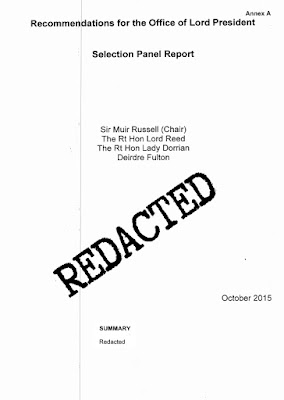
How judges select Scotland’s judges - in secret Documents obtained from the Scottish Government revealed Lord Reed sat on the selection panel for the office of Lord President - along with Sir Muir Russell, Judge Lady Dorrian, and Deirdre Fulton – considered five candidates for the position of Scotland’s top judge.

This same panel – which included Lord Reed – went on to recommend Lord Carloway for the position as Lord President & Lord Justice General of the Court of Session.

Written exchanges between civil servants and the selection panel which are included in the released papers - reveal a short listing meeting was held on 1 September 2015.

The panel considered that two applicants Lord Carloway [Redacted] merited an interview on the basis of the quality of their applications.

Two emails from Lord Reed, dated 14th ^ 15 October 2015 – released by the Scottish Government in the FOI documents - give a minimal, and heavily redacted description of Lord Reed’s role in the panel’s work, which ultimately recommended Lord Carloway for the position of Scotland’s top judge.

In one email, Lord Reed states: “This strikes me as an excellent report. I have made a few minor suggestions as shown on the attached version. Most of the suggestions are trivial, [redacted]”

In a second email Lord Reed writes “I am content with the amended report. I agree, in particular, with the points which were made by Leeona. The amended version beems to me to present an accurate account, and a fair and balanced assessment [redacted]”

A further potential interest not declared, brought ot the attention of journalists by a legal source, identifies Lord Reed’s work together with Lord Carloway – on a ‘compatibility issues review’ to consider if the High Court of Justiciary in Scotland would still have to give permission for appeals in criminal cases to go forward to the UK Supreme Court.

The review group was itself established by Lord Carloway, with others appointed to the group being Lord Reed (Deputy President of the UKSC), and others - Lady Dorrian (Lord Justice Clerk); David Harvie (Crown Agent); Roddy Dunlop QC (Treasurer of the Faculty of Advocates); and John Scott QC (President of the Society of Solicitor Advocates).

The review concluded - "Appeals to the Supreme Court of the United Kingdom (UKSC) should not require certification by the High Court of Justiciary that the issue raises a point of law of general public importance, a review chaired by the Lord Justice General has concluded."

Although – it should be pointed out – coincidentally, the review on appeals to the UKSC – limited to appeals in criminal cases - came too late to help in several serious cases of judicial conflicts of interest in Scotland – particularly on a well known case where Court of Session judge & Privy Councillor - Lord Malcolm (Colin Campell QC) heard a case up to eight times - while failing to declare his own son represented the defenders in multi million pound damages action.

A report on the Lord Malcolm conflict of interest case can be found here: CONFLICT OF INTEREST: Papers lodged at Holyrood judicial interests register probe reveal Court of Session judge heard case eight times - where his son acted as solicitor for the defenders.

The two potential conflicts of interest, not declared by Lord Reed in relation to what was a law changing UKSC ruling of significant impact – again highlight the need for a publicly available Register of judges’ interests - to ensure members of the judiciary do not forget to disclose interests which may have a bearing on cases before them.

The issue also brings into question again, the self imposed secrecy on judicial interests by the judges of the UK Supreme Court and wider UK Judiciary – who have resisted calls to become more transparent and declare their interests in the same way all public servants and elected politicians are required to declare in publicly available registers of interest.

The current stance of UK Supreme Court judges on transparency in relation to declarations of interest, is a point blank refusal by the judiciary to comply with the public expectation of transparency.

The UK Supreme Court’s website states the following in relation to judicial expenses and interests:

Justices' interests and expenses

Background

Prior to the creation of the Supreme Court of the United Kingdom, the highest court in the UK was the Appellate Committee of the House of Lords. The members of the Committee were Lords of Appeal in Ordinary appointed under the Appellate Jurisdiction Act 1876. Although those appointments gave them full voting and other rights in the House of Lords, the Law Lords had for some years voluntarily excluded themselves from participating in the legislative work of the House. Notwithstanding that, they were bound by the rules of the House and provided entries for the House of Lords Register of Interests.

On the creation of the Supreme Court the Lords of Appeal in Ordinary became Justices of the Supreme Court. They retain their titles as Peers of the Realm, but are excluded by statute from sitting or voting in the House, for so long as they remain in office as Justices of the Supreme Court. As such, they are treated as Peers on leave of absence; and do not have entries in the House of Lords Register of Interests. Historical information remains accessible via the House of Lords website.

Other judges in the UK, such as the judges of the Court of Appeal and the High Court in England and Wales, and in Northern Ireland, and the Court of Session in Scotland, do not have a Register of Interests. Instead they are under a duty to declare any interest where a case comes before them where this is or might be thought to be the case.

Current position

Against this background the Justices have decided that it would not be appropriate or indeed feasible for them to have a comprehensive Register of Interests, as it would be impossible for them to identify all the interests, which might conceivably arise, in any future case that came before them. To draw up a Register of Interests, which people believed to be complete, could potentially be misleading. Instead the Justices of the Supreme Court have agreed a formal Code of Conduct by which they will all be bound, and which is now publicly available on the UKSC website.

In addition all the Justices have taken the Judicial Oath - and they all took it again on 1 October 2009 - which obliges them to "do right to all manner of people after the law and usages of this Realm without fear or favour, affection or ill will"; and, as is already the practice with all other members of the judiciary, they will continue to declare any interest which arises in the context of a particular case and, if necessary, recuse themselves from sitting in that case - whether a substantive hearing, or an application for permission to appeal.

In relation to the UK Supreme Court’s stance on declarations of interests, and declarations of conflicts of interest, Diary of Injustice reported on the issue in detail during 2017, here: SUPREME SECRETS: UK Supreme Court refuses to publish recusal data - Court rejects release of info on UKSC justices' conflicts of interest in response to Freedom of Information recusals probe on top UK court

During the probe of UKSC recusals and failure to declare interests, a common thread of dishonesty was noted in court staff’s handling of a Freedom of Information request from Scotland – which was only answered after coverage of the issue in The National newspaper, which prompted the Information Commissioner’s Office to order the court to respond to the request.

Lord Reed’s limited biography on the UK Supreme Court website (reprinted below) does not feature either of the issues identified linking the judge to Lord Carloway’s appointment as Lord President nor any mention of review & other work undertaken with Lord Carloway – including the UK Supreme Court sitting in Edinburgh, which included Lord Carloway as a sitting judge on the UKSC panel.

The announcement by 10 Downing Street of Lord Reed’s appointment as President of the UK Supreme Court in July 2019 read as follows:

The Rt Hon Lord Reed will succeed Baroness Hale of Richmond as President of the Supreme Court of the United Kingdom, alongside three additional appointments as Justices.

The Queen has been pleased to confer a peerage of the United Kingdom for Life on Lord Reed upon his appointment as the President of the Supreme Court in recognition of the contribution that he has made to law and justice reform.

Lord Reed will take up the position of President on 11 January 2020. Lord Justice Hamblen, Lord Justice Leggatt and Professor Andrew Burrows will join the Supreme Court as justices on 13 January, 21 April and 2 June 2020 respectively.Her Majesty The Queen made the appointments on the advice of the Prime Minister and Lord Chancellor, following the recommendations of independent selection commissions.

Lord Reed will replace Lady Hale who retires on 10 January 2020 after serving as President of the Supreme Court since September 2017.

LORD REED UKSC BIOGRAPHY:

Lord Reed was appointed as a Justice of the Supreme Court in February 2012 and has served as Deputy President since June 2018. Prior to his appointment to the Supreme Court he served as a judge in Scotland, sitting from 1998 to 2008 in the Outer House of the Court of Session, where he was the Principal Commercial and Companies Judge, and from 2008 to 2012 in the Inner House.

He was educated at the Universities of Edinburgh and Oxford, and qualified as an advocate in Scotland and as a barrister in England and Wales. He practised at the Scottish Bar in a wide range of civil cases and also prosecuted serious crime.

As well as sitting on the Supreme Court and the Judicial Committee of the Privy Council, he is a member of the panel of ad hoc judges of the European Court of Human Rights, and a Non-Permanent Judge of the Hong Kong Court of Final Appeal. He is also the High Steward of Oxford University.

IMPORTANT NOTE: Readers should note this article does not take sides in the brexit debate. This article is a reporting of a failure by a UK Supreme Court judge to declare or discuss relevant interests and a potential failure to recuse - by a senior judge who is the new President of the UK Supreme Court.

Sunday, September 29, 2019

SUPREME INTERESTS: UK Supreme Court Judge Lord Reed's undeclared links to Lord Carloway selection panel & appeal review work - will not alter UKSC "unlawful" Parliament suspension ruling - but should feature in register of judges' interests

UKSC judge Lord Reed linked to Lord Carloway job panel. A POTENTIAL undeclared conflict of interest of the next President of the UK Supreme Court (UKSC) – in relation to a recent ruling on the unlawful suspension of Parliament - has been discovered from documents obtained from the Scottish Government.

Papers obtained via Freedom of Information legislation and published in 2016 reveal that Scottish judge Lord Reed – who has sat on the Supreme Court since 2012 – also sat on the selection panel which recommended the appointment of Lord Carloway (Colin Sutherland) as Lord President in 2015.

The potential conflict of Lord Reed - identified during discussions with legal sources – has a bearing (but no overall effect) on the ruling by eleven Supreme Court justices in relation to the findings of three Scottish appeal court judgesheaded by Lord Carloway – who declared Prime Minister Boris Johnson’s decision to suspend parliament in the run-up to the October Brexit deadline as unlawful.

In that ruling, Lord President, Lord Carloway, decided that although advice to HM the Queen on the exercise of the royal prerogative of prorogating Parliament was not reviewable on the normal grounds of judicial review, it would nevertheless be unlawful if its purpose was to stymie parliamentary scrutiny of the executive, which was a central pillar of the good governance principle enshrined in the constitution; this followed from the principles of democracy and the rule of law. The circumstances in which the advice was proffered and the content of the documents produced by the respondent demonstrated that this was the true reason for the prorogation.

However, the failure of Lord Reed to declare he sat on the appointments panel which recommended Lord Carloway for the top judicial job in Scotland – is one of two potential conflicts of interest for the Supreme Court judge which may have required to have – at the very uleast - been aired and debated for recusal - prior to the UKSC hearing on the suspension of the Westminster Parliament.

How judges select Scotland’s judges - in secret Scottish Government documents previously obtained by the media revealed the selection panel for the office of Lord President - of which Lord Reed was a member, along with Sir Muir Russell, Judge Lady Dorrian, and Deirdre Fulton – considered five candidates for the position of Scotland’s top judge.

Written exchanges between civil servants and the selection panel which are included in the released papers - reveal a short listing meeting was held on 1 September 2015.

The panel considered that two applicants Lord Carloway [Redacted] merited an interview on the basis of the quality of their applications.

Two emails from Lord Reed, dated 14th ^ 15 October 2015 – released by the Scottish Government in the FOI documents - give a minimal, and heavily redacted description of Lord Reed’s role in the panel’s work, which ultimately recommended Lord Carloway for the position of Scotland’s top judge.

In one email, Lord Reed states: “This strikes me as an excellent report. I have made a few minor suggestions as shown on the attached version. Most of the suggestions are trivial, [redacted]”

In a second email Lord Reed writes “I am content with the amended report. I agree, in particular, with the points which were made by Leeona. The amended version beems to me to present an accurate account, and a fair and balanced assessment [redacted]”

A further potential interest not declared, brought ot the attention of journalists by a legal source, identifies Lord Reed’s work together with Lord Carloway – on a ‘compatibility issues review’ to consider if the High Court of Justiciary in Scotland would still have to give permission for appeals in criminal cases to go forward to the UK Supreme Court.

The review group was itself established by Lord Carloway, with others appointmed to the group being Lord Reed (Deputy President of the UKSC), and others - Lady Dorrian (Lord Justice Clerk); David Harvie (Crown Agent); Roddy Dunlop QC (Treasurer of the Faculty of Advocates); and John Scott QC (President of the Society of Solicitor Advocates).

The review concluded - "Appeals to the Supreme Court of the United Kingdom (UKSC) should not require certification by the High Court of Justiciary that the issue raises a point of law of general public importance, a review chaired by the Lord Justice General has concluded."

Although – it should be pointed out – coincidentally, the review on appeals to the UKSC – limited to appeals in criminal cases - came too late to help in several serious cases of judicial conflicts of interest in Scotland – particularly on a well known case where Court of Session judge & Privy Councillor - Lord Malcolm (Colin Campell QC) heard a case up to eight times - while failing to declare his own son represented the defenders in multi million pound damages action.

A report on the Lord Malcolm conflict of interest case can be found here: CONFLICT OF INTEREST: Papers lodged at Holyrood judicial interests register probe reveal Court of Session judge heard case eight times - where his son acted as solicitor for the defenders.

The two potential conflicts of interest, not declared by Lord Reed in relation to what is a law changing UKSC ruling of significant impact – again highlight the need for a publicly available Register of judges’ interests - to ensure members of the judiciary do not forget to disclose interests which may have a bearing on cases before them.

The issue also brings into question again, the self imposed secrecy on judicial interests by the judges of the UK Supreme Court and wider UK Judiciary – who have resisted calls to become more transparent and declare their interests in the same way all public servants and elected politicians are required to declare in publicly available registers of interest.

The current stance of UK Supreme Court judges on transparency in relation to declarations of interest, is a point blank refusal by the judiciary to comply with the public expectation of transparency.

The UK Supreme Court’s website states the following in relation to judicial expenses and interests:

Justices' interests and expenses

Background

Prior to the creation of the Supreme Court of the United Kingdom, the highest court in the UK was the Appellate Committee of the House of Lords. The members of the Committee were Lords of Appeal in Ordinary appointed under the Appellate Jurisdiction Act 1876. Although those appointments gave them full voting and other rights in the House of Lords, the Law Lords had for some years voluntarily excluded themselves from participating in the legislative work of the House. Notwithstanding that, they were bound by the rules of the House and provided entries for the House of Lords Register of Interests.

On the creation of the Supreme Court the Lords of Appeal in Ordinary became Justices of the Supreme Court. They retain their titles as Peers of the Realm, but are excluded by statute from sitting or voting in the House, for so long as they remain in office as Justices of the Supreme Court. As such, they are treated as Peers on leave of absence; and do not have entries in the House of Lords Register of Interests. Historical information remains accessible via the House of Lords website.

Other judges in the UK, such as the judges of the Court of Appeal and the High Court in England and Wales, and in Northern Ireland, and the Court of Session in Scotland, do not have a Register of Interests. Instead they are under a duty to declare any interest where a case comes before them where this is or might be thought to be the case.

Current position

Against this background the Justices have decided that it would not be appropriate or indeed feasible for them to have a comprehensive Register of Interests, as it would be impossible for them to identify all the interests, which might conceivably arise, in any future case that came before them. To draw up a Register of Interests, which people believed to be complete, could potentially be misleading. Instead the Justices of the Supreme Court have agreed a formal Code of Conduct by which they will all be bound, and which is now publicly available on the UKSC website.

In addition all the Justices have taken the Judicial Oath - and they all took it again on 1 October 2009 - which obliges them to "do right to all manner of people after the law and usages of this Realm without fear or favour, affection or ill will"; and, as is already the practice with all other members of the judiciary, they will continue to declare any interest which arises in the context of a particular case and, if necessary, recuse themselves from sitting in that case - whether a substantive hearing, or an application for permission to appeal.

In relation to the UK Supreme Court’s stance on declarations of interests, and declarations of conflicts of interest, Diary of Injustice reported on the issue in detail during 2017, here: SUPREME SECRETS: UK Supreme Court refuses to publish recusal data - Court rejects release of info on UKSC justices' conflicts of interest in response to Freedom of Information recusals probe on top UK court

During the probe of UKSC recusals and failure to declare interests, a common thread of dishonesty was noted in court staff’s handling of a Freedom of Information request from Scotland – which was only answered after coverage of the issue in The National newspaper, which prompted the Information Commissioner’s Office to order the court to respond to the request.

Lord Reed’s limited biography on the UK Supreme Court website (reprinted below) does not feature either of the issues identified linking the judge to Lord Carloway’s appointment as Lord President nor any mention of review & other work undertaken with Lord Carloway – including the UK Supreme Court sitting in Edinburgh, which included Lord Carloway as a sitting judge on the UKSC panel.

LORD REED BIOGRAPHY:

Robert John Reed, Lord Reed became Deputy President of The Supreme Court on 7 June 2018. He was appointed as a Justice of The Supreme Court in February 2012.

He studied law at Edinburgh University and undertook doctoral research in law at the University of Oxford. He qualified as an advocate in Scotland and as a barrister in England. He practised at the Scottish Bar in a wide range of civil cases, and also prosecuted serious crime.

He served as a senior judge in Scotland for 13 years. From 2008 to 2012 a member of the Inner House of the Court of Session, and from 1998 to 2008 a member of the Outer House of the Court of Session, where he was the Principal Commercial Judge.

As well as sitting on the Supreme Court and the Judicial Committee of the Privy Council, he is also a member of the panel of ad hoc judges of the European Court of Human Rights, and is a Non-Permanent Judge of the Court of Final Appeal in Hong Kong. He is also the Visitor of Balliol College, Oxford.

Lord Reed is one of the two Scottish Justices of The Supreme Court.

To update readers – on 24 July 2019, the last working day of Prime Minister Theresa May, HM the Queen appointed Lord Reed to serve as the President of the Supreme Court of the United Kingdom and declared her intention to raise him to the peerage. 

Lord Reed will take over as President of the United Kingdom Supreme Court from Baroness Hale of Richmond on 11 January 2020.

IMPORTANT NOTE: Readers should note this article does not take sides in the brexit debate. Rather this article is a reporting of a failure to declare or discuss relevant interests and a potential failure to recuse - by a senior judge who has been appointed as the new President of the UK Supreme Court.