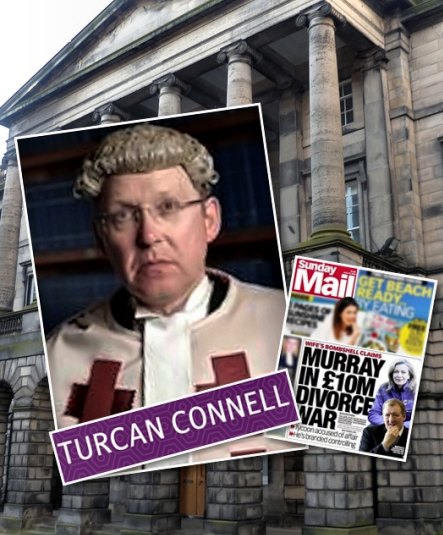
Showing posts with label Turcan Connell. Show all posts

Tuesday, March 19, 2019

ACCESS DENIED: Senior associate at Turcan Connell accessed confidential file note for ‘no professional reason’– prompting judge to rule law firm cannot act in ex Rangers owner’s divorce case due to conflict of interest

File access & Conflict of interest. CONCERNS of a lack of protection for client files at a top Scottish law firm - prompted a Court of Session judge to ban the Edinburgh based firm of lawyers from acting in a £10 million divorce case.

The ruling  against Turcan Connell - came after it emerged the wife of one of the law firm’s partners had accessed confidential file notes relating to the financial information of Kae Tinto Murray - who had taken on new legal representation in relation to a divorce case involving her husband – ex Rangers FC owner - Sir David Murray.

Details heard in court of the accessing of confidential files was so severe - it prompted Lord Neil Brailsford to issue a damning opinion which barred Edinburgh law firm Turcan Connell from further acting for Sir David Murray in the divorce case.

The application for interdict against Turcan Connell - was brought by Kae Murray - to prevent the law firm from acting further for her husband Sir David Murray, in proceedings she had raised for divorce, with capital and alimentary financial claims, and for the setting aside of a pre-nuptial agreement regulating their financial affairs in the event of divorce.

Ms Murray and Sir David Murray separated on 22 March 2016. A summons in an action of divorce at the instance of the petitioner against Sir David Murray was signeted on 22 May 2018.

At the beginning of June 2018 Mr Littlefield met with the petitioner and advised that he could no longer act for her in relation to her trust and personal affairs.

She was also advised that Turcan Connell were acting for Si David Murray in the divorce proceedings and that, accordingly, Turcan Connell could no longer act for her in relation to the divorce.

On 4 June 2018 SKO Family Law sent a mandate to Turcan Connell requiring them to provide SKO with the petitioner's files. That mandate was complied with. On 18 June 2018 a partner in SKO emailed Mr Littlefield primarily in relation to matters arising out of implementation of the mandate.

The email did however further ask for confirmation of what steps TC had "taken to ensure that any electronic information that you hold on behalf of [the petitioner] cannot be accessed by anybody within the firm who (i) may act for [the petitioner's husband] in the context of the divorce action, and/or (ii) may be a witness in the divorce action to follow."

On 11 September at a By Order hearing in the divorce action the issue of a challenge to Turcan Connell's continued representation of Sir David Murray was raised. The present petition was presented on 18 September 2018. As previously noted the petitioner's electronic file held by the respondents was locked down on 21 September 2018.

Senior Counsel for the petitioner informed the court of two occassions where Yvonne Littlefield accessed files in relation to Kae Murray - after the separation of the petitioner and Sir David Murray,.

On one occasion – Yvonne Littlefield accessed a file note relative to a telephone conversation that Mr Littlefield had with the petitioner on 14 March 2018.

On a second occasion, Yvonne Littlefield - accessed the petitioner's electronic file again on 17 July 2018, being a time both after Turcan Connell had ceased to act for the petitioner and after the summons in the divorce proceedings had been served.

Counsel noted that in her affidavit, the explanation for accessing the petitioner's electronic file on those occasions given by Mrs Littlefield was that she had, in the company of her husband Mr Littlefield, met the petitioner in the company of Sir David Murray at a social occasion.

In the context of a social meeting Yvonne Littlefield deponed in her affidavit that "She [the petitioner] struck me at the time as being the sort of person that I would like to include in future invites and it was my intention to keep in touch with her. I do try when meeting clients to understand what is going on in their lives and believe that such knowledge does enhance the relationship. Obviously all matters relating to clients are confidential but clients do appreciate it when they get a sense that they are genuinely appreciated."

Yvonne Littlefield went on to state further "I have been asked why I have accessed file notes on the file. I would have done so simply for the very purpose of being up-to-date. I don't know now but it may be that I had in mind inviting [the petitioner] to a Turcan Connell event."

Senior counsel for the petitioner submitted that the explanation proffered by Mrs Littlefield was inadequate. The petitioner was not, and had never been, Mrs Littlefield's client.

Mrs Littlefield had never acted for the petitioner nor offered her any professional advice. It was the submission of senior counsel that no proper justification for Mrs Littlefield's access to the files had been tendered and that her ability to do so on the dates that she did "simply demonstrates the extent to which, within the respondent's office, there is scope for information moving within a firm".

The information claimed to be confidential comprised the “retained knowledge” of Mr Noel Ferry – a partner in Turcan Connell, and information in two files compiled by Mr Littlefield, electronic copies of which continued to be held by the firm.

Noel Ferry had earlier represented Kae Murray in the negotiation and preparation of the pre-nuptial agreement with Sir David Murray – while Mr Ferry was Head of Family Law in another firm of solicitors, Maclay Murray & Spens.

In 2013. Noel Ferry joined Turcan Connell initially as a senior associate and from April 2015 as a partner working in that firm’s Glasgow office in the field of family law.

Lord Braisford’s opinion states that “Since joining Turcan Connell, Mr Ferry has not acted for nor had any dealings with the petitioner. Since her marriage to Sir David Murray the petitioner has on a number of occasions instructed and obtained advice from another partner of TC, Mr Peter Littlefield.”

After a consideration of both parties files - Lord Brailsford said “On the basis of the foregoing analysis I form the view that the information contained in Mr Littlefield's files constitutes information which is confidential to the petitioner disclosure of which would be potentially adverse to her interests.”

Lord Brailsford said it was the case an obvious conflict of interest existed from the date of service of the summons.

In his ruling Lord Brailsford went onto say: “I am bound to state that my view is that a conflict, or at least potential conflict, and therefor the need to have an effective information barrier, should have been obvious to TC from the date of the service of the summons in the action of divorce by the petitioner against her husband, a continuing client of the firm, on 22 May 2018.”

Additionally, Turcan Connell had not "provided the assurances necessary to satisfy the court that there was no risk of disclosure of information prejudicial to the petitioner outwith the direct control of those who had thus far given undertakings".

The judge concluded: "Consideration of the line of authority I have been directed to demonstrates that the importance of protecting a client's confidential information is such that professional advisors, in circumstances where they subsequently wish to act for someone with an interest adverse or potentially adverse to the former client, have an onerous burden placed upon them. A consideration of the amount of time that such files might take to investigate is in my view an inadequate reason for failure to consider all material held which might contain information confidential to the former client. I would add that in addition to these eight conclusions on the basis of the information before me, the concerns I expressed at the conclusion of the first hearing appear in large part, to continue to exist.”

“I respectfully agree with the observations of Lord Millet in Bolkiah (supra) that ad hoc arrangements made retrospectively, that is after a potential conflict between existing client and past client have emerged, are unlikely to be as robust as permanent arrangements which operate automatically and are already in place and operative when a conflict emerges. The reason for this is plain, ad hoc arrangements can take time to put into place. During any period before an ad hoc security arrangement or information barrier is erected and is operative there is the potential, by means of either deliberate or inadvertent action for confidential information to leak.”

“In the present case the most important information barrier was the "lock down" system of electronic files. For reasons which, as I have already said, no explanation was forthcoming, lock down did not operate for a period of something in the order of three and a half months after there was an obvious risk created by the petitioner ceasing to instruct TC and that firm correspondingly informing her that they could not act on her behalf in divorce proceedings against her husband.”

“As I have already observed the lack of adequate explanation for that intervention causes me concern. I consider that that fact increases the risk of disclosure of confidential information which is the petitioners concern in this petition. I am also concerned that there has been incomplete examination of all sections of the petitioner's electronic file. This fact leads me to the conclusion that the court is still, notwithstanding that the respondents were given additional time to provide further information, in a position where it cannot be satisfied as to the precise level of any disclosure of confidential information which has occurred.”

Of further note in Lord Braislford’s opinion – “The petitioner's submission was developed to show that any information barrier which existed within TC in the context of the petitioner's file was of an "ad hoc" nature and therefore subject to the general criticism of ad hoc security arrangements made in Bolkiah (supra) and Georgian American Alloys (supra).

In support of the proposition that, in the context of the present case, ad hoc security arrangements were likely to be inadequate three principle factors were advanced. The first was that the petitioner's file was only "locked down" on 21 September 2018. This was three days after the present petition had been served upon TC. It was, further, four months after the summons in the divorce case was signeted and at least three and a half months after TC had ceased to act for the petitioner. This was said to clearly demonstrate that the information barrier being relied upon by TC was ad hoc and merely put in place to deal with contingencies as they arose. I was reminded that in Bolkiah (supra) Lord Millet observed that information barriers need to be "an established part of the organisational structure of the firm, not created ad hoc and dependent upon the acceptance of evidence sworn for the purpose by members of staff engaged on the relevant work".

The second ground was that a necessary implication of the date of lock down was that up to that date there was unrestricted access to the petitioner's file. A corollary of that was that TC required to rely upon "a large number of affidavits in which qualified and support staff set out their best recollection as to why they accessed the file, whether they recall anything about it and whether they would have discussed the contents with anyone."

That consideration increased the level of risk of disclosure of information of a confidential nature whether inadvertently or otherwise. Reliance was made in this respect to observations of Field J in Georgian American Alloys (supra).  It was also observed by counsel for the petitioner at this point that whilst no criticism was made of TC there were three persons who had accessed the file from which affidavits had not been obtained. This was said to demonstrate the difficultly which would arise when ad hoc security arrangements required to be justified. The ad hoc nature of an arrangement meant, as a matter of probability, that no record of access would be kept and therefore attempts to identify potential disclosure at a later stage would be correspondingly difficult.

The third area of criticism was directed at the work done by Turcan Connell in an attempt to demonstrate that there had been no disclosure of confidential information.

Mr Davie had interrogated the correspondence" area of Turcan Connell's electronic file for the petitioner. That exercise had enabled Mr Davie to show who had accessed that part of the file and what documents they had seen. He had not however sought to interrogate those parts of the electronic file relating to "emails", "finance" or "signed documents". That failure necessarily meant that who had accessed those parts of the file and what they may have accessed was unknown. In these circumstances it simply could not be said that there had been no disclosure of confidential information. It was submitted that there were was "no apparent reason why the respondent could not have provided the petitioner with the print offs for the remainder of the documents" which would have at least enabled them to satisfy themselves in relation to those parts of the file.

Having regard to all the foregoing considerations the submission was that it was impossible to know what the extent of the risk of disclosure in the past had been. Whilst it was accepted that the file had been locked down since 21 September it was further submitted that the risk of disclosure was not removed. The submission was developed by stating that the petitioner could see no obvious reason why TC required to retain the petitioner's file within its electronic system at all. It was suggested that if TC had taken the step of removing the information from its system and storing it off-site, a step which was taken in relation to files in Bolkiah (supra) as a matter of example, that could have gone further towards removing risk of future disclosure. In these circumstances it was submitted that TC had not demonstrated to the extent necessary that the level of risk existing was acceptable. The submission was further renewed that the appearance of justice and the broader ground of the need to preserve the administration of justice justified the granting of interdict as craved.

The full opinion is available here: OPINION OF LORD BRAILSFORD In the petition KAE ALEXANDRA TINTO or MURRAY Petitioner for interdict

Clients concerned as to the confidentiality of their files with solicitors should pay particular attention to events in this case, particularly where a solicitor moved between firms (not an uncommon thing) but of course, the implications of such a move on confidentiality and failure to protect it, as revealed in this case.

Interestingly, and of note – the following publicly available biographies of Yvonne Littlefield, and that of her partner – Peter Littlefield  on the Turcan Connell website - make no mention of any marital connection, despite considerable details in other areas.

Bio – Peter Littlefield

Peter works principally in the areas of contentious probate, succession planning, trust law, will drafting, tax planning, asset protection, executry administration and charities. Peter specialises in tax and estate planning for private clients, including entrepreneurs and landowners. His work includes advice in connection with complex issues arising out of estates and post-death tax planning. He also advises a number of major national charities on Scots succession law.

Peter joined Turcan Connell 2002. He is a member of the Society of Trust and Estate Practitioners (STEP). Peter graduated with an MA (Hons) degree in Sociology from the University of Edinburgh before completing his LLB degree and Diploma in Legal Practice. He speaks at seminars and conferences on succession and trust law.

Peter was assumed as a Partner in April 2011. He is married with two children, and enjoys skiing, mountain biking and the occasional triathlon.

Bio: Yvonne Littlefield

After graduating from the University of Edinburgh in 1997 (LLB HONS DipLP), Yvonne trained with a firm of Glasgow Solicitors.  Following qualification as a solicitor in 1999, Yvonne joined Turcan Connell in April 2001 and was promoted to Senior Associate in 2015.

Yvonne advises clients in all areas of asset protection, succession and tax planning during lifetime including in particular, the use of trusts.  She regularly advises on (inheritance) tax efficient Wills, and deals with the executry administration of complex (sometimes contentious) estates.  She is also involved in incapacity planning e.g. Powers of Attorney and, where necessary, guardianship  applications.

Yvonne has been invovled with several clients and their wider families spanning more than a decade, and values the ongoing relationships, and the benefits that can provide when offering advice.

Yvonne is a fully qualified member of STEP (Society of Trust and Estate Practitioners) and a Notary Public. 


Monday, August 16, 2010

R.I.P. OFF : Lack of independent regulation reveals solicitors, accountants & will writers should not be trusted on wills, final wishes & bequests

Will fraud bkWill fraud by solicitors, will-writers & accountants prove many professions cannot be trusted with consumers final wishes. A CONCERTED CAMPAIGN by solicitors & other financial professionals to retain market dominance in the multi billion pound will writing & will handling business in the UK has been brought back into focus in the past two weeks after allegations were made by solicitors against ‘cowboy’ will-writing private companies offering the same poor, often extortionately costing & woefully under regulated services for will-writing & will handling as many people have already experienced from the legal profession, who currently dominate the will writing & will handling market.

Put simply, solicitors, accountants, will-writers and all their colleagues who are in the will writing & will handling business, should not be trusted by members of the public to handle wills, final wishes & bequests. All are as bad as each other, and all are as poorly regulated as each other. Not one to mend another – trust one over the other, and you are sure to be ripped off, either by the solicitor, the accountant, the bank, or the will-writer.

Sure, there are many professional bodies who openly & publicly guarantee their so-called professional members will never rip off your will, will never rip off your remaining family, will never ruin your final wishes & take what you leave behind for themselves, but the sad truth is all these guarantees are hollow, as hollow as a rotted tree with no innards. I covered this issue in more detail in November 2009, here : Consumer warning on wills : Don't make your lawyer your executor as soaring cases of 'will fraud' show Law Society closes ranks on complaints

Scotsman coverage of some of the stories relating to Andrew PenmanRipping off the dead - Guarantees from the Law Society of Scotland of professionalism of their solicitors on handling wills are worthless as the media reports time & again. Trust a lawyer to handle your will, and you may well get one of the many Andrew Penmans running around, more of which you can read about here : Solicitors who rip off dead clients : How Borders solicitor Andrew Penman ruined an executry estate Trust an accountant as your executor, and you may well get one of the many Norman Howitts running around, more of which you can read about here : Accountants who rip off wills & abuse their positions as Executors : How Borders accountant Norman Howitt ruined a will and a family

Last week, the Society of Trust and Estate Practitioners - the international professional body for workers in the trust industry and the (often overlapping) field of estate administration whose members are mainly solicitors, barristers, attorneys, accountants, trust officers and trust administrators as well as banking and insurance professionals in the trust field, issued a press release claiming that a Survey Reveals Incompetence and Dishonesty of “Cowboy” Will Writers. The Press Release from STEP, bearing in mind their membership includes solicitors, accountants & bankers, reads as follows :

Interim results from a survey published today by the Society of Trust and Estate Practitioners (STEP), reveal the scale of the threat posed to the consumer from cowboys in the will writing market. The survey found that 75% of STEP members have encountered cases of “incompetence or dishonesty in the will writing market in the last 12 months”, and prompted STEP to again call for better consumer protection. Two thirds of respondents reported coming across hidden fees which were not outlined in the stated price for a will, and 63% had direct experience of cases where will writing companies had gone out of business and disappeared with their clients’ wills. Just over one third had encountered cases where incompetence had led to significant additional tax bills.

Chief Executive David Harvey said: “This research shows how widespread cowboy will writers have become and it is clear those who charge a fee for writing a will should now be regulated. They must have an appropriate qualification, and they must have proper indemnity insurance. Soon the consumer will be protected by new regulation in Scotland and this benefit needs to be extended to cover the rest of the UK."

Examples of malpractice included a company which approached young mothers in shopping malls, telling them their children would be taken into care after they died if they failed to make a will. One consumer was charged £12,000 up-front for executor services only for their family to find the firm involved had gone out of business not long after, disappearing with their wills and money. In June the Legal Services Board launched a review of the threat posed to consumers in England & Wales by unprofessional will writers and is currently seeking evidence of consumer harm. The Scottish Parliament is currently going through the process of regulating non-lawyer will writers through the Legal Services (Scotland) Bill.

Certainly an interesting Press Release from STEP, but it hardly tells the real story of what is going on in the UK will industry, where solicitors dominate the market. Notably, STEP use an example where one consumer was charged £12,000 up-front for executor services yet the Scottish legal profession can beat that hands down, where, to quote one example, Edinburgh law firm Turcan Connell charged fees of more than £16,000 to administer an estate with net assets of under £14,000 – and the Law Society then rejected a complaint from the deceased client’s widow, Dr Kate Forrest.

Legal bill wipes out net assets - The Herald January 02 2007The Herald newspaper reported : “[Dr] Forrest complained that the firm had told her only that it would charge £200 an hour, had entered into unnecessary work, and had failed to give her estimates, or issue itemised bills, despite repeated requests. She claims the firm then gave an undertaking to halt the charges, in a meeting with witnesses at the firm's office, but this did not materialise. When the Law Society examined the complaint, it ruled that the meeting could not be taken into account as the firm had no record of it, and it accepted an explanation by managing partner Douglas Connell that the complaint had been based entirely on a "misunderstanding". The £16,000 in charges had the effect of more than wiping out any assets in the estate, which had gross assets of £69,574 but debts of £55,731.”

Hardly a glowing recommendation for regulation by the Law Society of Scotland of solicitors handling wills, rather it proves deceased clients will be ripped off by any professional, with no recourse for their remaining family while the solicitor gets away with it – the perfect, ultimate, R.I.P. OFF.

BBC Panorama investigation on wills - no longer existsBBC Panorama report into corruption in the will writing industry omitted problems of solicitors ripping off dead clients. Coincidentally, the BBC’s Panorama programme ran a report on the wills industry, highlighting various rip offs by will-writing companies. The programme bizarrely implied while will-writing companies were quite obviously ripping off consumers to the tune of thousands of pounds, the situation was very different if a solicitor handled a will – something many victims of solicitors mishandling wills all across the UK could easily dispute. Curiously the BBC Panorama programme on this issue is now no longer available, although readers can still view a summarised text version of the report carried out by Panorama journalist Vivian White, here : Call for tighter will-writing laws as consumers duped

The new regulation in Scotland which STEP are referring to in their Press Release, relates to amendments contained in the Legal Services (Scotland) Bill, which may well end up seeing the Law Society of Scotland regulate non-lawyer will writers. I reporter on the Scottish plans for regulation of non-lawyer will writers, here : Scottish Government plan to regulate non-lawyer 'will writers' may see Law Society regulate all complaints against mishandled wills, legal business

Consumers should be in no doubt the Legal Services (Scotland) Bill is turning into one of the biggest rip offs of consumer choice of legal services in Scotland, a far cry from the intentions of the Which? super complaint and the Office of Fair Trading’s report into lawyers dominance of Scotland’s legal services marketplace.

Since the Law Society of Scotland (dubbed by some as the 'World's worst regulator') cant even regulate their own member solicitors when it comes to defrauding deceased clients, wills, executry estates & beneficiaries, I doubt the Law Society is going to be very effective in regulating anyone else who is involved in the rip off will writing & handling industry, unless of course, the Law Society simply use their regulatory powers as an excuse to wipe out the competition, ensuring everyone has to use a lawyer to write or handle a will.

This advice may be hard to swallow, but take it from one who has witnessed, investigated and been a victim of solicitors ripping off the dead – trust no lawyer, accountant, will writer, or any other so-called professional when it comes to your will & final testament, and never appoint one as your executor … its the sure fire road to perdition ….

Saturday, June 09, 2007

Obsession for control divides legal profession over opening up of legal services monopoly in Scotland

Over the past few weeks I have covered the important issue of access to legal services in Scotland - which is currently the well controlled monopoly of solicitors & advocates.

Put simply, if you need access to legal services, only a lawyer or advocate will do, and if they don't want to take your case, that's it - no access to justice for you - so, forget about using a lawyer to sue a lawyer, or take any controversial case anywhere near a court because if it's not in the legal profession's interest to take the case on, you are left out in the cold - along with many of the Scottish public who now can't get access to legal services.

The wise thing to do is open up the legal services market, as I have said in articles such as : Consumers call for OFT Inquiry to investigate restriction of legal services in Scotland & It's time for Injustice to end, but will the SNP end Injustice in Scotland ?

The established policy of the Law Society of Scotland, and the rest of the legal profession over the decades, has been to fight any possibility that anyone, other than lawyers or advocates, could offer legal services to the public - and thus, control the public's access to justice.

That much was proved by the FOI battle between Kevin Dunion & the Scottish Executive over the release of documents which revealed the extent of how the legal profession went about protecting it's monopolistic business model on legal services - to the point that even a serving Lord Advocate (Lord Hardie) had recommended repeal of legislation (which had been held back for years by legal profession lobbying) to open up the legal services market, which is surely in the public interest.

Now, recently, as I indicated above, I reported on the Which? "Super Complaint" against the legal profession in Scotland over this very issue, and the Law Society of Scotland's response was quite clearly hostile, rejecting any 'interference' from the London based OFT regulator, and officials at Drumsheugh Gardens, base of the Law Society's Headquarters, swiftly mounted a public relations campaign against any idea we needed more choice in the Scottish legal services market.

I reported the Law Society's attitude on this issue here :

Law Society of Scotland reject Which? 'interference' & "super complaint" to OFT against lawyers monopoly on access to justice

The spin campaign by the Scottish legal profession has however, taken a new turn with the infamous legal firm of Turcan Connell - known to many as a legal firm used by ruthless landlords in the pursuit & intimidation of tenants across Scotland, wading into the "Tesco Law" argument with a letter from Douglas Connell to Law Society Chief Executive Douglas Mill, calling for "a more creative approach". Letters of a similar nature were also sent to the new Justice Minister Kenny MacAskill ...

To quote the Herald article :

"In letters sent yesterday to the Law Society's chief executive Douglas Mill and to the new Cabinet Secretary for Justice, Kenny MacAskill, a former solicitor, Connell argues that "many small towns would benefit from solicitors, accountants, surveyors and approved FSA regulated practitioners being able to join together to take advantage of the economies of scale - this would be a Scottish solution to Scottish issues".

He says changes to the practice rules could allow lawyers to share fees with non-lawyers and to create firms which would allow a minority of non-lawyer partners, all approved by the Law Society of Scotland."

Douglas Connell seems, on the face of it, to be going against Law Society policy on this issue, but is he really ? or, as many in the legal world have already said this week, is this just more of an organised softening of the Scottish legal profession's attitude towards the likes of "Tesco Law", more properly known as the Clementi reforms, which in England & Wales, have opened up the legal services market somewhat more than before.

The Law Society of Scotland surely know it's inevitable their long held and long protected monopoly on legal services will fall ... and so it needs to find a new role for itself in the face of increased competition to its own members in the legal services market .. but will long held beliefs in the Law Society of omnipotence & control freakery be able to give way to the public interest ?

Of course, let us remember, while the Clementi reforms in England & Wales should be implemented - there has to be an effective independent regulatory for those people & companies which will enter the legal services market, because relying on the likes of accountants self regulators & the rest, will prove as disastrous as the kind of corrupt self regulation we have seen for years at the hands of the Law Society of Scotland.

The new regulator which is surely required to keep an eye on those who will enter the legal services market after Clementi is adopted, must NOT be the Law Society of Scotland - they have proved themselves over the decades to be untrustworthy in regulation of the legal profession.

There must be a fully independent regulator with strong powers of enforcement to police those who will be able to handle the public's legal work, to ensure standards are met and adhered to. Let's not let the Law Society try to find a new niche for themselves, because they certainly don't deserve it after the way they have treated clients of crooked lawyers for all these years - and lets be careful of believing who is really promoting change ...

Of course, Mr Connell, you could always change the Law Society of Scotland's policy on access to legal services a more democratic way, by having a vote in the membership, or is the legal profession, or perhaps more accurately, the Law Society's leaders not democratic enough to allow it's members to vote on leadership & policy issues these days ? Scotland managed it, why not the lawyers ?

With one foul swoop, Mr Connell, you and the rest of Scotland's 10,000 solicitors could vote in a new administration at Drumsheugh Gardens and do away with 17 years of dictatorial control, intimidation of clients & solicitors, corrupt complaints procedures & fiddled investigations, and an infamous anti client policy which has brought about 5000 complaints a year, and total client dissatisfaction with Scottish solicitors and their work - or, is it perhaps the Scottish legal profession prefers it this way ?

Here is the full article from the Herald newspaper on this 'apparent' divide in the legal profession's view on how to open up legal services in Scotland, and just to remind you all of at least one issue of 'self regulation' over a serious complaint regarding Messrs Turcan Connell, a news item from the Herald earlier this year is also quoted for your interest ...

http://www.theherald.co.uk/business/news/display.var.1452701.0.0.php

Connell renews call for ‘Tesco law’ for Scotland
SIMON BAIN June 07 2007

The Scottish legal profession's apparent lone voice in favour of the easing of restrictive practices has called for a "Scottish solution" to the threat of "Tesco law" crossing the Border.

Douglas Connell, co-founder of private client advisers Turcan Connell which operate a multi-disciplinary practice across law, accountancy and finance but which can only admit lawyers as partners, has called on the Law Society of Scotland to adopt "a more creative approach".

In letters sent yesterday to the Law Society's chief executive Douglas Mill and to the new Cabinet Secretary for Justice, Kenny MacAskill, a former solicitor, Connell argues that "many small towns would benefit from solicitors, accountants, surveyors and approved FSA regulated practitioners being able to join together to take advantage of the economies of scale - this would be a Scottish solution to Scottish issues".

He says changes to the practice rules could allow lawyers to share fees with non-lawyers and to create firms which would allow a minority of non-lawyer partners, all approved by the Law Society of Scotland.

Scotland would not have to follow the Clementi proposals in England and Wales, which float a whole range of alternative structures, including multi-disciplinary partnerships and externally-owned legal service firms as envisaged by Tesco.

Connell warns: "Cross-border mergers have already taken place but that trend may see more substantive moves south of the border if recognition of new forms of business structure become available to practitioners in England and Wales but not in Scotland. It would be galling to see Scottish firms having to export themselves to England in order to avail themselves of an English solution to a problem which could be resolved here in Scotland."

Turcan Connell this week opened a London office and has a large number of English qualified staff.

and now the article from the Herald newspaper on Turcan Connell's attidude over clients ... having many wonder what else is in the Turcan Connell closet ....

Law Society of Scotland rejects complaint over estate ruined by huge legal fees

http://www.theherald.co.uk/business/77839.html

Legal bill wipes out net assets
IAIN MORSE and SIMON BAIN January 02 2007

A leading Edinburgh law firm which charged fees of more than £16,000 to administer an estate with net assets of under £14,000 has had a complaint against it to the Law Society of Scotland rejected.

The complaint was made by widow Dr Kate Forrest, a lecturer in Russian in Edinburgh, against Turcan Connell, the multi-disciplinary firm which prides itself on its "family office".

Forrest complained that the firm had told her only that it would charge £200 an hour, had entered into unnecessary work, and had failed to give her estimates, or issue itemised bills, despite repeated requests. She claims the firm then gave an undertaking to halt the charges, in a meeting with witnesses at the firm's office, but this did not materialise.

When the Law Society examined the complaint, it ruled that the meeting could not be taken into account as the firm had no record of it, and it accepted an explanation by managing partner Douglas Connell that the complaint had been based entirely on a "misunderstanding".

The £16,000 in charges had the effect of more than wiping out any assets in the estate, which had gross assets of £69,574 but debts of £55,731.

The Law Society reported that the firm had "apologised for the oversight" in billing, and that "simple oversight … should not be defined as inadequate professional service".

In November, Jane Irvine, the Scottish Legal Services Ombudsman, issued a rare public rebuke to the Law Society over its handling of complaints, urging it to "recognise that the consumer age has dawned".

The Scottish Executive is poised to scrap self-regulation by the profession, policed by the ombudsman, and introduce a Scottish Legal Complaints Commission, which the society is fiercely resisting.

The number of complaints received by the Law Society of Scotland has shot up from 2402 during 2002 to 4849 last year. The 12-page annual report of the society's Client Relations Office records 1057 cases in which no action was taken at all last year, while in 108 cases a solicitor's conduct was found unsatisfactory.

The current procedure starts with a reference to the law firm against which the complaint is made, and internal procedures to be followed by firms are laid down by the society. Only after these are exhausted can complainants proceed to the Law Society itself. And then, perhaps surprisingly, complainants can be charged by the law firm for their work in submitting the relevant evidence to the society.

The evidence regarded as acceptable by the society may be limited only to the files presented by the law firm, though it can order the production of "missing"documents - such as the record of a meeting. If a complaint is rejected by the society, the complainants have recourse to the courts. But this means finding a law firm prepared to act against another firm - which as The Herald has reported can be difficult in Edinburgh - at a minimum cost of several thousand pounds, a considerable disincentive to taking legal action.

Kate Forrest says she is left with no choice but to go to court if she wishes to challenge an outstanding fee in excess of £8000. She says: "For me this would be expensive and risky. I am not rich and they know this very well."

The Law Society of Scotland said: "A complaint about a fee could be service or conduct as it could result from a breach of a rule if there was no letter of engagement, or IPS (inadequate professional service) if there was insufficient communication about a fee with a client.

"If a client feels a fee is too much then it can be referred to the Auditor of Court who can decide what a reasonable fee might be. Firms may also charge for providing a bill which itemises each letter, phone call, etc, especially if it is for a large volume of work.

"If someone takes a court action against a solicitor then the society is not involved in that process."

Turcan Connell said: "We care deeply about ensuring that we give every client the best possible service. Our trust and tax experts are among the most proficient in Scotland, and we always strive to protect our clients' interests and minimise their costs as far as possible.

"Dr Forrest is no longer a client. We resolutely protect the privacy of all current and former clients, and would not make any public comment on an individual's personal circumstances or relationship with us."

Tuesday, January 02, 2007

Law Society of Scotland rejects complaint over estate ruined by huge legal fees

It looks like the Edinburgh legal & financial investment firm of Turcan Connell, which has offices at 1 Earl Grey Street, Edinburgh and in Guernsey,the Channel Islands can be added to the long list of legal firms to stay away from, judging from today's Herald newspaper report on how they administered an estate.

Turcan Connell seem to like the money and publicity .. as long as they are getting it written for their benefit, that is ... noting their recent claim to fame of hitting £450m in their investments ... see here : Law firm Turcan Connell funds hit £450m ... but despite the £450m in their investment portfolio .. they still manage to ruin an estate ... much in the same way, it seems that crooked Borders solicitor Drew Penman - Scotland's Most Famous Crooked Lawyer of Stormonth Darling Solicitors, Kelso .. did to my family .. and a few other clients too.

I can sympathise with Dr Kate Forrest on this one .. making a complaint against a firm of solicitors who have raped an estate can be a tedious affair .. and the Law Society, it all it's crooked glory, are loathed to do anything on such cases, as they have done in the case of Dr Forrest's complaint against Turcan Connell .. well ..actually, the Law Society of Scotland have went one better, and thrown the complaint out.

Quotes from the Herald article today :

Forrest complained that the firm had told her only that it would charge £200 an hour, had entered into unnecessary work, and had failed to give her estimates, or issue itemised bills, despite repeated requests. She claims the firm then gave an undertaking to halt the charges, in a meeting with witnesses at the firm's office, but this did not materialise.

When the Law Society examined the complaint, it ruled that the meeting could not be taken into account as the firm had no record of it, and it accepted an explanation by managing partner Douglas Connell that the complaint had been based entirely on a "misunderstanding".

The £16,000 in charges had the effect of more than wiping out any assets in the estate, which had gross assets of £69,574 but debts of £55,731.

The Law Society reported that the firm had "apologised for the oversight" in billing, and that "simple oversight … should not be defined as inadequate professional service"

Well, when a lawyer tells you they will charge only a set fee .. believe me .. it's a LIE. You got that one, right ? in English. A LIE.

Ask a lawyer for estimates of work ? What you get, if anything, is a LIE. Got that ? A LIE. I've tried it myself. They didn't provide me with an estimate despite repeated requests, and the lawyer then denied I ever made such requests - removed the file notes which matched my email records, took a sickie to get out of the complaint (he got off the hook of course) and then became a Law Accountant.

Another client of a lawyer who contacted me, told me they got an estimate back for £1500 and the final bill ended up at £8000.

Lawyers fake up paperwork on a daily basis. There must be more faked paperwork in lawyers offices in Scotland than there is fake currency floating round the planet.

They don't always fake up the paperwork too well though .. When Drew Penman was faking up the paperwork on my complaint .. he got some of the dates wrong and some of the staff entries upside down .. managed to insert the wrong documents into the wrong order .. and cleverly, the Law Society Complaints Reporter found this one out for himself .. that's why he recommended Drew Penman be prosecuted before the SSDT and be struck off .. but, being represented by equally crooked James Ness, now the Director of Law Care ... Penman got off the hook with even more fiddled evidence at the Complaints Committee hearing.

So you see .. faking up the paperwork is common .. and fake estimates from a lawyer for work .. if you ever actually manage to get one .. aren't worth the ink it takes to type them out.

I liked the part in the article where the Law Society said it couldn't accept the information relating to the 'meeting' where fees were discussed .. "as the firm had no record of it" ... great cop-out there, if familiar .. which goes down to fiddled minutes of meetings - which usually exist .. but the lawyer can remove them at will, because the Law Society of Scotland says they can do that .. it's called "right of lien" which is also used to keep files from a client until they pay for their services .. and even then .. surprise, any file the lawyer deems shouldn't be released to the client, is held back.

Maybe the minutes of the meeting did actually exist in this case ... we shall perhaps, never know .. but I know the same happened in my complaint against Drew Penman ... minutes of meetings were denied to exist .. the mysteriously turned up .. some of them faked of course .. so Dr Forrest should perhaps pursue that one further.

More quotes from the Herald article :

"If a client feels a fee is too much then it can be referred to the Auditor of Court who can decide what a reasonable fee might be. Firms may also charge for providing a bill which itemises each letter, phone call, etc, especially if it is for a large volume of work.

"If someone takes a court action against a solicitor then the society is not involved in that process."

Well, the process involving the 'Auditor of the Court' is usually referred to as "Judicial Taxation" ... but it's certainly no cure for the whims of crooked legal firms to charge what they want for services which usually are poorly handled.

You will all remember the famous £45,000 bill for photocopying which Tods Murray hit one of their clients with .. which was I heard, reduced to around £7,000 or even less after 'Judicial Taxation' .. but it doesn't always go the way of the client .... as the Auditor of the Court can get things wrong a lot too .. and there have been a few challenges to the validity of the Auditor of the Court's position over the years .. one fine example being a Judicial Review of the Auditor's actions, which you can read about here : OUTER HOUSE, COURT OF SESSION [2006] CSOH 169 OPINION OF J GORDON REID Q.C., F.C.I.Arb (sitting as a Temporary Judge) in the Petition of DANIEL PATRICK COYLE Petitioner; for Judicial Review of a decision of the Auditor of the Court of Session .. some good info on the Auditor of the Court contained in that one ...

However, the Law Society's statement : "If someone takes a court action against a solicitor then the society is not involved in that process." is simply, a LIE.

Here's proof of otherwise : The Corrupt Link Revealed - How the Law Society of Scotland manages client complaints & settlements.

More proof here : Law Society of Scotland claims success in gagging the press over Herald newspaper revelations of secret case memos

The Law Society of Scotland have a well practiced policy of managing all claims against solicitors, to make sure claims get nowhere and clients lose everything.

Indeed, what is happening to the estate in terms of the legal charges which will wipe out the estate assets, is quite common. After all, that's exactly what Drew Penman did to me .. and that's exactly what lawyers up and down Scotland do to estates - wipe them out by using up all their assets, cash, opening up high interest overdraft accounts with favoured Banks and squandering all the money in cosy deals between themselves and the Banks. Simple stuff - it's policy on all estates.

Here is a remarkably similar story Peter Laing from Scotland on Sunday wrote about my case involving crooked lawyer Drew Penman :

Scotland on Sunday February 2001 - Legal Profession in the dock over complaints about self regulation

Take a will to a lawyer, and plenty of you will get the same. I get reports of this all the time, and I know it's true, because it happened to my family.

I doubt Dr Forrest will be able to get a lawyer to sue a lawyer .. many of us have tried it, and it doesn't work, as you can see from my own coverage in the Scotsman which began with this story way back in October 1994 :

Scotsman 18 October 1994 Son threatens to walk away from inheritance after legal row

Complaints such as Dr Forrest's should be referred to the new SLCC, as it's plain for all to see the Law Society of Scotland are not doing their job, and never really have. It's time for a full review of the treatment of complaints against lawyers by clients over the years which have been subject to the utmost prejudice in favour of solicitors, by the most corrupt self regulatory body in existence - the Law Society of Scotland.

Here's the link to the Herald article today, and prepare yourselves for an even more gruesome story of the lengths crooked lawyers will go to defeat complaints later this week. Gruesome, and perhaps even, evil.

http://www.theherald.co.uk/business/77839.html

Legal bill wipes out net assets
IAIN MORSE and SIMON BAIN January 02 2007

A leading Edinburgh law firm which charged fees of more than £16,000 to administer an estate with net assets of under £14,000 has had a complaint against it to the Law Society of Scotland rejected.

The complaint was made by widow Dr Kate Forrest, a lecturer in Russian in Edinburgh, against Turcan Connell, the multi-disciplinary firm which prides itself on its "family office".

Forrest complained that the firm had told her only that it would charge £200 an hour, had entered into unnecessary work, and had failed to give her estimates, or issue itemised bills, despite repeated requests. She claims the firm then gave an undertaking to halt the charges, in a meeting with witnesses at the firm's office, but this did not materialise.

When the Law Society examined the complaint, it ruled that the meeting could not be taken into account as the firm had no record of it, and it accepted an explanation by managing partner Douglas Connell that the complaint had been based entirely on a "misunderstanding".

The £16,000 in charges had the effect of more than wiping out any assets in the estate, which had gross assets of £69,574 but debts of £55,731.

The Law Society reported that the firm had "apologised for the oversight" in billing, and that "simple oversight … should not be defined as inadequate professional service".

In November, Jane Irvine, the Scottish Legal Services Ombudsman, issued a rare public rebuke to the Law Society over its handling of complaints, urging it to "recognise that the consumer age has dawned".

The Scottish Executive is poised to scrap self-regulation by the profession, policed by the ombudsman, and introduce a Scottish Legal Complaints Commission, which the society is fiercely resisting.

The number of complaints received by the Law Society of Scotland has shot up from 2402 during 2002 to 4849 last year. The 12-page annual report of the society's Client Relations Office records 1057 cases in which no action was taken at all last year, while in 108 cases a solicitor's conduct was found unsatisfactory.

The current procedure starts with a reference to the law firm against which the complaint is made, and internal procedures to be followed by firms are laid down by the society. Only after these are exhausted can complainants proceed to the Law Society itself. And then, perhaps surprisingly, complainants can be charged by the law firm for their work in submitting the relevant evidence to the society.

The evidence regarded as acceptable by the society may be limited only to the files presented by the law firm, though it can order the production of "missing"documents - such as the record of a meeting. If a complaint is rejected by the society, the complainants have recourse to the courts. But this means finding a law firm prepared to act against another firm - which as The Herald has reported can be difficult in Edinburgh - at a minimum cost of several thousand pounds, a considerable disincentive to taking legal action.

Kate Forrest says she is left with no choice but to go to court if she wishes to challenge an outstanding fee in excess of £8000. She says: "For me this would be expensive and risky. I am not rich and they know this very well."

The Law Society of Scotland said: "A complaint about a fee could be service or conduct as it could result from a breach of a rule if there was no letter of engagement, or IPS (inadequate professional service) if there was insufficient communication about a fee with a client.

"If a client feels a fee is too much then it can be referred to the Auditor of Court who can decide what a reasonable fee might be. Firms may also charge for providing a bill which itemises each letter, phone call, etc, especially if it is for a large volume of work.

"If someone takes a court action against a solicitor then the society is not involved in that process."

Turcan Connell said: "We care deeply about ensuring that we give every client the best possible service. Our trust and tax experts are among the most proficient in Scotland, and we always strive to protect our clients' interests and minimise their costs as far as possible.

"Dr Forrest is no longer a client. We resolutely protect the privacy of all current and former clients, and would not make any public comment on an individual's personal circumstances or relationship with us."