Showing posts with label Criminal Records. Show all posts

Friday, March 11, 2016

CROWN CROOKED: Crown Office crime files reveal Scotland’s Prosecutors & staff charged with Drugs crimes, Police assault, threats & perverting the course of justice

Crime & drugs empire at Crown Office revealed. AMID a string of collapsed cases involving high profile criminals, plea deals with gangsters, failures to to prosecute those responsible for multiple deaths, & multi million pound frauds involved legal eagles - documents obtained by the media reveal Scotland’s Prosecutors have their very own crime gang - right at the heart of the Crown Office & Procurator Fiscal Service (COPFS).

Information released in response to Freedom of Information requests now reveal prosecutors & key staff among the ranks of Lord Advocate Frank Mulholland’s £110m-a-year Crown Office empire - have been charged with a string of criminal offences over crimes ranging from violence to misuse of drugs, making threats and offences against Police Officers.

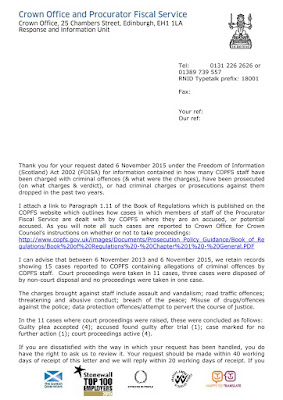
In a period of just two years – from November 2013 to November 2015 - the Crown Office admitted it retained records showing 15 cases reported to COPFS containing allegations of criminal offences by COPFS staff. Court proceedings were taken in 11 cases, three cases were disposed of by non-court disposal and no proceedings were taken in one case.

The charges brought against staff include assault and vandalism; road traffic offences; threatening and abusive conduct; breach of the peace; Misuse of drugs/offences against the police; data protection offences/attempt to pervert the course of justice.

In the 11 cases where court proceedings were raised, these were concluded as follows: Guilty plea accepted (4); accused found guilty after trial (1); case marked for no further action (1); court proceedings active (4).

Crooks among Them – Prosecutors own crime gang revealed. The only case where a COPFS employee was found guilty after trial relates to that of Iain Sawers, 27, from Edinburgh, who was found guilty of passing information to the criminal fraternity - during a seven-day trial at Edinburgh Sheriff Court in September 2014.

A jury found Sawers guilty on a charge of attempting to pervert the course of justice, the Official Secrets Act and nine under the Data Protection Act.

Sawers joined the Productions Office of the Procurator Fiscal Service in Chambers Street in the city in 2008.

His induction covered security of information and the warning that any breach could lead to disciplinary proceedings. He was also told, under the Official Secrets Act, the unauthorised disclosure of documents was an offence.

The offences by Sawers came to light when police began an investigation into the case of 27-year old Calum Stewart on charges of breach of bail and attempting to pervert the course of justice by threatening his ex-partner, Kelli Anne Smillie, if she gave evidence in a trial in July, 2013.

Stewart paid for her and her mother to leave the country and go on holiday to Benidorm on the week of the trial.

The police investigations led them to a number of phone calls and text messages between Stewart and Sawers between 24 and 29 January 2014.

These led to Stewart phoning Kelli Anne threatening her and her mother. They were to be witnesses in the outstanding trial which has since been deserted by the Crown.

The police also recovered Sawers' iPhone. Although many messages had been deleted, forensic experts were able to recover them and the telephone numbers of the senders and receiver. They showed that between April 2008 and January 2014, Sawers had passed on information to other people on nine occasions.

A check on the productions office computer showed shortly after receiving a call, Sawers' secret personal user number was used to access the information.

The jury also found Stewart guilty of attempting to pervert the course of justice and breach of bail. Neither men gave evidence during the trial – much to the relief of the Lord Advocate.

The Crown Office also admitted 40 staff  had been subject to disciplinary action, been suspended, dismissed or have been moved to other duties as a result of disciplinary action between January 2013 to late last year and  that 14 of those staff members were suspended in the period requested. The reasons for suspension included allegations related to potential criminal activity and/or charged by Police; and breach of trust.

Of the 40 members of staff who were suspended, 10 were dismissed from the Crown Office.

However officials refused to identify the reasons for their dismissal, insisting they wished to protect the identities of their colleagues and nature of the sackings.

A legal insider has since come forward this week to indicate former Crown Office staff including some of those who were sacked or had faced criminal charges - are back working with private law firms and public bodies with links to the Scottish Government.

The Scottish Sun newspaper reported further, here:

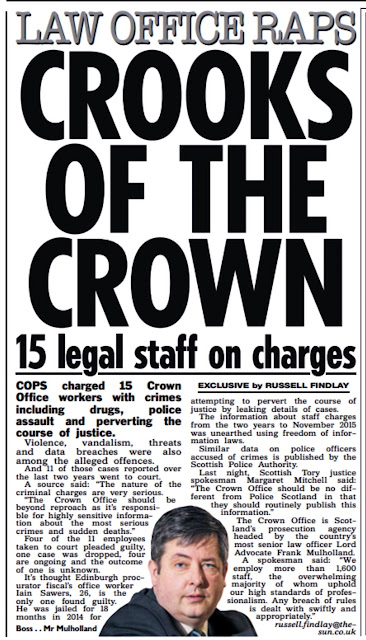
Crooks of the Crown: 15 legal staff on charges

EXCLUSIVE by RUSSELL FINDLAY 7 Mar 2016

COPS charged 15 Crown Office workers with crimes including drugs, police assault and perverting the course of justice.

Violence, vandalism, threats and data breaches were also among the alleged offences.

And 11 of those cases reported over the last two years went to court.

A source said: “The nature of the criminal charges are very serious.

“The Crown Office should be beyond reproach as it’s responsible for highly sensitive information about the most serious crimes and sudden deaths.”

Four of the 11 employees taken to court pleaded guilty, one case was dropped, four are ongoing and the outcome of one is unknown.

It’s thought Edinburgh procurator fiscal’s office worker Iain Sawers, 26, is the only one found guilty.

He was jailed for 18 months in 2014 for attempting to pervert the course of justice by leaking details of cases.

The information about staff charges from the two years to November 2015 was unearthed using freedom of information laws.

Similar data on police officers accused of crimes is published by the Scottish Police Authority.

Last night, Scottish Tory justice spokesman Margaret Mitchell said: “The Crown Office should be no different from Police Scotland in that they should routinely publish this information.”

The Crown Office is Scotland’s prosecution agency headed by the country’s most senior law officer Lord Advocate Frank Mulholland.

A spokesman said: “We employ more than 1,600 staff, the overwhelming majority of whom uphold our high standards of professionalism. Any breach of rules is dealt with swiftly and appropriately.”

Friday, March 16, 2012

ALL THE LORD PRESIDENT’S MEN : Benefits cheats, drunk drivers & tax dodgers, yet identities of convicted Scottish judges to remain secret for now

Courts Judges Scotland montageProsecutors & Lord President refuse to identify colleagues convicted of criminal offences. AN ongoing investigation by Diary of Injustice into the backgrounds of Sheriffs, High Court Judges & Senators of the Court of Session which has already revealed at least SEVEN Scottish judges have CRIMINAL CONVICTIONS for road traffic offences while others face charges involving BENEFITS FRAUD, featured in the Scottish newspapers earlier this week where msps including the Scottish National Party’s John Finnie joined calls for the Crown Office & Procurator Fiscal Service (COPFS) to identify the accused benefits cheating judge, along with the remaining members of Scotland’s judiciary who are now known to have criminal convictions even though the Lord Advocate has claimed it is not in the public interest to release the identities of Scotland’s criminally convicted judges.

The investigation into judges backgrounds which has already turned up shifty relationships with criminal gangs, law firms who have serially defrauded clients on a massive scale, dodgy financial institutions, insurance companies convicted of criminal offences in foreign jurisdictions & other ‘vested interests’, both within the UK & in offshore tax havens, has now uncovered evidence of further cases where members of Scotland’s judiciary were interviewed by Police under caution yet were not charged despite the seriousness of some of the alleged offences ranging from assaulting wives or partners, to making threats against members of the public, and in at least one case, straying too close to an organised crime gang based in Glasgow.

Since the revelations were exclusively reported in the Sunday Mail newspaper last week and followed up by the Daily Record on Monday, further information has been provided to Diary of Injustice alleging at least one High Court judge was interviewed under Police caution in connection with liaisons with prostitutes & fears he may have strayed too close to organised crime gangs. No charges appear to have been made in the case and the judge was apparently allowed to retire and keep his substantial pension.

A legal insider told Diary of Injustice “…there is now concern within the Crown Office of accused persons or those already convicted of criminal offences may use the information to find out whether the judge at their trial has an undisclosed criminal record”. It has also been indicated to Diary of Injustice journalists that there is a strong possibility sheriffs found guilty of drink driving & road traffic offences have pronounced guilt on members of the public charged with similar offences.

The original disclosure from the Crown Office, released late in 2011 relating to the criminal convictions of members of Scotland’s judiciary stated :

COPFS CRIMINAL CHARGES JUDGES SCOTLAND• 3 contraventions of the Road Traffic Regulation Act 1984, section 89 – all pled guilty – sentences of £120 and 4 penalty points; £400 and 6 penalty points and £140 and 3 penalty points.

• 1 contravention of the Road Traffic Act 1988, section 143 with an alternative charge of a contravention of section 165 of that Act – pled guilty to the alternative charge – sentence of £100

• 1 contravention of the Road Traffic Act 1988, section 5(1)(a) – pled guilty – sentence of £650 and disqualification from driving for 2 years

• 1 contravention of the Road Traffic Act 1988, section 3 – pled guilty – sentence of £200 and 4 penalty points

• 1 contravention of the Social Security Administration Act 1992, section 111A(1)(a) – plea of not guilty has been entered and the case is presently ongoing

However, the Crown Office REFUSED to release any further information on the cases, citing fears the public may be able to speculate on the nature & seriousness of the allegations & criminal charges made against the judges who Scotland’s prosecutors are increasingly relying on to hand down verdicts in cases where the Crown Office fails to present accurate or substantive evidence against accused.

Speaking for the Crown Office, Mr McGeechan continued : “The courts have indicated that the most important safeguard in that regard is an absolute guarantee against publication. In particular, I consider that the details of charges contained within a report to the Procurator Fiscal from the police or other reporting agency are not necessarily a reflection of any charges which the Procurator Fiscal may bring or deem appropriate and to release these to the public could cause speculation over an allegation without it having been tested in open court. Having considered the circumstances of this particular case, I have come to the conclusion that the public interest falls overwhelmingly in maintaining the exemptions in this instance.”

Mr McGeechan also admitted in one of the cases where ANOTHER judge had been charged with committing a criminal offence, there was “insufficient evidence to justify criminal proceedings”, a term now familiar in Scotland where members of the justice system appear to have escaped criminal proceedings on multiple occasions after ‘Crown Counsel” gave their usual ‘independent instructions’ not to proceed like in the case of the FOURTEEN LAWYERS who were not prosecuted for millions of pounds worth of LEGAL AID FRAUD after Crown Counsel gave similar instructions claiming a lack of evidence to prosecute.

The Crown Office were forced to admit : “The one case that was not prosecuted, having carefully considered the facts and circumstances of this case, Crown Counsel gave an independent instruction that there was insufficient admissible evidence to justify criminal proceedings.”

The information disclosed by the Crown Office, which can be viewed online here : Crown Office : Criminal Charges against Scottish Judges while the ongoing investigation by Diary of Injustice into members of Scotland’s judiciary has already revealed a series of judges appear to be involved in OFFSHORE TAX AVOIDANCE schemes, associations with convicted criminals & organised crime, prostitution rackets, accepting hospitality & payments from well known corrupt solicitors representing dodgy law firms while others on the bench are engaging in questionable investments & duties which appear to be in conflict with their positions as members of the judiciary. More on these findings can be read in an earlier article here : Offshore trusts, property holdings, insurance syndicates, hospitality from dodgy lawyers, yet no plans for a register of interests for Scottish judges

The Judiciary of Scotland were also asked, via Freedom of Information legislation for more details about the convictions, and what steps were taken after the judges joined the ranks of Scotland’s criminal fraternity, however the Judicial Office for Scotland claimed that as they held the information for the Lord President who is not accountable to FOI, they were not required to disclose it.

The Judicial Office for Scotland stated : “As far as your request for information relating to disciplinary measures taken against members of the Scottish judiciary is concerned, I can confirm that the Judiciary and Courts (Scotland) Act 2008 places a number of responsibilities on the Lord President as head of the Scottish judiciary including responsibility for matters regarding judicial conduct. In that regard the Lord President has issued a Statement of Principles of Judicial Ethics for the Scottish Judiciary and has made Complaints About the Judiciary (Scotland) Rules 2011 both of which can be accessed at www.scotland-judiciary.org.uk. However, the Lord President is not a public authority for the purposes of the 2002 Act. Accordingly he is not required by law to provide information in terms of that Act.”

The Judicial Office continued to evade disclosing the identities of the judges, stating further : “The Judicial Office for Scotland was established by the Scottish Court Service to provide administrative support to the Lord President in the discharge of his non-judicial functions as head of the judiciary in Scotland. Such information as is generated in that context including both matters regarding judicial conduct and matters relating to the type of criminal offences described above and which is in the possession of the Judicial Office for Scotland is generated for and held by the Judicial Office for the purposes of the Lord President and in our opinion falls within section 3(2)(a)(i) of the 2002 Act, i.e. held on behalf of another person. I therefore advise you that this information is not held by the Scottish Court Service. I refer you to section 17 of the 2002 Act. Your request for information regarding disciplinary measures about particular members of the Scottish judiciary is accordingly refused.”

The Judicial Office for Scotland also claimed the cost of locating, retrieving and producing the information sought would exceed the sum prescribed by Scottish Ministers in the Freedom of Information (Fees for Required Disclosure) (Scotland) Regulations 2004 (currently £600) and would therefore not be providing any further information on the judges criminal records.

The Judicial Office for Scotland, who are the representative body for Scotland’s judges and the Lord President himself, Lord Hamilton, were asked for comment on the revelations. No response has been received at time of publication.

The Crown Office was also asked for a statement on whether it would now name & shame the judges who were convicted of criminal offences, including cheating the benefits system. No response has been received. However it has been disclosed by legal insiders that “angry discussions” have taken place over the disclosure of the information relating to the criminal records of Scottish judges.

The Scottish Government were asked for comment, however no statement has been issued.

The Scottish Court Service were asked for comment on the issue, however they refused to be drawn into the scandal, saying : “As matters of judicial conduct are for the Lord President, the Scottish Court Service cannot offer comment.”

The new problems of Scotland’s judges with criminal records come after a series of scandals in the judiciary, dating back many years where in the late 1980’s, Lothian & Borders Police accused senior members of Scotland’s judiciary of being involved in a “Magic Circle” justice for sexual favours scandal, more of which can be read on Scottish Law Reporter, here : Magic Circle returns to haunt Scots Judiciary

Scotland’s judges again found themselves the centre of attention a few years later when a top High Court judge, Sheriff Andrew Lothian resigned after a scandal involving trips to massage parlours. It also transpired the now former Sheriff’s ex wife had made serious allegations to Lothian & Borders Police & the Crown Office over several years, yet prosecutors had failed to act, some now claim on orders from the most senior levels of Scotland’s legal establishment who “were fully aware of Sheriff Lothian’s activities at the time”. More on the antics of Sheriff Lothian can be read via the Sunday Mail newspaper here : HERE & HERE & the story from the Sheriff’s former wife, at the Sun newspaper, HERE

Since then, a series of judges have featured in media reports where in one case, a Sheriff attended a wedding of a fugitive drug runner, while another Sheriff faced difficult questions over his relationships with murder victim Angelika Kluk, who died in 2006 Glasgow at the hands of Peter Tobin, who was convicted of the murder in 2007.

Robert Anthony, a serving Scottish Sheriff reluctantly quit in 2010, after being found charged with drink driving offences, reported by the Daily Record HERE. Sheriff Anthony, 48, was alleged to have been almost three times the limit when he was breath-tested.He was suspended from duty in his Glasgow courtroom pending the outcome of the case but resigned ahead of an expected court appearance which resulted in a two year ban, reported by BBC News HERE.

The Sunday Mail & Daily Record reports on convicted members of Scotland’s judiciary :

Judge convicted of fraud Sunday Mail March 11 2012MYSTERY OF JUDGE CONVICTED OF FRAUD

Crown Office refuse to identify judge convicted of benefit fraud

Mar 11 2012 Exclusive by Russell Findlay

A JUDGE has been convicted of benefit fraud – but his or her name is being kept secret. The Crown Office are even refusing to say if the fraudster is a High Court judge, sheriff or justice of the peace.

Legal campaigner and blogger Peter Cherbi discovered he or she was one of six judges convicted of crimes since 2005. Five were found guilty of road traffic offences but one admitted fiddling benefits while he or she passed judgment on other criminals. Officials also refuse to reveal how much was stolen or where the fraud took place. The mystery judge was convicted under section 111A(1)(a) of the Social Security Administration Act 1992.

While this identity is protected, the Crown Office have issued two press releases in the past four months naming others convicted under exactly the same section. One of them, who asked not to be identified, said: “My name, date of birth and where I’m from are online. “It was wrong but it is even more important for the public to know about a judge convicted of the same fraud.”

Labour justice spokesman Lewis Macdonald MSP said: “I would have thought the same rules should apply for members of the public and judges.”

The Crown Office keep a “hard copy file” of the six but say keeping the details secret is in the “public interest”.

Cherbi said: “People in front of a judge should know if they have a criminal record – that’s in the public interest.” He also asked the Judicial Office of Scotland to reveal the name under freedom of information law, without success.

Pressure over Cheating Judge - Daily Record 12 March 2012PRESSURE OVER CHEATING JUDGE ;

MSP calls on Crown Office to reveal name of benefits cheat judge

Mar 12 2012 By Magnus Gardham

THE Crown Office came under fresh pressure yesterday to name a judge who has been convicted of benefit fraud. SNP MSP John Finnie, a member of Holyrood’s justice committee, added his weight to the demands for the cheating judge to be publicly identified.

It emerged at the weekend that six judges have been convicted of offences since 2005. Five were found guilty of road traffic offences but one of them admitted fiddling benefits. It is not known whether the person was a high court judge, a sheriff or a justice of the peace. Nor is it known how much cash was defrauded.

The Crown Office, who will not even confirm if the judge was male or female, insisted secrecy was “in the public interest”. But Finnie said yesterday: “The law should treat everyone equally, regardless of who they are and what they do, and this is something that should be looked into.”

The Crown Office often name and shame benefit fraudsters by issuing press releases about them. Campaigner Peter Cherbi, who uncovered the secrecy, said: “People in front of a judge should know if they have a criminal record.”

As there is no Judicial Register of Interests in Scotland at this time, there are little if no requirements for judges to disclose their criminal records or dodgy financial interests. However, a public petition has been filed with the Scottish Parliament on this matter, more of which can be read here : judicial register of interests. It is clearly time for Scotland to follow other jurisdictions around the world such as New Zealand who are moving ahead with a Register of Pecuniary Interests of Judges Bill.
Monday, January 11, 2010

Law Society ‘routinely fails to report crime' as Crown Office admits it never received report on Glasgow lawyer theft cover-up investigation

Law Society of ScotlandLaw Society of Scotland failed to tell Crown Office of theft evidence. CROWN OFFICE OFFICIALS have admitted the Law Society of Scotland and the Scottish Solicitors Discipline Tribunal failed to inform them, and the Police, of alleged criminal activity after solicitor Catriona Macfarlane, based at Glasgow law firm Hasties, was found guilty by the Scottish Solicitors Discipline Tribunal (SSDT) in early November 2009 of covering up a £24,000 client theft by her own husband, a mortgage broker.

Law Society of Scotland v Catriona Macfarlane 5 verdictSolicitors Tribunal found solicitor guilty of covering up a theft, but didn’t tell Police or Crown Office. To-date, no criminal charges have been brought in this case, and many are now questioning why there has been no Police investigation over the highly detailed findings published by the Law Society and the Scottish Solicitors Discipline Tribunal (SSDT), which stated that Catriona Macfarlane’s actions had left her client in a vulnerable position and left them exposed to an unacceptable risk after it had been revealed she covered up her own husband's theft of £24,150 from a client who had approached Mrs Macfarlane to act for him in a house purchase deal.

You can read my earlier report on this case, here : Glasgow lawyer who covered up husband's £24k client theft gets slap on the wrist by Law Society tribunal, continues working and the SSDT’s verdict availabe for download in pdf, here: Law Society v Catriona Margaret Macfarlane

COPFSCrown Office were reluctant to release statement on lack of prosecution. Initially the Crown Office delayed responding to media enquiries, and then put off giving any statement on the affair after Crown Office officials delayed media reaction by re-categorising any enquiries as Freedom of Information requests, which can take up to 20 days or more to generate a reply. The Crown Office only issued a statement on the affair after Scotland’s FOI Commissioner Kevin Dunion had been informed of the misuse of FOI legislation to delay a COPFS statement on a potential criminal investigation.

A spokesman for the Crown Office was eventually forced to admit : “I can confirm that we have not received a criminal report in connection with either Nigel MacFarlane or Catriona MacFarlane in relation to the incident.”

Philip YellandLaw Complaints Chief Philip Yelland did not report investigation’s theft details to Police. This stark admission by the Crown Office that it had not been alerted to the case has raised growing questions over why the Law Society of Scotland and the Scottish Solicitors Discipline Tribunal did not contact the Police & Crown Office over the events which had been revealed in their own investigation, and has left many questioning why the Law Society’s Director of Regulation, Mr Philip Yelland, notorious for being involved in many ‘controversial’ Law Society complaints investigations also did nothing, despite his own public claims that solicitors engaging in such activity have been struck off in the past … although not always reported to the Police as they should have been …

Law Society’s Director of Regulation Philip Yelland claimed lawyers are struck off for bad conduct but evidence shows otherwise.

A senior legal insider today alleged the Crown Office was reluctant to prosecute members of the legal profession for criminal activity, and went onto accuse the Law Society of Scotland of routinely covering up criminal activity of its members it had detected in the course of investigating complaints against solicitors.

He said : “The Law Society of Scotland have to look at nearly 5000 complaints a year against solicitors and a good percentage of those relate to theft of a client’s funds, misappropriation of titles, fraud, and other activities which fall into the realms of criminal law. Not once however, do the Law Society turn over any details of criminal activity they uncover during the course of their investigations to the Police or the Crown Office, or even the Scottish Legal Aid Board, so effectively we have the body responsible for regulating solicitors in Scotland failing to pass on evidence of criminal actions to the proper authorities for a criminal investigation.”

He continued : “I would also have to question whether the new Scottish Legal Complaints Commission has, after one year of operation, passed on the details of any possible criminal activity on the part of solicitors it has detected, to the Police or Crown Office ?”

After enquiries made today, a source close to the SLCC confirmed that no cases had been passed by the SLCC onto the Police as of yet – which is odd, considering some of the kinds of allegations and evidence I have been reading in complaints cases presented to the SLCC for investigations.

A spokeswoman for one of Scotland’s consumer organisations today called on the Police & Crown Office to be more pro-active in detecting criminal activity carried out by members of Scotland’s legal profession.

She said : “It is worthwhile noting in the case of solicitor Catriona Macfarlane the Scottish Solicitors Discipline Tribunal were fairly exact in their findings and the level of detail, but it appears the Police and the Crown Office, who must have been aware of what had been reported by the Law Society and the SSDT, and the reports in the media, still did nothing.”

She continued : “Just as much as the Law Society of Scotland and the SSDT have a duty to protect consumers from solicitors who damage their clients, there is a duty on the Crown to detect and prosecute any criminal activity on the part of a solicitor to protect the general public. Why therefore has no action been taken by the Crown Office on this case where, according to the SSDT’s findings it seems a theft had been committed and covered up by a solicitor who is still able to practice.”

MacAskill tight lippedJustice Secretary Kenny MacAskill – tight lipped & soft on crimes committed by solicitors. From cases reported to me in the past involving criminal actions reported to or detected by the Law Society during the course of their investigations, it is clear to me the Law Society has a policy of not reporting criminal activity by solicitors to the Police or the Crown Office, and there is ample evidence to suggest the Crown Office itself has no wish to prosecute lawyers for criminal actions in Scotland, as I revealed in an earlier article I wrote here : Justice Secretary 'hush hush' on criminal records of lawyers as Crown Office claims its too costly to keep details on legal profession's crooks

Just to back that up once again, a client I know who reported his own solicitor to the Law Society of Scotland over fee irregularities and the misuse of his property titles claimed he had also tried to report the matter to the Police in his area but was told they did not want to become involved as the PF would probably do nothing.

He said : “I complained to the Law Society about my solicitor sending me demands for work he had not done and also refusing to hand over my title deeds until I paid his bill. The Law Society looked at the complaint and my solicitor then claimed the bill was an error but we then found out he had used my house titles to get himself a loan at the bank.”

He continued : “I called the Police in and they said it was a civil matter and wanted the Law Society to clear it up but the Law Society did nothing other than wipe the false bill, the lawyer got away with what he did at the bank and it took me nearly a year to get my title deeds back. He should have been charged and sent to jail along with all those at the Law Society who covered it up.”

The Crown Office were challenged today on the Macfarlane case, and asked if they have any intention of directing the Police to conduct enquiries with a view to bringing charges against the individuals concerned. So far, no comment has been received from the Crown Office.

Monday, September 28, 2009

Revelations show Legal Aid paid to ‘crooked lawyers’ with criminal convictions as Law Society fears grow over 'regulatory disclosure'

SLABLegal Aid has been paid to solicitors with criminal records & poor complaints histories. Sources close to the Scottish Legal Complaints Commission have today claimed that lawyers in Scotland who have criminal convictions for everything from driving offences to embezzlement, and even longer client complaints records on everything from fraud to habitual negligence, have, without any checks on their status, received public funding from the Scottish Legal Aid Board to defend accused persons, criminals and engage in copious amounts of expensive civil legal aid work usually resulting in unnecessarily long drawn out court cases.

Law Society of ScotlandThe Law Society of Scotland is not obliged to inform clients or the Scottish Legal Aid Board of solicitors criminal records. At the root of the problem seems to be the Law Society of Scotland’s exemption to Freedom of Information legislation, which I have covered before HERE. However, and quite astonishingly, according to sources at the Scottish Legal Complaints Commission, there is no official requirement on the Law Society of Scotland or even the SLCC itself to inform the publicly funded Scottish Legal Aid Board that solicitors, paralegals and other workers employed in the legal profession who have their fees paid for by legal aid funds, have criminal records or are currently charged with criminal offences or have poor complaints records in their service & conduct towards clients.

A legal insider today claimed the lack of any statutory agreements between the legal profession and the taxpayer funded Scottish Legal Aid Board was no accident. He said : "It has never been in the legal profession's best interests to disclose to anyone the fact there are a growing number of its members and employees who have been convicted of criminal offences. It should therefore be of little surprise to the public that no requirements for disclosure to bodies such as the Legal Aid Board exist, due to the fact the Law Society has continually resisted legislation or agreements which would require it to disclose any information on its members."

He continued : "This issue doesn't just relate to criminal convictions. The number and types of complaints against solicitors and their respective law firms should quite properly be disclosed to the Legal Aid board as it may be the case that a particular solicitor who is currently under investigation for financial irregularities as a result of client complaints, is perversely receiving vast amounts of legal aid funding to continue what he is doing. That just has to be wrong."

A senior solicitor, asked for comment said : "The Law Society seems to feel if such information was obliged to be disclosed to the Legal Aid Board, those affected solicitors and their legal firms would, quite rightly in my view, be excluded from receiving legal aid funding.

He continued : “Client applications for civil legal aid contain a wide variety of questions, to ensure a claim is justified. If the client wilfully conceals information, they may be subject to a criminal prosecution. It therefore seems justifiable to ask solicitors more about themselves before legal aid is handed over enabling them to represent their client. For instance, it may be the client has a good case but a bad solicitor. Perhaps introducing checks on solicitors backgrounds would improve services offered to clients and increase the chances of success in litigation funded by legal aid.”

Insiders at the Scottish Legal Complaints Commission, appalled at the situation, have today revealed there are secret moves currently underway to ‘improve’ information disclosure on 'crooked lawyers' to organisations such as the Scottish Legal Aid Board, which is a start in the right direction. However, one example being referred to in the secret discussions, as a basis for increased disclosure from the Law Society to statutory bodies, being the 'Memorandum of Understanding' between the Law Society and the troubled Financial Services Authority, has produced little results over the many years of its existence.

A financial expert claimed the Memorandum of Understanding which exists between the Financial Services Agency and the Law Society of Scotland has not succeeded in its desired effect. She said : "Compared with the numbers of media reports we see on lawyers engaged in financial frauds and the sheer numbers of complaints made to the Law Society of Scotland by disgruntled clients, the numbers of solicitors brought to the FSA's attention under the Memorandum of Understanding are very few, raising questions about the Law Society’s honesty."

She continued : "To be effective, I would recommend a legislative approach to oblige the Law Society and SLCC to disclose such information directly because MOU's basically don't work and have too many get-out clauses."

FSAThe Financial Services Authority reports only one matter referred from the Law Society of Scotland. A Freedom of Information request made to the Financial Services Agency seems to support the view the Law Society is not maintaining its side of the agreement, as the number of reported cases of complaints containing allegations of financial irregularities involving Scottish solicitors do not match those reported by the Law Society to the FSA in London. The FSA disclosed : "The Law Society of Scotland has not reported any solicitors to the FSA within the last 24 months, but it has informed the FSA of one matter regarded as a material concern within the same period."

The FSA went onto explain : "The Society is classified as a Designated Professional Body (“DPB”) and this enables it to regulate licensed firms for certain financial services business that arises out of legal work. The FSA maintains an oversight role, and much of the MoU sets out the framework of co-operation in relation to this regime. The other principal focus of the MoU relates to those member firms directly authorised by the FSA. As a consequence not all practising solicitors or the law firms they work for fall within the scope of the MoU. For example the FSA would not generally expect to be notified of concerns relating to a solicitor working in a firm that was neither licensed under the Society’s DPB regime nor directly authorised by the FSA."

You can download a copy of the Memorandum of Understanding between the Law Society of Scotland and the Financial Services Agency here : MoU between Financial Services Authority & Law Society of Scotland. Clearly, there are too many escape clauses in this 'Memorandum of Understanding' between the Law Society of Scotland and the Financial Services Authority for the agreement to be of any use in terms of consumer protection. Legislation, as those in the know suggest, is therefore certainly the way to go to ensure a full regulatory disclosure including of course, the criminal records of those who are employed in the legal profession - from paralegals to solicitors themselves.

COPFSScotland’s Crown Office are also left out of the loop on disclosures about ‘crooked lawyers’. Curiously, a similar ‘Memorandum of Understanding’ between the Law Society of Scotland and the Crown Office, over the notification of criminal activity which is reported to them by clients of rogue solicitors, or information discovered by the Society during the course of their own investigations, has also produced little by way of productive disclosure, indicating to many the Law Society is resistant to disclose any negative information on its members.

The Scottish Government’s Justice Department was asked for reaction on the revelations but had not responded by the publication of this article. However, a source close to the Law Society of Scotland said it would be “very angry” if information relating to solicitors criminal records or complaints investigations fell into the public domain but offered no reply when asked why consumers should not be allowed to judge if such information may affect their choice of legal representative.

Nevertheless, readers can help compile a register of solicitors in Scotland who have criminal convictions or poor client complaint records, simply by making a comment on this article, informing the name of the solicitor or law firm concerned, and adding any appropriate information which will then be passed onto consumer campaign groups for verification and inclusion in an appropriate register to be made publicly available to all consumers which may help & better inform their choice of legal representative in Scotland.

Monday, May 18, 2009

Criminal records of lawyers : Scots public kept in dark over convictions while England & Wales get ‘right to know’

lawsoc_eng_walesLaw Society of England & Wales reveals statistics on lawyers with criminal records. The Law Society of Scotland have today been upstaged by their English counterpart, the Law Society of England & Wales, who, responding to a Freedom of Information request, have reported that in the rest of the UK there are some 90 solicitors in practice in England & Wales who currently have criminal records, with an estimated 50 of those solicitors still retaining their practising certificates, entitling them to continue representing the public in legal matters.

Law Society of England & Wales statement on criminal records of solicitors : "The Law Society is not notified, as a matter of course, when a solicitor is charged with an offence but we are notified if a solicitor is convicted. There are currently 92 solicitors who have been convicted of criminal offences."

"50 of the 92 have current practicing certificates and are therefore currently entitled to practice. A random check of some of the 50 indicate that the convictions in those circumstances mostly relate to driving offences."

This is believed to be the first disclosure of such details on UK solicitors, and even though the Law Society of England & Wales are not bound by Freedom of Information laws, they acceded to the FOI request in the interests of assisting journalism and keeping the public informed of matters of potential concern

Law Society of ScotlandLaw Society of Scotland refuse to reveal details of criminal records of solicitors. While members of the public in England & Wales now have such information to hand, to assist in their choice of legal representatives, people in Scotland will not have access to such radical disclosure of solicitors criminal history, after the Law Society refused to publicly disclose any such details of the criminal records of Scottish solicitors.

Ian Donnelly - Lawyer begs for sex with mum & girl of 11 - Daily RecordCriminal convictions of Scots lawyers relate to very serious offences and many with criminal records still practise law. A senior Law Society insider today spoke of his concern that revealing the types of criminal charges and criminal convictions of lawyers in Scotland may well put people in fear of choosing a lawyer, given that while in England & Wales, many of the convictions seem to relate to driving, or minor offences, criminal convictions in Scotland range from very grave criminal offences of rape, child abuse, assault, fraud, embezzlement, drugs running, and even accessory to murder, rather than being limited to driving offences and the mode mundane.

He said : "There wont be many within the Scots legal profession or the Law Society of Scotland who will feel inclined to follow the lead of our English cousins in disclosing statistics on criminal records, simply because the seriousness of some of the criminal convictions of solicitors in Scotland would probably make people run a mile from many a legal firm."

"There is an even greater problem in that the numbers of solicitors who are actually charged with a criminal offence is, to be expected, much higher than the figures showing the number of resulting convictions."

He went on : “I personally know of several solicitors currently practising who have been charged with very serious offences, one of rape, one of internet grooming of children, several charges relating to significant financial frauds, not only against clients, but also involving financial institutions, and several younger solicitors in Edinburgh who have recently been charged with drug abuse and possession of cocaine.”

He ended the interview by concluding : “If clients were entitled to this kind of information, the affected law firms would suffer financially from loss of business, but you do raise an intriguing point in that if I were a member of the public I might want to know if my solicitor had a criminal record and what he or she had been charged with or what offences they were convicted for."

Law Chief held with rent boy - Sunday Mail 3 May 2009 eRent boys are a popular theme in criminal charges of leading Scots lawyers. I am all too aware of the seriousness of criminal activity and convictions of solicitors in Scotland, where in recent years we have seen a raft of solicitors hit the headlines such as Angela Baillie, who transported drugs into prison and was herself sent to jail, a Glasgow solicitor who was charged with gun running, also sent to jail, countless solicitors who have been charged with fraud, against clients & banks, some of whom seem to escape with lenient sentences, solicitors who have committed perjury in open court, and of course, the ever popular list of criminal charges relating to offences of a sexual nature, where some of the Scots legal profession's most senior members have been caught with boy prostitutes in shopping centre toilets and other equally sordid cases of rape & abuse - all a far cry from a few ‘driving offences’.

An angry client who was confronted with the fact their advocate has faced charges of serious sex offences today said : "This is an outrage we are not entitled to this kind of information in Scotland. Personally I am horrified at the revelations of what is going on inside the Scottish legal profession, and I think there has to be an immediate change in the law that all clients of solicitors know exactly who they are dealing with."

EXCLUSIVE Lawyer sued for 1millionJohn G O’Donnell has 21 negligence claims but no criminal charges, and is still practising – Your lawyer might have a similar record but no one will know until it is too late. I, of course, fully support the public's right to know whether or not their legal representatives have a criminal record, and also support the idea of full regulatory disclosure by all solicitors to clients, so that people can make up their minds whether the person or legal firm trusted with their legal affairs, is fit and honest enough to carry out the work entrusted to them.

It surely must be the right of clients to check out their solicitors first to see just how honest they are and how they have dealt with regulatory issues arising from perhaps, complaints from other clients. Also clients must of course be able to find out the conduct & negligence record of solicitors, which would in anyone’s mind certainly impact on their choice of legal representation.

I have written about full regulatory disclosure in an earlier article here : Disclosing the regulatory history of lawyers in Scotland to help give choice to the consumer and a more recent article here : Regulatory disclosure to solicitors clients 'a must' as legal ombudsman's report fails to name & shame rogue lawyers

SLCC squareSLCC currently hold no information on criminal charges or records of Scots lawyers. In view of the English Law Society's break from secrecy on the issue of criminal records of those in the legal profession, I asked the Scottish Legal Complaints Commission what they were doing about the issue north of the border, given the public interest would most definitely be served by clients being able to obtain both regulatory disclosure and also disclosure of criminal records or convictions of their solicitor.

I asked Jane Irvine, the SLCC Chair, whether the SLCC have any information regarding solicitors or advocates who are members of the Law Society of Scotland or Faculty of Advocates have criminal records, or are currently subject to criminal investigations or investigations from the Legal Aid Board or any other Government Department.

The Commission admitted it had no such information, despite a brief perusal of the newspapers showing plenty lawyers in the headlines for just about any criminal offence imaginable, and some which are too sordid to imagine.

Given the SLCC is now the sole gateway for complaints against the legal profession, one would think there surely exists a necessary role in collating such statistics relating to criminal activity within Scotland's 10,000 solicitors, given that such information may well be relevant not only to complaints investigations but also inquiries from members of the public who suspect or simply wish to enquire as to the honesty of their solicitors & legal firm.

Cash laundering link to law chief stabbing - Scotland on Sunday 29 January 2006Criminals from within Scotland’s legal profession staged a mafia hit on Law Society Chief in 2006. There amazingly seems to be no obligation on the part of solicitors or advocates to inform the Scottish Legal Complaints Commission, or the Law Society of Scotland that they are the subject of criminal investigations, or criminal charges or convictions. The only way the Law Society gets to know if a solicitor has been found guilty of a criminal offence, is from the Crown Office, and according to sources questioned on this issue today, the Law Society of Scotland does not always want to be told one of their solicitor members has been found guilty of criminal offences … unless the media asks first.

I asked the Scottish Legal Complaints Commission if they thought there should be such an obligation on the part of solicitors & those in the legal services market to report to them that they are facing or are the subject of criminal investigations, or criminal charges,or indeed have been convicted of a criminal offence.

The Commission responded by saying "We deal with complaints under our Act - Legal Profession and Legal Aid (Scotland) Act 2007. Under our legislation there is no obligation on the part of solicitors or advocates to report to the SLCC that they are facing or are the subject of criminal investigations or criminal charges."

Jane IrvineSLCC Chairman Jane Irvine. While the Commission's Chair, Jane Irvine recently supported the idea that the Law Society of Scotland should be brought within the scope of Freedom of Information legislation, which I reported on here : Legal Complaints Chief supports ‘consumer advantages’ of removing Law Society’s Freedom of Info immunity, there does seem to be a more pressing need for the public to be able to access all kinds of information relating to their legal representatives, to assist making a decision on who will represent their legal interests which often involve the most important parts of their lives, from buying a house, to making a will, to the defence of criminal charges or handling civil litigation of all types.

Simply, wouldn't you want to know if your lawyer has a criminal record ? or a negligence record ? or a poor complaints record ?