Showing posts with label LPLA Act. Show all posts

Tuesday, January 14, 2014

ROGUES LAW: Law Society of Scotland’s self regulation “cartel” of lawyers investigating lawyers must end, says legal academic

Decades of lawyers looking after each other has destroyed confidence in Scots legal profession. THE Law Society of Scotland should be stripped of its dual role of acting for lawyers and the public, says a leading legal academic who has publicly called for an end to the self regulation cartel of Scottish lawyers looking after each other. The call for change comes amid overwhelming evidence that Scots consumers & clients who fall victim to rogue lawyers rarely if ever secure a fair hearing for their complaints or receive correct recompense for significant financial losses or embezzlement by their solicitors, due to lawyers covering up for each other.

Speaking to the Sunday Mail newspaper ahead of a BBC Scotland investigation on how solicitors make a mockery of the current system of regulation of complaints against the legal profession, Professor Julia Black of the London School of Economics said independent regulation is vital to build public confidence.

On Wednesday 15 January 2014 at 22:35, BBC Scotland will broadcast their investigation “Lawyers Behaving Badly”, where journalist Samantha Poling investigates a regulation system which clients say favours the profession rather than the consumer, and goes undercover to investigate solicitors making a mockery of the system.

Those involved in the debate regarding self regulation of Scotland’s legal profession will be well aware of the ill fated attempts between 2001-2007 to create a more independent system of regulation, which saw the creation of the pro-lawyer, anti-client Scottish Legal Complaints Commission.

Since the SLCC was created in 2008 by Justice Secretary Kenny MacAskill, there have been little if any improvements in how consumer complaints against Scottish solicitors are investigated.

The current model of self-regulation of Scottish solicitors, where the SLCC investigate complaints against lawyers, appears to have led to record numbers of solicitors escaping sanction or prosecution for offences committed against clients.

Critics of the current system and its in-built pro-lawyer bias point to the fact the SLCC itself is effectively run by the Law Society who pay for its running through subscriptions raised by lawyers who in turn increase client fees to fund their own pat-on-the-back self regulation cartel.

Diary of Injustice reported on the secret vested interests at the Scottish Legal Complaints Commission in an earlier article here: A SPECIAL RELATIONSHIP : Investigation reveals Scotland’s ‘independent’ legal regulator is mired in family, business & personal links to legal profession & Law Society

The frequent, almost serial failures of the Scottish Legal Complaints Commission has been widely reported in previous articles.

The Sunday Mail reports :

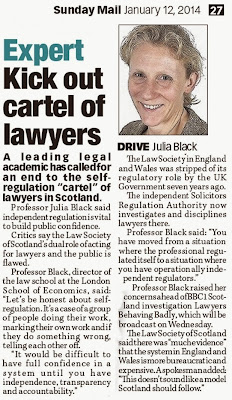
Expert: Kick out cartel of lawyers

Sunday Mail 12 January 2014

A leading legal academic has called for an end to the self regulation “cartel” of lawyers in Scotland.

Professor Julia Black said independent regulation is vital to build public confidence.

Critics say the Law Society of Scotland’s dual role of acting for lawyers and the public is flawed.

Professor Black, director of the law school at the London School of Economics, said: “Let’s be honest about self-regulation.

"It’s a case of a group of people doing their work, marking their own work and if they do something wrong, telling each other off.

“It would be difficult to have full confidence in a system until you have independence, transparency and accountability.”

The Law Society in England and Wales was stripped of its regulatory role by the UK Government seven years ago.

The independent Solicitors Regulation Authority now investigates and disciplines lawyers there.

Professor Black said: “You have moved from a situation where the professional regulated itself to a situation where you have operationally independent regulators.”

Professor Black raised her concerns ahead of BBC1 Scotland investigation Lawyers Behaving Badly, which will be broadcast on Wednesday.

The Law Society of Scotland said there was “much evidence” that the system in England and Wales is more bureaucratic and expensive. A spokesman added: “This doesn’t sound like a model Scotland should follow.”

Sunday, July 13, 2008

Law Society of Scotland to allow 'secret reports' from lawyers against clients amid prejudiced complaints handling reforms

In an effort to regain some control over the expected uncontrollable rising numbers of complaints against Scottish solicitors, the Law Society of Scotland has embarked on a little talked about series of adjustments to complaints procedures & reduction of client's rights in dealings with lawyers in an effort to regain the high ground over consumers of legal services in Scotland.

The Law Society has, decided to bring back the bad old days of complaints whitewashing, where a client who had complained against their solicitor had little or no part in the actual investigation & consideration of the complaint by the Law Society's infamous Complaints Committee structure, where lawyers had commonly put forward personal submissions either from themselves or their very own Law Society representative before the Committee, while the client of course, had no such luxury or entitlement.

There can be little doubt in this move, the Law Society wishes to retain full control over complaints against solicitors, and the client’s ability to gain access to justice to resolve any difficulties brought upon them by their less than honest or competent legal agents and no doubt the raft of whitewashing from the Law Society itself.

I myself experienced a version of this procedure, where James Ness, the now head of "Law Care", which specialises in dealing with stressed out crooked lawyers, put forward secret submissions for Kelso solicitor Andrew Penman of Stormonth Darling Solicitors, which I was not allowed to see or reply to.

The secret submissions in the Penman complaint then forced the Complaints Committee to change their original decision to prosecute Penman over an unbelievable wide range of frauds found by one of the Law Society's own investigators, which included deceiving Banks, the Inland Revenue, myself, other beneficiaries on legal & financial information relevant to Mr Penman’s woefully poor and rather dishonest legal service provided to my late father’s estate, even going so far to fiddling & falsifying files in an attempt to cover up his actings.

You can read more about the Andrew Penman complaint and how the Law Society of Scotland mishandled it here : Andrew Penman & Norman Howitt : Borders lawyer & accountant team up to ruin Cherbi executry estate

It is fairly clear, from not only my experience, but those of others reported to me, that clients must have a full involvement in the complaints process, whether that be at the Law Society of Scotland or the Scottish Legal Complaints Commission itself ... and from the following letter issued by the Scottish Consumer Council to the Law Society of Scotland over this matter, it would seem there are others in agreement on this :

SCC Director Martyn Evans takes issue with the Law Society of Scotland shifting the goal posts for clients once again …

SCC response to new process for handling conduct complaints

Martyn Evans, SCC Director :

“While we are unable to comment in detail on the proposed process, we are, as you might expect, concerned at the limited involvement which the complainer will have in the process. While we understand the argument that the complainer is seen as a witness, rather than as a party to the proceedings, we do not consider that this justifies allowing the complainer to have no involvement in the process other than to receive a copy of the final written report on the matter.

We are well aware that this has been an issue of contention in the past, with the solicitor being allowed to make representations on their own behalf, while the complainer is not allowed to do so. It is proposed that only the solicitor will have the opportunity to comment on, and make representations in relation to, the narrative and assessment document produced by the case investigator. This is a very one-sided process and is unlikely to be viewed by complainers as being fair.

If the Society is to ensure that its process is viewed as fair, rather than being seen to take the side of the solicitor, as has been the case in the past, the complainer must also be given the opportunity to comment on this document. It cannot be in the interests of natural justice to refuse to allow the complainer, who may have suffered considerably as a result of the solicitor’s conduct, the opportunity to comment on any representations made by the solicitor.”

Certainly a good thing the Scottish Consumer Council have taken this issue on board, and scanning through my own work on this matter over the years, I note the Scottish Legal Services Ombudsman of the time, who investigated how the Law Society of Scotland whitewashed the Andrew Penman complaint, recommended that solicitors should be banned from making personal submissions in the future as was made for Andrew Penman ... because as I found out from further revelations of the 'Penman submissions', it seems such submissions are usually full of lies and accusations against clients in a desperate attempt by 'crooked lawyers' to get themselves off the hook.

The Scotsman reports on Andrew Penman’s ‘secret representations’ to the Law Society of Scotland’s Complaints Committee :

Jury  still out on law in the dock - The Scotsman 2 March 1998

However, not content with reducing clients rights in terms of involvement in the complaint itself, the Law Society of Scotland has went one step further and reduced the time limit which clients have to complain against a solicitor from the current two years to one year - claiming this 'little talked about' alteration will "help clients" rather than hinder their ability to raise a complaint over poor legal service or conduct in the future.

Time limit on legal disputes – Evening Times 8 July 2008

Time Limit on Legal Disputes Evening Times July 8th 2008

So, as you can see from the above short comment in the Evening Times newspaper, if your lawyer has served you poorly and covered up his actions to the extent you don't find out what they did until a year afterwards .. there's no chance of getting any redress in the new system .. which is rapidly turning out to sound like the old system now ...

The Scottish Consumer Council’s reaction to this was issued in a Press Release last week as follows :

SCC News Release

Comment on the announcement by the Law Society of Scotland that the deadline for making complaints to them is to reduce to one year as part of the transition to the new Scottish Legal Complaints Commission

Sarah O'Neill, Legal Officer at the Scottish Consumer Council said it was essential that people who have a grievance don't delay lodging their complaint:

"The new Scottish Legal Complaints Commission will be able to award four times as much in compensation where cases are found against a solicitor as the Law Society of Scotland, but there's no point hanging on until October to bring your case in the belief that you’ll get a better outcome under the new SLCC.

"Any complaints relating to work handed to a solicitor for the first time up to and including 30th September 2008 will still be dealt with by the Law Society, which will continue to handle all pre October 2008 cases right up until 2010.

"We accept that there has to be a cut-off and that the Law Society needs to be able to manage the transition of its work to the new body. It's not ideal, though, as there will be cases where solicitors are instructed before October but problems only arise or become apparent long after that date, where clients may be justified in expecting their case to be dealt with under the new, potentially more generous SLCC system."

With two regulators chasing complaints against lawyers, all being handled by either serving or ex Law Society of Scotland staff, the only people to benefit from the Law Society’s changes will of course, be crooked lawyers …

Perhaps our political masters would like to step in and preserve the original intentions of the Legal Profession & Legal Aid (Scotland) Act 2007, which was to clear up corruption in regulation of the legal profession and make things somewhat independent from the lawyers .. which so far, we do not seem to be getting anywhere near ...

Thursday, June 26, 2008

Members interests show Scottish Legal Complaints Commission lacks intended independence from lawyers vested interests

As the days count down to the first of October 2008, when the new Scottish Legal Complaints Commission takes over regulation of service complaints from the Law Society of Scotland, new details emerge of the [sadly] lack of any effort on the part of the Scottish Government to appoint wholly independent individuals to oversee and adjudicate complaints against Scotland's 10,500 solicitors.

It appears almost, the Law Society of Scotland, which has succeeded in overpowering both the Legal Profession & Legal Aid (Scotland) Act 2007 and the new Scottish Legal Complaints Commission, has simply cloned itself into the new Commission.

I note for instance this week, with the announcement of the new Chief Executive of the Scottish Legal Complaints Commission - Elieen Masterman, was also a member of Law Society of Scotland's the Professional Conduct Committee, evidence of which you can see here in the Law Society's annual report of 2004

You can read the Journal of the Law Society's announcement of Eileen Masterman's appointment to the Chief Executive's position here : Complaints Commission has chief executive

Not a very thorough report from the Journal though - they missed out she served on Law Society Committees too ... tut tut ...

Now, I'm not saying the new Chief Executive shouldn't be in her post just because she sat on Law Society Committees .. but I am saying that surely, with the public spirit & intentions of the LPLA Act .. that people entirely independent from the legal profession .. entirely independent from the Law Society of Scotland and it's many regulatory branches .. could have at least been found to staff and run the new [but no longer independent] Scottish Legal Complaints Commission ...

Of course, the problem comes in such a situation we have here in the formation of an entirely new regulatory body, where there is a lack of political leadership or incentive to do other than what has done before.

Where for instance, there is no political leadership or political intervention in an industry to reform or change its ways .. that industry will do as it pleases as so many industries have done in the past when it came to disrespecting the rights of consumers.

Here we have that same situation, where the legal 'industry' in Scotland seems to be able to do as it pleases, because there is no political leadership or political intervention to ensure that the public interest is kept paramount over that of the industrial interest.

The legal profession’s interest in this case, is to keep control of regulation at all costs, to the point of co-opting what was intended to be a new 'independent' complaints commission, now staffed by the very same people, many who have corrupted the regulatory process for many years ensuring clients got nowhere against crooked members of the legal profession.

Sadly in this instance, there appears to be almost no political leadership at all coming from Justice Secretary Kenny MacAskill, who has simply sat back and allowed the Law Society to put forward its people to staff, run and enforce the new Scottish Legal Complaints Commission .. and absolutely nothing has been said about it at all ..

If you actually sit down and think about it, the Justice Secretary has failed to show leadership, raise comment, or even just raise an eyebrow on umpteen more issues facing Scots Law today, from corrupted disclosure practices of the Crown Office, to the failures of the Lockerbie Case, to the failure of Law & order up and down the country itself ..

Kenny MacAskill : Scots Govt ‘great debt’ to legal profession ensured SLCC was taken over by the Law Society & vested legal interests

Do better Kenny ? We Scots deserve better on Justice, I’m sure …

You can read some of my earlier articles on the formation & appointments process of the Scottish Legal Complaints Commission here :

Scottish Legal Complaints Commission - protecting the public or protecting the legal profession ?

Call for MacAskill appointments 'sleaze investigation' as revelations show Legal Complaints Commission member was subject of Police inquiry

Law Society staff secretly migrating into 'independent' complaints commission will ensure continuing problems of regulating Scottish lawyers

Here is the register of Members interests from the Scottish Legal Complaints Commission .. see if you can spot anyone who hasn't had dealings with lawyers or been part of the legal profession's self regulatory set up over the years .. you will be very hard pressed to do so, and it is that difficulty which gives rise to the fact the SLCC is not the independent complaints commission which Scots were promised …!

Scottish Legal Complaint Commission

Members Register of Interests (link opens as a .pdf document)

SLCC members interests Page 1SLCC members interests Page 2

Jane Irvine :

• Currently Scottish Legal Services Ombudsman.

• Professional contact with solicitors' firms Burness, Leslie Deans & Co and Allan McDougal.

• Professional contact with advocates Derek O'Carrol and John Campbell QC.

Douglas Watson :

• Former lay member of a Law Society of Scotland Committee dealing with Access to Legal Information. The role was unpaid.

• A cousin, Bruce Minto, is a partner in Dickson Minto, Solicitors.

• Formerly a Chief Superintendent with Lothian and Borders Police.

Linda Pollock :

• Executive Nursing Director (1989 -2006).

• Interim Board Nurse Director (2002-2003).

• Chief Nursing Officer’s Professional Advisor on nurse prescribing (2005-6).

• Past External Examiner with Robert Gordon’s University and Queen Margaret University.

• Research Honorary Fellow in the Social Science Faculty of Edinburgh University.

• Formerly, a part time nurse member of the Mental Welfare Commission (1997-2005).

• Currently, working as a Primary Care Consultant, undertaking research work commissioned by the Queen’s Nursing Institute in Scotland.

• Registrant member of the Nursing and Midwifery Council Appointments Board.

• Member of the Royal College of Nursing.

• Has accepted hospitality from Gillespie MacAndrew.

George L Irving CBE :

• Director of Social Work North Ayrshire Council 1999-2000.

• Board Member of Ayrshire Council on Alcohol.

• Ex-President of the Association of Directors of Social Work ( Scotland ).

• Chair of NHS Ayrshire and Arran from 2001-2006.

• Led the National Support Team, Management of Offenders 2005-2007.

• Visiting Professor to Glasgow Caledonian University School of Health and Social Care.

• Fellow of the Royal Society of Medicine.

• Fellow of the Royal Society of Arts.

• Member of the Rotary Club of Alloway.

Ian Gordon OBE, QPM, LL.B (Hons) :

• Retired Deputy Chief Constable of Tayside Police.

• Associate Professor in Policing for Charles Sturt University (Australia).

• Formerly Chair of the Association of Chief Police Officers in Scotland (ACPOS) Professional Standards Business Area.

• Vice-Chair of ACPOS General Policing Business Area.

• Director, Quaere Ltd

Margaret Scanlan :

• Consultant, Russells Gibson McCaffrey, Solicitors.

• Member of the Law Society of Scotland and holder of current practising certificate.

• Husband is a senior partner Russells Gibson McCaffrey.

• Husband is a member of the Law Society of Scotland and holder of current practising certificate.

• Past Chair of the Family Law Association.

• Former member of the Scottish Legal Aid Board.

David Smith :

• Member of the Law Society of Scotland and holder of current practising certificate.

• Former member/partner of Shepherd and Wedderburn LLP, Solicitors. Retired on 30/04/08.

• Wife is a Senator of the College of Justice and a non practising member of the Faculty of Advocates.

David Chaplin :

• Former member of Anderson Fyfe LLP, Solicitors. Retired on 30/04/08.

• Member of the Law Society of Scotland and holder of current practising certificate.

• Director and shareholder in Baliol Properties Limited.

Alan Paterson :

•Professor of Law and Director of the Centre for Professional Legal Studies at Strathclyde University.

• Research adviser to the Scottish Legal Aid Board.

• Lay member of the Judicial Appointments Board.

• Co-opted member of the Council of the Law Society of Scotland.

• Member of the Law Society of Scotland.

• Professional contact with Guild & Guild, Solicitors

Monday, October 15, 2007

OFT await SNP plans on access to justice reforms as Law Society demands protection of market monopoly & regulation.

While our Justice Secretary sweats over whether to fully implement the OFT's recommendations on reforming access to justice & legal services, a few of you have been asking my thoughts about the Legal Profession and Legal Aid (Scotland) Act 2007

The LPLA (Scotland) Act was passed, to address significant concerns over regulation of the legal profession.However, the LPLA (Scotland) Act we have now, a watered down version of what was initially planned is a watered down version of what was initially planned, and that is due of course, to protests from the legal profession during the consultation phase of the LPLA Bill through the Parliament in 2006, and amendments lodged by MSPs allied to the legal profession during the LPLA Bill debate at Holyrood in December.

The LPLA (Scotland) Act, does something for regulation of the legal profession, in terms of bringing about the Scottish Legal Complaints Commission, who will to a degree, oversee the investigation & regulation of service complaints against solicitors, but regulation of conduct complaints, and the disciplinary process, is still handled by the Law Society of Scotland.

The LPLA (Scotland) Act, therefore, falls down on removing regulatory and disciplinary procedures from the legal profession in their entirety, and while it is the case that lawyers can regulate their colleagues, or discipline their colleagues, there will be no true transparency or accountability in regulation of the legal profession in Scotland until the SLCC gets the necessary powers to deal with all complaints against solicitors while also handling disciplinary procedures.

A quick example of the SLCC as it currently stands would run something like this :

A client makes a service complaint against their solicitor.

The SLCC & Law Society argue as to whether it is indeed a service complaint, with the Law Society trying to take control of the complaint designating it a "conduct issue", resting in their remit, rather than a "service" issue, resting with the SLCC.

The SLCC win their argument, investigate the complaint, find the solicitor guilty of poor service, then ask the Law Society to prosecute the solicitor on particular issues.

The Law Society prosecute the solicitor, either bungling the case deliberately, or through incompetence, and the solicitor who was found guilty by the SLCC after an investigation of the client's complaint, escapes justice yet again.

Not an ideal arrangement, but one which has been foisted upon us by the Law Society's demand to retain a regulatory & disciplinary role with regard to complaints against solicitors.

The question would then be, will Kenny MacAskill as Cabinet Secretary for Justice, or the SNP administration currently in charge of the Scottish Executive, change such arrangements so the SLCC will handle all regulatory & disciplinary matters involving the legal profession ?

I think the answer to that one isn't particularly clear, when actually it should be clear.

If the LPLA (Scotland) Act and the Scottish Legal Complaints Commission don't property address the failures of regulation of the legal profession, Scotland should surely expect it's Executive or Government to address any failures and remedy the problem accordingly ?

Well, you would think that to be the case, but time is ticking and the failure to progress issues such as the well known sins of the past by the legal profession, where countless solicitors remain in practice who have effectively ruined clients lives with the backing of the Law Society of Scotland, do not bode well for confidence in the current administrations ability to bring about an end to injustice, caused by the justice system as currently controlled it seems, by itself.

Another question which was put to me was : Would any political party have passed the LPLA (Scotland) Act. I think we all know the answer to that one.

I doubt that any political party other than Labour, would have been able to pass the LPLA (Scotland) Act.

For a start, Labour had the numbers in the Parliament in their favour, and also the backing of Westminster, who themselves, have seen just as many representations from constituents in Scotland who have encountered problems with the legal profession & crooked lawyers.

The Conservatives certainly would not have passed any laws which took away regulation by solicitors of complaints against solicitors or passed anything which would have increased fines for crooked lawyers, or compensation payments to ruined clients. Indeed there were some within the Conservative party who worked against the LPLA (Scotland) Act, such as Bill Aitken MSP, now bizarrely, the Convener of the sole Holyrood Justice Committee. Mr Aitken attempted to limit the scope and remit of the LPLA Bill during it's parliamentary phase, debate & eventual vote, to the point of making the legislation useless

Yes, there are some within the Conservatives (I count one) who have done much for their constituents with regard to such legislation, and indeed it was a Conservative who in-effect, started the ball rolling on what eventually became the LPLA (Scotland) Act, but that MSP, none other than Phil Gallie, is no longer at Holyrood, and I doubt the Conservative party leadership if god forbid, they were ever in charge of the Scottish Executive again, would have passed such lawyer busting legislation.

The LibDems, while being part of the former Labour/LibDem Scottish Executive who did pass the LPLA (Scotland) Act, were not for the majority, a willing partner in the progress of the LPLA Bill hearings at Holyrood.

If the LibDems were solely in charge of the Scottish Executive, I do not believe they would have proposed or passed such legislation, and indeed, a LibDem English Peer, Lord Lester of Herne Hill QC was employed by the Law Society of Scotland to opinion a legal challenge against the LPLA (Scotland) Act by threatening court action against the Scottish Executive & Parliament

Lastly we come to the SNP.

Given John Swinney's now famous skirmish with Douglas Mill before the Justice 2 Committee over a secret memo, where it was revealed Mr Mill was interfering in negligence claims against solicitors interfering, and Mr Swinney's representation of constituents who have problems with the legal profession and the Law Society, I would have to say the SNP might have passed the LPLA (Scotland) Act if they were solely in charge of the Scottish Executive, but that's only a "might".

There are many who believe the SNP would not dare disobey a substantial influence from the legal profession within their party to propose and pass such law reforming legislation as the LPLA (Scotland) Act ... and admittedly, the SNP are yet to prove their track record on the justice system and reform of the legal profession as these areas, strangely, have been left out of significant proposals up to now.

In short, the SNP have everything to prove and everything to lose, on justice, access to justice, and injustice. Are they up to the challenge ? The clock is ticking on justice & injustice and so far, there are little developments which could without doubt be said to put right the sins of the past ...

Today in the Scotsman, there is an interesting piece on Kenny MacAskill's performance as Justice Secretary.

The report predictably is focused on the Law Society of Scotland's fears over implementing the OFT's recommendations for wider access to justice, and thus breaking the centuries old monopoly held by solicitors & advocates over legal services - the prime money spinner for the Scottish legal profession.

In fact, reading the piece today, one could be forgiven for thinking the public interest and surely the right of every individual to access to justice & legal services, takes second place to the apparent right of solicitors & the Law Society of Scotland to retain their monopoly and decide who gets access to justice and who does not. A justice system fit for a 'banana republic' perhaps ?

Isn't it about time our politicians started giving the public some benefit instead of the professions ? Where are the reforms and inquiries into injustice we are due ?

Read on for the article from the Scotsman :

How has Kenny MacAskill fared in the hot seat ?

JENNIFER VEITCH

BY THE time the Office of Fair Trading (OFT) started looking at that Which? super-complaint in May, the political landscape had shifted - Labour were out and the SNP were in, albeit by a nose.

So a new justice secretary has been left with the task of responding to the OFT's recommendations and reacting to the legal profession's inevitable concerns about potentially seismic changes to the legal services market.

To an extent, Kenny MacAskill has been able to hit the ground if not running, then jogging. In the eyes of lawyers at least, he does enjoy one major advantage over Cathy Jamieson, his predecessor because, before switching careers to become an MSP in 1999, he was a practising solicitor for 20 years.

The MSP for Edinburgh East and Musselburgh knows from past and relatively recent experience what it's like to be a lawyer dealing with the everyday challenges of demanding clients.

Combined with his experience of the legislative process in parliament, that should make him a seasoned legal veteran.

So as the profession awaits the Scottish Government's response to the OFT's recommendations with some trepidation, will he adopt a softer approach to the previous administration, once colourfully accused by the Law Society of Scotland of "naked lawyer-bashing"?

In other words, whose side will MacAskill be on?

Anyone attending the recent Law Society of Scotland conference on alternative business structures knows that there are several to competing interests to choose from.

Should he listen to big firms who want to compete with English rivals, or small firms who want to protect access to justice? Or middle-class consumers who want a better deal when shopping around for conveyancing services, or working-class people who can't afford to pay for a lawyer in the first place?

At the conference, MacAskill seemed to be trying to tread the very fine line between spelling out that change was inevitable - and without "endless" time to navel gaze on what exactly that change would be - and trying to convince the profession that he was still on their side. Up to a point, anyway.

Apart from a slightly clumsy attempt at a football league analogy - I'm not sure quite how many firms would like to be compared to the Old Firm, let alone Stirling Albion or Gretna - his speech appeared to be well-received.

He made the right lawyer-friendly noises about protecting and indeed promoting the integrity of the Scottish profession and the legal services market.

He also made it clear that he was not afraid to go a different way from Westminster and would not "blindly follow" the Clementi blueprint.

Yet, given the recent spats between Messrs Salmond and Swinney and the Labour government at Westminster, over everything from the financial settlement to foot-and-mouth disease, MacAskill may have to reassure those who fear the Scottish National Party may seek to preserve difference from England for its own sake rather than the good of Scotland.

If he does seek to press ahead with reforms before Clementi takes effect in England at the turn of the next decade, he will need to show the profession there is a sound basis for change at such a fast pace.

MacAskill is now facing a tough test. He will have to weigh the profession's concerns and decide whether there is hard evidence that alternative business structures will harm the public interest. If he finds none, then firms will have to deal with the consequences.

But, however much MacAskill's brain still works like that of a lawyer, his instincts will be those of a politician. If it comes to the crunch, who is more important in winning votes - lawyers or consumers?
Saturday, July 28, 2007

Scottish Legal Complaints Commission to be located in Scotland's 'legal centre' of Edinburgh

The process of bringing the Scottish Legal Complaints Commission into existence has taken another step in the right direction with the announcement by Justice Secretary Kenny MacKaskill that it is to be situated in Edinburgh.

No big surprises there for anyone, as Edinburgh is probably the best home for it, given the propensity of legal firms in the capital to be among the worst violators of clients rights over the years, all neatly kept under wraps by the present regulator of the legal profession - the Law Society of Scotland.

I'm pleased, of course, to see the SNP are going ahead with the formation of the SLCC despite all the threats, jibes, obstruction & interference coming from the legal profession & judiciary on this one ...

For a minute I thought the Law Society of Scotland had twisted the arm of the Scottish Executive into axing the new complaints body along with many other provisions of the Legal Profession & Legal Aid (Scotland) Act 2007, although I'm sure there's still time for a few more dirty tricks & fiddles along the way ...

Taken together, all those open letters from ex judges hopping back & forth between London & Edinburgh, threats of Court Action from bitter leaders of the Law Society, and strike threats from the solicitor membership carefully engineered by the Law Society itself, must be a powerful set of persuasive tactics to do otherwise .. but for now it does seem the SNP are pressing ahead with something no doubt a few of it's members don't particularly like.

Of course, there are a few pointers to watch out for as the new Complaints body takes shape ..such unspeakable ideas as :

(i)The legal profession don't slip a few spies& allies into the new SLCC (already it has been rumored a few staffers from the Law Society are quietly preparing to be wormed into the SLCC as 'ears for the Law Society' ... a terrible thing indeed if true ...

(ii)The lawyer appointees to the SLCC Panel via the Lord President are required to declare their regulatory history & that of their firm - something which anyone would rightly expect after reading the appalling history of complaints regulation by the Law Society of Scotland over the years, and not withstanding the fact there doesn't seem to be a lawyer or legal firm in Scotland without an atrocious clients complaint record

(iii) We don't get the same old lay members who sit on each others Committees same old 'lay members' who sit on each others committees & fiddle away client complaints as has been general practice in the past by the Law Society and many other self regulatory bodies who conveniently place each other's members on each other's Complaints Committees to ensure client complaints get buried and there is no chance of litigation to recover compensation for the culture of negligence which has infected the Scottish legal profession like a virus over the past 17 years (oddly coinciding with the same people being at the helm of the Law Society of Scotland for the same past 17 years)

The new Scottish Legal Complaints Commission might have half a chance at being independent, accountable & transparent (three things the present self regulators of the Scottish legal profession could never claim to be) it these values were adhered to .. but with the legal profession and their allies going out of their way to make life difficult for the public & politicians alike on this issue, when will the core problems of the legal profession actually be tackled to stamp out the causes of these high levels of complaints ?

Surely, with the Law Society having been in denial for the past two decades on the quality of legal services in Scotland, consistently putting forward an argument it was effectively regulating the profession & maintaining standards to the highest degree- when it was not, there must be wholesale change within the Law Society of Scotland and the membership to bring new policies of marinating standards and treating clients with respect.

Only a change of leadership at the Law Society of Scotland will bring improvements to the legal profession and it's dealings with the public - after all, how can a profession be able to reform itself when it is led by the likes of individuals who have threatened our democratically elected legislatures with Court Action & bullying tactics simply because the right to keep control of complaints against colleagues (and fiddle them to the nth degree as always) was to be lost to a new independent regulator ...

Over to you, Mr Justice Secretary for an end to injustice in Scotland

Over to you, solicitors of Scotland to take your own colleagues aside and improve your public standing & standards of practice. Stop being led by the nose of people who have led you into one disaster after another and stop blaming clients & campaigners for the woes you yourselves have created.

If, as solicitors, you want a greater standing & respect resolve the well known problems which have existed for too long in your own ranks rather than hounding to death members of the public who point out and rightly challenge the wrongs of the legal profession.

Article follows from the Herald newspaper.

http://www.theherald.co.uk/politics/news/display.var.1579970.0.0.php

Executive set to end public sector jobs exodus from Edinburgh
DOUGLAS FRASER, Scottish Political Editor July 28 2007

The move of civil service jobs out of Edinburgh is being challenged under the new Nationalist administration, with 60 new posts being located in the capital by the Justice Minister.

Kenny MacAskill yesterday said the new Scottish Legal Complaints Commission (SLCC) will be in Edinburgh, where he is an MSP, and that the Scottish Executive is keen to see such scrutiny bodies get together in one centre so that they can cut duplication and costs.

Officials are looking for office space, or a campus, where other watchdog bodies could join it, such as the public services ombudsman.

The relocation of civil service jobs out of Edinburgh has been highly controversial, particularly with the shift to Inverness for the headquarters of Scottish Natural Heritage.
advertisement

The previous administration wanted to continue the move, so that other parts of the country benefited from government spending on jobs, with a presumption that new agencies would not be in Edinburgh.

Former First Minister Jack McConnell even said it was good for Edinburgh that it should lose these jobs.

But he faced growing criticism from Edinburgh MSPs, including his own party's, that jobs were not being widely dispersed and that most were going to Glasgow.

The largest planned relocation, of more than 1000 civil servants in the Registers of Scotland, was put on hold.

An executive spokeswoman said yesterday: "We are currently considering the future direction of the policy on public sector jobs location."

The SLCC office, intended to operate independently of the legal profession on some categories of complaints, will be operating by late next year.

With up to 60 staff, it is aimed at ensuring complaints against the profession are resolved quickly and effectively.

Mr MacAskill, the Edinburgh East and Musselburgh MSP, was one of those who was critical of the policy while in opposition, and yesterday placed the SLCC in the capital city, arguing that is the centre of Scotland's legal community. The decision was "finely balanced", according to Mr MacAskill.

"After detailed consideration, a number of factors tipped the balance in favour of siting the commission in Edinburgh. Scotland's capital city is widely recognised as Scotland's legal centre.

"This decision therefore places independent complaints handling at the heart of the civil and criminal justice system and close to the hub of the legal profession.

"Taken together with the government's desire that the SLCC should share accommodation with other scrutiny bodies in the future, it is clear that Edinburgh is the preferred and right location for this body."

The SLCC is to be funded by a levy on lawyers, and a further charge to those who are complained against.

and the Press Release from the Scottish Executive on the SLCC ... does anyone get the feeling this new independent complaints body might not be all that we hoped for ?

Scottish Legal Complaints Commission Press Release 27/07/2007

Edinburgh has been chosen as the base for the new Scottish Legal Complaints Commission (SLCC) which is due to be up and running in late 2008.

The SLCC, which will be independent of the legal profession, will have up to 60 staff and a remit to ensure that any complaints against the profession are resolved quickly and effectively.

Justice Minister Kenny MacAskill said:

"The decision of where to site the Scottish Legal Complaints Commission was finely balanced. However, after detailed consideration, a number of factors tipped the balance in favour of siting the Commission in Edinburgh.

"Scotland's capital city is widely recognised as Scotland's legal centre. This decision therefore places independent complaints handling at the heart of the civil and criminal justice system and close to the hub of the legal profession.

"Taken together with the Government's desire that the SLCC should share accommodation with other scrutiny bodies in the future, it is clear that Edinburgh is the preferred and right location for this body."

The SLCC was established by the Legal Profession and Legal Aid (Scotland) Act 2007. The Act gained Royal Assent on 19 January 2007 and it is anticipated that the SLCC will become operational in late 2008. Having selected Edinburgh as the location for the SLCC, the next step will be to identify suitable premises that meet the SLCC's needs in terms of space requirements and organisational efficiency. In conducting this search, other factors will also be considered such as shared services potential with other organisations and future co-location opportunities on a campus basis.

Key points of the new complaints handling system:

* New independent complaints handling body to be set up - the Scottish Legal Complaints Commission

* The Commission will be headed up by a board composed of a non-lawyer chair plus four non-lawyer members and four lawyer members who are appointed by Scottish Ministers after consultation with the Lord President of the Court of Session

* Scottish Ministers will have no locus in relation to the Commission's decisions on complaints

* Funding will be from the legal profession through two levies: a general levy and a levy on practitioners generating complaints. The Commission will discuss its draft budget with the professional bodies each January. Vexatious or frivolous complaints will be sifted out and will not be the subject of a levy

* Making a complaint will carry no cost to the complainer

* The Commission will act as a gateway to receive and sift complaints which could not be resolved at source

* The Commission will deal with inadequate professional service complaints and low value negligence cases (awards below 20,000 pounds) but the professional bodies and their discipline tribunals will continue to deal with professional discipline and complaints about the conduct of practitioners

* The Commission will be able to review the way in which the professional bodies handle conduct complaints and will be able to enforce its recommendations

* There will be a limited right to appeal the decisions of the Commission - by application to the Court of Session

* The Commission will publish an annual report which Scottish Ministers will lay before the Scottish Parliament

* The office of the Scottish Legal Services Ombudsman will be abolished and the Commission will take over the review functions

Tuesday, March 20, 2007

Dean of Faculty attacks legal aid & regulatory reforms as a threat to lawyers independence as prospect of political meddling by legal profession looms

Politics is alive & well in the legal profession it seems, with Roy Martin QC, the Dean of Faculty, using a recent admissions ceremony for new solicitors entering the Scottish legal profession, to attack the reforms of independent regulation brought forward in the Legal Profession & Legal Aid (Scotland) Bill, as well as having a rant at the drying up of the legal aid river of money flowing into his colleagues pockets.

Mr Martin, QC, is, of course,quite upset that the traditional practice of lawyer covering up for lawyer, has been thrown on it's head by the recently passed but long over due LPLA Bill, given that around 5000 plus complaints a year are made against solicitors in Scotland by clients on everything from embezzlement to fraud to theft of property, negligence, inflated accounts, falsified work, and just about every other crooked practice one could think of.

Unlike Mr Martin and his colleagues, those who don't have the convenience of professional self regulation' would normally be facing criminal charges and jail sentences on many of those complaints made by clients to the Law Society & Faculty of Advocates, but the convenience of self regulation by the Faculty & Law Society has certainly been successful over the years in protecting the many crooked lawyers in the profession from justice, while also making sure the client who has lost out at the hands of their legal representatives, gets little or no compensation .

The right to sit in judgement on one's colleagues & friends, to make sure they only get a slap on the wrist when caught with their hands in the till, is of course, why Mr Martin & his colleagues in the legal profession have for so long, fought tooth & nail to protect their self given right of self regulation - which the legal profession sought & gained from governments long ago.

We all saw, in the following examples of previous articles, how the legal profession & it's 'leading lights' attacked the proposed LPLA Bill, to make dealing with legal agents much fairer for the consumer, and we also saw how the Chief Executive of the Law Society, Douglas Mill, went one step further & threatened our Scottish Parliament with a Court challenge should the LPLA Bill not be amended to it's liking (although Mill actually preferred the legislation be killed off completely).

Law Society of Scotland threatens Court challenge against Scottish Executive over LPLA legal reform Bill

Law Society of Scotland & Lord Lester QC challenge new legislation to protect Scottish public against crooked lawyers

Scotsman responds to Peter Cherbi and the Herald with a living eulogy of Douglas Mill

Law Society of Scotland claims success in gagging the press over Herald newspaper revelations of secret case memos

Scottish legal profession campaigns against open debate in Scottish Parliament on independent regulation of complaints against lawyers

Who is a greater threat to the Parliament in that one then ? the public, or the legal profession ? ... seems the lawyers can even get away with threatening court action against our elected representatives, while any such attempt by a member of the public is laughed off ...because of course, the public would never be able to secure legal representation to actually take on such a case against the Parliament & win ...

However, Roy Martin's blast at the LPLA Bill may be more than just the rant of an upset lawyer because he didn't get his way ...

I understand several on-the-side meetings have been held between some members of the legal profession and some of Scotland's Political parties, with ideas being raised regarding limitation of the implementation of the LPLA Bill and scaling back of some of it's provisions - in exchange for possible donations & political support .. and no doubt some favours down the road .. such as those sticky secret mortgages on the side which quite a few ministers of the current Scottish Executive enjoy, paid for by us, the taxpayer, through their Parliamentary expenses allowances.

Two Scottish Executive Ministers revealed to be charging mortgage interest payments to the public

Scottish Labour Politician rents his own son's flat for £7000 a year, charging it up to taxpayers

I wonder if the major political parties involved in the Holyrood elections may wish to comment on that one ?

Could this be a fundamental shifting of the power base perhaps in Scottish politics, where the legal establishment might just be setting out to make sure it's favored candidates get in after the elections, and that indeed ... all those promises contained in the LPLA Bill of independent regulation for lawyers & higher compensation payments to ruined clients, might just go the way of those provisions in the Law Reform (Misc Provisions) Bill 1990, which were to open up the rights of Courtroom representation to the client and break the monopoly of solicitors & advocates - who are still the only authorised representatives of the public in our courts.

Scottish Executive thought to be blameworthy for allowing restrictive practices in legal services

Scottish Executive fails to block FOI disclosure on records of restricted access to Courts

We therefore have an example of that already in the above case ... so, no one can say it hasn't happened before ...

In an interesting development though, Roy Martin's tenure as Dean of Faculty proves yet again that nothing changes ... with only just last week, a complaints hearing against one of Scotland's most famous Advocates rigged so that the client wouldn't be able to attend ... certainly a sad indictment of regulatory practices as they stand .. and yet again more evidence, if required these people need to be left to educate their colleagues in the ways of honesty, transparency & competency, while someone else, outside the legal profession, handles the regulatory side of things.

A reminder to you all ... If you have experienced poor treatment from the Law Society of Scotland in a complaint or lost money to a crooked lawyer and nothing was done about it, Please sign Petition PE1033 and begin the campaign for redress and resolution to the way clients have been discriminated against by crooked lawyers & the Law Society of Scotland under their decades old prejudiced self regulatory complaints system.

Related article from the Herald newspaper with link :

http://www.theherald.co.uk/politics/news/display.var.1270776.0.0.php

Lawyers’ independence 'undermined by politicians'
DAVID LEASK March 19 2007

Scotland's top advocate has accused politicians of undermining the independence of his profession.

Roy Martin, QC, the dean of the Faculty of Advocates, warned of a creeping threat to lawyer's freedoms - just as they are needed most.

Mr Martin, in a hard-hitting message to Scotland's latest crop of young lawyers, fired a broadside against new regulation and legal aid funding problems eroding their time-honoured and cherished independence from the state.

He told an admission ceremony for newly-qualified solicitors at Edinburgh's Parliament House: "There is a danger that interests which do not properly recognise the importance in a civilised society of an independent legal profession are taking steps which have already undermined, and will continue to undermine, that independence. In a society where the individual citizen is increasingly subject to regulation and control by the state, what the lawyer does is unique because it is he or she who has the responsibility of standing between the citizen and the state in all its guises - and it is essential that the lawyer can do so, and be seen to do so, independently."

Mr Martin's speech, said to be the most controversial delivered at the event in a generation, summed up simmering discontent on what some lawyers see as interference from Holyrood, Westminster, and even Brussels.

The dean has already joined with other senior law figures in warning of what they see as a threat to the independence of the justiciary and attacking the executive's Scottish Legal Complaints Commission which, widely welcomed by lay people, will effectively end centuries of self-regulation.

However, a spokesman for the Scottish Executive last night dismissed any suggestion recent reforms would do anything to take away lawyers' freedoms.

He said: "The last four years have been a time of unprecedented reform in the justice system.

"New laws and procedures have laid the platform for a more efficient, more effective justice system that treats victims, witnesses and consumers with increasing care and respect."

Saturday, December 16, 2006

Legal Profession & Legal Aid Bill finally passed by Scottish Parliament, with amendments.

At around 5.31pm on Thursday, 14th December 2006, the LPLA Bill was finally passed by the Scottish Parliament - seven years after myself & several others asked the Scottish Parliament's Justice & Home Affairs Committee of 1999 to consider the issue of corruption within the Scottish legal profession & rampant prejudice in responding to complaints against solicitors & advocates.

The passing of the LPLA Bill, did, however, not go unconditional, as you saw in my article on the day of the debate : Law Society of Scotland lobbies Scottish Parliament to pass anti consumer amendments on LPLA Bill threatening Court action if demands not met ... and many anti consumer amendments, demanded at the point of threat of Court action by the Law Society's Chief Executive Douglas Mill, were passed by what seems to be a roll of MSPs infatuated - or maybe even on the payroll, of the Law Society of Scotland. At least, however, the ₤20,000 fine limit - which pro-crooked lawyers msp Bill Aitken demanded be reduced to a paultry ₤5,000 was left alone.

I covered the Law Society of Scotland's threat to take the Parliament to court on the LPLA Bill here : Law Society of Scotland threatens Court challenge against Scottish Executive over LPLA legal reform Bill

I think you can describe some of those politicians who passed the Law Society's amendments, as enemies of the people. After all, what I said on Thursday is true - these MSPs helped criminals amend the Law, so they can go on being criminals - albeit they will have to be a little more inventive on how they get round the new Laws. Sick isn't it ? but what can you expect from a desperate bunch of people as lawyers - who have infiltrated our parliamentary democracy & run it for their own private dictatorship - while we have to pay.

Doubt me ? Well, you have already seen how easy the Law Society of Scotland have censored the Scottish Media, in articles I wrote here : Law Society of Scotland actively censors the Scottish Press to kill articles on crooked lawyers & here : Scottish Legal Profession censors the Press to kill off bad publicity - Part II .. so neutering the Scottish Parliament would have been easy.

After all, a few of it's members are juts crooks too .. such as this example ;Scottish Parliament withholds documents as Deputy First Minister faces allegations of questionable mortgage arrangements - milking their expenses & giving false information on mortgages so they can get the taxpayer to pay them off and then of course there's this example : Scottish Labor Politician rents his own son's flat for £7000 a year, charging it up to taxpayers .... so it would be easy to nobble that lot then ! ... plenty dirty secrets to hide in exchange for favourable votes .. and please note how Nicol Stephen msp & John Home Robertson msp voted - for the crooked lawyers anti consumer amendments .... makes you think, doesn't it ?

You can see who voted for & against the amendments in the Official Report from the Parliament on the LPLA Bill debate at Holyrood.

Only John Swinney & Colin Fox really seem to have taken consumer interests to heart with comments they made in the chamber - comments which will be most unwelcome at Drumsheugh Gardens, where no doubt, Douglas Mill will be ripping what little hair he has left, out in a beetroot red rage.

Here is what John Swinney said in comments relating to how an ex Boss of the Law Society, Kenneth Pritchard, intervened in a case to protect crooked lawyers, and thus obstruct the law :


Later on in the debate, John Swinney, again, makes comments on a story I covered here : Chief Executive of the Law Society of Scotland branded a liar after FSA denies claims of intervention to block complaints body on how the current Chief Executive of the Law Society of Scotland, Douglas Mill, was caught out lying in the newspapers over the remit of the Financial Services Authority, in a campaign of legal profession sponsored isinformation against the public :


What now for the LPLA Bill ?

Well, it will, or should go into law .. unless some unforeseen happens ... but for those of us who have campaigned for so many years (since 1994, myself ... others just as long) ... this is only the beginning of a new battle ... to ensure the new Scottish Legal Complaints Commission actually does it's job and the public do get justice and proper compensation when they find their crooked lawyer has messed up their legal affairs - or worse, embezzled all their money .. something typical of the Scottish legal profession - go to a lawyer, and expect to be robbed - that should be pasted onto each lawyer as Government Health Warning - just like a packet of cigarettes.

If I can be a little more cinematic on it, let me quote Winston Churchill's Mansion House speech to the Lord Mayor's Luncheon on 10 November 1942 ... "This is not the end. It is not even the beginning of the end. But it is, perhaps, the end of the beginning." and that is where we now stand on the issue of crooked lawyers in Scotland - more to come, folks ...

Read on for the reports of the LPLA Bill passing the Scottish Parliament, from the Scotsman & Herald newspapers, links to follow with the articles.

http://thescotsman.scotsman.com/politics.cfm?id=1861122006

Complaints against lawyers procedure amended
HAMISH MACDONELL SCOTTISH POLITICAL EDITOR

MINISTERS bowed to warnings from the legal profession yesterday and changed the proposed new complaints procedure for lawyers, introducing a right of appeal for the first time.

The Legal Profession and Legal Aid (Scotland) Act was passed by Holyrood yesterday, creating an independent commission to deal with consumer complaints against lawyers.

But lawyers had warned of legal action and a possible breach of European human rights law if ministers went ahead with their original plans, which would have refused a right of appeal to lawyers against decisions of the commission.

During the final day's debate in parliament Johann Lamont, the deputy justice minister, said ministers accepted the need for a right of appeal and this was added to the bill before it was passed.

Labour MSP Jackie Baillie lodged the amendments to allow a limited right of appeal.

"They [the amendments] would preserve the essence of the current policy, not undermine them," Ms Lamont said.

The changes to the bill will mean that lawyers must seek leave to appeal to the Court of Session before they are able to challenge a commission decision. The grounds of all appeal are limited to error in law, procedural impropriety, that the commission has "acted irrationally" or where its findings are not supported by the facts.

The Executive accepted moves to distance ministers from the appointments process for the new body, handing over responsibility for this to the Lord President.

http://www.theherald.co.uk/politics/76788.html
Lawyers win right to appeal consumer watchdog decisions
ROBBIE DINWOODIE December 15 2006

Lawyers were yesterday given a limited right of appeal against a new independent commission to deal with consumer complaints.

The profession, which remains deeply uneasy about the Legal Profession and Legal Aid (Scotland) Bill, had claimed that without any form of appeal the new procedure would fall foul of the European Convention on Human Right and the legislation could become the first at Holyrood to be struck down as incompetent.

The Scottish Legal Complaints Commission will have the power to bring the Society of Advocates or Law Society of Scotland before the Court of Session on contempt charges if either of the professional bodies fails to implement its recommendations.

The bill also provides for compensation payments of up to £20,000 to clients found to have received poor service. An attempt by a Labour back bencher to have this reduced to £15,000 failed in a vote.
The current £5000 level was raised from £1500 only in the past 18 months.

A spokesman for the Faculty of Advocates said: "The faculty will require to consider in further detail whether or not these and other amendments do address the concerns which have been raised about compliance with the convention."

Douglas Mill, chief executive of the Law Society of Scotland, said: "The parliament has taken steps today to try to ensure the legislation is both legal and fair.

"A number of other positive amendments were also brought forward, which, it is hoped, will improve the legislation to ensure that it can work in practice, something the society has promoted from the start of this process."

Thursday, December 14, 2006

Law Society of Scotland lobbies Scottish Parliament to pass anti consumer amendments on LPLA Bill threatening Court action if demands not met

Just imagine you were a politician for a minute, and someone you knew committed a murder or another serious crime, but got away with it.

This criminal, then came to you, asking you to amend the Law so they could murder someone else and get away with it, and just to keep themselves happy, they want you to also write amendments to the Law so they could abuse, murder & steal to their hearts content - and get away with it.

Would you do it ? Would you help a murderer or a fraudster or a child abuser, amend the law so they could carry on murdering, stealing, or abusing and get away with it ?

That is precisely what the Scottish legal profession is asking MSPs to do today in the Scottish Parliament in the debate on the Legal Profession & Legal Aid (Scotland) Bill , which aims to bring independent regulation to the legal profession, and take away the current crooked self regulation system operated by the Law Society of Scotland - which has seen thousands of complaints fiddled against crooked lawyers so clients get little or no compensation while the crooked lawyer gets off the hook from many client complaints & keeps on practising & keeps on robbing other clients who cant get anywhere trying to recover their lost money

Such cases as TOP LAWYER AT THE CENTRE OF 12 NEGLIGENCE CLAIMS are all too common, and from my own experience, just look how crooked lawyer Drew Penman was - and got away with it, to carry on being a crooked lawyer, so much I nominated him for Scotland's Most Famous Crooked Lawyer in Tueday's article Scottish Legal Awards - Lawyer Lawyer on the wall, who is the most crooked of us all ?

The Law Society of Scotland are today, promoting Jim Wallace MSP, former Deputy First Minister and Justice Minister, and Jackie Baillie, former Social Justice Minister and current member of the Justice 2 Committee as allies in their battle to prevent the public from getting a fair hearing when it comes to complaints against crooked lawyers.

Bit strange, isn't it ? that a Former Justice Minister would support a gang of criminals ? would support a profession which has ruined peoples lives, embezzled all their money, even caused the death of people - to save a lawyer from prosecution over fraud, corruption, embezzlement, rape, abuse, drugs dealing .... what kind of politician would support such a group of people ?

It's not just Jim Wallace though - as you can see from the amendments listed for the Parliamentary Debate - there are several other MSPs who have come forth to support Scotland's twisted & corrupt legal profession - hellbent on killing any chance of independent scrutiny of their corrupt behaviour towards clients.

Link to the Amendments: Marshalled List of Amendments selected for Stage 3

Please note Bill Aitken - Conservative MSP for Glasgow - he seems to be one of the Chief mouthpieces for crooked lawyers in this war against consumer reforms it seems - and he is so in love with the idea that crooked lawyers should be allowed to embezzle your money & get away with it - he demanded the proposed maximum fine of £20,000 for crooked lawyers be reduced to a mere £5000 in his Amendment No.179.

How do you like that idea then ? An MSP - a politician you elected, but now a mouthpiece for the Law Society of Scotland, wants a crooked lawyer to only have to pay £5000 at the very most - if for instance - they ruin your business, ruin your life, take your home, embezzle all your money. What kind of punishment or deterrent is that ?

Jackie Ballie MSP - former Social Justice Minister & Justice 2 Committee member isn't far behind Bill Aitken with anti-consumer amendments either - she also proposed the lowering of the £20,000 for crooked lawyers be reduced to £15,000 ... what a rip off ! - and why should there even be a limit of fine ?

How about when a lawyer ruins your business and you lose £100,000 or more ? You won't get much back from the £5,000 or £15,000 fine limit these MSPs are proposing ... and it's no use saying get a lawyer to sue the lawyer - that doesn't work as we all know - and which is why we are here today with the LPLA Bill.

In fact, it seems, out of 129 MSPs at the Scottish Parliament, only a few have stepped forward with any motivation at all on the part of the public - John Swinney MSP (SNP) and Colin Fox (SSP), to mention the most daring. Everyone else has kept a brutal silence on this issue - despite the fact every single MSP knows full well the corruption in the Scottish legal profession and how endemically corrupt the Law Society of Scotland's self regulatory complaints regime has been for decades.

Other MSPs who posted a variety of amendments to the LPLA Bill are : Jeremy Purvis (LibDem) , David Davidson (Conservative), Johann Lamont (Labour), Stewart Maxwell (SNP) & Hugh Henry (Labour)

The Law Society of Scotland has done its utmost to kill off the LPLA Bill, even having groups of lawyers meet with MSPs - even members of the Justice Committees themselves, where lawyers have privately warned some MSPs the LPLA Bill is not to become law unless it writes the amendments itself - and with the amendments proposed by Glasgow's Bill Aitken MSP - it looks like the Law Society of Scotland have done just that.

It's almost as if the Law Society of Scotland wants to censor the Scottish Parliament - just as it has done with the Scottish media - which I wrote about here :
Law Society of Scotland actively censors the Scottish Press to kill articles on crooked lawyers and here :
Scottish Legal Profession censors the Press to kill off bad publicity - Part II

The Law Society of Scotland is running so scared of the LPLA Bill, the legal profession have now threatened to boycott legal work - all because of the fact that lawyers won't be able to fiddle complaints against themselves with the advent of independent regulation of complaints in the LPLA Bill .. and an article today in the Herald Newspaper quotes those threats - so the crooked lawyers aren't going to take on all those cases such as executry, conveyancing or court work, for which the law requires they are registered as practicing solicitors.

Good ... that means they wont be able to rip you off for vast fees for selling your house or buying a house, or ripping off dead clients wills - like crooked lawyer Andrew Penman did with my dad's will, and they can't prolong Civil Court work you asked them to do for you - so they can fatten up the account at the end of the work done ... It might just bring a new more honest breed of person into the legal arena who is able to undertake the work for you without all those fat inflated bills to feather the high living lifestyles of all those crooked lawyers.

Not content with threatening to boycott legal work, the Law Society of Scotland has also issued a Press Release with a threat of a Court Challenge to the Parliament against the LPLA Bill if the legal profession's demands of amendments are not met. How's that for dictatorship then ! .... has Douglas Mill now become the new Saddam Hussein ? We get rid of one Dictator and another one springs up - but this time, it's at home - and Mr Mill & the gang of political control-freak lawyers in the Scottish legal profession are far more dangerous to the public & the judicial system than any politician - as has been proved time & again.

Douglas Mill's threat of a Court challenge to the LPLA Bill is well known, because he called the newspapers to publish his threat in early November- I covered it here : Law Society of Scotland threatens Court challenge against Scottish Executive over LPLA legal reform Bill,. but it just goes to show how far the Law Society is willing to go to keep complaints handling to themselves - all this to keep crooked lawyers in jobs - who would otherwise be in jail if they tried their wholesale client rip offs, embezzlements & other activities anywhere else.

Peter Cherbi's message to the Scottish Parliament today :

Resist the threats & intimidation of the Law Society of Scotland & the legal mafia. Pass the Legal Profession & Legal Aid (Scotland) Bill without all those so obviously anti consumer amendments and give the public a chance to be heard for once. You all know we are right in what we say - and how long all of us victims - the seen & unseen have suffered - do something about it, and bring honesty to the Scottish legal profession. Give the public a reason to trust the people who must represent us in the Courts & legal system - because at the moment, we have no one to trust with our legal affairs. No one.

Herald article here : http://www.theherald.co.uk/politics/76711.html

Law change ‘may harm clients of solicitors’
DOUGLAS FRASER December 14 2006

Solicitors may walk away from mainstream legal work if there is too much regulatory burden placed on them by legislation which is entering its final stage at Holyrood, the Law Society of Scotland has warned.

A spokeswoman said yesterday that if the costs of remaining as a solicitor are increased by the charges for sustaining a new complaints system, including fines of up to £20,000, that may encourage solicitors to redefine themselves as lawyers or legal advisers instead.

If they do not carry out executry, conveyancing or court work, for which the law requires they are registered as practising solicitors, they would be free to carry on without that badge – on commercial work, for instance.

The spokeswoman said solicitors would prefer to remain as a unified profession, but added that costs and regulation could change that. The outcome would only harm customers' interests, it was claimed, taking many lawyers outside the remit of the new complaints system. It may also make lawyers more selective in the cases they are willing to take on.

The Law Society of Scotland has made repeated warnings about the Legal Profession and Legal Aid (Scotland) Bill, on which MSPs will take their final decisions today.

With key amendments facing them, one of those warnings is that the bill as it stands this morning could become the first piece of Holyrood legislation to be struck down for being incompatible with human rights legislation.

Press Release (or declaration of War against the Scottish public & Parliament) by the Law Society of Scotland here :

Former Ministers Back Society's Calls for Change to Legal Reform Bill

TWO influential MSPs have backed the Law Society of Scotland's concerns and will bring forward vital amendments to the legal Profession and Legal Aid (Scotland) Bill tomorrow (Thursday 14 December).

Jim Wallace MSP, former Deputy First Minister and Justice Minister, and Jackie Baillie, former Social Justice Minister and current member of the Justice 2 Committee, are among those who have put forward amendments to the Legal Profession and Legal Aid (Scotland) Bill.

The Society has warned consistently that the Bill, which includes setting up a Scottish Legal Complaints Commission to handle service complaints against lawyers, could breach the European Convention on Human Rights. Unless its flaws are addressed it could become the first Act of the Scottish Parliament to be struck down as incompetent.

The former ministers' amendments, as well as a series of amendments by the Scottish Executive and David Davidson MSP, seek to correct flaws highlighted by the Society. They include the need to provide a right of appeal to the courts against SLCC decisions and involvement of the Lord President in the appointment of Commission members.

Douglas Mill, the Chief Executive of the Society, stressed that the Stage 3 debate tomorrow (Thursday December 14) was the final chance for MSPs to ensure that the new process for making complaints against solicitors is better than the current system.

He said: "The Society backs the principle of establishing an independent body to handle service complaints against solicitors in Scotland but that must be an improvement on the existing system for the public and legal profession alike.

"We have made our concerns known on a number of occasions and a large number of amendments have already been tabled during the parliamentary process which have led to some improvements but the question of ECHR compliance and the independence of the SLCC from government are fundamental and must be addressed tomorrow.

"The Society hopes the amendments brought forward at the Stage 3 debate will correct the flaws in this Bill and ensure it does not face a court challenge at a later stage."

Other changes that the Society hopes will be agreed during the debate include lowering the maximum compensation levels for individual findings of poor service by lawyers from £20,000 and ensuring greater accountability of the work and costs of the SLCC.