Showing posts with label solicitor advocates. Show all posts

Friday, March 21, 2014

Courts Reform (Scotland) Bill v Vested Interests: Law Society warns against taking £150K claims away from ‘Victorian’ Court of Session’s stranglehold on Scots access to justice

Can a Sheriff tell the difference between £5K & £150K? Law Society thinks not. REFORMING Scotland’s Courts is never going to be an easy task when the judiciary, the legal profession and some of the people who actually run the courts system have vested significant financial interests in maintaining the current way of how things are done in our expensive, mostly out of reach and much derided justice system.

When a business is highly profitable, closed shop and draws in billions for lawyers, law firms, judges, their relatives, and anyone else who earns their keep from Scotland’s justice system, then why change it? - the Law Society of Scotland told msps earlier this week in their submissions to the Scottish Parliament’s Justice Committee who are considering the Courts Reform (Scotland) Bill

After all, the poor little Scots client and their family, matters little to lawyers with pound signs in their eyes and the wealthy, secretive judges clinging desperately to their hidden interests and fat Fred Goodwin style pension books.

Unless by chance, that same poor little Scots client and their hard working family has a legal case, a family tragedy, or a damages claim which can be milked for fees right up to the last minute before the lawyer walks off into the sunset, leaving the client unrepresented on the steps of Scotland’s ‘highest court’ – the Court of Session – also known as the worst, most abrasive, most intimidating and most expensive highest court in the entire European Union.

And then, lets not forget those hard working Scots clients who happen to have a property or land which a solicitor works out could be his at the end of the case, leading to a not too lengthy repossession to pay extortionate legal fees, handed over to the solicitor in a wink by some smiling happy judge who fails to disclose his own wife runs the very same law firm who are also known to fiddle their fee notes on a regular basis.

Then of course, there are the criminal cases where, if there is a prospect of extorting a few more million from Scotland’s publicly funded annual £150 Million legal aid budget, it’s full steam ahead for lawyers and the legal aid board have to fork out or else.

So you just know when the idea of reforming Scotland’s courts comes along to the Scottish Parliament, the vested interests crowd will be there protesting about tweaks, turns and a lot of what is effectively window dressing, because fiddling about with the current stitch up may impinge on lawyers profits. Easy to spot, about as easy to spot as a judge lifting his tax dodging offshore trust from one island and making off with it to another.

This week, a number of vested interests published their submissions to the Scottish Parliament’s Justice Committee on the Courts Reform (Scotland) Bill. Unsurprisingly, the Law Society, Faculty of Advocates and the Solicitor Advocates all came out against many of the key proposals in the Courts Reform (Scotland) Bill.

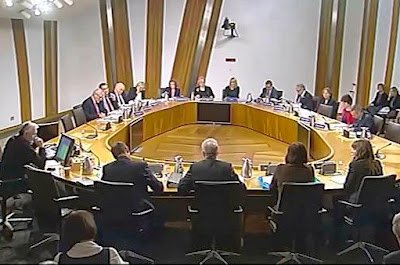
Courts Reform (Scotland) Bill 18 March evidence session at Justice Committee, Scottish Parliament

The Law Society of Scotland said in it’s own submission that the proposals contained in the bill could adversely affect access to justice due to the insufficient resources being allocated to implement the major reforms.

The Law Society went on to express concern at the dramatic increase in the threshold for cases to be heard in the Court of Session (up to £150,000 from £5,000) and warned that this will result in a large transfer of cases from the Court of Session (where no one without a deep pocket and a bent brief obtains justice) to the sheriff courts – without a matching increasing in the number of sheriffs.

The Law Society also expressed concern about the proposed changes to judicial review in Scotland, which will introduce a three month time limit on judicial review cases. The Law Society has already warned that this will restrict access to justice, although anyone who actually bothers to read some of the Judicial Reviews handed down by the Court of Session may well wonder why anyone bothers asking help from what is effectively a wave through for injustice and the vested interests of big business.

Adding to the profession’s mission to keep the money rolling in, the Faculty of Advocates claimed the reforms will put the best legal representation out of reach for ordinary men and women and favour those with deep pockets – as if it doesn't already. Ever heard the one about the QC, the bung and the ruined client? It’s a common joke around Parliament Square …

The Faculty went on to claim that one reason litigants pursue their cases in the Court of Session is because of the right to instruct counsel, who often act for pursuers on a no win no fee basis in personal injury cases. However, the Faculty forgot to explain to msps some of the other less professional ways in which Advocates end up very much in pocket even after allegedly representing someone on a no win no fee case.

In the Sheriff court, the Faculty said, use of counsel has to be sanctioned. Raising the threshold to £150,000 would therefore make it more difficult to instruct counsel, which the Faculty of Advocates claimed would reduce choice.

The Society of Solicitor Advocates also queried the impact of the Bill on access to justice, especially in relation to the lack of automatic sanction for counsel. It also warned that any financial savings that may be brought in by the changes will be “small and disproportionate to the detriment the changes will bring about,” and that the proposals will not make the justice system any more efficient, faster or less costly.

As usual, party litigants, those with out legal representation and anyone with a case which does not draw in big numbers, fails to get any mention.

All submissions of evidence for the Courts Reform (Scotland) Bill can be read here: Submissions received on the Courts Reform (Scotland) Bill

Wednesday, January 20, 2010

Thomson review of solicitor advocates proposes ‘common standards, conduct’ after Lord Gill’s ‘dereliction of duty’ criticisms in murder appeal

ScottishGovernmentScottish Government published the Thomson review of solicitor-advocates. A REVIEW OF SOLICITOR ADVOCATES carried out by the Scottish Government has recommended there should be a single code of conduct for solicitor-advocates & advocates, as well as a single complaints process for clients to use when the standard of their legal representatives fall beneath the acceptable mark. Oddly enough, all the issues covered in the Thomson review could mostly be resolved by implementing the much needed panacea of full independent regulation, which we all know is now necessary to shape up Scotland’s poorly regulated legal profession.

Lord GillLord Gill criticised a solicitor-advocate for leaving the trial of his client to lobby the Government for more legal aid fees. The review of solicitor-advocates was instituted after the Law Society persuaded Mr MacAskill to act on the criticisms from Scotland’s Lord Justice Clerk, Lord Gill in the February 2009 appeal of Alexander Woodside over the conduct of his defence during his original trial at Glasgow’s High Court for murder during 1998. One of Mr Woodside’s defence team, Gerry Brown, a solicitor-advocate with Livingstone Brown solicitors in Glasgow, and Convener of the Law Society of Scotland’s “Criminal Law Committee” had ‘absented himself’ from the trial of his client to travel to London for the day to lobby for more legal aid fees in a lobby group organised by the Law Society of Scotland.

Lord Gill branded Mr Woodside’s solicitor-advocate’s conduct as “a dereliction of duty” and expressed the following concerns : "This appeal has highlighted problems of rights of audience that seem not to be unique to this case. I think it would be opportune if there were to be a review of the working of the system overall." He added: "I fail to see how any practitioner could be justified in absenting himself from any part of a murder trial except in an emergency."

The main recommendations of the review, which is being chaired by Senior Scottish Investment Banker Ben Thomson who was appointed by Justice Secretary Kenny MacAskill, after the Law Society intervened and turned Lord Gill’s criticisms into one of those dreaded establishment in-house reviews, which at least did come up with some useful recommendations not entirely liking to the Law Society : (1) A universal standard examination for admission as a pleader in the Supreme Courts should be established and all pleaders should be reviewed on a regular cycle (2) There should be one code of conduct for all pleaders (3) The complaints process should be enhanced and provide for one process for advocates and solicitor advocates.

The Scottish Government’s media release on the publication of Mr Thomson’s report quotes the investment banker as saying : "There is a great deal that we can be proud of in our legal profession in Scotland, and I believe that maintaining the two separate branches of the profession preserves our strong Scottish traditions and encourages healthy competition. However it is apparent that there are different rules and conventions surrounding advocates and solicitor advocates which can cause issues. Our recommendations look to address these issues, by proposing a common qualification, common standards, and a common monitoring and complaints process for all pleaders. We have been pleased to see that there is widespread support for these proposals amongst those with whom we have discussed them."

Ian SmartLaw Society of Scotland President Ian Smart. The Law Society, who must be pleased with themselves for deflecting any major parliamentary attention into the under-regulated solicitor-advocates who can whoosh off on Law Society lobbying expeditions, commented via their President Ian Smart, saying : “We want to see changes brought in that will make sure that we have a fair and effective system that works for everyone and that clients are properly represented in court whether by an advocate or a solicitor advocate. This is very much a draft report and further consideration must be given to the report’s recommendations and their implementation, for example, whether there should be a single complaints process for those appearing in the Supreme Courts. We will continue to contribute to discussions before the final report is published in March this year.”

SLCC squareScottish Legal Complaints Commission may end up investigating solicitor-advocates. However, it turns out the single complaints process proposed in the Thomson review would see complaints given to the hapless Scottish Legal Complaints Commission, which itself has had a year of scandal over its shoddy conduct towards clients making complaints against members of the legal profession, while racking up huge expenses claims for its board members and so far having no success stories to present to the public. The Law Society are of course, concerned that involving the SLCC in the regulation of solicitor-advocates will cloud the ease in which most complaints against solicitor-advocates – even from judges, have been treated with slight of hand.

The Thomson review on solicitor advocates can be downloaded here : Rights of Audience Review and any comments you wish to make on the Thomson review, and solicitor-advocates should be submitted by February 19, 2010 to thomsonreview@scotland.gsi.gov.uk

Admittedly, I was not going to cover this particular review, but after details of a complaint against a solicitor advocate in a civil case was passed to me this morning by a colleague in the media, I think its probably fair to say the public should have a shout in this review, and hopefully express some views which some in the know should take into account.

As solicitor-advocates also operate in civil courts, it is obviously important to ensure they are effectively regulated, to ensure consumer protection, which clearly is just as remiss in the world of solicitor-advocates, as it is in the remainder of Scotland’s sub-standard legal profession. If any readers do have experiences of using solicitor-advocates, I would urge them to participate in the review, and send in comments to the review team in the contact details listed above, along with download links to the actual review itself.

Clearly the concerns expressed by Lord Gill, and the interests of consumers must ensure that fully independent regulation is applied to solicitor advocates, and all other branches of the legal profession, if of course, we are to have any trust in those whom we pay to represent our legal interests and ensure access to justice …

Saturday, March 14, 2009

Lawyers argue over ‘delaying tactic’ review calls to MacAskill as Dean of Faculty condemns Law Society’s failure of regulation

richard keen qcRichard Keen, Dean of Faculty of Advocates. The Law Society of Scotland has been attacked by the Dean of the Faculty of Advocates, Richard Keen QC, who claims the Law Society has yet again abdicated its responsibility for regulation of the Scots legal profession, specifically in this instance, the Society’s role in regulating solicitor-advocates, who are lawyers specially qualified to represent clients in the higher courts without the need to engage a fully qualified advocate from the Faculty.

Richard Keen, the dean of the faculty said to newspapers : "Lord Gill's opinion … highlighted failures concerned with the operation of the way in which solicitor advocates are regulated. The faculty had hoped for a constructive response from the Law Society. "It did not expect the Law Society to abdicate its responsibility as regulator in the face of the Lord Justice Clerk's criticisms.”

He went on : "It is not appropriate for the Law Society to kick this into the long grass by asking for an independent inquiry or investigation. If the Law Society is to prove itself the regulator it claims to be it should demonstrate that by regulating.”

"What there obviously has been is a failure of regulation in respect of solicitor advocates, and the faculty hopes that this will be dealt with sooner rather than later.”

The issues of regulatory failure which have prompted the row between the Law Society of Scotland & Faculty of Advocates was recently brought into the spotlight by Lord Gill who found significant failures in the work of solicitor-advocates, who were failing their clients best interests, where in one instance, a member of a defence team who represented convicted killer Alexander Woodside’s appeal relating to the conduct of his defence at his trial at the High Court in Glasgow in 1998, absented himself from the trial for a day to go to London as part of a Law Society delectation to lobby on legal aid fees.

Lord Gill, commenting on matters, branded the solicitor’s act in the Woodside appeal, “a dereliction of duty”, and found that among other things, solicitors were failing to advise their clients (contrary to Law Society rules), that they have the right to be represented by an advocate from the Faculty of Advocates, which may have been more in their client's best interests.

Lord HamiltonLord President Lord Hamilton supports the Law Society’s call for rights of audience review. However, the Law Society of Scotland, seeking to defuse the situation, has resorted to its tried & trusted approach to such criticism .. by doing nothing itself, and asking for a Government review of the issue, a review with the Lord President, Lord Hamilton, has hurriedly signed up to and which the Law Society itself is seeking to take control of, by way of the various legal 'steering groups' the Scottish Government relies on for such 'studies', steering groups which are themselves made up mostly of members of the legal profession who can be trusted to steer things the way of the Law Society's wishes.

I doubt there will be much change in the way solicitor-advocates are regulated with any study which comes from Kenny MacAskill's Justice Department, simply because it appears the Law Society has a 'free hand' to do as it pleases under MacAskill, who is far too cosy with his 'former' colleagues in the legal profession, to the point his own Ministerial negligence has allowed the newly created 'independent' Scottish Legal Complaints Commission to be co-opted by the legal profession in a most brutal way against consumer interests.

Here follows the Herald newspaper's report on the story, and following that, the Law Society of Scotland's own Press Release .. pleading innocence as ever ...

Law Society attacked over review request

BRIAN DONNELLY March 13 2009

Scotland's legal elite have clashed publicly over plans to review the regulation of solicitor advocates after concerns about the system were raised by the country's second most senior judge.

The Dean of the Faculty of Advocates has called on the Law Society of Scotland to face up to its responsibility for regulating solicitor advocates.

The society this week wrote to the Scottish Government requesting an independent review of the system. The faculty believes the society should carry out its own overhaul.

Solicitor advocates are lawyers qualified to represent clients as an advocate in higher courts in England, Wales and in Scotland, the Supreme Court and High Court.

The Lord Justice Clerk, Lord Gill, expressed concern during a recent murder case about the regulation of the group of solicitors.

He found that some solicitors were failing to advise their clients, contrary to Law Society rules, that they have the right to be represented by an advocate, which may be in their best interests.

He added that some solicitor advocates were doing advocacy work beyond their competence and they had a lack of awareness of their professional duties.

He revealed some of the senior solicitors had accepted instructions from their own law firms without advising clients of the availability of counsel, and were "self-certifying" themselves as the lead solicitor in serious criminal cases.

Lord Justice Clerk said: "From the standpoint of the administration of justice the idea that any solicitor advocate can accept instructions, perhaps from his own employee, as leader in a serious trial regardless of his experience and skill, is matter for concern.

"The concept of seniority is in my view conducive to the interests of justice. It does not apply in the case of solicitor advocates ... in practice there is no concept of seniority other than for the purpose of charging fees."

The society asked Justice Secretary Kenny MacAskill to report back next year on an independent review of all aspects of the rights of audience in the Supreme Courts.

Richard Keen, QC, the Dean of the Faculty, said the society had abdicated its responsibility for regulation after Lord Gill "highlighted failures".

He said: "The Faculty had hoped for a constructive response from the Law Society of Scotland, which is the regulatory authority for solicitor advocates.

"It is not appropriate for the Law Society to kick this into the long grass by asking for an independent inquiry or investigation. If the Law Society is to prove itself the regulator it claims to be it should demonstrate that by regulating.

"There is no call and none certainly from the Lord Justice Clerk, for an investigation into rights of audience in general.

"What there obviously has been is a failure of regulation in respect of solicitor advocates, and the faculty hopes that this will be dealt with sooner rather than later.

"If the Law Society feels that as regulator it is not able to investigate and deal with that matter, no doubt another way can be found to do this on their behalf - although why the public purse should have to incur expense on something which the Law Society is already paid to do is not immediately obvious."

Lorna Jack, chief executive of the Law Society of Scotland, said: "We believe that after almost 20 years it is time for an independent, comprehensive review of rights of audience in the higher courts."

She added that the society has a "rigorous" regulatory system to ensure the public interest is protected and standards maintained.

… and now the Law Society’s own version of events, choosing to smokescreen the entire episode with a call for a review by the Justice Secretary .. a review which will inevitably be kicked back for the Law Society to handle itself …

LAW SOCIETY COMMENTS ON CALL FOR REVIEW OF RIGHTS OF AUDIENCE IN SCOTLAND’S HIGH COURTS

Lorna Jack, chief executive of the Law Society, said:

“Following on from Lord Justice Clerk, Lord Gill’s call for a review, the Lord President Lord Hamilton had written to Kenny MacAskill, Cabinet Secretary for Justice, to add his support for a review and we are in favour of this. We believe that after almost 20 years it is time for an independent, comprehensive review of rights of audience in the higher courts.

“Qualified solicitor advocates were given rights of audience in the High Courts and Court of Session in 1990, with the first appearing in the higher courts in 1993, giving clients an extended choice of well trained, experienced and regulated legal professionals to represent them.

“The Society is the regulatory body for all solicitors. This includes solicitor advocates. All of our members are expected to adhere to the professional standards set out in law and the Society’s rules. The Society has a rigorous regulatory system in place to ensure that the public interest is protected and high standards are maintained.

“Solicitor advocates must also comply with Supreme Court Rules. These rules were first approved by the Lord President Lord Hope in 1992 and then in 2002 by Lord Roger when they were reissued.

“To date the Society has never had to prosecute a member for professional misconduct arising from them acting as a solicitor advocate.

“Any complaints about solicitor advocates should be made to the Scottish Legal Complaints Commission (SLCC). The SLCC would deal with any service complaints while issues of conduct would be passed by them to the Society.

Lorna Jack added: “We would welcome a wide ranging review and the opportunity for ongoing discussion of the various issues with the government and the Faculty. We are currently in a time of significant change and this is an important issue for the future of the legal profession.”