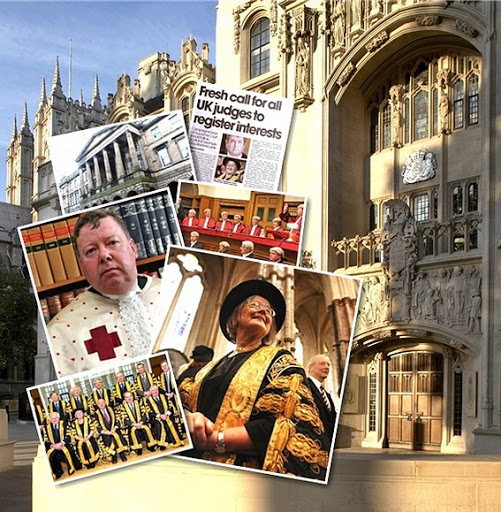
Amid media plaudits from Lord Hope – who currently serves with other Scottish judges in courts in the United Arab Emirates & Gulf States - where Human Rights abuses, domestic abuse & trafficking in migrant workers lead the order of business - Lord Reed - Robert John Reed (Baron Reed of Allermuir) – who has previously sat at the European Court of Human Rights and on a string of other appointments – now presides over the UK’s most powerful court.
Prior to his appointment to the Supreme Court in February 2012 - after the death of Lord Rodger, Lord Reed sat in the Outer House of the Court of Session, and became principal commercial judge in 2006.
Lord Reed was then appointed a Privy Councillor – a position enjoyed by other Court of Session judges such as Lord Malcolm (real name Colin Campbell QC) and joined the Inner House of the Court of Session where he sat from 2008 to 2012.
However, in September 2019 - when the UK Supreme Court upheld the prorogation case brought by MSP Joanna Cherry (and others) – documents obtained from the Scottish Government revealed Lord Reed sat on the same appointments panel which recommended Lord Carloway for the position of Lord President – Carloway (real name Colin Sutherland).
Lord Carloway is the same judge who upheld the Judicial Review case brought by the same MSP – Joanna Cherry (and others) in Scotland, against the prorogation of Parliament.
In the findings of three Scottish appeal court judges – headed by Lord Carloway himself, – Lord Carloway upheld the respondents contention that the Prime Minister’s advice to HM the Queen that the United Kingdom Parliament should be prorogued from a day between 9 and 12 September until 14 October was unlawful because it had the purpose of stymying Parliament.
In that ruling, Lord President, Lord Carloway, decided that although advice to HM the Queen on the exercise of the royal prerogative of prorogation Parliament was not reviewable on the normal grounds of judicial review, it would nevertheless be unlawful if its purpose was to stymie parliamentary scrutiny of the executive, which was a central pillar of the good governance principle enshrined in the constitution; this followed from the principles of democracy and the rule of law. The circumstances in which the advice was proffered and the content of the documents produced by the respondent demonstrated that this was the true reason for the prorogation.
Scrutiny of Papers obtained via Freedom of Information legislation and published in 2016 from the Scottish Government – revealed the same UKSC judge Lord Reed – also sat on the selection panel which recommended the appointment of Lord Carloway (Colin Sutherland) as Lord President in 2015.
The failure of Lord Reed to declare he sat on the appointments panel which recommended Lord Carloway for the top judicial job in Scotland – is one of two potential conflicts of interest for the Supreme Court judge which should have been aired and debated for recusal - prior to the UKSC hearing on the suspension of the Westminster Parliament.
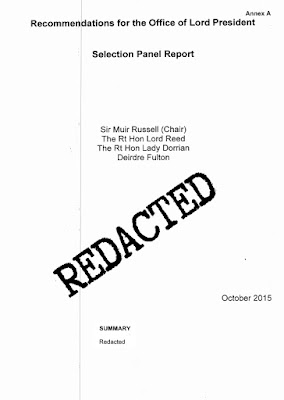 How judges select Scotland’s judges - in secret Documents obtained from the Scottish Government revealed Lord Reed sat on the selection panel for the office of Lord President - along with Sir Muir Russell, Judge Lady Dorrian, and Deirdre Fulton – considered five candidates for the position of Scotland’s top judge.
This same panel – which included Lord Reed – went on to recommend Lord Carloway for the position as Lord President & Lord Justice General of the Court of Session.
Written exchanges between civil servants and the selection panel which are included in the released papers - reveal a short listing meeting was held on 1 September 2015.
The panel considered that two applicants Lord Carloway [Redacted] merited an interview on the basis of the quality of their applications.
Two emails from Lord Reed, dated 14th ^ 15 October 2015 – released by the Scottish Government in the FOI documents - give a minimal, and heavily redacted description of Lord Reed’s role in the panel’s work, which ultimately recommended Lord Carloway for the position of Scotland’s top judge.
In one email, Lord Reed states: “This strikes me as an excellent report. I have made a few minor suggestions as shown on the attached version. Most of the suggestions are trivial, [redacted]”
In a second email Lord Reed writes “I am content with the amended report. I agree, in particular, with the points which were made by Leeona. The amended version beems to me to present an accurate account, and a fair and balanced assessment [redacted]”
A further potential interest not declared, brought ot the attention of journalists by a legal source, identifies Lord Reed’s work together with Lord Carloway – on a ‘compatibility issues review’ to consider if the High Court of Justiciary in Scotland would still have to give permission for appeals in criminal cases to go forward to the UK Supreme Court.
The review group was itself established by Lord Carloway, with others appointed to the group being Lord Reed (Deputy President of the UKSC), and others - Lady Dorrian (Lord Justice Clerk); David Harvie (Crown Agent); Roddy Dunlop QC (Treasurer of the Faculty of Advocates); and John Scott QC (President of the Society of Solicitor Advocates).
The review concluded - "Appeals to the Supreme Court of the United Kingdom (UKSC) should not require certification by the High Court of Justiciary that the issue raises a point of law of general public importance, a review chaired by the Lord Justice General has concluded."
Although – it should be pointed out – coincidentally, the review on appeals to the UKSC – limited to appeals in criminal cases - came too late to help in several serious cases of judicial conflicts of interest in Scotland – particularly on a well known case where Court of Session judge & Privy Councillor - Lord Malcolm (Colin Campell QC) heard a case up to eight times - while failing to declare his own son represented the defenders in multi million pound damages action.
A report on the Lord Malcolm conflict of interest case can be found here: CONFLICT OF INTEREST: Papers lodged at Holyrood judicial interests register probe reveal Court of Session judge heard case eight times - where his son acted as solicitor for the defenders.
The two potential conflicts of interest, not declared by Lord Reed in relation to what was a law changing UKSC ruling of significant impact – again highlight the need for a publicly available Register of judges’ interests - to ensure members of the judiciary do not forget to disclose interests which may have a bearing on cases before them.
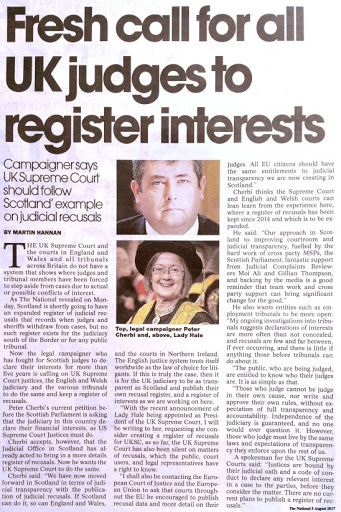
The issue also brings into question again, the self imposed secrecy on judicial interests by the judges of the UK Supreme Court and wider UK Judiciary – who have resisted calls to become more transparent and declare their interests in the same way all public servants and elected politicians are required to declare in publicly available registers of interest.
The current stance of UK Supreme Court judges on transparency in relation to declarations of interest, is a point blank refusal by the judiciary to comply with the public expectation of transparency.
The UK Supreme Court’s website states the following in relation to judicial expenses and interests:
Justices' interests and expenses
Background
Prior to the creation of the Supreme Court of the United Kingdom, the highest court in the UK was the Appellate Committee of the House of Lords. The members of the Committee were Lords of Appeal in Ordinary appointed under the Appellate Jurisdiction Act 1876. Although those appointments gave them full voting and other rights in the House of Lords, the Law Lords had for some years voluntarily excluded themselves from participating in the legislative work of the House. Notwithstanding that, they were bound by the rules of the House and provided entries for the House of Lords Register of Interests.
On the creation of the Supreme Court the Lords of Appeal in Ordinary became Justices of the Supreme Court. They retain their titles as Peers of the Realm, but are excluded by statute from sitting or voting in the House, for so long as they remain in office as Justices of the Supreme Court. As such, they are treated as Peers on leave of absence; and do not have entries in the House of Lords Register of Interests. Historical information remains accessible via the House of Lords website.
Other judges in the UK, such as the judges of the Court of Appeal and the High Court in England and Wales, and in Northern Ireland, and the Court of Session in Scotland, do not have a Register of Interests. Instead they are under a duty to declare any interest where a case comes before them where this is or might be thought to be the case.
Current position
Against this background the Justices have decided that it would not be appropriate or indeed feasible for them to have a comprehensive Register of Interests, as it would be impossible for them to identify all the interests, which might conceivably arise, in any future case that came before them. To draw up a Register of Interests, which people believed to be complete, could potentially be misleading. Instead the Justices of the Supreme Court have agreed a formal Code of Conduct by which they will all be bound, and which is now publicly available on the UKSC website.
In addition all the Justices have taken the Judicial Oath - and they all took it again on 1 October 2009 - which obliges them to "do right to all manner of people after the law and usages of this Realm without fear or favour, affection or ill will"; and, as is already the practice with all other members of the judiciary, they will continue to declare any interest which arises in the context of a particular case and, if necessary, recuse themselves from sitting in that case - whether a substantive hearing, or an application for permission to appeal.
In relation to the UK Supreme Court’s stance on declarations of interests, and declarations of conflicts of interest, Diary of Injustice reported on the issue in detail during 2017, here: SUPREME SECRETS: UK Supreme Court refuses to publish recusal data - Court rejects release of info on UKSC justices' conflicts of interest in response to Freedom of Information recusals probe on top UK court
During the probe of UKSC recusals and failure to declare interests, a common thread of dishonesty was noted in court staff’s handling of a Freedom of Information request from Scotland – which was only answered after coverage of the issue in The National newspaper, which prompted the Information Commissioner’s Office to order the court to respond to the request.
Lord Reed’s limited biography on the UK Supreme Court website (reprinted below) does not feature either of the issues identified linking the judge to Lord Carloway’s appointment as Lord President nor any mention of review & other work undertaken with Lord Carloway – including the UK Supreme Court sitting in Edinburgh, which included Lord Carloway as a sitting judge on the UKSC panel.
The announcement by 10 Downing Street of Lord Reed’s appointment as President of the UK Supreme Court in July 2019 read as follows:
The Rt Hon Lord Reed will succeed Baroness Hale of Richmond as President of the Supreme Court of the United Kingdom, alongside three additional appointments as Justices.
The Queen has been pleased to confer a peerage of the United Kingdom for Life on Lord Reed upon his appointment as the President of the Supreme Court in recognition of the contribution that he has made to law and justice reform.
Lord Reed will take up the position of President on 11 January 2020. Lord Justice Hamblen, Lord Justice Leggatt and Professor Andrew Burrows will join the Supreme Court as justices on 13 January, 21 April and 2 June 2020 respectively.Her Majesty The Queen made the appointments on the advice of the Prime Minister and Lord Chancellor, following the recommendations of independent selection commissions.
Lord Reed will replace Lady Hale who retires on 10 January 2020 after serving as President of the Supreme Court since September 2017.
LORD REED UKSC BIOGRAPHY:
Lord Reed was appointed as a Justice of the Supreme Court in February 2012 and has served as Deputy President since June 2018. Prior to his appointment to the Supreme Court he served as a judge in Scotland, sitting from 1998 to 2008 in the Outer House of the Court of Session, where he was the Principal Commercial and Companies Judge, and from 2008 to 2012 in the Inner House.
He was educated at the Universities of Edinburgh and Oxford, and qualified as an advocate in Scotland and as a barrister in England and Wales. He practised at the Scottish Bar in a wide range of civil cases and also prosecuted serious crime.
As well as sitting on the Supreme Court and the Judicial Committee of the Privy Council, he is a member of the panel of ad hoc judges of the European Court of Human Rights, and a Non-Permanent Judge of the Hong Kong Court of Final Appeal. He is also the High Steward of Oxford University.
IMPORTANT NOTE: Readers should note this article does not take sides in the brexit debate. This article is a reporting of a failure by a UK Supreme Court judge to declare or discuss relevant interests and a potential failure to recuse - by a senior judge who is the new President of the UK Supreme Court.