Showing posts with label Judicial Appointments Board. Show all posts

Thursday, October 19, 2017

TRIBUNAL INTERESTS: Calls for wealthy, well connected interests & professions who dominate tribunals & appeals system to be brought into line with transparency & declarations in published register of interests

Tribunals are dominated by wealthy, powerful individuals & professional groups. AMID an ongoing media probe into the undeclared, and significant interests of individuals and professional groups who dominate public tribunals, a call has been made for all tribunal members to declare and register their interests.

The manner in which tribunals are created and governed in Scotland, is a familiar model of professionals within the same groups and spheres of influence - awarding jobs to colleagues, the favoured, and vested interests.

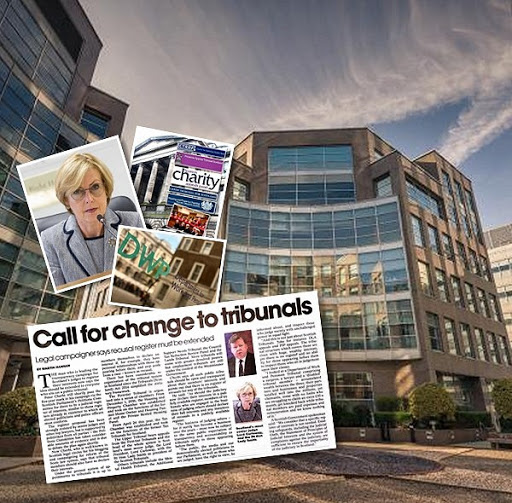
A no expenses spared approach for tribunal members who tow the line is often the case, enhanced with office accommodation such as the new tribunals centre being created in Glasgow at 3 Atlantic Quay, a high-quality office development close to the River Clyde in the centre of the city.

Last week, the Scottish Courts & Tribunals Service (SCTS) confirmed they and Her Majesty’s Courts and Tribunals Service (HMCTS) have decided to rationalise their accommodation and move jointly into the new centre – which is being rented out at nearly £2million a year from the Moorfield Group and partners Resonance Capital.

The moves planned to start next year will also mean that accommodation is ready for the tribunals that are going to be devolved to the SCTS.

Members of tribunals are recruited by the Judicial Appointments Board (JAB) during appointments rounds regularly held to fill vacancies in the murky world of the Scottish Courts and Tribunals Service and Judiciary of Scotland.

Applicants face interviews from their peers across the legal, professional, charitable and public service world & industries awash with public cash, junkets, charity interests, coaching, arbitration & consultancy profits.

Successful candidates are subsequently appointed by Scottish Ministers.

An example of a recent appointments round run by the Judicial Appointments Board saw 30 new Legal Members and 19 Ordinary Members appointed by the Scottish Ministers to the First-tier Tribunal for Scotland and assigned to the Housing and Property Chamber by the President of Scottish Tribunals, Lady Smith.

A full report on the appointments can be found here: TRIBUNAL REGISTER: Calls for transparency as legal & wealthy, well connected interests dominate Tribunals system membership - Register of Recusals & Interests should be extended to cover all Tribunals in Scotland

The names of those appointed are:

Legal Members: Yvonne McKenna; Lesley-Anne Mulholland; Nairn Young; Shirley Evans; Alastair Houston; Steven Quither; Petra Hennig McFatridge; Colin Dunipace; Lesley Johnston; Anne Mathie; Kay Springham; Alan Strain; Aidan O’Neill; Jan Todd; Alison Kelly; Valerie Bremner; Eleanor Mannion; Virgil Crawford; Pamela Woodman; Lynsey MacDonald; Karen Kirk; Neil Kinnear; Fiona Watson; Nicola Irvine; Graham Dunlop; Andrew Upton; Joel Conn; Melanie Barbour; Lesley Ward; Andrew McLaughlin.

Ordinary Members: Eileen Shand; Elizabeth Williams; Janine Green; Jennifer Moore; Linda Reid; Angus Lamont; David Fotheringham; David MacIver; David Wilson; Gerard Darroch; Gordon Laurie; James Battye; Leslie Forrest; Tony Cain; Elizabeth Currie; Frances Wood; Jane Heppenstall; Melanie Booth; Sandra Brydon.

Not one of these members  - the thirty lawyers – or the nineteen ‘ordinary’ members - has declared any interests in a publicly available register of interests – as there is currently no requirement to do so.

The Judicial Appointments Board publish a version of a register of interests,- available here: Judicial Appointments Board - Register of Interests

However, the JAB register of interests leaves out any mention of property wealth and many other interests known to be held by those serving on the quango tasked with recruiting Scotland’s judiciary and tribunal members.

A legal insider commenting on the JAB register observed: “It appears as if members are poor souls sitting round a table with little to declare, whereas the undeclared financial wealth and status on this list is significant and ought to be declared”

The world of Disability Living Allowance appeals and PIP appeals has too come under the spotlight - after a study of appeal panels revealed members wealth and property totalling in the millions compared to disabled applicants who were being ‘knocked back’ on applications for a few extra pounds a month.

The tribunal structure which covers benefits appeals are riven with huge, wealthy interests, yet there is no register and no ability for those appearing before them to inspect those who sit in judgement upon their claims.

In one look at a DWP Tribunal comprising a surgeon, a lawyer and a 'disabled' tribunal member - accumulated wealth between the three, their partners and businesses and properties totalled well into the millions, yet claimants, some with no limbs who are struggling to claim an extra £30 a month and get knocked back while tribunal members are paid expenses & remuneration know nothing of it.

An adviser who assists those facing benefits appeal tribunals gave an example of a benefits tribunal membership:

A surgeon tribunal member - of 25 years experience as a medical practitioner owned several properties, has several positions on public bodies, has a long history of advising Government departments on medical legislation, has appeared as an expert witness on many occasions for NHS trusts and assisted Medical Defence Unions in the UK against hospital negligence claims.

His partner has a similar level of interests in terms of wealth and property, has a wide variety of positions in advising and acting for quangos,public bodies, professions, local and central government.

A solicitor member of the tribunal, who has over 20 years experience of a solicitor owns numerous properties, holds several other positions on tribunals and has made a lucrative career of advising and representing quangos, public bodies and has fought and won cases for professional groups.

However, the third member – the disability member of the tribunal – proved to be the most interesting.

The disability member, who is in receipt of DLA – holds significant assets and property well out of the reach of any typical DLA or PIP claimant.

This same disability member appears to hold several positions on public bodies and has frequently travelled on publicly funded junkets.

And, the same disability member has been the author of written reports on individuals – one which was described by a former local Government employee as “a personal vendetta” against a claimant from the same town in which the tribunal was held.

The former benefits adviser also recalled a recorded hearing – in which the same disability member became aggressive during a benefits appeal hearing - and demanded an assisted blind claimant remove their black glasses.

The net worth of the three members of this particular DLA tribunal was estimated at around £5.2m – taking into account the tribunal members partners, whose interests often coincided with public bodies, professions, local and central government.

It has also been alleged remuneration and expenses for benefits appeal tribunal members include payments for “knocking back applicants”.

A former Local Government employee who worked in the benefits section of a council told of how he had been part of a discussion at his former workplace where a senior member of staff claimed DLA tribunal members had on occasion been paid hundreds of pounds more for throwing out DLA applications.

Clearly, those before such a tribunal have the right to know who they face, and the interests of those who judge them.

The National reports further:
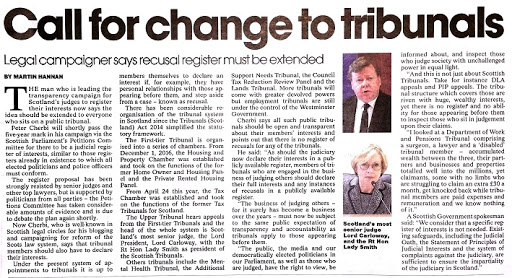
Call for change to tribunals - Legal campaigner says recusal register myst be extended

Martin Hannan Journalist 14 October 2017 The National

THE man who is leading the transparency campaign for Scotland’s judges to register their interests now says the idea should be extended to everyone who sits on a public tribunal.

Peter Cherbi will shortly pass the five-year mark in his campaign via the Scottish Parliament’s Petitions Committee for there to be a judicial register of interests, similar to those registers already in existence to which all elected politicians and police officers must conform.

The register proposal has been strongly resisted by senior judges and other top lawyers, but is supported by politicians from all parties – the Petitions Committee has taken considerable amounts of evidence and is due to debate the plan again shortly.

Now Cherbi, who is well-known in Scottish legal circles for his blogging and campaigning for reform of the Scots law system, says that tribunal members should also have to declare their interests.

Under the present system of appointments to tribunals it is up to members themselves to declare an interest if, for example, they have personal relationships with those appearing before them, and step aside from a case – known as recusal.

There has been considerable re-organisation of the tribunal system in Scotland since the Tribunals (Scotland) Act 2014 simplified the statutory framework.

The First-tier Tribunal is organised into a series of chambers. From December 1, 2016, the Housing and Property Chamber was established and took on the functions of the former Home Owner and Housing Panel and the Private Rented Housing Panel.

From April 24 this year, the Tax Chamber was established and took on the functions of the former Tax Tribunals for Scotland.

The Upper Tribunal hears appeals from the First-tier Tribunals and the head of the whole system is Scotland’s most senior judge, the Lord President, Lord Carloway, with the Rt Hon Lady Smith as president of the Scottish Tribunals.

Others tribunals include the Mental Health Tribunal, the Additional Support Needs Tribunal, the Council Tax Reduction Review Panel and the Lands Tribunal. More tribunals will come with greater devolved powers but employment tribunals are still under the control of the Westminster Government.

Cherbi says all such public tribunals should be open and transparent about their members’ interests and points out that there is no register of recusals for any of the tribunals.

He said: “As should the judiciary now declare their interests in a publicly available register, members of tribunals who are engaged in the business of judging others should declare their full interests and any instances of recusals in a publicly available register.

“The business of judging others – for it surely has become a business over the years – must now be subject to the same public expectation of transparency and accountability as tribunals apply to those appearing before them.

“The public, the media and our democratically elected politicians in our Parliament, as well as those who are judged, have the right to view, be informed about, and inspect those who judge society with unchallenged power in equal light.

“And this is not just about Scottish Tribunals. Take for instance DLA appeals and PIP appeals. The tribunal structure which covers those are riven with huge, wealthy interests, yet there is no register and no ability for those appearing before them to inspect those who sit in judgement upon their claims.

“I looked at a Department of Work and Pensions Tribunal comprising a surgeon, a lawyer and a ‘disabled’ tribunal member – accumulated wealth between the three, their partners and businesses and properties totalled well into the millions, yet claimants, some with no limbs who are struggling to claim an extra £30 a month, get knocked back while tribunal members are paid expenses and remuneration and we know nothing of it.”

A Scottish Government spokesman said: “We consider that a specific register of interests is not needed. Existing safeguards, including the Judicial Oath, the Statement of Principles of Judicial Interests and the system of complaints against the judiciary, are sufficient to ensure the impartiality of the judiciary in Scotland.”

YOUR TRIBUNAL: A publicly funded adversarial environment full of vested interests:

Next year, tribunals will move to an expensive new home in the centre of Glasgow.

The Scottish Courts and Tribunals Service (SCTS) and Her Majesty’s Courts and Tribunals Service (HMCTS) are to rationalise accommodation in Glasgow and the new Tribunals Centre will be located at 3 Atlantic Quay. 

The SCTS claim the 34 hearing rooms for cases to be heard, the design of the centre will provide excellent facilities for all tribunal users, and specific  support for young users with additional support needs.  Additionally, the centre will provide facilities for vulnerable witnesses to give evidence to both Glasgow Sheriff Court and the High Court.

During 2018, the SCTS-supported Housing and Property and Health and Education Tribunal Chambers will move into the new Centre. The HMCTS-operated social security tribunal will move at a similar time with other tribunals HMCTS services to follow at a later date.

The SCTS provides support to many of Scotland’s devolved tribunals and is making preparations for the future transfer of the UK reserved tribunals operations in Scotland, currently provided by HMCTS.

Lady Smith, President of Scottish Tribunals – who is in charge of the £7.8million Scottish Child Abuse Inquiry – claimed:  “The creation of the new Tribunals Centre in Glasgow is the latest important development in the evolution of the Scottish Tribunals. The premises will act as a hub for tribunals supported by SCTS, providing a range of modern facilities and services for tribunals users. They will also offer a separate, appropriately designed space, for vulnerable witnesses and users, including for witnesses providing evidence for Sheriff and High Court cases in Glasgow. This co-located approach to provision for the tribunals should be regarded as a flagship for the administration of justice in Scotland in the 21st century.”

Eric McQueen, Chief Executive, SCTS said: "This has been an exciting opportunity with SCTS and HMCTS working together to create a bespoke tribunals centre, improving the services we provide for tribunals, while reducing costs.  It also provides an early opportunity to bring together SCTS and HMCTS staff to prepare for forthcoming tribunal reforms.”

Kevin Sadler, Deputy Chief Executive, HMCTS said: “We are committed to improving people’s experience of the justice system by providing facilities that are modern, comfortable and accessible.We have worked collaboratively with SCTS on this opportunity and we look forward to creating a joint tribunals centre with them in the heart of Glasgow.”

If you have any experience before any of these Tribunals, or information in relation to cases, Diary of Injustice journalists would like to hear about it. All information and sources will be treated in strict confidence, contact us at scottishlawreporters@gmail.com

Previous articles on the lack of transparency within Scotland’s judiciary, investigations by Diary of Injustice including reports from the media, and video footage of debates at the Scottish Parliament’s Public Petitions Committee can be found here : A Register of Interests for Scotland's Judiciary.

Previous reports on moves to publish judicial recusals in Scotland and a media investigation which prompted further reforms of the Scottish Register of Judicial Recusals can be found here: Judicial Recusals in Scotland - Cases where judges have stood down over conflicts of interest

Tuesday, September 26, 2017

GOOD LORD, GLITCHES: “Gremlins & Glitches” theme of Lord Carloway’s opening of new legal year - Court of Session misses out on promised digital reforms, top judge takes swipe on judicial appointments in Law Society speech

Lord Carloway opens legal year 17-18. SCOTLAND’S top judge has marked the opening of the new legal year with an admission of significant problems with the rollout of digital technology in Scotland’s creaking, Victorian era courts & justice system.

Lord President and Lord Justice General - Lord Carloway (real name Colin Sutherland) – who presides over a £42milion a year 700 strong group of Sheriffs & Sheriffs Principal, Justices of the Peace and Court of Session judges who call themselves “Senators” – told his handpicked, closed door legal world audience that “Gremlins and glitches” had yet again slowed down major digital technology reforms.

Luckily for the creaking Court of Session and it’s judges - who are known to despise transparency and openly snear, perhaps even smite media intrusions into their haphazard and often calamitously costly hearings to litigants – Lord Carloway added integrated digital reforms were still some way off from impinging on salivating legal teams fees, which can in some cases have resulted in tens of thousands of pounds for what passes as a day’s ‘work’.

Carloway, spoke to an audience which included Lord Thomas, the Lord Chief Justice of England and Wales  and Lady Thomas, along with Sir Declan Morgan, the Chief Justice of Northern Ireland and Lady Morgan, Mr Justice Frank Clarke the new Chief Justice of Ireland and President of the Irish Supreme Court, Mr Justice John MacMenamin, a member of the Supreme Court in Ireland – and the new President of the United Kingdom Supreme Court, Baroness Hale and her husband, Dr Julian Farrand.

Lord Carloway told his audience: “As is often the case, pronouncements, about the advent of digital technology as the panacea for procedural and evidential woes, have proved somewhat optimistic. The new digital Integrated Case Management System has been rolled out in the sheriff courts, but glitches and gremlins have slowed its process. Even assuming that the digital portal, which is designed to absorb all court documents, including productions, into the ICMS, will be operational in the not too distant future, it may still be some time before the ICMS is introduced to the Court of Session.”

However, earlier this year, in late February of this year, The Times reported - Lord Carloway -  “Scotland's most senior judge has claimed that the Scots legal system is stuck in the 19th century and needs to be modernised to provide better justice.

Lord Carloway, the lord president of the Court of Session and lord justice general of the High Court, claimed that many rules and procedures appeared to be "preserved in aspic".

Dear oh dear. The Scottish Courts and Tribunals Service (SCTS) received over £105million of public cash in the latest Scottish Government budget. If the courts cannot achieve a visit to PC World on £100million a year to equip the ageing Court of Session justiciary with an integrated computer framework, well, the public are not getting value for money.

Admittedly, over £11million of that figure is directed to the judiciary, in an effort to split the ever burgeoning judicial budget which hit £40.5million in 2016.

Alas, as in many public body accounts in Scotland - Cayman Islands style creative accounting  became the in-thing – where some Scottish Government Minister decided it would be good figure fiddling to split the judicial budget into two. That way, the financial accounts look like the judiciary took a £12million a year hit, yet in reality they now receive a near £12million bung via the main Courts budget.

And, yet, in yesterday’s Opening of the Legal Year 2017-2018 address to the usual closed shop audience, ever closed for fear of public criticism – amongst a speech of gremlins, glitches & the goonies, Lord Carloway reverts back to the myths of a ‘respectable’ and functioning justice system, which rests firmly in the day dreams of Scotland's judicary, and annual profits of mostly Edinburgh based law firms and cash collectors – otherwise known as the Faculty of Advocates.

Lord Carloway’s Opening of the Legal Year 2017-2018 speech in full:

Welcome everyone to the opening of the legal year. First let me thank you all for coming. Can I first introduce our guests from our neighbouring jurisdictions:

Lord Thomas, the Lord Chief Justice of England and Wales and President of the Courts of that jurisdiction and Lady Thomas;

Sir Declan Morgan, the Chief Justice of Northern Ireland and Lady Morgan

Mr Justice Frank Clarke the new Chief Justice of Ireland and President of the Irish Supreme Court

Mr Justice John MacMenamin, a member of the Supreme Court in Ireland

and a welcome return to Edinburgh to the new President of the United Kingdom Supreme Court, Lady Hale and Dr Julian Farrand

I am also pleased to welcome the Cabinet Secretary for Justice, Michael Matheson, Annabelle Ewing, Minister for Community Safety and Legal Affairs and Paul Johnston, the Director General for Education, Communities and Justice.

It is also a pleasure to have with us Liam McCollum, Chair of the Bar of Northern Ireland, Paul McGarry, the Chair of the Bar of Ireland, Seamus Woulfe, the Attorney General of Ireland and David Barniville, also from the Bar of Ireland.

Without indulging in a lengthy essay on the current state of the Scottish Courts and Tribunals, I would like to say a few words about where we are now and where we are going next.

We have now seen the structural changes of the Courts Reform Act bedding in; with the advent of the Sheriff Appeal Court, the All Scotland Sheriff Personal Injuries Court and the raising of the exclusive jurisdiction of the sheriff court to £100,000. We have introduced important changes to the structure of Scotland's tribunals, with the establishment of the First-tier Tribunal for Scotland and the creation of distinct chambers for housing and property and for taxation.

As anticipated by the reforms, there has been a significant reduction in both appellate and first instance civil work in the Court of Session and in summary criminal appeals to the High Court. There has also been a predicted drop in the number of commercial cases. As a consequence of all of this, this court the Court of Session ought to become leaner, trimmer and fitter in the coming years.

There ought to be a significant reduction in waiting times for civil first instance and appellate hearings. This has already happened with appeals, which are generally being disposed of (including judgment) on average within 8 months of marking. Proofs of 4 days duration are fixed within 6 months of the request to do so. However, I fully recognise that further work requires to be carried out to accommodate longer proofs, within much shorter time-scales. I include in that equation the issue of the final opinion. This will be achieved partly as a consequence of the abolition of court terms in the coming year. This has already seen some of these proofs being allocated over what was formerly known as the Summer Vacation or Recess.

The policy of having at least 4 non-commercial judges in the Outer House over a period of at least three months will continue, or rather increase to five, so as to avoid any criticism that ordinary first instance business is being regarded as less of a priority than other work. Major inroads have been made in relation to providing all judges with sufficient writing time in civil cases. Statistically, there has been a substantial improvement in the time taken to issue judgments, even if there continue to be problems in specific cases.

The High Court is already processing solemn appeals as efficiently as is reasonably practicable with disposals occurring within 6 months of the grant of leave. It is anticipated that far fewer criminal appeal courts will be needed in the coming months. This will mean that we will be able to continue to run two civil Divisions each week if necessary. The post reform developments will result in much less reliance on retired or temporary judges and, in the sheriff courts, dependence upon fee paid and retired sheriffs. I remain very conscious of the fact that almost all High Court cases require an extension of time. However, I do not consider that this is caused by an inefficiency in the system. Rather, the introduction of enhanced disclosure, the need to search electronic databases and social media and advances in forensic science have made it all but impossible to comply with timescales set in a different era whilst at the same time accommodating the diaries of parties' legal representatives. As a result of concerted efforts over the past year, all sheriff courts are now able to fix summary trial diets within the optimal 16 week timescale. In relation to domestic abuse cases that timescale is under 10 weeks. Reform in sheriff and jury practice ought to place the sheriff courts onto a similar efficient footing to the High Court.

As I said at this time last year, the focus must now change from structure to function. As is often the case, pronouncements, about the advent of digital technology as the panacea for procedural and evidential woes, have proved somewhat optimistic. The new digital Integrated Case Management System has been rolled out in the sheriff courts, but glitches and gremlins have slowed its process. Even assuming that the digital portal, which is designed to absorb all court documents, including productions, into the ICMS, will be operational in the not too distant future, it may still be some time before the ICMS is introduced to the Court of Session.

The enormously ambitious rules rewrite project, under the auspices of the Scottish Civil Justice Council, continues apace. Having produced its first report, the project now enters a second stage designed to develop a core narrative of draft civil rules applicable in both the Court of Session and the sheriff court. It has, to some, rather dull aspects, but the development of case management powers in relation to the conduct of proofs and other hearings will see an exciting change in the way things are done and the time which it takes to do them; provided, that is, that we continue to have a judiciary committed to improvement.

The next significant reform in solemn criminal procedure will be the expanded use of recorded evidence with vulnerable and child witnesses. This is already done, although not always consistently across the board. It is in summary criminal procedure that greater change is anticipated with fundamental proposals being made following upon the "New Model" paper produced earlier this year. The plan is to have all pre-trial procedures conducted by a digital case management process. More important will be the creation of a means to store, manage and share evidence digitally and securely. The idea that truth can be ascertained by using a combination of memory test, pressure and general inconvenience to witnesses will be replaced by a system which gives far greater precedence to images and statements recorded electronically at or about the time of the relevant incident and to the need to accommodate witnesses generally.

I would now wish to thank all of my judicial colleagues, especially the Lord Justice Clerk, Lady Dorrian, for their continued help and support. I am grateful to the administrative judges Lords Malcolm (formerly Lord Menzies), Turnbull, Boyd and Matthews, for all their assistance throughout the year. I also thank the SCTS chief executive, Eric McQueen, the new head of the Judicial Office, Tim Barraclough, our new Principal Clerk, Gillian Prentice, and all the court clerks and other staff working here in Parliament House, in the High Court Centres and throughout the country. Their commitment and hard work remain important an driving force in ensuring not only the continued existence of the justice system but also its progress. I have also very much appreciated the court's continuing engagement with the Law Officers, all of whom are here today, in helping to develop policies and plans, both past and future, which make the system, as it is at present, fit for the 21st century.

Not least, I wish to thank the legal profession, especially those institutions represented here today, including the Faculty, the WS, SSC and Law Society, and also all those many counsel and solicitors who have participated so willingly, and for no reward, in the committees and working groups now beavering away in the background, for their dedication to the Scottish Legal System, for the effort which all have put in over the last year and in anticipation of the invaluable work which they will be carrying out in the coming year.

Lord Carloway, Lord President 25 September 2017

THE LORD PRESIDENT’S OTHER SPEECH:

The duties of a Lord President and his judges are far and wide.

International travel junkets akin to playing diplomat, or perhaps as unmasked by media attention - just charging up the taxpayer for ‘law conferences’ around the world in 5-Star hotels with golf courses, river tours and first class travel.

Or just a trip across Edinburgh to a law conference, the Lord President does not miss an opportunity to get his oar in give a speech, even if only to a shady bunch at the Law Society of Scotland annual conference – whose members are well practiced in dodging those murky Police Scotland & Crown Office hit-a-brick-wall probes into mortgage dealing, money laundering & bulk buying of properties on the cheap.

While the focus of Lord Carloway’s speech to the Law Society of Scotland audience, already fattened on over £1.3billion pounds of legal aid since the 2008 financial crash, and countless Scottish Government contracts of up to £20million a year and tens of millions more fleeced from public authorities & public bodies, the top judge took another swipe at those who may ‘interfere’ with a measure of transparency in the junta-like regime of Scotland’s courts & judiciary.

Lord Carloway breezed to his Law Society audience: “Under the ancien regime, before the advent of the Judicial Appointments Board, judges and sheriffs were recommended to the Queen for appointment by the Secretary of State, following consultation with the Lord Advocate and, in practice, the Lord President . It was perceived, by some, perhaps many, that judges were the product of cronyism or political patronage. It is true to say that every Lord Advocate in the century or so prior to 1970 was appointed to a superior court bench. Many nominated themselves as Lord President , Lord Justice Clerk  or became judges in the House of Lords .”

“That tradition was broken not so much with the appointment of Lord Wilson of Langside, who became Director of the old Scottish Courts Administration (now the Scottish Courts and Tribunal Service) and then Sheriff Principal of Glasgow, but when Norman Wylie appointed George Emslie to be Lord President in 1972. Nevertheless, Lord Advocates  continued to be appointed as Lords Ordinary and, one way or another, often progressed rapidly to similar positions of high judicial office .”

“The appointment of judges generally was political in the sense of the selection being by government; a system which is common, albeit with different focus, in many western democracies. It is seen as an element in the balance of power. Its merits and demerits have recently been analysed by the new President of the UK Supreme Court, who has mooted re-involvement of politicians from both government and opposition in the appointment of the most important chairs in the English legal system.”

“No-one would pretend that every judicial appointment from that era was of a person with complete legal and personal skills equipping him (as all judges then were) for high judicial office or a sheriffdom. There were problems. What is clear, however, is that the person who was, in practice, recommending the appointment would be fully appraised of the candidate's qualities and failings. The Lord Advocate would be well aware of his prospective appointee's experience, ability and knowledge. Consultation with the Lord President ensured that there was substantial input on suitability from the person who would be responsible for the new judge's future performance and behaviour.”

Judicial Appointments

“There has been much recent public discussion, both in Scotland and in neighbouring jurisdictions, about the challenges which exist in the recruitment of new members of the judiciary. It is imperative, if Scotland is to maintain a high quality judiciary, especially at Court of Session level, that those at the top of the profession in the litigation field are highly motivated to apply for judicial office. It is equally important that the selection process itself does not deter or subsequently reject those candidates best qualified to fulfil the role. The aim must be to secure the services of those whom the profession regard as the leaders in their field and who are seen as the most able of their generation.”

“The independence of the judiciary is a vital element in our system. It is maintained primarily by selecting persons who have acted as independent advocates or solicitors throughout their professional lives, who have prosecuted and defended, and who have acted on the one hand for government, insurance companies and global conglomerates and on the other for the private individual, legal aided or otherwise, who has allegedly been oppressed or who has a legal right requiring vindication.”

“What must not be lost sight of is the simple fact, which cannot be underestimated, that for the Scottish justice system to operate properly, it needs judges and sheriffs who are not just competent lawyers with reasonable or even good people skills. It needs, at the high end, the best lawyers of the generation to lead the way; to take over the chairs of the permanent Divisions and to provide their wings. In the sheriff courts, although the same quality of legal skill and experience may not be a necessity, the appointments must be of people whom the profession recognise as prominent within their ranks.”

“I very much welcome the willingness of the new Chair of the Judicial Appointments Board to engage in a discussion about how the selection process might be improved to ensure that we do persuade the leading lights of the profession to apply for judicial office, and that the very best are successful in their applications.”

The full speech is available here:  LP Law Society of Scotland Annual Conference Keynote Address 19September2017

Put it this way. If suddenly, the Government banned elections, any form of public vote was suspended, and instead politicians were selected in the way the Lord President extols as fit for judges who head a £2.5 billion pound per annum publicly funded justice system, it would be branded undemocratic, a system of jobs for the boys, and well, in all honesty – totalitarian.

The “Greater Good” – The phrase used by the Lord President in the opening paragraph of his speech to the Law Society conference - is served by Transparency, in increasing amounts, and taken several times daily by a judiciary, courts and justice system in dire need of reform.

Saturday, December 19, 2015

TOP JUDGE OF PARLIAMENT HOUSE: Lord Carloway appointed as Scotland’s Lord President & Lord Justice General of the Court of Session

Top judicial post of Lord President taken by Lord Carloway. SCOTLAND’S Lord Justice Clerk - Lord Carloway - has been confirmed as the new Lord President & Lord Justice General of the Court of Session.

The post of Lord President – with a salary of £220,655 per year - became vacant after Lord Brian Gill unexpectedly walked out of the top judicial post in May of this year – giving only 30 days notice he intended to quit.

The move, elevating the Lord Justice Clerk to the top job of Lord President comes after a secretive panel constituted by First Minister Nicola Sturgeon under the Judiciary and Courts (Scotland) Act 2008.

The behind-closed-doors panel, comprising Sir Muir Russell & Mrs Deirdre Fulton from the Judicial Appointments Board for Scotland, Lord Reed of the UK Supreme Court and Court of Session judge Lady Dorrian - began a search in July for a new top judge - with orders to recommend a name to the First Minister by 30 October 2015.

The secretive recruitment process for a Lord President is reported in further detail here: To play the President - Hunt begins for Scotland’s next top judge

Lord Carloway – real name Colin Sutherland - is known for his backing for the Scottish Government’s failed plan to remove corroboration from Scots law.

While in the role of Lord Justice Clerk, Lord Carloway authored the Carloway Review Report & Recommendations 2011 – which backed a joint effort by Scottish Ministers and the Crown Office to remove the centuries old safeguard against wrongful convictions requiring evidence in criminal trials to be corroborated from two independent sources.

The Carloway Review and it’s recommendation to abolish corroboration - was opposed by members of the judiciary in their Response by the Senators of the College of Justice to SG consultation : Reforming Scots Criminal Law & Practice.

The campaign to retain corroboration was backed by Lord Gill - the then Lord President - who spoke out at the Scottish Parliament’s Justice Committee - defining the injustice safeguard as one of the "finest features" of Scotland’s justice system. Video footage of Lord Gill’s evidence to MSPs can be found here: Lord President Brian Gill evidence to Justice Committee on retention of corroboration

The same Justice Committee – who voted against plans to remove corroboration from Scots Law - dubbed Lord Carloway “disdainful and dismissive” over his support for scrapping the need for corroboration in criminal cases.

In April of this year, as the Scottish Government retreated on their plans to abolish corroboration - Lord Carloway hit out at elements of the legal profession who campaigned for retention of the injustice safeguard.

During Lord Carloway’s speech to the Commonwealth Association of Law Reform Agencies Biennial Conference - the Lord Justice Clerk accused lawyers & critics of having "transparent self-interest" in retaining the centuries old injustice safeguard.

Lord Carloway said: "Reactionary or excessively defensive forces among the legal profession can, and often do, behave in a manner obstructive to progressive law reform, especially where there is transparent perceived financial self-interest."

The judge’s remarks provoked robust responses from Thomas Ross - the Chair of the Criminal Bar Association, reported in The Herald HERE

Mr Ross argued lawyers opposed to ending the safeguard - under which two pieces of evidence are required to secure a conviction - were acting against their own financial interests.

Recently Lord Carloway was appointed head of the Scottish Sentencing Council – a quango created by Scottish Ministers which was condemned by two previous Lord Presidents – Lord Gill and Lord Hamilton – as a political attempt to interfere with the judiciary and Scotland’s courts system.

The appointment of Lord Carloway to the role of Lord President – made by the Queen upon receiving a nomination from the First Minister - retains the 500 year old tradition of male only top judges.

Lord Carloway will be formally installed as Lord President early in the new year, 2016.

Once appointed as Lord President, Lord Carloway will be asked to give evidence to the Scottish Parliament’s Public Petitions Committee in connection with three year probe on proposals to require judges to register their interests, as called for in Petition PE1458: Register of Interests for members of Scotland's judiciary.

If Lord Carloway’s stated views on ‘transparency and self interest of vested legal interests’ are anything to go by, perhaps the new Lord President will reach a different view from his predecessor Lord Gill – who spent two of his three year term as top judge fighting plans to enhance judicial transparency with a register of judges’ interests.

The petition calls for the creation of a publicly available register of judicial interests containing information on judges backgrounds, their personal wealth, undeclared earnings, business & family connections inside & outside of the legal profession, offshore investments, hospitality, details on recusals and other information routinely lodged in registers of interest across all walks of public life in the UK and around the world.

The proposal to require judges to declare their interests enjoys cross party support, and was widely backed by MSPs during a full debate in the Scottish Parliament’s main chamber on 9 October 2014 - reported in full with video footage of MSPs and Scottish Ministers speaking during the Holyrood debate, here: Debating the Judges.

Previous articles on the lack of transparency within Scotland’s judiciary, investigations on judicial interests including reports from the media, and video footage of debates at the Scottish Parliament’s Public Petitions Committee can be found here : A Register of Interests for Scotland's Judiciary

Lord Carloway’s appointment as Lord President has been welcomed by the Dean of the Faculty of Advocates, who were recently revealed to have taken ownership of Scotland’s top court buildings from Edinburgh City Council.

James Wolffe QC, Dean of the Faculty of Advocates, said: “His appointment as head of Scotland’s judiciary is richly merited – having regard not only to his personal qualities but to his distinguished career of service, as an advocate before his appointment to the bench in 2000, as a judge since that date, and since 2012 as Lord Justice Clerk.

“Lord Carloway becomes Lord President at an important time for our legal system as it responds to technological, social and institutional change. I look forward very much indeed to working with him.”

Christine McLintock, President of the Law Society of Scotland who spent much of the week condemning legal aid cuts, commented: “I warmly congratulate Lord Carloway on his appointment. As one of our most senior and respected judges, and with a wealth of experience across both criminal and civil law, he has already made a substantial contribution to justice and the rule of law here in Scotland. I have every confidence he will make an even greater contribution as our Lord President.

“Lord Carloway assumes this role at a critical time for Scotland’s justice system, with major reforms to improve the efficiency of our courts but also pressures from reductions in public spending. We are also seeing a transformation in the legal services market, with new business models, changing expectations from clients and a greater internationalism amongst legal firms. Against this backdrop of change, we look forward to working with Lord Carloway, building on the excellent relationship we have enjoyed with him as Lord Justice Clerk.”

The appointment now creates a vacancy for the office of Lord Justice Clerk.

The First Minister is required by s19 of the Judiciary and Courts (Scotland) Act 2008 to establish a panel to recommend individuals suitable for this appointment.

Lord Carloway’s most recent appearance at the Scottish Parliament came during an evidence session before the Justice Committee on 8 December 2015 during which the Lord Justice Clerk gave evidence to MSPs on the Abusive Behaviour & Sexual Harm (Scotland) Bill.

Lord Carloway Justice Committee Scottish Parliament 8th December 2015

LORD CARLOWAY:

Lord Carloway is a graduate of Edinburgh University (LLB Hons) and was admitted to the Faculty of Advocates in 1977. He served as an Advocate Depute from 1986 to 1989 and was appointed Queen’s Counsel in 1990. From 1994 until his appointment as a Judge he was Treasurer of the Faculty of Advocates.

Lord Carloway was appointed a Judge in February 2000 and was elevated to the Inner House in August 2008. He became Lord Justice Clerk in August 2012.

He was an editor of ‘Green’s Litigation Styles’ and contributed the chapters on ‘Court of Session Practice’ to the Stair Memorial Encyclopedia and ‘Expenses’ in Court of Session Practice.

Lord Carloway was the joint editor of ‘Parliament House Portraits: the Art Collection of the Faculty of Advocates’ and is a former president of the Scottish Arts Club. He is the author of the Carloway Review on key elements of criminal law and practice which was published on 17 November 2011. Many of the recommendations from this review have been taken forward in the Criminal Justice (Scotland) Bill, approved by Parliament earlier this week.

Lord Carloway is also currently leading a steering group overseeing the Scottish Court and Tribunal Service review into Evidence and Procedure, including options for improving how children and other vulnerable witnesses provide evidence in criminal cases.

Friday, March 25, 2011

Ex-Law Society Boss involved in Master Policy memo scandal & Climategate inquiry Chief retain 5 year, £290 a day Judicial Appointments quango jobs

Kenny MacAskill denies existence of memosEnsuring establishment support for another 4 years as Justice Secretary ? AMONG the multitude of justice related quango appointments quietly announced in the past week by Justice Secretary Kenny MacAskill, are the reappointments for five more years of former Law Society President Martin McAllister and former Permanent Secretary for the Scottish Government (Chief of the civil service in Scotland), Sir Muir Russell to the quango which recommends the appointments to Scotland’s judiciary, the Judicial Appointments Board, with salaries of £290 per day plus expenses for a meagre time commitment of 20 to 30 days per year.

Martin McAllisterMartin McAllister, former Law Society President. Martin McAllister, who was implicated in the memogate scandal involving the Law Society of Scotland, Marsh and Douglas Mill over ‘claims fixing’ allegations made by Cabinet Secretary for Finance John Swinney, retains his well paid Judicial Appointments Board position on top of yet another publicly funded quango position as part-time Convenor of the Mental Health Tribunal for Scotland with a whopping recession busting payment of £430 per day plus expenses.

My earlier report on Mr McAllister's controversial initial appointment to the Judicial Appointments Board, including details of the Law Society’s secret memos implicating his involvement in a scandal which went onto claim the resignation in January 2008 of Douglas Mill the then Chief Executive of the Law Society of Scotland, is here : Justice Secretary MacAskill denies knowledge of ‘claims fixing’ memos identifying former law chief sent to Judicial Appointments.

When asked about Mr McAllister’s past for my earlier report, the Justice Secretary’s spokesperson claimed there was no information of any matter involving Mr McAllister and his role in claims against the Master Policy during his time as Law Society President : Mr MacAskill’s spokesperson said at the time : “Mr McAllister was appointed through fair and open competition by an independent panel. We are not aware of any formal complaint about Mr McAllister’s role in relation to claims and complaints during his time as President of the Law Society of Scotland, and no evidence has been presented to us which would raise any questions over the decision of the selection panel.”

John Swinney, a trustworthy manJohn Swinney, Cabinet Secretary for Finance & Sustainable Growth. However, the Scottish Government Finance Chief, John Swinney when in opposition during the summer of 2006 at the Scottish Parliament's Justice 2 Committee, questioned the then Law Society Chief Executive Douglas Mill over contents of his own memos, which referred to Martin McAllister. Mr Swinney said : "I am interested in what the witnesses have just said about the Law Society having nothing to do with the arrangements for handling negligence claims. I have in front of me a memorandum in connection with the case of one of my constituents. It was issued by Mr Mill on 5 July 2001.”

"Mr Mill's memo was written to the then president of the Law Society, Mr McAllister. It refers to the broker of the master policy. Mr Mill suggests that it would be good if he and the others involved all got together and had a "summit meeting" to discuss how to dispose of my constituent's "several valid claims". Mr Mill and I have discussed the matter at length over the years, but I find that a rather strange memo if it is to sit comfortably with the statement that the president has just made.

“The memo of 5 July encourages "a summit meeting on the up-to-date position"to be held to look at "both the complaints and the claims aspects." That rather suggests that the Law Society has been involved. The claim remains unresolved to date and yet the memo is dated 5 July 2001."

Clearly Mr Swinney’s evidence to the Justice 2 Committee during 2006, which can be viewed in video footage on InjusticeTV HERE, raises serious questions over the honesty of the Scottish Government’s claim not to have known of Mr McAllister’s past involvement in the Marsh memo scandal.

In the case of the reappointment of Sir Muir Russell to the Judicial Appointments Board, the former head of the civil service in Scotland, is now better known for his chairing of the Climategate inquiry into into allegations that leading academics at the University of East Anglia manipulated data on global warming. The ‘results’ of that ‘inquiry’ can be found HERE.

The Herald newspaper revealed in a report “Holyrood fiasco peer’s £40k for chairing Climategate review” by Paul Hutcheon that Sir Muir Russell walked away with nearly £6000 a month (totalling £40,000) for leading the Climategate probe which unsurprisingly cleared scientists at the University of East Anglia of data manipulation.

The Herald report said : “The inquiry chaired by Sir Russell investigated claims that researchers at East Anglia had distorted statistics on global warming. Hacked e-mails written by university staff led to fears that information on climate change was being manipulated, a row that was played out internationally. The six-month probe concluded with Russell and his team noting the “rigour and honesty” of the scientists. A freedom of information request has revealed that the university paid Russell a £40,000 fee for his chairmanship. He also benefited from £2908 in travel and £976 for accommodation.”

Here follows the announcement from the Scottish Government of Sir Muir Russell & Martin McAllister’s reappointments to the Judicial Appointments Board, for another five years on £290 per day plus expenses, all coming out of public funds :

Judicial Appointments Board for Scotland

The Cabinet Secretary for Justice today (22/03/2011) announced the reappointments of Sir Muir Russell as the Chairing Member, and Mr Martin McAllister as a member to the Judicial Appointments Board for Scotland.

Sir Muir Russell was first appointed as Chairing Member of the Judicial Appointments Board for Scotland on October 1, 2008 for a three year period. His background is as a civil servant and he held a number of posts before being appointed Permanent Secretary at the Scottish Office in 1998. He was Principal of the University of Glasgow from 2003 until his retiral in 2009. He is a Vice Chair of Governors of the Glasgow School of Art, the Chairman of the Dunedin Concert Trust, a Member of the Board of the Moredun Research Institute, the Chairman of the Council of the Hannah Research Institute and a Fellow of the Royal Society of Edinburgh.

This reappointment will run for a further three years from October 1, 2011 to September 30, 2014. He is an experienced chair who demonstrates particular strengths in building relationships both internally and with external partners. This post is part-time and attracts a remuneration of £17,500 per annum for a time commitment of 20 to 30 days per year. He has no other public appointments.

Mr McAllister was first appointed as a legal member on September 1, 2008 for a three year period. He is a partner with Taylor and Henderson Solicitors. He is a former President of the Law Society of Scotland and has convened several of its Committees including Legal Aid, Professional Practice and Professional Conduct. Mr McAllister is currently a part-time tutor at the University of Strathclyde and a part-time Convenor of the Mental Health Tribunal for Scotland.

As a practicing Solicitor and former President of the Law Society he brings valuable experience of the largest element of the legal profession in Scotland. This reappointment will run for a further three years from September 1, 2011 to August 31, 2014. This post is part-time and attracts a remuneration of £290 per day a for a time commitment of 20 to 30 days per year. Mr McAllister is also a part-time Convenor of the Mental Health Tribunal for Scotland with a remuneration of £430 per day.

The Judicial Appointments Board for Scotland was established by Ministers in 2002, and it became an independent advisory non-departmental public body on June 1, 2009. The Board has statutory responsibilities under the Judiciary and Courts (Scotland) act 2008. The Board's role is to make recommendations to Ministers for appointment to the office of judge, sheriff principal, sheriff, and part-time sheriff as well as other judicial offices set out in the Act.

These Ministerial public appointments were made in accordance with the Commissioner for Public Appointments in Scotland's Code of Practice.

All appointments are made on merit and political activity plays no part in the selection process. However, in accordance with the original Nolan recommendations, there is a requirement for appointees' political activity within the last five years (if there is any to be declared) to be made public. There is no political activity to be declared.

BACKGROUND to the Judicial Appointments Board:

The role of the Judicial Appointments Board is to recommend to the Scottish Ministers individuals for appointment to judicial offices within the Board's remit and to provide advice to Scottish Ministers in connection with such appointments. The Board is responsible for recommending individuals suitable for appointment to the following judicial offices Judge of the Court of Session, Chair of the Scottish Land Court, Sheriff Principal, Sheriff, Part-time Sheriff, Temporary judges.

The JAB’s website claims : “The selection of individuals for recommendation must be made solely on merit and an individual may only be selected for recommendation if he or she is of good character. Only the judicial and legal members of the Board may assess the applicants' knowledge of the law or their skill and competence in the interpretation and application of the law. Decisions about an applicant’s suitability to be recommended for appointment are made by the whole Board.”

Ironically, a research report carried out by the Judicial Appointments Board claimed that jobs for Scottish judges were controlled by an old boys network , probably the same old boys network which ensures who gets jobs on the Judicial Appointments Board itself.

Monday, October 19, 2009

Judicial Appointments Board research claims jobs for Scottish judges are controlled by lawyers 'old boys network'

JAB logoScotland's Judicial Appointments Board - full of old boys itself. With much fanfare yet little surprise, Scotland's Judicial Appointments Board, the Ministerial appointed 'quango' which helps appoint Scotland's judges and sheriffs, has published research which ironically claims that jobs for judges are influenced and controlled by the legal profession's old boys network.

The research, which started after a Sunday Herald investigation found that most of Scotland's judges have identical backgrounds (approaching clone status) found about 67% of members of Scotland's legal profession, of whom only around 19% replied (a total of 2319 responses received), that “being in the right social network” influenced which members of the legal profession went on to become a sheriff or a judge after a few nods & winks from those already in the judiciary.

Lord HamiltonScotland’s Lord President, Lord Hamilton. Lord Hamilton, who recently stated to the Scottish Parliament he should be able to tap someone on the shoulder and make them a sheriff, commented on the research, saying : "It is of the first importance that individuals appointed to judicial office are of the highest calibre. Selection for appointment must be solely on merit but it is essential that applications should be encouraged from the widest range of persons eligible. I welcome the Board's decision to instruct this survey and look forward to having the opportunity to examine its results."

Lord Hamilton speaks on judicial appointments ..


richard keen qcThe Dean, Richard Keen QC. Richard Keen, the Dean of the Faculty of Advocates, who is still busy challenging the right of asbestos sufferers to claim compensation from insurance companies, commented on the JAB’s jobs for boys survey : "The Faculty of Advocates welcomes any measure to ensure a judicial process that secures the appointment of those best qualified and equipped to discharge judicial functions. It is particularly important that we have a process which provides for appointments throughout the system without regard to gender, ethnic background, marital status, sexual orientation, political affiliation, religion or disability.”

Ian SmartLaw Society of Scotland President, Ian Smart. The Law Society of Scotland were also quick to get their oar in, with a statement from Ian Smart, who said : "Following the publication of the Gill Report, we are potentially entering a completely new era in the field of judicial appointments. Against that background particularly, this is important research indicating the willingness of JABS to continuously improve and modernise the recruitment process and to encourage applications from candidates from all strands of the legal profession. It will be interesting to monitor future developments in judicial appointments as a result."

You can download & read the research at the following links :

Volume 1: Link opens in new windowMain Report Volume 2: Link opens in new windowTabular Report Link opens in new windowComparison paper on the "Three Surveys ..... Same Answers?", and for comparison, the Judicial Appointments Commission (for England and Wales) and the Northern Ireland Judicial Appointments Commission have undertaken similar research within their jurisdictions. For further information on their research work, please visit: JAC's Link opens in new window"Barriers to Applications for Judicial Appointment Research" NIJAC's Link opens in new window"Research into Barriers and Disincentives to Judicial Office"

However, the Judicial Appointments Board’s desire to get the message out on ‘jobs for the boys’ in Scotland’s courts, necessitates a closer inspection of the JAB itself ….

MacAskill tight lippedJustice Secretary Kenny MacAskill appoints JAB members on the ‘recommendation’ of Scotland's Lord President Lord Hamilton. Unsurprisingly, while the Judicial Appointments Board's research, carried out by an external consultancy at cost to the taxpayer claimed old boys networks controlled judicial appointments, the JAB failed to mention that some of its own members, all Ministerial appointees are themselves well known in legal circles for being part of old boys networks which have helped cover up some of the worst scandals to hit Scotland's legal profession for decades.

Martin McAllister 2000Martin McAllister played a key part in huge Law Society claims cover up scandal which toppled Douglas Mill from his post. One fine example of old boys network appointments to the Judicial Appointments Board itself, would be that of the case of JAB member Martin McAllister, whose name featured heavily in the 'Law Society of Scotland secret memo claims scandal' where secret memos, sent to Mr McAllister (who was at the time President of the Law Society) by his [then] Chief Executive colleague Douglas Mill, exposed a policy of concerted and deliberate actions aimed at controlling and curtailing claims & complaints made against 'crooked lawyers' by members of the public.

John SwinneyCabinet Secretary John Swinney exposed Law Society claims fixing scandal involving Martin McAllister. Oddly enough, when Mr MacAskill was asked about Martin McAllister's part in the claims fixing scandal, the Justice Secretary denied any knowledge of the matter, this despite the fact Mr MacAskill's Cabinet colleague, the Cabinet Secretary for Finance, John Swinney, exposed McAllister & Mill's secret memos & deliberate actions against members of the public, during recorded hearings of the Scottish Parliament's Justice 2 Committee, where Mr Swinney's confrontation with Douglas Mill over the memos addressed to Martin McAllister, eventually led to Mill's downfall as Chief Executive of the Law Society of Scotland after 11 years in the job.

Cabinet Secretary John Swinney confronted Douglas Mill over claims fixing memos involving the then Law Society President Martin McAllister.


Douglas Mill Memo to Martin MacAllister 5 July 2001 - stop the MacKenzies from appearing at the Justice CommitteeMemos of a feather flock together as Mill’s secret memos to Martin McAllister proposes ways to kill off claims & complaints against crooked lawyers. You can read my earlier report on Mr McAllister's controversial appointment to the Judicial Appointments Board, including details of those secret memos here : Justice Secretary MacAskill denies knowledge of ‘claims fixing’ memos identifying former law chief sent to Judicial Appointments and decide for yourselves how the old boys network control even appointments to quangos such as the Judicial Appointments Board who themselves, make the appointments of Scotland’s judges.

For readers interest, here are the current Judicial Appointments Board members (who appear not too short of an old boys network either by the looks of it)

Sir Muir Russell, KCB, DL, FRSE (lay Chairing Member)

Sir Muir Russell became Principal of the University of Glasgow in October 2003. He was born in 1949 and was educated at The High School of Glasgow and Glasgow University, where he took a first class honours degree in Natural Philosophy. Prior to his appointment at the University of Glasgow he was Permanent Secretary to the Scottish Executive. He was elected as a Fellow of the Royal Society of Edinburgh in 2000 and holds honorary degrees from the University of Strathclyde and the University of Glasgow. His interests include music, food, wine and occasional golf. Sir Muir was appointed to the Board in October 2008 for three years.

Ms Elspeth MacArthur (lay member)

Elspeth MacArthur's background is in human resources and she has been Director of Human Resources at the University of Edinburgh for the past nine years. Ms MacArthur is also a member of the Board of Management at the John Wheatley College, which is committed to regeneration and combating social exclusion in the east end of Glasgow. Ms MacArthur was appointed to the Board in July 2007 for three years.

Sandy Mowat CA (lay member)

Sandy Mowat's background is in business as a Chartered Accountant. He was senior and managing partner of Alexander Sloan, Chartered Accountants until he retired in late 2007. He now practices on his own account and holds a number of non-executive directorships and charity trustee appointments. In April 2008 Mr Mowat was appointed to the Investigation and Enforcement Committee of The Institute of Chartered Accountants of Scotland and in April 2009 was appointed Secretary and Treasurer of The Baird Trust. Mr Mowat was appointed to the Board in January 2008 for three years.

Professor Andrew Coyle CMG (lay member)

Andrew Coyle is Professor of Prison Studies in King's college, University of London. Between 1997 and 2005 he was founding Director of the International Centre for Prison Studies in King's College. He is a prisons adviser to several United Nations bodies and to the Council of Europe. He is a member of the Foreign Secretary's Expert Panel against Torture and of the National Advisory Body on Offender Management. He worked for 25 years at a senior level in the prison services of the United Kingdom. While in the Scottish Prison Service he was Governor of Greenock, Peterhead and Shotts Prisons. Between 1991 and 1997 he was Governor of Brixton Prison in London. He was appointed a Companion of the Order of St Michael and St George in 2003 for his contribution to international penal reform. He is a Fellow of King's College London. Professor Coyle was appointed to the Board in January 2009 for three years.

Rev John Miller (lay member)

John Miller was born in 1941. After university he was a youth worker at a church in Niddrie, Edinburgh. He became a minister of Castlemilk East Parish in Glasgow in 1971. He and his wife Mary were closely involved in the life of the Castlemilk housing scheme for the next 36 years. From 2001 to 2002 he was Moderator of the Church of Scotland's General Assembly, representing the Church of Scotland at national and international level. He then returned to parish life. In 2005 the Lord Provost awarded him the Glasgow Loving Cup for his contribution to the City. On retirement in 2007 John and Mary Miller spent 18 months working in Zimbabwe. Reverend Miller was appointed to the Board in March 2009 for three years.

The Honourable Lady Smith (judicial member)

Lady Smith was appointed a Judge of the Supreme Court in 2001. She is a graduate of the University of Edinburgh. She was admitted to the Faculty of Advocates in 1980 and was Standing Junior Counsel to the Countryside Commission. Lady Smith was appointed Queen's Counsel in 1993. She served as a Temporary Sheriff from 1995 to 1999. Lady Smith was appointed Chair of the Scottish Partnership on Domestic Abuse from 1998 to 2000 and served as Advocate Depute from 2000 until she was appointed a Judge. She has served as a member of the Court of Session Rules Council and is a past Chair of the Advocates Family Law Group and Chair of the Advocates Professional Negligence Law Group. Lady Smith was appointed to the Board from July 2008 for three years.

Sheriff Principal Sir Stephen Young Bt QC (judicial member)

After qualifying as a solicitor he worked in London and Glasgow for three and a half years. He then trained as an advocate and was called to the Bar in 1977. He was appointed as a Sheriff in 1984, serving in Glasgow and Greenock. In 2001 he was appointed Sheriff Principal of Grampian, Highlands and Islands, where he is responsible for the administration of justice in the sheriff courts throughout the North and North East of Scotland and the Western and Northern Isles. Sheriff Principal Young was appointed to the Board in June 2007 for three years.

Sheriff Kenneth Ross (judicial member)

Sheriff Ross was appointed a Sheriff in 1997, serving at Linlithgow until 2000 and since then at Dumfries. He is a graduate of Edinburgh University and qualified as a solicitor in 1973. From 1975 until 1997 he was a partner in the firm of Gillespie, Gifford & Brown, Solicitors, Dumfries. He served on the Council of the Law Society of Scotland from 1987 until 1996, convening the Complaints and Guarantee Fund Committees. He was President of the Law Society of Scotland in 1994/5. He sat as a Temporary Sheriff between 1987 and 1997 and has been a member of the Scottish Legal Aid Board since 2004. Sheriff Ross was appointed to the Board in October 2008 for three years.

Mr Roy Martin QC (legal member)

Mr Martin was admitted to the Bar in Scotland in 1976 and in England and Wales in 1991. He became a Queen's Counsel in 1988. He was the Dean of the Faculty of Advocates from 2004 to 2007. Mr Martin has served as a Temporary Sheriff, a part-time Chair of Industrial Tribunals, and is currently a Chair of the Police Appeals Tribunal. He is a Governor of Loretto School and a Trustee of the National Library of Scotland. Mr Martin was appointed to the Board in June 2007 for three years.

Martin McAllister (legal member)

Mr McAllister is a partner with Taylor and Henderson Solicitors based in Saltcoats, Ayrshire. He is a former president of The Law Society of Scotland and has convened several of its Committees including Legal Aid, Professional Practice and Professional Conduct. Mr McAllister is currently a part time tutor at Glasgow Graduate School of Law and a part time Convenor of The Mental Health Tribunal for Scotland. Mr McAllister was appointed to the Board from September 2008 for three years.

Surely its now time to make the appointments of Scotland’s judiciary a lot more transparent than this lot could ever manage ? After all, do the courts not serve the public and the interests of justice, rather than so obviously serving themselves ?

Sunday, October 12, 2008

Judges 'a law unto themselves' as calls grow for First Minister to inject transparency into 18th Century style Scots judiciary

Scotland's Chief Judge, Lord Hamilton and the rest of the self serving, unaccountable club of Scotland's judiciary come off rather detached from the rest of Scotland (and reality) in an excellent investigation carried out by the Sunday Herald newspaper today.

Many people who have found themselves made the victim by an unaccountable and almost freewheeling Scots judiciary over the years in cases questioning the judges decisions or support of colleagues in the legal profession should breathe a sigh of relief the spotlight of transparency is now once again firmly on those who who profess to be impartial, but in reality support their brethren at almost any cost, and enjoy almost no checks on their power.

While the legal profession itself is now subject to a degree of independent regulation though the Legal Profession & Legal Aid (Scotland) Act 2007, Scotland's Judiciary have little or no independent systems to regulate appointments or cases of judicial misconduct - most of those powers being centred on one person, the Lord President, Lord Hamilton, who appears to believe the position of one man running an entire Judicial system in a democracy is a natural thing which should worry no one ...

Here you can see the Lord President's take on his own powers of regulation and appointment :

Lord Hamilton - trust me people, I'm a Judge ...


As you can see from the above video .. transparency and independence .. .calls for which led to the establishment of the 'independent' Scottish Legal Complaints Commission, have not penetrated the ivory towers of Scotland's judiciary.

It is true that over the years, there have been attempts at creating organisations, or 'quangos' for want of a better word, to reign in the powers of the judiciary and the legal establishment.

However each of those organisations which were created to perform, or give the impression they would introduce or give a level of independent scrutiny over such things as appointments and the general workings of the likes of the judiciary and the legal profession, have been co-opted by those who they were tasked with keeping an eye on.

The recent demise of the Scottish Legal Complaints Commission’s much vaunted ‘independence’ by the Justice Secretary’s stuffing the Commission of ex Law Society Committee members, ex-Police, and former Law Society staff, have effectively neutered the SLCC before it even began its work .. much to the noticeable delight of the legal establishment … which I have reported previously HERE, with a notable report on just how the legal establishment saw to it their people were co-opted onto the SLCC here :

Call for MacAskill appointments 'sleaze investigation' as revelations show Legal Complaints Commission member was subject of Police inquiry

One such body created to scrutinise the appointments of Judges, the Judicial Appointments Board, has been totally taken over by the legal establishment, and is itself full of lawyers, serving Judges, some even scandal tainted themselves, and are themselves appointed on the recommendation of - yes - Scotland's Chief Judge, the Lord President, Lord Hamilton.

I reported recently on revelations of scandals within the appointments process to the Judicial Appointments Board here :

Justice Secretary MacAskill misused Government appointments regulator in ‘jobs for lawyers’ scandal

I have reported on problems with accountability and transparency of the Judiciary in an earlier story concerning the Judiciary & Courts Bill, now passed by the Scottish Parliament, here :

Judiciary & Courts Bill 'not worth the paper it's written on' as Scottish Parliament hears judges ask for 'a measure of trust'

Also, lets not forget the fairly poor relationship between Scotland’s judiciary and the SNP Government, which occasionally breaks out into public with each side blaming the other for failures attributable to both :

Justice Secretary MacAskill blames Lord President for delays in ‘access to justice’ applications row

Scotland needs a much more transparent and accountable judiciary .. that much is clear, but perhaps more importantly, it remains to be clear whether the SNP Government, even with the popular First Minister Alex Salmond at the helm, has the power, or perhaps even .. the will … to actually take the Judiciary in hand and give Scotland a 21st Century judicial system, rather than continue to allow it to operate in the 18th Century in which it and it’s members have become accustomed to …

The Sunday Herald's excellent report follows :

Male, white, middle class, privately educated, Edinburgh resident, New Club member ... is it time to change the face of the Scottish judiciary?

INVESTIGATION: By Paul Hutcheon, Investigations Editor, and Tom Gordon, Scottish Political Editor

IT IS not often the heads of government and the courts come together in the same room in Scotland. The separation of political and judicial power, one of the mainstays of the nation's democracy, means the first minister and lord president are rarely in each other's company However, in the coming weeks, Alex Salmond will be legally obliged to confer with Lord Hamilton on the selection of three new judges.

Together, they will pore over a list sent to Salmond on Tuesday by the Judicial Appointments Board, recommending who should be awarded the scarlet robe, known colloquially at court as the "red jersey". Their decision will then be forwarded to the Queen for final approval.

The rarity of the encounter emphasises its importance, as judges are at the heart of Scotland's establishment. Their decisions not only reflect the civil and criminal law, they also contribute to it, establishing precedents that affect the lives of thousands.

In 2001, Lord Abernethy's acquittal of a student accused of rape because there was no evidence of force, despite the woman repeatedly saying no, threw the country's rape laws into chaos. Although a later review rejected this interpretation, it is only now that legislation is passing through Holyrood to reform Scotland's antiquated sexual offence laws.

Yet in spite of their power, precious little is known of the men and women in wigs who earn some of the largest salaries in the public sector. On the eve of a momentous decision for Salmond and Scotland's legal system, a Sunday Herald investigation of the 35 judges in post on January 1 this year reveals the country's bench to be deeply unrepresentative of Scotland in terms of race, gender, and class.

While appointments must be made on merit - no-one would argue for incompetent judges - the investigation shows how the Scottish bench invites a perception that is a self-perpetuating and well-guarded clique likely to deter applicants with the "wrong" background.

Earlier this year, amid much media approval, three female Scottish judges made history by sitting together on the same civil case. What was less well publicised by the Scottish Court Service was that the trio constituted almost the entire female judiciary of the nation.

Only four women - Ladies Paton, Dorrian, Smith and Clark - wear the scarlet robe, compared with 31 men at the start of the year, a paltry 11%.

Other areas of public life, such as politics and less elite parts of the law, have managed to address equally striking gender inequality, but never the Scottish bench.

According to Sex And Power, an index produced by the Equality and Human Rights Commission, female appointments to the bench lag significantly behind other areas of public life. Women filled 32% of all public appointments in 2007-2008, covering 26% of all head-teacher posts in secondary schools and 21% of university principals. A third of MSPs are women.

In the law in Scotland, there has been progress in terms of women taking up the profession. Half of this autumn's trainee advocates are women, compared with one in 20 in the 1990s, but on present form, there is little prospect of this being mirrored on the bench. In the past six years, only two of the 14 judges appointed have been female.

The legal establishment's record in appointing ethnic minority judges is also poor, as not a single member of the bench is black or Asian, and two Jewish judges, Lord Caplan and Lady Cosgrove, have now retired.

"We need to work towards a truly representative judiciary," said a spokesperson for the Equality and Human Rights Commission. "How many disabled people, people from the LGBT lesbian, gay, bisexual, and transgender community or from different race or faith groups sit on the bench? What are the barriers that prevent these groups from progressing in our legal system? Our judiciary needs to become more reflective of Scottish society."

The living arrangements of the 35 judges also point to a caste far removed from those appearing before them in the dock. Although the court of session, which hears civil and appeal cases, is in the capital, the high court, which hears the most serious criminal trials, moves around the country.

Yet public records show that 89% of the "senators of the College of Justice" live in the Lothians, 83% in the capital itself, and 71% in just four plush Edinburgh postcodes. Twelve judges, or 34%, live in the New Town area, and five in the Grange. Another five, or 14%, have an EH4 1 code, which covers the most affluent parts of Edinburgh's west end, while 8% stay in Trinity. Not a single judge lives in Glasgow, Dundee, Aberdeen or any other Scottish city.

The most recent Scottish Index of Multiple Deprivation, which two years ago divided the country into 6505 small neighbourhoods and ranked them according to poverty and affluence, confirms the extent to which the country's judges and their families are physically cut off from most of Scotland.

The second-least deprived neighbourhood in Scotland - area 6504 on the index - consists of a handful of streets and just under 800 people, but they include no less than five judges: Lords Carloway, Kingarth, Turnbull, Uist and Nimmo Smith all live within a few yards of each other in the west end of Edinburgh, near the Dean Bridge Two judges live three doors apart on Ann Street, regarded as the city's most desirable address. The average house price in area 6504 last year was £488,143 - more than three times the national average. The pattern is repeated across the judiciary.

The most affluent 1% of Scotland on the index is home to 13 judges, or 37% of the total. The richest 5% is home to 20 judges, or 57% of the bench. By contrast, the poorest 5% of Scotland's council wards produce 25% of the prison population.

Wealth, of course, is a factor. On the lowest rung of the judicial pay ladder, remuneration for the 21 senators of the College of Justice currently sitting in the court of session's Outer House is £170,200. Above them, the 11 judges of the Inner House, who hear appeals, each earn £193,800.

The country's most senior judge, the lord president, earns £211,000, while his deputy, the lord justice clerk, earns £203,800. Lord McGhie, chair of the Scottish Land Court, who makes up the 35th member of Scotland's judiciary, is a relative pauper on £136,500. All told, the combined bill for judges' salaries this year will exceed £6 million.

A survey of the senators' schooling suggests judges have a similar upbringing, as well as similar tastes in property later in life. While only 4.5% of children in Scotland attend private schools, 71% of judges were educated in the independent sector. A third attended either George Watson's College, Edinburgh Academy or Glenalmond in Perthshire.

Sometimes the clubbishness is quite literal. Membership of the exclusive New Club, a lynchpin of the Edinburgh establishment, appears de rigeur amongst senators, with 43% of judges listed as members in Who's Who.

The patterns becomes even more vivid at the highest levels of the judiciary.

While four members of the 35-strong bench are female, only one woman currently sits in the Inner House, equivalent to 9% of the total. Similarly, while 71% of all judges live in just four Edinburgh postcode sectors, such as EH3 6 and EH4 1, the percentage jumps to 90% for the Inner House. Attendance at independent schools also increases for Inner House judges, from 71% to 82%.

The creation in 2002 of the JAB, which advises ministers on the selection of judges, appears to have made little progress in modernising the bench. Set up to make the appointments system more transparent, the board's recommendations have helped appoint 14 judges. Of these fourteen, two (15%) are women - a slight improvement on the overall figure of 11% - while four (29%) attended state schools, the same figures for judges overall.

Both the board and the wider legal profession acknowledge that a problem exists. Neil Stevenson, head of diversity at the Law Society of Scotland, said: "It is vital that membership of the judiciary is diverse and reflects modern Scotland and that the system of appointing judges is open and transparent.

"The society is working with the JAB and others to examine the barriers that might exist - or that people perceive exist - about becoming a judge or sheriff. We want to ensure that Scottish solicitors are supported and encouraged to apply to become a judge, if that is their career choice."

It is against this backdrop that the three vacancies to the bench have taken on an added significance. Two of the vacancies are the result of recent deaths - Lord Macfadyen and Lord Johnston - while the third has arisen through the forthcoming retiral of Lord McEwan. Applications for a red jersey are supposed to be secret, but in the gossipy world of the Scottish legal system, a handful of favourites have already emerged.

These include Gordon Jackson, the former Labour MSP for Glasgow Govan, and the QCs Valerie Stacey and Paul Cullen. As Glasgow residents, Jackson and Stacey buck the trend for living in the capital - although both have houses in the exclusive Pollokshields area.

Cullen, a member of the New Club, lives in Edinburgh's Morningside. Another name being mentioned is sheriff Ian Peebles.

There is a growing consensus that increasing diversity on the bench is a worthwhile goal, although not everybody signs up to this ambition. Lord McCluskey, a retired judge, said he was sceptical of the arguments for diversity. "It isn't just a case of saying we should appoint three women to the bench," he said. "If I am going to be in hospital for an operation on my brain, I don't want the surgeon to be picked by reason of diversity. I don't want a one-eyed woman from Jamaica. Merit is the only consideration."