Showing posts with label Lothian and Borders Police. Show all posts

Monday, September 17, 2018

TOP OF THE COPS: Police Scotland media team in row over “wrong” word in transcript of top cop explaining away suspension, demotion & reinstatement after male-led cop tribunal cleared him from FIVE allegations of serious sexual assault

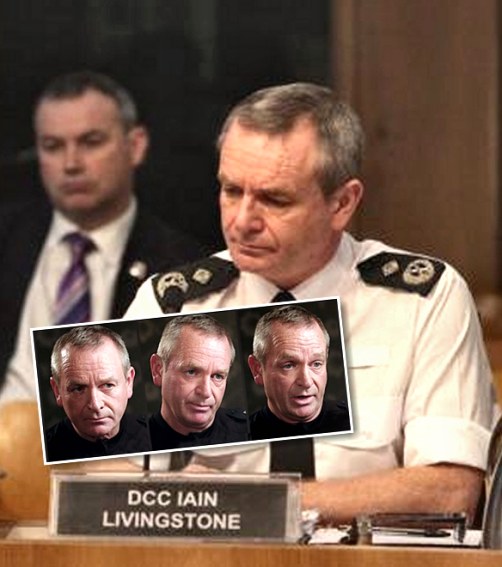
Scotland’s new Top Cop once faced serious sexual assault probe. THE “WRONG” word in a transcribed version of an interview with the officer who is now Scotland’s new Chief Constable – Iain Livingstone – became the subject of bitter exchanges between media officers of Police Scotland and a national newspaper.

Reports from inside the media have revealed the matter became the subject of protracted requests to the Daily Mail newspaper from Police Scotland’s media unit – which includes a Communications officer identified as Chris Starr.

The dispute arose after a mistake was identified in the paper’s published transcript of a television interview asking Iain Livingstone about how he dealt with five allegations of serious sexual assault from a female colleague.

The mistake amounted to one word – “all” .. which should have read from interview as “wrong”.

However, questions have arisen as to why Police Scotland’s media unit hare being used to target the media over the wording of a transcript – a task which should have been allocated to a law firm.

And, while cops have taken issue with reporting of the sexual assault allegations against Scotland’s new Chief Constable, Police Scotland and the Scottish Police Authority continue to resist full disclosure and publication of the full details of the FIVE allegations of sexual assault made against Iain Livingstone by a female officer who has since left the force.

Livingstone was recently confirmed as Scotland’s new Chief Constable after a gruesome sequence of suspensions of colleagues, a damning report on how Scots Police spied on journalists and whistle-blowers, and the Ministerial backed ousting of former Chief Constable Phil Gormley.

During the BBC Scotland Investigates documentary “A Force In Crisis” - investigative journalist Sam Poling asked Mr Livingstone about the 'allegations of sexual assault' and about him being 'bumped down from superintendent to constable and suspended'.

Mr Livingstone said: “There was a set of circumstances in 2000 whereby at a social event at Tulliallan, at a training event I had too much to drink.

I fell asleep in the wrong place and that was “wrong” and I shouldn't have done that, and clearly I accept that.

I was suspended, I spent time off work. There was a hearing convened where I did accept I fell asleep.

I was cleared of any sexual impropriety.

I was cleared of any level of sexual intent and at that hearing, initially, I was then demoted from superintendent to constable.

I immediately appealed against that and I was reinstated.

I came back to work, I accepted that I made a mistake, I accepted I had learned from it and since that time I have continued to conduct my duties with absolute rigour and professionalism.”

Asked whether he could be the 'strong professional leader with integrity' that the public want as chief constable, Iain Livingstone said: “I think I could discharge the responsibilities of the job. 'One of my main strengths, I think, is the ability to work collectively and to work in a collegiate manner.”

“I do think I could do the job, I just need to be quite clear in my own mind that that's what I want to do for the next three to five years.”

Mr Livingstone was suspended in 2003 after a female officer said she was sexually assaulted at Tulliallan, Scotland's police training college.

At the time he was 36, a father of three, and held a post in Her Majesty's Inspectorate of Constabulary, which used to oversee regional police forces.

There were no legal proceedings - although Mr Livingstone was demoted from superintendent to constable in 2004 following a disciplinary hearing.

Five allegations of serious sexual assault were dismissed but, at an internal misconduct hearing, he admitted being in the woman's room overnight after falling asleep.

The hearing, chaired by the then assistant chief constable of Strathclyde Police, found there had been no sexual impropriety or intent.

The woman, who had been on the accelerated promotion scheme for graduates, was reported to have left the scheme, which guarantees fast-track promotion.

A statement to the Press issued by a Police Scotland media representative in May on the subject of the BBC Scotland interview stated: “This matter was subject to due process by Lothian and Borders Police and was formally concluded under police regulations 14 years ago.”

“A hearing concluded that there was no sexual impropriety or intent on Mr Livingstone's part and he has nothing further to add.”

TIMELINE OF SEXUAL ASSAULT ALLEGATIONS AGAINST TOP COP:

FEBRUARY 2003: Iain Livingstone, then 36, is suspended amid sexual assault claims and admits he is 'shattered'.

AUGUST 2003: Prosecutors drop proceedings against Mr Livingstone - but he faces internal disciplinary proceedings.

JUNE 2004: Mr Livingstone is demoted from the rank of superintendent to constable, which means a loss of more than £1million in salary and pension payments.

AUGUST 2004: Tayside's Chief Constable John Vine upholds Mr Livingstone's appeal and reinstates him, agreeing that the original decision was 'harsh'.

OCTOBER 2015: Now Deputy Chief Constable of Police Scotland, Mr Livingstone emerges as a candidate for the top job after Sir Stephen House quits.

DECEMBER 2015: Former Norfolk Constabulary Chief Constable Phil Gormley is named as the new boss of Police Scotland.

JULY 2017: Mr Livingstone announces his retirement, saying it was a 'privilege to serve the people of Scotland'.

SEPTEMBER 2017: Amid the bullying row engulfing Mr Gormley, Mr Livingstone cancels his retirement plan and takes charge of the single force.

APRIL 2018: Front runner to become the new full time chief, Mr Livingstone is confronted about his conduct in a BBC Scotland TV documentary.

Journalist Sam Poling questioned Iain Livingstone during the BBC Scotland documentary, A Force in Crisis, which aired on Monday 30 April 2018.

The transcript of the interview between Sam Poling & then Deputy Chief Constable Iain Livingstone (now promoted to Chief Constable) reads as follows:

SAM POLING: What about your background?

DCC IAIN LIVINGSTONE: My background as a police officer?

SAM POLING: The allegations of sexual assault. You ended up admitting misconduct, staying in the room of a junior officer.

You were bumped down from superintendent to constable and suspended. Am I right?

DCC IAIN LIVINGSTONE: No, not on that, no you're not right.

SAM POLING: You weren't taken down from superintendent to constable?

DCC IAIN LIVINGSTONE: No, I wasn't taken down from superintendent to constable and then suspended.

There was a set of circumstances in 2000 whereby at a social event at Tulliallan, at a training event, I had too much to drink.

I fell asleep in the wrong place and that was wrong and I shouldn't have done that, and clearly I accept that.

I was suspended, I spent time off work. There was a hearing convened, where I did accept I fell asleep.

I was cleared of any sexual impropriety. I was cleared of any level of sexual intent and at that hearing, initially, I was then demoted from superintendent to constable.

I immediately appealed against that and I was reinstated.

I came back to work, I accepted that I made a mistake, I accepted I had learned from it and since that time I have continued to conduct my duties with absolute rigour and professionalism.

SAM POLING: The public want a strong professional leader with integrity in their chief constable. Is that you?

DCC IAIN LIVINGSTONE: I think I could discharge the responsibilities of the job. One of my main strengths, I think, is the ability to work collectively and to work in a collegiate manner.

I do think I could do the job, I just need to be quite clear in my own mind that that's what I want to do for the next three to five years.

SEXUAL ASSAULT ALLEGATIONS AGAINST TOP COP TO REMAIN SECRET:

A statement from Police Scotland in response to the Freedom of Information request refused any form of disclosure or acknowledgement of the status of any files held by Scotland’s single national Police service read as follows:

“Police Scotland endeavors to provide information whenever possible. However, under section 18(1) of the Act, a public authority may refuse a request where:

• if the information existed and was held by the authority, it would be exempt from release under any of Sections 28 to 35, 38, 39(1) or 41 of the Act; and

• the authority considers that to reveal whether the information exists, or is held by it, would be contrary to the public interest.

In this instance, it is considered that to reveal whether the information you have requested exists, or is held by Police Scotland, would be both exempt from release under the Act and contrary to the public interest. There is a strong public interest in protecting individuals' privacy, and personal information is exempt from release into the public domain under section 38 of the Act if it would be unfair, unlawful or otherwise breach the Data Protection Act.

For these reasons, Police Scotland must refuse your request under section 18(1) of the Act.

This notice should not be taken as conclusive evidence that the information you have requested exists or is held.”

Material in relation to new complaints made against DCC Iain Livingstone was sought from the Scottish Police Authority in February of this year, after information was received with regards to further serious complaints made against Police Scotland’s current ‘interim’ Chief Constable.

However, the Scottish Police Authority under Susan Deacon deliberately delayed releasing their response to the Freedom of Information request – by a number of months, as members of the Scottish Police Federation and Scottish Government ministers bolstered DCC Livingstone’s position as front runner for the top job – despite the grim details of a case involving 5 allegations of serious sexual assault which were dismissed by a tribunal composed of Livingstone’s male cop colleagues.

The Scottish Police Authority were asked to provide details of :

  • The numbers of complaints, subject of complaints, and identities (not name, but by rank, status as Police Officer, civilian employee, member of the public or other)

  • Who have made complaints (and the numbers of complaints) against current DCC Iain Livingstone from 1 April 2013 to the date of this FOI request

  • The status, and outcomes of these complaints.

However, and some time after discussions over the Freedom of Information request had taken place, inside & outside the SPA - the Scottish Police Authority responded to the FOI request four months late, in early June - denying access to all of the information sought in relation to DCC Livingstone.
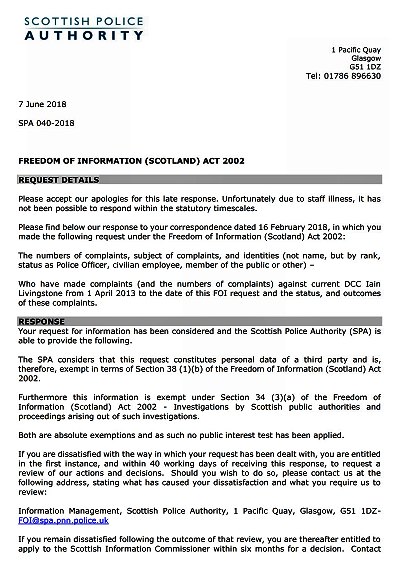
In their response, issued months late and outwith Freedom of Information timescales, the Scottish Police Authority wrongly claimed the material sought was “personal data of a third party” in a concerted attempt to conceal further details of complaints against DCC Livingstone from the public.

The Scottish Police Authority stated in it’s letter of response, dated 8 June 201: 

The SPA considers that this request constitutes personal data of a third party and is, therefore, exempt in terms of Section 38 (1)(b) of the Freedom of Information (Scotland) Act 2002.

Furthermore this information is exempt under Section 34 (3)(a) of the Freedom of Information (Scotland) Act 2002 - Investigations by Scottish public authorities and proceedings arising out of such investigations.

Both are absolute exemptions and as such no public interest test has been applied.

A request for review has been lodged, and material also sent to the Scottish Information Commissioner with regards to the SPA’s refusal to disclose the information.

The Scottish Police Authority’s eagerness to conceal information in relation to a senior Police Officer - who has been previously accused of 5 allegations of serious sexual assault, and has faced further complaints including an ‘interaction’ with another officer - raises questions about the impartiality of the recruitment round to appoint a new Chief Constable to Scotland’s crisis hit single Police service.

With reference to the five allegations of serious sexual assault, Iain Livingstone was cleared of sexual impropriety or intent – by a tribunal headed by a male top cop colleague – Assistant Chief Constable John McLean of Strathclyde Police.

The former lawyer and Raith Rovers footballer had been suspended for 17 months after the WPC claimed she had been sexually assaulted during the party.

A qualified lawyer and member of the Law society of Scotland, Mr Livingstone switched careers in 1992, joining Lothian and Borders Police.

In just 10 years, Livingstone – who had also once played for Raith Rovers - had clearly been fast tracked, reaching the rank of superintendent.

At the time of the allegations and ‘internal’ investigation by his Police colleagues, Livingstone was not prosecuted by the Crown Office over the claims.

Instead, Livingstone admitted a less serious allegation about being in the woman's room overnight and falling asleep.

It should be noted that during the time of the investigation & tribunal, handled by Police, the Lord Advocate was Colin Boyd, Baron Boyd of Duncansby – now a judge in the Court of Session, and the Solicitor General was Elish Angiolini – recently appointed by Nicola Sturgeon a Scottish Minister to investigate how complaints are handled against Police in Scotland – reported here: PROBE CONFLICT: £604K public cash inquiry magnate Ex Lord Advocate appointed to investigate Police complaints – linked to lawyers representing cops facing complaints

A full report on Police Scotland’s refusal to release the details of allegations against Iain Livingstone can be found in an earlier article here: TOP COP SECRETS: Transparency lacking at Police Scotland as spy scandal cops refuse to disclose files on complaints & historical sexual assault case details involving Deputy Chief Constable Iain Livingstone

A report on the Scottish Police Authority’s refusal to release information in connection with the allegations of sexual assault against Iain Livingstone can be found here: THE COP FACTOR: Scottish Police Authority refuse to release documents on sex assault case top cop who wants to be Chief Constable - now, new info said to contain more complaints & references to ‘interaction with another officer’

Sunday, December 18, 2011

Identity of Mr Big who paid for ‘hitman’ to slash Law Society ex Chief Accountant ‘is known to Police’ as Robert Graham gets ELEVEN years for attack

Robert Leiper Graham was sentenced to eleven years for attack on Law Society’s Chief Accountant Leslie Cumming. ROBERT GRAHAM (46), the ‘hitman’ who was convicted in mid November 2011 by a majority jury verdict after being extradited from Australia to face trial for carrying out an attack on Leslie Cumming the now retired Chief Accountant of the Law Society of Scotland,  was sentenced to ELEVEN YEARS earlier this week on Thursday at the High Court in Edinburgh for his part in what was alleged to have been an attempted murder bid rather than ‘a wounding’ (as key legal insiders suspect) to warn Mr Cumming off investigating ‘crooked lawyers’.

The mysterious attack on Leslie Cumming in 2006, was the subject of private briefings given by the Law Society’s most senior officials, seeking to blame the attack on critics of the legal profession yet only one single newspaper ran the Law Society’s claims after it had become clear the attack was most likely organised by a crooked colleague of Mr Cumming connected to or from within the legal profession itself.

Reported on BBC News and in the Daily Record newspaper, Judge John Morris QC, passing sentence in Edinburgh, told Graham: "You have been convicted by a jury of a pre-meditated and sustained murderous attack on a member of the public going about his lawful business, and you did that apparently for financial gain.” He continued : "In these circumstances I'm sure you'll appreciate a substantial custodial sentence is appropriate." Judge Morris also recommended deportation for Graham after he had served his sentence.

While Graham has never admitted who paid him to carry out the attack, it is widely accepted Police are well aware of the identity of the villain(s), reported to be connected to Scotland’s legal world. However as of yet, no steps have been taken to arrest anyone else in connection with the 2006 attack, casting doubt on the ability of Lothian & Borders Police to get the individuals behind the crime, whose identity & position some say “may be causing fear & alarm in legal circles for the opening of a larger can of worms if additional arrests are ever made.”

TRIAL OF LAW SOCIETY ACCOUNTANT’S ATTACKER :

During the trial, Graham denied attempting to murder the Law Society accountant, claiming he did not assault Mr Cumming, rather he intervened in the attack, (allegedly carried out by another party) to stop Mr Cumming getting “a bigger hiding”. Graham also told the court he was born in Ireland as Paul Francis McGhee before emigrating to New Zealand at the age of nine but in Britain he called himself Robert Graham. The court also heard from a witness that Graham had confessed to a colleague that he had "done a judge in" and was paid £10,000 by a guy in a BMW to give him "a good working over".

The witness who told the court of the alleged boast by Graham, scaffolder Nicholas Wells said he started work at Wembley Stadium in January 2006 and Graham joined a few weeks later. In a statement to police, he said: "He told me around this time he had done a judge in in Edinburgh, having jumped out some bushes at him. I can recall him telling me the guy from the BMW paid him £10,000 to do the job and told him to give the guy a good working over." Mr Wells told the court he had been approached by the police at a site he was working on in Edinburgh in 2009. Asked if he had told them the truth, Wells replied: "As I remember it at the time." He added: "I was taking a lot of drugs at the time. I was taking a lot of sleeping tablets ... it is hard to remember it all clearly now."

The court heard that during the assault, Mr Cumming grasped the balaclava worn by the attacker in an attempt to pull it off while further DNA evidence was recovered from the Barbour jacket Mr Cumming was wearing at the time of the attack. Additional DNA material was taken from Mr Cumming before doctors treated his wounds, and the DNA was linked back to Graham in tests.

At the conclusion of the trial, John Logue, Area Procurator Fiscal for Lothian & Borders, said: “In 2006 Robert Graham targeted and tried to kill Leslie Cumming because he was paid to do so. Today, almost six years later, he has been found guilty of this vicious and cowardly attack after being extradited from Australia.”

Mr Logue continued : “He was brought to justice by the perseverance and diligence of officers in Lothian and Borders Police who tracked him down, assisted by Interpol and authorities in New Zealand and Australia. I hope that today’s successful prosecution will secure the confidence of the Scottish public that those who try to evade justice will be pursued and brought before the courts.”

Commenting after the majority verdict convicted Robert Graham of the attack on Mr Cumming, the Solicitor General for Scotland, Lesley Thomson QC, said : "He uses the name Robert Leiper Graham in this country and Paul Francis McGhee in New Zealand. The Crown is not in a position to say he is either of these people at this stage." Ms Thomson also said when Graham left New Zealand in 1999 there was an outstanding warrant out for him and that a notice had been served on him in a move to deport him from Britain.

Leslie Cumming, former Law Society of Scotland’s Chief Accountant. At the end of the trial, Mr Cumming commented : "The police perseverance and professionalism and the Crown Office input have been vital in securing the result. It's important to me that I got that closure and I just want to thank the members of the team who were involved in this complicated case for their efforts on my behalf. The actual event was horrific and bloody and having to explain to the court in such detail as we could recall at this time was traumatic for my wife and me. I hope now the trial is complete and the result is known that this nightmare has ended for us and we can get back to normal life."

However, the multi million pound investigation carried out by Lothian & Borders Police and the subsequent conviction of Robert Graham left more questions than answers over why the attack occurred in 2006, who allegedly paid Graham to carry our the attack and why Law Society of Scotland officials and a media outlet were so keen to pin the blame for the attack on critics & campaigners in a year where the Scottish Parliament had begun a major investigation into the Law Society of Scotland and its notoriously prejudiced closed shop handling of the regulation of crooked lawyers.

Over the years, insiders have claimed the Police have a good idea of exactly who ordered the attack on Mr Cumming, some even linking up the incident to other well reported frauds in Scotland which involved millions of pounds, well known crooked solicitors and a banker. However Lothian & Borders Police have said nothing officially on any of these claims.

The answer to the attack may well lie in Leslie Cumming's role with the Law Society of Scotland, where as its Deputy Chief Executive and Chief Accountant, Mr Cumming was in charge of teams of inspectors who audit the financial accounts of law firms to ensure compliance with the Law Society’s rules (rules to keep accounts, not rules to rip off clients as much as possible and undetected). Mr Cumming was also involved in disciplinary cases, of which there are many, many resulting in no criminal convictions where, for example a solicitor might make off with half a million pounds from a deceased’s client will, and get away with it, and be allowed to carry on working.

It is also noteworthy Mr Cumming in his role as Deputy Chief Executive played number two to the also now former Chief Executive Douglas Mill, who resigned in disgrace after a scandal involving the fiddling of Master Policy insurance claims against crooked lawyers which was exposed by the now Cabinet Secretary for Finance, John Swinney during a meeting of the Justice 2 Committee later the same year Cumming was attacked. The video footage of Mr Swinney’s exposure of Douglas Mill & the Law Society’s Master Policy fraudulent insurance fiddle scheme, can be viewed online HERE.

The conviction of Graham for the assault on Mr Cumming also closes the book on the Law Society’s attempt to fit-up critics & campaigners for the 2006 incident, where it was reported, senior Law Society officials had even provided statements to Police urging them to ‘collar’ persons the Law Society ‘did not get along with’.

Law Society of Scotland officials used Police, newspapers in attempt to link their critics to attack on Chief Accountant Leslie Cumming The Law Society of Scotland has of course, declined to explain why its senior officials gave private briefings to newspaper journalists just after the attack on Mr Cumming in late January of 2006, urging the publication of stories which were intended to pin the blame for the assault on Mr Cumming on critics & law reform campaigners who were seeking an end to self regulation of the legal profession (Cash laundering link to law chief stabbing, 29 January 2006, Scotland on Sunday). However, journalists at the time identified those at the Law Society who were involved in the private briefings & telephone calls to newspapers. Strangely, not one Law Society official was identified in the Scotland on Sunday story despite the highly charged accusations levelled against critics & law reform campaigners published in the paper.

A spokesperson for the Law Society of Scotland said of Mr Cumming at the end of the trial : "He was a dedicated and popular member of staff and the attack was a great shock to his former colleagues. Leslie was determined not to let the attack stop him from living life to the full and he has done that in so many ways."

Like his former Boss, Douglas Mill who has a consultancy business, Leslie Cumming now runs his own consultancy business, Leslie Cumming Consultancy Services.

The trial of Robert Graham at the High Court in Edinburgh commenced on 7 November 2011 and last for 9 days. It was prosecuted by the Solicitor General for Scotland, Lesley Thomson QC, who was the Procurator Fiscal in the abandoned Fatal Accident Inquiry into the death of a young girl who was massively overdosed with radiation, the Crown Office made the usual claims “lessons will be learned”.

Mr Logue’s claims that those who try to evade justice will be pursued & brought before the courts apparently do not apply to lawyers who swindle millions of pounds from the legal aid budget each year in multiple frauds, as revealed by Diary of Injustice in an earlier report here : FOURTEEN lawyers accused of multi-million pound legal aid fraud escape justice as Scotland’s Crown Office fail to prosecute all cases in 5 years

In a double slap to Mr Logue’s contentions of what happens to those who evade justice, one of the FOURTEEN alleged legal aid fraudster lawyers who escaped prosecution by the Crown Office, was/is married to one of Mr Logue’s own Procurator Fiscal colleagues, reported here : Admissible Evidence ? Crown Office Prosecutor married to lawyer accused of legal aid fraud, both still working, Legal Aid Board ‘convinced of guilt’

Diary of Injustice previous coverage of the attack on Leslie Cumming and the saga of the trial of Mr Graham can be read here : The blame game & who paid for attack on Law Society Chief accountant Leslie Cumming

Tuesday, November 08, 2011

Leslie Cumming ‘hit’ trial : Accused pleads not guilty to attack used by Law Society Chiefs in media effort to silence critics of crooked lawyers

Leslie Cumming, former Law Society Chief Accountant was attacked in January 2006, Law Society blamed critics, others blamed corrupt lawyers who feared investigation. NEARLY SIX YEARS after a ‘murder hit’ was carried out on Leslie Cumming, the now retired Chief Accountant of the Law Society of Scotland, the trial of the man charged over the attack, Robert Graham (46) who was arrested in Australia late last year and extradited back to Scotland earlier in 2011, began yesterday at the High Court in Edinburgh, with the accused pleading not guilty to the ‘frenzied attack’ on Mr Cumming, lodging a special defence claiming the offence was not committed by him but by a third party, whose name he did not know.

The attack in late January 2006, saw Mr Cumming suffer multiple stab wounds during an attack near his home in Murrayfield, Edinburgh. However, just a few hours after the attack, Mr Cumming’s colleagues at the Law Society of Scotland rushed to contact journalists at certain newspapers, to organise an effort to blame the ‘murder hit’ on critics of the legal profession & campaign groups who called for reform of regulation of lawyers in Scotland. According to one newspaper journalist who covered the story at the time, private off-the-record briefings were given by senior Law Society officials to selected journalists where it was made plain that critics of the Law Society “deserved to be blamed for the attack”.

Law Society of Scotland officials used Police, newspapers in attempt to link their critics to attack on Chief Accountant Leslie Cumming. As it became clear the Law Society was not to have its way in media attempts to finger its key critics for a part in the attack on Mr Cumming, information discussed among journalists in the few days after the incident revealed that senior officials of the Law Society had provided claims & statements to Lothian & Borders Police alleging critics, campaigners and even some ruined clients who had complained to the Law Society were behind what was described as a ‘murder hit’ on Mr Cumming.

A journalist had also reported from Police sources that “Law Society officials were putting pressure on the Police to interrogate & charge certain people over the incident”, (the same certain people the Law Society wanted to discredit before a Justice Committee investigation into regulation got off the ground later that year) although none of the individuals whose names were allegedly handed over to Lothian & Borders Police by the Law Society reported being contacted by the Police at any time during the investigation.

Yesterday during the first day of the trial of Robert Graham at the High Court in Edinburgh, who is being prosecuted by the current Solicitor General, Lesley Thomson, (who may be better known to some as the Procurator Fiscal in the abandoned Fatal Accident Inquiry into the death of a patient who was massively overdosed with radiation at the Beatson Oncology Centre in Glasgow ), the court heard from Dr Rachel Miller, the forensic medical examiner who examined Mr Cumming in hospital three days after the attack occurred. Dr Millar told the court : “The pattern and type of injuries were consistent with a sustained, frenzied, vicious attack with a sharp, pointed weapon such as a knife which could have had a serrated edge”.

Dr Miller said she was informed that Mr Cumming fell onto his knees pulling the attacker towards him. The attacker had then walked away. She said Mr Cumming had sustained more than 40 injuries, although some were due to medical treatment and others had been picked up while gardening.

Dr Miller continued, telling the court Mr Cumming had injuries to the face, chest, back, arms and legs and that sutures & staples had been used to close some wounds and a chest drain had been put in. Dr Miller said the pattern and type of injuries sustained by Mr Cumming were "consistent with sustained, frenzied, vicious attack" with a sharp pointed weapon which could have had a serrated edge. At the initial hearing yesterday, the jury were also shown photographs of Mr Cumming's injuries.

Today the High Court heard from Mr Cumming himself, who told the jury he saw a "circle of pale face coming out of the darkness" as he emerged from his car in Ormidale Terrace, a lane behind his home in Murrayfield. Mr Cumming went onto describe the attack, telling jurors he realised a blade or knife was involved. He remembered being struck on the side of his face and then shortly afterwards realising he had blood running down the side of his neck. Further details on today’s hearing before judge John Morris QC is reported in the Daily Record newspaper HERE.

Followers of the story so far on the attack on Leslie Cumming will now be familiar with a report which appeared in the newspaper Scotland on Sunday on 29 January 2006,a report which appeared in the newspaper Scotland on Sunday (Cash laundering link to law chief stabbing, 29 January 2006)) a few days after the incident occurred, where senior Law Society figures attempted to pin the blame for the attack on this blog, critics of the Law Society’s poor regulation of crooked lawyers and campaign groups.

Without naming the Law Society officials who said it, Scotland on Sunday reported in the article : Senior figures in the Law Society have made it known they feel some of the websites criticising lawyers are tantamount to incitement to violence” while sources close to the Police confirmed separately to this reporter the highest officials at the Law Society were urging the Police and even the Scottish Executive of the time to stamp out online criticism of lawyers.

At the time of the incident, Diary of Injustice had existed for around three weeks after its creation in the first few days of 2006 to support the passage of the Legal Profession & Legal Aid (Scotland) Bill through the Scottish Parliament in what was to become a very bitter, at times venomous fight between the vested interests of lawyers and consumer groups campaigning for independent regulation of corrupt Scottish lawyers. Needless to say as the evidence now shows, the vested interests won and what became the Scottish Legal Complaints Commission was compromised by the Law Society before it began its official duties in October 2008.

Turning back to the attack on Mr Cumming, as the years dragged on without a result on the case, and after several appeals by Lothian & Borders Police to catch the attacker, along with a report on the BBC’s Crimewatch programme, a development eventually led to the arrest of Robert Graham in Australia in early November of last year, reported by Diary of Injustice here : Australian Police arrest suspect in connection with 2006 murder bid on Law Society of Scotland Chief Accountant Leslie Cumming.

Police hunt for clues on the attempted murder of Law Society Chief Accountant Leslie Cumming in January 2006 (click image or HERE to view video)


The trial at the High Court in Edinburgh is expected to last all week. Mr Cumming retired from the Law Society of Scotland after the attack and now runs his own consultancy business, Leslie Cumming Consultancy Services.

Thursday, August 25, 2011

Simon San Murder : Not so fast Lord Advocate, We need full explanations, may be independent inquiry says Justice Committee Convener Christine Grahame

Christine GrahameHolyrood Justice Committee Convener Christine Grahame wants explanations from Lord Advocate, Police over failures in Simon San murder case. FOR ONCE in its long history of appearing to operate without any oversight, the Crown Office & Lord Advocate may not escape so easily with the usual excuses in a murder case so appallingly handled it generated an apology from the Police Force which investigated it as CHRISTINE GRAHAME msp, the Convener of the Scottish Parliament’s Justice Committee tells BBC News there may be room for an independent public inquiry into the authorities handling of the investigation & prosecution of the racially motivated murder in August last year of Simon San.

Christine Grahame talks to BBC News : Full explanation is needed, there might be room indeed for an independent inquiry (Click image to watch video)


Christine Grahame spoke to BBC News, saying a "full explanation" was needed from the Lord Advocate, who had said in a statement the media were told was ‘attributed to a spokesperson’ on Tuesday that an inquiry would not be held by the Crown Office.

Ms Grahame told BBC Scotland: "I think we need full explanations from the constabularies about what their processes are following on from this case and we need a full explanation from the Lord Advocate.Once these are in the public domain then we can see where we go from there. If these explanations are not satisfactory then there might be room indeed for an independent inquiry."

Simon SanSimon San, murdered in a racist attack by thugs in Edinburgh. The Daily Record newspaper reported on the failures by Police & the Crown Office in the murder of Mr San, saying : Simon, a shy, gentle man who hated violence, was ambushed outside his family's Yong Hua Garden takeaway in Lochend, Edinburgh, in August last year. A pack of feral youths surrounded his Smart car and began rocking it back and forth. Simon phoned police and got out of the car.

Witnesses saw the gang force Simon back towards a wall. Reid then punched him in the face while he was on the phone. Simon hit his head on the pavement and suffered fatal brain injuries. The scum went through his pockets and stole his car keys and phone as he lay dying. Locals then heard the neds calling their victim a "Chinky".

Simon's family told the cops he was a victim of racial hatred but their warnings fell on deaf ears. Instead, the police focused on the idea that Simon was the victim of a robbery gone wrong - a theory the force's own report into the failed investigation calls "misguided".

The report says "little emphasis" was placed on the gang's racist language. The "interview strategy" for the four accused included "a number of questions relating to robbery, but none regarding any racist element or language". The cops also failed to properly look at possible racial incidents in the gang's records. Police papers said one was "racially prejudiced" and had previously been reported for a racist offence.

The prosecution of those involved in the death of Mr San earlier this year saw the conviction of a 16 year old youth, John Reid, who admitted the culpable homicide of Mr San and was sentenced to five years for the killing. Two other 16-year-olds pleaded guilty to assault charges in connection with the case, however in April, Michael Roberts, had his original 42-month sentence cut to 26 months and Keir Rodger had his 34-month term cut to 24 months by appeal judges. A 14-year-old, who cannot be identified, who also faced an assault charge in connection with the death of Mr San, had his not guilty plea accepted by the Crown but admitted breaching bail conditions.

Full report on calls for an independent inquiry the Simon San murder case from BBC Scotland (click image to watch video)


Deputy Chief Constable Steve Allen’s apology to the family of Simon San was reported throughout the media in which the Capital’s Police Force admitted failures to treat the murder of Mr San as a racially motivated incident.

Lothian & Borders Police Deputy Chief Constable Steve Allen said: "There is no doubt that Simon's family have not had the service from my force that we would hope to give any family or any victim of crime. I have apologised privately to the family for that failure and would like to repeat that apology publicly."

Aamer Anwar, the San family solicitor, said: “Simon San's family lost faith and trust in police because of the actions of these officers. They feel had they not complained about their treatment, they would have never found out about the mistakes made by the officers. The officers may well be disciplined but for Simon's family they have played a role in lack of justice which they should have been entitled to as a grieving family.”

“Simon's father believes his son lost his life and is convinced that the accused received a lesser sentence because the officers failed to investigate the racial motivation of this case. They also feel that they were treated in this manner because they were Chinese.”

Lord Advocate Frank MulhollandLord Advocate Frank Mulholland – ‘will not be instructing an inquiry’. However, in stark contrast to the apology from the Police and demands for an inquiry from the victim’s family, the Crown Office in what many will see as a now typical reaction to the call for an investigation by the Lord Advocate, issued a blunt statement denying there was any evidence to treat the case as racially motivated or that an inquiry was needed. A spokesperson for the Crown Office adding to their original statement : "We can confirm the Lord Advocate will not be instructing an inquiry and is satisfied with the Crown's prosecution of the case. Mr John Logue, the Area Procurator Fiscal for Lothian & Borders, has offered to meet with Mr San's family to discuss any questions which they might now have."

There has been no reaction today from the Crown Office to Ms Grahame’s welcome comments on the matter, however clearly in the interests of justice, there must be a full inquiry into the murder of Simon San to establish how the authorities have let down his family, the justice system, and Scotland.

Wednesday, August 24, 2011

Racist murders in the East, Sectarian letter bombs & deaths in the West : Are Scotland’s Crown Office & Police institutionally out of touch ?

Crown OfficeDoes the Crown Office have the will to investigate racist or sectarian crimes in Scotland? IN a country where the authorities appear to avoid investigating murders as racially, or even religiously provoked at all costs, and where members of religious or racial minorities are, according to academics, statistically more likely to be jailed by an apparently prejudiced justice system, it comes as no surprise that over a decade after the racially motivated murder of Surjit Singh Chhokar, there are now new calls for an inquiry into how the Crown Office and now, Lothian & Borders Police, avoided investigating the murder of a Chinese man from Edinburgh, Simon San in August 2010 as a racially motivated crime.

In a statement released by Lothian & Borders Police, the Deputy Chief Constable Steve Allen has apologised to the family of Mr San for not investigating the murder as a racist incident.

Simon San was attacked whilst at work in the Lochend area of Edinburgh in August 2010. He suffered injuries from which he died and Lothian and Borders Police launched a murder inquiry. Four young men were quickly identified and subsequently appeared in court.

The prosecution of those involved in the death of Mr San earlier this year saw the conviction of a 16 year old youth, John Reid, who admitted the culpable homicide of Mr San and was sentenced to five years for the killing. Two other 16-year-olds pleaded guilty to assault charges in connection with the case, however in April, Michael Roberts, had his original 42-month sentence cut to 26 months and Keir Rodger had his 34-month term cut to 24 months by appeal judges. A 14-year-old, who cannot be identified, who also faced an assault charge in connection with the death of Mr San, had his not guilty plea accepted by the Crown but admitted breaching bail conditions.

According to the statement released by Lothian & Borders Police, Mr San's family made a number of complaints about the police response and an internal investigation was undertaken. This investigation, which was known as Operation Waymark, is now completed. The San family has been involved throughout and the report has been discussed with them.

Lothian & Borders Police Deputy Chief Constable Steve Allen said: "There is no doubt that Simon's family have not had the service from my force that we would hope to give any family or any victim of crime. I have apologised privately to the family for that failure and would like to repeat that apology publicly."

Mr Allen also apologised on behalf of the organisation for not listening to the family when they said they thought the attack was racially motivated; for not making them feel that their views mattered, and for not recording and investigating the attack on Simon as a racist incident.

He added: "We said that Simon was in the wrong place at the wrong time. He was not. Simon was at his place of work in a city that was his home. He was playing his part as an active member of our community, contributing through work to the economic success of this city. Simon was a fellow citizen who was killed tragically and pointlessly."

The force is committed to learning from Operation Waymark and is now more alert to the needs and perception of family members. It has already taken steps to review its management of critical incidents and is refreshing guidance and training given to all officers and police staff in relation to identifying when a hate crime has occurred. The DCC has also spoken individually to all officers and police staff mentioned in the complaint.

Mr San's family have been supported all along by Edinburgh and Lothians Regional Equality Council. ELREC's chairman, Mr Foysol Choudhury, said: "We commend the family for their courage and perseverance to ensure the mishandling of Simon's murder investigation is made public and other families who experience a similar event will not have their suffering prolonged. We also want to thank the enquiry team for their effort in delivering the answers the family had been seeking."

Aamer Anwar, the San family solicitor, said: “Simon San's family lost faith and trust in police because of the actions of these officers. They feel had they not complained about their treatment, they would have never found out about the mistakes made by the officers. The officers may well be disciplined but for Simon's family they have played a role in lack of justice which they should have been entitled to as a grieving family.”

“Simon's father believes his son lost his life and is convinced that the accused received a lesser sentence because the officers failed to investigate the racial motivation of this case. They also feel that they were treated in this manner because they were Chinese.”

'Mr Trieu Seng San (father of Simon San) stated : “Simon San was the youngest of my six children. He was a good son and a good brother. Simon's murder destroyed the whole family. I, along with my family, am very angry with the treatment we received from Lothian and Borders Police. The findings do not offer me any peace; they merely confirm that we were right that we have not been treated appropriately by the officers.”

“The racial motivation was completely denied by the officers despite there being evidence but though this material was provided to the Crown Office, the sentencing Judge and family were told there was no such evidence. The family welcome the findings and thank Lothian & Borders Police for their robust inquiry, but still feel they have been denied justice. They are now requesting that the Lord Advocate order an immediate inquiry into their actions following the findings of the Police Complaint.”

The Crown Office released the following statement in response to the apology to the San family from Lothian & Borders Police over their failures in the murder of Mr San. The statement from the Crown Office denies there was any evidence in law to show to show that the attack on Mr San was racially motivated , however as yet the statement does not appear on the Crown Office website.

The statement, from a Crown Office spokesperson said : Lothian and Borders police have today apologised for mistakes they have made in this case. In light of this apology the Area Procurator Fiscal has offered to meet Mr San’s family again to discuss any questions which they might now have.

The Crown was alert to the question of racial motivation from the beginning of the investigation and raised the issue with the police at an early stage. After careful consideration of all the available evidence provided to the Crown by the police, Crown Counsel concluded that there was no evidence to show that the attack on Mr San was racially motivated.

For a racial aggravation to be proved there must be evidence to demonstrate the motivation for the commission of the crime. There was no evidence in law to support this and this remains the case. There was evidence of a racial term used by the accused sometime after the crime but this was not evidence of motivation for the crime.

Notwithstanding this the Advocate Depute advised the High Court when John Reid pled guilty to culpable homicide in October 2010 that it was the strongly held view of Mr San's family that the offence was racially motivated. In addition a victim impact statement was provided to the court which conveyed the family’s views on the motivation for the crime.

The Solicitor representing the family thanked the Advocate Depute prior to the accused pleading guilty for the sensitive way in which the family had been treated and the way the case was presented.

There are now, unsurprisingly, questions being raised why the Crown Office failed to prosecute the murder of Mr San as a racially motivated crime and there are now calls for an inquiry into the way the Crown Office handled the case. However, the Crown Office have refused calls for an inquiry into why the incident was not investigated as a racially motivated murder.

A spokesperson for the Crown Office said : "We can confirm the Lord Advocate will not be instructing an inquiry and is satisfied with the Crown's prosecution of the case. Mr John Logue, the Area Procurator Fiscal for Lothian & Borders, has offered to meet with Mr San's family to discuss any questions which they might now have."

Last night on BBC Newsnight Scotland, the Deputy Chief Constable of Lothian & Borders Police Mr Allen was interviewed on his force’s investigation of the case, however Crown Office officials apparently refused to take part in the programme, or at least “were unavailable”, as is now the recognised code for nothing further to add.

Lothian & Borders Police DCC Steve Allen speaks on his force’s failures in the racially motivated murder of Simon San (click image to watch video)


The overall impression is that any lessons supposedly learned from the recommendations from the ‘independent inquiries’ carried out by Advocate Raj Jandoo of the Crown Office’s failure to prosecute the 1998 murder of Surjit Singh Chhokar as a racist crime, have after all these years, not had much effect on how racist cases are eventually prosecuted in the justice system. The accusations at the time of Surjit Singh Chhokar’s murder was that the Crown Office and the Scottish justice system was institutionally racist. Today, the same accusations appear to hold sway.

In a remarkable twist of fate, the author of the reports into the Chhokar case, Dr Jandoo, may well have been the victim of racism himself, after being convicted in 2005 of an incident involving a "bomb threat" aboard an aircraft flying to the Isle of Lewis.

Whilst it is now clear that racist crimes face an uphill battle to be prosecuted in the Scottish justice system, crimes involving sectarianism also appear to suffer the same problems, where a string of murders across Scotland in the past year, regarded widely by many in the communities in which they occurred as having sectarian connotations, have not seen even a hint of the notion being put forward by the authorities who appear to be doing everything they can to avoid any mention of religious divisions in Scotland.

Even the Scottish Parliament’s Petitions Committee who were considering a public petition, Petition PE1073 which challenged the Scottish Justice system for incarcerating religious minorities including Catholics at a higher rate than the rest of the population, met in secret to debate whether to even publish research carried out by an academic which backed up the Petition’s claims, such is the apparent fear of acknowledging sectarianism within Scotland and even our justice system.

The research, undertaken by Dr Susan Wiltshire of Glasgow University for the Petitions Committee, can be downloaded from the Scottish Parliament’s website, here : Offender Demographics and Sentencing Patterns in Scotland and the UK: Research commissioned by the Public Petitions Committee in consideration of PE1073 (203KB pdf)

Indeed, the only recent moves to tackle sectarianism by the Scottish authorities have come on the back of conflict between groups of football club supporters & online incidents involving death threats against individuals, after letter bombs were sent out to politicians, football personalities and even a Scottish QC, allegedly motivated by sectarianism & religious hate, issues which most in authority in Scotland appear to be keen to sweep under the carpet.

Clearly, there are still attitudes on religious & racist crimes within Scotland’s criminal justice system which are just as “Victorian” as our civil justice system and the impression is left that Scotland’s prosecution services are out of touch with Scottish society and its expectations of justice in the 21st century.

Thursday, January 04, 2007

Complaining against a lawyer ? You should expect a knock from the Police

To all those who made complaints against lawyers .... how long was it before the Police ended up at your door, armed with 'anonymous tips' or information from 'unquotable sources' you were up to something ?

Well, for those who have made complaints of a significant nature against their lawyer .. be that a local lawyer in a small town, or one of the so-called Edinburgh 'high-flyers' ... it doesn't take long before either yourself or other members of your family gain the attention of the Police.

For many who have contacted me over the years, it seems to be little more than a few weeks after making the complaint to the Law Society of Scotland .. about their crooked lawyer,

For me, well .. when I made my complaint against crooked lawyer Andrew Penman , of Stormonth Darling Solicitors, Kelso , I sent a copy to the Scotsman newspaper, back in 1994 .. so I had media attention .. and it took the Police a wee while longer to come knocking on my door. Take it from me, going to the Press as soon as I made the complaint against Penman was probably one of the best things I did for myself, and ultimately, my campaign to bring independent regulation to the legal profession in Scotland.

Scotsman 18 October 1994 Son threatens to walk away from inheritance after legal row

There was another difference though ... I knew the Police in the Borders quite well .. (don't forget, they were almost living with us for several months to catch a gang of drug dealers in Jedburgh) .. so the Police talked [on the side] .. told me what was going on and why I was being targeted. That was the junior officers, you understand .. not the 'big white chiefs' .. with all their wire braiding ... that lot were obviously well in the hook of the legal mafia.

I remember some of these incidents quite well.

One Saturday afternoon, for instance, PC Keith Sudlow, turned up on his own at my house in Bongate, Jedburgh, on account that Norman Howitt , the crooked accountant who had ripped off my dad's estate .. and even worse, had stolen my mum's pension book, had made a claim he was being threatened over the sale of my dad's car to his business partner. The origin of the 'threat', was unspecified, but my name was given by Howitt to the Police at Wilton Hill Police Station, Hawick.

However, what had actually happened was that Norman Howitt had given the false information to the Police to knock me off the scent of finding out who he had actually sold the car to at the time - which turned out to be Felix Sears , of Melrose - who was well known to Norman Howitt as a friend & business associate. I hadn't known of the identity of the purchaser of my dad's car at the time - but was told that by the Police .. so Howitt's plan sort of backfired and ended up giving me more information on his crooked dealings involving my dad's estate.

What knocked that particular Police inquiry on it's head, was the wee snippet of information that when Norman Howitt secretly sold my dad's car to his friend, Felix Sears, he stuffed the money into his firm's business accounts - the crooked firm of Borders accountants : Welch & Co, Chartered Accountants, Hawick & Galashiels

When the Cops verified that information .. that was it ... a few off the record apologies to me .. but no action against Norman Howitt - who I think certainly should have been charged with providing false information to the Police, to cover up his own crimes. Wouldn't you agree ?

Another incident I remember quite well, was 30 October 1997, when 3 Police officers, among them, Sergeant Murray, PC Stuart Roughhead & one other, ended up outside our kitchen door brandishing a search warrant & one of those thingies to bash in the door of a house.

Quite a surreal incident that morning, I must admit .... talking to my mum for a few minutes & her giving me a shopping list, then the cops try to break down the door.

Why were the Police at my house that day ?

Well, they had received information from one of the lawyers I had made a complaint against, that I was up to no good .. so they were here to shake me & my mum down.

Of course, the Police entered the house, and began having a look around, then after Sgt Murray actually decided to tell me his name, I asked, "hmm .. are you by any chance, Kevin Murray's dad ?" .

His face went as white as a sheet. He said "Yes, I am. How do you know Kevin ?"

"Well", I said, "Kevin, your son, has been one of the CID officers operating in my house & property for months to catch the drugs gangs in Bongate View".

The officers looked at each other in astonishment, and I could see what was going to happen next.

The 'search' on the bogus information provided by one of the crooked lawyers I was complaining against, stopped. The conversation then went on to stuff such as "ooch, the weather is a wee bit chilly today" & "how nice the posters were on my bedroom wall" ... It seemed one particular blonde caught the eye of Sgt Murray .... If the new retired Sgt Murray is reading this, he will no doubt remember verbatim what happened that day .. or of course, I could play it back to him ...

So that was it .. search ended, after I had asked what the hell was going on, why were we being searched, and why, then the Police had been in our house for so long, was I obviously being accused of something I couldn't have possibly been up to - whatever that was .. because I still don't know.

After the officers left, I found out a wee bit more about what had happened.

It seemed .. the clever lawyers & their friends in the Police, had been unaware of the months long Police operation at my house .. and that when the Procurator Fiscal had been asked to sign the search warrant for my house on that morning, he was actually fresh from a meeting with the Officer in charge of G Division CID at the time, discussing the actual operation to catch the drugs dealers in Bongate View.

Well, there is another version .. perhaps more sinister ...

I was told that the information may have been given to the Police to kill off the drugs operation against the Jedburgh drugs dealers .. so they could go on selling drugs ... I certainly didn't believe that at the time, but come to think of it now, the family who were selling the drugs to all the Jedburgh kids, were represented by this particular legal firm .... so you see .. there could have been a motive there.

I remember a string of other visits from the Police, all on the back of false information provided by crooked lawyers in an attempt to 'persuade' me into dropping complaints against them .. but of course, I had too much press attention .. so nothing could ever really be done against me on that level ... lucky me ..because some of the other visits had the prospect of harm to myself.

Well, the Herald Newspaper is reporting that another individual seems to have gone through the same as me - a few years before my experience ... and the alleged Police involvement in a long history of intimidation & worse against the individual, Mr Duff, seems to spring from .. complaints made against lawyers.

Well, I am running another story related to this issue soon, .. so I wont spoil that one, but for now, read of Mr James Duff's experiences with the Police .. and remember folks ... it seems to be quite common for crooked lawyers to provide the Cops with malicious allegations against complaining clients, to cover up their crooked behaviour .. and this tactic mostly works .. although not so much in my case, as there are still plenty in the Police who give me snippets of information on crooked lawyers and a whole lot more besides ...

While reading the Herald's story on Mr Duff, you might like to read FOI Commissioner Kevin Dunion's decision in favour of Mr Duff on his FOI request to the Police - which is now currently in the Court of Session .. Decision 068-2005 (pdf document)

http://www.theherald.co.uk/news/77924.html

15th-century law brings police chief to court
ALAN MacDERMID January 03 2007

A former businessman who claims to have been ruined by faked police reports has invoked an ancient Scottish law to have a chief constable brought to court.

Jim Duff used an action known as lawburrows, dating to 1429, to obtain a warrant citing David Strang, head of Dumfries and Galloway Constabulary, to appear.

It was granted by Sheriff Smith at Dumfries Sheriff Court and the hearing is due to take place there on January 18.

In his court papers Mr Duff, a former housebuilder from Lochmaben, Dumfriesshire, stated he was in business until 1976 when he was "illegally made bankrupt".

He alleged that Mr Strang's officers had for years been involved in defrauding him of his lands, house and money by conspiring with a former Dumfries solicitor.

Lawburrows is described as an ancient Scottish remedy against anticipated physical harm to a person or damage to property. To obtain an order for lawburrows, the applicant must show he has reasonable cause to believe the respondent will cause bodily harm to him, his family or property. It is easier to obtain than an interdict and could require Mr Strang to post a bond of up to £10,000 for his future behaviour.

Mr Duff claimed he had "a vast amount of evidence" to prove his cases, including fake police reports. He said that, in January 2005, he applied under the Freedom of Information Act for copies of the reports, and claimed that, when he received them, officers' names were blanked out on the orders of the chief constable. He had been ordered later by the commissioner to name the officers, which he had done.

Mr Duff said he had written to Mr Strang 83 times between 2004 and 2006 advising him that reports had been fabricated and requesting him to ask another chief constable to investigate. He said Mr Strang refused and "incited his officers to further fabricate reports in order to mislead the procurator-fiscal and the Crown Office."

Mr Duff said he had been living in fear for years and believed the chief constable "would continue his vendetta against him".

His action calls for the sheriff to order Mr Strang to find caution of £10,000 "or such other sum as the court considers appropriate" and if he fails to do so to grant warrant for his imprisonment for a period not exceeding six months.

Last year, Mr Duff raised a similar action against the Lord Advocate at Edinburgh Sheriff Court. It was dismissed, but he is appealing and a hearing has been set for January 23.

Mr Strang was not available for comment yesterday.

How lawburrows 'terrify evil doers'

Lawburrows was first enacted by the parliament of James I in 1429 as a remedy against threats to the safety of members of the public. The aim stated in the Act was "...to prevent such delinquencies (the issuing of threats) and terrify evil doers..."

It has a number of advantages over the interdict – the most common action against someone who threatens violence – which can be refused by the court on the grounds of public interest, requiring witnesses to be provided by the applicant. It also leaves uncertainty about what happens should the defender disobey the interdict. If it is a first offence, a nominal punishment or warning may be imposed.

Lawburrows, however, is noted for its simplicity, speed of execution, low cost of process and the absolute certainty of the exact penalty should the order be contravened. Neither the police nor procurator-fiscal is initially involved.

In an initial writ to the Sheriff Court, the pursuer asserts that he fears harm to his person, property, family, tenant or employees from the defender. He asks the sheriff to obtain a certain sum of money (a "caution") or a bond as security against being molested or troubled further by the defender.

As soon as this writ is received, the sheriff must immediately order it to be served on the defender and a date for an early hearing has to be fixed.

At the hearing, the standard of proof is "on the balance of probabilities" as in other civil actions, so only one credible witness is needed if there is evidence to show there are reasonable grounds for the pursuer's fear of harm.

If the pursuer is successful, the sheriff can order a sum of money to be found (or a bond to be given) and he can order that, should the defender fail to provide this, he shall be imprisoned for up to six months. If the defender does any harm of the kind specified in the writ, the pursuer may raise an action for "contravention of lawburrows" asking that the money be divided equally between the Crown and himself

Sunday, November 26, 2006

Deputy First Minister faces Police inquiry over fiddled mortgage expenses claims as more revelations on msps property deals come to light.

A fiddle or a muddle ? .. but when it comes to the Scottish Parliament, a muddle is always a fiddle .. and that's how one person viewed Deputy First Minister Nichol Stephen's claims for mortgage interest payments from the Parliament, as a member of the public has made a complaint to Lothian & Borders Police, asking for an investigation into the affair - reports the Sunday Herald newspaper.

Of course, it has taken a member of the public to ask for that step .. as it seems there are no MSPs able to 'cast the first stone' these days ... with virtually everyone at Holyrood having some dark secret in their closet, and being too terrified of revelations on their own conduct coming out in tit for tat leaks - don't worry - plenty more to come out, people !

I wonder how Lothian & Borders Police will handle the investigation ? Another whitewash perhaps ? Ultimately, they can only do what they are told to do ... and the force being as politicised as it is now, I doubt we will end up with a situation where Stephen & a host of other MSPs who have fiddled their expenses & failed to declare income, interests & more, will be carted off in the Black Maria (YES!)

I don't have particularly fond memories of the way Lothian & Borders Police handle investigations ... I remember, for instance, one time when a major drugs investigation was underway in Jedburgh, using my own home as a base for surveillence, a tabloid journalist called me one day to ask the motives of a serving CID officer under the Detective Chief Inspector of CID in "G" Division at Hawick at the time, who was ratting out his own [married] boss for having an affair with a [married] victim of a burglary he had once 'interviewed'. This, and a lot of other things I took note of at the time, including [still serving] senior Officers seemingly out to get their own PCs for making suggestions to the public, led me to believe the Force was fighting itself .. so much that it botched that particular drugs op and left Jedburgh awash with drugs .. to this day it seems. I have still to write about all this sometime ...

There is also the not-so-good record of Lothian & Borders Police at the Scottish Parliament .. on everything from stolen laptops to allegedly stolen cellular phones (all inside jobs by Parliamentary Staff, apparently .. no one caught yet of course) . and then there is the well known cocaine den at Holyrood, where some staff seem to be in an almost permanent haze of the white stuff. Frightening, one would think .. but all allowed to go on right under everyone's noses, as it were. or is it up everyone's noses, I forget .. with all the leaks to leak these days.

Maybe we need to call in Taggart or Hamish MacBeth on this one ... for a wee bit of impartiality ?

Anyway, not to be outdone by the LibDems - who really need chucking out of Scottish politics .. the Guardian & Observer (yes, ENGLISH newspapers) are reporting on the deeds of former & current SNP MSPs and a Green MSP, which it is only fair to report, because it shows there are a lot of the MSPs at it, at the Scottish Parliament.

Well, it will be interesting to see if the Police are allowed to do an investigation .. and even if Stephen is investigated - surely along with several other MSPs ... how will the Crown Office react ? Will they receive political orders to drop the case as Stephen is a Minister in the Scottish Executive ? ... same going for other MSPs who undoubtably should be investigated such as John Home Robertson ... no prosecutions because they are members of the governing party ?

Only time will tell .. but of course, more revelations to come of course ... and next time Mr Stephen .. instead of being kissy kissy with the likes of Tom McMorrow & ICAS, ... please take note of what members of the public have warned you about. Resolving a few issues would save a lot of headlines, you know.

UPDATE 27 November : The Scotsman are covering the Stephen expenses story here : Deputy first minister faces police inquiry over expenses

Also, to answer questions on my interest in Nichol Stephen's expenses fiddle, which came out of ICAS claims to the press, back in July, of getting the OK on amendments which run contrary to my campaign regarding regulation of legal complaints in the LPLA Bill, read this :
Scottish Accountants try to amend LPLA Bill for their own benefit - but refuse independent regulation safeguards for the consumer

Links from the Sunday Herald and Guardian to follow :

http://www.sundayherald.com/news/heraldnews/display.var.1042292.0.0.php

Stephen faces police probe on mortgage
By Paul Hutcheon

THE DEPUTY First Minister is facing a police probe into a breach of Holyrood expenses guidelines that resulted in him receiving around £50,000 in mortgage payments charged to the taxpayer.

Lothian and Borders police have been asked to investigate why Nicol Stephen, the Scottish Liberal Democrats leader, gave inaccurate information to parliament about a loan he took out on a property in Edinburgh.

Solidarity MSP Tommy Sheridan is also threatening to take the matter to Holyrood's standards committee.

The row follows the Sunday Herald's revelation last week that Stephen, who is also the Scottish Executive enterprise minister, is billing the taxpayer for mortgage interest payments on a house jointly owned with his wife. He has been charging the public almost £9000 a year through the Edinburgh accommodation allowance (EAA) to stay in a house in Morningside, despite rules blocking payments for joint mortgages.

Stephen failed to tell the parliament in 2003 that his mortgage was taken out with his wife and instead submitted a document which only had his name on it, thus entitling him to the payments.

The revelations prompted Stephen to inform officials about the false information he provided just hours after the Sunday Herald story came out.

The parliament's corporate body, which runs Holyrood, ruled on Thursday that Stephen had "failed to follow the guidelines" on allowances and slapped the MSP on the wrist. But Holyrood stopped short of calling on Stephen to pay back the near £50,000, as members ruled he had not intended to break the guidelines.

Stephen accepted his error but claimed he had not benefited financially. The deputy First Minister said he would transfer the property into his name, a move that will entitle him to keep claiming the payments.

However, a member of the public has urged police to investigate the Minister's role in providing false information to the parliament. The letter of complaint calls on officers in Lothian and Borders police to examine whether an "error" was committed and why the LibDem leader declined to inform parliament he had a joint mortgage.

And Tommy Sheridan said: "I am going to write to the presiding officer, George Reid, because I think it is wrong that people who receive the allowance judge whether another member who received the EAA broke the rules. If he doesn't do anything about it I will refer it to the standards committee."

A Scottish Liberal Democrats spokesman said last night: "There is no question of gain to Mr Stephen or his wife and no cost to the parliament. The parliamentary authorities have made it clear that there has been no improper use of allowances."

and now the Guardian website reports on msps property transactions ...

http://politics.guardian.co.uk/scotland/story/0,,1957465,00.html

MSPs buy and sell houses - and taxpayer pays

Politicians defend profitable Holyrood perk after Nationalist makes nearly £40,000 on flat

Lorna Martin, Scotland editor
Sunday November 26, 2006
The Observer http://www.observer.co.uk

Calls to scrap the accommodation allowance for MSPs were stepped up last night after it emerged that members of the Scottish Parliament were buying and selling taxpayer-funded properties to each other and keeping the profits.

The Observer has learned that Andrew Wilson, the former Nationalist MSP, made nearly £40,000 when he sold his Edinburgh flat to Nationalist MSP Rob Gibson and his partner, the Green MSP Eleanor Scott, after losing his seat in the 2003 elections. All three have billed the public for mortgage interest payments on the same property.

Wilson bought the flat in May 2000 for £92,000 and sold it more than three years later for £130,000. He qualified for the housing perk because he lived too far away to commute daily to Edinburgh. Land registry documents show that when he was an MSP, Wilson was registered as living in Milngavie, Glasgow, at a property owned by the parents of his friend Duncan Hamilton, another former Nationalist MSP.

When Wilson sold his Edinburgh flat to Gibson and Scott, they started to claim mortgage interest payments on the property. It will now be worth significantly more than the £130,000 they paid.

While there is no suggestion the politicians have broken any rules, it highlights the money-making potential of the housing allowances for MSPs.

Last night Gibson said Scots were getting their MSPs 'dirt-cheap'. He said he would welcome an independent review but insisted the current system was effective and efficient.

'If you add up the costs of those who rent or those who stay in hotels, buying is by far the cheapest option,' he said. 'When Andrew [Wilson] was selling his place the market was very buoyant, but who knows what it might be like in four years?

Gibson added: 'What has also not been mentioned are the capital costs, such as furniture, we are required to make for a second home. I would welcome an independent review as it would reveal the comments of Tommy Sheridan and the tabloid suggestion that this is a money-making scheme to be inaccurate.' Dr Scott accepted that there was a public perception issue regarding the allowance. 'It is important that MSPs are not making rules to suit themselves,' she said. 'That is why the Greens have tabled a motion asking for a completely independent review of all MSPs' expenses and allowances. I'd be happy to adhere to whatever they come up with.'

Modelled on the Westminster system, Holyrood's accommodation allowance permits MSPs to claim rent or mortgage interest payments on a property in Edinburgh, or to stay in a hotel. Annual payments through the allowance are capped at about £11,000. The scheme also permits recipients to claim for council tax, as well as for a television licence and bills.

On Friday, it emerged that Deputy First Minister Nicol Stephen had broken Holyrood guidelines after claiming thousands of pounds of taxpayers' money to buy a home in Edinburgh, on which he had a joint mortgage in place. The Scottish Parliamentary Body said the rules stated that MSPs were only entitled to reimbursement of mortgages in their own name after 2001. However, it accepted that Stephen had made no financial gain and that the claim had been made in error.

At least 48 MSPs have profited from the mortgage interest scheme, which has cost the taxpayer about £2m since 1999. The main complaint about the perk is that it allows MSPs to buy properties with public cash and then keep the profits when a flat is sold.

Also controversial is the practice of renting from relatives. Labour MSP John Home Robertson has been billing the public £600 a month to stay in his son's flat while Transport Minister Tavish Scott admitted billing the taxpayer to stay at his sister's flat.

Scott used taxpayer's money to help buy a £100,000 flat, made a £36,000 profit, and then used that to help buy a £300,000 family home. He now bills the taxpayer £1,000 a month for that.

Tommy Sheridan, the Solidarity MSP and a long-time critic of the scheme, called for all MSPs who have financially gained to repay any profits.

In a statement on his website, he said: 'There should be no profit made on expenses from the taxpayer and anyone who has made a profit, or is about to, should do the decent thing and give it back.'

Earlier this month, the parliament's presiding officer said the scheme would be reviewed after attracting heavy criticism.