Showing posts with label Colin McKay. Show all posts

Friday, February 11, 2011

Poisoned Chalice : MacAskill forced to parachute Government’s own lawyer onto Scottish Legal Complaints Commission after Advocates shun job offer

MacAskill tight lippedHumiliation for Justice Secretary MacAskill in latest SLCC appointments round as no one applies for lawyer position. KENNY MACASKILL, Scotland’s Justice Secretary and the controversial anti-consumer Scottish Legal Complaints Commission (SLCC) were both left in a humiliating position of being forced to beg Richard Keen QC, the Dean of the Faculty of Advocates for help in finding a suitable recruit to fill a ‘lawyer-only’ position at the ‘independent’ law complaints regulator, the SLCC, after documents published today reveal not one single member of the entire Scottish legal profession applied for one of four newly created & lavishly paid positions on the SLCC’s board.

The lack of any candidates subsequently forced the Scottish Government to appoint its own standing Junior Counsel to the advertised position at the SLCC, in what some say amounted to a face saving exercise for the Justice Secretary.

The humiliating lack of interest from Scotland’s 460 or so Advocates in the latest recruitment drive for the Scottish Legal Complaints Commission’s already lawyer-heavy board was revealed in documents obtained through Freedom of Information legislation which show only one Advocate ‘was identified’ by the Scottish Government’s own recruitment team for the ‘lawyer-only’ position, after no one else from the Faculty of Advocates applied to join the infamously anti-client, anti-consumer SLCC.

The sole ‘identified’ Advocate whose name was entered into the recruitment process was later named by the Justice Secretary as the well known Maurice O’Carroll, who happens to be the Scottish Government’s own standing Junior Counsel.
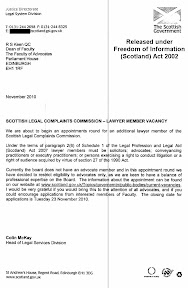
Scottish Government officials were forced to write to Faculty of Advocates after no one came forward to join the SLCC’s board. According to papers released in response to a Freedom of Information request to the Office of the Commissioner for Public Appointments for Scotland (OCPAS), a recruitment panel chaired by Colin McKay, the Scottish Government’s Head of Legal Services Division, encountered difficulties in its stated mission to “identify specific advocates that they could approach” to fill the lawyer-only board appointment, forcing Mr McKay to write directly to the Dean of the Faculty of Advocates himself, Richard Keen QC “for his help in encouraging applications” to join the SLCC. However, it appears the Scottish Government’s plea to the Faculty fell on deaf ears, and not one Advocate came forward to join the frequent flyers from the legal profession who are already rooted on the SLCC’s board.

The lack of interest from advocates in joining the SLCC became such a humiliation, the Scottish Government were forced to ask for an exception to the code of public appointments. An email from the Scottish Government to OCPAS, obtained as a result of a Freedom of Information request read : “The panel interviewed the candidate and considered them suitable for appointment. The Lord President has now confirmed that he is content to accept the Panel’s assessment that the candidate is appointed.“We confirm that the current SLCC lawyer round resulted in there being a lack of choice to fill the lawyer member position on the Board. A low response was not unexpected as the applicants for this appointment must be a advocate practising in Scotland and therefore the pool of candidates is very small. The appointing Minister [Kenny MacAskill] was informed of the situation and gave his approval for the appointment round to continue. I therefore request an exception to the Code to allow us to proceed with the round on that basis.”

Humiliation for MacAskill as “no Ministerial choice being achieved” in SLCC’s lawyer-only board member recruitment process. The OCPAS assessor who sat in on the Scottish Government’s recruitment process reported to her superiors, stating : “This appointment was for a lawyer member with the person specification requiring applicants to be an Advocate practicing in Scotland. This appointment was part of an appointment round also appointing non lawyer members but it was able to proceed on a separate timetable resulting in a much shorter timescale being achieved. This was achieved primarily because of the limited field of potential applicants and the targeted advertising and short application form used.”

“Historically it has been difficult for the Commission to attract Advocates to these appointments. The targeted advertising and short application form may have contributed to the outcome of an appointable candidate being recommended albeit with no Ministerial choice being achieved.”

The Justice Secretary chose to omit any reference to the lack of interest in joining the SLCC, and simply, announced Mr O’Carroll’s appointment in a quietly issued press release, stating : “Mr O'Carroll has extensive and varied advocacy experience. His breadth of experience and professional standing will complement and strengthen the current Board. This appointment will run for five years from a date which has still to be confirmed but likely to be sometime around March. This post is part-time and attracts a remuneration of £212 per day for a time commitment of up to six days per month.”

A senior source within the Scottish Government’s Justice Department speaking earlier this week to Diary of Injustice said : “This has been a face saving exercise for the Justice Secretary. If Mr O’Carroll had not been parachuted into the appointments process, there would have been no takers for the poisoned chalice of a position on the board of the SLCC.”

SLCC jobsThe SLCC announced in November it was looking for four ‘Frequent Flyers” to join its board : High Salaries & little work as a sweetener. The latest recruitment round for adding four additional “frequent flyers” to the Scottish Legal Complaints Commission’s board, where expenses claims are lavish, and work is minimal, were split into three positions earmarked for ‘non-lawyers’ with “consumer backgrounds” and one lawyer member’ who was “required to be a practising advocate”. I reported on the recruitment announcement in an earlier article of November 2010, here : Quangocrats wanted : Scottish Legal Complaints Commission seek ‘non-lawyer’ board members with legal & ‘consumer’ backgrounds at £209+ a day

Solicitors were apparently excluded from the latest ‘lawyer-only’ board member position because the SLCC felt it looked like there were too many solicitors, former solicitors & even non-practicing solicitors on its board already, namely Professor Alan Paterson OBE, FRSE, David Smith, Margaret Scanlan OBE & David Chaplin.

It is also noteworthy that much of the SLCC’s current staff who actually handle the complaints work, migrated over from the Law Society of Scotland’s Client Relations Office, itself which has been the focus of well founded accusations of corrupt self-regulation of solicitors and regular cover ups to protect ‘crooked lawyers’ from complaints lodged by financially ruined clients.

It will be interesting to see exactly who qualifies for the SLCC’s three new ‘non-lawyer’ positions, as the current crop of ‘non-lawyer’ board members comprises two ex-senior Police Officers, a member of the Scottish Criminal Cases Review Commission and a Doctor with several other quango positions including one at the Accounts Commission for Scotland. More details on the SLCC’s board members and their numerous positions can be found in an earlier article, here : More ‘jobs for the boys’ than action on ‘crooked lawyers’ : What it takes to be a Board Member at the Scottish Legal Complaints Commission

A legal insider speaking to Diary of Injustice this morning indicated observers of the SLCC may not be in for too much of a surprise in who will be appointed by the Justice Secretary to the three ‘non-lawyer’ positions currently on offer at £209+ per day along with additional expenses, for as little as six days work per month and lasting five years.

It is also worth bearing in mind that work is not a problem at the SLCC, as there isn’t much to do, which I revealed last month, here : ‘One complaint upheld’, 928 more sent back to Law Society & £1.8million spare cash : Scottish Legal Complaints Commission's 2010 annual report

Margaret Scanlan - Called to the Bars - Sunday Mail  15 March 2009 emailThe new quangocrats will have a chance to work with existing SLCC Board members already featured in newspapers for being ‘on the razzle’. The recruitment advertisement from the Scottish Government stated : “The Scottish Legal Complaints Commission (SLCC) requires 3 non lawyer members to become part of their Board with effect from February 2011. The successful candidates will be appointed by Scottish Ministers in consultation with the Lord President of the Court of Session.As a non lawyer member you will have the ability to apply objective and impartial judgement to the resolution of disputes, have the ability to offer guidance on one or more of the following Commission activities: regulation, consumer rights, consumer advocacy, consumer needs and have the ability to contribute to an effective team.”

The Scottish Government issued a statement in response to queries from Diary of Injustice about the latest failed SLCC appointments round. Their spokesperson said : "Mr O'Carroll was appointed following an open and transparent recruitment process regulated by the Scottish Commissioner for Public Appointments."

The Scottish Legal Complaints Commission issued a brief statement, saying : “All Members of the SLCC Board are Ministerial public appointments and are made in accordance with the Office of the Commissioner for Public Appointments in Scotland’s Code of Practice.”

Neither the SLCC nor the Scottish Government commented on allegations Mr O’Carroll ‘was volunteered for the appointment’, or revelations not one Advocate applied for the position other than one of the Government’s own lawyers.

Given the Scottish Legal Complaints Commission has only upheld one single complaint against an unknown solicitor or law firm in the past three years, I doubt the level of work will be much of a problem for any of the new recruits to the SLCC’s Board. Readers can find out just how effective the SLCC has been since it came into being, in my coverage of its 2010 annual report, revealed last month, here : ‘One complaint upheld’, 928 more sent back to Law Society & £1.8million spare cash : Scottish Legal Complaints Commission's 2010 annual report

My earlier coverage of the Scottish Legal Complaints Commission and its much less than expected performance as a regulator of complaints against Scotland’s legal profession, can be read here : The Scottish Legal Complaints Commission – The story so far

Background to new ‘lawyer board member’ of the Scottish Legal Complaints Commission :

Maurice O'CarrollMaurice O’Carroll, appointed to the Scottish Legal Complaints Commission. Mr O'Carroll is a graduate of the University of Edinburgh who was admitted to the Faculty of Advocates in 1995. Prior to being called to the Bar Mr O'Carroll worked in Brussels for three years, initially with the European Commission and then with a commercial law firm specialising in international trade. Since 2002 he has been ad hoc Advocate Depute for the Crown Office and Standing Junior Counsel to the Scottish Government since 2003. He has a range of experience which includes planning inquiry work, public and administrative law, conducting employment tribunals and employment appeals tribunals, Inner House experience and providing opinions in relation to each of these areas.

Sunday, February 06, 2011

Solicitors (Scotland) Act 1980 : Scottish Government refuse to repeal Law Society’s self regulating powers of lawyers investigating themselves

Law Society & Scottish GovernmentOne in the same ? : Scottish Government side with Law Society against Holyrood petition to repeal complaints whitewash law. THE SCOTTISH GOVERNMENT has pointedly & expectedly, sided with the Law Society of Scotland over the debate on consistently poor regulation of Scotland’s solicitors & legal services market, telling the Scottish Parliament’s Petitions Committee it will not repeal the much hated, much questioned, much misused & infamously anti-consumer Solicitors (Scotland) Act 1980, the Westminster enacted thirty year old legislation which allows the Law Society of Scotland to ‘look after & cover up after their own’ by investigating complaints against their own solicitor colleagues.

Colin McKay, image sourced from Scottish Government online documentation. COLIN MCKAY, the Deputy Director of the Scottish Government’s Legal Systems Division, responding on behalf of the current SNP minority Scottish Government which has done little for consumer protection against ‘crooked lawyers’ in Scotland’s monopolistic legal services market, currently dominated by the Law Society of Scotland, said “The Scottish Government has no plans to repeal Solicitors (Scotland) Act 1980 (“the 1980 Act”), to fundamentally alter the current regulatory arrangements for solicitors, or to remove the independence of the legal profession. A strong and independent legal profession, with core values that protect the interests of justice and of the public, is a fundamental part of our democracy.”

MacAskill tight lippedKenny MacAskill’s Justice Department laughably claims regulation of lawyers in Scotland ‘is robust enough’. The terse Government response from Mr McKay, which goes on to laughably argue Scottish lawyers face “a robust … regulatory system already in place”, comes in response to a petition, Petition PE1388, originally filed as an e-petition at the Scottish Parliament by a Mr William Burns calling “on the Scottish Parliament to urge the Scottish Government to repeal the Solicitors (Scotland) Act 1980, end self-regulation, and remove the independence of the legal profession, bringing it onside with true democracy.”. The online petition drew some 161 signatures, and a number of discussion comments highly critical of the Law Society of Scotland and its regulation of complaints against solicitors.

Mr McKay’s questionable references to a ‘robust regulatory system already in place’ for the Scottish legal profession may refer to the hapless, anti-client Scottish Legal Complaints Commission, who as I reported late last month, has only managed to uphold one complaint against an unknown solicitor or law firm in three years : One complaint upheld’, 928 more sent back to Law Society & £1.8million spare cash : Scottish Legal Complaints Commission's 2010 annual report

SLCC Annual Report 2010 How we dealt with complaints Page 14Robust regulation’ or the usual anti-consumer, anti-client bias towards complaints against ‘crooked lawyers’ ? The SLCC’s second annual report, almost identical to it's 2009 annual report reveals the ‘robust’ Scottish Legal Complaints Commission received a total of 3,561 enquiries during that period, resulting as it claimed, in 1,452 cases classified as “legal complaints”. However, the majority of these cases (928) were sent back to the Law Society of Scotland or Faculty of Advocates under the SLCC’s controversial policy of refusing to deal with any legal business or cases involving instructions given to solicitors which occurred prior to 1 October 2008, the date the SLCC formally began operating, while others were apparently closed ‘as being out of the SLCC’s jurisdiction’.

SLCC Annual Report 2010 Complaints statisticsSLCC fiddled while complaints burned : Statistics reveal one single complaint upheld in three years ! Buried deep in the annual report, the sobering statistics of Mr MacAskill’s ‘robust regulator’ reveal that of the 204 complaints the SLCC reported it had or was actually dealing with during the last year, amazingly, the law complaints quango only managed to fully uphold one single complaint, along with a handful of others being ‘mediated’ or ‘resolved’ in ways not fully described. The Annual report states : *17 complaints were resolved through mediation and 17 others still under consideration for mediation at the end of the year; * 170 complaints went to investigation, of which 92 were still in hand at the end of the year; * of these, 23 were resolved at or before the stage of an investigation report; * seven were withdrawn by the complainer; * 48 complaints were referred for determination, of which eight were partially and one fully upheld, 15 were not upheld, one was withdrawn, and 23 were still being considered at the end of the year.

Robust regulation ? … well its a good thing the SLCC & Law Society of Scotland are not in charge of the Police, or there would be no prosecutions of criminals in Scotland, ever !

Colin McKay’s full response to Petition PE1388 can be downloaded from the Scottish Parliament’s website HERE (pdf), and is reprinted below in full :

The Scottish Government has no plans to repeal the Solicitors (Scotland) Act 1980 (“the 1980 Act”), to fundamentally alter the current regulatory arrangements for solicitors, or to remove the independence of the legal profession. A strong and independent legal profession, with core values that protect the interests of justice and of the public, is a fundamental part of our democracy. A robust system of regulation for the legal profession is also vital, and the Scottish Government believes that such a system is currently offered by the Law Society of Scotland (“the Society”), one of the objects of which, set out in section 1 of the 1980 Act, is to promote the public interest in relation to the solicitors’ profession.

Furthermore, any complaints relating to the services provided by solicitors are handled by an independent body, the Scottish Legal Complaints Commission (SLCC), which was established by the Legal Professional and Legal Aid (Scotland) Act 2007. Complaints relating to misconduct are investigated in the first instance by the Society, which can refer cases to the Scottish Solicitors’ Discipline Tribunal, an independent body which has equal numbers of solicitor and non-solicitor members, appointed by the Lord President.

The SLCC has the power to investigate the way a conduct complaint was handled by the relevant professional body (in this case, the Society). This is known as a handling complaint and the SLCC can produce a report including making certain recommendations relating to the way the complaint was dealt with. The professional body then has a period of three months in which to notify the SLCC, the practitioner concerned, and the person who made the handling complaint of any actions it has taken to comply with the recommendations. If no action has been taken, it must specify why not, and can actually be required to take action by the SLCC.

In response to the Petitions Committee’s question to the Scottish Government : “More generally, what is your response to the points made in the petition?”, Mr McKay replied :

The petitioner raises concerns about the “self-regulation” of the legal profession and, in particular, about the tension between the Society’s duty to the public and its duty to its members. While the Scottish Government believes that the Society currently has a robust system of regulation in place, it does recognise that modern regulatory systems must be seen to be independent. In particular, it believes that regulatory functions such as those exercised by the Society must be carried out by a body with significant lay membership, to ensure such independence and a focus on the public interest.

The Scottish Parliament recently had an opportunity to consider such matters, and the regulation of the legal profession in general, through the consideration of the Legal Services (Scotland) Bill. Although this Bill (which received Royal Assent in November 2010) was primarily directed at creating a regulatory framework for new forms of legal business structures, it also made significant changes to the 1980 Act in relation to the regulation of solicitors. These changes include provision to ensure that there is a clear split between the regulatory and representative functions of the Society, through the creation of an independent regulatory committee with at least 50% lay membership (section 133). That committee will be responsible for the exercise of all the regulatory functions of the Society, and will carry out those functions independently of the Council of the Society (and of any other person or interest). In addition, the Act will introduce certain “regulatory objectives” which will apply to all regulators of legal activities, including the Society. These objectives include promoting and protecting “the interests of consumers” and “the public interest generally” (see section 1).

Given these planned amendments to the 1980 Act (which the Scottish Government plans to implement this year), and the robust nature of the regulatory system already in place, the Scottish Government does not believe repeal of the 1980 Act, or the other measures suggested by the petitioner, to be necessary or desirable.

A campaigner speaking to Diary of Injustice on Friday afternoon said the Scottish Government’s reply to the aims of the petition sounded more like an advertisement for retaining the Law Society of Scotland as a complaints regulator in perpetuity.

He said : “I have to wonder which side the Scottish Government are on when it comes to protecting clients against crooked lawyers & poor legal representation when they sit back and simply allow solicitors to continue covering up complaints against their own colleagues. The response from Mr McKay is so similar to the Law Society’s letter from Mr Clancy, it is beginning to look obvious to all the Law Society are in charge of the Justice Department and Government policy on anything to do with the justice system or anything to do with reforming the way lawyers & the courts regulate themselves.”

My earlier coverage of the ‘anything-but-robust’ Scottish Legal Complaints Commission and its much less than expected performance as a regulator of complaints against Scotland’s legal profession, can be read here : The Scottish Legal Complaints Commission – The story so far