Showing posts with label Scottish Borders. Show all posts

Thursday, June 04, 2009

Westminster Expenses : Ex Scottish Borders Libdem MP Lord Kirkwood claimed furnishings & more on taxpayer - should be stripped of title

archiekirkwoodArchy Kirkwood as a member of Parliament offered little help to victims of crooked Scottish Borders lawyers. Former Scottish Borders MP, now 'Lord' Archy Kirkwood features in today's Telegraph newspaper revelations on the Westminster expenses scandals, and deservingly so, as the paper reports he "claimed £5,000 in expenses to refurbish his London flat before retiring as an MP and selling it to his daughter for less than half its value."

Scotsman coverage of some of the stories relating to Andrew PenmanArchy Kirkwood offered little help against crooked lawyer Andrew Penamn & crooked accountant Norman Howitt. I always wondered what Archy Kirkwood did for the Scottish Borders, because all I was ever able to secure from him was a letter writing contest to the former Scottish Office then Scottish Executive on the corruption of crooked Borders lawyer Andrew Penman of Stormonth Darling solicitors, Kelso - right in the heart of Archy Kirkwood's constituency. It seemed to me, backed up by information provided by others in the region, Mr Kirkwood was a touch soft on the likes of crooked lawyers, and particularly didn't want to do much regarding corrupt Borders accountants such as Norman Howitt, who you can read more about here : A picture is worth a thousand words - Images of fraud reveal corruption & deceit by lawyers & accountants in the Scottish Borders

Norman Howitt Accountant JRW Group Hawick Scottish BordersBorders accountant Norman Howitt of JRW Group, Hawick took pensioner’s pension & bank book, even made false statements to Police to cover his tracks, but Kirkwood did nothing. Now, you’d think ‘Lord’ Kirkwood would have done something about a crooked accountant confiscating a pensioner’s pension book and wanting to take control of a pensioner’s entire savings for himself .. but, strangely, no. It seems there was too much to gain from supporting the same crooked accountancy and legal firms as one of the region’s leading solicitors informed me …

However, it wasn't just me who felt the lack of support from Mr Kirkwood during his time as an MP, after several people in the Borders began to contact me over similar problems in getting Mr Kirkwood to do anything for them at all other than the standard fair of writing letters, while refusing to raise issues or early day motions at the Westminster Parliament, during the time where that's all we had as a legislature.

Taking a look around the Scottish Borders as I did before I left it years ago (and apparently it has changed little to-date) backs up the idea the region needs younger, harder working idealistic politicians who have the region's people and Scotland's interests at heart, rather than preferring the Westminster cabal to give them long term jobs and the facility to milk the taxpayer for expenses while their constituency lies in ruins.

I note Lord Kirkwood still remains in the LibDems armoury, his name cropping up on the GovNet website here, alongside other such luminaries as Lord Foulkes of Cummock, also an MSP : Govnet Advisory Board, which lists his following details as :

Lord Archy Kirkwood of Kirkhope

Archy Kirkwood was MP for Roxburgh and Berwickshire for 22 years, standing down at the May 2005 General Election. First elected in June 1983, he became the Liberal Party’s spokesman on Health, Social Services and Social Security. In 1992, he became the Chief Whip of the Liberal Democrat parliamentary party. In 1997 Archy became Chair of the Social Security Select Committee (now Work & Pension Committee).

He served on the House of Commons Audit Committee and on the House of Commons Commission and was knighted in 2003 for services to Parliament. Archy was made a life peer in 2005. He is currently head of external relations at the office of the Liberal Democrat Leader.

However, despite all of his positions, 'Lord' Kirkwood is now revealed as just another British politician who has milked the taxpayer, for, as the Telegraph reports, everything down to £3,000 for carpets and flooring for his kitchen and bathroom from John Lewis and £94 for a lavatory paper holder and tiles from Fired Earth.

Not satisfied with that, as the Telegraph continues to report, he returned to John Lewis to buy a £207 bathroom cupboard and mirror, curtains for £90 and lighting worth £72. Whatever relationship carpets, flooring, and other furnishings has to politics, evades me. Pay the money back. In fact, give up your title - as sure as all titles should be stripped from any politician caught milking the system.

Congratulations to the Telegraph for their excellent reporting, and I hope someone makes 'Lord' Kirkwood pay all the money back he has claimed from the taxpayer, along with all the other Westminster, and Scottish politicians who have done the same. Politicians are paid plenty for their job, and should bear in mind its all about representing the community, not ripping us off.

Pay the money back 'Lord' Kirkwood. In fact, since everyone was recently shouting to take Sir Fred Goodwin's title away, give up your title too, 'Lord' Kirkwood, as sure as all titles & privileges should be stripped from any politician caught milking the system.

The Telegraph reports :

MPs' expenses: Lord Kirkwood did up flat on expenses, then sold it cheaply to daughter

Lord Kirkwood, a Liberal Democrat peer, claimed £5,000 in expenses to refurbish his London flat before retiring as an MP and selling it to his daughter for less than half its value.

By Jon Swaine
Published: 10:30AM BST 03 Jun 2009

The peer, a work and pensions spokesman, used public funds to buy carpets, curtains and bathroom furniture for his Westminster flat from stores including John Lewis and Fired Earth.

He made the purchases after announcing in April 2004 that he would retire as MP for Roxburgh and Berwickshire at the general election in May 2005. During his final year in the Commons, he claimed a total of £18,806 in allowances for the flat, which he bought for £182,500 in 2001.

These included about £670 a month to pay the interest on its mortgage. He then sold it in May 2007 to his daughter Holly, 31, a journalist for Country Life magazine, for £100,000. On Tuesday he said the flat had been valued at £225,000.

Three weeks before the sale, a flat in the same building sold for £358,000.

When he made the claims, Lord Kirkwood, then Sir Archy Kirkwood, sat on the House of Commons commission which was overseeing the first publication of basic details of MPs' expenses. As the details were published in October 2004, he said that he welcomed the fact that "taxpayers can really see how their money is being spent".

However, he dismissed suggestions that voters would be shocked by the amount of money involved. "I'm not saying it's an insignificant sum, but it's pretty small beer," he said.

Between November and December 2004, Lord Kirkwood claimed more than £3,000 for carpets and flooring for his kitchen and bathroom from John Lewis. He also claimed £94 for a lavatory paper holder and tiles from Fired Earth.

In April 2004, the month he announced his intention to step down as an MP, he claimed £200 for repairs to the flat's electrics. In June 2004, he claimed £50 for fans. In July he claimed £660 for unspecified work by a contractor.

Over the following months, he returned to John Lewis to buy a £207 bathroom cupboard and mirror, curtains for £90 and lighting worth £72.

In February 2005, he claimed £145 for a clothes rail and storage devices, £78 for kitchen stools and £56 for roller blinds. He also claimed £115 for computer equipment through his office expenses two months before he retired.

Lord Kirkwood, 63, had designated as his main home a house in Selkirk where he still lives with his wife Rosemary.

He claimed more than £63,000 in House of Lords allowances last year, including £20,019 on overnight subsistence: the Lords' equivalent of second home allowances.

He claimed £11,419 in "day subsistence" allowances, £11,419 in office running costs and £9,741 in travel costs.

Lord Kirkwood, who was knighted for services to Parliament in 2003, was one of five Lib Dem MPs put forward for peerages by Charles Kennedy, the then party leader, after the 2005 election. He announced his retirement after it was decided that his seat should merge with that of Tweeddale, Ettrick and Lauderdale, which was held by Michael Moore, a fellow Lib Dem.

Lord Kirkwood said yesterday: "When I sold the flat to my daughter a professional valuation was secured on the property. It was valued at £225,000. This was declared for capital gains.

"The fuse box and wiring system was unsafe and needed to be replaced. There were some costs of relaying flooring in parts of the property."

Thursday, February 05, 2009

Dean of faculty hints at rising fraud claims against solicitors as 'Penman Levy' bites hard into Scots law firms

richard keen qcRichard Keen QC. Richard Keen QC, the Dean of the Faculty of Advocates, has admitted there will be a sharp rise in claims against solicitors, with both the Master Policy & Guarantee Fund being heavily affected as many of the dubious buy-to-let schemes, involving solicitors apparently faking up securities for clients, begin to be discovered.

Richard Keen QC said in “The Firm” article which you can read here : Reasons to be cheerful : “Are there any prospects for growth in the present environment? I would predict that over the next 12 months we are almost certainly going to see a substantial increase in the identification of loan fraud related to buy to let projects. I would not be at all surprised if this came to dominate claims on the Master Policy and the Guarantee Fund.”

Law Society of ScotlandLaw Society will face many claims against crooked lawyers. Prospects for growth, as the Dean himself indicates, seem to be a huge jump in fraud claims against the legal profession, with the Master Policy & Guarantee Fund both being put to the test as many banks and financial instructions discover that many ‘buy-to-let’ schemes have frankly, been nothing short of bare faced fraud, on the part of many clients and solicitors, hungry for fat profits on highly dubious deals, backed by faked up securities many of the Banks failed to accurately confirm supported the transactions taking place.

You can read more about the buy to let fraud here : Buy-to-let fraud hits thousands

Buy-to-let fraud has hit the property market and the legal profession many times before, and many will remember how some clients of the defunct law firm Scott Moncrieff & Dove Lockhart (known for their jailed solicitor partner John McCabe where £4 million disappeared), were apparently also engaged with some of the solicitors in ‘buy-to-let’ fraud schemes, in which several Scottish banks lost a great deal of money.

Scotsman coverage of some of the stories relating to Andrew PenmanLessons to be learned – The ‘Penman Levy’ ends up costing Scots lawyers & legal firms dear. The growth in ‘buy to let fraud’ & claims against crooked lawyers is not the only growth area in the legal system these days .. as solicitors in Scotland must also now fork out a huge annual complaints levy, dubbed by some senior lawyers as the "Penman Levy", in reference to the multitude of 'crooked lawyer' scandals reported in the media after my own personal battle with the legal profession, which involved the Law Society's determination to defy prosecution in the case of crooked Borders lawyer Andrew Penman.

You can read more about the Scotsman’s reporting of the Andrew Penman case, here : Andrew Penman of Stormonth Darling Solicitors, Kelso -The Scotsman stories

However, while each Scottish solicitor was forced this year to pay an average of £400 each to fund the “Penman Levy" to run the Scottish Legal Complaints Commission, amounting to a whopping £2.4 million, it seems some solicitors have decided to recoup their ‘Penman Levy’ costs by fiddling their fee demands to clients, as many Scots are about to find out, if they are expecting a bill from their lawyer.

In a recent survey of 20 contacts throughout Scotland who have received demands from their solicitors for payment of fees, every single bill was found to be well far of the 'cost estimate' originally provided by the solicitor to the particular client, and it is also worth noting that in each case, where timescales for a resolution to the client's problem had been given, not one single case out of the 20 clients concerned, had progressed to a solution.

In one case, involving a boundary dispute with a neighbour, the client, of a famous Edinburgh legal firm, was told in 2005, it would cost in the region of £2,000 to study the papers, seek Counsel's opinion, and bring the case to court.

However, last week the client received a demand for an additional second Counsel's opinion, which came to £2,105.55 pounds alone, which the client was not informed had even been given in 2008. When the client asked to see the actual opinion, his request was refused, with a letter arriving two days later demanding full payment of the £2,105.55 otherwise immediate steps would be taken to recover the funds.

After a little checking by the client, directly with the Advocate, it has been discovered the QC who was supposed to have given Counsel's opinion on the boundary dispute, had never actually undertaken the work, nor even given the first Counsel's opinion the solicitor had charged his client £1520, during 2007.

Obviously in this case, a significant fraud has taken place against the client, by one of Edinburgh's 'most respected legal firms', and this particular case will no doubt generate another complaint against a 'crooked lawyer' to add to the thousands of complaints filed each year by clients against their solicitors in Scotland.

SLCC squareSLCC wont investigate cases before late 2008. However the ‘do-nothing’ Scottish Legal Complaints Commission will not even investigate this complaint or any matter arising from the case, as the SLCC conveniently decided it would not examine any complaints connected with legal work instructed prior to 1st October 2008, when the Commission began operation.

Studying the raft of solicitors bills recently sent out to clients, there does appear to be an increasing trend by Scots legal firms, desperate for any income they can get, to provide false accounts to clients, for cases which partners have taken on but have never seriously pursued as per agreements reached with clients to represent their legal interests.

The only advice I can offer for now is : If you have currently engaged a solicitor in any way whatsoever, you must carefully scrutinise your solicitors fee demands and bills, because the likelihood is, their fee demands are inaccurate and unjustified.

In another case, a family who were due to receive property as part of their deceased father's estate in the Scottish Borders, were forced to wait three years, before being told there was no assets left in the estate and they must put in money to pay a whopping £5,300 bill for legal services, undertaken by a notorious firm of solicitors based in the Scottish Borders.

In yet another instance, a client was recently sent a bill for £3,520 by a Glasgow law firm, despite the fact he actually settled the case with his neighbour over a land dispute in 2007. The recent fee demand was accompanied by a 7 day threat of court action if no payment was received, apparently being sent on the basis "the account had been misfiled and never sent out" - this despite the fact the client retained his fee payments and took his client file from his solicitor's office in 2007 after settling the case, and settling all fees due which totalled £1,477 at the time.

Many of the other cases brought to my attention of inflated accounts & demands from solicitors involve case work such as, land purchases or sales gone wrong, divorces, custody cases, boundary disputes, failures in executry work, false QC's opinions, backdated or allegedly misfiled accounts, fictitious work undertaken on cases which have no hope of reaching a settlement.

A paralegal I know who recently was sacked along with several other staff from her struggling legal firm, described the client billing situation in the Scots legal profession as "fraudulent at best", and went on to claim "at the moment its pandemonium in many legal firms I know of, where friends and paralegals I know personally have been asked to type up bills for clients which they know themselves are fictitious as the work has never been done".

"I remember a few weeks ago there was a client telephoned to speak to the senior partner over the size of his bill and the fact it was nearly £6,000 over the estimate initially provided. The senior partner told me he didn't want to speak to the client under any circumstances, and I was to call the Police if the client made any hint he would not pay or insulted any members of staff on the telephone".

"I know for a fact that client's case is a mess and twice the solicitor took the matter into court just to have the case adjourned so he could get more fees out of the client for doing nothing”

“The case, which involved a neighbour who had built on their land, has left the client with a property they cant sell. Probably the mess will be left for someone else to clean up if they can get another solicitor to look at it which I honestly don't think will happen after the mess my former employers made of their case."

So the lesson for anyone of you who has received or is about to receive a bill from their solicitor, is to check it out thoroughly, because the chances are, there is a lot of false work added to that account, which you either never authorised, or were never told would be required.

I suppose the other lesson, perhaps this time for solicitors is – speak out against the bad apples in the profession, because in the long run it will be a lot cheaper for you, generate much more respect, and probably bring in business & clients who for now, doubt your honesty and ability as a profession to regulate yourselves.

Oh, by the way, (I have to ask) how do solicitors really feel about having to pay out £400 a year to fund the SLCC, simply because the Law Society decided to fiddle the case against Andrew Penman, the Scotsman’s reporting of which brought about many hundreds more scandals involving crooked lawyers reported in the Scottish media to this day ?

Read on for some more examples of sleazy solicitors from Scotland’s legal profession (from the Scotsman) :

Sleazy side of legal profession

""We must ensure those with the highest standards are protected from the dishonest few" - leslie cumming

By GINA DAVIDSON

AS Leslie Cumming lay bleeding outside his Murrayfield home, the victim of a frenzied stabbing, his cool legal brain was probably already clicking into gear.

While his body fought to stem the flow of blood from a dozen wounds, his mind was whirring through the possibilities of who would have wanted to attack him. It wasn't long before the top law official was able, from his hospital bed, to give Lothian and Borders Police a rundown of lawyers he is and has investigated for suspected money laundering.

Now, two lawyers are to be interviewed by detectives in connection with the attack on the 62-year-old, while police also sift through all the Law Society files that are the work of months of painstaking investigation by chief accountant Cumming and his 12-strong team.

Yet while the attack on Cumming saw the reality of violent crime intrude into his highly regulated world of balance sheets and law books, it has also focused the public interest on corrupt lawyers. Ever since he was appointed chief accountant of the Law Society of Scotland back in 1984, Cumming has taken it upon himself to weed out rogue or "bent" lawyers throughout the country.

Back in the early 1990s, he ensured the Law Society took a hard-line stance against crooked lawyers who embezzled clients' money, changing the five-year inspection of firms' books to two years. The move came after lawyer John McCabe, who had worked for Edinburgh firm Scott Moncrieff & Dove Lockhart, was jailed for ten years for defrauding his clients out of more than £4 million.

More than two years ago the Law Society - which represents more than 8000 lawyers - along with the National Criminal Intelligence Service held a series of seminars aimed at raising awareness about the ways criminals might try to exchange stolen for clean money.

That was when the Proceeds of Crime Act became law, making it illegal for professionals to handle criminals' money without asking questions. As a further safety measure, he also oversaw the introduction of regulations which mean every firm must submit a financial certificate every six months to the Law Society, providing financial information about the firm and confirming compliance with accountancy rules.

Such scrutiny was bound to make him some enemies. Yet Cumming has always maintained that solicitors in Scotland are in the majority honest, with just a few spoiling the reputation of the profession. He has said: "Our system relies on the near 100 per cent honesty of the profession which is what we find time after time.

"It is our duty to the profession and their clients to ensure that those who maintain the highest standards and their clients are protected from the actions of the few who act dishonestly."

Sources in the legal profession claim there are currently 19 lawyers on petition charges - which means they've committed an offence which could mean a minimum sentence of more than five years in jail - although a spokesman for the Crown Office says they have no way of confirming the number as they don't list occupations.

Legal sources also suggest that, despite the Proceeds of Crime Act which could see lawyers face up to 14 years in prison for turning a blind eye to money laundering, there are still those who believe the rewards are worth the risk.

"It all depends on how well your practice is doing, that seems to be the excuse when people are struck off," says one Edinburgh lawyer. "That if business isn't going so well, and they have clients who have money to 'invest' in property, then it becomes an option. But lawyers know the risks. If a client comes in with £100,000 in cash and says he wants to buy something, be it property or shares, bells should be ringing.

"If a lawyer doesn't do the necessary checks, ask the necessary questions and then gets found out to be dealing with dirty money, then they go to jail, it's as simple as that. Most would think it isn't worth the risk, but there will always be those who are blinded by the cash."

Another adds: "The change in the law has been onerous for solicitors. It means that when a new client comes through the door we have to ask for passports, driving licences, utility bills . . . it's a bureaucratic nightmare.

"If there's any reason to suspect the client of trying to pass off stolen money you have to report them to NCIS in England. The solicitors are being asked to police clients rather than the police, and if we get it wrong we go to jail."

Another city solicitor says: "Embezzling has been seen as a way out of trouble for some lawyers in the past, but these days firms' books are gone through with a fine-tooth comb every two years. The accountants at the Law Society know exactly what to look for, so there's no hiding any dodgy practices."

However, despite all the checks and balances, one case which slipped Cumming's net for a decade, until just two years ago, was that of former solicitor John Kennedy Forster. A partner at Stranraer-based solicitors Ferguson & Forster, MacFie & Alexander, he admitted 35 charges of embezzling £667,000 from his clients to pay for school fees, his large home with outdoor swimming pool and foreign holidays.

His sentencing was deferred several times at the High Court in Edinburgh, to allow for compensation proceedings to be resolved and for a report to be submitted by forensic accountants. Finally though on March 18, 2004, he was jailed for six and a half years.

According to Cumming, the case took so long because it "involved a uniquely complex system with the evidence well hidden".

He added: "But as with all cases, once the cracks appeared layer after layer of the fraud was exposed and produced the evidence which we needed and which the Crown then used.

"Most successful frauds involve several strands and depend on a position of particular power or influence. The hardest to uncover are those where there's an element of complicity. It's a constant challenge and each time we find a scheme we ensure that all our inspection teams know about the mechanisms and how it worked so that they can recognise the signs in the future."

Police sources here in Edinburgh believe there are few, if any, corrupt lawyers working in the Capital, and that the Law Society's checks are currently adequate for preventing illegal financial activities, although they admit there will be those who don't get caught quickly enough.

One says: "I've seen a few dodgy lawyers in my time, but not on the financial front.

"There's more organised crime in Glasgow than Edinburgh but then the property market here is much more expensive and so that maybe proves the attraction. But I do think that there's only a few corrupt lawyers in Scotland - although they can be damaging to the whole of the profession."

But perhaps the most telling thing about crime among Scotland's lawyers is that claims on the Law Society's Guarantee Fund - a fund which compensates clients who have suffered loss as a result of a solicitor's dishonesty, and which is paid into by partners in law firms - have steadily fallen under Cumming's tenure.

Each partner pays around £200 a year into the fund, which is in excess of £1 million. For the year 2003-2004, the last year for which figures are available, the total paid out was £187,000, whereas when the fund was first established in the early 1990s, the compensation payouts were as high as £1.35m.

LOWERING THE BAR: CROOKS WHO MAKE UP LAW'S LIST OF SHAME

1991: Edinburgh lawyer John McCabe was jailed for ten years after admitting 34 charges of fraud totalling more than £4 million. He conned banks and building societies into handing over loans of up to £500,000 and ploughed the money into disastrous business ventures. He fled to South America, leaving a taped confession, but returned within a few days and was arrested at Heathrow Airport.

1996: A five-year sentence was handed to David Hoey, a lawyer from Leven, after he was found guilty at the High Court in Edinburgh of stealing more than £500,000 from elderly clients. He had already been struck off when the offence came to light.

1996: After a probe into his firm's financial affairs, Donald Pirie was struck off. A police investigation found that the Cowdenbeath-based lawyer, who lived in East Linton, had embezzled £63,000 from clients, including £40,000 from his parents. He was jailed for five and a half years.

1997: Stephen Crilley pocketed £45,000 in fees due to his firm because he believed he was underpaid. He was a partner with Grant & Wyllie until resigning in 1996 and was struck off the following year. He avoided going to prison by repaying the money.

1997: Pat Elliot was jailed for 18 months after she was found guilty of stealing £60,000 that was destined for two charities from a client's will. Elliot, of Crown Terrace, Glasgow, was also struck off.

1998: Alexandra MacRae, a lawyer who underwent a sex-change operation and was previously known as Steven Raw, admitted to embezzling more than £16,000 from a client's account in order to pay her Dundee firm's debts. She was struck off before later being sentenced to 15 months. However, she appeared in court again in 2001 and was sentenced to three years for embezzling almost £100,000 from an elderly client while she had worked as a lawyer.

2000: William Stevens of Saughtonhall Drive was jailed for four years at the High Court in Edinburgh for embezzling cash from elderly clients to pay for school fees. He was also struck off, although had resigned as a partner with firm Bennett and Robertson in 1997.

2001: Alistair Liddle prompted a police hunt in 1997 after vanishing, leaving his family in Forres, just as the Law Society was to investigate his firm. He was struck off in 1999 and traced to Cornwall in 2001, where he admitted embezzling £17,875 from a client's account. He was jailed for a year.

2001: Solictor Bruce Gordon of Piersfield Terrace in Edinburgh was struck off after being found guilty of professional misconduct for embezzling £55,000 from a dead man's estate. He was jailed for a year.

2003: Alastair Hall, a former partner of A&R Robertson and Black in Blairgowrie, was jailed for 11 years after stealing £500,000 from clients. He admitted five charges of embezzlement, two of fraud and a bankruptcy offence.

2004:Edinburgh lawyer Ricky McAnulty was jailed after admitting embezzling almost £20,000 from the accounts of five clients. He was struck off and sentenced to 18 months in Saughton.

2004: Douglas Criggie, who owned Cumberland Street firm Criggie & Co, was charged with embezzling £50,000 from clients. But his firm was sequestrated after it was discovered he had unpaid loans and bills totalling £300,000 and he went bankrupt. He was struck off by the Law Society in May 2004 and the Crown Office is still considering prosecution.

2005: Glasgow lawyer Calum Blyth was jailed for two years after being found guilty of embezzling £108,000 from his clients and obtaining a further £27,000 by fraud while working for Blyth Solicitors between 1996 and 1999

Saturday, October 20, 2007

Solicitor Andrew Penman of Stormonth Darling Solicitors Kelso & Accountant Norman Howitt – The Scotsman reports 1994 - 2001

Scotsman coverage & others Andrew Penman

How a solicitor and an accountant from the Scottish Borders ruined my family and how the Law Society covered it up. As many of this blog are now well aware, the Scotsman newspaper and other media outlets wrote many reports on developments in my case against crooked lawyer Andrew Penman of Stormonth Darling Solicitors, Kelso and crooked accountant Norman Howitt of the JRW Group in the Scottish Borders, the two so called 'professionals' who swindled the estate of my late father and got away with it due to self regulation of solicitors and accountants in Scotland.

Mr Howitt was the Executor, and Mr Penman was his legal agent - and when a crooked Executor and crooked lawyer team up, there's not much hope for honesty ... and Mr Howitt, not content with ruining the legal & financial affairs of my late father, did the same to my mother, insisting she pass all her assets to him for reasons of wanting to keep all the money for himself.

Some have been asking to understand a little more of my case against Drew Penman & Norman Howitt, so in light of a recent story in Scotland on Sunday passed to me by a Scotsman journalist I had completely forgot about (the one where I was going to take legal action against the then Scottish Legal Services Ombudsman, Mr Garry S Watson, who was just as terrible at his job as the Law Society of Scotland are at handing complaints against crooked lawyers, here in today's article, are the reprints of the Scotsman & Scotland on Sunday reports on my case, and campaign to bring independent regulation of lawyers in Scotland.I trus tthey are of use to some readers who suffer the same problems in dealings with the legal profession.

I get so many similar stories from people all over Scotland, of how lawyers and executors have ruined the estates of their relatives, it almost looks like some kind of macabre sport played out by lawyers to increase their profits, all the while knowing the Law Society of Scotland will let them off the hook if anyone dare complain against their actions. The way to stop these kinds of things happening in the future, is of course, to take all regulatory & disciplinary function away from the legal profession and ensure transparent, accountable and honest complaints investigations & consideration of client complaints ... but we will have to wait and see if the SNP actually achieve this through the new Scottish Legal Complaints Commission, which itself is already encountering problems even before it begins operation sometime in late 2008 ...

It should be noted this article is an update from the previous article featuring the Scotsman reports due to graphical and code changes on this blog.

Andrew Penman of Stormonth Darling Solicitors, Kelso & Norman Howitt, accountant, now with the JRW Group, Galashiels. - The Scotsman & Scotland on Sunday articles 1994 – 2001 :

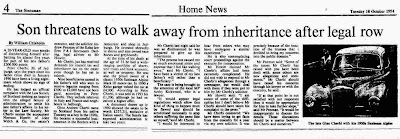
Son threatens to walk away from inheritance

By William Chisholm The Scotsman 18 October 1994

A 20-year old man from Jedburgh speaks of disinheriting himself after battling almost five years for a share of his father's £300,000 estate.

Peter Cherbi, 20, from Jedburgh, says the years since his father Gino died in January 1990, have been a living nightmare which shows no signs of ending.

He has lodged an official complaint with the Law Society of Scotland seeking an inquiry into the alleged failure of administrators to settle his late father's affairs. In his letter to the Law Society, Mr Cherbi names the accountant Norman Howitt of John Welch & Co, the estate's executor, and the solicitor Andrew Penman of Kelso law firm P & J Stormonth Darling, legal adviser to Mr Howitt.

Mr Cherbi has received demands for council tax and inheritance tax on the estate, even though he has yet to inherit.

None beneficiaries named in his father's will who were to receive legacies ranging from 」500 to 」2000 have not been paid, according to Peter Cherbi. They include relatives in Italy and France and neighbours in Jedburgh.

Gino Andrew Cherbi came to Scotland from his native Tuscany as a boy in the 1920's. He became a successful businessman in the Borders with a restaurant and shop in Jedburgh. He invested shrewdly in shares and also owned race horses and greyhounds.

At the time of his death at the age of 72, he had a wide ranging portfolio of shares, unit trusts and bank accounts as well as property. He was also the proud owner of a classic 1950s Sunbeam Alpine Mark 3 motor car. In 1990 a Kelso garage valued the car at 」4000. According to Peter Cherbi, it was sold in 1993 for £1,200, although he had received a higher offer.

A document drawn up in1990 showed the estate to be worth £257,211 exclusive of Italian assets. The family had expected administration to take two years.

Mr Cherbi last night said he was so disillusioned he was prepared to give up his inheritance.

"The process has caused me so much emotional strain and expense that I feel like walking away", said Mr Cherbi.

"I have been a victim of my late father's will rather than a beneficiary"

The case is being brought to the attention of local MP Archy Kirkwood, who is a lawyer.

"It would appear legal regulations which allowed this kind of thing to happen must be flawed and should be scrutinised nationally to stop others suffering the same fate as myself", said Cherbi.

"I would be interested to hear from others who have undergone a similar experience"

He is also contemplating court proceedings against the executry for compensation.

Mr Howitt claimed Mr Cherbi's affairs had been extremely complicated. he did not wish to respond to Mr Cherbi's allegations through a newspaper, but would deal with them if they were put to him by Mr Cherbi's solicitor.

Mr Howitt said "I am aware of some of the difficulties but I don't believe Mr Cherbi should have taken his complaint to the press".

Mr Cherbi countered "We have been trying to get facts from the executry for a year via my own solicitor. It was precisely because of the inaction of the trustees that I decided to bring my concerns into the public domain"

Mr Penman said "Some of the issues Mr Cherbi has raised with you have been dealt with. some others are new allegations and comments" Mr Cherbi should have raised his concerns through his lawyer or wth the executry, he said.

"If at that point he is not satisfied with our responses, then it would be appropriate for him to take further steps", said Mr Penman. "It would be inappropriate to discuss the details. Those discussions should be a matter between Mr Cherbi and ourselves"

Inquiry call over bungling lawyer

Executry dispute - Son queries why Law Society reversed decision to prosecute lawyer

William Chisholm The Scotsman 11 October 1996

The son of a Borders businessman wants a report which investigated allegations of misconduct by a solicitor handling his father's estate to be re-opened.

Peter Cherbi has sent the report to Scottish Secretary Michael Forsyth, with a demand for further action. He wants Mr Forsyth to force the Law Society to reopen the report to allow a prosecution of the lawyer, Andrew Penman, by the Scottish Solicitors Discipline Tribunal.

The Law Society investigation concluded that Mr Penman, of the Kelso law firm of P & J Stormonth Darling, should be prosecuted by the tribunal for the "appalling" way he handled the executry of Gino Cherbi, a Jedburgh businessman whose estate was valued at £300,000, after his death in 1990, aged 73.

But the decision to prosecute Mr Penman has been shelved in favour of a reprimand.

Now Mr Cherbi's son, Peter claims the society's about-face cannot be justified given the findings of the investigation, including  "an apparent attempt to mislead the Royal Bank of Scotland, and failure to collect estate assets".

When The Scotsman spoke to Mr Penman, he said the complaint against him had been thoroughly investigated by the Law Society and that was an end to the matter. In general, he could not make comments because of confidentiality.

The law Society report outlined lengthy and unexplained delays and a repeated failure by Mr Penman to respond to correspondence. It also alleged a complete lack of proper management in the handling and progressing of the executry.

There had been a "bungled and unsuccessful attempt to put the files in order".

Peter Cherbi was to have been the main beneficiary from his late father's estate. Others named in the will were to receive legacies ranging from £500 to £2000. But Mr Cherbi has been told there are no funds left in the estate.

A document showed the estate to be worth £257,211 exclusive of Italian finds. The overseas assets included an account with the Banco di Roma containing some £26,000 which was not collected by the executry. The Society report states that Mr Penman apparently attempted to mislead the Royal Bank on this matter.

The committee of the Law Society which first considered the report in June this year expressed grave concern at the way the executry had been handled. Members agreed that Mr Penman's actions were so serious and reprehensible as to amount to professional misconduct and recommended prosecution by the Scottish Solicitors Discipline Tribunal.

But the decision was changed after Mr Penman submitted written representations to the society. He claimed the executry had been complex although he accepted matters could and should have been dealt with more expeditiously.

Mr Penman also apologised to the complainer (Mr Cherbi) and to the Law Society.

Mr Cherbi said Mr Penman's pleadings "contradicted the society's own findings", adding that the Cherbi estate had suffered substantial financial loss.

WHen the Law Society committee reconsidered the matter, it was decided a reprimand and a compensation award of £1000 to the estate would be more appropriate.

P & J Stormonth Darling were instructed to limit their fee for work done from the date of death until October 1994 when Mr Penman ceased dealing with the file, to £3000 plus VAT.

Peter Cherbi told The Scotsman "I am shocked at the findings of the Law Society investigation which has uncovered many disturbing facts about the way my late father's estate was handled. I will not be allowing this matter to rest"

The Law Society advised Mr Cherbi not to instigate civil action while their investigation was in progress. He said the completion of the inquiry meant he was now in a position to sue for full recovery of the estate although the society report had been promised 15 months ago.

Mr Cherbi has also asked Mr Forsyth to instruct the Law Society to reopen the files so that prosecution can be taken before the solicitors tribunal.

Following the finding of professional misconduct he has also registered a complaint against Norman Howitt, an accountant with John J Welch & Co, Galashiels, who acted as executor of his father's estate.

In his submission to the Institute of Chartered Accountants of Scotland, Mr Cherbi alleges a lack of control by Mr Howitt over the activities of Mr Penman which resulted in financial loss to the estate.

A Law Society spokeswoman said the complaint had been dealt with and Mr Cherbi had exercised his right to refer the matter to Scotland legal services ombudsman to whom the file had now been sent.

Mr Penman said the Law Society papers with the committee's deliberations showed that a press statement from Mr Cherbi contained many untruths and half-truths. "I would consider that the press release if published as it stands would be defamatory of me" he said.

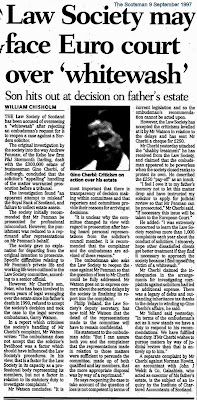
Law Society may face Euro court over 'whitewash'

Son hits out at decision on father's estate

William Chisholm  The Scotsman 9 September 1997

The Law Society of Scotland has been accused of overseeing a "whitewash" after rejecting an ombudsman's request for it to reopen a case against a Borders solicitor.

The original investigation by the society into the way Andrew Penman, of Kelso law firm P & J Stormonth Darling, dealt with the £300,000 estate of businessman Gino Cherbi, of Jedburgh, concluded that the solicitor's "appalling" handling of the matter warranted prosecution before a tribunal.

The investigation found "an apparent attempt to mislead the Royal Bank of Scotland and failure to collect estate assets".

The society initially recommended that M Penman be prosecuted for professional misconduct. However, the punishment was reduced to a reprimand after representations on Mr Penman's behalf.

The society gave no explanation for departing from the original intention to prosecute.

Specific difficulties relating to Mr Penman's private life and working life were outlined to the Law Society's committee, according to a senior official.

However, Mr Cherbi's son, Peter, who has been involved in seven years of legal wrangling over the estate since his father's death in 1990, refused to accept the society's decision and took the case to the legal services ombudsman, Garry Watson.

In a report which criticises the society's handling of Mr Cherbi's complaint, Mr Watson writes; "The ombudsman does not accept that the solicitor's livelihood was a factor which should have influenced the Law Society's procedures. In his view, that is a factor for the Law Society in it's capacity as a professional body representing its members, but not a factor in relation to its statutory duty to investigate complaints".

Mr Watson concludes; "it is most important that there is transparency of decision making within committees and that reporters and committees provide their reasons for arriving at decisions.

"It is unclear why the committee changed its view with regard to  prosecution after having heard personal representations from the solicitor's council member. It is recommended that the complainer and the ombudsman are advised of these reasons"

The ombudsman also asks the Law Society to reopen the case against Mr Penman so that the question of loss to Mr Cherbi could be fully addressed. Mr Watson goes on to express concern about the serious delays by the society in finalising its report into the complaint.

Philip Yelland, the Law Society's deputy secretary, has now told Mr Watson that the detail of the representations made to the committee will have to remain confidential.

His statement to the ombudsman adds; "But I can assure both you and the complainer that the representations made in relation to those matters were sufficient to persuade the committee, made up of both qualified and lawyer members, that the more appropriate disposal was by way of a reprimand"

He says reopening the case to take account of the question of loss is not competent in terms of current legislation and so the ombudsman's recommendations cannot be acted upon.

However, the Law Society has accepted the criticisms levelled at it by Mr Watson in relation to the delays and has sent Mr Cherbi a cheque for £250.

Mr Cherbi yesterday attacked the "shabby treatment" he has received from the Law Society and claimed that the ombudsman appeared to be powerless when the society closed ranks to protect its own. He described the £250 "pay-off" as an insult.

"I feel I owe it to my father's memory not to let this matter drop and have instruced my solicitor to apply for judicial review so that Mr Penman can be prosecuted" Mr Cherbi said. "If necessary this issue will be taken to the European Court".

He added; "I was extremely concerned to learn the Law Society received more than 1000 complaints each year about the conduct of solicitors. I sincerely hope other dissatisfied clients get better treatment if they find it necessary to approach the society because I find myself the victim of a whitewash".

Mr Cherbi claimed the inadequacies in the arrangements for investigating complaints against solicitors had led to additional expense. There was a legacy of debts and outstanding inheritance tax thanks to the delays in winding up Gino Cherbi's affairs, he said.

Mr Yelland said yesterday ; " In terms of the ombudsman's act as it now stands we have a duty to respond to his recommendations. We have fulfilled that duty. If Mr Cherbi wishes to pursue matters by way of judicial review then that is entirely up to him.

A separate complaint by Mr Cherbi against Norman Howitt, an accountant with John J Welch & Co, Galashiels, who acted as executor of his father's estate, is the subject of an inquiry by the Institute of Chartered Accountants of Scotland.

Plea to Dewar for inquiry on Law Society role in wrangle.

William Chisholm  The Scotsman 2 December 1997

A MAN who lost much of his inheritance because of a solicitor's incompetence is to challenge a decision not to allow him access to key documents drawn up by the Law Society of Scotland in the course of an eight year legal wrangle.

Peter Cherbi, from Jedburgh, has asked the Scottish Secretary, Donald Dewar, for an independent investigation into the circumstances surrounding the handling of the £300,000 estate of his late father, Gino Cherbi, a Borders businessman.

The demand for an inquiry into the role of the law society and the Scottish legal services ombudsman, Garry Watson, was made yesterday after Mr Cherbi heard that Mr Watson was closing the file on the case.

Mr Cherbi alleges that the society conspired to prevent prosecution of the solicitor who dealt with his father's affairs.

Mr Cherbi also plans to raise a court action against the society to force its officials to release crucial reports int he case.

Written submissions lodged on behalf of a lawyer, Andrew Penman, persuaded the society's complaints committee to abandon plans to refer his "appalling" handling of the executry to the Scottish Solicitors Discipline Tribunal.

Instead, the committee decided that a reprimand and a compensation award of £1000 to the estate would be a more appropriate penalty, despite grave concerns about Mr Penman's professional misconduct.

After the decision, Mr Cherbi took his complaint to Mr Watson, who carried out a separate inquiry into the society's handling of the case.

The ombudsman concluded "It is most important that there is transparency of decision making within committees and that reporters and committees provide their reasons for arriving at decisions".

Mr Watson said the complainer and the ombudsman should be advised why the complaints committee had changed its mind on prosecuting Mr Penman.

His report also disclosed that a society memorandum contained concerned that a solicitor who represented Mr Penman before the committee had made reference to Peter Cherbi's character and that such references had been considered "unfair".

But now Mr Watson has told Mr Cherbi he has received the written representations made on Mr Penman's behalf on the basis that they remain confidential to the ombudsman's office.

Mr Watson adds "However, I can assure you that these representations solely relate to the solicitor himself; they do not contain any comments with regard to yourself."

Mr Cherbi said yesterday "The Law Society must have tremendous pulling power when they can get the legal services ombudsman to alter his stance.

"They are only interested in protecting their own members. I am not even able to see the evidence presented to the committee on Mr Penman's behalf yet he had access to all of my submissions".

In Mr Cherbi's opinion, Mr Watson was a 'puppet of the law society'. In a letter seeking Mr Dewar's intervention, Mr Cherbi states "I am the victim of a very sleazy cover-up by the law society to protect a very bad solicitor who has already been found guilty of misconduct".

He said he had no intention of giving up the fight to recover his father's estate in full.

Mr Cherbi is to seek judicial review of the law society's alleged mishandling of his complaint.

The society has sent him a cheque for £250 to compensate him for long delays in processing the case, a payment Mr Cherbi describes as an insult.

The Scotsman asked Mr Watson to comment after his decision to close the file in the Cherbi case.

In a written response, he said "I am not in a position to make any public comment on a matter, which, in accordance with my remit, is private between myself and complainer".

Philip Yelland, the law society's deputy secretary, said "Mr Cherbi appears to be expressing concern about the ombudsman's position and it would be inappropriate for us to say anything if he wishes to take further action.

When Mr Cherbi, senior, died aged 73 in 1990, he left stocks and shares, property, and other assets valued at more than £250,000.

There were also overseas assets including an account with the Banco di Roma, containing an estimated £26,000. which was not collected by the executry. The estate has yet to be settled.

A separate complaint by Mr Cherbi  against an accountant who acted as executor of the estate is the subject of a separate inquiry by the Institute of Chartered Accountants of Scotland.

Jury still out on law in the dock

Does the Law Society act in the public's best interest over legal malpractice , asks Jenny Booth   2 March 1998

Like small children utterly dependent on their parents, most of us trust our legal advisers implicitly to protect us from life's little Dickensians - financial ruin, for example - at some of the most important stages in our existence.

We do not expect, having purchased our dream home, to find that planning permission has been granted for a new motorway to run through the garden. And we would be more than a little upset to discover that a trust find set up to look after our elderly and ailing parents had actually furnished our solicitor's holiday apartment in Spain.

So, who doo you turn to when you believe your solicitor has made a mess of your affairs ?

This may be hard to stomach, but at the moment, the first thing to do is to contact another lawyer, or, to be more precise, the Law Society of Scotland, which acts both as the professional body for lawyers and as the first port of call for members of the public with complaints about their lawyers.

Self regulation has been in place at the society for years, and while few would claim it is perfect, the Law Society says it is working well. It believes that lawyers have enough pride in their profession to want to clamp down hard on colleagues who break the rules.

But there are those who do not agree.

A recently formed Scottish organisation called Injured By The Law claims that when it comes to a clash between a member of the public and one of its own members, the Law Society is failing to deliver justice

Peter Paton, the chairman of the pressure group says ; "There are many cases of professional misconduct by solicitors that have been inadequately dealt with by the Law Society of Scotland.The system isn't working. It has inbuilt bias towards their own members. The legal profession has proved beyond a doubt that the Law Society, a self regulatory body, can't regulate its own members. There is no clear redress for victims of incompetent solicitors"

Paton says over 1000 complaints were registered by the society in 1997. "It is clear that they don't have the will to discipline their own members, and when they do, the disciplinary procedure is dismal. Because of this, we feel that this function should be replaced by an independent law commission"

Among the members of the group, one of the newest and angriest is Peter Cherbi, a man who lost his interitance because the winding up of the estate of his late father, Gino Cherbi, was bungled by his solicitor, Andrew Penman, of P & J Stormonth Darling in Kelso.

When Cherbi senior died in 1990, he left stocks and shares, property, a car and other assets including an account in the Banco di Roma, worth nearly £300,000. The Borders businessman's will included a few legacies to friends and relatives, and after liabilities were met, the residue of the estate was to go to his son, Peter.

But by the time Penman had finished handling the estate, Cherbi was told there was nothing left to inherit.

The preliminary report by the Law Society complaints committee accused Penman of "appalling" mismanagement and recommended Penman should be reported to the Scottish Solicitors Discipline Tribunal. which has the power to strike solicitors off.

But the complaints committee changed its mind after reading confidential representations from Penman. and hearing in private from Penmans's solicitor.

The solicitor's identity was routinely kept confidential. but was later revealed to be a Law Society council member, James Ness, of the firm of solicitors, Austins, in Dalbeattie.

Cherbi says he was later told that at the committee hearing, Ness had questioned his character, and said Penman did not deserve to lose his career over such a man.

Eventually the committee decided instead merely to reprimand Penman, and it awarded the estate what Cherbi thought was a derisory £1000 compensation. This is the statutory top limit that the Law Society can award for the anxiety and distress caused by an incompetent solicitor. If a complainer wants compensation for his loss, he must sue for negligence through the courts.

Cherbi complained to the independent Scottish legal services ombudsman, Garry Watson, who investigated the handling of the case. Watson reported that it was unfair that Ness had been able to make a personal plea to the committee while Cherbi was not invited to be present. This practice has now been reformed by the law Society at the ombudsman's request, and neither side in a dispute can now make final representations in person.

Watson wrote : "it is most important that there is transparency of decision making within committees and that reporters and committees provide reasons for arriving at decisions".

His report recommended that the Law Society reopen the case, but the Law Society declined.

Cherbi wrote to the Scottish Secretary asking for an independent investigation but was advised to take legal moves to have his case reconsidered. He is preparing to apply for the Law Society's decision to be judicially reviewed. "I'm not going to let the matter rest" says Cherbi. "I feel the Law Society has presided over a whitewash. I have struggled to seek answers on my case, but have got nowhere"

While I have mostly been treated with courtesy, which I have reflected in my dealings with the Society,, I have been aware of an undercurrent of inappropriate remarks at senior level against me, as well as a tendency to keep information secret that would otherwise contradict previous Society rulings." "I have been approached by many others who have suffered similar injustices with the Law Society"

But while there is undoubtedly still a phalanx of people like Cherbi, who seem to have very good reason to feel aggrieved, there is some evidence that the problems of the early and mid-nineties may be becoming a thing of the past.

In general policy as well as individual cases, the legal services ombudsman has been very critical of the Law Society's procedures for some years.

When Watson took over as ombudsman, his first report for 1994, refers to "unjustifiable delay at each stage of the Law Society investigation". In his 1995 report he said there were a number of "rogue investigations" which were " a discredit to the Society".

But some of the most glaring problems had been cleared up by 1996 ; "I am pleased to report that gross delay and rogue investigations with confusion and lack of control have been largely eliminated. Delays and errors continue to arise ... but they are of a different and manageable order of magnitude.

Law Society accused of closing ranks as claim fails

William Chisholm The Scotsman 5 June 1998

An unprecedented attempt to force the Law Society of Scotland to prosecute a solicitor for professional misconduct will continue, even though an application for legal aid has been rejected.

Peter Cherbi from Jedburgh, claims that his late father's £300,000 estate has been ruined and rendered worthless becuse of the way a Borders lawyer, Andrew Penman, handled the affairs of Gino Cherbi who died in 1990.

A Law Society investigation found that the solicitor, a partner in the law form P & J Stormonth Darling, should be prosecuted before a disciplinary tribunal because of the serious nature of the case.

But the decision was later overturned in favour of a reprimand after representations were made on Mr Penman's behalf.

Mr Cherbi, who is calling for " more than a slap on the wrist" then took the case to Garry Watson, the legal services ombudsman.

He criticised the society's handling of the complaint and said it was unclear why its committee had changed its view about prosecution. Mr Watson asked for the case to be re-opened so that the question of loss to Mr Cherbi could be fully addressed.

But the society decided that course of action was not competent in terms of the law, which emant the ombudsman's recommendation could not be acted upon. Instead, Mr Cherbi received a cheque for £250 to compensate him for delays in processing the inquiry.

Mr Cherbi revealed yesterday that Henry Mcleish, the Scottish Home Affairs Minsiter, had twice advised him to seek independent legal advice about any further action he might wish to take.

"The advice I received was to apply for a judicial review, challenging the Law Society's refusal to prosecute Mr Penman", said Mr Cherbi"  "Its been impossible to get justice via the society which simply closed ranks to defend its own. Now the Scottish Legal Aid Board seems to be holding justice to ransom, by refusing my legitimate application for legal aid"

The board told Mr Cherbi that his request had been turned down becuase it was not satisfied the application showed he had a probably cause of action.

He believes the board's decision may have been influenced by a letter from Douglas Mill, the secretary of the society. Although no formal objection to Mr Cherbi's application was taken, Mr Mill felt it proper to draw certain issues to the attention of SLAB.

Mr Mill wrote "Mr Cherbi is clearly a person with an interest to complain and was entitled to make his complaint. It is for the Law Society in terms of the relevant legislation, to determine firstly whether the complaint can be upheld and then determine the appropriate penalty. The complainer does not have a part to play in determining penalty"

Mr Cherbi claims the society is keen to head off any judicial interference in its procedures. If his case were to succeed, it would set a precedent in Scots law. He would also be seeking costs.

In a statement to the legal aid board, Mr Cherbi said the interference of Mr Penman's representative at a complaints committee hearing was unfair.

He had not been given access to the evidence and was not allowed to appeal before the committee "commuted the solicitors sentence"

Mr Cherbi's action has the backing of Injured By The law, an organisation which seeks to help individuals who believe they have been denied legal justice. Ray Keddie, it's director said "I am extremely concerned by the actions and conduct of the Scottish Legal Aid Board in denying civil legal aid to Peter Cherbi"

He also criticised the Scottish Office for its "ambiguous advice" in recommending action that required people to apply for legal aid. He claimed it was then rejected on concocted grounds to maintain the status quo of the society and protect positions within the profession.

Injured By The Law was also calling into question the conduct and motives of mr Mill in his letter to the legal aid board and SLAB's acceptance of the contents. Mr Keddie said ;" The contents are highly unusual and irregular to procedure"

But Fiona Shaw, SLAB's spokeswoman said it was the statutory right of any opponent in a civil case to object to an application for legal aid. She added "We have treated the society's letter in the same way as any other correspondence we receive."

She confirmed that Mr Cherbi's solicitor had asked the board to review the application for legal aid,, and that review was now under way.

In a statement, the society said Mr Mill's letter to SLAB was not irregular in its terms, nor was it an attempt to stall the course of justice.

"Mr Cherbi is entitled to seek judicial review if he wishes to do so. If he does, the society will defend it" . There was no question of the process of judicial review being a dangerous precedent. It was an ordinary legal process and the society had been involved in judicial review proceedings before.

"Any suggestion that in some way the society is interfering with the process of justice is wholly unfounded", the statement concluded.

Independent watchdog for lawyers proposed

Law Society of Scotland's internal system flawed, says Scottish Consumer Council

Camillo Fracassini - Consumer Affairs Correspondent  8 January 1999

Complaints against solicitors in Scotland should be investigated by an independent watchdog because self regulation is not working, the Scottish Consumer Council will say today.

The recommendation is part of a highly critical SCC report into the way complaints about solicitors are handled by the lawyers professional body, the Law Society of Scotland.

According to a survey made as part of the study, 40% of those who had used the Law Society of Scotland's complaint's procedure thought their complaint had not been handled fairly.

The Law Society, the solicitors professional body, is also responsible for investigating complaints.

In the stufy, 415 people were interviewed by the SCC. Even looking at those whose complaints against their solicitors were upheld, shows that a third felt they had been unfairly dealt with.

The report is also highly critical of solicitors.

Of clients who complaint to their lawyers, 16% said they were completely ignored and only 2% were told they could refer the matter to the Law Society.

More than a fifth of solicitors refused to investigate complaints and 40% of people were ignored, "fobbed off", told to change lawyers, or advised not to complain to the Law Society.

According to the survey, two fifths of complaints took between six months and two years to resolve and 17% took more than two years.

One complainant said "The whole experience was very disappointing. The Law Society was totally in favour of the lawyer. Dealing with the society was like talking to a wall"

Derdrie Hutton, the SCC Chairman, suggested "If consumers are to be confident that the procedures are entirely fair, we believe the research suggests that the way forward should be to establish an independent body to deal with complaints about solicitors in Scotland.

The SCC wants the Scottish parliament to review the Law Society's complaints procedure, with a vew to establishing an independent complaints body.

Solicitors should be made to give clients a letter of engagement, setting out how long the work will take, how much it will cost, and advising how to complain if they are not happy with the service, it said.

The SCC added that all solicitors practices should also set up complaints procedures and appoint a specific solicitor to deal with complaints.

Martin Evans, the SCC director, said many people felt the system was biased in favour of solicitors : "They do not appear to trust the self regulatory process and do not trust the Law Society to look after the interests of consumers rather than its members. The lack of credibility of the current system doesn't serve consumers or the legal profession well".

Mr Evans added solicitors were not handling criticism positively : "Solicitors, as a profession, seem to feel threatened by complaints, rather than see them as something which can help them improve the service they provide."

Last night, Philip Dry, the president of the Law Society of Scotland, questioned the validity of the limited SCC survey and insisted self-regulation was still the best policy.

He said; "I continue to believe that a the society is best able to deal with client complaints which it does without cost to the public - and that any system used should be open to public scrutiny and constantly adapted and improved to meet the needs of clients of Scottish solicitors.

"The society does not agree with the recommendations made to the Scottish parliament to set up an independent complaints handling body. The recommendation is not supported by the survey results nor is the suggestion that the current system is fatally flawed".

Mr Dry said the Law Society had significantly improved its complaints procedure since the SCC first recommended the establishment of an independent complaints watchdog in 1986.

In November, it named 11 new lay members to its complaints committee in a bid to tackle the perceived bias.

Between 1994 and 1997 the number of complaints that ended successfully in mediation or conciliation increased by 79% while the number f complaints only rose by 4%.

Gary Watson, the Scottish legal services ombudsman said he remained opposed to an independent body "While I endorse a number of the recommendations made in the report but I would disagree with the principle recommendation for the establishment of an independent complaints body.

"My firm view is that as long as the Law Society is committed to improving the way in which it handles complaints then that is the best way forward for members of the public"

However, Peter Cherbi is still seeking redress more than two years after the Law Society of Scotland overturned its original decision to prosecute a solicitor he claimed was guilty of professional misconduct.

Mr Cherbi, from Jedburgh believes his father's £300,000 estate was effectively made worthless by the lawyers handling of his affairs.

While a Law Society investigation found that the solicitor should be prosecuted before a tribunal because of the serious nature of the case, the decision was overturned in favour of a reprimand after representations on the lawyer's behalf.

Mr Cherbi, who plans to sue the Law Society said "The Law Society of Scotland's complaints procedure is completely biased. There is absolutely no right of appeal for complainants and the ombudsman has no statutory powers - he an only make recommendations which may be refused by the society.

"There must be an independent regulatory for the legal profession with absolutely no ties to solicitors"

Law watchdog faces threat of court fight.

Client prepares to sue after allegation that ombudsman compromised independence.

By Peter Laing Scotland on Sunday August 8 1999

THE government-appointed watchdog charged with overseeing the complaints process against solicitors in Scotland is himself facing legal action.

Scottish Legal Services Ombudsman Garry Watson has been accused of failing to handle properly a complaint against the Law Society of Scotland, the professional body which represents solicitors.

Peter Cherbi says he intends to sue Watson claiming the ombudsman "took instructions" from the Law Society on what information to release about his case, and, therefore, compromised his independence.

Cherbi, from Jedburgh, says Watson's handling of the case may have harmed his chances of ever recovering a £300,000 inheritance from an incompetent solicitor.

Cherbi has instructed his solicitor to begin legal proceedings against Watson, who could receive a write seeking damages within the next few weeks. It is believed to be the first time anyone has attempted to sue an ombudsman.

Complaints against solicitors are investigated by the Law Society under a controversial system of self-regulation. Anyone who is unhappy with the decision of the Law Society can then ask for an investigation by the ombudsman, who has the power to make recommendations to the society.

But the ombudsman is currently flooded with complex cases, and last month had to apologise for delays of up to a year in handling them.

Cherbi's case started in 1990 when his 73-year-old father died, leaving behind an estate valued at around 」300,000.

Four years later he realised the estate, which was handled by local lawyer Andrew Penman, was almost worthless. Cherbi believes the money was lost through avoidable interest payments, fees and the mishandled selling of shares and investments.

Cherbi complained about Penman to the Law Society, who originally planned to prosecute him at a Scottish Solicitors Discipline Tribunal.

But after written submissions regarding Penman were received, they decided instead on a reprimand and ordered him to pay 」1000 compensation to Cherbi's estate. Angry at the Law Society's decision, Cherbi complained to the ombudsman in May 1997.

Watson investigated and concluded : "It is most important that there is transparency of decision-making within committees." Watson added he and Cherbi should be told why the Law Society decided not to prosecute Penman.

But un June 1997, Watson informed Cherbi that the Law Society had sent him the written submissions relating to Penman on the basis they remained confidential, and that the case was closed.

For the past two years, Watson and Cherbi have exchanged increasingly acrimonious letters on the subject.

Cherbi said : "In my opinion, by accepting the submissions about Penman on the basis that he would not divulge their contents, he has effectively been told what to do by the Law Society.

"As ombudsman he should be telling the Law Society what to do. I believe he has compromised the independence of his office.

"In my opinion, by not handling my case correctly, and refusing to pass on important information, he has made it more difficult to recover any of the inheritance I lost. For that reason, I have instructed my solicitor to begin proceedings for compensation"

Watson has refused to comment on the case. But in a letter he sent to Cherbi in February last year, he explained why the representations regarding Penman were not passed on.

He wrote "I ascertained that they [the representations] related entirely to the personal circumstances of the solicitor and had nothing to do with yourself. I can certainly see no reason why there should be a need for me to pass on information when it did not relate to, and was not relevant to, yourself. To suggest my actions compromise the independence of my office is patently absurd."

Watson, who was prepared to talk to Scotland on Sunday on general terms, added : "I deny any suggestion that my office is influenced by the Law Society.It is totally independent."

Watson said a new member of staff had been taken on to help bring down the time taken to deal with cases. he hopes to bring the average delay down from a year to two-four months.

The Scottish Consumer Council, in a report released earlier this year, revealed problems with the ombudsman, including that 85% of people whose complaints were not upheld by the ombudsman did not receive a satisfactory explanation.

Legal Profession in the Dock over complaints about self regulation

Peter Laing 18 February 2001 Scotland on Sunday

The power of lawyers to discipline corrupt or incompetent colleagues is to be investigated by the Scottish Parliament amid growing concern at the perceived failure of self-regulation in the legal profession.

The parliament's Justice Committee is to launch an inquiry after numerous complaints about the failure of solicitors to keep their own house in order.

Members of the public, some of whom have lost thousands of pounds as a result of legal blunders, claim the regulatory system simply allows solicitors to watch each other's backs. The result, they say is long delays in hearing complaints and paltry punishments when cases are upheld.

The Law Society of Scotland, the body which represents solicitors and investigates complaints against them, rejects the claims and will argue that it should keep its powers of self regulation.

Alisdair Morgan MSP, Chairman of the Justice Committee, said an investigation was "high up our agenda" and there was a strong possibility it would start within months.

Peter Cherbi is typical of the determined band of legal victims who feel solicitors should be stripped of their powers of self regulation. He claims a lawyer's error robbed him of a £300,000 inheritance. Ten Years on, he has been offered £15,000 compensation, but faces legal costs of at least £22,000.

Cherbi, from Jedburgh expected to inherit his father's estate when he died. aged 73, in 1990. Four years later, he realised the estate, which had been handled by local lawyer Andrew Penman, was worthless. Cherbi believes the money was lost through avoidable interest payments, fees and mishandled selling of shares & investments.

He complained to the Law Society, which originally planned to prosecute Penman. After written sumbissions, it decided on a reprimand and ordered him to pay compensation worth £1000.

Cherbi then complained about the Law Society to its watchdog, the Scottish Legal Services Ombudsman. But that has ended in acrimony and a possible legal action against the ombudsman.

A separate action for compensation against Penman resulted in an offer of £15,000 from his solicitors. Cherbi said "That is no use because I have legal costs for fighting my case of £22,000 and the estate is £43,000 in debt.. I am delighted that self-regulation is finally to be looked at. It's a liars' charter written by liars for liars. They sit on each other's committees and they are obsessed with protecting each other. "There has to be independent regulation with public participation. The victim must be able to get a fair hearing"

Phil Gallie, Tory Justice spokesman and a member of the Committee said "I have had a number of people coming to me with cases, four or five in the last six months. Some of these cases have been outstanding for several years"

A spokesman for the Law Society said there had been a 18% drop in complaints between 1999 and 2000, down from 1,338 to 1094

Andrew Penman & Norman Howitt : Lawyer & accountant team up to ruin Cherbi executry estate

As many of you know, the Scotsman newspaper and others wrote many reports on developments in my case against crooked lawyer Andrew Penman of Stormonth Darling Solicitors, Kelso and crooked accountant Norman Howitt of the JRW Group in the Scottish Borders, the two so called 'professionals' who swindled the estate of my late father and got away with it.

Mr Howitt was the Executor, and Mr Penman was his legal agent - and when a crooked Executor and crooked lawyer team up, there's not much hope for honesty ... and Mr Howitt, not content with ruining the legal & financial affairs of my late father, did the same to my mother, insisting she pass all her assets to him for reasons of wanting to keep all the money for himself.

Some have been asking to understand a little more of my case against Drew Penman & Norman Howitt, so in light of a recent story in Scotland on Sunday passed to me by a Scotsman journalist I had completely forgot about (the one where I was going to take legal action against the then Scottish Legal Services Ombudsman, Mr Garry S Watson, who was just as terrible at his job as the Law Society of Scotland are at handing complaints against crooked lawyers, here in today's article, are the reprints of the Scotsman & Scotland on Sunday reports on my case, and campaign to bring independent regulation of lawyers in Scotland.I trus tthey are of use to some readers who suffer the same problems in dealings with the legal profession.


I get so many similar stories from people all over Scotland, of how lawyers and executors have ruined the estates of their relatives, it almost looks like some kind of macabre sport played out by lawyers to increase their profits, all the while knowing the Law Society of Scotland will let them off the hook if anyone dare complain against their actions ...


The way to stop these kinds of things happening in the future, is of course, to take all regulatory & disciplinary function away from the legal profession and ensure transparent, accountable and honest complaints investigations & consideration of client complaints ... but we will have to wait and see if the SNP actually achieve this through the new Scottish Legal Complaints Commission, which itself is already encountering problems even before it begins operation sometime in late 2008 ...

Andrew Penman of Stormonth Darling Solicitors, Kelso & Norman Howitt, accountant, now with the JRW Group, Galashiels. - The Scotsman & Scotland on Sunday articles 1994 - 2001

Scotsman 18 October 1994 Son threatens to walk away from inheritance after legal row

Son threatens to walk away from inheritance

By William Chisholm The Scotsman Tuesday 18 October 1994

A 20-year old man from Jedburgh speaks of disinheriting himself after battling almost five years for a share of his father's £300,000 estate.

Peter Cherbi, 20, from Jedburgh, says the years since his father Gino died in January 1990, have been a living nightmare which shows no signs of ending.

He has lodged an official complaint with the Law Society of Scotland seeking an inquiry into the alleged failure of administrators to settle his late father's affairs.

In his letter to the Law Society, Mr Cherbi names the accountant Norman Howitt of John Welch & Co, the estate's executor, and the solicitor Andrew Penman of Kelso law firm P & J Stormonth Darling, legal adviser to Mr Howitt.

Mr Cherbi has received demands for council tax and inheritance tax on the estate, even though he has yet to inherit.

None beneficiaries named in his father's will who were to receive legacies ranging from £500 to £2000 have not been paid, according to Peter Cherbi. They include relatives in Italy and France and neighbours in Jedburgh.

Gino Andrew Cherbi came to Scotland from his native Tuscany as a boy in the 1920's. He became a successful businessman in the Borders with a restaurant and shop in Jedburgh. He invested shrewdly in shares and also owned race horses and greyhounds.

At the time of his death at the age of 72, he had a wide ranging portfolio of shares, unit trusts and bank accounts as well as property. He was also the proud owner of a classic 1950s Sunbeam Alpine Mark 3 motor car. In 1990 a Kelso garage valued the car at 」4000. According to Peter Cherbi, it was sold in 1993 for £1,200, although he had received a higher offer.

A document drawn up in1990 showed the estate to be worth £257,211 exclusive of Italian assets. The family had expected administration to take two years.

Mr Cherbi last night said he was so disillusioned he was prepared to give up his inheritance.

"The process has caused me so much emotional strain and expense that I feel like walking away", said Mr Cherbi.

"I have been a victim of my late father's will rather than a beneficiary"

The case is being brought to the attention of local MP Archy Kirkwood, who is a lawyer.

"It would appear legal regulations which allowed this kind of thing to happen must be flawed and should be scrutinised nationally to stop others suffering the same fate as myself", said Cherbi.

"I would be interested to hear from others who have undergone a similar experience"

He is also contemplating court proceedings against the executry for compensation.

Mr Howitt claimed Mr Cherbi's affairs had been extremely complicated. he did not wish to respond to Mr Cherbi's allegations through a newspaper, but would deal with them if they were put to him by Mr Cherbi's solicitor.

Mr Howitt said "I am aware of some of the difficulties but I don't believe Mr Cherbi should have taken his complaint to the press".

Mr Cherbi countered "We have been trying to get facts from the executry for a year via my own solicitor. It was precisely because of the inaction of the trustees that I decided to bring my concerns into the public domain"

Mr Penman said "Some of the issues Mr Cherbi has raised with you have been dealt with. some others are new allegations and comments" Mr Cherbi should have raised his concerns through his lawyer or with the executry, he said.

"If at that point he is not satisfied with our responses, then it would be appropriate for him to take further steps", said Mr Penman. "It would be inappropriate to discuss the details. Those discussions should be a matter between Mr Cherbi and ourselves"

Scotsman 11 October 1996 Iinquiry call over bungling lawyer

Inquiry call over bungling lawyer

Executry dispute - Son queries why Law Society reversed decision to prosecure lawyer

William Chisholm The Scotsman 11 October 1996

The son of a Borders businessman wants a report which investigated allegations of misconduct by a solicitor handling his father's estate to be re-opened.

Peter Cherbi has sent the report to Scottish Secretary Michael Forsyth, with a demand for further action. He wants Mr Forsyth to force the Law Society to reopen the report to allow a prosecution of the lawyer, Andrew Penman, by the Scottish Solicitors Discipline Tribunal.

The Law Society investigation concluded that Mr Penman, of the Kelso law firn of P & J Stormonth Darling, should be prosecuted by the tribunal for the "appalling" way he handled the executry of Gino Cherbi, a Jedburgh businessman whose estate was valued at £300,000, after his death in 1990, aged 73.

But the decision to prosecute Mr Penman has been shelved in favour of a reprimand.

Now Mr Cherbi's son, Peter claims the society's about-face cannot be justified given the findings of the investigation, including "an apparent attempt to mislead the Royal Bank of Scotland, and failure to collect estate assets".

When The Scotsman spoke to Mr Penman, he said the complaint against hiim had been thoroughly investigated by the Law Society and that was an end to the matter. In general, he could not make comments because of confidentiality.

The law Society report outlined lengthy and unexplained delays and a repeated failure by Mr Penman ro respond to correspondence. It also alleged a complete lack of proper management in the handling and progressing of the executry.

There had been a "bungled and unsuccessful attempt to put the files in order".

Peter Cherbi was to have been the main beneficiary from his late father's estate. Others named in the will were to receive legacies ranging from £500 to £2000. But Mr Cherbi has been told there are no funds left in the estate.

A document showed the estate to be worth £257,211 exclusive of Italian finds.

The overseas assets included an account with the Banco di Roma containing some £26,000 which was not collected by the executry. The Society report states that Mr Penman apparently attempted to mislead the Royal Bank on this matter.

The committee of the Law Society which first considered the report in June this year expressed grave concern at the way the executry had been handled.

Members agreed that Mr Penman's actions were so serious and reprehensible as to amount to professional misconduct and recommended prosecution by the Scottish Solicitors Discipline Tribunal.

But the decision was changed after Mr Penman submitted written representations to the society. He claimed the executry had been complex although he accepted matters could and should have been dealt with more expeditiously.

Mr Penman also apologised to the complainer (Mr Cherbi) and to the Law Society

Mr Cherbi said Mr Penman's pleadings "contradicted the society's own findings", adding that the Cherbi estate had suffered substantial financial loss.

When the Law Society committee reconsidered the matter, it was decided a reprimand and a compensation award of £1000 to the estate would be more appropriate.

P & J Stormonth Darling were instructed to limit their fee for work done from the date of death until October 1994 when Mr Penman ceased dealing with the file, to £3000 plus VAT.

Peter Cherbi told The Scotsman "I am shocked at the findings of the Law Society investigation which has uncovered many disturbing facts about the way my late father's estate was handled. I will not be allowing this matter to rest"

The Law Society advised Mr Cherbi not to instigate civil action while their investigation was in progress. He said the completion of the inquiry meant he was now in a position to sue for full recovery of the estate although the society report had been promised 15 months ago.

Mr Cherbi has also asked Mr Forsyth to instruct the Law Society to reopen the files so that prosecution can be taken before the solicitors tribunal.

Following the finding of professional misconduct he has also registered a complaint against Norman Howitt, an accountant with John J Welch & Co, Galashiels, who acted as executor of his father's estate.

In his submission to the Institute of Chartered Accountants of Scotland, Mr Cherbi alleges a lack of control by Mr Howitt over the activities of Mr Penman which resulted in financial loss to the estate.

A Law Society spokeswoman said the complaint had been dealt with and Mr Cherbi had exercised his right to refer the matter to Scotland legal services ombudsman to whom the file had now been sent.

Mr Penman said the Law Society papers with the committee's deliberations showed that a press statement from Mr Cherbi contained many untruths and half-truths. "I would consider that the press release if published as it stands would be defamatory of me" he said.

Scotsman 9 September 1997 Law Society may face Euro Court over whitewash

Law Society may face Euro court over 'whitewash'

Son hits out at decision on father's estate

William Chisholm The Scotsman 9 September 1997

The Law Society of Scotland has been accused of overseeing a "whitewash" after rejecting an ombudsman's request for it to reopen a case against a Borders solicitor.

The original investigation by the society into the way Andrew Penman, of Kelso law firm P & J Stormonth Darling, dealt with the £300,000 estate of businessman Gino Cherbi, of Jedburgh, concluded that the solicitor's "appalling" handling of the matter warranted prosecution before a tribunal.

The investigation found "an apparent attempt to mislead the Royal Bank of Scotland and failure to collect estate assets".

The society initially recommended that M Penman be prosecuted for professional misconduct. However, the punishment was reduced to a reprimand after representations on Mr Penman's behalf.

The society gave no explanation for departing from the original intention to prosecute.

Specific difficulties relating to Mr Penman's private life and working life were outlined to the Law Society's committee, according to a senior official.

However, Mr Cherbi's son, Peter, who has been involved in seven years of legal wrangling over the estate since his father's death in 1990, refused to accept the society's decision and took the case to the legal services ombudsman, Garry Watson.

In a report which criticises the society's handling of Mr Cherbi's complaint, Mr Watson writes; "The ombudsman does not accept that the solicitor's livelihood was a factor which should have influenced the Law Society's procedures. In his view, that is a factor for the Law Society in it's capacity as a professional body representing its members, but not a factor in relation to its statutory duty to investigate complaints".

Mr Watson concludes; "it is most important that there is transparency of decision making within committees and that reporters and committees provide their reasons for arriving at decisions.

"It is unclear why the committee changed its view with regard to prosecution after having heard personal representations from the solicitor's council member.

It is recommended that the complainer and the ombudsman are advised of these reasons"

The ombudsman also asks the Law Society to reopen the case against Mr Penman so that the question of loss to Mr Cherbi could be fully addressed. Mr Watson goes on to express concern about the serious delays by the society in finalising its report into the complaint.

Philip Yelland, the Law Society's deputy secretary, has now told Mr Watson that the detail of the representations made to the committee will have to remain confidential.

His statement to the ombudsman adds; "But I can assure both you and the complainer that the representations made in relation to those matters were sufficient to persuade the committee, made up of both qualified and lawyer members, that the more appropriate disposal was by way of a reprimand"

He says reopening the case to take account of the question of loss is not competent in terms of current legislation and so the ombudsman's recommendations cannot be acted upon.

However, the Law Society has accepted the criticisms leveled at it by Mr Watson in relation to the delays and has sent Mr Cherbi a cheque for £250.

Mr Cherbi yesterday attacked the "shabby treatment" he has received from the Law Society and claimed that the ombudsman appeared to be powerless when the society closed ranks to protect its own. He described the £250 "pay-off" as an insult.

"I feel I owe it to my father's memory not to let this matter drop and have instructed my solicitor to apply for judicial review so that Mr Penman can be prosecuted" Mr Cherbi said. "If necessary this issue will be taken to the European Court".

He added; "I was extremely concerned to learn the Law Society received more than 1000 complaints each year about the conduct of solicitors. I sincerely hope other dissatisfied clients get better treatment if they find it necessary to approach the society because I find myself the victim of a whitewash".

Mr Cherbi claimed the inadequacies in the arrangements for investigating complaints against solicitors had led to additional expense. There was a legacy of debts and outstanding inheritance tax thanks to the delays in winding up Gino Cherbi's affairs, he said.

Mr Yelland said yesterday ; " In terms of the ombudsman's act as it now stands we have a duty to respond to his recommendations. We have fulfilled that duty. If Mr Cherbi wishes to pursue matters by way of judicial review then that is entirely up to him.

A separate complaint by Mr Cherbi against Norman Howitt, an accountant with John J Welch & Co, Galashiels, who acted as executor of his father's estate, is the subject of an inquiry by the Institute of Chartered Accountants of Scotland.

Scotsman 2 December 1997  Plea  to Dewar for inquiry on Law Society role in wrangle

Plea to Dewar for inquiry on Law Society role in wrangle.

William Chisholm The Scotsman 2 December 1997

A MAN who lost much of his inheritance because of a solicitor's incompetence is to challenge a decision not to allow him access to key documents drawn up by the Law Society of Scotland in the course of an eight year legal wrangle.

Peter Cherbi, from Jedburgh, has asked the Scottish Secretary, Donald Dewar, for an independent investigation into the circumstances surrounding the handling of the £300,000 estate of his late father, Gino Cherbi, a Borders businessman.

The demand for an inquiry into the role of the law society and the Scottish legal services ombudsman, Garry Watson, was made yesterday after Mr Cherbi heard that Mr Watson was closing the file on the case.

Mr Cherbi alleges that the society conspired to prevent prosecution of the solicitor who dealt with his father's affairs.

Mr Cherbi also plans to raise a court action against the society to force its officials to release crucial reports int he case.

Written submissions lodged on behalf of a lawyer, Andrew Penman, persuaded the society's complaints committee to abandon plans to refer his "appalling" handling of the executry to the Scottish Solicitors Discipline Tribunal.

Instead, the committee decided that a reprimand and a compensation award of £1000 to the estate would be a more appropriate penalty, despite grave concerns about Mr Penman's professional misconduct.

After the decision, Mr Cherbi took his complaining to Mr Watson, who carried out a separate inquiry into the society's handling of the case.

The ombudsman concluded "It is most important that there is transparency of decision making within committees and that reporters and committees provide their reasons for arriving at decisions".

Mr Watson said the complainer and the ombudsman should be afvised why the complaints committee had changed its mind on prosecuting Mr Penman.

His report also disclosed that a society memorandum contained concerned that a solicitor who represented Mr Penman before the committee had made reference to Peter Cherbi's character and that such references had been considered "unfair".

But now Mr Watson has told Mr Cherbi he has received the written representations made on Mr Penman's behalf on the basis that they remain confidential to the ombudsman's office.

Mr Watson adds "However, I can assure you that these representations solely relate to the solicitor himself; they do not contain any comments with regard to yourself."

Mr Cherbi said yesterday "The Law Society must have tremendous pulling power when they can get the legal services ombudsman to alter his stance.

"They are only interested in protecting their own members. I am not even able to see the evidence presented to the committee on Mr Penman's behalf yet he had access to all of my submissions".

In Mr Cherbi's opinion, Mr Watson was a 'puppet of the law society'. In a letter seeking Mr Dewar's intervention, Mr Cherbi states "I am the victim of a very sleazy cover-up by the law society to protect a very bad solicitor who has already been found guilty of misconduct".

He said he had no intention of giving up the fight to recover his father's estate in full.

Mr Cherbi is to seek judicial review of the law society's alleged mishandling of his complaint.

The society has sent him a cheque for £250 to compensate him for long delays in processing the case, a payment Mr Cherbi describes as an insult.

The Scotsman asked Mr Watson to comment after his decision to close the file in the Cherbi case.

In a written response, he said "I am not in a position to make any public comment on a matter, which, in accordance with my remit, is private between myself and complainer".

Philip Yelland, the law society's deputy secretary, said "Mr Cherbi appears to be expressing concern about the ombudsman's position and it would be inappropriate for us to say anything if he wishes to take further action.

When Mr Cherbi, senior, died aged 73 in 1990, he left stocks and shares, property, and other assets valued at more than £250,000.

There were also overseas assets including an account with the Banco di Roma, containing an estimated £26,000. which was not collected by the executry. The estate has yet to be settled.

A separate complaint by Mr Cherbi against an accountant who acted as executor of the estate is the subject of a separate inquiry by the Institute of Chartered Accountants of Scotland.

Jury  still out on law in the dock - The Scotsman 2 March 1998

Jury still out on law in the dock

Does the Law Society act in the public's best interest over legal malpractice , asks Jenny Booth The Scotsman 2 March 1998

Like small children utterly dependent on their parents, most of us trust our legal advisers implicitly to protect us from life's little Dickensians - financial ruin, for example - at some of the most important stages in our existence.

We do not expect, having purchased our dream home, to find that planning permission has been granted for a new motorway to run through the garden.

And we would be more than a little upset to discover that a trust find set up to look after our elderly and ailing parents had actually furnished our solicitor's holiday apartment in Spain.

So, who do you turn to when you believe your solicitor has made a mess of your affairs ?

This may be hard to stomach, but at the moment, the first thing to do is to contact another lawyer, or, to be more precise, the Law Society of Scotland, which acts both as the professional body for lawyers and as the first port of call for members of the public with complaints about their lawyers.

Self regulation has been in place at the society for years, and while few would claim it is perfect, the Law Society says it is working well. It believes that lawyers have enough pride in their profession to want to clamp down hard on colleagues who break the rules.

But there are those who do not agree.

A recently formed Scottish organisation called Injured By The Law claims that when it comes to a clash between a member of the public and one of its own members, the Law Society is failing to deliver justice

Peter Paton, the chairman of the pressure group says ; "There are many cases of professional misconduct by solicitors that have been inadequately dealt with by the Law Society of Scotland.The system isn't working. It has inbuilt bias towards their own members. The legal profession has proved beyond a doubt that the Law Society, a self regulatory body, can't regulate its own members. There is no clear redress for victims of incompetent solicitors"

Paton says over 1000 complaints were registered by the society in 1997. "It is clear that they don't have the will to discipline their own members, and when they do, the disciplinary procedure is dismal. Because of this, we feel that this function should be replaced by an independent law commission"

Among the members of the group, one of the newest and angriest is Peter Cherbi, a man who lost his inheritance because the winding up of the estate of his late father, Gino Cherbi, was bungled by his solicitor, Andrew Penman, of P & J Stormonth Darling in Kelso.

When Cherbi senior died in 1990, he left stocks and shares, property, a car and other assets including an account in the Banco di Roma, worth nearly £300,000.

The Borders businessman's will included a few legacies to friends and relatives, and after liabilities were met, the residue of the estate was to go to his son, Peter.

But by the time Penman had finished handling the estate, Cherbi was told there was nothing left to inherit.

The preliminary report by the Law Society complaints committee accused Penman of "appalling" mismanagement and recommended Penman should be reported to the Scottish Solicitors Discipline Tribunal. which has the power to strike solicitors off.

But the complaints committee changed its mind after reading confidential representations from Penman. and hearing in private from Penman's solicitor.

The solicitor's identity was routinely kept confidential. but was later revealed to be a Law Society council member, James Ness, of the firm of solicitors, Austins, in Dalbeattie.

Cherbi says he was later told that at the committee hearing, Ness had questioned his character, and said Penman did not deserve to lose his career over such a man

Eventually the committee decided instead merely to reprimand Penman, and it awarded the estate what Cherbi thought was a derisory £1000 compensation.

This is the statutory top limit that the Law Society can award for the anxiety and distress caused by an incompetent solicitor. If a complainer wants compensation for his loss, he must sue for negligence through the courts.

Cherbi complained to the independent Scottish legal services ombudsman, Garry Watson, who investigated the handling of the case. Watson reported that it was unfair that Ness had been able to make a personal plea to the committee while Cherbi was not invited to be present. This practice has now been reformed by the law Society at the ombudsman's request, and neither side in a dispute can now make final representations in person.

Watson wrote : "it is most important that there is transparency of decision making within committees and that reporters and committees provide reasons for arriving at decisions".

His report recommended that the Law Society reopen the case, but the Law Society declined.

Cherbi wrote to the Scottish Secretary asking for an independent investigation but was advised to take legal moves to have his case reconsidered. He is preparing to apply for the Law Society's decision to be judicially reviewed. "I'm not going to let the matter rest" says Cherbi. "I feel the Law Society has presided over a whitewash. I have struggled to seek answers on my case, but have got nowhere"

While I have mostly been treated with courtesy, which I have reflected in my dealings with the Society,, I have been aware of an undercurrent of inappropriate remarks at senior level against me, as well as a tendency to keep information secret that would otherwise contradict previous Society rulings." "I have been approached by many others who have suffered similar injustices with the Law Society"

But while there is undoubtedly still a phalanx of people like Cherbi, who seem to have very good reason to feel aggrieved, there is some evidence that the problems of the early and mid-ninety's may be becoming a thing of the past.

In general policy as well as individual cases, the legal services ombudsman has been very critical of the Law Society's procedures for some years.

When Watson took over as ombudsman, his first report for 1994, refers to "unjustifiable delay at each stage of the Law Society investigation". In his 1995 report he said there were a number of "rogue investigations" which were " a discredit to the Society".

But some of the most glaring problems had been cleared up by 1996 ; "I am pleased to report that gross delay and rogue investigations with confusion and lack of control have been largely eliminated. Delays and errors continue to arise ... but they are of a different and manageable order of magnitude.

Scotsman 5 June 1998 Law Society accused of closing ranks as claim fails

Law Society accused of closing ranks as claim fails

William Chisholm The Scotsman 5 June Friday 1998

An unprecedented attempt to force the Law Society of Scotland to prosecute a solicitor for professional misconduct will continue, even though an application for legal aid has been rejected.

Peter Cherbi from Jedburgh, claims that his late father's £300,000 estate has been ruined and rendered worthless because of the way a Borders lawyer, Andrew Penman, handled the affairs of Gino Cherbi who died in 1990.

A Law Society investigation found that the solicitor, a partner in the law form P & J Stormonth Darling, should be prosecuted before a disciplinary tribunal because of the serious nature of the case.

But the decision was later overturned in favour of a reprimand after representations were made on Mr Penman's behalf.

Mr Cherbi, who is calling for " more than a slap on the wrist" then took the case to Garry Watson, the legal services ombudsman

He critisised the society's handling of the complaint and said it was unclear why its committee had changed its view about prosecution. Mr Watson asked for the case to be re-opened so that the question of loss to Mr Cherbi could be fully addressed.

But the society decided that course of action was not competent in terms of the law, which emant the ombudsman's recommendation could not be acted upon.

Instead, Mr Cherbi received a cheque for £250 to compensate him for delays in processing the inquiry.

Mr Cherbi revealed yesterday that Henry Mcleish, the Scottish Home Affairs Minister, had twice advised him to seek independent legal advice about any further action he might wish to take.

"The advice I received was to apply for a judicial review, challenging the Law Society's refusal to prosecute Mr Penman", said Mr Cherbi" "Its been impossible to get justice via the society which simply closed ranks to defend its own. Now the Scottish Legal Aid Board seems to be holding justice to ransom, by refusing my legitimate application for legal aid"

The board told Mr Cherbi that his request had been turned down becuase it was not satisfied the application showed he had a probably cause of action.

He believes the board's decision may have been influenced by a letter from Douglas Mill, the secretary of the society. Although no formal objection to Mr Cherbi's application was taken, Mr Mill felt it proper to draw certain issues to the attention of SLAB.

Mr Mill wrote "Mr Cherbi is clearly a person with an interest to complain and was entitled to make his complaint. It is for the Law Society in terms of the relevant legislation, to determine firstly whether the complaint can be upheld and then determine the appropriate penalty. The complainer does not have a part to play in determining penalty"

Mr Cherbi claims the society is keen to head off any judicial interference in its procedures. If his case were to succeed, it would set a precedent in Scots law. He would also be seeking costs.

In a statement to the legal aid board, Mr Cherbi said the interference of Mr Penman's representative at a complaints committee hearing was unfair.

He had not been given access to the evidence and was not allowed to appeal before the committee "commuted the solicitors sentence"

Mr Cherbi's action has the backing of Injured By The law, an organisation which seeks to help individuals who believe they have been denied legal justice. Ray Keddie, it's director said "I am extremely concerned by the actions and conduct of the Scottish Legal Aid Board in denying civil legal aid to Peter Cherbi"

He also criticised the Scottish Office for its "ambiguous advice" in recommending action that required people to apply for legal aid. He claimed it was then rejected on concocted grounds to maintain the status quo of the society and protect positions within the profession.

Injured By The Law was also calling into question the conduct and motives of Mr Mill in his letter to the legal aid board and SLAB's acceptance of the contents. Mr Keddie said ;" The contents are highly unusual and irregular to procedure"

But Fiona Shaw, SLAB's spokeswoman said it was the statutory right of any opponent in a civil case to object to an application for legal aid. She added "We have treated the society's letter in the same way as any other correspondence we receive."

She confirmed that Mr Cherbi's solicitor had asked the board to review the application for legal aid,, and that review was now under way.

In a statement, the society said Mr Mill's letter to SLAB was not irregular in its terms, nor was it an attempt to stall the course of justice.

"Mr Cherbi is entitled to seek judicial review if he wishes to do so. If he does, the society will defend it" . There was no question of the process of judicial review being a dangerous precedent. It was an ordinary legal process and the society had been involved in judicial review proceedings before.

"Any suggestion that in some way the society is interfering with the process of justice is wholly unfounded", the statement concluded.

Scotsman 8 January 1999 Independent watchdog for lawyers proposed

Independent watchdog for lawyers proposed

Law Society of Scotland's internal system flawed, says Scottish Consumer Council

Camillo Fracassini - Consumer Affairs Correspondent The Scotsman 8 January 1999

Complaints against solicitors in Scotland should be investigated by an independent watchdog because self regulation is not working, the Scottish Consumer Council will say today.

The recommendation is part of a highly critical SCC report into the way complaints about solicitors are handled by the lawyers professional body, the Law Society of Scotland.

According to a survey made as part of the study, 40% of those who had used the Law Society of Scotland's complaint's procedure thought their complaint had not been handled fairly.

The Law Society, the solicitors professional body, is also responsible for investigating complaints.

In the study, 415 people were interviewed by the SCC. Even looking at those whose complaints against their solicitors were upheld, shows that a third felt they had been unfairly dealt with.

The report is also highly critical of solicitors.

Of clients who complaint to their lawyers, 16% said they were completely ignored and only 2% were told they could refer the matter to the Law Society.

More than a fifth of solicitors refused to investigate complaints and 40% of people were ignored, "fobbed off", told to change lawyers, or advisd not to complain to the Law Society.

According to the survey, two fifths of complaints took between six months and two years to resolve and 17% took more than two years.

One complainant said "The whole experience was very disappointing. The Law Society was totally in favour of the lawyer. Dealing with the society was like talking to a wall"

Derdrie Hutton, the SCC Chairman, suggested "If consumers are to be confident that the procedures are entirely fair, we believe the research suggests that the way forward should be to establish an independent body to deal with complaints about solicitors in Scotland.

The SCC wants the Scottish parliament to review the Law Society's complaints procedure, with a view to establishing an independent complaints body.

Solicitors should be made to give clients a letter of engagement, setting out how long the work will take, how much it will cost, and advising how to complain if they are not happy with the service, it said.

The SCC added that all solicitors practices should also set up complaints procedures and appoint a specific solicitor to deal with complaints.

Martin Evans, the SCC director, said many people felt the system was biased in favour of solicitors : "They do not appear to trust the self regulatory process and do not trust the Law Society to look after the interests of consumers rather than its members. The lack of credibility of the current system doesn't serve consumers or the legal profession well".

Mr Evans added solicitors were not handling criticism positively : "Solicitors, as a profession, seem to feel threatened by complaints, rather than see them as something which can help them improve the service they provide."

Last night, Philip Dry, the president of the Law Society of Scotland, questioned the validity of the limited SCC survey and insisted self-regulation was still the best policy.

He said; "I continue to believe that a the society is best able to deal with client complaints which it does without cost to the public - and that any system used should be open to public scrutiny and constantly adapted and improved to meet the needs of clients of Scottish solicitors.

"The society does not agree with the recommendations made to the Scottish parliament to set up an independent complaints handling body. The recommendation is not supported by the survey results nor is the suggestion that the current system is fatally flawed".

Mr Dry said the Law Society had significantly improved its complaints procedure since the SCC first recommended the establishment of an independent complaints watchdog in 1986.

In November, it named 11 new lay members to its complaints committee in a bid to tackle the perceived bias.

Between 1994 and 1997 the number of complaints that ended successfully in mediation or conciliation increased by 79% while the number f complaints only rose by 4%.

Gary Watson, the Scottish legal services ombudsman said he remained opposed to an independent body "While I endorse a number of the recommendations made in the report but I would disagree with the prinsiple recommendation for the establishment of an independent complaints body.

"My firm view is that as long as the Law Society is committed to improving the way in which it handles complaints then that is the best way forward for members of the public"

However, Peter Cherbi is still seeking redress more than two years after the Law Society of Scotland overturned its original decision to prosecute a solicitor he claimed was guilty of professional misconduct.

Mr Cherbi, from Jedburgh believes his father's £300,000 estate was effectively made worthless by the lawyers handling of his affairs.

While a Law Society investigation found that the solicitor should be prosecuted before a tribunal because of the serious nature of the case, the decision was overturned in favour of a reprimand after representations on the lawyer's behalf.

Mr Cherbi, who plans to sue the Law Society said "The Law Society of Scotland's complaints procedure is completely biased. There is absolutely no right of appeal for complainants and the ombudsman has no statutory powers - he an only make recommendations which may be refused by the society.

"There must be an independent regulatory for the legal profession with absolutely no ties to solicitors"

Law Watchdog faces threat of court fight - Scotland on Sunday 9 August 1999

Law watchdog faces threat of court fight.

Client prepares to sue after allegation that ombudsman compromised independence.

By Peter Laing Scotland on Sunday August 8 1999

THE government-appointed watchdog charged with overseeing the complaints process against solicitors in Scotland is himself facing legal action.

Scottish Legal Services Ombudsman Garry Watson has been accused of failing to handle properly a complaint against the Law Society of Scotland, the professional body which represents solicitors.

Peter Cherbi says he intends to sue Watson claiming the ombudsman "took instructions" from the Law Society on what information to release about his case, and, therefore, compromised his independence.

Cherbi, from Jedburgh, says Watson's handling of the case may have harmed his chances of ever recovering a £300,000 inheritance from an incompetent solicitor.

Cherbi has instructed his solicitor to begin legal proceedings against Watson, who could receive a write seeking damages within the next few weeks. It is believed to be the first time anyone has attempted to sue an ombudsman.

Complaints against solicitors are investigated by the Law Society under a controversial system of self-regulation. Anyone who is unhappy with the decision of the Law Society can then ask for an investigation by the ombudsman, who has the power to make recommendations to the society.

But the ombudsman is currently flooded with complex cases, and last month had to apologise for delays of up to a year in handling them.

Cherbi's case started in 1990 when his 73-year-old father died, leaving behind an estate valued at around £300,000.

Four years later he realised the estate, which was handled by local lawyer Andrew Penman, was almost worthless. Cherbi believes the money was lost through avoidable interest payments, fees and the mishandled selling of shares and investments.

Cherbi complained about Penman to the Law Society, who originally planned to prosecute him at a Scottish Solicitors Discipline Tribunal.

But after written submissions regarding Penman were received, they decided instead on a reprimand and ordered him to pay £1000 compensation to Cherbi's estate. Angry at the Law Society's decision, Cherbi complained to the ombudsman in May 1997.

Watson investigated and concluded : "It is most important that there is transparency of decision-making within committees." Watson added he and Cherbi should be told why the Law Society decided not to prosecute Penman.

But un June 1997, Watson informed Cherbi that the Law Society had sent him the written submissions relating to Penman on the basis they remained confidential, and that the case was closed.

For the past two years, Watson and Cherbi have exchanged increasingly acrimonious letters on the subject.

Cherbi said : "In my opinion, by accepting the submissions about Penman on the basis that he would not divulge their contents, he has effectively been told what to do by the Law Society.

"As ombudsman he should be telling the Law Society what to do. I believe he has compromised the independence of his office.

"In my opinion, by not handling my case correctly, and refusing to pass on important information, he has made it more difficult to recover any of the inheritance I lost. For that reason, I have instructed my solicitor to begin proceedings for compensation"

Watson has refused to comment on the case. But in a letter he sent to Cherbi in February last year, he explained why the representations regarding Penman were not passed on.

He wrote "I ascertained that they [the representations] related entirely to the personal circumstances of the solicitor and had nothing to do with yourself. I can certainly see no reason why there should be a need for me to pass on information when it did not relate to, and was not relevant to, yourself. To suggest my actions compromise the independence of my office is patently absurd."

Watson, who was prepared to talk to Scotland on Sunday on general terms, added : "I deny any suggestion that my office is influenced by the Law Society.It is totally independent."

Watson said a new member of staff had been taken on to help bring down the time taken to deal with cases. he hopes to bring the average delay down from a year to two-four months.

The Scottish Consumer Council, in a report released earlier this year, revealed problems with the ombudsman, including that 85% of people whose complaints were not upheld by the ombudsman did not receive a satisfactory explanation.

Scotland on Sunday February 2001 - Legal Profession in the dock over complaints about self regulation

Legal Profession in the Dock over complaints about self regulation

Peter Laing 18 February 2001 Scotland on Sunday

The power of lawyers to discipline corrupt or incompetent colleagues is to be investigated by the Scottish Parliament amid crowing concern at the perceived failure of self-regulation in the legal profession.

The parliament's Justice Committee is to launch an inquiry after numerous complaints about the failure of solicitors to keep their own house in order.

Members of the public, some of whom have lost thousands of pounds as a result of legal blunders, claim the regulatory system simply allows solicitors to watch each other's backs. The result, they say is long delays in hearing complaints and paltry punishments when cases are upheld.

The Law Society of Scotland, the body which represents solicitors and investigates complaints against them, rejects the claims and will argue that it should keep its powers of self regulation.

Alisdair Morgan MSP, Chairman of the Justice Committee, said an investigation was "high up our agenda" and there was a strong possibility it would start within months.

Peter Cherbi is typical of the determined band of legal victims who feel solicitors should be stripped of their powers of self regulation. He claims a lawyer's error robbed him of a £300,000 inheritance. Ten Years on, he has been offered £15,000 compensation, but faces legal costs of at least £22,000.

Cherbi, from Jedburgh expected to inherit his father's estate when he died. aged 73, in 1990. Four years later, he realised the estate, which had been handled by local lawyer Andrew Penman, was worthless. Cherbi believes the money was lost through avoidable interest payments, fees and mishandled selling of shares & investments.

He complained to the Law Society, which originally planned to prosecute Penman. After written submissions, it decided on a reprimand and ordered him to pay compensation worth £1000.

Cherbi then complained about the Law Society to its watchdog, the Scottish Legal Services Ombudsman. But that has ended in acrimony and a possible legal action against the ombudsman.

A separate action for compensation against Penman resulted in an offer of £15,000 from his solicitors. Cherbi said "That is no use because I have legal costs for fighting my case of £22,000 and the estate is £43,000 in debt..

I am delighted that self-regulation is finally to be looked at. It's a liars' charter written by liars for liars. They sit on each other's committees and they are obsessed with protecting each other. "There has to be independent regulation with public participation. The victim must be able to get a fair hearing"

Phil Gallie, Tory Justice spokesman and a member of the Committee said "I have had a number of people coming to me with cases, four or five in the last six months. Some of these cases have been outstanding for several years"

A spokesman for the Law Society said there had been a 18% drop in complaints between 1999 and 2000, down from 1,338 to 1094 .