Showing posts with label civil justice. Show all posts

Saturday, July 30, 2016

NO MONEY NO JUSTICE: Slow, costly courts, £220K a year judges on junkets & justice staff on the take prompt Scottish Government proposal for 25% hike in court fees

Scotland’s courts to become 25% more rip-off than before. EVERYONE knows the Scottish Courts and Tribunals Service (SCTS) and our powerhouse Sheriff Courts & the fabled Court of Session teeter on the brink of consternation, calamity, comedy and collapse at the end of each working legal week.

Every time a member of the judiciary takes time off their busy schedule of frequently flying £5K international holidays on the taxpayer - to perform the actual £200,000 a year job of being a judge and sit and listen to the daily farce and often dodgy evidence presented by Crown Office prosecutors before the Criminal Courts - you would honestly think from their faces - the end of the world had arrived.

Judges are so rich poorly paid these days, they have to conceal their vast wealth with the threat of constitutional calamity if it were revealed - or flog their multi million pound Victorian villas, properties in the country, undeclared holiday homes in Dubai or wherever - to members of their own family – for millions of pounds and avoiding those awful taxes which apply to the rest of us.

Let’s not even talk about the others … week long holidays in Qatar, North America, the far east, or jetting off to New Zealand for a week, then retiring a few days later, the gold Rolexes, collections of valuable items, taxpayer funded security fit for Royalty, extra ermine gowns & hanging around the works of Leonardo Da Vinci in the hope of life eternal.

How about the well paid poorly paid overworked court staff you say? Well, not really.

‘Hospitality’, undeclared deals on the side with law firms and other less talked about financial arrangements for increasing numbers of court staff compensate for the daily struggle of putting pen to paper and reminding the elderly sheriff the one before him ‘is a bad yin’.

So, where does all the money come from to pay for your access to justice and the privilege of appearing before someone festooned in 18th Century fancy dress and surrounded by wood panelling and enormously expensive digital recording equipment - conveniently unplugged so as not to record the daily courtroom farce or your expert witness disagreeing with Lord know-it-all.

The Scottish Government gave the Scottish Court Service a whopping £88.9million of your cash in the 2016-2017 budget. Plenty there to go around.

The judiciary on it’s own receive a staggering £40million of public cash, to groan, grizzle, gloat & giggle as they listen to counsel after counsel, litigant after litigant – while dreaming of appearances & junkets to warmer, wealthier climes.

The Legal Aid budget – once standing at over £160million a year and now allegedly a very very very dodgy £136.9million in the 2016-2017 budget - your cash going on lawyers, criminals and some of the most laughable, inept court hearings in existence.

The Crown Office & Procurator Fiscal Service (COPFS) – widely regarded by all sides as the pre-eminently most corrupt institution in the entire Scottish justice system – received a staggering £112.5million of your cash. To do what? to cover up it’s own staff and prosecutors leaking case files and evidence to criminals, or snorting cocaine and beating up Police Officers.

And, let’s not forget the £58 million of public cash spent by the Scottish Court & Tribunal Service on new doorknobs, a lick of paint and new scones for the Court of Session ‘powerhouse’ - which must rank as Europe’s slowest, most distorted, most expensive & interest ridden seat of justice, ever.

All this must be paid for, somehow. Loads-a-money. Your money. Certainly not theirs, for they are all public servants paid for by you.

So we come to the Scottish Government’s proposal to go for ‘full cost recovery’, buried in the now familiar loaded consultation papers issued by the Justice Directorate of the Scottish Government.

And, instead of blaming the fee rises on our slow, difficult and inaccessible courts, the Scottish Government instead has chosen to blame budgetary cuts imposed by Westminster.

The Scottish Government Consultation on Court Fees 2016 sets out proposals for fees in the Court of Session, the High Court of the Justiciary, the Sheriff Appeal Court, the sheriff court, the Sheriff Personal Injury Court, and the justice of the peace court. Court fees are a major source of income for the Scottish Courts and Tribunals Service and it has become necessary to increase fees in order to achieve full cost recovery. It seeks views on two options each of which is aimed at providing full cost recovery.

Fee hikes across the board of almost 25% for civil actions in Scotland and alternative targeted rises are being proposed by Scottish ministers – as part of a consultation on Scottish court fees which runs until October.

Court fees have generally been reviewed every three years, with the last round being implemented in 2015, however this time around "the Scottish Government has decided to accelerate the move towards full cost recovery".

The Consultation on Court Fees – open until 12 October 2016 - sets out proposals for fees in the Court of Session, the High Court of the Justiciary, the Sheriff Appeal Court, the sheriff court, the Sheriff Personal Injury Court, and the justice of the peace court. Court fees are a major source of income for the Scottish Courts and Tribunals Service and it has become necessary to increase fees in order to achieve full cost recovery. It seeks views on two options each of which is aimed at providing full cost recovery.

The Scottish Government states “It is necessary to raise fees so that the Scottish Court and Tribunals Service is able to achieve full cost recovery from its courts. We are consulting on two options seeking the views of stakeholders on the best way to achieve this. Stakeholders will be able to provide their opinions on which option is better from the point of view of their own court actions and, if they are an organisation, of their clients. This will help the Scottish Government's decision on which option should be incorporated into the necessary Scottish Statutory Instruments.”

“A review is justified both by the need to end the cost to the public purse of subsidising the civil justice system, and by the introduction of the new simple procedure which replaces the current small claims and summary cause procedures."

Simple procedure will be phased in from 28 November for actions worth not more than £5,000. It is planned to retain existing fee levels for summary cause and small claims actions, so that at present levels lodging a claim for up to £200 under simple procedure would mean a fee of £18, and £78 for a claim above that level and up to £5,000.

If a flat rise is the option chosen, all Court of Session and sheriff court fees will rise by 24%, the amount needed to fund a deficit of £5.4m on gross fee income of £22.2m in 2014-15. That would mean lodging fees of £22 or £97 for simple procedure cases, £119 (from £96) for summary applications and ordinary sheriff court actions, £187 (from £150) for non-simple divorces, and £266 (from £214) for Court of Session or Sheriff Personal Injury Court actions. Hearing fees would jump from £227 to £282 in the sheriff court, and from £96 to £119 per half hour (single judge), or from £239 to £297 per half hour (bench of three) in the Court of Session.

Suggested targeted fee rises, the other option, would raise more money overall. The £18 simple procedure lodging fee would remain unchanged, as would the £150 divorce lodging fee and the £227 sheriff court hearing fees, as well as fees in the recently introduced Sheriff Appeal Court. However there would be a £100 lodging fee for a simple procedure claim for more than £200, £120 for summary applications and ordinary causes, and £300 for a Court of Session action. In that court the cost of lodging a record would almost double from £107 to £200, and hearing fees more than double to £200 for every half hour before a single judge, and £500 per half hour before a bench of three.

The alternative scheme would also see the introduction of graded fees in commissary court proceedings for authorising executors to handle a deceased person's estate. Whereas at present for all estates worth more than £10,000 there is a flat fee of £225, it is proposed to exempt estates worth less than £50,000 but to charge £250 for estates between £50,000 and £250,000, and £500 for larger estates.

The consultation paper states on Page 8: "We are aware that there will be a tipping point where fee increases may deter people from raising actions", the paper observes. "We do not believe that the level of rises in either option 1 or 2 as proposed will have a deterrent effect as individual fees will still be relatively low, particularly when viewed against the total costs of taking legal action including the cost of legal advice."

Be sure to enter your thoughts in the Scottish Government’s consultation. Go here to do so: Consultation on Court Fees You have until 12 October 2016.

Wednesday, November 12, 2014

UNCIVIL LAW: Watered down Civil Court reforms translate to more judges & specialist courts to satisfy business model of 'lawyer only' access to Scotland's "Victorian" Civil Justice system

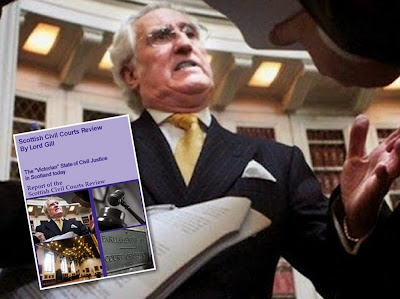
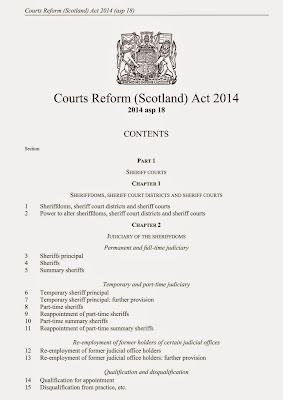
New court reforms claim justice will go faster. SCOTLAND’s embattled top judge, Lord President Lord Brian Gill has welcomed the implementation of the Courts Reform (Scotland) Act 2014 – legislation aimed at reforming Scotland’s hugely expensive and out of touch civil justice system which features watered down proposals Lord Gill originally made over five years ago in 2009.

Among the proposed changes will see an increase the value limit of cases heard in the sheriff court from £5,000 to £100,000, and the swelling of Scotland’s already burgeoning judicial ranks with the introduction of summary sheriffs to deal with some types of criminal and civil cases in the sheriff courts and the establishing of a Sheriff Appeal Court and a specialist personal injury court of national jurisdiction within the sheriff court.

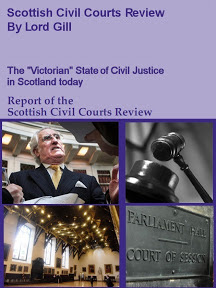
The legislative reforms – mostly designed to benefit the legal profession instead of fee paying clients & the wider public, come after Lord Gill and his team conducted a two year review of Scots Civil justice which began in 2007. Two years later in 2009, Gill – then Lord Justice Clerk – published his report and rounded on the stagnation of justice, branding Scotland’s courts as “Victorian” and unfit for purpose.

Gill (72) - who is fighting a bitter two year battle with the Scottish Parliament in an attempt to avoid members of the judiciary having to declare their interests such as sizeable, secret wealth, multi million pound property portfolios, links to big business, criminal records and offshore tax avoidance – issued a statement claiming the announced reforms, which only came about after an additional review of Gill’s original recommendations “will provide Scotland with a civil justice system fit for the 21st century”

Courts Reform (Scotland) Act 2014. The ‘reforms’ – which claim to speed up justice also target non lawyer and much cheaper McKenzie Friends, otherwise known as “Lay Representatives” in Scotland’s courts. The move, seen as a protectionist measure by the Scottish Government & judiciary to discourage people from using lay representatives, makes a MacKenzie Friend jointly liable with the person they are representing for all costs in a legal case if they lose.

Among other restrictions & sanctions placed on lay representatives, which do not apply to members of the legal profession, Section 98 0f the act states: Lay representation: supplementary provision (2) Provision under subsection (1) may include, in particular, provision— (g)  enabling the court, in awarding expenses against a non-natural person in any case to find a lay representative jointly and severally liable for the expenses.

The Lord President also confirmed his intention to appoint Sheriff Principal Mhairi Stephen as the President and Sheriff Principal Craig Scott as Vice President of the new Sheriff Appeal Court.

Lord Gill said: “These reforms will safeguard the integrity of Scots law by creating an efficient court structure. Every case will be heard by the appropriate court. The system will be accessible and cost effective for the litigant. My colleagues and I in the Review Team are particularly grateful to the Scottish Parliament for having passed into law almost all of our recommendations.”

Lord Gill added: “The process of implementation will now begin. I intend to appoint Sheriff Principal Stephen as the President, and Sheriff Principal Scott as Vice President, when the court comes into being.”

Justice Secretary, Kenny MacAskill who has remained a steadfast advocate of the legal profession, said: “I am delighted that this Government’s Court Reform Bill has become enshrined in law and has today received Royal Assent.Our courts have remained relatively unchanged for decades but this new legislation will bring about the most important change for Scottish courts for more than a generation. This is a hugely important step forward in making Scotland’s civil justice system more accessible, affordable and efficient for those people who need to resolve civil disputes.”

MacAskill continued: “We have listened to and accepted concerns from some stakeholders and made amendments to ensure that people get access to the most appropriate legal representation in their cases. I am confident that the reformed courts structure, including the new national specialist personal injury court, will ensure that cases can be raised and dealt with quickly and effectively and there is easier and more affordable access to justice.We look forward to working with our partners across the justice system to implement these reforms.”

However, despite claims the reforms will make justice faster, legal insiders and observers to Scotland’s courts expect little to change in what are the most adversarial, most inaccessible and most expensive courts & legal system in the entire European Union.

Civil Courts Review : Scots Justice still “Victorian” years after judge called for reforms:

The Scottish Civil Courts Review of 2009 authored by then Lord Justice Clerk, now Lord President Lord Brian Gill, castigated Scotland’s Civil Justice System as being Victorian, costly, and unfit for purpose, yet years on from the review, little of the proposed reforms have been implemented due to pressure from vested interests in the legal world, and a lack of political will to deliver access to justice to all Scots.

The Civil Courts Review can be viewed online here : Scottish Civil Courts Review Synopsis, Scottish Civil Courts Review Vol1 Chapters 1-9 & Scottish Civil Courts Review Vol2 Chapters 10-15

Gill, giving a speech to the Law Society of Scotland’s 60 year anniversary conference several years ago, reproduced in full here said : “The civil justice system in Scotland is a Victorian model that had survived by means of periodic piecemeal reforms. But in substance its structure and procedures are those of a century and a half ago. It is failing the litigant and it is failing society.

“It is essential that we should have a system that has disputes resolved at a judicial level that is appropriate to their degree of importance and that disputes should be dealt with expeditiously and efficiently and without unnecessary or unreasonable cost. That means that the judicial structure should be based on a proper hierarchy of courts and that the procedures should be appropriate to the nature and the importance of the case, in terms of time and cost. Scottish civil justice fails on all of these counts. Its delays are notorious. It costs deter litigants whose claims may be well-founded. Its procedures cause frustration and obstruct rather than facilitate the achievement of justice."

Previous articles on the Civil Courts Review and reforms of Scotland's antiquated civil justice system can be found on Diary of Injustice here: Scottish Civil Courts Review.

Friday, February 07, 2014

Seven years on, Lord Gill’s Civil courts reforms head to Parliament as Scots face prospect of little change on access to poor quality, expensive & selective civil justice system

Victorian and late, Civil Courts reform will change little in Scots justice system. SEVEN YEARS after Lord President Lord Brian Gill (then Lord Justice Clerk) was commissioned in 2007 to study Scotland's expensive closed shop civil justice system which culminated in the unremarkable 2009 Civil Courts Review conclusion that ‘things had to change’, the Scottish Government have today finally announced plans to bring the Courts Reform (Scotland) Bill to the Scottish Parliament for consideration by MSPs later this year.

The much heralded Gill Civil Courts Review published in 2009 which can be viewed online here : Scottish Civil Courts Review Synopsis, Scottish Civil Courts Review Vol1 Chapters 1-9 & Scottish Civil Courts Review Vol2 Chapters 10-15 has so far impacted little on how Scots are able to access justice in the Scottish courts. At the time, Lord Gill branded Scotland’s civil justice as “Victorian” and “failing society”. Little has changed from those criticisms some seven years on.

However, many of the reforms proposed by Lord Gill in 2009 which could have helped the man on the street gain a hearing in court have unsurprisingly been opposed by the legal profession and solicitors who are concerned they will lose their long held almost exclusive rights of audience and ability to charge whatever they want for legal services.

If anything, several of Lord Gill’s key recommendations published over four years ago including those which criticised the justice system as being expensive and out of reach in 2009, are now long out of date, due to the shocking and ever rising costs of legal representation and costs of court time and services which litigants have compared being akin to “extortion charges demanded by protection rackets.”

Published today, in what is clear an attempt to take the sting of the embarrassment suffered by Justice Secretary who yesterday lost his battle to the long held safeguard of corroboration of evidence from the criminal justice system, the Scottish Government have heralded a number of changes which are claimed as a substantial improvement on what is currently nothing short of a money spinning closed shop Civil justice business model for the legal profession, and the judiciary.

The Scottish Government claims the Courts Reform (Scotland) Bill implements many of the recommendations of the Scottish Civil Courts Review, led by principal reviewer Lord Gill and commissioned in 2007. Lord Gill recommended substantial changes to modernise and improve the structure and operation of the courts, which he described in the review as ‘slow, inefficient and expensive’.

The Bill will also modernise Scotland’s courts by introducing greater specialisation and enabling more user-friendly procedures. Key provisions in the bill include:

• Increasing the threshold under which the sheriff court can deal with civil cases from £5,000 to £150,000 - freeing up the Court of Session to deal with the most challenging civil disputes. This is expected to strengthen the role of the sheriff court, while reducing costs and delays for litigants.

• Creation of a new national personal injury sheriff court, where such cases will be heard by specialist sheriffs.

• Creation of a national Sheriff Appeal Court to deal with summary criminal appeals from sheriff and justice of the peace courts, and civil appeals from sheriff courts. This will help avoid the need for some civil appeals to be heard in the Court of Session and some criminal appeals in the High Court, delivering more proportionate costs, while preserving the right to appeal to the higher courts.

• Creation of a new judicial post – the summary sheriff - to resolve lower value civil cases such as debt cases more swiftly and efficiently, while also dealing with summary criminal cases.

• Plans for specialist sheriffs and specialist summary sheriffs in areas of law such as family, housing, personal injury and commercial law, with the expertise to deal with these issues as swiftly as possible.

• New procedures for judicial review cases in the Court of Session including a three month time limit, and new procedures for appeals within the Court of Session and some appeals to the UK Supreme Court to improve efficiency.

Justice Secretary Kenny MacAskill said: “As highlighted by Lord Gill, our civil justice courts have remained relatively unchanged for more than a generation and need to be made more effective and efficient. This bill takes forward our commitment to ensure that Scotland’s civil justice system becomes more accessible, affordable and efficient for those people who need to resolve civil disputes.

He continued: “At present many lower value personal injury cases are raised in the Court of Session costing the parties a disproportionate amount and clogging up the court. In future, most of these cases will be able to be raised in the specialist personal injury court with specialist sheriffs and procedures designed to achieve settlement swiftly and at a proportionate cost to the parties. The sheriff courts are well placed to handle this transfer as the total cases coming out of the Court of Session is only around three per cent of the civil caseload in the sheriff courts.

MacAskill, who was once a High Street solicitor went on to claim: “Our reforms will help us ensure that the right cases are heard in the right places - reducing delays, cost and bureaucracy. They will also offer clearer routes to justice and more specialisation for a range of cases, from personal injury cases to family law.”

The Lord President, Lord Gill, said: “With the introduction of this Bill Scotland has the opportunity to have a civil justice system that is fit for a modern Scotland. Delay and cost have been the bane of Scottish justice for decades. These reforms will enable the courts to deliver the quality of justice to which the public is entitled. I am grateful to the Cabinet Secretary for Justice for his support for the proposals of the Scottish Civil Courts Review and for his vision in promoting this legislation.”

Which? Executive Director Richard Lloyd said: "Getting the courts working better for people must mean cases being dealt with quickly and cost-effectively. Which? supports the plans under the Courts Reform Bill to move business below the value of £150,000 in to the Sheriff Courts as this will mean more consumers will be able to seek redress for poor services or faulty goods. That will be good for consumers and good for the many businesses that play fair with their customers."

The Scottish Government did not provide any supportive comments directly from litigants who have found it difficult to gain hearings in court, however Diary of Injustice can.

Commenting on the Scottish Government’s civil justice reform proposals, a personal litigant who has recently been charged tens of thousands of pounds for incomplete transcripts of court hearings before Scotland’s senior judges claimed the reforms do not go far enough.

He said: “It is all very well to produce press releases claiming advancements in justice but when litigants really need to use court services and find they cannot obtain legal representation, it is often the case court fees are too expensive, and of such poor quality that justice is unobtainable in the Scottish courts.”

He continued: “And even if you do have a solicitor, it will end up costing you thousands of pounds to achieve very little if anything.”

Speaking to Diary of Injustice today, a legal insider claimed the Civil Courts reforms will not serve to improve the image of Scotland’s expensive yet poor quality justice system at home or abroad.

He  said: “If the Justice Secretary hopes these piecemeal reforms will attract civil cases and other business to the Scottish courts, he will be sadly disappointed.”

He continued: “London’s courts, internationally respected and much less problematic than Scotland will continue to have clear advantages over the Scots model which is after all based upon a small jurisdiction widely associated with excessive legal fees, inferior legal services, and mounting problems with its judiciary.”

BACKGROUND TO CIVIL JUSTICE REFORM IN SCOTLAND

Lord Gill Lord Justice ClerkThe Lord Justice Clerk, now Lord President, Lord Gill, author of the Civil Courts Review. The Lord Justice Clerk, Lord Gill, in his speech to the Law Society of Scotland’s 60 year anniversary conference several years ago, reproduced in full here said : “The civil justice system in Scotland is a Victorian model that had survived by means of periodic piecemeal reforms. But in substance its structure and procedures are those of a century and a half ago. It is failing the litigant and it is failing society.

“It is essential that we should have a system that has disputes resolved at a judicial level that is appropriate to their degree of importance and that disputes should be dealt with expeditiously and efficiently and without unnecessary or unreasonable cost. That means that the judicial structure should be based on a proper hierarchy of courts and that the procedures should be appropriate to the nature and the importance of the case, in terms of time and cost. Scottish civil justice fails on all of these counts. Its delays are notorious. It costs deter litigants whose claims may be well-founded. Its procedures cause frustration and obstruct rather than facilitate the achievement of justice."

Previous articles on the Civil Courts Review and reforms of Scotland's antiquated civil justice system can be found on Diary of Injustice here: Scottish Civil Courts Review.

Friday, June 15, 2012

Vested interests ‘run Scotland’s courts’ as judges rule £90K & £120K civil jury awards over accident deaths ‘were excessive’

Lord_Hamilton_03Decision to ‘guide’ juries on civil awards shows vested interests have free run of our courts. A RULING in Scotland’s Court of Session by a five judge bench under the retiring Lord President, Lord Hamilton that damages awards made by civil juries to relatives of two people killed in separate accidents ‘were excessive and the claims should be heard again’ will prove to many that vested interests of professions, big business & insurance firms have the ability to skew justice in their favour in Scotland’s courts. The ruling, made earlier this week is seen by some as the thin end of the wedge to ending civil juries in damages awards in Scotland’s courts are over ‘paltry’ sums which not even a Banker would accept as a bonus or a judge would accept as an annual salary or retirement pension..

Previously, civil juries at the court of Session had found negligence on the part of the defenders had caused the deaths, where in the first case, KIRSTY MAY HAMILTON Pursuer and Respondent; against FERGUSON TRANSPORT (SPEAN BRIDGE) LTD Applicant and Defender: jurors awarded Kirsty Hamilton £120,000 after her mother, Caroline (aged 50) died in a road traffic accident when her car was crushed by a lorry near Fort William. Ms Hamilton was 17 at the time of her mother’s death. In the second case, GILBERT DENNIS THOMSON Pursuer and Respondent; against DENNIS THOMSON BUILDERS LTD Applicant and Defender, Dennis Thomson, was awarded £90,000 by a civil jury for the death of his son James, then aged 26, who died in an accident on a building site. Mr Thomson senior was 57 at the time of his son’s death.

However, the five judge bench - Lord Eassie, Lord Clarke, Lord Emslie, Lord Brodie and Lord Hamilton who heard the appeals of the companies previously found to be liable for the cause of the two fatalities, have now decided the compensation claims of the relatives should be heard again, and this time, the jurors should be given “guidance” from the presiding judge in assessing damages, with the judge suggesting a spectrum in which the award might lie.

The implication of the judges decision is that any further awards made in the cases should be much less than originally made by the earlier jury, leading many to conclude that vested interests are controlling the Scottish courts and the public’s access to justice.

In a telling excerpt from the opinion of the court, Lord Hamilton, sounding more like he was more concerned with curtailing publicity & growing enquiries over the disparity of justice where the amount of financial awards made by judges in damages actions without juries are falling well short of awards made in cases where a civil jury has made it’s decision, said : "If greater regard than hitherto is not had by judges to jury awards then the disparity between the judicial and jury awards is likely to remain.” Lord Hamilton went onto claim such a “state of affairs which lacks the consistency which is one of the hallmarks of a mature system"

The now retired Lord President commented that the absence of directions about sums awarded in similar cases by a civil jury, as opposed to that awarded by a judge was a "less than satisfactory aspect of civil jury trials". Lord Hamilton went onto say it was time "to set a framework for civil juries against which they can address levels of damages"which may easily be interpreted as an attempt to deprive a civil jury from making any kind of award which does not sit easily with a judge, or the vested interests of insurers & big business.

Lord Hamilton suggested several ways to address the disparities between awards made by judges & civil juries in Scotland’s Courts, saying : “The objective must now be to seek to narrow that disparity and to eliminate, in so far as practical, that lack of consistency. That can be done by three measures: first, by judges, sitting alone or in the Inner House, having significantly more regard to available jury awards (particularly where they demonstrate a pattern); secondly, by juries being given by the presiding judge fuller guidance than hitherto as to the level of damages which, consistently with other cases, might reasonably be awarded by them; and, thirdly, by appellate courts continuing to intervene, where necessary, on comparative justice grounds as envisaged under statute since 1815. This is a process which will take time and experience to mature.”

In what some may interpret as comments intended to stave off any intervention by the Scottish Parliament (similar to the asbestos damages bill) to remedy what many will perceive as a huge injustice in the cases of the deaths of the two persons, Lord Hamilton wrote in his opinion : “There is no reason to suppose that Parliament intended that awards by juries should have priority over awards by judges - or vice versa. Judicial and jury awards give different but complementary guidance for what is a just award of damages. In an age when life may be thought to be more precious than it may have been thought to be by earlier generations, and where consequentially the loss of the life of a close relative may seem a greater loss than it might have seemed earlier, the input of jury awards, reflective of the views of the community, may, in death cases, be particularly important.”

Lord Hamilton continued : “While awards made by juries without the benefit of judicial guidance may be at greater risk of being arbitrary or of having been influenced by illegitimate factors, those made with that (non-prescriptive) benefit are likely to be a valuable source for assessment in future cases. As to the second element, some suggestions are made below (para [76]) as to what procedural arrangements might be put in hand. The objective should be to eliminate, or at least reduce, the disparity between judicial and jury awards while at the same time securing that "awards ... in comparable cases ... bear a coherent relationship with each other" (Girvan, per Lord Clyde at page 25). If that objective is achieved, then parties whose disputes over damages are litigated can be better satisfied that they have had a fair trial - whether the adjudicating body is a judge or a jury.”

The size of the awards made by the civil juries in Scottish courts may surprise international readers, particularly those from the United States where awards in similar cases would normally run into the hundreds of thousands of dollars, or even millions of dollars. However, Scotland’s justice system has yet to catch up, if ever, with other jurisdictions who allow greater access to justice to victims of injustice, rather than what is seen as the regular influence of vested interests in Scotland’s courts which limits justice, and punishment over the loss of loved ones, to what amounts to little more than a few pennies after legal fees are paid.

As as happened in so many cases before in Scotland’s courts, bankers, politicians and judges can expect bigger bonuses & retirement pensions than any relative can expect via a future award made by a judge or civil jury in a case in a Scottish court.

The full details of the opinion can be read here : CSIH 52 PD2039/09 and PD1444/09 OPINION OF THE LORD PRESIDENT in motions for new trials in causis (1) KIRSTY MAY HAMILTON Pursuer and Respondent; against FERGUSON TRANSPORT (SPEAN BRIDGE) LTD Applicant and Defender and (2) GILBERT DENNIS THOMSON Pursuer and Respondent; against DENNIS THOMSON BUILDERS LTD Applicant and Defender

Of note is the inclusion in the hearing of counsel from the Scottish Government Legal Directorate appearing for Scottish Ministers.

BBC News reported on the case here : Awards in Highland and Shetland accidents 'excessive' judges rule

Saturday, March 24, 2012

Reform of civil justice & court costs ‘a dying duck’ : Lawyers vested interests respond to Scottish Government’s Taylor Review

Taylor Review Page Cover_Page1Taylor Review consultation will fail to address, reform Scotland’s rip-off justice system. NEARLY FOUR YEARS AGO, the Lord Justice Clerk, Lord Gill issued his Civil Courts Review, describing Scotland’s justice system as “… a Victorian model that had survived by means of periodic piecemeal reforms. But in substance its structure and procedures are those of a century and a half ago. It is failing the litigant and it is failing society.” The well respected judge who some hope will replace Lord Hamilton as Lord President, went onto criticise the civil justice system even further, leaving little doubt in anyone’s mind of the futility of using Scotland’s civil courts, saying “Its delays are notorious. It costs deter litigants whose claims may be well-founded. Its procedures cause frustration and obstruct rather than facilitate the achievement of justice”. The Scottish Government’s response to Lord Gill’s two year Civil Courts Review was, more talk, and little action, and adding insult to injury, a review of Lord Gill’s review, branded the Taylor Review.

Over a year after Lord Gill had issued his highly critical findings on Scotland’s Victorian civil justice system, the Scottish Government announced their plans, with a proviso many of the ‘reforms’ would take years to implement, if ever. This was reported here : Scottish Government’s response to Civil Courts Review : Class Actions, more cases to Sheriff Courts, & faster, easier access to justice ‘over years’ and finally in 2011, the Scottish Government announced a review of Lord Gill’s review, seen by most as a time wasting exercise for vested interests, reported here : Scottish Government delay reforms on costs of litigation & access to justice as Minister announces 18 month 'time wasting' review by retired sheriff.

It took at least another six months before the Taylor Review team launched their consultation, covered by Diary of Injustice, here : Going to court is like being taken to the cleaners ? Participate in the Review of Expenses and Funding of Civil Litigation in Scotland Consultation.

While the Taylor Review has yet to report on, & recommend reforms to the way justice is obtainable (usually unobtainable) in Scotland, the vested interests of the legal profession have, predictably, released their own responses to the Taylor Review, giving little prospect of any changes to the ridiculous cost of litigating in Scotland’s civil courts.

Readers can view the legal profession’s responses to the Taylor Review at the following links : Response from the Law Society of Scotland, Law Society of Scotland’s Remuneration Committee on shortfall in judicial expenses, Response from the Faculty of Advocates, Response from the Glasgow Bar Association

Not withstanding the amount of time which has passed since Lord Gill’s critique on Scotland’s costly, antiquated civil justice system, nearly a full four years which have seen costs of going to court spiral in Scotland, there is little if anything in the responses from the legal profession which may contribute to any significant falls in the costs of obtaining justice in Scotland. Lets face it, lawyers are never going to concede justice could, and should become cheaper, simply because it affects their profits, and of course, the wider influence of the legal profession on public & political life in Scotland. Scots therefore, should not expect easier or cheaper access to justice anytime soon.

BACKGROUND TO CIVIL JUSTICE REFORM IN SCOTLAND

Lord Gill Lord Justice ClerkThe Lord Justice Clerk, Lord Gill, author of the Civil Courts Review. The Lord Justice Clerk, Lord Gill, in his speech to the Law Society of Scotland’s 60 year anniversary conference last year, reproduced in full here said : “The civil justice system in Scotland is a Victorian model that had survived by means of periodic piecemeal reforms. But in substance its structure and procedures are those of a century and a half ago. It is failing the litigant and it is failing society. It is essential that we should have a system that has disputes resolved at a judicial level that is appropriate to their degree of importance and that disputes should be dealt with expeditiously and efficiently and without unnecessary or unreasonable cost. That means that the judicial structure should be based on a proper hierarchy of courts and that the procedures should be appropriate to the nature and the importance of the case, in terms of time and cost. Scottish civil justice fails on all of these counts. Its delays are notorious. It costs deter litigants whose claims may be well-founded. Its procedures cause frustration and obstruct rather than facilitate the achievement of justice."

The Scottish Government’s full response to Lord Gill’s Civil Courts Review can be viewed online here : Scottish Government Response to the Report and Recommendations of the Scottish Civil Courts Review or can be downloaded directly, here : Scottish Government Civil Courts Review response (pdf)

Readers can download the Civil Courts Review report in pdf format, from the Scottish Courts Website at the following links : Volume 1 Chapter 1 - 9 (Covers McKenzie Friends, procedures, advice etc, 2.99Mb) Volume 2 Chapter 10 - 15 (Covers mainly the issue of Class (multi party) actions etc, 2.16Mb) Synopsis (215Kb)

Readers may also wish to gauge how Holyrood and the Scottish Government are treating the Civil Courts Review, from a report covering the last Holyrood debate on the subject, along with video footage, here : Holyrood debate reveals civil justice reforms & McKenzie Friends may be a long way off as Scottish Ministers stumble over Lord Gill review proposals

Diary of Injustice’ coverage of the Civil Courts Review from its publication to the present, can be found here : Civil Courts Review - The story so far.

Wednesday, December 28, 2011

Going to court is like being taken to the cleaners ? Participate in the Review of Expenses and Funding of Civil Litigation in Scotland Consultation

Taylor Review Page Cover_Page1Taylor Review consultation on costs of justice aims to tackle widespread evidence that litigation in Scottish courts is expensive, exclusive & unproductive. GOING TO COURT is like being taken to the cleaners, whether its down to the fees of your own solicitors, the fees of the other side’s legal team or the court’s fees. No matter how you word the dreaded ‘access to justice’ equation, going to court in Scotland is a bit of a rip-off. There is no escaping the fact that justice, and access to it, is, with ample evidence, widely perceived to be the domain of the rich, vested interests, someone who can slip a judge a benefit on the side, or the ones who know how to bend legal aid rules to pick up public funds for taking on cases for convicted rapists, murderers & fraudsters which make the rest of the nation sick.

Put it this way, if you’ve ever had the feeling a serial child murderer stands a better chance of obtaining access to court & millions in taxpayer funded legal aid for a dispute over prison rights, as opposed to your own court case involving claim against a swindler who stole your investments, a lawyer who ruined a will or took your house, a medial professional who committed negligence or who caused a death in your family, or some other professional who, through their actions ruined your life and then kept on ruining your life in some kind of vendetta, you are in the right country. It all happens here, every week of every month of every year.

Those of you who attempt to pursue a case through Scotland’s antiquated “Victorian” court system to gain ‘justice’ simply end up joining a queue of thousands of people who walk in & out of Scotland’s revolving door courts system each year achieving nothing more than lining the pockets of the legal profession, the courts, & the judge who sits there on a £200K plus salary, managing an occasional grumble or mumble in some kind of inaudible verbal abortion more reminiscent of a silent horror movie, while frequently finding or ruling for the vested interests who his or her lordship dare not upset.

In an attempt to address the cost aspect of obtaining justice in Scotland’s Victorian civil courts, the Scottish Government’s Taylor Review of Expenses and Funding of Civil Litigation in Scotland has announced a consultation which readers and anyone with an interest in access to justice issues in Scotland should participate in. I also encourage anyone who does participate in the Taylor Review to ask their msp to participate. After all, you can bet your last penny the vested interests of the legal profession are participating in the consultation, and demanding costs be kept as they are, so justice can be delivered at great expense rather than being delivered on the cheap.

Heaven help Scotland’s greedy multi billion pound legal services rip-off industry if costs of going to court or conducting litigation were ever likely to be reduced …

The Taylor Review consultation paper is available to download here:

Consultation Paper (Word Document) 2253.5 kb

Consultation Paper (PDF Document) 856.85 kb

An announcement from the Taylor Review Team encourages participation in the consultation, stating : We hope that the consultation process will generate considerable debate and that you will feel able to respond to the questions that we pose.  Please do not feel that you must respond to every question.  There may be particular issues which interest you and you should feel free to limit your answers to such areas.  If there are additional points that you wish to make that are not covered by the Consultation Paper then please feel free to do so.

You can find out more about the Taylor Review HERE and readers should note responses to the consultation are to be received by the review team no later than Friday 16 March 2012.

Review of Expenses and Funding of Civil Litigation in Scotland

STATEMENT BY SHERIFF PRINCIPAL TAYLOR

LAUNCH OF TAYLOR REVIEW CONSULTATION

In September 2009, the Scottish Civil Court's Review (SCCR) under the chairmanship of The Rt. Hon. Lord Gill presented its Report to the Scottish Government. I am pleased that the Scottish Government has responded so positively to the recommendations in the Report.

The Board of the SCCR knew that Lord Justice Jackson was undertaking a Review of Civil Litigation Costs in England and Wales and would be reporting in early 2010. Accordingly, the Board thought it would be prudent to await the outcome of LJ Jackson's Report before formulating recommendations on judicial expenses in this jurisdiction.

LJ Jackson reported in 2010 and the Westminster Government has responded to that Report. The Legal Aid Sentencing and Punishment of Offenders Bill is presently making its way through the Westminster Parliament.

Earlier this year I was invited by the Scottish Government to chair a Review into the Expenses and Funding of Civil Litigation in Scotland. Part of my remit is to consult widely. Since the Review commenced, we have spoken to a number of people with an interest in the Scottish civil judicial process in order that we might identify those areas where it is thought that reform is necessary. We wrote to over 90 individuals and bodies seeking guidance on the issues upon which we should be consulting. I am also deeply indebted to the members of the Reference Group who have given of their time both generously and free of charge. Their contribution has been invaluable. This consultation document is the product of these discussions and responses. The responsibility for the content is, nonetheless, mine.

The consultation document covers a wide range of issues which have a significant impact on access to justice. Access to justice is a right and it has been said with some force that its absence is "an enemy of the rule of law". For example, we ask for views on whether access to justice would be improved if lawyers in Scotland were allowed to enter into agreements with clients whereby the lawyers could express their fee as a percentage of the damages recovered. We also give an opportunity for members of the public and lawyers alike to give their views on the desirability of referral fees which is an issue which has generated considerable interest south of the border.

It is a matter of chance that we embark upon consultation at a time when the Westminster Bill is being debated in the House of Lords. The Scottish Government recognises the importance of access to justice and has adopted a different approach from its English and Welsh counterparts. It does not intend to make major changes to the scope of legal aid even in these times of austerity. It would however wish legal aid to become "a funder of last resort."

I hope that there will be considerable debate generated by this document and that I will receive responses from as many sources as is possible. By so responding the Scottish public and professions will hopefully draw attention to all aspects of the issues contained in the consultation document. To assist the consultation process we propose to have public meetings in Aberdeen, Dumfries, Edinburgh, Glasgow and Perth. A wide range of responses should minimise the risk of there being unintended consequences arising out of the recommendations which will eventually be contained in my Report. I intend to report before the end of 2012.

Wednesday, September 21, 2011

Civil Courts Review TWO YEARS ON : “Victorian” flaws in Scots legal system ‘may last for decades’ as lawyers vested interests stifle justice reforms

Lord GillLord Gill’s Civil Courts Review published in 2009 recommended significant reforms to Scots justice system yet little has changed in two years. TWO YEARS ON from the CIVIL COURTS REVIEW undertaken by Scotland’s Lord Justice Clerk, Lord Gill in February 2007 which culminated in his report published in September 2009 recommending significant wide ranging reforms to Scotland’s antiquated civil justice system, Scots are finding access to civil justice & access to courts has, in reality, changed little despite much talk at the Scottish Parliament on the report’s reforms and several amateur attempts by the Scottish Government to legislate wider access to justice, all of which have been watered down in the face of almost warlike hostility from lawyers worried their profit margins would sink as people chose other forms of getting to court.

Sadly, the stinging criticisms of Lord Gill, who himself branded Scotland’s civil justice system as “Victorian”, failing to deliver efficiency of justice or Scots accessibility of justice appear to have been lost in the mists of time with little progress on the Lord Justice Clerk’s proposals to rectify the justice system’s ills, yet those consumers in Scotland who face the torture of using Scotland’s expensive, seemingly endemically dishonest legal profession to get to court, would rather the proposed reforms be speeded up than having review after review, and then as is now the case, reviews of the reviews.

Last year, on the first anniversary of the Civil Courts Review, and the blaze of publicity which surrounded its publication, we saw little change, almost a few steps backwards as I reported last August 2010, here : Civil Courts Review one year on : Scotland’s out-of-reach justice system remains Victorian, untrustworthy and still controlled by vested interests

Another year has now passed, yet the only movement on Lord Gill’s proposals by the Scottish Government, was to launch another review, as I reported earlier in March, here : Scottish Government delay reforms on costs of litigation & access to justice as Minister announces 18 month 'time wasting' review by retired sheriff, announced after I reported in January Civil Justice Advisory Group calls for radical reform of Scotland’s civil justice system, says people should be at the heart of Scottish civil justice

I reported on the ‘progress’ of the Sheriff Taylor review (the review of the review), earlier in July, here : Lawyers can talk, yet fee paying clients & court users remain shut out of Scottish Government review of the costs & funding of litigation in Scotland. A consultation was to be published on the Taylor Review website HERE although none has yet appeared.

Clearly, Civil Justice Reform and giving Scots control over their own access to justice & legal services, instead of the present arrangement where the legal establishment and lawyers control & decide which Scots have access to justice, is not a priority for the Scottish Government.

Indeed, it could well be argued the Scottish Government are delaying for as long as possible, most of the access to justice reforms because they will put power into the hands of Scots to resolve their legal issues & court issues much faster, at less cost, and with less potential for failure, than the present “Victorian” system offers us. The reason for the delays ? Well, its not too difficult to see if Scots are able to resolve their legal issues faster and cheaper, the legal profession are going to make a lot less money out of their clients.

Reminding readers once again of those words, Lord Gill, in his speech to the Law Society of Scotland’s 60 year anniversary conference last year, said : “The civil justice system in Scotland is a Victorian model that had survived by means of periodic piecemeal reforms. But in substance its structure and procedures are those of a century and a half ago. It is failing the litigant and it is failing society."

He continued : "It is essential that we should have a system that has disputes resolved at a judicial level that is appropriate to their degree of importance and that disputes should be dealt with expeditiously and efficiently and without unnecessary or unreasonable cost. That means that the judicial structure should be based on a proper hierarchy of courts and that the procedures should be appropriate to the nature and the importance of the case, in terms of time and cost.”

“Scottish civil justice fails on all of these counts. Its delays are notorious. It costs deter litigants whose claims may be well-founded. Its procedures cause frustration and obstruct rather than facilitate the achievement of justice."

"Unless there is major reform and soon, individual litigants will be prevented from securing their rights, commercial litigants will continue to look elsewhere for a forum for their claims, public confidence in the judicial system will be further eroded, Scotland’s economic development will be hindered, and Scots law will atrophy as an independent legal system.”

“Major reform and soon”, as Lord Gill said himself, has not happened. One may rightly being to wonder if Lord Gill’s reforms are ever expected to occur while the vested interests of money makers in the legal profession have their way. September 2010 has come and nearly ended, yet, again, little has changed for those in Scotland who need a justice system fit for the 21st Century, rather than what we currently have, the “Victorian” version controlled by vested interests from the legal establishment.

An official from one of Scotland’s consumer organisations admitted today he was ‘despondent’ about any major reforms to Scotland’s civil justice system over the next ten years. He said : “There is a general feeling the civil courts review is dead & buried along with any chance to launch major reforms to civil justice in the next decade.I don't believe this is a priority for the current Scottish Government and I don't think it will be one for the next”

He continued : “It’s just not in the interests of those earning money out of the justice system to see a different playing field where consumers can get easier, cheaper & faster access to justice in Scotland. Lawyers keep claiming if such reforms came in, they would go out of business, however lawyers dont own the justice system, they just use it to make money. Until we get away from the idea the legal profession owns & operates the justice system and the courts as their own business, there will be little chance of constructive reform of civil justice in Scotland.”

Readers can download the Civil Courts Review report in pdf format, from the Scottish Courts Website at the following links :

Volume 1 Chapter 1 - 9 (Covers McKenzie Friends, procedures, advice etc, 2.99Mb)

Volume 2 Chapter 10 - 15 (Covers mainly the issue of Class (multi party) actions etc, 2.16Mb)

Synopsis (215Kb)

My coverage of the Civil Courts Review from its publication to the present, and the pace of reforms to civil justice in Scotland can be found here : Civil Courts Review - The story so far however the story so far is that Scots do not have control over their own access to justice, and Scotland still has a justice system which is Victorian, prejudiced, politicised, controlled by vested interests & definitely a little crooked.

Friday, April 22, 2011

Law Society‘s ‘Manifesto for vested interests’ : Give public a little legal knowledge, ensure lawyers keep control of access to justice & courts

Law Society of ScotlandLaw Society’s manifesto for lawyers says public should know more about the law, less about those sitting behind a lawyer’s desk. THE current, embattled President of the Law Society of Scotland, Jamie Millar who has been caught up in various arguments with leading west coast lawyers over the manipulative control freak nature of Scotland’s governing body for lawyers yesterday claimed Scots consumers should be given a wider knowledge of the law and how it works, although perhaps not enough knowledge so that consumers might end up choosing not to waste a few thousand pounds with a solicitor, and instead go it alone in courts on small scale legal disputes, thus depriving the legal profession of millions of pounds of lost business.

While making the usual appropriate pre-election noises to catch the attention of msps & political parties hoping to form the next Scottish Government, the Law Society is apparently, keen to keep its “Manifesto for 2011(pdf) in the news, given the upcoming Holyrood elections in a couple of weeks time. The ‘manifesto’, or rather a ‘wish-list’ for the legal profession which covers issues such as :

1. Public knowledge and understanding of the legal system
2. Access to legal services, advice and representation
3. A civil justice system that meets the need of society
4. Good legislation
5. A sustainable economy

On the theme of Public knowledge and understanding of the legal system, the Law Society’s manifesto states it believes it is essential for the Scottish Government to ensure a greater public knowledge and understanding of the legal system. To this end, we propose that :

1. Changes should be made to the curriculum in secondary schools to include a course on law and the legal system and consideration given to the creation of a new secondary school law qualification
2. Each new act of the Scottish Parliament should be accompanied by an information leaflet as well as online information that properly explains the new law and its impact on the citizen

Perhaps unsurprisingly, the Law Society’s plans for making changes to the curriculum in Scotland’s secondary schools will ensure it and various business models attached to the Scottish legal profession will control how law and the legal system is taught in Scotland’s schools.

On the issue of Access to legal services, advice and representation, the Law Society claims in its manifesto that it believes that access to justice remains a key element of a free and fair society, yet in reality, the Law Society of Scotland holds world records for opposing many reforms to Scotland’s legal system, from the raising of small claims ceilings to class actions, and opposing the introduction of independent regulation of legal services even at the point of legal threats to the legislative process in the Scottish Parliament itself.

The Law Society also notably opposed the introduction of McKenzie Friends (lay assistants or courtroom helpers for unrepresented party litigants), which had been kept out of Scotland for some FORTY YEARS by the legal profession, who feared McKenzie Friends would chip away at lawyers dominance of access to the courts.

The Law Society’s proposals on Access to Justice as contained in their manifesto are a jumble of calls for additional reviews of reviews already carried out of Scotland’s antiquated civil justice system. The Society’s proposals, which can be described at best as a delaying game for introducing to Scotland many reforms already in place in England & Wales, state :

1. A review be undertaken into civil litigation costs and funding, similar to the work done by Lord Jackson in England and Wales
2. Any move to withdraw the right to have devolution minutes in criminal cases heard by the United Kingdom Supreme Court be rejected
3. A full audit is made of the compatibility of Scots criminal law with the European Convention on Human Rights, to ensure the mistakes that lead to the Cadder case cannot easily recur
4. Pro bono costs orders, similar to those allowed in England and Wales under s194 of the Legal Services Act 2007, should be introduced in Scotland
5. A review be undertaken into the current arrangements for public interest actions under the legal aid system

On the issue of a civil justice system that meets the need of society, or perhaps the Law Society means, “meets the needs of the Law Society rather than the public”, the Law Society says it believes that urgent changes are required to the civil justice system to make it more efficient and ensure it better meets the needs of a changing society. Yet the many urgent changes proposed by the Law Society have for years, been stifled from introduction by its own members and by Law Society lobbying against reforms.

1. The recommendations made by the review of civil courts by Lord Gill be taken forward, including the separation of civil and criminal cases and the appointment of District Judges to deal with summary crime
2. Specialised sheriffs are introduced and an increase in the threshold for Court of Session cases
3. Compulsory pre action protocols in civil cases be introduced
4. Consideration to be given for ways of incentivising pro bono schemes- perhaps through the tax system
5. A review of the administration of criminal cases and the impact it has generally on the administration of justice

The topic of “Good Legislation” again meets with similar calls for reviews, evaluations & calls for more consultation with the public & of course the legal profession over the passing of legislation. Obviously the Law Society might be worried some new legislation may slip through putting consumer rights ahead of the perceived priority rights of members of the Law Society of Scotland, something the Society could never allow to happen of course.

The Law Society’s proposals on “Good Legislation” are :

1. Parliament legislate only when it is necessary to modernise the law, to comply with decisions of the court or to conform to international obligations
2. A review be undertaken into the Scottish Parliament’s consultation processes, to ensure they match the aspirations of the Consultative Steering Group
3. An evaluation be made of the Scottish statutes and subordinate legislation passed since 1999 and the effectiveness of the legislation
4. A wide ranging review be undertaken of the areas of the law which are appropriate for consolidation and amendment
5. A programme of consolidation and codification be commenced (in those areas of the law identified as appropriate) and for this programme to begin in the first year of the new Parliament

And finally, to cap it all, the topic of “Sustainable Economy” puts the Law Society of Scotland and its members at the heart of (don't laugh) playing “an integral role in Scotland’s future economic success”, presumably by ripping off taxpayer funded legal aid and clients whenever possible.

The Law Society’s ‘Great Scottish rip-off’ proposals on a Sustainable Economy guided forward by the legal profession, state :

1. The Legal Services (Scotland) Act 2010 continues to be viewed as a business opportunity for Scottish firms and for the Scottish Government to press ahead with the necessary implementing regulations
2. Scotland be promoted as a place for international arbitration and for proposals for an international arbitration centre to be a priority
3. Existing powers of the Scottish Parliament and any new powers devolved through the Scotland Bill be used to maximise Scotland’s international competitiveness and economic growth
4. The legal profession be included by the Scottish Government and its agencies in its international economic and business promotion and prioritisation

Speaking in a Press Release to support the Law Society’s Manifesto for 2011, President of the Society, Jamie Millar said: "We heard about some of the practical difficulties this lack of understanding has caused, with the Family Law (Scotland) Act 2006 highlighted as one example of where there appeared to be a poor understanding of the impact of the law on co-habitants. A number of important Bills have been passed during last parliament, such as the including the Domestic Abuse (Scotland) Bill and the Patients Rights (Scotland) Bill. Both of these will have significant impact on citizens and it's important they are aware of the legislation, their rights and most importantly the help available to them.”

He continued : "From those we spoke to, there was a strong feeling that for the legal system to be effective there had to be a better understanding and awareness amongst the general public of how the law and justice system operates not least to try and grow a greater sense of citizenship in our society and our democracy. That is why we have called for this in our manifesto. Public education is not simply a job for government and our parliamentarians however. The Society, as well as the wider legal profession, has an important role to play in partnership with others to increase awareness. The Schools Law Web is one example of where stakeholders have recently come together to successfully provide legal education for schools."

Interestingly, the Law Society had earlier this year, interdicted attempts at the Scottish Parliament to open up the issue of legal education in Scotland’s schools, preventing open debate on suggestions that teachers would be better placed to teach law to kids in schools, rather than costly business models connected to the legal profession itself.

The Law Society’s Press Release went onto claim “A number of political parties have already talked about the importance of providing better information for the public and praised the Society's proposals for the introduction of legal education in secondary schools to build awareness of the justice system and installing citizenship from an early age.”

On this point, Mr Millar said: "Increasing the public's knowledge and understanding of the law would have significant benefits not just for the legal system, but for society as a whole. It is something that we will continue to push for during the election campaign and indeed once a new government is in place."

Sure thing Mr Millar. You could draft in crooked Scottish Borders solicitor Andrew Penman to teach pupils of the importance of falsifying file notes, how to deliberately deceive banks, and the Inland Revenue & mishandle wills, while also sending in John G O'Donnell & Catriona Macfarlane to teach honesty, along with the Legal Defence Union to teach to get out of being held to account for alleged misuse of taxpayer funded legal aid.

So, now readers know what Scotland would look like if it was run by the Law Society of Scotland.

The Law Society’s proposals have been rounded on by consumer groups as little more than an attempt to control the extent of, or even delay many of the reforms already suggested by the Scottish Civil Courts Review, undertaken by the Lord Justice Clerk, Lord Gill, who branded Scotland’s civil justice system a Victorian model unfit for purpose.

Readers can compare the Law Society of Scotland’s Manifesto for 2011with the more detailed & less vested-interest-dominated Civil Courts Review report in pdf format, from the Scottish Courts Website at the following links : Volume 1 Chapter 1 – 9 , Volume 2 Chapter 10 – 15 & Synopsis

My coverage of the Civil Courts Review from its publication to the present, and the pace of reforms to civil justice in Scotland can be found here : Civil Courts Review - The story so far.

Tuesday, March 08, 2011

Scottish Government delay reforms on costs of litigation & access to justice as Minister announces 18 month 'time wasting' review by retired sheriff

Fergus Ewing Scottish ParliamentScottish Govt. Minister Fergus Ewing announces 18 month review of costs of litigation & justice in Scotland. THE SNP minority Scottish Government today stand accused of obstructing Scots access to justice by intentionally delaying reforms to the infamously staggeringly high costs of using Scotland’s justice system, after it was announced on Friday that a review of the costs & funding of litigation in Scotland, an area of major concern highlighted by Scottish judge Lord Gill in his 2009 Civil Courts Review, will finally take place ‘sometime after April 2011’, some two years after the Lord Justice Clerk severely criticised much of Scotland’s civil justice system which he himself branded “Victorian”.

However, those hoping for the Scottish Government to introduce speedy reforms as recommended in the Civil Courts Review to reduce the extortionate costs of getting to court or using any legal services in Scotland will be in for an even greater shock, as the review itself is to take a staggering e-i-g-h-t-e-e-n months to complete.

The announcement from the Scottish Government, made by the Minister for Community Safety, Mr Ewing, stated : “A review of the costs and funding of litigation in Scotland will be undertaken by Sheriff Principal James Taylor. This review was recommended by the Lord Justice Clerk, Lord Gill in his report of the Review of the Scottish Civil Courts. Sheriff Principal Taylor will begin the review when he retires from the bench in April. It is anticipated that the review will take around 18 months and the final report will be sent to the Scottish Ministers for consideration of further action, on completion.”

Mr Ewing, making an announcement one might normally expect from the Justice Secretary, said : "It is this Government's desire to make Scotland a forum of choice for litigation and to ensure Access to Justice for all Scotland's population. This review will better inform the costs of litigation, the barriers which prevent access to the courts for some and consider what alternative options there may in the context of the Scottish Civil Courts Review conducted by Lord Gill."

The terms of reference for the review announced by the Scottish Government are :

To review the costs and funding of civil litigation in the Court of Session and Sheriff Court in the context of the recommendations of the Scottish Civil Courts Review, and the response of the Scottish Government to that review. In undertaking this review, to:

* consult widely, gather evidence, compare our expenses regime with those of other jurisdictions and have regard to research and previous enquiries into costs and funding, including the Civil Litigation Costs Review of Lord Justice Jackson

* consider issues in relation to the affordability of litigation; the recoverability and assessment of expenses; and different models of funding litigation (including contingency, speculative and conditional fees, before and after the event insurance, referral fees and claims management)

* consider the extent to which alternatives to public funding may secure appropriate access to justice, and pay particular attention to the potential impact of any recommendations on publically funded legal assistance

* have regard to the principles of civil justice outlined in Chapter 1, paragraph 5 of the Civil Courts Review

* consider other factors and reasons why parties may not litigate in Scotland

* report with recommendations to Scottish Ministers, together with supporting evidence within 18 months of the work commencing

However, according to Scottish Government inside sources speaking to Diary of Injustice yesterday, the review when finally completed may have little or no impact or bring any real reductions in court costs because by the time its conclusions are handed over to Scottish Ministers by the end of 2012 at the earliest, possibly taking until 2013, inflation, higher legal fees, dwindling personal wealth & reductions in legal aid availability will combine with a whopping four or even five years on since Lord Gill made his initial recommendations in 2009 to put an end to any consumer hopes of lower costs of using Scotland’s “Victorian” justice system.

A court user & experienced party litigant commenting on the Scottish Government’s latest proposals branded the review as little more than a delaying tactic.

He said : "The latest proposal is just another example of the wilful delay which has previously been used by vested interests when defending the status quo.”

He continued : “First we had to wait many years for Lord Gill's Civil Court's Review, which is now 18 months old, now we have to wait for the Sheriff Principal to retire followed by a further 18 months for his review to be completed. No doubt this will be followed by yet further delay from Parliament, and all to investigate failings long since identified by the Scottish Public and a number of consumer organisations.”

“Given this record of procrastination some might credibly maintain that there is no sincere desire within the Legal and political communities to remedy the conspicuous defects of the Civil Justice System in Scotland, the powers that be preferring instead to engage in numerous 'window dressing' exercises.”

A consumer official who spoke to Diary of Injustice described the Scottish Government’s eighteen month review proposals as “an exercise in time wasting”. He also criticised the terms of the review, claiming it would not answer the root causes of high costs within the justice system or recommend effective solutions to the affordability of access to justice in Scotland.

He said “Everyone is well aware the costs of using the courts in Scotland are far too high. However, I really don't think Lord Gill had it in mind he would write his conclusions only to find after four years nothing would be done to remedy the financial burdens placed on those consumers seeking access to legal services in Scotland.

He continued : “People may well begin to believe, with good cause that the Scottish Government’s 18 month review of litigation costs is little more than an attempt to appease the legal establishment amid their concerns Lord Gill’s Civil Courts Review overreached itself and was overly critical of many lucrative areas of business in the courts. Personally, I have little faith in Mr Ewing’s review.”

Clearly there is no appetite in this Scottish Government for providing access to justice for ordinary Scots, who through bitter experiences of using the justice system are finding more often than not that access to justice is more like access to extortion. Perhaps Lord Gill may be well advised to speak out once again on the progress of civil justice reform.

BACKGROUND TO CIVIL JUSTICE REFORM IN SCOTLAND

Lord Gill Lord Justice ClerkThe Lord Justice Clerk, Lord Gill, author of the Civil Courts Review. The Lord Justice Clerk, Lord Gill, in his speech to the Law Society of Scotland’s 60 year anniversary conference last year, reproduced in full here said : “The civil justice system in Scotland is a Victorian model that had survived by means of periodic piecemeal reforms. But in substance its structure and procedures are those of a century and a half ago. It is failing the litigant and it is failing society. It is essential that we should have a system that has disputes resolved at a judicial level that is appropriate to their degree of importance and that disputes should be dealt with expeditiously and efficiently and without unnecessary or unreasonable cost. That means that the judicial structure should be based on a proper hierarchy of courts and that the procedures should be appropriate to the nature and the importance of the case, in terms of time and cost. Scottish civil justice fails on all of these counts. Its delays are notorious. It costs deter litigants whose claims may be well-founded. Its procedures cause frustration and obstruct rather than facilitate the achievement of justice."

Against the background of Lord Gill’s criticisms of Scotland’s “Victorian” civil justice system, in which some cases continue to be heard by judges some fifteen years after they first entered the court system, the current Scottish Government have a poor track record of responding to the many recommendations contained in Lord Gill’s 2009 Civil Courts Review, as I have previously reported, here : Civil Courts Review one year on : Scotland’s out-of-reach justice system remains Victorian, untrustworthy and still controlled by vested interests & here : Scottish Government’s response to Civil Courts Review : Class Actions, more cases to Sheriff Courts, & faster, easier access to justice ‘over years’.

Sadly, many of the Scottish Parliament’s msps failed to push the SNP administration to address much of the 100 year plus malaise of Scotland’s civil courts system. Only a handful of Scottish politicians rose to the occasion to challenge the Scottish Government over Lord Gill’s recommendations. Video footage of those Holyrood debates on civil justice reform & Lord Gill’s Civil Courts Review can be viewed at LawyerTV.

Readers can find out more & download a copy of the Civil Courts Review report in pdf format, from the Scottish Courts Website at the following links :

My coverage of the Civil Courts Review from its publication to the present, and the pace of reforms to civil justice in Scotland can be found here : Civil Courts Review - The story so far.

Wednesday, January 19, 2011

Civil Justice Advisory Group calls for radical reform of Scotland’s civil justice system, says people should be at the heart of Scottish civil justice

Consumer Focus Scotland logoConsumer Focus Scotland’s Civil Justice Advisory group publishes its report on civil justice reform. SCOTLAND's “Victorian” civil justice system came in for yet more criticism today as the Civil Justice Advisory Group, reconvened in January 2010 by Consumer Focus Scotland under the chairmanship of Lord Coulsfield with a remit to consider the proposals of the Scottish Civil Courts Review, led by the Lord Justice Clerk, Lord Gill, published its report and called for a radical rethink on how the civil justice system in Scotland can be reformed to make it more fit for purpose & user friendly.

In today’s report the Civil Justice Advisory Group proposes that the focus should be on creating a civil justice system designed around the people who use it, addressing the various needs that users have at each stage in resolving their disputes, to ensure that these are resolved in the most effective way as early as possible.

“Ensuring effective access to appropriate and affordable dispute resolution”, the Final Report of the Civil Justice Advisory Group (pdf), published by Consumer Focus Scotland, makes a series of recommendations that include:

* The development of a ‘triage’ approach to civil justice problems, aiming to ensure that users are directed to the most appropriate pathway for the resolution of their problem.

* The creation of a web-based system bringing together information on rights, responsibilities, sources of help, and advice and options for dispute resolution.

* Funding should be made available to pilot more proactive public legal education initiatives to build legal capability amongst particular groups.

* The introduction of new court rules to encourage, but not compel, parties to seek to resolve their dispute by mediation or another form of alternative dispute resolution, prior to going to court.

* A mediation scheme should be available which could be accessed before a court action is raised, as well as being available to the court.

* The need for a clear separation between civil and criminal business in the third-tier of civil jurisdiction proposed by the Gill review.

* The third-tier should operate within a simplified process, with plain English, user-friendly rules, and clear, simple forms. Efforts should also be made to ensure the culture of the third-tier is not intimidating for litigants.

* The establishment of a specialist jurisdiction to deal with housing cases.

* The Scottish Government to review the way in which family cases are dealt with, including the rules and procedures which should apply.

* National roll out of in court advice services, although these should not necessarily be based within individual courts.

The report also calls on the Scottish Government to ensure that the full range of relevant interests should be given the opportunity to provide sufficient input to future civil justice reform. It will now be submitted to the Scottish Government to support its implementation of the Gill review proposals on civil justice.

Lord Coulsfield said the Group’s aim is to make the civil legal process more effective and efficient as well as easier for its users: “I hope that we have made suggestions which will contribute to the creation of a system which will encourage the resolution of disputes by agreement wherever possible, but also provide for an unintimidating and accessible and efficient court procedure where agreement cannot be reached.”

Lord Coulsfield continued : “Our intention was, through taking a broader look at the experience of people who need the help of the civil justice system, to make recommendations that will spare those who do not need to go to court from having to do so, and reduce the stress for those who do.”

Welcoming the report, Scotland’s Minister for Community Safety, Fergus Ewing MSP, said the Group is putting forward an important set of options: “Scotland’s civil justice system must be open to all who need it and has to offer support that is neither too slow nor too intimidating for users.”

Mr Ewing continued : “I would like to thank the Civil Justice Advisory Group under Lord Coulsfield for their work. They have given us a series of very helpful recommendations for future reform, which we shall now consider as part of our approach to reforming the wider civil justice system.”

The Civil Justice Advisory Group was first established in 2004 by the Scottish Consumer Council, one of Consumer Focus Scotland’s predecessor organisations. It published its report Civil Justice in Scotland: A Case for Review? (available as a PDF by clicking here) in November 2005, and four of the six recommendations of this report were incorporated in the remit of the Scottish civil courts review. The Civil Justice Advisory Group was re-established in January 2010 to consider some of the key proposals of the Scottish civil courts review.

In addition to Lord Coulsfield who chairs the Group, its membership includes representatives from the Law Society of Scotland, Faculty of Advocates, Scottish Court Service, Consumer Focus Scotland, Citizens’ Advice Scotland, Scottish Legal Aid Board, Scottish Association of Law Centres, Scottish Mediation Network, Scottish Committee of the Administrative Justice and Tribunals Council, as well as Professor Alan Paterson from the University of Strathclyde.

The full report “Ensuring effective access to appropriate and affordable dispute resolution – The Final Report of the Civil Justice Advisory Group” can be downloaded HERE (pdf). A summary of the final report can be downloaded HERE (pdf).

I have previously reported on the Civil Justice Advisory Group’s consultation and its activities, HERE

As Consumer Focus have said today, people should be put first and at the heart of Scotland’s civil justice system, and no effort should be spared to ensure all Scots have access to justice, an access which comes as a right, at a reasonable cost which all can afford, and free of the obstructions of vested professional interests whose aims are more often than not to stifle or defeat the aims of justice and the individual’s access to justice out of financial motives, or protection of those who use the law as nothing more than a business model to control who among us gains access to the courts.

BACKGROUND TO CIVIL JUSTICE REFORM IN SCOTLAND

Lord Gill Lord Justice ClerkThe Lord Justice Clerk, Lord Gill, author of the Civil Courts Review. The Lord Justice Clerk, Lord Gill, in his speech to the Law Society of Scotland’s 60 year anniversary conference last year, reproduced in full here said : “The civil justice system in Scotland is a Victorian model that had survived by means of periodic piecemeal reforms. But in substance its structure and procedures are those of a century and a half ago. It is failing the litigant and it is failing society. It is essential that we should have a system that has disputes resolved at a judicial level that is appropriate to their degree of importance and that disputes should be dealt with expeditiously and efficiently and without unnecessary or unreasonable cost. That means that the judicial structure should be based on a proper hierarchy of courts and that the procedures should be appropriate to the nature and the importance of the case, in terms of time and cost. Scottish civil justice fails on all of these counts. Its delays are notorious. It costs deter litigants whose claims may be well-founded. Its procedures cause frustration and obstruct rather than facilitate the achievement of justice."

Readers can find out more & download a copy of the Civil Courts Review report in pdf format, from the Scottish Courts Website at the following links :

My coverage of the Civil Courts Review from its publication to the present, and the pace of reforms to civil justice in Scotland can be found here : Civil Courts Review - The story so far.