Showing posts with label Client Fraud. Show all posts

Monday, February 04, 2013

SWINDLE SOCIETY : Profits dive at troubled Scots law firms while legal aid fraud, client rip-offs, solicitors negligence, dishonesty & complaints increase sharply

Law Society of ScotlandScots law firms feel the financial squeeze while clients feel the effects of rising fees, rip offs & legal aid swindles. TIMES ARE TOUGH as we all know, but many clients will feel it hard to shed a tear over recent news from the Law Society of Scotland announcing that Scottish solicitors are apparently earning less cash for their greedy partners as profits take another dive at Scots law firms. Should ordinary Scots feel sorry for a profession which writes its own rules, charges what it likes, has talked up and abused the housing market to the point of making homes unaffordable for many, has ruined families for their own financial benefit and even stolen from the dead ? Hardly.

The Law Society of Scotland reported in a recent Press Release : Drop in profits shows market still tough for Scots law firms that trading conditions remain tough for solicitors' firms, despite an increase shown in profits for sole practitioners and larger firms, according to a survey commissioned by the Law Society of Scotland. The Law Society's Cost of Time survey for 2012, based on the results of 244 participating firms, showed an overall drop in profits per partner levels which are now on a par with those of 2010, with cash flow issues proving to be a particular problem for solicitors.

However, while lawyers profits may be down, complaints made by clients, legal aid swindles, theft, dishonesty, embezzlement. negligence and client rip-offs are unsurprisingly all on the rise as Scottish solicitors follow tried & tested methods of extorting every penny from already impoverished clients and even taxpayers & the public purse, as increasing amounts of cash greedy law firms who previously refused to offer legal aid to clients now scramble to sponge off the Scottish Government’s £160 MILLION legal aid budget.

In December 2012, Diary of Injustice reported on the latest annual report from the hapless, anti-client Scottish Legal Complaints Commission (SLCC), who were themselves forced to admit that complaints against Scottish solicitors had risen significantly on the previous year at a figure of 16% here : From Bad to Worse : Complaints against lawyers up 16%, few cases upheld, Board members on £20K expenses, reports anti-client Scottish Legal Complaints Commission in 2012 annual report

The Law Society of Scotland’s survey claimed : Median profits for equity partners in Scotland have dropped to £64,000, the same level as two years ago, following an increase in 2011. Partners in medium sized firms have seen the biggest drop, with 2-4 partner firms dropping from £75,000 to £67,000 in 2012 and 5-9 partner firms seeing a £4,000 fall to £76,000 in 2012. However the survey showed an increase of £7,000 to £53,000 on average for sole practitioners and those in 10+ partner firms have seen a rise in their per partner profits from £144,000 to £163,000.

The results illustrate the extent of the difference between the profitability of larger firms with 10 or more equity sharing partners and smaller firms, with larger firms' average profit per equity partner exceeding those at smaller firms by £79,000. Equity partners in a law firm are not paid a salary, and the profits they earn are often used to fund working capital, so the figures have to be interpreted with care. The apparent paper profit is not the same as actual earnings.

The research has also shown a drop in law firms' bank balances in the past year from over £200,000 last year to just over £50,000 this year for 10+ partner firms. 2-4 partner firms have seen their median bank balance fall from £27,000 to £6,000, and 5-9 partner firms have also seen a major fall.

Clearly however, the reduction in law firms' bank balances and lack of cash for partners have made dishonesty, negligence and almost bare faced theft of client funds an even more tantalising way out of many law firms’ financial black holes as clients experience large fee demands for legal services which seem to have no effect on clients legal troubles.

In some cases brought to the attention of Diary of Injustice, some of Edinburgh’s ‘top’ law firms are regularly charging clients well over £150 plus VAT for letters & emails which comprise only a few lines of text and many of which appear to be repeated communications, or in other words, lawyers using both email & written correspondence to inflate fees demanded from clients.

In other cases, clients have been contacted by a solicitor years later, the solicitor claiming fees had not been accurately charged (in once recent case up to £30,000) and were now being demanded within seven days, otherwise the solicitor would apply to have clients sequestrated.

In several such cases currently being monitored by Diary of Injustice, not one of the solicitors or law firms have been able to substantiate work now being claimed for which in certain cases is claimed to date back to 2001. However, as Scotland’s Sheriff courts, the Court of Session and regulators such as the Law Society of Scotland & Scottish Legal Complaints Commission appear unwilling to the point of prejudice to hear out the clients side of the story, there appears to be little help for those who are now being trapped by greedy solicitors effectively demanding money with menaces which clearly are not due.

However, it is not just clients who are feeling ripped off, as figures reveal many law firms are going back to the legal aid register, apparently with intentions to plunder public coffers to make up for shortfalls in business …

The Scottish Legal Aid Board (SLAB) confirmed in a statement published along with in their latest annual report that the number of solicitors and firms registered to provide civil and criminal legal assistance has increased again and is at the highest level for five years. At the end of March 2012 there were 662 firms registered to provide civil legal assistance (36 more than 2009) and 591 firms and 1,431 solicitors registered to provide criminal legal assistance (25 more firms and 75 more solicitors than in 2009)

Sources within the Scottish Government have now told Diary of Injustice the Scottish Legal Aid Board have reason & increasing evidence to suspect that law firms re-entering the Legal Aid register and many currently on its books are submitting increased numbers of false claims for legal aid work on cases which are clearly going nowhere.

Lorna Jack, chief executive of the Law Society of Scotland, who is more used to issuing lavish claims about the size of Scotland’s legal industry, regularly putting out statements claiming a Scotland wide worth of over £1 billion pounds, told the media: "The cost of time survey is a good indicator of the general health of the profession on an annual basis and it's clear that the effects of the recession are not over.We're all well aware of tightening budgets right across the private and public sectors and we are encouraging our members to think very seriously about how they shape their business and look hard at their strengths and weaknesses to make the most of available opportunities.

Ms Jack continued : "The legal services sector is, and will remain, highly competitive. We anticipate the arrival of the first licensed legal services providers in Scotland in the first half of this year and we will undoubtedly see further consolidation. As the legal market continues to change it's vital that our members make sure that they are running a tight ship and take steps to ensure that they are effective business managers as well as excellent solicitors. Our professional practice team at the Society, headed by Coral Riddell, are more than happy to provide information and advice to solicitors who want to discuss best business practice."

While the Law Society of Scotland has plenty of advice for law firms on how to increase their profits, there is precious little advice or help available for clients who are caught in complicated swindles masterminded by their solicitors who operate safe in the knowledge that weak self-regulation will see them escape any punishment or need to pay compensation for their wrongdoing.

However, consumers can help themselves and avoid the rip offs by taking this simple advice : Let’s be honest folks, this recession is a tough one. Save your money. Don't feed the legal profession, feed yourself and your own family, and, if you do have problems with a solicitor, or have been forced to make a complaint about your solicitor, tell someone in the media about it.

Monday, November 21, 2011

Lord Advocate Mulholland in the dock as Crown Office dithers over prosecuting yet another CROOKED LAWYER who stole £116K from client accounts

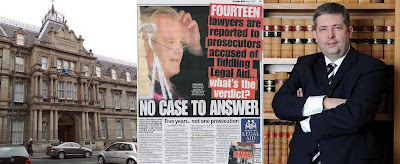
Another case of “Inadmissible evidence” for the Crown Office ? SCOTLAND’S CROWN OFFICE & PROCURATOR FISCAL SERVICE, fresh from revelations they REFUSED to prosecute FOURTEEN lawyers who were reported to prosecutors by the Scottish Legal Aid Board (SLAB) for stealing millions from Scotland’s taxpayer funded £160 MILLION legal aid budget under the former Lord Advocate now Dame Elish Angiolini DBE QC, face allegations the same policy is continuing under Lord Advocate Frank Mulholland QC after a new case reported in the Sunday Mail newspaper revealed prosecutors in Hamilton are DITHERING over whether to prosecute yet another crooked lawyer Antony David Murphy, who stole £116,000 from clients accounts holding deposits from homebuyers.

Antony David Murphy, (55) was finally struck off last week by the Scottish Solicitors Discipline Tribunal (SSDT) after long running complaints were finally acted on by the Law Society of Scotland due to fears the clients who had lost much of their money with Murphy would turn to the media and generate a series of unwelcome headlines for the notoriously corrupt system of rubber-stamp self-regulation run by the Law Society of Scotland & Scottish Legal Complaints Commission (SLCC).

The full judgement and details of the complaints made against Anthony Murphy can be downloaded from the SSDT’s website HERE or viewed online here : Council of the Law Society of Scotland v Anthony David Murphy :

Edinburgh 14 September 2011; The Tribunal having considered the Complaint dated 11 May 2011 at the instance of the Council of the Law Society of Scotland against Antony David Murphy formerly of 31 Chapel Street, Hamilton. Lanarkshire now of 3 Chateau Grove, Hamilton, Lanarkshire;

;Find the Respondent guilty of Professional Misconduct in respect of his knowingly permitting a client to sell heritable property to a third party when his clients were contractually bound to sell to others,

;His knowingly falsely representing to his professional body that his accounting records had been destroyed when they had not and his acting recklessly by clearing monies out of his client account that he could not be sure were due to him as fees and in so doing his removing approximately £116,200 worth of clients monies to which he was not entitled, all in breach of Article 7 of the Code of Conduct for Scottish Solicitors 2002,

;His failure to account to the liquidators of Company A and Company E or respond to the reasonable enquiries of the liquidators and his breach of Rule 4 of the Solicitors (Scotland) Accounts Rules Etc 2001;

;Order that the name of the Respondent Antony David Murphy be struck off the Roll of Solicitors in Scotland; Find the Respondent liable in the expenses of the Complainers and of the Tribunal including expenses of the Clerk, chargeable on a time and line basis as the same may be taxed by the Auditor of the Court of Session on an agent and client, client paying basis in terms of Chapter Three of the last published Law Society’s Table of Fees for general business with a unit rate of £14.00; and Direct that publicity will be given to this decision and that this publicity should include the name of the Respondent.

However not all the heads of complaint were found by the SSDT to have been proven, and controversially the tribunal backed away from finding Murphy had defrauded the Inland Revenue, where in its judgement it stated : “The Tribunal is also not able to find, on the basis of the evidence led, that the Respondent acted dishonestly by not disclosing money to the Inland Revenue.”

A legal insider commenting on the decision said the Law Society of Scotland were reluctant to inform on or find in complaints that solicitors were defrauding HMRC due to fears it may encourage UK tax authorities to take a closer look at law firms, many of whose accounts are known to be a mess and “full of fraudulent activity”.

CLIENT ACCOUNTS AT SCOTTISH LAW FIRMS ARE DANGEROUS HAVENS FOR YOUR MONEY :

In a shocking example of the level of endemic fraud within the Scottish legal profession showing how solicitors steal from client accounts on a regular basis, just one of the cases brought to the attention of Diary of Injustice over the past year told the story of an apparently small but well known law firm in the Scottish Borders which was found to have dozens of bank accounts where client funds had been lost on a regular basis and worse still, one of the solicitors in the law firm, a well known fraudster, has, according to information seen by Diary of Injustice, 23 different bank accounts in different banks & different names, some using variations of his own name, others allegedly in his family members name with control signed over to him.

Legal insiders this afternoon have indicated the Law Society of Scotland are not eager to see Murphy prosecuted by the Crown Office. A decision is yet to be made by the Procurator Fiscal in Hamilton. Diary of Injustice can also reveal today another investigation being carried out by authorities into a well known advocate accused of legal aid fraud is said to be “going badly” with expectations of a prosecution diminishing due to “interference from legal circles in the investigation”.

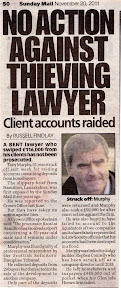
The Sunday Mail reports :

No action taken against lawyer who swiped £116k from clients

Nov 20 2011 By Russell Findlay, Sunday Mail

A BENT lawyer who swiped £116,000 from his clients has not been prosecuted. Tony Murphy, 55, was struck off last week for raiding accounts containing deposits from homebuyers.The slippery brief from Hamilton, Lanarkshire, was first exposed by the Sunday Mail three years ago.

He was reported to the Crown Office last June. But they have taken no action against him. A Crown Office spokesman said: "The procurator fiscal at Hamilton has received a report concerning a 51-year-old male and it remains under consideration."

Murphy was found guilty of professional misconduct by the Scottish Solicitors' Discipline Tribunal. He collected deposits from 29 buyers but then acted in the sale of the development to another company. Only part of the deposits were returned and Murphy also took a £50,000 fee after court action against the firm. He was also found to have failed to account to the liquidators of two companies and to have falsely represented to Law Society officials that his accounts had been destroyed in a flood.

Murphy was linked to dodgy builder Stephen Connelly who has been struck off as a company director until 2018. He left homebuyers and taxpayers £485,000 out of pocket when his Glen Isla Homes firm failed.

TRIBUNAL’S DECISION IN MURPHY CASE RE-WROTE COMPLAINT, BACKED AWAY FROM CLAIMING TAXMAN WAS DEFRAUDED

After hearing evidence from the complainers, some of which was reporter by the SSDT in the judgement Council of the Law Society of Scotland v Anthony David Murphy, the Tribunal found Ms Grandison and Mr Ritchie to be credible and reliable witnesses and accepted their evidence. The Tribunal found the facts in Articles 1.1, 2.1, 2.3, 3.1, 10.1, 10.4, 10.5, 10.6, 10.7, 10.9 and 10.10 of the Complaint to be proved beyond reasonable doubt. The facts in Articles 2.2, 3.2, 10.2, 10.3 and 10.8 of the Complaint the Tribunal found proved beyond reasonable doubt subject to the following deletions and amendments. With regard to Article 2.2 the Tribunal deleted the final two sentences as no evidence was led with regard to this. In connection with Article 2.4 the Tribunal deleted from “Enquiries were made” in line 12 to “Company D” in line 18 and from “Enquiries” in line 21 to “Company D” in line 23, as the Tribunal was not satisfied beyond reasonable doubt that these facts were proved on the evidence. In connection with Article 3.2 the Tribunal deleted the last two sentences as no evidence was led to substantiate this. In connection with Article 3.3 the Tribunal deleted from “They delivered” in line 6 to “of another” in line 13 and from “It was clear” in line 18 to “number of years” in line 25, because the Tribunal did not consider the evidence sufficient to substantiate this and the Tribunal also made a number of minor amendments in this Article to reflect the evidence led. In connection with Article 10.2 the Tribunal deleted the sentence starting “The Respondent” in lines 5 and 6 as this was not borne out by the evidence. In relation to Article 10.3 the Tribunal deleted from the words “The Complainers” in line 2 to “Respondent” in line 6 as the Tribunal was not satisfied that this had been proved on the basis of the evidence led. In connection with Article 10.8 the Tribunal deleted the last three sentences as this was not spoken to in evidence. The Tribunal also deleted Articles 4.1 – 9.1 and 11.1 to 11.2 as the fiscal did not lead any evidence with regard to these averments.

On the facts found as proved the Tribunal had no hesitation in finding the Respondent guilty of professional misconduct. In respect of the Company A matter, the Respondent was aware that his client, Company A had concluded missives with a number of individuals in respect of the sale of units to them. Despite this knowledge and without advising the prospective purchasers or their solicitors, the Respondent acted on behalf of Company A when it negotiated and sold its interests in the development to a third party. The Tribunal considered that the Respondent brought the profession into disrepute by knowingly permitting his client to sell heritable property to a third party when his client was contractually bound to sell to others. The Tribunal also considered this to be a breach of Article 7 of the Code of Conduct for Scottish Solicitors 2002. It is important in order to preserve the integrity of the conveyancing system in Scotland, that solicitors should not, where they are aware that a client has concluded missives with a number of purchasers, proceed to negotiate a separate transaction and act in the sale of a development site to a third party knowing that the client would be in breach of the various contracts with prospective purchasers. The Respondent should have refrained from acting for Company A in respect of the subsequent transactions. As a result of the Respondent’s actions a number of purchasers were financially disadvantaged in that they did not receive their full deposits back. The Tribunal found it unnecessary to decide whether the Respondent’s conduct in this matter also amounted to a breach of Article 1 and / or Article 5a of the Code of Conduct. The Tribunal however had no hesitation in finding that the Respondent’s conduct in acting in this manner amounts to professional misconduct in terms of the Sandeman test. (Richard Allan Sandeman-v-The Council of the Law Society of Scotland [2011] CSIH 24 P433/10).

The Tribunal also found the Respondent guilty of professional misconduct in respect of his knowingly falsely representing to the Law Society that his accounting records had been destroyed in a flood when they clearly had not been. Article 7 of the Code of Conduct for Scottish Solicitors provides that “solicitors must act honestly at all times and in such a way as to put their personal integrity beyond question”. The Respondent was in breach of this code by providing false information to his professional body and the Tribunal consider that this would be regarded by competent and reputable solicitors as serious and reprehensible. The Tribunal was also extremely concerned by the fact that the Respondent acted so recklessly in clearing money out of his client’s accounts on 4 November 2008 when he could not be sure that these monies were actually due to him. The Tribunal was satisfied on the basis of the evidence from Morna Grandison that in doing so he removed approximately £116,200 of client’s money to which he was not entitled. The Tribunal consider this to be totally unacceptable and it puts the Respondent’s personal integrity in severe doubt.

The Tribunal also found the Respondent guilty of professional misconduct in respect of his failure to account to the liquidators of Company A and Company E and failure to respond to the reasonable enquiries of the liquidators concerning matters of importance identified by the liquidators. The Tribunal consider that it puts the Respondent’s personal integrity into question when he does not answer questions about client’s funds. The Tribunal also had concerns with regard to the apparent unlimited use of a credit card on the Company A and Company D accounts but the clients did not make a complaint about this and the Tribunal was unable to find it proved beyond reasonable doubt that the Respondent was not authorised to use this money.

The Tribunal also found the Respondent guilty of professional misconduct in respect of his breach of Rule 4 of the Accounts Rules due to the shortfall of more than £8,000 on his client account. The Tribunal was not able to find a breach of Article 9 of the Code of Conduct or find the Respondent guilty of professional misconduct in respect of misleading the solicitors acting for the purchasers of the properties at Property 2, because it is not clear to the Tribunal what the Respondent had been told by Company C. The Tribunal accordingly cannot find that what the Respondent stated in his letter of 10 September 2007 was dishonest. Company C were the finders for the purchasers and accordingly it is likely that the purchasers would have had some contact with Company C. No evidence was led with regard to what any of the purchasers were told. The Tribunal is also not able to find, on the basis of the evidence led, that the Respondent acted dishonestly by not disclosing money to the Inland Revenue.

Tuesday, August 30, 2011

Fake Legal Aid scam reveals solicitor claims client is being investigated for fraud, faces arrest, demands 'cash bung' for 'no action settlement'

SLAB_logoNot content with £160million, fake legal aid investigation scam by rogue lawyers now demands cash from frightened clients. THESE less than profitable times of law firms during the recession are leading to increased levels of fraud by solicitors against their clients in everything from imaginary fee demands to imaginary court cases, as the latest take on LEGAL AID FRAUD reveals some Scottish solicitors are so desperate for money to fund their lifestyles, they are targeting their legal aid clients by claiming they are being investigated by the Scottish Legal Aid Board (SLAB) for fraud and may face arrest & a jail term, but that a cash payment made privately to the solicitor will settle any case against the clients.

In several cases brought to the attention of Diary of Injustice where it appears cases are funded by legal aid, including at least one criminal case, the solicitors told their frightened clients their legal aid claims were being investigated by the Scottish Legal Aid Board for irregularities in their declarations of assets & finances and that they may go to prison if caught. Clients were then told a cash payment covering up to in some cases, half of their legal aid claims to-date, would prevent any criminal charges being made by SLAB.

Clients are apparently told SLAB would “rather settle the case than take it to court”, but that any settlement “will be taken as an admission of guilt” and the solicitor will have to withdraw from acting on the client’s behalf.

One client allegedly on legal aid was told if she repaid £10,000 in cash to her solicitor, “the money would be forwarded to the Scottish Legal Aid Board who indicated they will agree to a no action settlement”. The client did not have the amount demanded by her solicitor who then reduced his demand to £2,000, again insisting on cash payments, which are currently being paid in instalments from the client’s state benefits although those payments will now cease as of publication of this article today.

An investigation into the cases brought to the attention of Diary of Injustice has revealed there were never any investigations by the Scottish Legal Aid Board in these cases as it transpires most of the cases (except the criminal case) were never funded by legal aid in the first place and therefore could not be investigated by SLAB for legal aid fraud.

Earlier this year in February, the Scottish Legal Aid Board announced increasing numbers of law firms were registering to provide legal aid (pdf), where an increase of 5% in the number of firms registered for civil legal aid (620 to 654), an increase of 3% in the number of solicitors registered for criminal legal aid (1353 to 1392) and an increase of 2% in the number of firms registered for criminal legal aid (562 to 573) took place, noticeably due to the financial downturn. In civil legal aid, the number of applications increased by almost 40% over the past 3 years (22,028 in 2009-2010 and 15,861 in 2007-2008). The current year has seen no diminution of the higher levels of applications.

lindsaymontgomeryLindsay Montgomery CBE, Chief Executive of the Scottish Legal Aid Board commented at the rise of law firms running back to claim legal aid : “This appears to be a continuing effect of the recession with legal firms seeking new or additional income streams, whilst the increase in civil legal aid applications is likely to be a mixture of increased need for legal help as a result of the recession and solicitors willing to take on cases which they may not have previously. This may tie in with recent data** released by the Law Society which suggests that smaller firms in some sectors were finding business more difficult.”

However, as the recession continues, a pattern of rising levels of client fraud by solicitors & law firms across Scotland who are desperate to bring in cash in tough financial times seems to indicate in this latest ploy against clients, the solicitors had set out from the very start to scam their unwitting clients into unrecorded repayments of huge cash sums for non existent civil claims cases which the solicitors claimed had been progressing to or already in a court, and were funded by legal aid.

One client of an Edinburgh law firm who was told she stood accused of committing legal aid fraud said she was too scared to contact the Scottish Legal Aid Board to verify if the claims of an investigation into her finances & life were true. She also told Diary of Injustice her solicitor had shown her “photocopied letters” allegedly from the Scottish Legal Aid Board claiming SLAB were investigating her legal aid application and claims made by her solicitor.

The client’s solicitor refused to give her copies of the alleged letters from SLAB alleging legal aid fraud, and insisted she deal only through him and not contact the legal aid board directly, claiming she may be arrested if she did. The solicitor told his client if she made a repayment of three thousand pounds in cash to the solicitor, the SLAB investigation and any resulting case against her would be dropped.

However, it has been established through sources at the Scottish Court Service, the client’s case, a civil damages claim against her local authority which has allegedly been in the courts for two years, does not exist. The client has now refused to pay any money to her solicitor.

One campaigner pointed out the fact clients caught in this latest scam have been told that after they make a cash payment to settle the supposed investigation & accusations of legal aid fraud, that their solicitor will have to withdraw from their case, makes it very convenient for the solicitor who is likely to face no complaint from gullible clients who feel they are lucky to have escaped arrest for a crime which did not occur. Additionally as the payments are requested in cash, there is no record.

An official from one of Scotland’s consumer organisations today commented on the situation.

She said : “Consumers who are in receipt of legal aid should receive some form of contact from the Scottish Legal Aid Board to their home address registered on their initial application. If not they should check with their solicitor and the Scottish Legal Aid Board to ensure they are not being led up the garden path.”

She continued : “Anyone who feels their legal aid case is dragging on unnecessarily should contact the Scottish Legal Aid Board to find out what funding the board has provided to their case.”

A former employee of an Edinburgh law firm who first blew the whistle on this new type of solicitor-client fraud claimed one solicitor from a firm which recently registered to provide legal aid is accused in a complaint of conning four thousand pounds from a client he told was being investigated by SLAB for a fraudulent legal aid claim, when in reality, no investigation existed. The client foolishly handed over the cash to the solicitor, finding it by selling his car. According to the insider, the cash was not entered into the law firm’s accounts.

Victims of this very creative fraud are in an uncertain position, because as no legal aid fraud technically took place since the cases were never funded by legal aid in the first place, the Scottish Legal Aid Board can do nothing about it.

SLCC LAW SOCIETYSLCC & Law Society are not eager to consider legal aid fraud complaints The only recourse for clients conned out of tens of thousands of pounds by solicitors who falsely claim their clients are being investigated for legal aid fraud would be for those affected clients to file a complaint with the Scottish Legal Complaints Commission (SLCC) or the Law Society of Scotland, who are well known for dismissing complaints against the legal profession no matter how serious the offences committed or extent of funds lost.

Let’s be honest, neither the SLCC or the Law Society of Scotland are going to want to admit this is occurring within the legal profession, or take any action against it. However, as it appears there are solicitors out there demanding, and receiving large cash payments from their clients which are going undeclared, perhaps HMRC may wish to take a closer look at the Scottish legal profession and how it does business.

If readers feel their legal aid funded cases are suffering from unnecessary delays, I recommend you contact Citizens Advice Scotland, Consumer Focus Scotland, the Scottish Legal Aid Board , and of course, please let us here at Diary of Injustice know what has been happening to your case. You can also let other consumers know about these kinds of solicitor scams, via the excellent Consumer Action Group.

Personally, I recommend large headlines in newspapers and in the online media regarding named solicitors & law firms who are conning their clients as the only way of getting any action these days on complaints against the unsavoury elements of Scotland's increasingly dishonest legal profession.

Friday, August 19, 2011

Questions over safety of £160m Legal Aid payments to lawyers as insiders claims some Scots law firms accounts are “dogs breakfasts”

SLAB_logoCan Scots lawyers be trusted with £160m of legal aid public funds when client frauds continue to occur ? LAW FIRMS identified in client frauds should not expect to automatically receive public funds from the ONE HUNDRED & SIXTY MILLION POUND taxpayer funded legal aid budget managed by the Scottish Legal Aid Board (SLAB), until solicitors and their regulators publicly prove they are preventing further fraud by beefing up strict supervision over their internal accounting procedures, according to a senior legal insider who branded Scottish lawyers accounts generally as “a dogs breakfast” and in some cases “lacking any credibility in the business world”.

Last weekend, the Sunday Mail newspaper reported a significant fraud involving up to £150,000 of client funds from Kilmarnock law firm BELL & COMPANY SOLICITORS. It was further reported the law firm called in the Police after the fraud, which had apparently been going on for some months, had been discovered. A paralegal was identified in connection with the fraud and is reported to have been dismissed from her post. There are as yet no reports of any criminal charges being made in the case.

It was later revealed Bell & Co Solicitors regularly conduct legal aid work, receiving, £119,100 of taxpayer funded legal aid for 2009-2010, £82,600 in 2008-2009, £81,800 in 2007-2008, £83,700 in 2006-2007, £81,800 in 2005-2006, £79,700 in 2004-2005, & £91,100 in 2003-2004. All figures are sourced from SLAB’s own legal aid payments figures, available HERE

There is no suggestion whatsoever the fraud at Bell & Co Solicitors extends to legal aid payments, and, according to news reports, the law firm did call in the Police as soon as the fraud was discovered, however as the firm is registered with the Scottish Legal Aid Board and regularly receive payments, SLAB was asked if they were concerned about reports in the press of a law firm which receives legal aid public funds had been identified in a substantial client fraud.

A spokesperson for the Board said : “Any allegation of fraud against a firm’s client account does not mean that legal aid fraud was being committed. The Board has not been notified by the Law Society or the Police of any concerns in respect of legal aid payments to this firm. However, it is our normal practice where there have been any allegations of fraud that we make enquiries to satisfy ourselves that public funds are not at risk.”

The spokesperson continued : “The Board's auditing processes ensure the on-going monitoring of all firms registered to provide legal assistance. We only grant applications that meet statutory tests and on receipt of accounts submitted by solicitors; pay only for work that actually, necessarily and reasonably has been undertaken.”

SLAB was further asked to confirm if any enquiries regarding Bell & Co had been made. Their spokesperson said : “Unfortunately, it would not be appropriate for us to comment further, the statement is the fullest response we can make.”

A senior legal  insider, who prefers not to be named, said SLAB should be more pro-active in taking away legal aid payments from law firms who are identified in frauds of any kind until such time as they prove themselves fit to receive public funds.

He said : “If as happens in some cases already part of the media record, a law firm’s internal structure is such that large scale frauds can go on for a lengthy period of time before being identified, there are obviously problems within the audit procedures of that particular law firm and its supervision of its partners and employees. Clearly this raises questions as to whether it is safe to pay vast amounts of public money to such firms. In my opinion, thought should be given to automatically deregister law firms identified in fraud cases until they publicly prove to the Scottish Legal Aid Board their audit procedures & supervision will prevent such incidents occurring in the future.”

He continued : “Additionally, if a case arises where there is a report of fraud at a law firm, if the firm is registered to provide legal aid there should be a requirement on the Law Society of Scotland and the Police to notify the Scottish Legal Aid Board immediately so the board can make enquiries of the firm  itself and conduct its own audit if required rather than having to read about it in the newspapers first.”

He also backed up claims from others within the profession that solicitors internal audit procedures are a mess.

He said : “Many sets of firm’s accounts I have seen resemble a dogs breakfast and would lack any credibility in the business world. One might say in certain instances, accounts were simply fabricated to get past an audit.“

A former employee of an Edinburgh law firm alleged a general culture of dishonesty in audit procedures, particularly on how accounts for services to clients are prepared.

She said  : “In some cases it is clear there are charges put on clients bills for services which the client neither authorised, requested or required. In one case I am aware of, a client’s bill was three times the amount it should have been. The Law Society took over two years to agree the fee note should be reduced. The law firm pursued the client through the courts for money it claimed was owed to it, yet there was never any doubt the work it alleges it was due payment for, never took place.”

It should be noted in the particular case referred to above, the Sheriff ruled in favour of the law firm’s since-discovered-to-be-fabricated evidence which did not help matters and resulted in a protracted time of threats of repossession & bankruptcy against the client concerned.

The matter was only resolved when the case was given to a journalist to investigate who discovered one of the two counsels opinions had been faked as the Advocate who it was claimed had given the opinion was ill at the time and not working. Upon being shown the evidence, along with an email from the Advocate who denied giving any opinion in the case, the law firm subsequently ceased its demands for any fees, however there are no reports of any action being taken against the law firm and its legal representatives who clearly lied in court to obtain recovery of fees it was not due.

SOLICITORS ‘WERE USELESS AND UNABLE TO COUNT’ :

The general perception of Scots law firms failing to keep accurate accounts was coincidentally reflected in sentiments reportedly expressed by the Chief Executive of the Scottish Legal Aid Board (SLAB), Lindsay Montgomery, who was alleged to have said in an allegedly recorded conversation with the Govan Law Centre’s Mike Dailly that solicitors “were useless and unable to count”.

The controversial, unverified remarks were made public by Mr Dailly who claimed the SLAB Chief Executive had leaned on the Law Society of Scotland to silence its Access to Justice Committee, which was chaired by Mr Dailly until he & its members resigned in protest after arguments broke out over the Committee’s published proposals to scrap the Scottish Legal Aid Board and merge it with the scandal ridden, anti-client Scottish Legal Complaints Commission.

The Daily Record newspaper reported on the proposals to merge SLAB with the SLCC and take legal aid under the wing of solicitors directly : “The access to justice committee's plan would transfer the responsibility for administering legal aid to a new body created out of the Scottish Legal Complaints Commission (SLCC), who are currently paid for the solicitors they oversee. Committee chairman Mike Dailly claimed the changes could save £40 million.”

Top Scots QC Paul McBride, who is a Board member of the Scottish Legal Aid Board was reported to have “slammed the proposed changes as "preposterous.” and said further : "SLAB exist to enable access to justice and to make sure legal aid delivers the maximum value for the taxpayer. The board serve a vital role and save the public an enormous amount every year. The idea of putting lawyers in charge of administering money to themselves is preposterous and unworkable. "This is like putting Homer Simpson in charge of a doughnut factory."

While debate still rages on whether the SLAB Chief Executive made the remarks or not, I revealed earlier this week some Scottish lawyers most certainly do have the ability to count their own bank accounts, where : In just one of the cases brought to the attention of Diary of Injustice over the past year, an apparently small but well known law firm in the Scottish Borders was found to have dozens of bank accounts where client funds had been lost on a regular basis and worse still, one of the solicitors in the law firm has, according to information seen by Diary of Injustice, 23 different bank accounts in different banks & different names, some using variations of his own name, others allegedly in his family members name with control signed over to him.