Showing posts with label Police. Show all posts

Wednesday, August 23, 2017

POLICE REGISTER: ‘First responder’ Police Officers transparency in cops business interests register beats ‘last responder’ secretive elite judges still locked in 5 year battle against Holyrood on judicial interest register

Police Officers business interests register beats secrecy on judicial interests. POLICE SCOTLAND has released the latest data on their officers business interests, revealing enterprises from property letting to golf, education, entertainment & consultancies.

The information, disclosed in response to a Freedom of Information request, follows on from an article in May which revealed 1,512 Police Officers in Scotland have secondary businesses & jobs in addition to their work as Police Officers.

The information relating to business interests of Police Officers is recorded on the Police Scotland HR system (SCOPE).

Police Officers in Scotland  are required to conform to the provisions of the Police Service of Scotland Regulations 2013 which state: “A constable must not have a business interest without the consent of— (a) the Authority, in the case of a senior officer; (b) the chief constable, in the case of any other constable, provided that, in the case of any such constable in whose case the chief constable has an interest otherwise than as chief constable, the chief constable must refer the matter to the Authority for it to consider whether to consent.”

While the details disclosed by Police Scotland does not name actual companies and businesses in which officers are involved, the level of detail gives a flavour of potential cross over between cops second jobs and activities in public authorities, public contracts and particularly relationships with the legal world.

Police Scotland refused to provide an actual breakdown of organisations by name, claiming the cost would be too much to provide this information.

However, there is a significant public interest in the identification of businesses in which Police Officers operate, alongside their occupation as law enforcers, given potential conflicts of interest which can only truly be judged by the public, rather than Police Scotland itself.

The latest figures from Police Scotland reveal that since January 2015 there has been 354 Police Officers and 48 Police Staff who have been granted a business interest which is recorded on their SCOPE record.

However, Police Scotland refused to provide information on the number of Police Officers and Police Staff who have had a business interest refused – citing cost grounds on providing the information.

Police Scotland claimed they would have to “manually check each and every individuals personnel file to see if any individuals have applied and been refused”.

The full disclosure from Police Scotland on Police Officers & civilian staff outside business interests as of July 2017:

Executive: Property Letting.

Chief Superintendent: Education, Entertainment, Property Letting.

Superintendent: Agriculture, Property Letting, Shop or Other Like Business.

Chief Inspector: Coach, Director of Scottish Police Credit Union, Driving, Education, Golf, Photography, Property Letting, Shop or other like business, Sport Related, Voluntary Worker

Inspector: Administration, Board of Director, Football Club, Coach, Consultant, Crew member, Dance Class, Driving related, Education, Entertainment, Holiday Letting, Photography, Play in a Band, Property Letting, Referee, Retail Industry, Sales, Shop or other like business, Sport Related, Trade, Voluntary Worker:

Sergeant: Account manager, Administration, Agriculture, Childminding, Coastguard Rescue Officer, Construction, Consultancy, Driving, Education, Entertainment, Fitness, Football, Interior design/upholstery business, Gardening related, Health related, Landscape gardening, Musical interest, Office work, Photography, Piper, Play in a Band, Property Letting Retail, self-employed Joiner, Shop or other like business, Sport Related, Trade, Voluntary bailiff, Voluntary Worker.

Police Constable: Administration, Agriculture, Army cadet force instruction, beauty therapies, Catering, Cake making, Child-minding, Child nursery, Cleaning services, Coach, Coastguard Rescue Officer, Construction, Consultancy, Crew member, Cricket, Deer stalking, Driving, Education, Electrician, Entertainment, Fitness, Football, Foster carer, Freelance instructor, Gardening related, Ground maintenance worker, Gym attendant, Handicrafts, Handyman, Health related, Home carer, Indent chipping, Joiner, Martial arts, Motorcycle training instructor, Musical interest, Office work, Partner in family own farm, Parent Council, Photography, Piper, Play in a Band, Political, Professional footballer, Property Letting, Referee, Reservist, Retail, RNLI Lifeboat crew, Sales, Search Team Member, Self-defence Instructor, self-employed Joiner, Shop or other like business, Sport Related, Sports Therapy/rehabilitation, Spray Painter, Stockman, Tele-marketing, Territorial ARMY, Therapist, Trade, Training, Tutor, Unpaid Garage assistant, Voluntary Worker, Volunteer - Highland hospice, Volunteer - HM Coastguard, Web development and hosting, Writer.

Police staff (Civilian employees): Administration, Agriculture, B&B / Guest House, Beauty Therapies, Bicycle repairs, Caretaker, Cleaning Services, Comedy writer / Performer, Consultant, Consultant trainer, Dance class, Director, Driving, Education, Electrician, Entertainment, General maintenance Person, Handicrafts, Musical interest, Office work, Photography, Play in a Band, Property Letting, Receptionist/Administrator, Relief Support Worker, Reservist, Retail, Sales, Sale and Marketing, Secretary/treasurer, Self-catering holiday accommodation, Shop or other like business, Sport Related, Therapist, Trade, Voluntary Worker Wedding planner and car hire.

A Freedom of Information request recently published by Police Scotland on the website whatdotheyknow reveals figures of at least 1,512 Police Officers who have business interests outside their main employment in the Police Service for Scotland.

Regulation 5 of the aforesaid regulations outlines the provisions concerning any 'business interest' of a police officer. Police officers may also choose to disclose business interests of spouses or partners.

All police officers business interests are granted by the Chief Constable, which are based on their own particular circumstances and review dates are similarly set (based on individual).

Legislatively, the term 'business interests' covers a variety of categories and directorships fall within this. While a member of police staff is not legislatively required to declare business interests/secondary employment, contracts of employment can outline constraints on such activity.

For instance, some senior posts in Police Scotland are restricted; some politically, some commercially, some both.

Furthermore, the Anti-Corruption Policy includes putting in place procedures that support the identification of risks that business interests or secondary employment may pose to the organisation or individual.

An earlier Freedom of Information request to Police Scotland revealed certain business interests of the force’s top cops, :

For Chief Officers, this permission is granted (under Regulation 5 of the Police Service of Scotland Regulations 2013) by the Police Authority. The conditions and circumstances are outlined in this legislation which is available online, therefore section 25(1) of the Freedom of Information (Scotland) Act 2002 applies: information which the applicant can reasonably obtain other than by requesting it under section 1(1) is exempt information.

Information provided by Police Scotland revealed executive members (including the now resigned DCC Neil Richardson) business interests from 1 April 2014-31 March 2015.

Deputy Chief Constable Rose Fitzpatrick: Property letting, Member and Trustee of various Charitable Organisations

Deputy Chief Constable Neil Richardson: Property letting, Board Member for Scottish Institute of Policy Research Trustee/Vice President of various Police Associations

Journalists then requested further details from Police Scotland in a request for review of the FOI disclosure, requesting the organisations referenced in the initial disclosure be identified.

The subsequent response from Police Scotland revealed:

Deputy Chief Constable Neil Richardson: Trustee, The Police Treatment Centres charity; Vice President, Police Mutual Board Member; The Scottish Institute for Policing Research.

Deputy Chief Constable Rose Fitzpatrick: Member, Scottish Chief Police Officers Association; Trustee, The Rank Foundation (Charitable Organisation); Trustee, Salle Ossian Community Sports Club (Charitable Organisation); Advisory Panel Member, Dfuse (Charitable Organisation; Patron, Revolving Doors (Charitable Organisation)

In relation to the numbers of properties rented out by senior Police Officers, Police Scotland refused to release details on the numbers of properties.

Police Scotland said in their response to the Freedom of Information request:  “In relation to the number of properties relating to each Deputy Chief Constable, I have decided not to provide this level of information requested by you as it is considered to be exempt in terms of the Freedom of Information (Scotland) Act 2002 (the Act).”

“The number of properties which the respective Deputy Chief Constables hold as business interests is classed as personal information and as such Police Scotland believes that the disclosure of this information would cause unwarranted prejudice to the rights and freedoms and legitimate interests of the data subjects. Accordingly, release of this  information into the public domain would breach the requirement to process personal data fairly, as laid down by the first data protection principle in Schedule 1 of the Data  Protection Act 1998. This is an absolute exemption and does not require the application of the public interest test”"

Police Scotland also refused to provide any values for the properties rented out by senior Police Officers, claiming the force did not hold the information:

Police Scotland said in their response: “Finally, Police Scotland does not hold details on the value of each property, as there is no requirement to do so under Regulation 5 of the Police Service of Scotland Regulations 2013.”

In comparison to the Police Scotland disclosure - members of Scotland’s 700 plus strong judiciary – who take the ultimate decisions on the results of Police detection of crime - do not share any details on their outside interests save a handful of judges who serve on the ruling Board of the Scottish Courts and Tribunals Service (SCTS).

COPS DECLARE, JUDGES CONCEAL:

Members of Scotland's judiciary continue to wage a bitter five year campaign against proposals to require members of Scotland’s judiciary to declare their interests, and links to big business.

The salary scales of officers in Police Scotland - where all officers are required to declare their interests - show a Police Scotland constable can expect £24,204 per annum going up to £83,925 for a Chief Superintendent with 3 years experience to Assistant Chief Constables: £115,000, Deputy Chief Constables: £169,600 and the Chief Constable: £212,280

However – Scotland;s judges have no such requirement to declare interests, despite their huge  judicial salaries skyrocketing from Sheriffs on £144,172 a year up to Sheriff Principals on £155,706 a year while judges of the Outer House of the Court of Session earn £179,768 a year, Inner House judges earning £204,695. The Lord Justice Clerk (currently Lady Dorrian) earns £215,695 a year, and the Lord President (currently Lord Carloway, aka Colin Sutherland) earns £222,862 a year.

The proposal to bring greater transparency to Scotland’s judiciary - Petition PE1458: Register of Interests for members of Scotland's judiciary - first debated at the Scottish Parliament’s Public Petitions Committee in January 2013 – calls for the creation of a publicly available register of judicial interests – containing information on judges’ backgrounds, figures relating to personal wealth, undeclared earnings, business & family connections inside & outside of the legal profession, membership of organisations, property and land, offshore investments, hospitality, details on recusals and other information routinely lodged in registers of interest across all walks of public life in the UK and around the world.

A full debate on the proposal to require judges to declare their interests was held at the Scottish Parliament on 9 October 2014 - ending in a motion calling on the Scottish Government to create a register of judicial interests. The motion was overwhelmingly supported by MSPs from all political parties.

Previous articles on the lack of transparency within Scotland’s judiciary, investigations by Diary of Injustice including reports from the Sunday Herald and Sunday Mail newspapers, and video footage of debates at the Scottish Parliament’s Public Petitions Committee can be found here : A Register of Interests for Scotland's Judiciary.

Thursday, August 17, 2017

COPS & LAWYERS: Concerns on Public Bodies Legal Fees spending as figures reveal Scottish Police Authority fork out over £1m in legal fees, Police Scotland spend at least £1.3 million on external lawyers

Millions from Police budget ends up funding lawyers. SCOTLAND’S single national Police service – Police Scotland is spending millions of pounds of public cash on external law firms, advocates & QCs over and above the significant costs of it’s own in-house legal teams.

The single national Police service for Scotland has admitted paying at least £1,316,819 to external solicitors, QCs, advocates and the courts over a three year period - over and above costs for in-house legal teams.

The largest beneficiaries of public cash from Police Scotland are Clyde & Co (formerly Simpson & Marwick) who were paid £361,801.91.

However, while that firm was still Simpson & Marwick prior to its merger with Clyde & Co, they earned £284,914.15, giving total earnings since January 2014, of £646,716.06.

Other big-earning firms from Police Scotland’s public cash splurge on major law firms were Morton Fraser (£278,069.60) and Ledingham Chalmers (£103,906.08).

However, the figures - released in response to a Freedom of Information request - Police Scotland & SPA Fees to external lawyers, law firms & QCs 2014 to 2017 - are now subject to scrutiny - after journalists questioned the Police as to why over half a million pounds paid by the Police to a law firm named in a £400m collapsed Hedge Fund scandal and a suspended judge were excluded from the figures handed over by Police well out of timescales tolerated by the Scottish Information Commissioner.

It was reported by the Scottish Sun in March 2016, a sum of £187K was paid to lawyer Peter Watson – a sheriff who has been suspended from the judicial bench for well over two years, and a further £364,830 was paid to Levy and Mcrae – the Glasgow based law firm named in a £28m writ in connection with the collapse of the Heather Capital hedge fund, run by Gregory King who is subject to a Crown Office probe now in it’s fourth year.

Police Scotland also disclosed at least £52,014 has been paid to in respect of Opinions of Counsel and Senior Counsel instructed by in-house Legal Services directly and at least £32,378 has been paid to the Scottish Court Service since January 2014 by in-house Legal Services directly.

Police Scotland also disclosed the names of law firms and Advocates Chambers who have received legal fees.

And, today, it has emerged in an additional, three months late FOI disclosure – the controversial Scottish Police Authority (SPA) has admitted to spending millions more on legal fees for it’s own use, with at least £623K spent on external law firms and £435K on it’s own in-house legal teams.

SPA Legal Costs (in-house and Third Party) From Jan 2014 to June 2017 saw the following public cash spends on third party legal costs: £154,449 (2013/14) £104,570 (2014/15) £175,785 (2015/16) £167,667 (2016/17) and £20,543 spent already in this financial year which runs to 2018 making a total of £623,012 on third party legal costs.

Costs for the SPA’s own in-house legal team has now reached £434,512 in just three years.

However, unlike Police Scotland, the secretive Scottish Police Authority refused to identify the names of law firms & counsel involved in it’s £1million plus legal expenses bill.

The SPA’s refusal to identify legal firms via FOI legislation has now been submitted for review, and possible investigation by the Scottish Information Commissioner, after weeks of deliberate delays by the SPA in disclosing the legal costs.

Additionally, questions are also being raised with the Scottish Information Commissioner on Police Scotland’s attitude towards Freedom of Information timescales after weeks of deliberate delays in the force’s handling of FOI requests.

The breakdown of the total figure for solicitors' fees by solicitor from 2014 – 2017 as paid by Police Scotland are as follows:

AC White £396; Allan Black & McCaskie £300; Allcourt Solicitors £462; Balfour & Manson £1236.3; Blackadder & McMonagle £342; Brazenall & Orr £168; Carruthers Curdie Sturrock & Co. £324; Clyde & Co.(Simpson & Marwick) £361801.91; Cockburns  £54; Corrigal Black £306; Criggies £42; Douglas Gilmour & Son £36; DWF £134.8; Gray & Gray £60; George Mathers & Co £600; Grigor & Young £1920; Hamish L Melrose £540; Hunter & Robertson Solicitors £1872; John Henderson & Sons £2232; Leddingham Chalmers £103906.08; Linda George Family Law £984; MacIntosh Humble £174; Mackie Thomson £96; Mackintosh Wylie £48; Macnabs Solicitors £312; Malcolm & Hutchison £132; Mathie McCluskey £78; McCluskey Browne £2032; McCusker McElroy & Gallanagh £30; McIntyre & Co £258; McLellan Adam Davis £54; MacDonald McIver & Co £353.1; Morton Fraser £278069.6; Patten Prentice £96; Rankin & Aitken £42; Reid Cooper £15901.92 ;Russel & Aitken £60; Russell, Gibson McCaffrey £4084.8; Simpson and Marwick £284914.15; Stewart Balfour £48; Thorntons £3760.16; W & AS Bruce £60 TOTAL: £1,068,320.82

The sum paid to advocates broken down by chamber and year are as follows:-

Chambers fees from 2014 - 2017: 5 Essex court £16620; Ampersand £84000; Arnot Manderson £12840; Axiom  £8640;  Black  £6600; Compass £20334; Terra Firma £3780 TOTAL: £152,814

The National newspaper reports on the Police spend on external law firms, here:

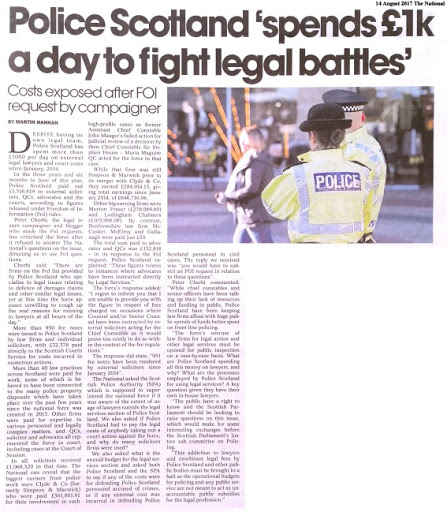
Police Scotland ‘spends £1k a day to fight legal battles’

Martin Hannan Journalist 13th August

Police Scotland's legal costs were exposed after FoI requests

DESPITE having its own legal team, Police Scotland has spent more than £1000 per day on external legal lawyers and court costs since January, 2014.

In the three years and six months to June of this year, Police Scotland paid out £1,316,819 to external solicitors, QCs, advocates and the courts, according to figures released under Freedom of Information (FoI) rules.

Peter Cherbi, the legal issues campaigner and blogger who made the FoI requests, has criticised the force after it refused to answer The National’s questions on the issue, directing us to use FoI questions.

Cherbi said: “There are firms on the FoI list provided by Police Scotland who specialise in legal issues relating to defence of damages claims and other similar legal issues, yet at this time the force appears unwilling to cough up the real reasons for running to lawyers at all hours of the day.”

More than 950 fee notes were issued to Police Scotland by law firms and individual solicitors, with £32,378 paid directly to the Scottish Courts Service for costs incurred in numerous actions.

More than 40 law practices across Scotland were paid for work, some of which is believed to have been connected to the many police property disposals which have taken place over the past few years since the national force was created in 2013. Other firms were paid for expertise in various personnel and legally complex matters, and QCs, solicitor and advocates all represented the force in court, including cases at the Court of Session.

In all, solicitors received £1,068,320 in that time. The National can reveal that the biggest earners from police work were Clyde & Co (formerly Simpson & Marwick) who were paid £361,801.91 for their involvement in such high-profile cases as former Assistant Chief Constable John Mauger’s failed action for judicial review of a decision by then Chief Constable Sir Stephen House – Maria Maguire QC acted for the force in that case.

While that firm was still Simpson & Marwick prior to its merger with Clyde & Co, they earned £284,914.15, giving total earnings since January 2014, of £646,716.06.

Other big-earning firms were Morton Fraser (£278,069.60) and Ledingham Chalmers (£103,906.08). By contrast, Renfrewshire law firm McCusker, McElroy and Gallanagh were paid just £30.

The total sum paid to advocates and QCs was £152,814 – in its response to the FoI request, Police Scotland explained: “These figures relates to instances where advocates have been instructed directly by Legal Services.”

The force’s response added: “I regret to inform you that I am unable to provide you with the figure in respect of fees charged on occasions where Counsel and/or Senior Counsel have been instructed by external solicitors acting for the Chief Constable as it would prove too costly to do so within the context of the fee regulations.”

The response did state, “951 fee notes have been rendered by external solicitors since January 2014”.

The National asked the Scottish Police Authority (SPA) which is supposed to superintend the national force if it was aware of the extent of usage of lawyers outside the legal services section of Police Scotland. We also asked if Police Scotland had to pay the legal costs of anybody taking out a court action against the force, and why do many solicitors firms were used?

We also asked what is the annual budget for the legal services section and asked both Police Scotland and the SPA to say if any of the costs were for defending Police Scotland personnel accused of crimes, or if any external cost was incurred in defending Police Scotland personnel in civil cases. The reply we received was “you would have to submit an FOI request in relation to these questions”.

Peter Cherbi commented: “While chief constables and senior officers have been talking up their lack of resources and funding in public, Police Scotland have been keeping law firms afloat with huge public spends of funds better spent on front line policing.

“The force’s overuse of law firms for legal action and other legal services must be opened for public inspection on a case-by-case basis. What are Police Scotland spending all this money on lawyers, and why? What are the processes employed by Police Scotland for using legal services? A key question given they have their own in-house lawyers.

“The public have a right to know and the Scottish Parliament should be looking to raise questions on this issue, which would make for some interesting exchanges before the Scottish Parliament’s Justice sub committee on Policing.

“This addiction to lawyers and exorbitant legal fees by Police Scotland and other public bodies must be brought to a halt as the operational budgets for policing and any public service are not meant to act as unaccountable public subsidies for the legal profession.”

Previous articles on the Scottish Police Authority can be found here: Scottish Police Authority - Poor governance, private meetings & lack of accountability at Police regulator

Sunday, May 14, 2017

COPS & JOBBERS: Scotland’s 1,512 ‘Two Job’ Cops required to declare outside business interests – meanwhile 700+ strong Scots judiciary resist Holyrood probe calling for judges' register of interests

Cops declare business interests, judges conceal their interests. MORE THAN fifteen hundred officers from Police Scotland – Scotland’s single national Police force – supplement their public salaries with second jobs and business interests ranging from entertainment to finance, legal, property letting and private security related businesses.

Police Officers – who as first responders to issues of public safety concerns and reports of criminal activity - are required to declare their interests to Police Scotland. The information is then kept on a database which can be accessed via Freedom of Information legislation.

However, in comparison - members of Scotland’s 700 plus strong judiciary – who take the ultimate decisions on the results of Police detection of crime - do not share any details on their outside interests save a handful of judges who serve on the ruling Board of the Scottish Courts and Tribunals Service (SCTS).

A Freedom of Information request recently published by Police Scotland on the website whatdotheyknow reveals figures of at least 1,512 Police Officers who have business interests outside their main employment in the Police Service for Scotland.

All police officer business interests are granted by the Chief Constable, which are based on their own particular circumstances and review dates are similarly set (based on individual circumstances).

The information relating to business interests of Police Officers is recorded on the HR system (SCOPE).

Police Officers in Scotland  are required to conform to the provisions of the Police Service of Scotland Regulations 2013 which state: “A constable must not have a business interest without the consent of— (a) the Authority, in the case of a senior officer; (b) the chief constable, in the case of any other constable, provided that, in the case of any such constable in whose case the chief constable has an interest otherwise than as chief constable, the chief constable must refer the matter to the Authority for it to consider whether to consent.”

The FOI request published by Police Scotland which also sought details of Police Officers ‘secondary employment’ drew a response stating the Police Service of Scotland Regulations 2013 does not recognise the term 'secondary employment'.

The published response from Police Scotland goes on to state: “However, Regulation 5 of the aforesaid regulations outlines the provisions concerning any 'business interest' of a police officer.”

An earlier Freedom of Information request to Police Scotland revealed certain business interests of the force’s top cops, :

For Chief Officers, this permission is granted (under Regulation 5 of the Police Service of Scotland Regulations 2013) by the Police Authority. The conditions and circumstances are outlined in this legislation which is available online, therefore section 25(1) of the Freedom of Information (Scotland) Act 2002 applies: information which the applicant can reasonably obtain other than by requesting it under section 1(1) is exempt information.

Information provided by Police Scotland revealed executive members (including the now resigned DCC Neil Richardson) business interests from 1 April 2014-31 March 2015.

Deputy Chief Constable Rose Fitzpatrick: Property letting, Member and Trustee of various Charitable Organisations

Deputy Chief Constable Neil Richardson: Property letting, Board Member for Scottish Institute of Policy Research Trustee/Vice President of various Police Associations

Journalists then requested further details from Police Scotland in a request for review of the FOI disclosure, requesting the organisations referenced in the initial disclosure be identified.

The subsequent response from Police Scotland revealed:

Deputy Chief Constable Neil Richardson: Trustee, The Police Treatment Centres charity; Vice President, Police Mutual Board Member; The Scottish Institute for Policing Research.

Deputy Chief Constable Rose Fitzpatrick: Member, Scottish Chief Police Officers Association; Trustee, The Rank Foundation (Charitable Organisation); Trustee, Salle Ossian Community Sports Club (Charitable Organisation); Advisory Panel Member, Dfuse (Charitable Organisation; Patron, Revolving Doors (Charitable Organisation)

In relation to the numbers of properties rented out by senior Police Officers, Police Scotland refused to release details on the numbers of properties.

Police Scotland said in their response to the Freedom of Information request:  “In relation to the number of properties relating to each Deputy Chief Constable, I have decided not to provide this level of information requested by you as it is considered to be exempt in terms of the Freedom of Information (Scotland) Act 2002 (the Act).”

“The number of properties which the respective Deputy Chief Constables hold as business interests is classed as personal information and as such Police Scotland believes that the disclosure of this information would cause unwarranted prejudice to the rights and freedoms and legitimate interests of the data subjects. Accordingly, release of this  information into the public domain would breach the requirement to process personal data fairly, as laid down by the first data protection principle in Schedule 1 of the Data  Protection Act 1998. This is an absolute exemption and does not require the application of the public interest test”"

Police Scotland also refused to provide any values for the properties rented out by senior Police Officers, claiming the force did not hold the information:

Police Scotland said in their response: “Finally, Police Scotland does not hold details on the value of each property, as there is no requirement to do so under Regulation 5 of the Police Service of Scotland Regulations 2013.”

The omission of any property values in the data ‘held’ by Police Scotland make it difficult to determine whether individual officers rent out lower or higher value properties, and  establish a value of property portfolios held by serving public officials such as top cops – who’s counterparts higher up the ladder in the criminal justice system and courts are known to own multi million pound property portfolios.

In comparison - while it is generally known there are Police Officers who own more than one property and those who are involved in multiple property lets, there are also members of the judiciary, Crown Office Prosecutors and their families who own much higher value property portfolios – collectively valued in the tens of millions of pounds.

While there is some information now in the public arena in relation to the letting empires of Police Officers and some other public servants, both the judiciary and Prosecutors are currently running scared from declaring their interests and wealth, using their significant power in the justice system to block release of details of their links to business and values of assets.

Neil Richardson, who left Police Scotland after serving as the force's number two - to previous Chief Constable Stephen House – was blocked from buying the Audi he used at the single force after an intervention by the chief constable. Richarson was informed by the Scottish Police Authority (SPA) that he could not take the car with him into retirement.

Interests and business links of Police Scotland officers who leave the force have come under further scrutiny, where in one recent case the Sunday Herald newspaper reported a former detective who played a key role in the failed £60m Police Scotland computer project now works in IT for the Scottish Government.

Alec Hippman, who was responsible for briefing MSPs about the troubled i6 scheme, landed a role in the Scottish Government in January 2016 after leaving the single force.

And in January 2916, the Sunday Herald newspaper revealed the then Chief Constable of Police Scotland Sir Stephen House set up his own company in the final weeks of his job as Chief Constable.

House formed Sarantium Solutions Ltd in October 2015 when he was heading towards the exit door of the single force.

Police Service of Scotland Regulations 2013 - Business interests:

5.—(1) A constable must not have a business interest without the consent of— (a) the Authority, in the case of a senior officer; (b) the chief constable, in the case of any other constable, provided that, in the case of any such constable in whose case the chief constable has an interest otherwise than as chief constable, the chief constable must refer the matter to the Authority for it to consider whether to consent.

(2) If a constable acquires or is likely to acquire a business interest, the constable must forthwith give written notice of that interest to the chief constable or, in the case of a senior officer, the Authority.

(3) If a constable has a business interest and is appointed to the office of chief constable, deputy chief constable or assistant chief constable, the constable must forthwith give written notice of that interest to the Authority unless the constable has previously disclosed that interest to the Authority.

(4) An individual applying for appointment to the Police Service, other than an individual referred to in paragraph (5), must give written notice to the chief constable of any business interest which that individual has or is likely to acquire after appointment.

(5) An individual applying for appointment to the office of chief constable, deputy chief constable or assistant chief constable must give written notice to the Authority of any business interest which that individual has or is likely to acquire after appointment.

(6) An individual or constable is regarded as having a business interest if— (a) that individual or constable carries on any business or holds any office or employment for hire or gain (otherwise than as a constable) in the United Kingdom; (b) that individual or constable resides at any premises where any member of that individual’s or constable’s family keeps a shop or carries on any like business in Scotland; (c) that individual or constable holds, or any member of that individual’s or constable’s family living with that individual or constable holds, any licence, certificate or permit granted in pursuance of the laws relating to liquor licensing or betting and gaming or regulation of places of public entertainment in Scotland or has any pecuniary interest in such licence, certificate or permit; or (d) that individual’s or constable’s spouse (not being separated from that individual or constable), civil partner (not being separated from that individual or constable) or cohabitant (not being separated from that individual or constable) keeps a shop or carries on any like business in Scotland.

(7) For the purposes of this regulation— (a) “member of that individual’s or constable’s family” includes parent, son, daughter, dependant, brother, sister, spouse (not being separated from that individual or constable), civil partner (not being separated from that individual or constable) or cohabitant (not being separated from that individual or constable); and (b) “cohabitant” means a member of a couple consisting of— (i) a man and a woman who are living together as if they were husband and wife; or (ii) two individuals of the same sex who are living together as if they were civil partners.

COPS DECLARE, JUDGES CONCEAL:

Members of Scotland's judiciary continue to wage a bitter five year campaign against proposals to require members of Scotland’s judiciary to declare their interests, and links to big business.

The salary scales of officers in Police Scotland - where all officers are required to declare their interests - show a Police Scotland constable can expect £24,204 per annum going up to £83,925 for a Chief Superintendent with 3 years experience to Assistant Chief Constables: £115,000, Deputy Chief Constables: £169,600 and the Chief Constable: £212,280

However – Scotland;s judges have no such requirement to declare interests, despite their huge  judicial salaries skyrocketing from Sheriffs on £144,172 a year up to Sheriff Principals on £155,706 a year while judges of the Outer House of the Court of Session earn £179,768 a year, Inner House judges earning £204,695. The Lord Justice Clerk (currently Lady Dorrian) earns £215,695 a year, and the Lord President (currently Lord Carloway, aka Colin Sutherland) earns £222,862 a year.

The proposal to bring greater transparency to Scotland’s judiciary - Petition PE1458: Register of Interests for members of Scotland's judiciary - first debated at the Scottish Parliament’s Public Petitions Committee in January 2013 – calls for the creation of a publicly available register of judicial interests – containing information on judges’ backgrounds, figures relating to personal wealth, undeclared earnings, business & family connections inside & outside of the legal profession, membership of organisations, property and land, offshore investments, hospitality, details on recusals and other information routinely lodged in registers of interest across all walks of public life in the UK and around the world.

A full debate on the proposal to require judges to declare their interests was held at the Scottish Parliament on 9 October 2014 - ending in a motion calling on the Scottish Government to create a register of judicial interests. The motion was overwhelmingly supported by MSPs from all political parties.

Previous articles on the lack of transparency within Scotland’s judiciary, investigations by Diary of Injustice including reports from the Sunday Herald and Sunday Mail newspapers, and video footage of debates at the Scottish Parliament’s Public Petitions Committee can be found here : A Register of Interests for Scotland's Judiciary.

Saturday, August 01, 2015

ACT OF FRAUD: Files reveal how law chiefs battled to recover £1.8m legal aid cash from estate of suicide lawyer as new questions emerge over ability of Crown Office to pursue legal aid cheat lawyers

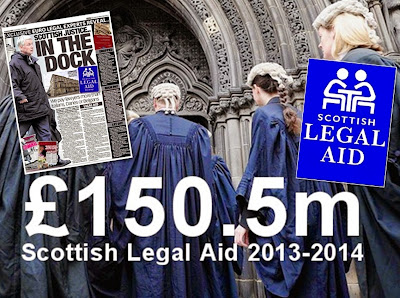
£150m annual legal aid bill ‘a fraud target’ DOCUMENTS revealing how an agreement was eventually secured by the Scottish Legal Aid Board (SLAB) & Civil Recovery Unit of the Crown Office & Procurator Fiscal Service (COPFS) to recover £1.8million in fraudulently claimed legal aid have been released by Legal Aid chiefs.

The case of Scotland’s largest legal aid fraud – masterminded by solicitor James Muir who committed suicide in 2005 while under investigation for making multiple & fraudulent claims for publicly funded legal aid – echoes forward to 2015 as the annual legal aid bill of £150 million becomes an ever increasing target for scammers & fraudsters both inside & outside the legal profession.

A minute of agreement archived at the Registers of Scotland and released by SLAB in response to a Freedom of Information request tells the tale of how the stolen public funds were eventually paid back by Muir’s former law firm and his window - Susan Muir – who was a serving Police Officer at the time.

The agreement was signed in September 2007 – two years after Mr Muir committed suicide.

The document describes how Muir’s former law firm - Messrs Sneddon Morrison Solicitors (formerly Sneddons SSC) would repay £259,941,70 to the Scottish Legal Aid Board, and £87,000 to the Civil Recovery Unit of the Crown Office.

Susan Muir, the widow of James Muir, agreed to repay £519,061.84 to the Scottish Legal Aid Board and then a further £884,000 to the Civil Recovery Unit from the sale of a property in Bothwell.

One of the witnesses to the agreement is William Macreath – head of Glasgow based law firm Levy & Mcrae. At the time, and currently, the same law firm represent the Legal Defence Union and the Scottish Police Federation.

Currently, Levy & Mcrae are battling a multi million pound writ lodged against them in connection with allegations over their role in the collapse of Heather Capital,a £400million hedge fund.

However, while the two year effort to recover the fraudulently claimed legal aid and it’s ‘eventual’ repayment was championed by SLAB and the Crown Office at the time, there are questions now as to why the Lord Advocate has not used similar methods to recover millions more in public cash from other lawyers who have also been accused of making dodgy legal aid claims.

Since 2007, numerous solicitors accused of making false or fraudulent legal aid claims have featured in media headlines.

In April 2011 a Sunday Mail newspaper investigation revealed Kilmarnock solicitor Niels S Lockhart had claimed at least £600,000 of taxpayers' money in just two years.

A Report to the Law Society of Scotland Section 31, Legal Aid (Scotland) Act 1986: Niels S Lockhart released by the Scottish Legal Aid Board to the media - accused Lockhart of deliberately ramping up his claims.

After Lockhart ignored a warning from SLAB to curb his claims, the Scottish Legal Aid Board investigated before a probe team concluded that his applications were a systematic attempt to create extra fees. But despite deciding that he routinely made "unnecessary and excessive" claims, SLAB did not call in police. They referred Lockhart to the Law Society of Scotland who also decided no fraud had taken place.

A further investigation by Sunday Mail newspaper in 2011 established that fourteen solicitors accused of making fraudulent legal aid claims escaped prosecution by the Crown Office.

However, unlike in the James Muir case, the Scottish Legal Aid Board and the Crown Office appear to have made no attempts whatsoever to recover public funds in the additional cases -  which could potentially total millions of pounds.

The documents, provided by the Scottish Legal Aid Board in response to an FOI request along with a statement of SLAB’s investigation of James Muir and subsequent events including the eventual recovery of the fraudulently claimed legal aid funds are published, with signatures & addresses redacted, below:

Statement from the Scottish Legal Aid Board:

The firm of James H G Muir SSC was subject to investigation by the Board's Compliance and Solicitor Investigation unit from November 2004. The firm was identified through the Board's on-going programme of monitoring and investigating of legal aid expenditure.

Issues were identified from an analysis of expenditure, and investigation work on the profile of applications received and accounts submitted for payment in respect of Children's cases by the firm. Theses issues included the persistently high cost of cases, the nature of the subject matter, the content of material submitted with accounts, as well as inconsistencies between the personal details of children on applications submitted and the same information included with the accounts. These aspects, together with discrepancies in information submitted by Mr Muir subsequently cross-checked with third parties such as the Scottish Court Service and Scottish Children Reporter Agency, caused sufficient concern for the Board to contact the Crown Office and Procurator Fiscal Service ("COPFS") in February 2005. COPFS in turn instructed Strathclyde Police to investigate the matter.

Mr Muir died on 20 April 2005. The criminal section of the Crown Office could not carry out in further investigative work as, with the death of Mr Muir, there could be no prosecution of any party. Mr Muir's death also presented a number of matters that required to be resolved. These included the ingathering of the Estate, the involvement of the Civil Recovery unit and the work of forensic accountants in establishing any 'dirty money' streams to assets.

The CRU worked to preserve and identify assets, while the Board sought to establish the extent of any fraudulent activities and charges made by Mr Muir. This work not only involved investigating Mr Muir's firm, which was established in 2001, but also required us to consider his activities when he was a Partner with his previous firm, Sneddon Morrison.

Once the extent of the fraud, the most serious ever uncovered by the Board, was established at £1,8m, it was then a matter to secure the recovery of the sums from both the estate of the late Mr Muir and in addition the firm of Sneddon Morrison. It was established that the partners and staff of Sneddon Morrison were not involved in the fraudulent scheme carried out by Mr Muir when a partner, but the firm did benefit from the fraudulent payments and consequently were required to repay these sums, which they did.

A considerable amount of analysis, enquiry and investigation was dedicated to this case. Work had to be done to demonstrate to all relevant parties that Mr Muir had indeed perpetuated a fraudulent scheme on the Board over several years, and in respect of the Proceeds of Crime all the defrauded sums had to be repaid. This was achieved without having to resort to costly and lengthy court proceedings, although this was a course of action the Board and the Civil Recovery Unit would have taken, and had been ready to take, had it proved necessary.

A Minute of Agreement was signed and lodged in September 2007 and thereafter the defrauded sums were repaid which includes the £812,827 paid to the Board as detailed above.

As you will appreciate the period from the initial enquiry in 2004 to the final recovery of fraudulently claimed funds in 2007 involved considerable time and a number of Board staff dedicated to investigate this matter adequately. Initially the focus was on Mr Muir's own firm but as the enquiry widened other cases in respect of Accounts paid to Sneddon Morrison were also considered. Much of 2005 was devoted to the retrieval of information and during this time the Board liaised closely with the Civil Recovery Unit to ensure all assets were identified and all sums that could be classified as fraudulently claimed were repaid.

It is of course a matter of regret that Mr Muir died during the investigation but consequently the nature of the enquiry changed from one in respect of fraud to recovery.

It took some months for the Board to establish the extent of the fraud as it did for the Executor of the late Mr Muir's estate to in-gather sums and to realise assets: this meant that work on this case continued throughout 2006. The Board and the Civil Recovery Unit agreed figures for repayment from both the Estate and the Partners of Sneddon Morrison, and this process of negotiation—which took some months and active involvement of the Board's senior management—was successfully concluded in 2007 when the fraudulent sums were finally repaid.

The fraud was initially identified as a result of the Board's implementing a new process for internal review of Legal Aid expenditure: that process highlighted the activities of Mr Muir. The Board has a proactive counter fraud culture. This includes the on-site audit of all firms and solicitor registered for Criminal Legal Assistance, an Accounts Verification Unit with access to the Scottish Court Service system to enable third party verification, a process that can also adopted in respect of the Scottish Prison Service and Police Offices. In addition there is an imbedded Analysis and Management Information unit within the Board that actively monitors trends in Legal Aid expenditure by firm and individual solicitors highlighting any changes or anomalies that require further clarification or enquiry.

The Agreement: MINUTE OF AGREEMENT between 

(1) THE SCOTTISH LEGAL AID BOARD, 44 Drumsheugh Gardens, Edinburgh, EH3 7SW and

(2) THE CIVIL RECOVERY UNIT, on behalf of the Scottish Ministers, 25 Chambers Street, Edinburgh and

(3) MESSRS SNEDDON MORRISON, Solicitors, formerly Sneddons SSC, a firm of solicitors having a place of business at Clydesdale Bank Chambers, 16 East Main Street, Whitburn, EH47 ORY and

(4) MRS SUSAN MUIR, and

(5) MRS SUSAN MUIR qua Executrix of the iate James Hamilton Gibb Muir SSC

Whereas the parties wish to resolve their dispute regarding the repayment of sums paid from the Scottish Legal Aid Fund to Messrs Sneddon Morrison, Solicitors, formerly Sneddons SSC, and James Muir SSC, deceased, they have agreed as follows:

(1) Messrs Sneddon Morrison, Solicitors, formerly Sneddons SSC, will pay the sum of £259,941,70 to the Scottish Legal Aid Board with immediate effect.

(2) Messrs Sneddon Morrison, Solicitors, formerly Sneddons SSC, will make payment of the sum of £87,000 to the Civil Recovery Unit, on behalf of the Scottish Ministers, with immediate effect.

(3) Messrs Sneddon Morrison, Solicitors, formerly Sneddons SSC, withdraw, waive and renounce any claim or right of relief which may lie against Mrs Susan Muir or the estate of the late James Muir, and further waive all claims for payment of any other sums which may be due to the firm of Sneddon Morrison, Solicitors, formerly Sneddons SSC, from Mrs Susan Muir or the late James Muir or his estate by way of partnership accounting or any other reason.

(4) Mrs Susan Muir qua Executrix will make payment of the sum of £519,061.84 to the Scottish Legal Aid Board as soon as reasonably practicable, and no later than 2 months from the date of signing this agreement. . /

(5) Susan Muir-will arrange for the dwellinghouse to be marketed for sale within 1 month of the date of this agreement, in the event that such steps have not already been initiated by her prior to signature of this agreement.

(6) Susan Muir will make payment of the sum of £884,000 to the Civil Recovery Unit, on behalf of the Scottish Ministers, from the free proceeds of the sale of that dwellinghouse and from monies within her late husband's estate being the balance after payment of those sums identified as payable to the Scottish Legal Aid Board and from monies within such accounts and/or other investments as are directly related to savings or investments from the late Mr Muir's earnings from the Scottish Legal Aid Fund. Where any portion of that sum is derived from.the free proceeds of sale of the dwellinghouse, payment of that portion will be made within 4 months of the date of signing this agreement. Where any portion of that sum is derived from any other sources, payment will be made within 2 months of the date of signing this agreement.

(7) Susan Muir, as an individual and qua executrix withdraws, waives and renounces any claim or right of relief which may lie against the firm of Sneddon Morrison, Solicitors, formerly Sneddons SSC, and the whole partners thereof.

(8) All payments made under this agreement are net of VAT, and any refund of VAT made to either Messrs Sneddon Morrison, Solicitors, formerly Sneddons SSC, or Susan Muir, qua executrix or otherwise, in respect of the payments which are the subject of this agreement, shall be paid to the Scottish Legal Aid Board. Any refund of Income Tax made to Susan Muir, qua executrix or otherwise, in respect of the payments which are the subject of this agreement, shall be paid to the Scottish Legal Aid Board.

­(9) The Scottish Legal Aid Board and the Civil Recovery Unit, on behalf of the Scottish Ministers, discharge the parties to this agreement of the respective claims against said parties upon payment in full of all sums due to them in terms of clauses 1, 2, 4 and 6 by those parties under this agreement.

(10) The above agreement is without prejudice to the right of the Scottish Legal Aid Board and the Civil Recovery Unit, on behalf of the Scottish Ministers, to initiate appropriate proceedings in the event that any party fails to make payment as agreed upon.

(11) The Scottish Legal Aid Board by Tom Crighton Murray, Director of Legal Services and Applications, at Edinburgh on the Seventh day of September Two Thousand and Seven; and they are signed on behalf of the said Civil Recovery Unit, on behalf of the Scottish Ministers, by Lorna Hams, Head of the Civil Recovery Unit, at Edinburgh on the Seventh day of September Two Thousand and Seven in the presence of Claire Meikle, witness, of Victoria Quay, Edinburgh; and they are signed on behalf of the said Messrs Sneddon Morrison, SSC, by Roy Donald Lumsden, Eric Robert Lumsden, David Andrew Johnstone and James Morrison, four of their partners, and the said James Morrison has adhibited the firm name of Sneddon Morrison & Co, all at Whitburn, West Lothian on the Fourth day of September Two Thousand and Seven in the presence of Graeme Alexander Laird, witness, of West Main Street, Whitburn; and they are signed by the said Susan Muir, as an individual, at Glasgow on the Sixth day of September Two Thousand and Seven in the presence of William Couperthwaite Macreath, witness, of 266 St Vincent Street, Glasgow, G2 5RL; and they are signed by the said Susan Muir, qua Executrix of the late James Hamilton Gibb Muir SSC, at Glasgow on the Sixth day of September Two Thousand and Seven in the presence of William Couperthwaite Macreath, witness, of 266 St Vincent Street, Glasgow, G2 5RL.

Further reports & investigations on Legal Aid Fraud can be read here: Legal Aid Fraud - Prosecutors & Legal Aid Chiefs operate inconsistent policy on pursuing legal aid cheats

Thursday, July 23, 2015

SPEAK UP IN PRIVATE, M'LUD: Terse exchanges between Scotland's top cop & judge on Police corruption claims saw Chief Constable slapped down amid accusations of interfering with the role of the judiciary

Top cop cannot interfere with judiciary – Sheriff AN EXCHANGE of letters between the Chief Constable of Police Scotland and a Sheriff Principal relating to comments made by a Sheriff of ‘endemic’ Police corruption during a criminal trial of a Police Officer - reveal Scotland’s top cop said the Sheriff hearing the case should have raised his concerns in private instead of airing such matters in open court.

The case, reported earlier last month by the media HERE saw the Chief Constable accused of trying to interfere with the role of Sheriffs after the top cop expressed his anger at a sheriff who suggested a cover-up culture might exist within his force.

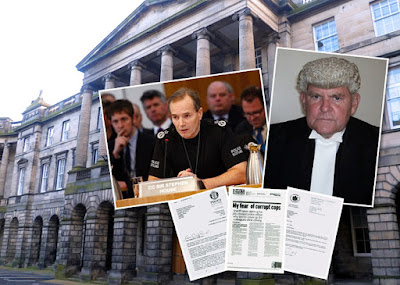
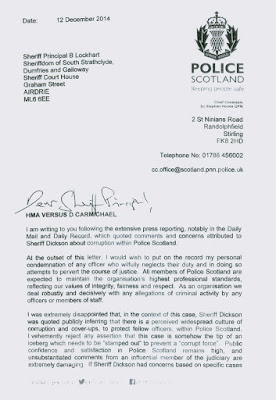
In a letter to Sheriff Principal Brian Lockhart – Sheriff Dickson’s boss, Sir Stephen House wrote: “I was extremely disappointed that, in the context of this case, Sheriff Dickson was quoted publicly inferring that there is a perceived widespread culture of corruption and cover-ups, to protect fellow officers, within Police Scotland. I vehemently reject any assertion that this case is somehow the tip of an iceberg which needs to be "stamped out" to prevent a "corrupt force" Public confidence and satisfaction in Police Scotland remains high, and unsubstantiated comments from an influential member of the judiciary are extremely damaging .”

The Chief Constable then went on to suggest it would have been better for Sheriff Dickson to raise his concerns in secret, rather than in court.

Sir Stephen House told Sheriff Principal Lockhart: “If Sheriff Dickson had concerns based on specific cases and evidence, I would have expected him to raise these with, either directly or via yourself, in confidence, rather than read about these via sensationalised media reporting.”

Clearly, aggrieved at the situation, the Chief Constable then sent a flurry of press cuttings to Sheriff Principal Lockhart, along with an offer to meet to discuss the situation.

Responding to the criticisms, Sheriff Principal Brian Lockhart told the Chief Constable members of the judiciary are entitled to make comment on cases before them, and the offer to meet was refused.

Full text of letters between top cop & sheriff released by Judicial Office. Sheriff Principal Lockhart told Chief Constable House: “Assuming that the press reports are accurate, in my view Sheriff Dickson was entitled to draw from the facts before him that this cover-up may not have been a one-off incident. The off-duty detective who saw McKiliion, apparently under the influence, driving away from a supermarket, deliberately chose not to state his name or job when she called the incident in, as she thought it would not be dealt with appropriately. She was clearly right to do so, in this case. The lead investigating officer recognised McKiliion, chose not to breathalyse him, and radioed his control room to say there was no-one at the house. He then said to his younger colleague "You don't want to grass on another cop or you will have no future in the police." His colleague felt intimidated.”

“Taken together, this is ample evidence to support the Sheriffs remarks. He expressed concern that this might not be a one-off instance. He said "there may be (emphasis mine) a perceived culture that police officers are willing to prevent the arrest and prosecution of a colleague." He said that if such a culture exists, it required to be stamped out. In my view his remarks were neither 'sweeping' nor 'unsubstantiated'. They were carefully phrased expressions of concern, justified by the evidence in the case before him.”

“Moreover, Sheriff Dickson was commenting in his capacity as a judge on evidence led before him, in a case likely to raise considerable public concern. This he was entitled to right, and a duty, to state them, in order that public confidence in the judicial system is not further damaged. To suggest otherwise fails to recognise the role of the judiciary. The integrity of the police force is not merely a matter of concern to senior police officers but to us all.”

“For these reasons, as Sheriff Principal I do not propose to take any action in this case. However, I think it is important that the Lord President is aware of this exchange of correspondence and I am accordingly forwarding a copy to him.”

Whether the Lord President at the time – Lord Brian Gill – took any further action on the matter, is unknown.

However, during his time as Lord President, Lord Gill was prone to issue guidance and edicts if matters concerning the judiciary boiled over into the media - therefore it would be surprising if Scotland’s top judge at the time gave no input on this affair.

Ironically, the Police Officer who was the subject of the heated exchange had his conviction quashed last week on appeal.

David Carmichael was originally sentenced to seven months in prison for wilful neglect of duty after a court heard claims he deliberately lied to protect a fellow officer from being investigated for allegations of drink driving.

Former Strathclyde police constable Carmichael had been freed on interim liberation pending an appeal against his conviction and the jail sentence imposed on him.

Sheriff Dickson prepared a report for judges at the Justiciary Appeal Court in Edinburgh posing the question whether on the facts found in the case was he entitled to convict.

Lord Drummond Young, sitting with Lady Clark of Calton and Sheriff Principal Ian Abercrombie QC, ruled that the answer was in the negative.

The senior judge said they would give reasons in writing for the decision later.

Carmichael's counsel, Gordon Jackson QC, said: "This appellant was convicted of a common law offence of neglect of his duty as a police officer."

Mr Jackson said the alleged failure fell into three parts - failure to make full and proper inquiry, failure to follow a procedure requiring a person to reveal who was driver of a car and a false report.

The senior counsel said: "That would be a matter of police discipline but would not be neglect of his duty."

While the events are now well documented, Justice Diary has published the correspondence between the Chief Constable & the Judiciary in full which was released by the Judicial Office in response to Freedom of Information Requests – given the content of the communications is in keeping with the public’s right to know, and the current debate on role of the judiciary along with judicial transparency & accountability.

Thursday, September 01, 2011

Law Society SCDEA ‘info sharing deal’ on mob lawyers wont affect 99% of Scotland’s crooked solicitors who rip-off, steal millions from clients

Scdea_logoSCDEA signs ‘info sharing’ agreement with Law Society over crooked lawyers involved only in crime gangs. AFTER MANY YEARS of chasing ‘crooked lawyers’ linked to Scotland’s criminal underworld apparently without gaining one single conviction, the Scottish Crime & Drug Enforcement Agency (SCDEA) has signed an ‘information sharing’ agreement with the Law Society of Scotland which allegedly grants the Police access to information on lawyers otherwise not shared by the Law Society such as breaches of professional rules, standards or criminal activity. The deal is two-way, with the Law Society expecting Police to inform the notoriously corrupt regulator of information relating to information they gather on rogue lawyers.

However, while Police will supposedly get an “in” to the murky world of Law Society investigations into their own members, the remainder of solicitors clients, both corporate and the ordinary consumer or man on the street, will not be provided with any information on how crooked their lawyer really is or who among the criminal fraternity they are associated with.

If for instance, it turns out an unassuming High Street solicitor or accountant in, say Edinburgh, or even better still, the sleepy Scottish Borders, has been quietly laundering cash & property for Scottish crime & drug lords or even a former-gang-member-turned-informer-now-back-into-crime, other clients of this particular solicitor or accountant will not be told of their lawyer’s dealings & profiteering from the legal underworld. Hardly seems fair now, does it.

A copy of the Law Society-SCDEA information sharing deal can be downloaded at an external link, here : Information Sharing Protocol between Law Society of Scotland & Scottish Crime & Drug Enforcement Agency (pdf) and it is worth noting the Scottish Legal Complaints Commission (SLCC),who are now supposed to be the single gateway for complaints about the legal profession in Scotland, is not covered in the agreement.

Philip YellandShare thee not : Law Society of Scotland’s Regulation Chief Philip Yelland not one to share info on colleagues. Since at least 2009, the SCDEA has been issuing annual reports alleging it’s officers are investigating at least 291 "professionals” employed by Scotland’s crime gangs to organise their highly profitable criminal empires. These “professionals”, who are known to receive large amounts of money for their advice & work, apparently include lawyers, accountants, property agents and surveillance experts, all furthering the ends of crime. However no recorded prosecutions have appeared in the SCDEA’s annual announcements and this year’s latest take on the story, published in June, revealed the SCDEA had been chasing crooked lawyers attached to Scottish mobsters for at least two years, apparently without any success, because the Law Society of Scotland’s regulation department, under the command of Philip Yelland and the notoriously crooked Institute of Chartered Accountants for Scotland (ICAS) were “still investigating” the cases.

In a report published in the Herald newspaper on Monday 6 June, the SCDEA’s director general, Deputy Chief Constable Gordon Meldrum, is reported to have claimed 12 of the specialists “taken out” were key players acting as lynchpins for the top 20% of Scotland’s 360 organised crime groups.

The Herald went onto report “Mr Meldrum is unable to name any of the 12, because of ongoing proceedings against them involving the Crown Office, the Law Society of Scotland and the Institute of Chartered Accountants of Scotland.”

Since the June announcement by the SCDEA, which I reported on here : Two years later, Police Chief refuses to name crooked lawyers & accountants in SCDEA ‘swoop’ because Law Society & ICAS ‘are still investigating’, several insiders have told Diary of Injustice the Law Society & ICAS delays “were making a fool out of attempts to bring their members linked to organised crime, to justice”.

NO CASE TO ANSWER Sunday Mail 17 July 2011CRIME IS OK FOR SOME : Police & Crown Office refused to charge legal aid thief lawyers plundering millions from taxpayers. It has also emerged that while the Law Society of Scotland and the Scottish Crime & Drug Enforcement Agency are today eager for a bit of publicity, other elements of the legal profession linked back to the Law Society, such as the Legal Defence Union, have been ACTIVELY INTERVENING in criminal cases against solicitors and brokering deals with the Scottish Legal Board & Crown Office, deals which allowed up to FOURTEEN crooked lawyers to escape prosecution for LEGAL AID FRAUD, which I revealed in an earlier article published here : FOURTEEN lawyers accused of multi-million pound legal aid fraud escape justice as Scotland’s Crown Office fail to prosecute all cases in 5 years

The fact FOURTEEN crooked lawyers were not prosecuted for stealing MILLIONS OF POUNDS of taxpayers money after the Crown Office REFUSED to prosecute any of them, claiming there was insufficient evidence in each case, makes a mockery of the criminal justice system, the Police, regulation of the legal profession, and attempts to protect public money from fraudsters in the legal establishment.

It is worth noting not one single Police Chief or Scottish Government Minister has criticised any of the Crown Office FOURTEEN REFUSALS to prosecute legal aid fraudster lawyers.

Commenting in the agreement between the SCDEA and the Law Society, Deputy Chief Constable Gordon Meldrum, Director General of the SCDEA said in a Press Release published by the Law Society of Scotland : "We know that serious organised crime groups use the services of specialists, including lawyers, to support their criminal enterprises. Their role is crucial to the ongoing operation of criminal enterprises by providing the means necessary to launder money, acquire property and make other financial investments. Without this expert advice, crime groups would find it very difficult to operate.”

Mr Meldrum continued : "The vast majority of professionals are law abiding citizens, but there are a small number of unscrupulous lawyers, as well as professionals in other sectors, who are operating on behalf of organised crime. Some professionals may find themselves drawn into the criminal underworld through lack of awareness, or they may be subject to threats and blackmail by criminals. Their involvement can lead to reputational damage, loss of employment, a criminal record and even a custodial sentence.That's why our new collaborative agreement with the Law Society of Scotland is so important. We need to know more about who is involved and the nature of their involvement so that we can take steps to disrupt criminal activity."

Cameron Ritchie, president of the Law Society of Scotland, speaking on the smoke & mirrors agreement with the SCDEA for public consumption, said: "This is an important step for both organisations in ensuring the sharing of relevant information which will assist in the detection and disruption of organised crime in Scotland. It is absolutely vital for maintaining public trust and the reputation of the profession that we take the necessary action to ensure that our members adhere to the high regulatory and ethical standards expected of all Scottish solicitors.”

Law Society of ScotlandMore crooked lawyers than ever, yet Mr Ritchie trumpets the usual spin, claiming the Law Society operates a ‘robust regulatory regime’ Mr Ritchie continued : "We have a robust regulatory regime, including financial compliance systems, and know that the vast majority of our members are completely honest in their business practices and work very hard on behalf of legitimate clients. However those who are unscrupulous, those who are coerced into criminal activity or those who inadvertently serve organised crime, need to be identified and dealt with appropriately. "This initiative will further strengthen our financial compliance regime and we welcome the information sharing protocol as a deterrent to those involved in serious organised crime who would seek to use solicitors, or other professionals, to facilitate their activities."

However, all eight of Scotland’s Police forces do not appear to want to work together with the public when it comes to clients reporting their solicitor or accountant to the Police for theft, embezzlement or fraud in a growing number of instances where clients are usually given the cold shoulder by Police even when large sums of money or even property are reported stolen by their solicitors or accountants. In fact, in some cases, the Police have been positively hostile, and even threatening against members of the public who report corruption in the legal world.

In a rising, and perhaps ‘profitable’ (as an ongoing investigation appears to be revealing) trend for some Police Officers, it appears members of the Scottish legal profession are using the Police and even serving Sheriffs as a private army to threaten clients or creditors with grievances, as Scottish Law Reporter recently covered, here : Serving Sheriff’s law firm drafted in to defend Desmond Cheyne QC over French home work dispute, allegations builders ‘were threatened’ by Police

Neither the SCDEA or Law Society of Scotland are compliant with Freedom of Information legislation therefore the public will have to rely on less than believable media announcements from both organisations on how well this information scheme fares.

While the agreement between the Law Society & SCDEA is good for a few announcements, and perhaps Ministerial bragging rights at functions & evening dinners, the vast majority of ‘crooked lawyers’ who generate thousands of complaints from clients every year in Scotland will not be affected, nor will clients of crooked Scottish lawyers have any right to be informed of exactly what their lawyers are up to behind closed doors.

Just try reporting your crooked lawyer to your local Police and see how far you get. Nowhere, very fast, with the chance the solicitor will call in a favour and have the Police target you instead.

Monday, July 11, 2011

Spies, Lies, Hacking & Facebook : Law Society Master Policy snooped on ‘difficult clients’ to undermine damages claims, complaints about lawyers

logoIf your complaint against a solicitor involves negligence, or the theft of your funds, prepare to be hacked. LET’S BE HONEST. Spying hacking or snooping is endemic in daily life. In the name of cutting crime, the last UK Labour Government even passed legislation, the Regulation of Investigatory Powers Act, with our own Scottish version (RIPSA), which greatly expanded the number of organisations who could spy or even in some cases, hack into your every move where, for example your local authority could & did use snooping powers which were originally meant to sniff out terrorists, to check if you put recyclables in your general waste bin, if you were trying to get your child into a school outwith your home address area or if your dog made a foul & murderous use of a tree in a public park.

So, while many of us may, or may not be so shocked about the lurid headlines of the past two weeks which culminated in the closure this past weekend of the News of the World newspaper, after allegations were made that former journalists hacked into the phone messages of celebrities, politicians & public figures (crooked or otherwise) and allegedly, murder victims, it should come as no surprise to all of us, the same tactics employed by certain sections of the media to dig up dirt on, well, anyone, have been employed by the legal profession for decades to target those consumers who have been put in the unenviable position of being forced to complain about their solicitors poor service, taking in many subjects & actions which, if committed by the ordinary man on the street, would be classed as criminal.

Spot the difference ? Well that’s easy. Headlines about the News of the World have been in the news for months, if not years. The revelations proved too strong for News International to bear, the advertisers pulled their business, there are rumours yet more allegations are to be revealed, and so, the paper closed.

When it comes to the legal profession and its insurers use of snooping practices to follow clients, dig up dirt on their lives, use friendly pubic servants out for financial gain to intimidate the ‘difficult ones’, put clients on blacklists banning them from ever obtaining a lawyer again, harassing clients families, generally making life difficult, well … such things are not talked about in public and hardly ever, if at all, hit the headlines.

Over the years many people who have contacted me over their complaints about solicitors, have spoke of an almost shared experience, numbering well into the hundreds of people, where for instance, individuals have encountered problems with their mail, problems with their bank, problems with the Police, problems with their local council, and so on, and all these problems beginning, strangely enough, only after they had been ripped off by their solicitor and had felt strongly enough about it to register a complaint with the Law Society of Scotland, demanding compensation for negligence, or lost, stolen or embezzled funds.

Coincidence ? Yes, perhaps, if it happened to three or four people in the past twenty years ... but as the numbers built up, and even journalists from various newspapers who referred these increasing numbers of clients to me began to say themselves, “Coincidence flies out the window when dealing with crooked lawyers and the Law Society, these people have been targeted”.

Coincidentally, all of those who suffered many of these reported difficulties brought on by their complaint to the Law Society, were those seeking to take legal action against their solicitor, legal action against the Law Society of Scotland, legal action against an advocate or to pursue a damages claim against the Master Policy, the Law Society of Scotland’s Professional Indemnity Insurance scheme designed to protect crooked lawyers from damages claims for negligence.

I recently reported on the level of intrusion into the lives of consumers by the Law Society of Scotland and persons working for its Master Policy insurance scheme, in an article on the latest SLCC research into the Master Policy, here : Suicides, ill health, financial ruin : Will SLCC's latest Master Policy report deliver solution to Law Society 'pro-crooked lawyer' insurance scheme ?

In the earlier article, I reported on the text of a document sent to a solicitor suggesting ways in which to protect himself from a complaint, and an impending claim against the Master Policy. I also reported how John Swinney, the Scottish Government’s Finance Chief revealed the text of a secret memo where a Director of Marsh UK discussed secret moves with the then Chief Executive of the Law Society of Scotland, Douglas Mill, to spy on members of the public by collating information on clients & their claims against the Master Policy.

Marsh UK were identified in memos released by Cabinet Secretary John Swinney during a Justice Committee meeting at the Scottish Parliament, which revealed the Law Society of Scotland & its insurers were engaged in interference in clients legal representation and were also actively blocking damages claims & court cases against crooked lawyers from entering the Scottish courts.

A legal insider speaking to Diary of Injustice some weeks ago alleged several firms of Private Investigators in Edinburgh & Glasgow have been routinely used by law firms working on behalf of the Master Policy to “dig up dirt on difficult clients”. He named several firms and provided information still being looked into.

He said : “If someone becomes publicly involved with the Law Society of Scotland to the degree a solicitor may end up in court or the society faces severe criticism for its actions, that person is checked out. Its been this way for years.”

He continued : “Its common knowledge if a client manages to obtain legal representation to pursue a negligence claim against their former solicitors, their lives will be put under the microscope using any means possible. This has involved using Private Investigators and other bodies to engather information. I’d like to think this is used for honest purposes but I know its not. Put it this way, if there’s no dirt there, it will be put there and used to make someone’s life very very difficult.”

One of the firms of Private Investigators named by the insider initially denied allegations their role “entails surveillance on difficult clients of solicitors”, however in an email received prior to publication of this article this afternoon, they have since admitted working for a key law firm acting for the Master Policy.

Their admission may have been influenced by the fact copies of mobile phone text messages and a dummy letter sent upon my advice from a client who was suspicious about the security of his mail to his new solicitor, ended up in the wrong hands, with the information therein being made available to certain people at the law firm who are defenders in an ongoing legal action. It also transpires Facebook profiles of the client’s son & daughter were also found among papers of the defending law firm, who are fighting allegations with significant proof that they deliberately lost their client's case against a leading insurance firm.

The firm of Private Investigators, who claim to use former Police officers in their work, have requested a meeting with Diary of Injustice to discuss the matter further and I will report any developments to readers as the story unfolds.

In a recent report on Scottish Law Reporter, it is worth noting the subject of “Police involvement” on the side of an advocate who had been the subject of complaints to the Faculty of Advocates by builders chasing sums allegedly owed to them. Scottish Law Reporter reported the builders had been threatened by a Police Office from Strathclyde Police after a Sheriff and former Law Society Fiscal’s law firm had become involved in the dispute.

The details in the above story as reported by Scottish Law Reporter reads almost the same for tens of clients, who, after making a complaint to the Law Society of Scotland, and in some cases going onto make a claim against the Master Policy, encountered growing problems with their local Police forces, information on which unexplainably ended up with law firms representing & defending ”crooked lawyers” in court.

Recently, the case of Ian Puddick, a plumber who exposed a love affair between his wife and an insurance executive was debated in the Westminster Parliament, where MPs were told actions resulting from the involvement of a “private security firm”  (Kroll) who were hired by the insurance executive “to bury” Mr Puddick led to Mr Puddick being raided by several units from the City of London Police including its Anti-Terror branch with claims over a million pounds of public money were spent on investigating Mr Puddick, whose life was made a misery. It is a fact Kroll were owned by MMC (Marsh McLennan Companies) during these incidents in 2009. In June 2010, Marsh & McLennan Co Inc agreed to sell investigations unit Kroll to a firm led by former Marsh CEO Michael Cherkasky for $1.13 billion.

MMC (Marsh McLennan Companies) is currently chaired by Conservative Peer Lord Ian Lang. MMC is the parent of Marsh UK, who operate the Law Society of Scotland’s Master Policy, and who also provide insurance services for the Scottish Government, much of Scotland’s local authorities & public services, many bodies within the Scottish legal system including the Police.

Today, anyone in Scotland who has perhaps at some stage, felt there was someone looking over their shoulder because they complained about their solicitor, or took the matter to court, can take a little heart from the fact the Scottish legal profession are now spying on their own, with the revelation that two ‘representative bodies’ of Scotland’s legal profession are snooping on the lives of staff at the Scottish Legal Complaints Commission, (SLCC), according to documents shown by a legal insider to Diary of Injustice which include printouts of Facebook pages, a list of names and other information gathered on individuals who work at the SLCC.

One has to wonder, if the Scottish Legal Complaints Commission has managed to close down record numbers of complaints yet has only managed to uphold one single complaint against a solicitor, why would information on those working at the SLCC be of such importance to the likes of the Law Society of Scotland and other ‘representative bodies’ of Scottish solicitors ?