Showing posts with label Freedom of Information. Show all posts

Wednesday, March 20, 2024

UNFIT FOR INTERPOL: UK Government want to “plant their choice at the head of INTERPOL” – The not-so-secret campaign to place Scots or British top cop candidates at the head of Global Law Enforcement group in Tories “post-Brexit INTERPOL strategy”

UK Tory Govt want their choice for INTERPOL boss AN ONGOING media investigation into why Police Scotland stalled the release of the registers of interests of current & recently retired senior Police Officers - has heard claims the force was told to refuse or delay the release of information - to assist the Conservative UK Government’s ‘post-Brexit INTERPOL strategy’ efforts “to plant their choice at the head of INTERPOL” - the Global policing organisation .

Journalists began investigating claims the Tories wanted to place a Scottish Policing figure at the heart of INTERPOL last year, after material was handed to the media on the extent of lobbying by the Scottish & UK Governments to bring the INTERPOL 2024 conference to Glasgow, in November 2024 – with the Tory UK Government able to announce their choice of Boss to influence and lead the Global Law Enforcement organisation.

Material released under Freedom of Information legislation by the Scottish Government confirmed some aspects of information already handed to journalists – claims which were backed up in the content of Freedom of Information disclosures and content in a letter written by Emma Gibbons, Head of International Law Enforcement Cooperation Unit at the UK Home Office.

Emma Gibbons wrote: “I am writing to you as the Senior Responsible Officer (SRO) for delivery of the UK-hosted INTERPOL General Assembly (GA) 2024, which will take place in Glasgow in the first week of November next year. As SRO, I lead the Home Office delivery team and hold overall responsibility for the event, including the use of the budget. I am supported by the Home Office INTERPOL team as the central co-ordinating delivery team, who oversee the governance detailed below and manage the day to day preparations for this event, working hand in glove with the NCA NCB.”

Ms Gibbons continued: “This is a genuinely exciting event, marking the culmination of the Government’s 5 year, post Brexit INTERPOL strategy. It will see the election of a new leadership team to the organisation in addition, we hope, to the election of a UK national as the new Secretary General.”

“Hosting the event gives the UK a headline role in a major international law enforcement diplomatic event and secures the UK’s place as a world-leader in law enforcement. This is key to the UK’s intention to remain at the forefront of global law enforcement cooperation. With this in mind, event delivery will require collaboration across all units, departments, and organisations, which is why your contribution is crucial for the event’s overall success”

The Freedom of Information disclosures from the Scottish Government can be viewed or downloaded at these links:

(1: FOI - INTERPOL GA - 202300384398 - FINAL RELEASE (2): FOI - INTERPOL GA - 202300384398 - Email Attachments (3): Scottish Government FOI Response-202300384398

Earlier this week, journalists heard allegations from a whistle-blower who provided credible evidence the beleaguered Scottish Police Service had been told to stall any related data disclosures on senior Police Officers - while the UK Government sought to select a candidate for the INTERPOL Secretary General election later this year.

The claims – by a Policing insider – point to fears within UK policing circles that several current & former senior officers from Police Scotland may be seen internationally as too controversial because of their past records in Policing

A reading of the histories of several but not all of the Scottish Policing candidates currently being considered, or in some cases supported by the Conservative UK Government, reveal some of the following information:

One candidate was directly involved in an illegal spying operation to plant electronic surveillance tools on journalists and others digital devices, and was considered to have been part of a move by corruption unit officers to destroy records of investigations including fake passports, false identities and alleged serious criminality.

A second candidate was alleged to have given false evidence to an independent investigation on operational Policing issues, submitted false evidence to a Scottish Parliament Committee and in relation to their job received secret cash payments for employment related issues to help the officer avoid paying tax.

A third candidate was previously accused of multiple allegations of serious sexual assault.

Additional information provided in relation to Scottish Policing candidates also revealed a history of drunken misconduct, complaints from fellow officers of threatening behaviour, several accusations of assault, and a newly discovered file of complaints and poor professional conduct while in an earlier career.

Speaking to journalists earlier this week, the whistle-blower alleged Police Scotland had been told to stall the release of information in relation to Freedom of Information requests for the Registers of Interests of current and recently retired senior Police Officers.

Journalists also heard how figures from the Scottish and UK Government had become involved in the apparent secrecy around what transpires to be already released material from several years back.

A memo shown to a journalist by the whistle-blower reads to the effect that all effort should be made to delay, or refuse release of the information relating to current and former senior officers at Police Scotland and to refuse to give any response to media enquiries.

The material contained in the Registers of Interest for Senior Police Officers - which Police Scotland have been stalling to release an updated version for several months - was published in an earlier release form by this blog in an earlier article here: POLICE DECLARED: Cops Interests Register reveals controversial Chief Constable retains Law Society of Scotland membership, holds seat on ‘Sentencing Council’ quango – yet details fail to give clear picture of highly paid top cops links, interests

The information contained in the earlier version of the Police Scotland Register of Interests follows:

CC Iain Livingstone:

Public Appointments: Member - Independent Steering Group (Op Kenova), Reviewed Annually - No remuneration.

Member - Scottish Sentencing Council, Reviewed Annually - No remuneration.

No Financial and Business interests No Political activity No related party transactions No conflict of interest

DCC Fiona Taylor:

No Public Appointments

Financial and Business interests - Owns a flat which is let No Political activity No related party transactions No conflict of interest

ACC Bernard Higgins:

Public Appointments: Trustee - Police Care UK (formerly known as Police Dependents Trust), May 2013 - Present - No remuneration.

Board Member - Euro 2020 Local Organising Committee, 2017 - Present - No remuneration

No Financial and Business interests No Political activity No related party transactions No conflict of interest

ACC Angela McLaren:

Public Appointments: Trustee - The Police Treatment Centres, for a period of 3 years - No remuneration. - Companies House shows Appointed on: 01st December 2018.

Trustee - St George's Police Children Trust, for a period of 3 years - No remuneration. - Companies House shows appointed on 1st December 2018.

No Financial and Business interests No Political activity No related party transactions No conflict of interest

ACC Paul Anderson:

Public Appointments: Chair Racing Committee, Scottish Canoe Association, 2019-2020 - No remuneration.

No Financial and Business interests No Political activity No related party transactions No conflict of interests

Other Executive Officers

DCC Johnny Gwynne (retired 15/03/2019 but in post at the date of your request); DCC Will Kerr; ACC Mark Williams; ACC John Hawkins; ACC Gillian MacDonald; ACC Alan Speirs; ACC Malcolm Graham; ACC Steve Johnson;

No Public Appointments No Financial and Business interests No Political activity No related party transactions No conflict of interest

The above details were released to journalists in 2019.

However, in a short Freedom of Information response dated 21 December 2023 to a FOI request late last year by journalists - Police Scotland refused to provide any substantive information on Senior Officers interests and instead only released the following sentence:

“In response, I can advise that 2 members of Force Executive have registered interest for Property Letting and Shop or other like business between the dates of your request.”

An FOI review request regarding the limited disclosure, and failure to provide any real information on senior Police Officers interests was submitted in December 2023 - to which no response has yet been received even with the Scottish Information Commissioner’s office being notified of delays.

The full text of the Home Office letter on the INTERPOL Glasgow Conference can be viewed below:

I am writing to you as the Senior Responsible Officer (SRO) for delivery of the UK-hosted INTERPOL General Assembly (GA) 2024, which will take place in Glasgow in the first week of November next year. As SRO, I lead the Home Office delivery team and hold overall responsibility for the event, including the use of the budget. I am supported by the Home Office INTERPOL team as the central co-ordinating delivery team, who oversee the governance detailed below and manage the day to day preparations for this event, working hand in glove with the NCA NCB.

This is a genuinely exciting event, marking the culmination of the Government's 5 year, post Brexit INTERPOL strategy. It will see the election of a new leadership team to the organisation in addition, we hope, to the election of a UK national as the new Secretary General. Hosting the event gives the UK a headline role in a major international law enforcement diplomatic event and secures the UK's place as a world-leader in law enforcement. This is key to the UK's intention to remain at the forefront of global law enforcement cooperation. With this in mind, event delivery will require collaboration across all units, departments, and organisations, which is why your contribution is crucial for the event's overall success.

To ensure there is an effective level of join-up, we have agreed a delivery governance structure. At the top-level lies the GA Senior Group who will meet on an ad-hoc basis this year, moving to a more frequent rhythm of meetings in 2024. This group will maintain grip and confidence for seniors directly responsible for delivering the event, including reporting to Ministers, and managing any high-level risks. This group will also be used as the escalation route for urgent decisions. The Senior Group are all represented at working level in the GA Working Group.

The GA Working Group is the primary forum to manage working level delivery of the General Assembly; it tracks progress against key delivery milestones from now until the event in 2024. Attendees should be empowered to make decisions on behalf of their organisation/department and should be considered as responsible for driving forward relevant areas of event delivery as agreed by the group.

Ten subgroups feed into the GA Working Group (see Annex). They are there to support the Working Group in informed decision-making. The members of the subgroups are the subject matter experts; your expertise is crucial in supporting the delivery of this event. I therefore want to thank you for taking part as a key member of the Borders and Immigration subgroup and ask that you ensure that updates and issues for your specific delivery area are raised with the group in a timely fashion. The issues should be reported on and shared appropriately to the wider INTERPOL General Assembly 2024 Working Group, the Home Office planning committee, myself, and any other senior boards as necessary. It is essential that subgroups log notable risks and issues that could impact the delivery of the General Assembly 2024. Increasing risk items must be escalated via the boards outlined in the governance structure detailed above in which the Working Group feeds into. In the case of high-level risks, the ad-hoc Senior Group will be used as an escalation route for urgent decisions and risks.

We will also report progress against delivery into two additional boards to provide confidence at a senior level and a means of ensuring comprehensive communication to those involved: the Home Office led International Criminality Cooperation Board (ICCB) and the joint HO/NCA INTERPOL Strategy Delivery Board (ISDB). Both the ICCB and the ISDB will be used to keep senior stakeholders informed on planning progress in key areas. If you have any boards in your specific areas of delivery who you think need to be kept sighted do let us know.

The ISDB will agree sign-off on some of the more significant, high cost, or strategically important decisions in relation to the General Assembly 2024 planning. The ISDB will also approve any key delivery plans for the General Assembly and will be provided with regular updates from the Working Group. The key decisions made in these ISDB meetings will be fed into the ICCB for information and for comment where necessary.

This is a major event, with all that entails, but with close collaboration and regular communication, underpinning the principle of "no surprises", I am confident we can deliver a successful UK-hosted General Assembly 2024. If you have any concerns please do contact me or the team.

Journalists will continue to work on the investigation into how the UK Government is campaigning to put a UK Policing figure at the head of Interpol/

If readers, whistle-blowers or insiders have any information with regard to issues involving Police Scotland and Registers of Interests involving Police Officers, or the Conservative UK Government’s determination to get their candidate into the driving seat of INTERPOL - please contact the blog with further details either via the comments section or email us at scottishlawreporters@gmail.com or contact our journalists as per usual arrangements.

Thursday, January 11, 2024

NEW COP ON THE BLOCK: Complaints, infighting & resentment inside Police Scotland as files reveal new Chief Constable Jo Farrell was judged “Best candidate to meet the challenge of stability & operation excellence” at Scotland’s single national Police service

Candidate for change: Jo Farrell FOLLOWING a series of reports raising questions of judgement of the new Chief Constable of Police Scotland, it has emerged the Scottish Police Authority were of no doubt the ex Durham Constabulary Chief Jo Farrell - was the best candidate to lead ‘rapid cultural change” at Scotland’s national Law enforcement agency.

Documents obtained via Freedom of Information on the recruitment process for a new Chief Constable to replace ex Chief Iain Livingstone – reveal Lynn Brown, Chief Executive of the Scottish Police Authority (SPA) - informed Don McGillivray Director of Safer Communities at the Scottish Government of the SPA’s intention to appoint Ms Farrell as  the new Chief Constable of Police Scotland

Lynn Brown wrote: “Ms Farrell performed and scored consistently strongly across all elements of the assessment process, including the final interview, and against all the core Competencies and Values Framework for a senior officer in Scotland. It was the unanimous view of the panel that she should be appointed to the role.”

“Overall the panel's view is that Ms Farrell is the best candidate to meet the challenge of stability of operational excellence and the requirement for rapid cultural change against a back drop of financial constraints.”

“The Board met on the afternoon of Monday 12 June 2023 and agreed unanimously to approve the panels recommendation.”

“The Board approved that a 4-year contract (legislation allows for a contract of between 2 and 5 years) should be offered, although at this point this remains to be discussed and agreed with the recommended candidate. In addition, an appropriate start date will need to be agreed with the candidate.”

“The Authority will contact all the candidates and move to announce this appointment as soon as practicable if Ministers approve this appointment.”

Writing to Craig Naylor, the current HM Inspector of Constabulary - Martyn Evans, Chair of the Scottish Police Authority stated: “Jo Farrell is an outstanding and highly experienced senior police leader who has made an exceptional contribution to policing over her extensive career. Her appointment will bring exceptional professionalism, building on the high level of policing operational stability and effectiveness achieved in recent years and further accelerate the culture change programmes in Police Scotland”

It has since emerged the only other candidate for the Chief Constable role was Deputy Chief Constable Malcolm Graham.

Earlier this week, Deputy Chief Constable Graham announced his retirement from Police Scotland, leaving the force on 8 April 2024.

The full Freedom of Information disclosure on the recruitment round for a new Chief Constable of Police Scotland can be read or downloaded at the following link: LET 20231208 FOI Response - 2023-24-052 incl appendices collective

In additional reporting this week, it has been revealed a complaint has been made against Chief Constable Jo Farrell - by the civilian Deputy Chief Officer of Police Scotland - David Page - who is responsible for finance, procurement, and estates at the cash strapped force.

This complaint comes after an incident in November 2023, where Chief Constable Farrell was forced to apologise for an "error of judgement" after it emerged in news reports that a police officer drove the Chief Constable and Gary Ridley - chief finance officer for Durham Constabulary - home to England after her train was cancelled during Storm Babet in October.

There are suggestions from sources within Police Scotland that complaints now circulating against the Chief Constable are a result of anger that the new Chief brought in ‘outside help’ to look at how the force has been financially run into the ground by the Scottish Government and senior Police officers.

It is of note that while Police Scotland now faces severe financial constraints in spending cuts – the final months of Iain Livingstone’s lead of Police Scotland saw the force dubbed “Institutionally racist” by the now former Chief Constable - who has now moved on to another Police job in Northern Ireland.

Livingstone has been given a position as Officer in Overall Command of the ‘independent’ Kenova probe in Northern Ireland – which is tasked with examining Troubles-era offences, including more than 200 murders as well as kidnaps and torture.

There has been an extensive PR war by allies of the former Chief Constable to PR Police Scotland’s flaws and faults as other people’s responsibility.

However the reality in which Scotland’s single Police service now finds itself has became increasingly apparent with the crumbling of Scottish Government PR tactics to spin any issue as far from reality.

A previous report on on the reality of Police Scotland and the five years of Iain Livingstone’s leadership and SNP Government meddling in policing can be found here: POLICE SCOTLAND: Non Disclosure Agreements, whistle-blower witch-hunts, £Ms paid to silence victims, institutionally discriminatory & corrupt – The Scottish Govt Policing PR machine & lawyer-led Scottish National Police service that simply ran out of lies

More questions on Iain Livingstone’s leadership at Police Scotland can be found here: TOP COP SECRETS: Transparency lacking at Police Scotland as spy scandal cops refuse to disclose files on complaints & historical sexual assault case details involving Deputy Chief Constable Iain Livingstone

Any information sources wish to share with blog journalists on matters in relation to Police Scotland and policing matters, please contact via usual and known routes.

Monday, December 11, 2023

COPS CASH TO LAWYERS: Scotland’s single Police Service name Law firms who were paid TWENTY FOUR million pounds - during last Three years of Iain Livingstone’s term as Police Scotland Chief

Scots lawyers cash-in on cops SCOTLAND’s hard-up national police force – Police Scotland – paid over TWENTY FOUR million pounds to lawyers, advocates and Kings Counsel in just under a three year period – according to documents obtained via Freedom of Information legislation.

And some of the biggest earners among Scots law firms each received over THREE MILLION pounds from the SNP Scottish Government’s single Police service - which was until a few weeks ago run by Iain Livingstone – a ‘former’ lawyer whose register of interests earlier revealed he was still a member of Scotland’s dominant legal regulator and pro-lawyer lobbyist - the Law Society of Scotland.

A list of law firms named by Police Scotland in the Freedom of Information disclosure reveal the sheer scale of law firms, solicitors and advocates cashing in on Scotland’s beleaguered and broke law enforcement agency.

Journalists continue to look at the scale of payouts - declared, and undeclared from Police Scotland in relation to wrongdoing, the use of Non Disclosure Agreements and a range of other ‘confidentiality agreements’ to cover-up issues including misogyny, criminality and other wrongdoing at Scotland's National Police Service, including issues this blog earlier reported here: POLICE SCOTLAND: Non Disclosure Agreements, whistle-blower witch-hunts, £Ms paid to silence victims, institutionally discriminatory & corrupt – The Scottish Govt Policing PR machine & lawyer-led Scottish National Police service that simply ran out of lies

The new list of law firms identified by Police Scotland reveal high earning law firms such as Digby Brown, Pbw Law – run by ex-Sheriff Peter Watson, Glasgow based law firm Levy & Mcrae and other law firms of interest named in the FOI disclosure.

The list includes all payments ‘currently declared’ by Police Scotland in the FOI disclosure - in UK pounds sterling to law firms, and Faculty Services Ltd – the ‘accounting arm’ of the Faculty of Advocates.

Digby Brown £3,542,599.74; Faculty Services Limited £3,278,006.95; Pbw Law £3,125,900.10; R S Vaughan & Co £2,416,844.59; Levy & McRae Solicitors LLP £2,289,992.27; Ledingham Chalmers £1,921,785.46; Km Law £1,688,753.90; Clyde & Co £932,049.54; Morton Fraser Llp £788,754.02; Miller Beckett & Jackson £665,000.00; Thompsons Solicitors £460,255.00; Slater & Gordon £412,075.54; Gildeas Ltd £275,645.02; Reid Cooper Partnership £272,696.20; Bdo Llp £247,219.86; Macroberts Llp £145,329.69; Thorntons Law £111,842.70; Balfour & Manson Llp £96,791.77; BTO Solicitiors LLP £94,000.00; Jackson Boyd LLP £90,814.14

Watermans Solicitors Ltd £84,908.93; £Tlt Llp 82,305.60; £Kerr Brown 79,337.49; £Dac Beachcroft 70,985.38; £Horwich Farrelly 64,717.72; £Lawford Kidd 63,580.00; £MML Client 50,000.00; £Keoghs LLP £46,582.99; £Anderson Strathern Llp £44,611.80; Jane Gordon Legal Consultancy £42,126.10; Newlaw Scotland LLP £39,112.38; Kindertons £38,763.30; Brodies Llp £36,405.05; DJ MacKay £33,896.04; Livingstone Brown £31,976.30; John Boyle £30,170.00; Harper Macleod Llp £29,927.98; G A Fordyce & Co Solicitors £28,542.20; Lyons Davidson Scotland LLP £27,292.63; Brechin,Tindal,Oatts Solicitors; £26,076.90; Dla Piper Scotland Llp £25,240.76; D J McFall £25,000.00; Carpenters £20,572.94; DWF Law LLP £19,242.50; Curle Stewart £14,574.87; SatchellMoran £13,000.00; Irwin Mitchell £11,581.30

Mullen&Co £9,799.68; Parabis Scot £9,351.50; P I Campbell t/a Campbell McCartney £9,250.00; Aamer Anwar £8,598.20; Kudos Legal £7,952.66; Grant Smith Law £7,625.20; Braenalli&Or £7,500.00; Belmont Legal £7,064.20; DallasMcMillan £7,011.60; Rollos Law £6,603.20; J Myles & Co £6,568.80; Bridge Litigation £6,509.59; Bonnar Accident £5,742.20; Sheperd&Wedderburn £5,500.00; HEDS Law £5,497.20; Jones Whyte £4,615.09; Grigor & Young £4,500.00; Winn Sols £4,500.00; Crawford Legal £4,270.12; Henderson Chambers £3,240.00; Friends Legal £2,883.38; Bond Turner Limited £2,675.40; Spectra Drive Ltd £2,527.33; MacLeod & MacCallum £2,386.80; Lindsays £2,240.15; Burness Paull Llp £2,137.20; Keoghs £2,062.98; Gray&Gray £2,000.00; Kennedys £1,786.31; Mclennan Adam Davis Solicitors £1,248.00; I M S Ltd £1,128.00; Canford Law £1,107.90; McCready / Co £1,094.00

Strata Sol £829.35; Russells Gibson & Mccaffrey £804.00; McLennan Adams Davies £780.00; MSM Law £720.00; Walker & Sharpe Solicitors £652.15; RSAMotability £549.33; Legal Services Agency Limited £504.25; Corrigall Black £324.00; Cullen Kilshaw £312.00; Hunter And Robertson £306.00; Morgan Law £285.00; Boyd Turner £218.50; Killean & Co £194.78; Tc Young Solicitors £132.00; W & As Bruce Solicitors £84.00; Mcmullen Law Limited £72.00; Linda George Family Law £48.00; Milne/Burge £19.40

The Freedom of Information disclosure from Police Scotland stated: “I would ask that you note that the figures provided relate to all categories of payments made to law firms. Accordingly, the attached information encompasses payments in respect of compensation, legal fees and outlays - all in relation to firms instructed by Police Scotland, and firms on the opposing side of a court action or a claim.”

“Additionally, the figures provided are inclusive of payments made to firms and the Faculty of Advocates relating to Police Scotland’s participation in Public Inquiries, most notably the Sheku Bayoh Public Inquiry.”

However, Police Scotland refused to release the identities of advocates and Kings Counsel who received substantial public cash payments from the underfunded force – claiming their names were exempt from release.

The FOI disclosure stated: “Finally, in relation to advocates, payments are made to the Faculty of Advocates, however, the individual names of advocates instructed to represent the Chief Constable is considered exempt.”

“In terms of section 16 of the Freedom of Information (Scotland) Act 2002, I am refusing to provide you with this information.”

Commenting on the scale of payments to law firms, a solicitor who did not wish to be named said: “While some of the smaller payments to law firms relate to administration and other genuine legal work, the scale and frequency of larger payments to some law firms identified in the disclosure give us all an idea of the scale of secrecy, wrongdoing and cover up at Police Scotland.”

A now retired Police Officer described Police Scotland as “a sinister work environment” adding “senior officers prefer to cover up crime and wrongdoing within policing to please their political masters in the Scottish Government”

Wednesday, May 19, 2021

LAW, & LAWYERS: Scottish Legal Complaints Commission reveal FIVE cases of sexual offence allegations against lawyers & advocates – clients & courts go uninformed, regulator ‘does not record’ crimes, or consistently record if criminal complaints are made to Police Scotland or Crown Office

Legal regulator reveals sexual offence cases. SCOTLAND’S ‘independent’ legal services regulator – the Scottish Legal Complaints Commission (SLCC) - has revealed it received at least five cases containing allegations of a sexual nature against members of the legal profession since 2017.

In response to a media investigation of allegations of serious sexual assault and related offences alleged to be committed by solicitors & advocates – the Scottish Legal Complaints Commission disclosed the information in response to a series of Freedom of Information requests for relevant data from 2017 to 2021.

In one of three FOI responses, the legal regulator revealed: “Five cases containing an allegation of a sexual nature have been made to the SLCC within the time period specified”

However, the Scottish Legal Complaints Commission went on to state their response came with a caveat - in that the regulator’s search may not have captured all allegations of a sexual offence nature made against solicitors & advocates

The SLCC’s Information Officer stated: “I would reiterate that the SLCC cannot determine what criminal behaviour is and therefore this figure relates to allegations of a sexual nature and we make no comment on whether they would amount to a crime. These figures are subject to a caveat that the SLCC does not record if a crime has been committed or alleged in a recordable format, therefore the above represents a search within the summary of complaint and may not capture all allegations made.”

The SLCC further confirmed four cases were referred to the relevant professional bodies for investigation by the SLCC.

However – the Scottish Legal Complaints Commission went on to admit the regulator does not hold a record of reporting any matters directly to Police Scotland or the Crown Office.

The SLCC stated: “The SLCC does not consistently record if a complaint has also been made to Police Scotland or the Crown Office, however it may be referred to by the complainer at any point. It is entirely for the complainer if they decide to inform the SLCC that they have reported the matter to any other agencies. In respect of the cases identified above, the SlCc was made aware that two of the cases were reported to another agency.”

The SLCC were asked for information in the following questions using Freedom of Information legislation to obtain responses:

1. allegations of, complaints of - and evidence provided to the SLCC of; sexual offences including alleged rape, abuse and assault - committed by solicitors and Advocates/QCs

and information contained in;

2. How many such cases have been reported to the SLCC since January 2017 to the date of this FOI request

3. How many such cases have included evidence material handed to the SLCC since January 2017 to the date of this FOI request

4. How many of these cases resulted in the SLCC reporting matters to - Police Scotland and Crown Office and Faculty of Advocates & Law Society of Scotland

How many of these cases were the SLCC aware or had been made aware these cases had also been reported to - Police Scotland and/or Crown Office, and the Faculty of Advocates and the Law Society of Scotland

The SLCC Response:

I confirm that the SLCC holds some of the information that you have requested and I have responded to each point in turn below. The SLCC endeavours to release as much information as possible. However, it has decided that some of the information you have requested is exempt from disclosure under the exemption(s) found in section(s) 25 (1) of FOISA. I have explained below the reasons for the application of the exemption(s).

1. The SLCC procedure for dealing with allegations of a criminal nature are contained within the Policy and Procedure for the SLCC Complaints Process, s 3. 4. 28. I have included a link here. The SLCC and RPOs are unable to consider an allegation of crime as such as outlined in the Manual, however we can consider if specific actions have breached the professional standards. If a member of the public is of the opinion that a criminal act has occurred, SLCC staff will advise them to contact the Police in the first instance.

2. Five cases containing an allegation of a sexual nature have been made to the SLCC within the time period specified. I would reiterate that the SLCC cannot determine what criminal behaviour is and therefore this figure relates to allegations of a sexual nature and we make no comment on whether they would amount to a crime. These figures are subject to a caveat that the SLCC does not record if a crime has been committed or alleged in a recordable format, therefore the above represents a search within the summary of complaint and may not capture all allegations made.

3. The SLCC is not able to state what would constitute evidence of a crime as it is not a criminal reporting agency. All complaints to the SLCC to be properly made must be submitted on a complaint form outlining what the complaint is and a complainer may provide whatever supporting evidence they feel appropriate. The SLCC is unable to answer this point for the above reason as we do not hold this information. As the SLCC holds no information in relation to the scope of your request, and in line with the Freedom of Information (Scotland) Act 2002, I am issuing you with a Section 17 (1) (b) Notice stating that the information is not held.

4. Four cases were referred to the relevant professional bodies for investigation by the SLCC. Please note the SLCC does not hold a record of reporting any matters directly to Police Scotland or the Crown Office.

5. The SLCC is the gateway for all legal complaints. The SLCC does not consistently record if a complaint has also been made to Police Scotland or the Crown Office, however it may be referred to by the complainer at any point. It is entirely for the complainer if they decide to inform the SLCC that they have reported the matter to any other agencies. In respect of the cases identified above, the SlCc was made aware that two of the cases were reported to another agency.

A second FOI request to the Scottish Legal Complaints Commission sought information in response to the following questions:

1. I would like to make a Freedom of Information request for information contained in; the SLCC's procedures for how to deal with allegations of, complaints of - and evidence provided to the SLCC of; acts of a criminal nature which can be prosecuted under criminal law - committed by solicitors and Advocates/QCs and information contained in;

2. How many such cases have been reported to the SLCC since January 2017 to the date of this FOI request

3. How many such cases have included evidence material handed to the SLCC since January 2017 to the date of this FOI request

4. How many of these cases resulted in the SLCC reporting matters to - Police Scotland and Crown Office and Faculty of Advocates & Law Society of Scotland

5. How many of these cases were the SLCC aware or had been made aware these cases had also been reported to - Police Scotland and/or Crown Office, and the Faculty of Advocates and the Law Society of Scotland

The SLCC Response

I confirm that the SLCC holds some of the information that you have requested. The SLCC endeavours to release as much information as possible. However, it has decided that some of the information you have requested is exempt from disclosure under the exemption(s) found in section 25 (1) of FOISA. I have explained below the reasons for the application of the exemption(s).

1. The SLCC procedure for dealing with allegations of a criminal nature are contained within the Policy and Procedure for the SLCC Complaints Process, s 3. 4. 28. I have included a link here. The SLCC and RPOs are unable to consider an allegation of crime as such as outlined in the Manual, however we can consider if specific actions have breached the professional standards. If a member of the public is of the opinion that a criminal act has occurred, SLCC staff will advise them to contact the Police in the first instance.

2. The SLCC cannot determine what criminal acts are, however I have identified 12 cases where the complainer has made reference to crimes allegedly being committed by practitioners. The SLCC can only look at complaints in terms of the Rules and Standards applicable to solicitors and advocates in Scotland and we do not consistently record where a crime has occurred or been alleged in a searchable manner. These figures are subject to a caveat that the SLCC does not record if a crime has been committed or alleged in a recordable format, therefore the above represents a search within the summary of complaint and may not capture all allegations made.

3. The SLCC is not able to state what would constitute evidence of a crime as it is not a criminal reporting agency. All complaints to the SLCC to be properly made must be submitted on a complaint form outlining what the complaint is. The SLCC is unable answer this point for the above reason as we do not hold this information. As the SLCC holds no information in relation to the scope of your request, and in line with the Freedom of Information (Scotland) Act 2002, I am issuing you with a Section 17 (1) (b) Notice stating that the information is not held.

4. With the caveat of point 2, 5 of the 12 cases were referred to the relevant professional bodies for investigation by the SLCC. Please note the SLCC does not hold a record of reporting any matters directly to Police Scotland or the Crown Office. As the SLCC holds no information in relation to the scope of your request, and in line with the Freedom of Information (Scotland) Act 2002, I am issuing you with a Section 17 (1) (b) Notice stating that the information is not held.

5. The SLCC is the gateway for all legal complaints and therefore it is not possible to make a complaint directly to the Law Society of Scotland to the Faculty of Advocates.The SLCC does not consistently record if a complaint has also been made to Police Scotland or the Crown Office, however it may be referred to by the complainer at any point. It is entirely for the complainer if they decide to inform the SLCC that they have reported the matter to any other agencies.

Given the nature of several cases where serious allegations of sexuual offences committed by members of the legal profession have been reported to the Scottish Legal Complaints Commission, and material has been provided to regulators to support such allegations – clients, and members of the public may have cause for concern - given the SLCC appears to operate a deliberate policy of failing to record such incidents or notify Police Scotland and the Crown Office.

Information which has been provided to regulators in relation to allegations of sexual offences committed by lawyers and advocates - is currently being investigated by journalists as part of a wide ranging probe of how the legal profession in Scotland deal with offences of a sexual nature committed by solicitors and advocates.

From documents and material handed to the media - which currently cannot be published for legal reasons – there are strong indications both solicitors and advocates have remained in practice, and continued to represent clients in civil hearings, and criminal trials and criminal appeals – while their clients, and accused persons -  remained oblivious and uninformed as to to the nature of serious criminal allegations made against their legal representatives.

And, it appears from scrutiny of the material – which is also in the possession of MSPs – the Law Society of Scotland, the Scottish Legal Complaints Commission, and the Faculty of Advocates – have all sat on cases where allegations of a specific nature of rape, and other serious sexual assault – alleged to have been committed by named individuals within the Scottish legal profession – have been reported by clients, and victims.

In some cases currently being investigated, it can be revealed allegations reported to legal regulators – alleging serious sexual offences committed by named legal practitioners, and potential sexual misconduct committed over lengthy periods of time relating to lawyers working in the courts, and also those working for the prosecution service - have provided credible testimony where legal representatives have broken legal professional privilege in discussing cases related to clients, and accused – and have in writing – actively sought to undermine criminal trials and appeals by breaking confidentiality rules on multiple occasions.

The Judicial Office for Scotland were asked for comment on how the courts and judges should deal with legal representatives facing criminal allegations and investigations while the accused legal representative continues to represent clients, and appear in cases in court.

The media enquiry to the Judicial Office, submitted on 6 April 2021 is as follows:

Can the Judicial Office, Lord President, and Scottish Courts & Tribunals Service provide detail on what your procedures are for dealing with cases where you have been informed or become aware of: criminal complaints (including allegations of serious sexual offences) have been made against QCs, Advocates & solicitors who are representing clients in current court cases, criminal trials and appeals.

and can the Judicial Office, Lord President, and Scottish Courts & Tribunals Service comment on what steps you take to inform & notify:

current cases, criminal trials, appeals, presiding judges, clients & their legal representatives:

that allegations of criminal complaints (including allegations of serious sexual offences) against QCs, Advocates & solicitors have been notified to the Judicial Office, Lord President, and Scottish Courts & Tribunals Service

Additionally When allegations of criminal complaints (including allegations of serious sexual offences) are made to, or notified to the Judicial Office, and Scottish Courts & Tribunals Service by any or all of the following -

legal regulators such as the Faculty of Advocates, SLCC & Law Society of Scotland,PoliceScotland,Crown Office & Procurator Fiscal Service, a victim who has reported such allegations against QCs, Advocates, solicitors or law firms

What steps are then taken by the Judicial Office, Lord President and Scottish Courts & Tribunals service to ensure;

the allegations, Police investigations and any potential criminal charges do not impact on, or impede:

current cases, criminal trials & appeals currently represented by or involving the QC, Advocate or solicitor who is/are subject of criminal complaints (including allegations of serious sexual offences) ?

Does the Judicial Office, Lord President, and Scottish Courts & Tribunals Service require an Advocate or QC or solicitor who is subject to criminal complaints (including allegations of serious sexual offences) to notify:

current clients, the Scottish Courts & Tribunal Service,Crown Office,Advocate's chambers, law firm, the Judicial Office, and Lord President,The Faculty of Advocates,Scottish Legal Complaints Commission,Law Society of Scotland,and any presiding judges in current cases or criminal trials - that they are subject to a report of allegations of a criminal nature (including allegations of serious sexual offences) ?

As of date of publication, no response has been received from the Judicial Office in relation to the above media enquiry.

A Freedom of Information request to Police Scotland for information in relation to allegations of sexual offences committed by members of Scotland’s legal profession - resulted in a blanket refusal to disclose any information – on the grounds of cost of recovery of such information.

Police Scotland were asked for information in relation to:

allegations of, complaints of - and evidence provided to Police Scotland of;

sexual offences including alleged rape, abuse and assault - committed by solicitors and Advocates/QCs

and information contained in the following (from January 2017 to the date of this FOI request);

How many such cases have been reported since January 2017 to the date of this FOI request

How many such cases have included evidence material handed to Police Scotland since January 2017 to the date of this FOI request

How many of these cases resulted in Police Scotland reporting matters to - Crown Office and legal regulators Faculty of Advocates & Law Society of Scotland

How many of these cases were Police Scotland aware or had been made aware - cases reported to Police Scotland had also been reported to - the Crown Office directly, and reported by complainants to the Faculty of Advocates and the Law Society of Scotland

Police Scotland response:

Having considered your request in terms of the Act, I regret to inform you that I am unable to provide you with the information you have requested, as it would prove too costly to do so within the context of the fee regulations.

As you may be aware the current cost threshold is £600 and I estimate that it would cost well in excess of this amount to process your request.

As such, and in terms of Section 16(4) of the Freedom of Information (Scotland) Act 2002 where Section 12(1) of the Act (Excessive Cost of Compliance) has been applied, this represents a refusal notice for the information sought.

By way of explanation, it is not mandatory to record an individual’s occupation. I can further advise you that even when an occupation is recorded the only way to access this information is via each crime report. There are no relevant markers which allow the automatic retrieval of this level of information. As such this is an exercise which I estimate would far exceed the cost limit set out in the Fees Regulations.

You may be interested in our published crime statistics, which you can access via the following link: https://www.scotland.police.uk/about-us/our-performance

A media enquiry was also sent to the Crown Office and Procurator Fiscal Service (COPFS) on 29 March 2021 seeking a response

However, Andrew Coyle, Communications Manger for the Crown Office replied, stating “As per previous discussions with the Media Relations team, I'm passing your enquiry on to our Freedom of Information team for a response.”

COPFS intentionally converted the media enquiry into Freedom of Information request – with the goal of delaying a response for as long as possible.

The media enquiry to the Crown Office read as follows:

1. Can the Crown Office provide detail on your procedures for dealing with criminal complaints involving allegations of serious sexual offences against members of Scotland's legal profession

2. And, what procedures exist (including procedures for averting conflict of interest) for investigating allegations of, or criminal complaints of serious sexual offences against members of Scotland's legal profession (including Advocates & solicitors) who have previously worked at the Crown Office & Procurator Fiscal Service in any role including Advocate Depute

3. and can the Crown Office offer comment on how COPFS handle cases of, & allegations of criminal complaints (including allegations of serious sexual offences) against Advocates and QCs who have previously worked for COPFS and represented COPFS in court.

4. If the Lord Advocate and Crown Office become aware an Advocate or QC (and also an Advocate or QC who currently works for, or has previously worked for the Crown Office in any capacity) has become the subject of criminal complaints (including allegations of serious sexual offences)

Is the Crown Office & Lord Advocate obliged, or required to notify: the Scottish Courts & Tribunal Service, the Judicial Office, and Lord President,The Faculty of Advocates, Scottish Legal Complaints Commission

H Hart of the Crown Office Information and Response Unit replied on query 1 only – stating the following:

There is a general requirement that where an accused or potential accused is a member of the Crown Office & Procurator Fiscal Service (COPFS) staff the case must be reported to the office of the Deputy Crown Agent for Serious Casework (DCA SC). The case will be referred to Crown Counsel for instructions. If an allegation relates to a serving Advocate Depute, then external counsel can be appointed to oversee the investigation.

Where police report a case in which a Justice, Sheriff or other officer of the court is involved as an accused or is implicated in unlawful activities, then a report is required to be made to the DCA SC. Decisions around case marking do not require to be referred to Crown Counsel, although there are occasions where Crown Counsel’s Instructions (CCIs) are sought if the case is deemed to merit it. Factors that would be considered would include the seriousness of the alleged offending.

When a solicitor or trainee solicitor is reported to the Procurator Fiscal for criminal conduct, the DCA SCG will report the case to the Secretary of the Law Society of Scotland. Decisions around case marking do not need to be referred to Crown Counsel, although, again, there are occasions where CCIs are sought if the case is deemed to merit it. Factors that would be considered would include the seriousness of the alleged offending.

If COPFS receives a case in which an Advocate is an accused, following receipt of CCIs, the DCA SCG would write to the Dean of Faculty to make them aware. Similarly, information could be shared with the Judicial Office and/or Lord President if the accused under investigation is a serving member of the judiciary.

Media enquiries to the Faculty of Advocates on the specific nature of how the Faculty handle complaints and allegations relating to serious sexual offences involving advocates and QCs, resulted in the Faculty providing a link to their own procedures.

The Faculty of Advocates were asked the following questions for media comment:

Can the Faculty of Advocates provide detail on what your procedures are for dealing with criminal complaints (including allegations of serious sexual offences) against your members and can the Faculty of Advocates comment on how you handle cases of, & allegations of criminal complaints (including allegations of serious sexual offences) against your members

Additionally When allegations of a criminal complaints (including allegations of serious sexual offences) are made to, or notified to the Faculty of Advocates by - legal regulators such as the SLCC & Law Society of Scotland,Police Scotland,Crown Office & Procurator Fiscal Service, or a victim who has reported such allegations against your members

Does the Faculty notify the Advocate or QC who is the subject of the allegations?, and what steps are then taken by the Faculty?

Also, if there are allegations of serious sexual offences made against members of the Faculty of Advocates -

Is the Advocate or QC who is subject to the allegations allowed to continue practising in cases related to sexual offences, and/or any other criminal cases?

Is the Advocate or QC who is subject to the allegations obliged to notify their clients that they are subject to a report of allegations of a criminal nature (including allegations of serious sexual offences) ?

Is the Advocate or QC who is subject to allegations of a criminal nature (including allegations of serious sexual offences) obliged, or required to notify: the Scottish Courts & Tribunal Service, Crown Office, the Judicial Office, and Lord President, Scottish Legal Complaints Commission, Law Society of Scotland - that they are subject to a report of allegations of a criminal nature (including allegations of serious sexual offences)?

Fay McIsaac, Communications Officer for the Faculty of Advocates responded by email with the following short statement:

“The procedure for lodging a complaint against an advocate and how we handle any complaint is outlined on our website here: http://www.advocates.org.uk/making-a-complaint/how-to-make-a-complaint

Efforts to investigate the blanket silence by legal regulators, Police Scotland, Crown Office and the Judicial Office on cases involving allegations of a serious sexual nature and other allegations of serious criminal conduct committed by members of Scotland’s legal profession - has not hampered the ongoing media probe, which continues to review new material related to allegations of criminal offences against solicitors, advocates and QCs.

All responses to Freedom of Information requests from the Scottish Legal Complaints Commission, Crown Office & Procurator Fiscal Service, and Police Scotland can be read here: SLCC COPFS PoliceScotland FOI responses related to criminal cases solicitors advocates

Wednesday, January 22, 2020

JURY SERVICED: Register of Interests for 1,700+ Scottish Court staff has only ONE ENTRY in 3 years – Court employee’s link to winning £13K Sheriff Court jury catering contract concealed from FOI scrutiny by Scottish Courts & Tribunals Service

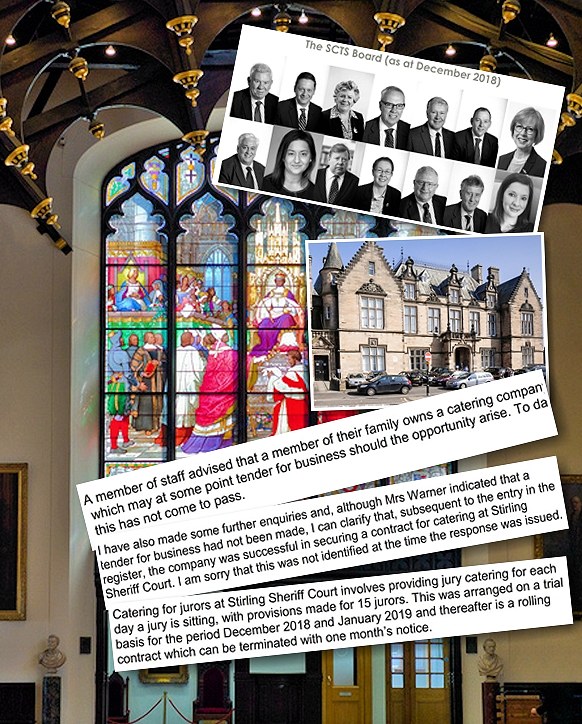
Court employee links to jury catering contract. QUESTIONS over the accuracy of a Register of Interests for employees of the Scottish Courts and Tribunals Service (SCTS) have emerged - after a member of staff’s link to a catering contract to provide food to jurors at one Sheriff court – was concealed from a Freedom of Information disclosure.

The lack of information in the SCTS register of staff interests, and failure to disclose court employees links to the award of a successful rolling catering contract – providing £13,000 of catering & food to jurors at Stirling Sheriff Court – was only admitted by the Court service - after a series of FOI requests established contracts were being handed out to companies linked to court employees.

Some weeks ago, questions were put to the Scottish Courts and Tribunals Service in the form of an FOI request - after information was provided to the media suggesting significant failures of court employees to declare profitable interests linked to contracts providing services to the courts and judiciary in Scotland.

For some context on this - the probe on court staff failing to declare links to money making contracts providing services to the courts, came about during additional scrutiny of how law firms & some court staff are using hospitality to earn ‘referral fees’, employment for relatives and other financial favours linked to criminal defence law firms poaching each other’s clients.

A full report on hospitality in Scotland’s courts –with links to earlier articles- can be found here: COURT GIFTING, M’LORD: Transparency declarations of ‘hospitality’ to Scotland’s Courts reveal gift giving by Police & Prosecutors to court staff - and reductions in declared hospitality from Legal Aid millionaire law firms

In response to the Freedom of Information enquiry, Gillian Warner of the Scottish Courts & Tribunals Service issued a disclosure with one single declaration, stating the following:

A member of staff advised that a member of their family owns a catering company which may at some point tender for business should the opportunity arise. To date this has not come to pass.

A request for a Freedom of Information review was submitted - and in response to that review - the SCTS were forced to reveal the contract for providing food to juries at Stirling Sheriff Court – was successful and had been awarded – despite the earlier claim that the contract had not been awarded.

Files reveal SCTS failure to disclose staff links to contracts. Margo Mackie, Deputy Head Information Governance & Correspondence said: “I have also made some further enquiries and, although Mrs Warner indicated that a tender for business had not been made, I can clarify that, subsequent to the entry in the register, the company was successful in securing a contract for catering at Stirling Sheriff Court. I am sorry that this was not identified at the time the response was issued.”

Ms Mackie added further detail in the FOI review with the entry as was declared in the SCTS staff register: “The company services a sports club in Stirling and provides outside catering for local companies for functions etc. There are no expected conflicts of interest here however, should a tendering exercise take place for any catering requirements within the Stirling area, it is quite possible that the company would attempt to secure that business. No specific additional steps identified or taken to mitigate any risk at this stage.”

However, when asked about the value of the contract and how long it had been running – the Court Service insisted a new Freedom of Information request must be submitted – which allowed the SCTS an extra twenty days for a response to be given.

It then emerged from the response to the new FOI request that the £13K rolling contract for catering – had been operational for at least a year – despite earlier claims from the Scottish Courts & Tribunals Service that no such contract existed.

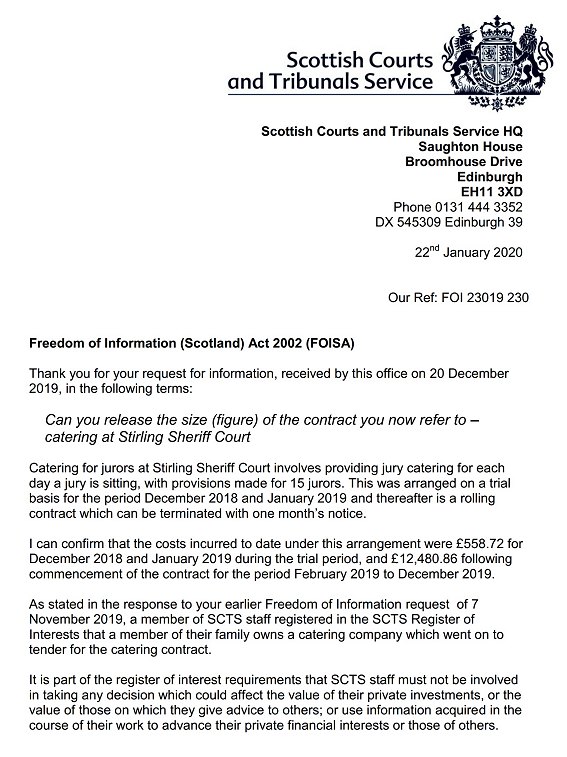
In response ot the second FOI request, Margo Mackie - Deputy Head Information Governance admitted: “Catering for jurors at Stirling Sheriff Court involves providing jury catering for each day a jury is sitting, with provisions made for 15 jurors. This was arranged on a trial basis for the period December 2018 and January 2019 and thereafter is a rolling contract which can be terminated with one month’s notice.”

“I can confirm that the costs incurred to date under this arrangement were £558.72 for December 2018 and January 2019 during the trial period, and £12,480.86 following commencement of the contract for the period February 2019 to December 2019.”

However, while elected politicians such as MSPs & MPs, and those in other public bodies such as Police Scotland are required to declare all their interests, a significant failing in in how employees of the Scottish Courts and Tribunals Service declare their interests has emerged – where Court staff are only required to declare interests they feel may be relevant, rather than a requirement for total disclosure.

A question was put to the SCTS, asking whether entries are only made in this SCTS staff register if a staff member feels they may have an interest to declare - rather than a full and comprehensive register of staff interests - per SCTS staff member - being kept and updated as appropriate - example the register of interests for Scottish Parliament MSPs.

In response, Margo Mackie - Deputy Head Information Governance stated: As regards your first point I can advise that SCTS follows the Civil Service Management Code which sets out regulations and instructions regarding the terms and conditions of service of civil servants. One of these regulations concerns "the declaration of relevant business interests which SCTS employees or members of their immediate family hold, which might compromise, or appear to compromise, their integrity, honesty, objectivity or impartiality”.

“SCTS staff are therefore required to declare any business interests (including directorships) or holdings of shares or other securities which they or members of their immediate family (spouse, including partner where relevant, and children) hold, to the extent which they are aware of them, which they would be able to further as a result of their official position.”

“This means that, where there is a potential for income or financial benefit to be gained from work related to the SCTS, staff must declare and register an interest. Such interests are declared by informing their Unit Head who considers whether the interest is appropriate and should be registered. Thereafter details are provided to Human Resources Unit for addition to the SCTS Register of Interests.Staff who do not declare and register an interest which subsequently comes to light may be subject to disciplinary action.”

After initially concealing information from a Freedom of Information request, admitting further details in a review, and then insisting on a second FOI request, the Scottish Courts & Tribunal Service claimed the member of staff had no part or involvement in procurement.

Margo Mackie Deputy Head Information Governance & Correspondence claimed: “It has been confirmed that the member of staff concerned is not involved in procurement and played no part in the quotes exercise which awarded the contract, nor do they have any active involvement in the running of the company.”

Margo Mackie added: “The matter of updating information contained in the register will be considered in future reviews of the procedures.”

However, no explanation has been given as to why the member of staff’s link to the successful contract was concealed from the initial Freedom of Information disclosure.

Independent Report – Court Employees Interests Register is insufficient

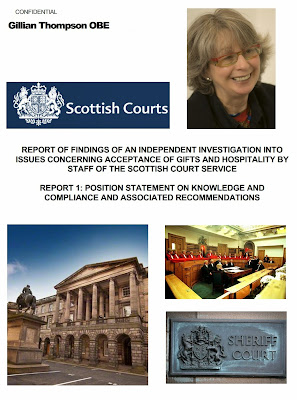
Report said SCS Registers insufficient, Court staff involved in private gains failed to declare. Former Judicial Complaints Reviewer Gillian Thompson’s Report on Hospitality & Gifts in the SCS stated:  “The information currently captured on the registers is insufficient to provide assurance that staff are using their common sense and considering issues such as conflict of interest.

Ms Thompson went on to recommend the “SCS should revise the Policy on Acceptance of Gifts, Rewards and Hospitality to ensure that it is fit for purpose for all staff, taking account of the various roles performed within SCS. It may also be time to revisit the levels of value for gifts and hospitality.”

The former AIB’s report also revealed court staff were using their positions to earn money privately from their links with lawyers and law firms operating in courts, stating “Several staff raised the issue of sheriff clerks who carry out extrajudicial taxations and private assessments and who personally benefit financially from these activities.”

Ms Thompson’s report roundly condemned this practice, stating: “Not only is it inappropriate in terms of the civil service code requirements for staff who are public servants to be able to receive private gain from their employment it is also highly divisive when other staff see such benefits being derived from simply being in the right post of Auditor of Court within the Sheriff Courts.”

Ms Thompson recommended in her report the “SCS should bring the practice of sheriff clerks profiting privately from their employment by SCS to an end as quickly as possible”.

Now, a number of additional claims by whistleblowers regarding undisclosed links between SCTS staff and high value contracts providing services to the courts are currently being examined by DOJ for further investigation and publication at a later date.

Readers should note the Scottish Parliament’s Justice Committee are currently considering an eight year cross party backed petition calling for a Register of Interests for members of Scotland’s judiciary.

Previous articles on the lack of transparency within Scotland’s judiciary, investigations by Diary of Injustice including reports from the media, and video footage of debates at the Scottish Parliament’s Public Petitions Committee can be found here : A Register of Interests for Scotland's Judiciary.

Previous articles on hospitality and gifts to the Scottish Courts and Tribunals Service, reports on gift giving to court employees and investigations by Diary of Injustice on the relationship between law firms and SCTS staff can be found here Hospitality and Gifts to the Scottish Courts.

Sunday, January 12, 2020

POLICE UNION SECRETS: Transparency petition by whistle-blower ex Police Officer closed by msps as Scottish Government block move to bring Freedom of Information compliance to Scottish Police Federation

Scots Police Fed. keeps secrets. A PETITION calling for Holyrood to recommend Freedom of Information compliance for the Scottish Police Federation (SPF) - has been closed - after the Scottish Government said it would block transparency compliance for the Union which covers all Police Scotland officers.

Petition PE1763 Freedom of Information Legislation (Scottish Police Federation) – submitted by whistleblower & ex-Police Officer Robert Brown – sought to bring the Scottish Police Federation into line with its counterpart - the Police Federation of England & Wales – which has been covered by Freedom of Information legislation since 2017

Legislation in England & Wales states: Freedom of Information Act etc: Police Federation for England and Wales: The Police Federation for England and Wales is to be treated for the purposes of— (a)10the Freedom of Information Act 2000,(b)the Data Protection Act 1998, and (c)section 18 of the Inquiries Act 2005, as if it were a body listed in Part 5 of Schedule 1 to the 2000 Act (public authorities).

The Police Federation of England & Wales FOI website section states the following: “The Police Federation of England and Wales (PFEW) is funded in part by police officers who pay subscriptions from their wages. We are not funded by the public, and we are the only staff association to be subject to Freedom of Information (FoI), which came into effect for the PFEW in April 2017. The Freedom of Information Act (2000) provides public access to relevant information held by public authorities. Should you wish to submit an FoI request, please contact us.”

Given the Police Federation of England & Wales obvious compliance with Freedom of Information legislation, Police Officers in Scotland and others with an interest in policing – an intense area of public interest – would benefit considerably to access to information - from the same level of transparency applied to the Scottish Police Federation - via compliance with the Freedom of Information (Scotland) Act 2002.

Commenting on the petition submitted by ex Police Officer Robert Brown to the Scottish Parliament’s Public Petitions Committee - Brian Whittle MSP said “The petition has real merit, especially given that England and Wales have already gone down the same route

Howeverm a short debate then took place – with the Convener Johann Lamont & Deputy Convener Gail Ross of the Public Petitions Committee backing away from taking the matter further.

The petition to bring equality of transparency for the Scottish Police Federation was then abruptly closed – after Committee members were told the Scottish Government will not bring Freedom of Information accountability to the Scottish Police Federation.

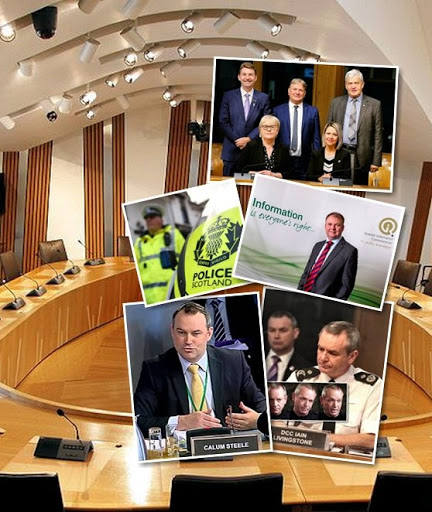
Last year - the powerful and secretive Scottish Police Federation – which acts as a lobbying force for police officers in Scotland and has the power to decide or deny help to Police Officers – saw it’s General Secretary - Police Constable Calum A Steele - found guilty by PoliceScotland in relation to a complaint of online social media abuse against a former senior Police Officer - 'Inappropriate and offensive' Police union boss guilty of abusing female former chief in Twitter tirade.

The issue arose from comments made by Calumn Steele in response to criticisms about the appointment of a Chief Constable – Iain Livingstone – who had previously been accused of five allegations of serious sexual assault against a female Police Officer – reported in further detail here: TOP COP SECRETS: Transparency lacking at Police Scotland as spy scandal cops refuse to disclose files on complaints & historical sexual assault case details involving Deputy Chief Constable Iain Livingstone

An earlier probe by Diary of Justice also revealed the Scottish Police Federation received millions of pounds of public cash over the years from the SNP Scottish Government - a full report can be viewed here: PROBE THE FED: Calls for Holyrood to probe secretive Scottish Police Federation as files reveal SPF General Secretary asked Scottish Government to withdraw £374K public cash grant funding - after social media transparency calls from cops

And, days after the Scottish Information Commissioner made an online statement via Twitter that it would recommend the Scottish Police Federation for Freedom of Information compliance – SPF General Secretary Calum Steele asked the Scottish Government to end the £374,000 public cash grant paid each year by Scottish Ministers to the Scottish Police Federation.

A full report on how Daren Fitzhenry – the Scottish Information Commissioner - backed away from promises to recommend FOI compliance for Scottish Police Federation, and evidence submitted by DOJ journalists to the Public Audit and Post Legislative Scrutiny Committee of the Scottish Parliament, is covered in further detail here: FOI PROBE: Holyrood Committee hear Scottish Information Commissioner backed off promise to bring Freedom of Information to Scottish Police Federation - even after Info. Tsar knew England & Wales Police Fed. already complied with FOI legislation

As thngs stand at the date of publication - the Scottish Police Federation remain exempt from Freedom of Information legislation – despite the same transparency laws applying to the Police Federation of England & Wales.

Video footage and a transcript report of the Petitions Committee debate on bringing Freedom of Information compliance to the Scottish Police Federation follows:

Scottish Police Federation Freedom of Information petition - Public Petitions Committee 5 Dec 2019

Freedom of Information Legislation (Scottish Police Federation) (PE1763)

The Convener (Johann Lamont, Scottish Labour): The next new petition is PE1763, headed “Make the Scottish Police Federation comply with FOI legislation” and lodged by Robert Brown. The petition calls on the Scottish Parliament to urge the Scottish Government to make the Scottish Police Federation comply with the Freedom of Information (Scotland) Act 2002.

Our briefing explains that freedom of information requirements apply broadly to public authorities such as Governments, councils and health boards. Police Scotland is subject to the requirements of the 2002 act, but the Scottish Police Federation is not. As police officers are prohibited from joining trade unions, the Scottish Police Federation was created as a staff association with responsibility for the welfare and efficiency of police officers. Trade unions are not covered by freedom of information legislation.

It could be argued that the Scottish Police Federation is akin to a trade union and, therefore, should not be covered by freedom of information requirements. However, the Scottish Police Federation was established by legislation; therefore, it could be argued that it has some similarities with public bodies. The Police Federation of England and Wales is required to comply with freedom of information legislation as a result of changes to the law that were made in 2017. The Scottish Government stated in July 2019 that it had no plans to make the Scottish Police Federation subject to freedom of information legislation.

Elaine Smith, who has noted her support for the petition, says:“I have realised that the Scottish Police Federation appear to be totally self-governing and do not conform to the standards set for England and Wales Federations”.

Do members have any comments or suggestions for action?

Brian Whittle (Scottish Conservative & Unionist):The petition has real merit, especially given that England and Wales have already gone down the same route. However, the Scottish Government has indicated that it has no intention of changing its position. Frustrating as it may be to both the petitioner and the committee with regard to investigating the issue, I do not know that there is anything in particular that we can do to push the matter forward, given that we know where the Scottish Government stands.

The Convener: I do not think that trade unions should fall within the remit of, or be caught by, freedom of information legislation. The police are not allowed to have a trade union, and the only way that they can have a staff association is through legislation. Would it be fair if what is, in effect, a trade union for the police fell under different legislation from that which applies to other trade unions?

The SPF is a unique organisation. However, given that I perceive the organisation as a trade union, I do not see why—unless I am arguing that all trade unions should be in the same position—it should be singled out. The police do not have any choice—they are not allowed, under different legislation, to set up a trade union.

Brian Whittle: The whole matter is really interesting following incidents down south, such as the plebgate scenario, that have brought the police there under the auspices of FOI legislation. Again, I go back to the fact that the Scottish Government has been quite firm in saying that it has no intention of moving down that route. I am, therefore, not quite sure what we can do with the petition.

Maurice Corry (Scottish Conservative & Unionist): It is a difficult one. The release of any information under FOI is entirely in the jurisdiction of the body that is being requested to release it, and there may be valid reasons why it cannot be released. There is some sort of parity. Perhaps we should go back and question the Scottish Government, just to double-check that it is still of the same view.

The Convener: The matter was not in the programme for government.

The Government said what it said in July 2019, so we know what the answer is going to be. We would only be deferring our decision on whether we want to explore the matter further. My feeling is that the case has not been made for why the SPF, as a quasi-trade union, should fall within the remit of FOI legislation, unless we are arguing that all trade unions should be subject to FOI—I would argue that they should not be. Why would we be inconsistent? There are particular circumstances that have led to the current position in England and Wales, but my sense is that there is not an issue in Scotland.

Gail Ross (Deputy Convener) (Scottish National Party): I agree. The Government has made it quite clear what its policy is, and that is not going to change. I agree with Brian Whittle—as a committee, we cannot really take the petition forward.

Maurice Corry: I have not said that I disagree with that; I just wanted to play the devil’s advocate, because the petition raises an issue that needs to be given serious thought. I understand the reasons why the SPF was set up.

The Convener: The petition highlights the difference between the circumstances in England and Wales and those in Scotland, and it gives us an opportunity to reflect on the situation. However, my sense is that there is no pressure for such a change in Scotland. It would require broader discussion about how a staff association inside the police should operate if it is not to operate like a trade union, and I do not think the case has been made for such a change.

My sense is that the committee agrees that we should close the petition under rule 15.7 of the standing orders, on the basis that the Scottish Government has confirmed very recently that it has no plans to make the Scottish Police Federation subject to freedom of information legislation.

Do members agree? Members indicated agreement.

Petition documents submitted by the petitioner, ex Police Officer Robert Brown – stated:

Elaine Smith MSP has made many representations on my behalf including writing to the various First Ministers, Justice Ministers, Lord Advocates, Police Complaints Commission, Strathclyde Police Authority, Police Investigation Review Commission, Strathclyde Police Federation and the Scottish Police Federation. Mrs Smith also lodged a number of parliamentary questions on my behalf including seeking clarification on the issue in July 2019 from the Cabinet Secretary for Justice and from the Scottish Parliament Information centre.

The Scottish Police Federation (SPF) is currently not required to comply with The Freedom of Information (Scotland) Act 2002, whereas the Police Federation of England and Wales is required to comply with the Freedom of Information Act 2000.

All UK police forces, except Police Scotland are also required to comply with the Act. In my opinion, the foregoing is an anomaly, given the situation in England and Wales and I would suggest that making the SPF compliant with The Freedom of Information (Scotland) Act 2002 would assist every member of the SPF, every one of the 17,000 police officers in Scotland as well as members of the public who come into contact with the police and who are interested in openness and transparency.

The SPF hold large amounts of information about police officers including financial and medical information, as well as details about criminal and misconduct allegations made against officers. As a result of their position in representing police officers who are subject to investigation, the SPF receive and retain information about members of the public

Neither SPF members, police officers, nor members of the public are able to access this information. The SPF also hold large amounts of information about police officers’
pay, pensions, welfare and how SPF subscriptions are spent and used among other matters which can be accessed by other Federation members, police officers and members of the public, elsewhere in the UK, but not in Scotland.

The current anomaly in my opinion is a bar to any SPF member, police officer, member of the public or other interested party to gain access to information which is readily available to interested parties in other parts of the UK. If Scotland prides itself on openness and transparency then a body which represents many people and holds information on many more should not be allowed to be excluded from this legislation when equivalent bodies in other parts of the UK are not excluded from the equivalent legislation, i.e. The Freedom of Information Act 2000. The Freedom of Information Act 2000 is specific to England and Wales and is therefore not applicable in Scotland. In my opinion, common sense dictates that the same standard should apply across the UK and accordingly this petition is calling for the SPF to be required to comply with the equivalent legislation in Scotland.

A question from Elaine Smith MSP on Freedom of Information compliance for the Scottish Police Federation – was answered by Humza Yousaf - the current Justrice Secretary – on 17 July 2019.

Elaine Smith (Central Scotland) (Scottish Labour): To ask the Scottish Government what its position is on making the Scottish Police Federation compliant with data protection and freedom of information legislation, in line with the Police Federation of England and Wales.

(S5W-24011)

Humza Yousaf: The Freedom of Information (FoI) acts provide for access to information held by public authorities and Trade Unions and Staff Associations are not generally covered by these acts.

The decision to add the Police Federation of England and Wales to FoI legislation was made by the Home Office and there are currently no plans to add the Scottish Police Federation to the Scottish FoI legislation.

Data Protection legislation does apply to the Scottish Police Federation and a link is attached below to their Privacy Statement, which explains how they processes personal data:

A briefing from the Scottish Parliament Information Centre (SPICe) - prepared for the Public Petitions Committee consideration of Petition 1763 - stated:

Background: Freedom of information

Freedom of information legislation allows individuals to request information held by public authorities. Freedom of information is devolved to the Scottish Parliament, so the legislative framework is slightly different between Scotland and England and Wales.

Broadly, freedom of information requirements apply to public authorities, such as governments, councils and health boards. They don’t generally apply to private bodies, although some private bodies carrying out public functions are covered (in relation to their public functions, rather than their wider work).

Police Scotland is subject to the requirements of the Freedom of Information (Scotland) Act 2002.

The Scottish Police Federation is not. The Scottish Police Federation Police officers are prohibited from joining trade unions.

The Scottish Police Federation was created by the Police Act 1 919 as a staff association with responsibility for the welfare and efficiency of police officers.

Trade unions are not covered by freedom of information legislation. They are seen as private bodies representing the interests of members. It could be argued that the Scottish Police Federation is akin to a trade union and therefore should not be covered by freedom of information requirements.

However, the Scottish Police Federation was established by legislation and could be argued to have some similarities with public bodies.

The Police Federation in England and Wales

The Police Federation in England and Wales is required to comply with freedom of information legislation, as a result of changes to the law in 20171.

The then Home Secretary Theresa May argued that this change was necessary to improve transparency and accountability2.

It formed part of a wider reform initiative covering the Police Federation, which had been hit by several scandals. These included the so-called “plebgate” incident, involving allegations that the then UK Government Chief Whip, Andrew Mitchell MP, had called police officers “plebs”.

Data protection legislation

Separately, data protection legislation controls how personal data (covering any information from which a living individual can be identified) can be used.

Individuals have rights to access information that organisations (including private bodies) hold about them personally under data protection legislation. Data protection is reserved to the UK Parliament (and is, at present, mainly controlled at a European Union level).

Freedom of information legislation cannot be used to require the release of information which would identify a living individual, unless this would also be possible under data protection legislation.

This would include information which would identify a police officer (including a police officer who was subject to a complaint) or a member of the public.

Data protection legislation will usually mean that the consent of the person affected would be required before their data can be released.

However, it is possible to release personal data to a third party without consent where it is “reasonable” to do so.

Consideration must be given to the circumstances of the case, including the type of information which would be disclosed. It is also possible for organisations to redact (block out) information which could lead to the identification of a living individual when responding to freedom of information requests.

Scottish Government Action

The Scottish Government has stated, in response to a parliamentary question from July 20193, that it has no plans to make the Scottish Police Federation subject to freedom of information legislation.

Scotland keeps it secrets, meahwhile England & Wales Police Federation is covered by Freedom of Information law:

Access to information Freedom of Information

The Police Federation of England and Wales (PFEW) is funded in part by police officers who pay subscriptions from their wages. We are not funded by the public, and we are the only staff association to be subject to Freedom of Information (FoI), which came into effect for the PFEW in April 2017. Much of the information you may ask for may already be on this website, so please take the time to search for what you need first.

How to ask for information: The Freedom of Information Act (2000) provides public access to relevant information held by public authorities. Should you wish to submit an FoI request, please contact us at foi@polfed.org

The General Data Protection Regulations and the UK Data Protection Act (2018) Subject Access provides a right for the requester to see their own personal data, rather than a right to see copies of documents that contain their personal data. If you wish to submit a SAR, please contact us at dataprotection@polfed.org.

For either of the above, we will have a better chance of finding the information you want if you are as specific as you are able to be and provide us as much detail as possible.

How long will it take to receive the information I want?: This will depend upon nature of the information you have asked for. If you have requested personal information about yourself then we should respond to your request within 1 calendar month from the point at which your request and identity has been verified.

For other requests you have a right to receive the information, or receive a valid refusal, within 20 working days, unless we need clarification.

Do you have an issue or case with the Scottish Police Federation (SPF) or any other information relevant to the SPF you wish to discuss? If so, please contact Diary of Justice with further details via scottishlawreporters@gmail.com.