
Showing posts with label Lord Brodie. Show all posts

Thursday, October 12, 2017

CRIME ON, CROWN: Historical Abuse probe dropped as Crown Office forced to pay £10K to law firm Clyde & Co - after judge suspends Police search warrant to obtain evidence relating to accusations against ‘influential’ clients

Crown Office paid £10K to law firm subject of Police raid. SCOTLAND’S Crown Office & Procurator Fiscal Service (COPFS) has been forced to pay £10K public cash in legal and ‘other fees’ to a law firm representing a ‘important client’ in relation to a botched search blocked by a judge.

The payment of £10,021.38 to Edinburgh law firm Clyde & Co (formerly Simpson & Marwick) was revealed by prosecutors in response to a Freedom of Information request amid ongoing media enquiries which have now established any possible criminal prosecution in connection with the allegations of abuse is “dead in the water”.

The events surrounding the search warrant occurred last summer, in which Police Officers obtained a search warrant to raid the premises of Edinburgh law firm Clyde & Co, in relation to material officers believed the firm held relating to evidence of historical sexual abuse of minors.

A search warrant issued by a Sheriff upon an application from the Crown Office to raid the law firm, resulting in two police officers attending the offices of Clyde & Co at 58 Albany Street, Edinburgh, at 10am on 22 July 2016 with a search warrant to obtain the evidence.

However, a stand off ensued while Clyde & Co applied to the court for a judge to revoke the search warrant.

The search warrant was subsequently revoked blocked by senior judge Lord Brodie after counsel for Clyde & Co claimed legal professional privilege was attached to the alleged evidence of abuse.

While the Crown Office have now admitted they were required to pay legal & other fees to Clyde & Co, prosecutors refused to divulge any further information on the case, citing the information was held as part of a criminal investigation – which has now been dropped.

Christine Lazzarin for the Crown Office stated in the FOI response: “Firstly I should clarify that a Bill of Suspension hearing emanates from criminal proceedings and any correspondence held between COPFS, the Scottish Courts and Tribunal Service (SCTS), Police Scotland and Clyde & Co in relation to this hearing is exempt.”

“By way of explanation, this correspondence is held by a Scottish Public Authority, namely the Procurator Fiscal, for the purposes of an investigation which the Procurator Fiscal had a duty to conduct to ascertain whether a person should be prosecuted for an offence and it is therefore exempt from release in terms of Section 34(1)(a)(i) of FOISA.”

“This is not an absolute exemption and I have therefore considered whether the public interest favours disclosure of the information, notwithstanding the exemption.”

“Whilst I appreciate that there is a great deal of information in relation to the hearing publically accessible on the SCTS web-site, I consider that there is a strong public interest in maintaining the confidentiality of correspondence in connection with allegations of criminality and consequently the Bill of Suspension hearing.”

“The confidentiality of such information ensures that the agencies involved in the criminal justice process can report to the Procurator Fiscal in a manner which is free and frank and for this reason I consider that the public interest favours upholding the exemption.”

“You have also asked for information about fees, costs, legal expenses or other funds paid by COPFS to SCTS and Clyde & Co. I can advise that COPFS paid a total of £10,021.38 in fees, and other legal costs to Clyde & Co after the hearing.”

Further enquiries into the case by the media have now established the investigation into the case of alleged abuse has now been dropped – with legal insiders at the Crown Office blaming the Crown Office handling of the search warrant, and the effect of Lord Brodie’s order cancelling the search warrant.

Legal sources have also speculated Police Scotland may have been forced to pay the same law firm – Clyde & Co – for their actions in seeking to serve the warrant and obtain the alleged evidence of abuse.

During the Financial year 2016 to 2017, a mysteriously large sum of public cash - £213,933.24 was paid to Clyde & Co by Police Scotland according to figures obtained in a recent media investigation into Police payments to law firms, reported in more detail here: Concerns on Public Bodies Legal Fees spending as figures reveal Scottish Police Authority fork out over £1m in legal fees, Police Scotland spend at least £1.3 million on external lawyers

However, faced with further searching enquiries, Police Scotland have point blank refused to disclose any further information about their payments to Clyde & Co and other law firms.

While the Crown Office have now dropped a prosecution in relation to the alleged abuse, the media are eager to speak to anyone involved in the investigation, or the victims themselves, who can if they wish come forward to DOI, by way of contacting the blog at scottishlawreporters@gmail.com

This latest floundered investigation into what is alleged to be an influential figure in relation to historical abuse crimes - is another blow for the failing leadership of the Crown Office - under current Lord Advocate James Wolffe QC & Solicitor General Alison Di Rollo (sister of Glasgow solicitor & former Law Society of Scotland President - Austin Lafferty)

Last month, it was revealed the Crown Office has given jobs – without interview – to relatives of high ranking Crown Office staff, who then went on to be charged with drug dealing offences – information which came to light in an ongoing investigation into Prosecutors interests and a secret Crown Office register of interests, reported in more detail here: DECLARE THE CROWN: Secrecy block on Crown Office Register of Interests - after fears info will reveal crooked staff, dodgy business dealings, prosecutors links to judiciary, criminals, drugs dealers and dodgy law firms

The Sunday Mail newspaper reported the payments from the Crown Office to Clyde & Co here:
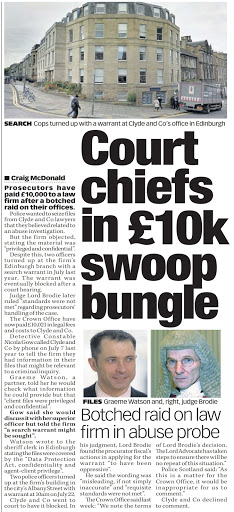
Court chiefs fork out £10k to law firm after botched raid in abuse probe

'Standards were not met' when cops turned up with a warrant at Clyde and Co's Edinburgh office and tried to seize 'privileged and confidential' material.

By Craig McDonald Sunday Mail 8 OCT 2017

Prosecutors have paid £10,000 to a law firm after a botched raid on their offices.

Police wanted to seize files from Clyde and Co lawyers that they believed related to an abuse investigation.

But the firm objected, stating the material was “privileged and confidential”.

Despite this, two officers turned up at the firm’s Edinburgh branch with a search warrant in July last year. The warrant was eventually blocked after a court hearing.

Judge Lord Brodie later ruled “standards were not met” regarding prosecutors’ handling of the case.

The Crown Office have now paid £10,021 in legal fees and costs to Clyde and Co.

Detective Constable Nicola Gow called Clyde and Co by phone on July 7 last year to tell the firm they had information in their files that might be relevant to a criminal inquiry.

Graeme Watson, a partner, told her he would check what information he could provide but that “client files were privileged and confidential”.

Gow said she would discuss it with her superior officer but told the firm “a search warrant might be sought”.

Watson wrote to the sheriff clerk in Edinburgh stating the files were covered by the “Data Protection Act, confidentiality and agent-client privilege”.

Two police officers turned up at the firm’s building in the city’s Albany Street with a warrant at 10am on July 22.

Clyde and Co went to court to have it blocked. In his judgment, Lord Brodie found the procurator fiscal’s actions in applying for the warrant “to have been oppressive”.

He said the wording was “misleading, if not simply inaccurate” and “requisite standards were not met”.

The Crown Office said last week: “We note the terms of Lord Brodie’s decision. The Lord Advocate has taken steps to ensure there will be no repeat of this situation.”

Police Scotland said: “As this is a matter for the Crown Office, it would be inappropriate for us to comment.”

Clyde and Co declined to comment.

POLICE STAND OFF AS JUDGE BLOCKS SEARCH WARRANT:

A full report on the opinion by Lord Brodie and his revocation of the Police Scotland search warrant was published by Scottish Law Reporter here: Police raid on Edinburgh law firm halted by judge - Lord Brodie hits out at Crown search warrant tactics against Clyde & Co over historic sex crimes investigation 

An excerpt from the Bill of Suspension, signed by Lord Brodie in relation to the search warrant follows:
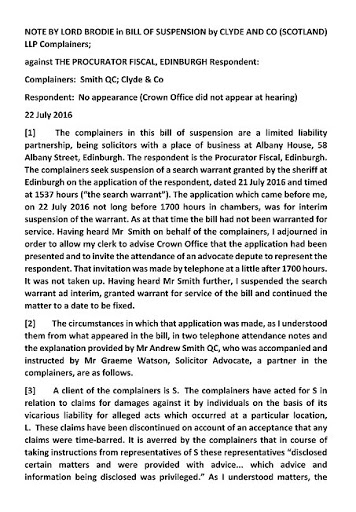
NOTE BY LORD BRODIE in BILL OF SUSPENSION by CLYDE AND CO (SCOTLAND) LLP Complainers;

against THE PROCURATOR FISCAL, EDINBURGH Respondent:

Complainers:  Smith QC; Clyde & Co

Respondent:  No appearance (Crown Office did not appear at hearing)

22 July 2016

[1]        The complainers in this bill of suspension are a limited liability partnership, being solicitors with a place of business at Albany House, 58 Albany Street, Edinburgh. The respondent is the Procurator Fiscal, Edinburgh. The complainers seek suspension of a search warrant granted by the sheriff at Edinburgh on the application of the respondent, dated 21 July 2016 and timed at 1537 hours (“the search warrant”). The application which came before me, on 22 July 2016 not long before 1700 hours in chambers, was for interim suspension of the warrant. As at that time the bill had not been warranted for service. Having heard Mr  Smith on behalf of the complainers, I adjourned in order to allow my clerk to advise Crown Office that the application had been presented and to invite the attendance of an advocate depute to represent the respondent. That invitation was made by telephone at a little after 1700 hours. It was not taken up. Having heard Mr Smith further, I suspended the search warrant ad interim, granted warrant for service of the bill and continued the matter to a date to be fixed.

[2]        The circumstances in which that application was made, as I understood them from what appeared in the bill, in two telephone attendance notes and the explanation provided by Mr Andrew Smith QC, who was accompanied and instructed by Mr Graeme Watson, Solicitor Advocate, a partner in the complainers, are as follows.

[3]        A client of the complainers is S.  The complainers have acted for S in relation to claims for damages against it by individuals on the basis of its vicarious liability for alleged acts which occurred at a particular location, L.  These claims have been discontinued on account of an acceptance that any claims were time-barred. It is averred by the complainers that in course of taking instructions from representatives of S these representatives “disclosed certain matters and were provided with advice... which advice and information being disclosed was privileged.” As I understood matters, the complainers retain in their possession documents and files, both paper and digital, generated in the course of acting for S which include information and advice in respect of which S, whose specific instructions have been taken on the point, asserts legal privilege.

[4]        On 7 July 2016 Detective Constable Nicola Gow contacted the complainers by telephone. She spoke to Mr Watson. There were at least three telephone calls between DC Gow and Mr Watson on that day. I was shown copies of Mr Watson’s telephone attendance notes. DC Gow indicated that she was aware that the complainers held certain information in their client files for S that might be relevant to a criminal inquiry which was currently being undertaken.  She already had copies of some documents but wished to obtain originals of these (including what she described as “originals” of unsigned statements held digitally), the litigation files and such other documents which were in the possession of the complainers. Mr Watson advised that the complainers would check what information they had access to with a view to establishing its whereabouts and what might be capable of being produced. Mr Watson indicated that the client files were privileged and confidential. Mr Watson advised that in the event of him receiving instructions to do so, he was willing to excise from the file certain material in order to assist the police inquiry. DC Gow suggested that they might arrange a time to look at the files together. Mr Watson said that he would need to take instructions on that proposal but that a provisional date for such a joint consideration of the files could be arranged. DC Gow indicated that she would discuss matters with her superior officer but that a search warrant might be sought.

[5]        On 11 July 2016, in anticipation that an application for a warrant might be made, Mr Watson, on behalf of S wrote to the Sheriff Clerk in Edinburgh requesting that the Sheriff Clerk contact the complainers in the event of any application to the sheriff with a view to S being represented at any hearing before the sheriff. Mr Watson explained in that letter that the complainers and S had provided such assistance to Police Scotland as they could within the confines of the Data Protection Act 1998, confidentiality and agent-client privilege. The letter included the sentence: “In our submission it would be oppressive and prejudicial for a warrant to be granted without first hearing from [S].” No reply has been received to that letter.

[6]        Subsequent to the conversations between Mr Watson and DC Gow and prior to 22 July 2016 neither the police, the respondent nor any other representative of the Crown contacted the complainers in relation to recovery of documents held by the complainers.

[7]        At about 1000 hours on 22 July 2016 two police officers attended at the offices of the complainers at 58 Albany Street, Edinburgh, claiming to be in possession of the search warrant which they proposed to execute. Initially they were reluctant to allow Mr Watson to read the search warrant and then they were reluctant to allow him to copy it. Once Mr Watson had succeeded in persuading the police officers to allow him to read and copy the search warrant he was able to ascertain that it had been granted at common law in terms of the crave of a petition at the instance of the respondent in these terms:

“to any Constable of Police Service of Scotland and/or members of staff from the Scottish Police Authority or any other Officer of Law with such assistance as they may deem necessary, to enter and search the offices, out buildings and storage facilities of Clyde & Co, Albany House, 58 Albany Street, Edinburgh and to be at liberty to secure and take possession of any papers relating to L whether in electronic or paper format, and any other evidence which may be material to the investigation into the alleged abuse at L held by said Clyde & Co, whether in a computer system or otherwise.”

Insofar as material to the issues raised in the bill, the averments in the petition were as follows:

“[S] have provided copies of documents referring to a code of conduct for staff … a punishment book, lists … statements, including what purports to be a statement taken from [a named person] and signed by her …

[S] have indicated that the originals of these documents are held by their legal representatives, Clyde & Co, Albany House, 58 Albany Street, Edinburgh. A request has been made to have these documents released to Police Scotland, however, the solicitor has refused to release these documents, citing reasons of client confidentiality.

The solicitor has indicated that they will provide the originals of the documents already provided in copy format only.

“There are reasonable grounds for believing that evidence material to the investigation … is found within the documents being withheld by the solicitor.  The solicitor has indicated to an officer of Police Scotland that there are two boxes of papers and electronic records relating to [L].”

The full note by Lord Brodie – which was published three months after the events of the search warrant took place, can be found here: COPFS Bill of Suspension - Clyde & Co - Lord Brodie

It is also worth noting the Scottish Government have recently announced the scrapping of time bar on historical sexual abuse cases, as the case referred to Lord Brodie does contain references to claims in relation to allegations of abuse becoming time barred.

The Scottish Government announcement on scrapping time bar for claims in relation to historical sexual abuse states the following:

The Limitation (Childhood Abuse) (Scotland) Act 2017 is a piece of legislation which changes the rules around the time limits within which you can make a claim for compensation in the civil courts. Usually you have to make your claim within three years of the injury, or (if it is later) three years from your sixteenth birthday.

This change will mean that there will no longer be a time bar on childhood abuse claims in the civil courts. (It applies to abuse of a person under the age of 18.) There will no longer be a requirement to make a claim within the three years or to ask the court to use its discretion to allow the case to go ahead after that period.

The law usually prevents claims being taken to court more than once. The Act makes a limited change to this for childhood abuse claims. If you took a claim to court before the Act became law, but lost because of the time bar, the Act means that you should not be prevented from taking another claim to court.

This change is in relation to the three year limitation period, which is relevant to abuse that took place on or after 26 September 1964.

The commencement of the Limitation (Childhood Abuse) (Scotland) Act 2017 means survivors of child abuse no longer face the ‘time-bar’ that requires personal injury actions for civil damages to be made within three years of the related incident.

Minister for Community Safety & Legal Affairs Annabelle Ewing, who took the legislation through Parliament, said the move was an important part of wider Scottish Government action to support survivors of childhood abuse.

Ms Ewing said: “Child abuse is the most horrific betrayal of our young people and, even where such crimes were committed decades ago, we will do all we can to help survivors get the justice they deserve. Police Scotland and the Crown continue to work tirelessly to bring perpetrators to justice through our criminal courts. And, while it may not be the right way forward for all, survivors may now be considering the option of accessing justice through the civil courts.

“This legal milestone would not have happened but for the courage of many adult survivors whose persistence and dedication have shone a light on the dark realities of child abuse. Through their brave testimonies they have made clear the great hurt and damage caused by the very individuals and institutions who should have cared for them.

“Alongside our national survivor support fund, the establishment of the independent public Inquiry into in-care childhood abuse, and the current consultation on a potential financial redress scheme, this removal of the civil time-bar underlines the Government’s commitment to ensuring Scotland is beginning to make amends for the grave failings of the past.”

Welcoming the introduction of the Act, Joanne McMeeking, Head of Improving Care Experiences at CELCIS at the University of Strathclyde, said: “The abolishment of the time bar is the result of many years of successful campaigning by survivors. It is a welcome addition to the package of effective reparation as outlined in the Action Plan on Justice for victims of Historic Abuse of Children in Care.”

For previous articles on the Crown Office, read more here: Scotland's Crown Office - in Crown detail

Friday, May 18, 2012

Court of Session hears Legal Defence Union boss who met SLCC complaints Chief stands accused of SEVEN counts of misconduct by Law Society reporter

Court BrodieCourt of Session's Lord Brodie hears Legal Defence Union boss accused of misconduct in Law Society report. DETAILS of a court case heard in Scotland’s Court of Session have revealed William Macreath aged 60, who is the head of the LEGAL DEFENCE UNION (LDU), a shady lawyer’s lobby group specialising in defending crooked colleagues has been accused of “five findings of inadequate services” and “seven findings of professional misconduct” by an unnamed reporter acting for the Law Society of Scotland. The stinging accusations against the LDU boss, who it was revealed last year had secret meetings with Jane Irvine, Chair of the Scottish Legal Complaints Commission (SLCC) in expensive Edinburgh hotels, are contained in one of four reports carried out by Law Society reporters investigating complaints originally made SEVEN YEARS AGO in 2005 by a fellow solicitor, Miss Norna Crabbe.

Details of the court case and allegations against Mr Macreath who is also a partner in Glasgow law firm Levy MacRae only came to light after the LDU boss petitioned the Court of Session for a Judicial Review against the Law Society of Scotland which in turn resulted in Miss Crabbe asking leave to enter the process and to lodge answers as additional respondent alongside the Council of the Law Society of Scotland in response to the petition filed by Mr Macreath.

Earlier this week, Miss Crabbe’s motion to the court to enable her to enter the case faced bitter opposition from advocate Helen Watts, acting on behalf of Messrs Simpson & Marwick who are representing Mr Macreath. During the debate on the case, the Judge, Lord Brodie who is known not to be a big fan of the media, heard the case had come about after it had taken the Law Society of Scotland no less than four reporters to wade through, investigate and report back on complaints made against Mr Macreath by Miss Crabbe in relation to litigation & legal services provided by Mr Macreath to Miss Crabbe over the dissolution of a firm in which Miss Crabbe had been a partner.

The court was told of how the third reporter who looked into the complaints made against Mr Macreath recommended that all heads of complaint made by Miss Crabbe against the petitioner be dismissed, with the exception of one finding of inadequate professional services upon which the third reporter recommended that no sanction be imposed on the petitioner in respect of that finding.

Miss Crabbe subsequently complained about the terms of the 2009 Report conducted by the third reporter and it was by way of response to Miss Crabbe's complaint about the 2009 Report that the respondent made its remit (which the petitioner avers was of a limited nature) to the fourth reporter.

In what appears to be a complete reversal of the third reporter’s findings, the fourth reporter reported in terms of the 2011 Report. In the 2011 Report the fourth reporter made five findings of inadequate services against the petitioner and seven findings of professional misconduct. The fourth reporter did not make a finding of inadequate professional services in relation to the one head of the complaint which had been upheld by the third reporter.

In response to the allegations, the court heard in Mr Macreath’s pleadings that he made detailed written representations to the respondent about the unfairness of the approach adopted in dealing with Miss Crabbe's complaint which led to the 2011 Report. The petitioner avers that he did not receive a substantive response from the respondents until 10 January 2012 when the respondent wrote to the petitioner advising that it proposed to proceed on the basis of the 2011 Report treating the 2009 Report as a nullity.

Details published by the court reveal Mr Macreath is seeking an interdict ad interim against the Council of the Law Society of Scotland from taking any procedural step to advance the disposal of the complaint by Miss Crabbe pending resolution of the proceedings; reduction of the Law Society’s decision of 10 January 2012 to set aside the 2009 Report and treat it as a nullity; an order by the Court ordaining the Law Society to set aside the terms of the 2011 Report; and an order by the Court ordaining the Law Society to obtain a supplementary report in terms specified at paragraph 14.4 of the petition.

However, after hearing both sides arguments in court, Lord Brodie granted Miss Crabbe’s plea to lodge responses, giving a fourteen day deadline for answers to be received by the court. The full terms of Lord Brodie’s opinion are reprinted below, however it should be noted there does not seem to be any mention of what work if any, the first & second reporters carried out with regard to Miss Crabbe’s complaints.

The opinion of Lord Brodie published by the Scottish Courts website is featured here and reprinted below : OUTER HOUSE, COURT OF SESSION [2012] CSOH 81 P47/12 OPINION OF LORD BRODIE in the Petition of WILLIAM COUPERTHWAITE MACREATH Petitioner; for Judicial Review of a decision taken by the Council of the Law Society of Scotland

Introduction

[1] In this application by motion in terms of rule 58.8(2) by Miss Norma Crabbe for leave to enter the process and to lodge answers as additional respondent to the petition, I heard Miss Crabbe in support of her motion and Miss Watts, Advocate, for the petitioner.

[2] Miss Crabbe objected to my hearing Miss Watts on the ground that, contrary to what appears on the Form 23.4 lodged on behalf of the petitioner, written intimation of opposition had not been given to her on the day that the opposition was lodged with the General Department, as required by rule 23.4(4). The relevant timetable of events, according to Miss Crabbe, was that she intimated her intention to enrol the motion by fax on Monday 30 April 2012. She enrolled the motion on Wednesday 2 May. Those acting for the petitioner lodged a form of opposition to motion (Form 23.4) with the General Department on 2 May but only intimated that opposition in writing to Miss Crabbe by way of letter which arrived on Thursday 3 May. The motion came before me on Friday 4 May. While I understood Miss Watts to dispute that there had been a failure to intimate opposition on 2 May, she accepted that she had handed an amended Form 23.4 to Miss Crabbe on the morning of 4 May prior to the motion calling before me. The amended Form 23.4 stated that the motion should be refused on the basis that the applicant was not directly affected by the issues raised in the petition and lacked the necessary interest and standing to justify her participating in the proceedings.

[3] Rather than taking further time to explore the factual dispute, I proceeded on the basis that, as Miss Crabbe claimed, written opposition to her motion had only been intimated to her on 3 May 2012 and that therefore there had been a failure to comply with rule 23.4(4). Rule 2.1 gives power to the Court to relieve a party from the consequences of failure to comply with the Rules of Courts. It is not entirely clear to me that there are necessary consequences of a failure to comply with the requirement to give written notice of opposition on the day of lodging it, at least where the motion is starred, the other party is on notice that the motion is opposed and the other party has attended to make her motion. But, assuming that it was open to me to refuse to hear Miss Watts or to grant the motion irrespective of its merits, I decided that it was entirely inappropriate for me to do so andto the extent that my hearing Miss Watts required me to exercise my powers under rule 2.1, I did so. In my experience at least, a motion such as this is unusual. It did not appear to me free from all difficulty. I welcomed the assistance which might be provided from either side of the bar and Miss Crabbe did not suggest that she had suffered any prejudice from having a shorter rather than longer period of notice of opposition.

The petition

[4] The petitioner is a solicitor. The respondent is the Law Society of Scotland. The petitioner seeks judicial review of a decision taken by the Council of the respondent, acting through its Regulation Department, and intimated by letter dated January 2011, to treat its report dated 28 September 2009, on a complaint against the petitioner (by Miss Crabbe) as a nullity and to proceed on the basis of the report, dated June 2011, on the same subject.

[5] Miss Crabbe is also a solicitor. The petitioner acted on her behalf between 1998 and 2005 in relation to litigation arising out of the dissolution of the firm of which Miss Crabbe had been a partner. Miss Crabbe became dissatisfied with the services provided to her by the petitioner in relation to this matter and in August 2005 intimated the complaint to the respondent which is referred to in the petition. The then statutory provision regulating such complaints was section 33 of the Law Reform (Miscellaneous Provisions) (Scotland) Act 1990. Section 33 requires the respondent to investigate a complaint made by any person with an interest and thereafter make a written report to the complainer and the practitioner concerned. It is averred in the petition that the respondent has appointed a series of four separate reporters to deal with Miss Crabbe's complaint. The report dated 28 September 2009 ("the 2009 Report") was a report by the third reporter and the report dated June 2011 ("the 2011 Report") was a report by the fourth reporter.

[6] The 2009 report by the third reporter recommended that all heads of complaint made by Miss Crabbe against the petitioner be dismissed, with the exception of one finding of inadequate professional services. The third reporter recommended that no sanction be imposed on the petitioner in respect of that finding. Miss Crabbe subsequently complained about the terms of the 2009 Report. It was by way of response to Miss Crabbe's complaint about the 2009 Report that the respondent made its remit (which the petitioner avers was of a limited nature) to the fourth reporter. The fourth reporter reported in terms of the 2011 Report. In the 2011 Report the fourth reporter made five findings of inadequate services against the petitioner and seven findings of professional misconduct. The fourth reporter did not make a finding of inadequate professional services in relation to the one head of the complaint which had been upheld by the third reporter.

[7] The petitioner avers that he made detailed written representations to the respondent about the unfairness of the approach adopted in dealing with Miss Crabbe's complaint which led to the 2011 Report. The petitioner avers that he did not receive a substantive response from the respondents until 10 January 2012 when the respondent wrote to the petitioner advising that it proposed to proceed on the basis of the 2011 Report treating the 2009 Report as a nullity.

[8] In these circumstances the petitioner seeks interdict ad interim against the respondent from taking any procedural step to advance the disposal of the complaint by Miss Crabbe pending resolution of the proceedings; reduction of the respondent's decision of 10 January 2012 to set aside the 2009 Report and treat it as a nullity; an order by the Court ordaining the respondent to set aside the terms of the 2011 Report; and an order by the Court ordaining the respondent to obtain a supplementary report in terms specified at paragraph 14.4 of the petition.

Rule of Court 58.8(2)

[9] Rule 58.8(2) provides as follows:

"Any person not specified in the first order made under Rule 58.7 as a person on whom service requires to be made, and who is directly affected by any issue raised, may apply by motion for leave to enter the process; and if the motion is granted, the provisions of this chapter shall apply to that person as they apply to a person specified in the first order".

Discussion

[10] It was Miss Watts's submission on behalf of the petitioner that Miss Crabbe was not a person "directly affected" by any issue raised in the petition. The petition would not resolve Miss Crabbe's complaint against the petitioner. To the extent that Miss Crabbe's patrimonial interests had been adversely affected by the petitioner's conduct of her affairs then her remedy was an action for damages. Moreover, it was not in the interests of expedient determination of the petition that Miss Crabbe should be allowed to participate. A two day first hearing had been fixed in the petition for 14 and 15 June 2012. It was likely that that hearing would have to be discharged if Miss Crabbe were to be added as a party.

[11] Miss Crabbe and Miss Watts were agreed that authoritative guidance as to what is meant by "directly affected" for the purposes of Rule 58.8(2) is to be found in the judgment of Lord Reed in AXA General Insurance Ltd v The Lord Advocate 2011 SLT 1061 at paras.170 to 175. In that passage, Lord Reed explains that the traditional analysis in terms of title and interest as a requisite for locus standi in a private law context, as set out in D & J Nicol v Dundee Harbour Trustees 1915 SC (HL) 712, is inappropriate where what is in issue are questions of public law, which is likely to be the case with an exercise of the supervisory jurisdiction. At para.174 of his judgment in AXA Lord Reed considers the terms of Rule 58.8(2). He explains that stipulation in the rule that a person must be directly affected by any issue raised, is no more than a reflection of the pre-existing requirement that a person must have sufficient interest. It is no more restrictive than that.

[12] There may be instances where having made a complaint to a regulatory authority the complainer should be taken to have surrendered any private interest in the matter to that authority but on the admittedly fairly superficial understanding of the scheme under the 1990 Act which I was able to glean from the parties' necessarily brief submissions, I do not see this to be such a case. It would appear from the petitioner's averments that the respondent involved Miss Crabbe in the complaints process. It entertained Miss Crabbe's complaint about the 2009 Report. It invited her to submit material which she claimed had not been considered by the third reporter. The petitioner complains of lack of procedural fairness on the part of the respondent in its consideration of the complaint. It is at the very least arguable that just as the petitioner had an expectation of procedural fairness, so did Miss Crabbe. The petitioner complains of delay on the part of the respondent. So did Miss Crabbe when she came to address me. It may be that, in contrast to the petitioner, Miss Crabbe has no direct patrimonial interest in the outcome of the complaint, but I consider that I am entitled to have regard to her interest in being vindicated in the event of her complaint being upheld just as the petitioner has an interest (additional to any purely patrimonial interest) in being vindicated by the complaint being dismissed, either in whole or in part. Depending on the outcome of the complaint, I would expect parties to consider that they had "won" or "lost" to a greater or lesser extent. The terms of the operative reporter's report may not be determinative of the complaint but any final decision will have to be based on that report, hence the petitioner's wish for the 2011 Report to be set aside in favour of the 2009 Report with any further report being limited to an identification of the documentation which was not available to the third reporter and a decision on the significance, if any, of such additional documentation. If it is clear that the petitioner has an interest in setting aside the 2011 Report in favour of the 2009 Report, then, conversely, I would see Miss Crabbe as having an interest, albeit perhaps not a patrimonial interest, in the 2011 Report remaining as the operative report.

[13] Were it to be suggested (and Miss Watts did not so suggest), I would not be satisfied that it would be an answer to Miss Crabbe's wish to participate that her interests can be adequately protected by the respondent's opposition to the petition. It may be that the respondent will take and maintain all relevant points available in answer to the petition but Miss Crabbe has no guarantee that that will be so. It may be that with a view to the economical conduct of the litigation, Miss Crabbe will not choose to add anything to what is put forward on behalf of the respondent, but she cannot know in advance whether the points which are to be insisted upon on behalf of the respondent and the way in which the proceedings are conducted will exactly coincide with her view of her interests.

[14] Miss Watts argued that it was not in the interests of the expedient determination of the petition that Miss Crabbe be allowed to participate. Miss Watts envisaged that the hearing fixed for 14 and 15 June 2012 would have to be discharged. I am not satisfied that this is necessarily so but were it to be so I do not see it as a consideration which could prevent a directly affected person being granted leave to enter the process.

Decision

[15] I shall therefore grant Miss Crabbe leave to enter the process. Miss Crabbe sought leave to lodge answers and I would grant leave for her to do so, ordaining that these be lodged within 14 days of the date of the interlocutor granting leave. [16] I reserve all questions of expenses.

LEGAL DEFENCE UNION – DEFENDING CROOKED LAWYERS, ACTING AGAINST CLIENTS :

The LEGAL DEFENCE UNION (LDU) is a small, yet powerful organisation which regularly represents crooked lawyers against investigations of client complaints which are carried out by the Law Society of Scotland & the Scottish Legal Complaints Commission (SLCC). It is now well known the LDU regularly intervene in cases and make submissions to both the Law Society & SLCC on solicitors behalf while the clients who have made the complaints are routinely refused access to the LDU’s submissions, dubbed by some complaints insiders as “more often than not, threatening & intimidatory”.

A report into the Law Society of Scotland’s Master Policy carried out by the University of Manchester Law School in 2009 for the Scottish Legal Complaints Commission was handed documents linking the Legal Defence Union to suicides of clients who had complained about their solicitors. Details of the cases were referred to in the report, which can be read in an article by Diary of Injustice here : Suicides, illness, broken families and ruined clients reveal true cost of Law Society's Master Policy which 'allows solicitors to sleep at night'

SLCC Lockhart montageInvestigation revealed Legal Defence Union rushed to aid £600K dodgy legal aid claims lawyer. Diary of Injustice conducted an in depth investigation into dealings between the Legal Defence Union and the Scottish Legal Aid Board (SLAB), revealing James McCann, a solicitor acting for the LDU brokered a deal between SLAB and the Law Society to deter action on complaints filed by SLAB against sole practitioner Niels S Lockhart, a solicitor who SLAB accused of making inflated claims for legal aid work after raking in SIX HUNDRED & SEVENTY TWO THOUSAND POUNDS of legal aid funds between April 2002 to March 2005.

Diary of Injustice reported on the secret deal struck between the Legal Defence Union, Scottish Legal Aid Board and the Law Society of Scotland to get Niels Lockhart off the hook from potentially being struck off, in an earlier article, here : One law for lawyers : Secret Report reveals Legal Aid Board, Law Society & Legal Defence Union ‘cosy relationship’ in Lockhart case

The secret SLAB report on Niels S Lockhart, obtained in 2011 by Diary of Injustice under Freedom of Information laws, can be viewed online here : SCOTTISH LEGAL AID BOARD S31 COMPLAINT REPORT TO THE LAW SOCIETY OF SCOTLAND : NIELS S LOCKHART

Jane Irvine SLCC ChairLegal Defence Union boss secretly met SLCC Chair Jane Irvine in no notes meetings at posh Edinburgh hotel. A further investigation carried out by Diary of Injustice into dealings between the Legal Defence Union and the Scottish Legal Complaints Commission revealed a series of secret off the record meetings at the plush Balmoral hotel in Edinburgh between Jane Irvine, the Chair of the SLCC and William Macreath, despite the fact Mr Macreath was under investigation by the Law Society of Scotland at the same time over complaints filed by solicitor Miss Crabbe. That report can be read here : Investigation reveals Scottish Legal Complaints Commission's links, secret 'off the record' dealings with lawyers lobby group Legal Defence Union

Documents obtained from the SLCC under Freedom of Information disclosures revealed Mr Macreath and the SLCC Chair exchanged correspondence and letters agreeing that no notes of their meetings would be kept. The FOI disclosures can be viewed online or downloaded here : Legal Defence Union & Law Care involvement in complaints to SLCC & here : FOI Disclosure : Involvement & meetings between Scottish Legal Complaints Commission & Legal Defence Union

The Scottish Legal Complaints Commission was asked for their reaction over the allegations against Mr Macreath and what impact it may have on any discussions held between the SLCC’s Chair, Jane Irvine and the LDU Boss. No response has been received at time of publication.