Showing posts with label Solicitors (Scotland) Act 1980. Show all posts

Thursday, March 10, 2011

Out of Focus : Consumer Focus Scotland’s “qualified support” for self regulation of lawyers halts Holyrood moves to scrap Solicitors Scotland Act 1980

Consumer Focus Scotland logoConsumer Focus Scotland’s support of self regulation closed Holyrood petition, say campaigners. A CLAIM by Consumer Focus Scotland that self regulation of lawyers “brings a number of benefits to consumers” along with a statement by the consumer organisation’s policy of ‘qualified support’ for the Law Society of Scotland’s model of self regulation of the legal profession, is today being blamed by campaigners for the failure earlier this week of a public petition which called for repeal of thirty year old legislation which continues to allow Scottish lawyers to investigate themselves while consumers in England & Wales now have fully independent regulation of legal services via the Legal Ombudsman.

The consumer organisation was also criticised by a solicitor for its apparent lack of understanding of how the Law Society’s Council operates behind closed doors, where Consumer Focus’ expectations that yet another, to-be-announced Law Society run Committee with ‘equal lay membership’ will resolve many of the concerns highlighted in the now closed petition.

Petition PE1388, which called for the repeal of the Solicitors (Scotland) Act 1980 was briefly heard at the Scottish Parliament’s Public Petitions Committee on Tuesday of this week. However, with all respondents to the committee, the Scottish Government (pdf), Law Society of Scotland (pdf) & Consumer Focus Scotland (pdf) failing to support the petition, it was left to one committee member, Robin Harper MSP to call for it’s closure, citing the highly controversial policy shift by Consumer Focus Scotland as one of the chief reasons the committee should not consider the petition any further.

Consumer Focus Scotland’s support for self regulation ‘played key role’ as Robin Harper MSP calls for closure of Petition PE1388 during Tuesday’s committee hearing (Click image to view video footage)

Members of the Petitions Committee were asked by its convener, Rhona Brankin MSP for their views on the petition, resulting in Robin Harper calling for the petition to be closed. Mr Harper said : “Happy to close it under Rule 15.7 Convener, the Scottish Government has indicated it’s got no plans to repeal the Solicitors' (Scotland) Act 1980, it responded to the question raised about the resignation of John McGovern, the repeal of the act is not supported by the Law Society of Scotland and Consumer Focus has a qualified support for self regulation on the grounds it does bring certain benefits to consumers.”

As I reported in early February, Consumer Focus Scotland refused to support the petition calling for repeal of legislation which allows solicitors to regulate & investigate themselves. Consumer Focus’ response came after I reported on the Scottish Government's refusal to repeal the 1980 Act and the Law Society of Scotland’s warning to the Petitions Committee over the petition which I reported on here : Law Society ‘warns’ Scottish Parliament : Solicitors (Scotland) Act 1980 ‘should not be repealed’ by msps or Scottish Government

Consumer Focus Scotland’s response (pdf) to the Petitions Committee, as briefly referred to Mr Harper during Tuesday’s meeting at Holyrood stated : While it is clear there is the potential for conflict between the representative and regulatory functions of the Society, we believe that self-regulation brings a number of benefits to consumers. These include : (i)The regulatory system will be tailor made for the needs and problems of that particular sector, and will reflect inside knowledge about the realities of that sector, (ii)The benchmarking of best practice over and above the basic minimum requirements & (iii)Self-regulation is quicker and less costly to put in place (and adapt to changing needs) than legislation.”

“However, our support of self-regulation by the legal profession (other than for investigation of complaints) is qualified. The SCC produced a good practice guide on effective self-regulation, which made clear that one of the key principles of a credible self-regulatory scheme is independent representation on its governing body.”

Consumer Focus Scotland’s response to the Petitions Committee also talked about the establishment under the Legal Services (Scotland) Act 2010 of a regulatory committee of the Law Society of Scotland with at least a 50% non-solicitor membership and non-solicitor convener, which in the quango’s view would give the Law Society the opportunity to demonstrate clearly that it is acting in the public interest in carrying out its regulatory functions.

Consumer Focus Scotland further stated : “The independence of the regulatory committee will be an important tool in ensuring public confidence in its regulatory functions and we were pleased that provisions were inserted into the 2010 Act to ensure that the Society’s Council must not interfere unduly in the regulatory committee’s business.”

“The provisions of the Solicitors (Scotland) Act 1980 (as amended), which set out the Society’s role in the regulation of solicitors, provide an important consumer protection. It is critical that there is a robust regulatory framework in place to protect consumers should things go wrong. While we have been critical in the past of the Society’s regulatory regime, we believe the changes being introduced by the 2010 Act should lead to increased public confidence, transparency and effectiveness in the regulatory process. This Act is not yet in force, however, and we believe it is important that an opportunity be given to demonstrate whether these changes do lead to such improvements.”

“For this reason we do not support the petition’s suggestion that the Scottish Government should repeal the Solicitors (Scotland) Act 1980 to end self-regulation of the legal profession. Should this restructuring of the Society’s governance arrangements and the application of the regulatory objectives not act to improve public confidence in its regulatory functions, however, we believe the dual regulatory and representative roles of the Society should be reviewed.”

One msp speaking to Diary of Injustice over the failure of Petition PE1388 branded Consumer Focus Scotland’s idea that a Law Society regulatory committee with a 50-50 lay member involvement will restore public confidence in regulation of the legal profession as “nonsense”.

He said : “I think Consumer Focus Scotland seem to have drifted off course from the widely held & clearly justifiable public perception that self regulation is not really an open or honest method of regulating any commercial or public service by any stretch of the imagination. For instance, would Consumer Focus Scotland claim the actions of various bankers were well regulated by their colleagues or the FSA in the light of the banking crisis and massive cuts to public services ?”

He continued : “Consumer Focus as the Scottish Consumer Council supported the introduction of the LPLA Bill which brought the Scottish Legal Complaints Commission in as an independent regulator. However we have recently learned there have been no prosecutions of solicitors under the 2007 LPLA Act and the SLCC which has the same proposed 50-50 lay member complement on its board is itself lacking public confidence. Why on earth would Consumer Focus Scotland believe the same arrangement at the Law Society could resolve the difficulties over regulation or complaints ? This is nonsense.”

There was further support today from a Glasgow solicitor who is keen to see reforms & amendments to the Solicitor’s (Scotland) Act 1980. However, he was severely critical of Consumer Focus Scotland for its apparently lack understanding of how the Law Society Council operates, particularly in the light of recent media attention & high profile resignations from the Law Society's Council over backdoor dealings & censorship of some its own members views on everything from regulation to saving money from the legal aid budget.

He said : “The Consumer Focus plan that an equal membership solicitor-lay committee at the Law Society will solve the ills of complaints will not work and as far as there being no interference from the Law Society’s Council, well I think recent events are enough to show us the people at Consumer Focus have no idea how the Law Society Council functions or operates, which seems to be mostly behind the membership’s backs. I think its a bit airy fairy to suggest the Council wont intervene with a committee, don’t you ?”

He also called for those solicitors who have publicised their disagreements with the Law Society over issues such as regulation & membership requirements to work with consumer campaigners to return the issue to Holyrood

He continued : “I don't think Holyrood can turn its back on this issue so easily, given msps have already intervened on the issue of regulation by way of the Legal Profession & Legal Aid Act. Perhaps there may be a greater chance of success if those within the legal profession who are allegedly disgruntled with the Law Society’s poor representation of its members interests and consumers or campaigners who share similar views over the Society’s responsibilities for regulation can come together to take this issue back to the Scottish Parliament after the elections in May.”

Mr William Burns, the petitioner who brought Petition PE1388 to the Scottish Parliament was scathing of the Petitions Committee’s consideration of the issues. He also revealed the Petitions Committee had refused to allow any oral evidence to be presented on the aims of the petition and public experiences with the Law Society’s control of self regulation of solicitors.

He said : “The result of the approximately 30-second hearing, coupled with the repeated refusal to allow us to give oral evidence before the Public Petitions Committee, confirmed of what I accused the nine members prior to the final hearing, that they ignored our abundance of written evidence in its entirety.”

He continued : “Prior to the decision being taken to close PE1388, I accused the committee members of being elected nobodies taking orders from unelected nobodies in the Scottish Government's legal division; legal collaborators with their comrades in the Law Society. The PPC confirmed this by not denying the accusation, before rushing their decision through on a fast track to close the petition.”

Readers should also note demise of another petition this week which the Law Society unofficially objected to, as Petition 1354 calling for Education of legal & consumer issues in Scottish schools was also closed by the Petitions Committee. Consumer Focus Scotland had rather heavily supported this petition as I reported earlier, HERE, however the Scottish Government and various education bodies said the idea was a non starter and with dwindling media coverage due to some over inflated egos, the petition fell flat on its face.

Petition PE1354 calling for education of legal & consumer issues in Scotland’s schools, closed also, apparently on Law Society orders (Click image to view video coverage)


It should be noted legal insiders have since claimed talks between the Scottish Government and the Law Society of Scotland have taken place on the issues raised in Petition 1354, as the Law Society is rumoured to be seeking to establish itself as the sole educator of legal issues in Scotland.

More worryingly, the petition was also rumoured to have been delayed by the Scottish Parliament, as its own lawyers were involved in an event held jointly with Law Society of Scotland at last year’s Festival of Politics held at Holyrood and chaired by Liz Campbell, the Law Society's director of Education and Training. Those who participated at the event included the latest Law Society Vice President, Austin Lafferty, of Austin Lafferty Solicitors and Law Society Council Member, Gavin Henderson, from the Office of Scottish Parliamentary Counsel and Patrick Gaffney of the Schools Law Web.

Scottish Government insiders have since revealed the Law Society of Scotland is attempting to ensure that the Schools Law Web, which claims its aims to bring teachers and lawyers together in an effort to introduce young people to the legal system and those who work within it, will be the sole provider of education of legal services to young Scots. Parents and those concerned with education may well want to take a closer look at this arrangement as time goes on.

John Lamont MSP, the Scottish Conservatives Justice spokesman & Convener of the Scottish Parliament’s Justice Committee was asked if the Scottish Conservatives have plans to further raise the issue of teaching consumer & legal issues in Scottish schools, given these subjects are apparently taught in England & Wales.

He said : “Those at school could gain hugely from knowledge of consumers’ rights and the roles and responsibilities of the legal profession and as such the Scottish Conservatives have actively encouraged and continued to support the idea.”

He continued : “As there is no national curriculum in Scotland however, there is no obligation on schools to adopt the idea; but we will be doing all that we can to encourage them to adapt citizenship into their pupils’ studies.”

Consumer Focus Scotland were asked today for their comments on the failure of both petitions at the Scottish Parliament.

On the issue of Petition PE1388 and its closure, a spokesperson for Consumer Focus Scotland said : “As detailed in our submission to the Petitions Committee on Petition 1388, we consider that regulation of the legal profession can be split into two broad categories: the complaints handling functions, and other regulatory matters such as regulating admission to the profession and setting and maintaining professional standards.”

The spokesperson continued : “Our primary concern regarding regulation of the legal profession has been with the issue of complaints against the profession. The Scottish Consumer Council, one of Consumer Focus Scotland’s predecessor bodies, published research in 1999 on complaints about solicitors, which revealed a clear perception that the Society was not impartial in its handling of complaints, appearing to take the side of the solicitor. Following the publication of the research, the SCC campaigned for a number of years for the establishment of an independent body to deal with complaints against solicitors, to ensure that the public has confidence in the legal system. As detailed in our evidence on Petition PE1388, Consumer Focus Scotland’s preference would be for the Legal Services Complaints Commission to have responsibility for investigating all complaints against solicitors, not just service complaints.”

On the matter of Petition 1354 and its closure, a spokesperson for Consumer Focus Scotland gave more hope the issue would be pursued as part of its work on civil justice reform.

The spokesperson said : “Consumer Focus Scotland has a keen interest in the issue of pubic legal education. In our report ‘Making Civil Justice Work for Consumers,’ published in March 2010, we identified a public legal education strategy as being the first step in our four-step approach to removing barriers to access to justice. Most recently, the report of the Civil Justice Advisory Group, published by Consumer Focus Scotland in January 2011, made recommendations around public legal education and our consumer agenda for Scottish Parliament, published in February 2011 also highlights this as a key policy issue.

Their spokesperson continued : “While our work plan for 2011-12 is still to be agreed by the Consumer Focus Scotland Board, we expect that the issue of public legal education will be an issue we pursue as part of our work on civil justice next year.”

Tuesday, March 01, 2011

Calls for Scottish Parliament to debate future of Law Society as lawyer admits people of Scotland deserve independent regulator of legal services

Scottish Parliament’s Petitions Committee to hear more details over Law Society resignations. IN an update to this article, today's session of the Scottish Parliament’s Petitions Committee will not be discussing Petition PE1388, a petition lodged by Mr William Burns calling for the Law Society of Scotland to be scrapped, after the Scottish Parliament surprisingly confirmed this morning the petition will not be heard during today's committee meeting.

MSPs were due to be told of further, well publicised disagreements between some of Scotland’s top lawyers & the Law Society over legal aid fees & media censorship, 'disagreements' which have now led to at least eight resignations from the Law Society and produced a surprising, if welcome claim from a high profile solicitor, the Govan Law Centre’s Mike Dailly, that "the people of Scotland deserve an independent statutory regulator of legal services".

The Law Society’s current difficulties, come amidst an ongoing confrontation between the Society & members of the Glasgow Bar Association which has now escalated into the threat of a legal challenge by the GBA to the Law Society’s authority to regulate & represent the legal profession. The powers which allow the Law Society to regulate & represent the profession were granted to the Society in the Solicitors (Scotland) Act 1980, the same legislation which Petition PE1388 is now asking Holyrood to scrap.

Mike DaillyGovan Law Centre’s Mike Dailly resigns from Law Society. Over the weekend, campaigners sensed a significant boost to their demands to reform regulation of Scotland’s legal profession and bring about the demise of the Law Society of Scotland in its current format after the Govan Law Centre’s Mike Dailly, who resigned late last week from the Law Society’s Council and as Convener of the Society’s Access to Justice Committee, made an astonishing statement in his resignation letter claiming : “My experience on Council of the LSS [Law Society of Scotland] has taught me two things : the people of Scotland deserve an independent statutory regulator of legal services and ; the Scottish legal profession deserve the right to choose who represents them.”

Mr Dailly’s resignation letter which accuses the Law Society President & the Scottish Legal Aid Board of collusion in attempting to silence solicitors criticism of the way SLAB operates, can be read in full at “The Firm’s” website HERE.

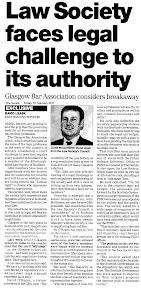
The Herald newspaper reported on a possible legal challenge to the Law Society’s authority. The series of resignations at the Law Society of Scotland began nearly two weeks ago with the resignation of former Glasgow Bar Association President John McGovern from the Law Society’s Council. Mr McGovern, who is known to have been critical of the Law Society over a number of policies including its stance on alternative business structures, and the Society’s dual role of representation & regulation, resigned claiming the Society has "a fundamental dishonesty at its core". Several days later, the Herald newspaper featured references to Mr McGovern’s resignation and a possible legal challenge to the Law Society’s authority by the Glasgow Bar Association (GBA) in a report, available HERE although it should be noted while the GBA was apparently happy to pursue the Law Society in the courts over requirements of membership, a spokesman for the GBA was quoted in the Herald report, stating : We have no problem with the Law Society’s regulatory role.

The issues surrounding the resignation of John McGovern from the Law Society were mentioned, although in no significant detail, by John Wilson MSP at the Scottish Parliament's Petitions Committee last week, as I reported here : Scottish Parliament raise questions over senior lawyer’s resignation, legal threats & claims Law Society has “a fundamental dishonesty at its core”

Since last week’s meeting of the Petitions Committee, events have somewhat overtaken the Law Society of Scotland & Scottish Government’s desire to shut down debate on , Petition PE1388, with the resignation of two additional Law Society Council members, Mike Dailly & David O’Hagan, and the entire membership of the Access to Justice Committee, all reported in Saturday’s edition of the Herald newspaper.

Campaigners and solicitors alike are now calling for a no holds barred debate at Holyrood on the future of the Law Society of Scotland and its dual roles of representing & regulating solicitors, as well as its duties of representing the public interest in legal issues as enshrined in the Solicitors (Scotland) Act 1980.

A solicitor speaking to Diary of Injustice yesterday, supported calls for a fuller debate on the Law Society’s future and more input into the petition currently under consideration at the Scottish Parliament which calls for the Law Society to be axed.

He said : “MSPs should now take the opportunity to support this petition by calling for further evidence from all parties with an interest on how best to proceed with changes to the legislation which has given the Law Society almost limitless power & conflicting roles of representing the rights of solicitors and the public.

An official from one of Scotland’s consumer organisations supported Mr Dailly’s call for Scots consumers to have an independent regulator of legal services.

She said : “Regulation of legal services in Scotland is currently provided by the Scottish Legal Complaints Commission as the first point of contact for consumers who complain about their solicitors, and the Law Society of Scotland."

"In the case of the SLCC, there is evidence to suggest the SLCC is not viewed by solicitors or consumers as independent. In the case of the Law Society of Scotland, there is long standing evidence to suggest the Law Society is not viewed as independent.”

She continued : “The SLCC was created as an independent body to regulate complaints against solicitors after the Scottish Parliament looked at regulation of the legal profession in 2006. However the SLCC appears to have frequently failed public expectations on key issues such as its monitoring role over the Master Policy. It is my view the SLCC as it currently stands has failed to deliver as an independent regulator of legal services in Scotland.”

She concluded : “Mr Dailly in his position as a solicitor is correct to have raised the issue of separating the Law Society’s functions of regulation & representation with a call for independent regulation of legal services in Scotland. This is an issue our organisation has campaigned on for many years and therefore I continue to support calls for an independent regulator of legal services in Scotland.”

The Scottish Government were asked to comment on claims contained in Mr Dailly’s resignation letter that the people of Scotland deserve an independent statutory regulator of legal services. A spokesperson for the Scottish Government said : “Scotland already has a robust system of regulation in place for the legal profession”.

On the matter of Mr Dailly’s allegations the Scottish Legal Aid Board put pressure on the Law Society of Scotland to silence his committee’s criticisms of SLAB and proposals to merge the Legal Aid Board with the Scottish Legal Complaints Commission, which were reported by Scottish Law Reporter last year HERE & HERE, the Scottish Government’s spokesperson said : “Both the Law Society of Scotland and the Board have refuted these allegations and we have full confidence in the Scottish Legal Aid Board”

Lets not kid ourselves here, the spate of resignations over at the Law Society of Scotland and the legal threats from the Glasgow Bar Association are more about legal aid payments to solicitors & law firms in Glasgow’s stipendiary magistrate courts than they are about defending the public’s right to expect an independently regulated legal profession.

However, if those who are now calling for independent regulation of the legal profession wish to make their mark and show the public a level of selfless community service which has never before come from the legal profession, they should make haste and go to the Scottish Parliament, presenting their arguments for :

(i) A fully independent regulator of the legal profession to replace the three shams, being the Scottish Legal Complaints Commission, the Law Society of Scotland & the Scottish Solicitors Discipline Tribunal.

(ii) The creation of a new democratic FOI compliant body to replace the Law Society of Scotland to represent the rights of solicitors, and

(iii) The creation of a powerful independent body to represent the public interest in legal affairs & legislation, as well as the rights of clients & consumers who use legal services in Scotland.

Its not rocket science, people, its justice, and providing access to justice through a well regulated, capable, trustworthy legal services market for Scotland in the 21st Century is surely something we can all achieve for the greater good of the community, instead of the greater wealth of a few in the legal profession.

In the light of the extra window of debate of the petition, I would hope those who have expressed issue with the Law Society will come forward and offer their opinions either in writing or in person to the Petitions Committee to aid the progress of Petition PE1388.

Tuesday, February 08, 2011

Consumer Focus Scotland refuse to support petition’s call to repeal ‘anti-consumer’ laws allowing lawyers to investigate complaints against themselves

Consumer Focus Scotland logoConsumer Focus Scotland’s response to Holyrood Petitions Committee gives qualified support for self regulation. IN a letter to the Scottish Parliament’s Petitions Committee, Consumer Focus Scotland have refused to support a public petition which calls for the scrapping of lawyers powers to investigate themselves.

The consumer body even went so far as to give a ‘qualified support’ to the Law Society of Scotland’s powers of self-regulation over complaints, powers which are backed up by the infamously anti-consumer Solicitors (Scotland) Act 1980, the Westminster enacted thirty year old legislation which allows Scottish solicitors to investigate & cover up complaints against their own colleagues.

While it is now clear the Law Society of Scotland retains its iron grip over self regulation of complaints with the apparent support from most ‘official quarters’ including the Scottish Government & even some consumer bodies, it is of note solicitors in England & Wales now face a more rigorous independent regulation in the form of the Legal Ombudsman.

Law Society of ScotlandLaw Society of Scotland’s interests conflict with public. While supporting the retention of self regulation of complaints against solicitors, Consumer Focus Scotland said in their letter to msps there were ‘tensions within the Law Society’s dual role of representing the public & the legal profession, stating that “while often the interests of the profession and the public may be the same, there will be times when they conflict”, the consumer body (which has been scheduled for closure by the Westminster coalition Government) told msps it does not support the aims of a public petition, Petition PE1388, which calls for repeal of the anti-consumer Solicitors (Scotland) Act 1980 and even went onto say, staggeringly, it felt “self-regulation brings a number of benefits to consumers”, despite most evidence pointing to the contrary.

Consumer Focus Scotland’s submission to the Petitions Committee in response to Petition PE1388 falls broadly into line with two earlier submissions to the Petitions Committee, one from the Law Society of Scotland, which I featured here : Law Society ‘warns’ Scottish Parliament : Solicitors (Scotland) Act 1980 ‘should not be repealed’ by msps or Scottish Government, and a statement from the Scottish Government who refuse to become involved in the aims of the petition, here : Solicitors (Scotland) Act 1980 : Scottish Government refuse to repeal Law Society’s self regulating powers of lawyers investigating themselves

The petition, Petition PE1388, originally filed as an e-petition at the Scottish Parliament by a Mr William Burns calls “on the Scottish Parliament to urge the Scottish Government to repeal the Solicitors (Scotland) Act 1980, end self-regulation, and remove the independence of the legal profession, bringing it onside with true democracy”.

I reported on events surrounding the petition in an earlier article, here : Law Society’s legislative powerbase 'is anti-consumer' as Holyrood to hear petition calling for repeal of the Solicitors (Scotland) Act 1980

Consumer Focus Scotland’s full response to the Petitions Committee concerning Petition PE1388, can be downloaded from the Scottish Parliament’s website, HERE (pdf) and is reprinted in full, below :

Consumer Focus Scotland welcomes the opportunity to submit evidence on this petition. Both Consumer Focus Scotland and the Scottish Consumer Council (SCC), one of our predecessor bodies, have had significant involvement over many years in the issue of the regulation of the legal profession. Following the passing of the Legal Services (Scotland) Act 2010, we are no longer actively working on this issue, however we are happy to provide evidence given our history of work in this area.

Self Regulation of the Legal Profession

Consumers who use solicitors do so at important and often stressful and difficult times in their lives. They place important transactions in the hands of their solicitors, and if things go wrong with that relationship it can have a devastating effect on client confidence. Where dissatisfaction does arise, consumers need to have no doubt about the impartiality of the regulatory system under which solicitors operate.

Complaints

Scotsman 8 January 1999 Independent watchdog for lawyers proposedThe Scottish Consumer Council proposed an independent watchdog for solicitors in 1999. 2011 and still no sign of any independence in legal complaints regulation. In 1999, the SCC published research into the experiences of those who had complained to the Law Society of Scotland (‘the Society’) about a solicitor. Half of those who responded believed that their complaint had not been handled fairly. The detailed responses revealed a clear perception that the Society was not impartial in its handling of complaints, appearing to take the side of the solicitor. Following the publication of the research, the SCC campaigned for a number of years for the establishment of an independent body to deal with complaints against solicitors, to ensure that the public has confidence in the legal system. It welcomed the establishment of the Scottish Legal Complaints Commission (‘the Commission’) by the Legal Profession and Legal Aid (Scotland) Act 2007.

While the Society retains its role in investigating conduct complaints, some of its previous practices which created the impression that the complaints process was weighted in favour of solicitors and as such had given SCC serious concern, have been changed and significantly improved. Nevertheless, our preference would be for the Commission to have responsibility for investigating all complaints against solicitors, not just service complaints. The distinction between the various types of complaint is not always clear, even to solicitors, and members of the public cannot be expected to distinguish between them. We have expressed concerns that unless all complaints are dealt with by the Commission, there will continue to be a lack of public confidence in the complaints system.

Other Regulatory Matters

Regulation of the legal profession does, of course, go beyond complaints handling and covers a wide range of work to promote and maintain high standards for solicitors and their clients such as the setting of standards of qualification, education and training. The petition suggests that self-regulation, and particularly the conflict between the Society protecting its members and acting in the public interest, is detrimental to the public interest. While it is clear there is the potential for conflict between the representative and regulatory functions of the Society, we believe that self-regulation brings a number of benefits to consumers. These include:

• The regulatory system will be tailor made for the needs and problems of that particular sector, and will reflect inside knowledge about the realities of that sector

• The benchmarking of best practice over and above the basic minimum requirements

• Self-regulation is quicker and less costly to put in place (and adapt to changing needs) than legislation.

However, our support of self-regulation by the legal profession (other than for investigation of complaints) is qualified. The SCC produced a good practice guide on effective self-regulation, which made clear that one of the key principles of a credible self-regulatory scheme is independent representation on its governing body.

We have regularly expressed concerns about the current levels of independent representation on the Society’s Council, believing these arrangements to reflect the interests of a membership body, rather than a regulator in the public interest. Our position throughout the passage of the Legal Services (Scotland) Act 2010 (‘the 2010 Act’) was that if the legal profession is to remain self-regulating (or co-regulating), a change of governance structure (of both the Society and the Faculty of Advocates ) is required to instil public confidence in the regulatory functions of these bodies.

We therefore fully supported the establishment within the 2010 Act of a regulatory committee of the Law Society of Scotland, with at least 50 per cent non-solicitor membership and a non-solicitor convenor. We believe creating a regulatory committee with significant non-solicitor involvement gives the Society the opportunity to demonstrate clearly that it is acting in the public interest in carrying out its regulatory functions. We would also note that the 2010 Act requires the Society, so far as practicable when exercising its regulatory functions, to act in a way which is compatible with the regulatory objectives outlined in the Act. These include protecting and promoting the interests of consumers and the public interest generally and promoting access to justice.

The independence of the regulatory committee will be an important tool in ensuring public confidence in its regulatory functions and we were pleased that provisions were inserted into the 2010 Act to ensure that the Society’s Council must not interfere unduly in the regulatory committee’s business.

The provisions of the Solicitors (Scotland) Act 1980 (as amended), which set out the Society’s role in the regulation of solicitors, provide an important consumer protection. It is critical that there is a robust regulatory framework in place to protect consumers should things go wrong. While we have been critical in the past of the Society’s regulatory regime, we believe the changes being introduced by the 2010 Act should lead to increased public confidence, transparency and effectiveness in the regulatory process. This Act is not yet in force, however, and we believe it is important that an opportunity be given to demonstrate whether these changes do lead to such improvements.

For this reason we do not support the petition’s suggestion that the Scottish Government should repeal the Solicitors (Scotland) Act 1980 to end self-regulation of the legal profession. Should this restructuring of the Society’s governance arrangements and the application of the regulatory objectives not act to improve public confidence in its regulatory functions, however, we believe the dual regulatory and representative roles of the Society should be reviewed.

Tensions in the Law Society’s Dual Roles

We do, however, have some sympathies with the issues raised by the petition, particularly in relation to the tensions that may result from the Society’s duties in relation to the profession and the public. As detailed within the petition, by virtue of section 1(2)(b) of the Solicitors (Scotland) Act 1980, the Society has a duty to promote the interests of the solicitors’ profession in Scotland, and to promote the interests of the public in relation to that profession. While often the interests of the profession and the public may be the same, there will be times when they conflict.

While the changes to the membership of the regulatory committee outlined above will enable the Society to more clearly demonstrate it is acting in the public interest, we believe there also requires to be significant non-solicitor involvement in the Society’s representative functions. In a press release issued by the Society in March 2010, it outlined examples of its ‘representative’ functions, including several which have a clear consumer or wider public interest.

Master Policy Report Suicides revealedLaw Society of Scotland’s Master Policy was revealed in an independent report to have caused consumers to have committed suicide. One such example is tendering and securing the Master Policy for professional indemnity insurance. The Master Policy provides clients with protection from losses caused by their solicitor’s negligence and therefore is of clear consumer interest. We would also see the representative functions of preparing best practice guidelines and the ‘Find a Solicitor’ tool as key means of the Society fulfilling its statutory duty to promote the public interest in relation to the profession.

We therefore think it is entirely appropriate that the representative functions of the Society be undertaken by a Council which contains non-solicitor membership. We have for a long time maintained that it is a considerable drawback for a professional organisation with a statutory responsibility to promote the public interest that its decision making body has no non-solicitors among its membership.

While section 132 of the 2010 requires the Society to make provision for the appointment of non-solicitor members to the Council, sections of the original Bill which would have given Scottish Ministers the ability to make regulations specifying the number of non-solicitor members on the Society’s Council were removed at Stage 2, following concerns that this could be perceived as compromising the independence of the profession. While we expressed some concern about removing these provisions, we acknowledged that the Society has publicly committed to appointing 20% of its Council membership as non-solicitors.

Although we would prefer this figure to be 50%, in keeping with the provisions relating to the Society’s regulatory committee, this represents a significant improvement on the current position. We believe these are important and necessary changes in order for the public to have confidence in the Society’s role of promoting the public interest. It is our understanding, however, that any proposed changes to the Society’s constitution are subject to approval by the profession at the Society’s Annual General Meeting in March 2011. Should the profession not accept a minimum of 20 per cent non-solicitor membership on the Society’s Council, we believe there would be merit in the Scottish Parliament revisiting this issue.

Readers can find out more about the Law Society of Scotland’s Master Policy and the havoc it has caused for consumers, to the point some have committed suicide, in an earlier article here : Suicides, illness, broken families and ruined clients reveal true cost of Law Society's Master Policy which 'allows solicitors to sleep at night'

An excerpt of the earlier article reported :

Page 8 - Consumer Focus Scotland refused cooperation from Law SocietySuicides, illness, family breakdown, loss of homes, loss of livelihood were all identified by interviewees as being directly associated with members of the public’s dealings with the Law Society & Master Policy. During the research team's investigation of claims against the Master Policy, team members were told of suicides which had occurred due to the way in which clients of crooked lawyers had been treated by the Law Society of Scotland and the insurers who operate the Master Policy protection scheme for solicitors against negligence claims. Quoting the report : "Several claimants said that they had been diagnosed with depression; that they had high blood pressure; and several had their marriages fail due to their claim. Some had lost a lot of money, their homes, and we were told that one party litigant had committed suicide."

Further excerpts from the Manchester University report into the Law Society's Master Policy & Guarantee Fund show the intolerable strain clients who attempt to claim against their 'crooked' solicitor have to endure : Claimants "described being intimidated, being forced to settle rather than try to run a hearing without legal support, and all felt that their claims’ outcomes were not fair. Some claimants felt that they should have received more support, and that this lack was further evidence of actors within the legal system being “against” Master Policy claimants. Judges were described as being “former solicitors”, members of the Law Society – and thus, against claimants. Some described judges and other judicial officers as being very hostile to party litigants." yet it appears msps do not care, as long as they are able to sleep as easily at night as their Law Society sponsors.

A campaigner speaking to Diary of Injustice this morning said he felt Consumer Focus Scotland could have said more with regard to the way many people have been treated at the hands of the Law Society of Scotland’s complaints system, but he accepted there was little appetite among msps on the Petitions Committee to do anything for victims of the legal profession.

He said : “MSPs are just not interested in doing anything positive for consumers of legal services in Scotland on the complaints & regulation front. They either fear or are already bought off by the Law Society of Scotland’s lobbying powers and the many other arms of the legal profession which they prefer to keep as friends rather than actually do something for us ordinary folks.”

A Holyrood insider speaking to Diary of Injustice this afternoon indicated there was little prospect of the Petitions Committee or the Scottish Parliament ever considering a repeal of the Solicitors (Scotland) Act 1980.

He said : “Petitions which concern the Law Society of Scotland and the legal profession’s handling of complaints are effectively binned before they are even opened by the PPC for consideration.”

Citizens Advice Scotland are yet to send in their requested response to the Petitions Committee.

Tuesday, February 01, 2011

Law Society ‘warns’ Scottish Parliament : Solicitors (Scotland) Act 1980 ‘should not be repealed’ by msps or Scottish Government

Michael ClancyUnwanted reforms : Law Society's Michael Clancy wades into campaign to repeal laws which allow Law Society power to protect lawyers against complaints. THE LAW SOCIETY OF SCOTLAND’S Director of Law Reform, Michael Clancy has written to the Scottish Parliament’s Petitions Committee expressing Law Society disapproval over a public petition asking MSPs to repeal the much hated, much questioned, much misused & infamously anti-consumer Solicitors (Scotland) Act 1980, the Westminster enacted thirty year old legislation which allows Scottish solicitors to ‘look after their own’ by investigating complaints against their own colleagues.

The petition, Petition PE1388, originally filed as an e-petition at the Scottish Parliament by a Mr William Burns calls “on the Scottish Parliament to urge the Scottish Government to repeal the Solicitors (Scotland) Act 1980, end self-regulation, and remove the independence of the legal profession, bringing it onside with true democracy.”.

I reported on events surrounding the petition in an earlier article, here : Law Society’s legislative powerbase 'is anti-consumer' as Holyrood to hear petition calling for repeal of the Solicitors (Scotland) Act 1980

Would Granny Swear by the Law Society - The Herald June 5 2006Holyrood has consistently failed to address reform of complaints against solicitors & serious evidence of organised corruption at the heart of the Law Society. The letter from Michael Clancy to the Petitions Committee, available here to read (pdf) and reprinted in full, below, goes on to remind MSPs they have considered the issue of regulation of the legal profession several times in the parliament’s history, giving the Law Society's glossed-over view of how the various debates over complaints reform have been handled, to the point complaints against the legal profession are still considered & investigated by the legal profession itself, or those connected to it.

While Mr Clancy claims enough consideration has been given to the issue of regulatory reform of the legal profession, the reality is that msps have never addressed some of the most damming evidence of collusion between the Law Society & insurance firms to protect ‘crooked lawyers’ from losing their jobs or having to compensate their victims for millions of pounds of fraud committed against clients each year.

Michael Clancy’s letter to the Petitions Committee said the Law Society does not agree it should be put out of business on complaints & cover-ups. Mr Clancy, who, along with his Law Society colleagues are now dubbed “access-all-areas” by MSPs & MPs due to frequent use of ‘parliamentary passes’ to communicate the Society’s ‘political & legislative wishes’ reveals in his letter : The Society does not agree with the proposition that the Solicitors (Scotland) Act 1980 should be repealed. The 1980 Act is based on the Legal Aid Solicitors (Scotland) Act 1949 but has been amended at various stages since its consolidation in 1980, most significantly by the Law Reform Miscellaneous Provisions (Scotland) Act 1990, the Council of the Law Society of Scotland Act 2003, the Legal Profession and Legal Aid (Scotland) Act 2007 and last year by the Legal Services (Scotland) Act 2010.”

Regulation of the legal profession in Scotland has been the subject of searching enquiry by the Justice 1 Committee of the Scottish Parliament. In the first session of the Scottish Parliament, this Committee held an Inquiry into the Regulation of the Legal Profession. The Committee focused on the way in which the profession handled complaints which had been perceived to be the main source of public concern. The Committee also looked at the general arrangements by which the legal profession was regulated. The Committee concluded that the system of regulation should be retained but recommended that it should be reformed to make it more acceptable to consumers and more representative of the public interest.

Scottish ExecutiveWorking Groups’ full of Law Society members studied how complaints should be best handled by lawyers, for lawyers. In 2005 the then Scottish Executive, issued a consultation paper on complaint handling arrangements which resulted in the introduction of the Legal Profession and Legal Aid (Scotland) Act 2007 and the creation of the Scottish Legal Complaints Commission. Simultaneously the Research Working Group on the legal services market in Scotland was considering the legal services market and also considered the regulatory framework for legal services in Scotland. The Research Working Group identified the following strands in the regulatory framework:-

i) The role of Parliament, Government and the Court. The Working Group identified that the United Kingdom Parliament and the Scottish Parliament both had legislative powers in relation to the Scottish legal profession. The Scottish Government and the Office of Fair Trading were also involved in the regulation of the legal profession with the policy lead lying with Scottish Ministers. The Court of Session and lower courts also exercise regulatory power over solicitors in terms of lawyers who practice advocacy before the courts who must conduct themselves in a manner which is acceptable to the Court.

ii) Regulation of solicitors – arrangements for the regulation of solicitors by the Law Society of Scotland are set out in the Solicitors (Scotland) Act 1980. The Society has a statutory responsibility for the promotion of the solicitors’ profession in Scotland and the interests of the public in relation to that profession. In carrying out its functions therefore the Society must not only have regard to the interests of the solicitors’ profession but also the public
interest.

LIAR AID Solicitor in probe escapes prosecutionUseless laws allow lawyers to cover up for each other, a fact which Mr Clancy’s letter omits to tell Holyrood’s Petitions Committee. The 1980 Act provides for the statutory basis for the Society, the right to practise, professional practice, conduct and discipline, and complaints and disciplinary proceedings relating to solicitors in Scotland. It has since been amended by subsequent legislation which has enhanced some of the statutory protections available to the client. In particular the regulatory objectives contained in Section 1 of the Legal Services (Scotland) Act 2010 will apply when that provision is brought into effect. The Council of the Society (which is to have a non solicitor component when the Legal Services (Scotland) Act 2010 is implemented, deals both with the Society's regulatory functions (e.g. the setting of standards for entry and education, rule making and monitoring and enforcement) and its representative functions (e.g. negotiating with Government, contributing to the development of the law and the system of administration of justice, representing the profession to the public and other stakeholders, services to members, marketing, and international activities).

Law Society listed its many powers, mostly used to protect solicitors who find themselves the subject of client complaints on everything from embezzlement to criminal activities. The 1980 Act provides the Society with powers to:-

• make regulations in respect of admission to the profession and training within it (section 5);
• make rules in relation to applications for and issue of practising certificates (section 13);
• make rules relating to admission as a solicitor with extended rights of audience (section 25A);
• make rules relating to professional practice, conduct and discipline (section 34);
• make rules relating to the keeping of accounts (sections 35, 36 and 37(6));
• make rules relating to professional indemnity insurance (section 44);
• control and manage the Scottish Solicitors Guarantee Fund (section 43, Schedule 3, Part I);
• handle compliance, enforcement and disciplinary issues arising out of the rules of the Society; and
• handle conduct complaints about solicitors (sections 38 - 42C). Service Complaints are dealt with by the Scottish Legal Complaints Commission.

All rules require the consent of the Lord President before they come into effect.

When the Legal Services (Scotland) Act 2010 comes into effect a regulatory committee (which will be composed of equal numbers of solicitors and non solicitors) will undertake the regulatory work of the Council in terms of Section 133 of the 2010 Act.

iii) External regulation – members of the Law Society of Scotland are subject to external regulation:-

The Court of Session : In the case of professional misconduct by a solicitor, the Court of Session on appeal from a decision of the Scottish Solicitors' Discipline Tribunal may exercise certain powers.

Scottish Solicitors’ Discipline Tribunal : The Tribunal is a statutory body empowered to adjudicate on complaints about professional misconduct and unsatisfactory professional appeals. The composition of the Tribunal is defined in statute and must consist of equal numbers of solicitor members and non solicitor members, all appointed by the Lord President of the Court of Session

Mr Clancy held up the Scottish Legal Complaints Commission as an example of independent regulation, however most feel the SLCC is an example of a Law Society ‘front company’, the SLCC itself staffed mostly by former Law Society employees & Committee members. Scottish Legal Complaints Commission : The Scottish Legal Complaints Commission was created under the Legal Profession and Legal Aid (Scotland) Act 2007. It is the single gateway for all complaints against legal practitioners. The SLCC is an independent statutory body accountable to Parliament. Its Board is appointed by Scottish Ministers in consultation with the Lord President.

iv) External regulators also include profession specific activities. These include:-

a) The Scottish Legal Aid Board under the Legal Aid (Scotland) Act 1986;
b) The FSA under the Financial Services and Markets Act 2000;
c) The Department for Business Innovation and Skills in respect of insolvency practitioner regulation and consumer credit regulation; and
d) The Immigration Services Commissioner under the Immigration and Asylum Act 1999.

Law Chief held with rent boy - Sunday Mail 3 May 2009 eHighly regulated or highly insulted & protected from the law ? : Mr Clancy’s letter to MSPs concludes, rather mockingly considering copious media coverage of ‘crooked lawyers’ in Scotland, that : “The solicitors’ profession is highly regulated and has been the subject of searching and consistent parliamentary scrutiny over the past 20 years. The petition fails to acknowledge this and the points raised in the petition have been adequately covered by parliament, especially in the last year with the passage of the Legal Services (Scotland) Act 2010.”

One MSP who read the Law Society’s letter commented this morning : “The Law Society may have all these rules & regulations behind them but it doesn't look like the Solicitors Act and related legislation are being used very well if at least twenty different cases brought to my attention by constituents who have problems with their lawyers, problems with the Law Society and problems with the Scottish Legal Complaints Commission are to be believed.”

He continued : “The terms of the Solicitors (Scotland) Act clearly grants too much power to a single professional regulator in today’s world of consumer protection. Clearly reform is required and perhaps it is now time for the Scottish Parliament to do what Westminster could not achieve with the 1980 Act, in giving power back to consumers, along with an independent body to represent their interests.”

A consumer official speaking to Diary of Injustice this morning agreed it is time to reform the way complaints against solicitors are handled by the legal profession, commenting that present ‘improved’ arrangements on complaints by way of the Scottish Legal Complaints Commission are proving “a disappointment” to many clients.

Scottish Parliament’s Petitions Committee considers petition calling for repeal of laws which allow Law Society to protect crooked lawyers from complaints (click image below to watch video)

The Scottish Parliament’s Petitions Committee considered Petition PE1388 during its session last week, 25 January 2011. The Parliament’s official report official report on the meeting stated :

Solicitors (Scotland) Act 1980 (Repeal) (PE1388)

The Convener: The final new petition today—indeed, the final new petition of this session—is PE1388, by William Burns, on behalf of the crusade for the protection of true democracy, seeking a repeal of the Solicitors (Scotland) Act 1980. I seek members' views on how to take the petition forward.

Bill Butler: We should continue the petition and write to the Scottish Government, asking whether it will repeal the 1980 act, end self-regulation and remove the legal profession's independence. I realise that the proposals are radical, but they are worthy of a response at the very least. After all, the petitioner says that these measures will bring the profession on-side with true democracy, so we should ask the Government whether it will accede to the suggestions made in the petition and, if not, why not. To be fair, we should also ask the Law Society of Scotland and Consumer Focus Scotland for their response to the petition's fairly radical proposals.

John Wilson: As well as writing to Consumer Focus Scotland, we should also seek Citizens Advice Scotland's views.

The Convener: Do members agree to continue the petition?

Members indicated agreement.

The Petitions Committee decided to write to the Scottish Government, Law Society of Scotland, Consumer Focus Scotland & Citizen’s Advice Scotland.

The committee’s letter to the Scottish Government asked : “Will you repeal the Solicitors (Scotland) Act 1980, end self-regulation, and remove the independence of the legal profession, bringing it onside with true democracy as called for by the petitioner? If not, why do you consider this to be unnecessary? More generally, what is your response to the points made in the petition?”

I will continue to report on events surrounding the petition as they unfold.

Wednesday, December 08, 2010

Law Society’s legislative powerbase 'is anti-consumer' as Holyrood to hear petition calling for repeal of the Solicitors (Scotland) Act 1980

Petitions CommitteeScottish Parliament’s Petitions Committee to hear petition calling for Law Society to be stripped of its power. LEGISLATION created at Westminster which has given the Law Society of Scotland a right to self-regulate Scotland’s 10,000 plus solicitors for over thirty years, a right which has in the eyes of many been abused to the point the phrase “crooked lawyer” has become common place in Scotland, is now facing a challenge at Holyrood after an online e-petition was filed at the Scottish Parliament calling on MSPs to repeal the Solicitors (Scotland) Act 1980 and end self regulation of Scotland’s legal profession.

The e-petition, filed by a Mr William Burns which is currently open for signatures until 6th January 2011 calls “on the Scottish Parliament to urge the Scottish Government to repeal the Solicitors (Scotland) Act 1980, end self-regulation, and remove the independence of the legal profession, bringing it onside with true democracy.”

To sign the e-petition and learn more about it’s aims, CLICK HERE. Alternatively you can text '421' and your name to 07537 400395 to add your e-signature to this e-petition. (Texts are charged at your standard network rate. Text signatures will not appear instantly.)

Mr Burns, speaking to Diary of Injustice said today :Every MSP has been provided free of charge a copy of the book “Legal Hell” by Angus M. Brown, a True Story illustrating how self-regulation is incontrovertibly wide open to corruption. This specific matter of policy and a superabundance of other material were submitted to the Justice 1 Committee of the Scottish Parliament between 22 June 2001 and 17 April 2002 for the “Regulation of the Legal Profession Enquiry” and can be found at: Justice 1 Committee Regulation of the Legal Profession Inquiry.”

Mr Burns continued : “My own submissions can be found at No 19 on the page. Representatives of the Law Society presented their own submissions and were also allowed to make lengthy oral presentations, unlike members of the public, creating an unfair imbalance in their favour. Many members went down various avenues to attain justice, but the common stumbling block is the Solicitors (Scotland) Act 1980, which allows the Law Society to protect its members through this self-regulatory legislation.”

The 4m Crooked Lawyer - Daily Record 1991A 30 year run of Scots crooked layers may become less frequent if fully independent regulation of Scots legal profession takes place. Any client of a solicitor in Scotland having been put in the unenviable position of having to complain about the legal services provided to them by their legal representatives will be well aware of the problems in trying to pursue complaints against solicitors, while having to deal with the almost unearthly processes employed by the Law Society of Scotland & Scottish Legal Complaints Commission to defeat the aims of consumers who for the most part, used the services of a solicitor expecting a fair deal and access to justice.

Indeed, many clients have come to realise that using Scottish legal services can mean lengthy waits of years for court appearances, common failures to deal with even the simplest of tasks, and the inevitable ‘padded’ and unexplained huge fee demands of solicitors for very little coherent work carried out on their clients behalf.

Forcing the Scottish Parliament to confront the Law Society’s legislative powerbase, the Solicitors (Scotland) Act 1980, which, as many legal insiders admit themselves, allows the Scots legal profession almost a free hand in the world of regulation & political double-dealing, may finally bring changes of increased consumer confidence in what is one of Scotland’s worst performing in terms of public trust, yet highest earning professions which, as the almost compulsory route for access to justice in Scotland, everyone at some stage in their lives must use.

The complaints process operated by both the Law Society of Scotland & SLCC has consistently been described by many involved in it as “Torturous” & “Prejudiced against clients while protective of crooked lawyers”, and the passage in the Scottish Parliament in 2006 of the Legal Profession & Legal Aid (Scotland) Act 2007, which created the Scottish Legal Complaints Commission (SLCC)after a long campaign to reform the legal complaints system, a campaign which involved many consumer campaign groups, organisations, individuals and even the media, has so far done nothing to resolve the intense prejudice consumers & clients face when attempting to secure a fair hearing of complaints they are inevitably forced to make against their solicitor when things go wrong.

The Solicitors (Scotland) Act 1980 established the Law Society of Scotland in terms of legislation, giving it many controversial powers & duties including representing the interests of its solicitor membership and the interests of the public (& client)in relation to the legal profession.

The 1980 act also empowered the Law Society of Scotland to maintain professional indemnity insurance cover and a ‘guarantee fund’ to ‘protect’ solicitors clients from negligent & crooked lawyers. Both schemes, the first known as the “Master Policy”, an insurance scheme run by brokers Marsh UK and backed by insurers Royal Sun Alliance & others, and the “Guarantee Fund”, an in-house compensation scheme managed by the Law Society itself are ultimately famous for their failures to pay out in most cases where solicitors have either stolen or frittered away their clients finances through theft, or their poor quality of work on their client’s behalf.

The Master Policy itself was the subject of an independent investigation carried out during 2009 by the University of Manchester’s Law School, The investigation’s findings linked the insurance arrangements for protecting crooked lawyers to the deaths of clients, while the Guarantee Fund was revealed as little more than a multi million pound masterpiece of claims dodging corruption.

Law Society of ScotlandRepealing the 1980 Solicitors Act and the Law Society will bring a fairer deal for public in access to justice & regulation of legal services complaints says petition. The Scottish Parliament’s website gives the following background information in relation to the petition : The action requested in the petition is necessary because, hitherto, decisions have been made by, for example, previous Justice 1 and 2 Committees, loaded in favour of a self-regulated legal profession, detrimental to the best interests of the public. Section 1(3), in particular, of the Solicitors (Scotland) Act 1980 epitomises the limitless scope the Law Society has to protect its members at the expense of the public, which states:

The Society may do anything that is incidental or conducive to the exercise of the functions [i.e., the promotion of- (a) the interests of the solicitors? profession in Scotland; and (b) the interests of the public in relation to that profession] or the attainment of those objects.?

Section 1 of the Act states, verbatim:

1.--(1) The Law Society of Scotland (referred to in this Act as "the Society") shall continue to exist and shall exercise the functions conferred upon it by this Act.

(2) The objects of the Society shall include the promotion of

(a) the interests of the solicitors? profession in Scotland; and

(b) the interests of the public in relation to that profession.

(3) The Society may do anything that is incidental or conducive to the exercise of these functions or the attainment of those objects.

(4) Schedule 1 shall have effect in relation to the Society.

Schedule 1 of the Act, under the heading "Powers", at 10 (e) and (f) state, respectively:

The Society may

(e) accept any gift of property for the purposes of the Society;

(f) accept, hold and administer any gift of property or hold as trustees any property for any purpose which the Society consider to be for the benefit of solicitors in Scotland or their dependants or employees or any substantial body of such solicitors or dependants or employees.

The use of the adverb "anything" in Section 1(3) above is not restrictive and does not limit the application or reference of the term and to what extent the Law Society can and does protect its members at the expense of the public. In fact, the Law Society has a vested interest in protecting its members. This creates a conflict of interest between Sections 1(2a) and 1(2b) because, if the Law Society is to choose who to protect, either a fully paid up licence member of the Society, or Joe Bloggs, their loyalty will naturally, and almost invariably, come down in favour of one of their members.

Furthermore, Schedule 1(10) (e) and (f) could reasonably be viewed as an invitation to prosperous solicitors to proffer gifts, monies or properties to the Society in exchange for quid pro quo favours. This additional bond of fellowship between the Society and its membership does nothing for the confidence of an aggrieved client with a justifiable complaint against a solicitor.

The 1980 Act is, therefore, potentially and actually a distinct conflict of interest. The aforementioned Section and Schedule alone leave the 1980 Act wide open to abuse. Self-regulation in any way shape or guise is the pivotal enemy of any true democracy; therefore any civilised society. It is not only undemocratic it is antidemocratic, anti-society and hostile to a public unconversant with all the nuances of our ambiguously cryptic laws.

There have been no Bills passed or laws enacted since 1980 that does anything to remedy this stark conflict of interest and there have been no recent announcements made by the Scottish Government that might have a bearing on our petition.

My advice ? If you have been forced by the actions of your solicitor or your legal representatives to make a complaint to either the Law Society of Scotland or the Scottish Legal Complaints Commission (SLCC), you may wish to consider signing the petition, and ensure the focus of attention in the debate on self regulation of the legal profession shifts to the legislative power the Law Society of Scotland uses against consumers & clients to preserve itself, preserve its members and preserve its political power to prevent legislative reforms aimed at giving the consumer & client a fair deal.

The Scottish Legal Complaints Commission were asked for comment on the aims of the petition. A spokesperson said "The SLCC has no comment to make about this petition as this time."

No one was available at the Law Society to give comment although a source close to the legal profession said “the Law Society will use any means to fight any attempt to remove its powers of self-regulation.”

A Holyrood insider commenting on the petition said he “could imagine various Directors of the Law Society again preparing their poison pen letters & ‘on the qt’ briefings for MSPs to save their skins once again” which, from my own personal experience with the Petitions Committee is probably what will happen next … so being forewarned, I would advise readers to sign the petition and spread the word !