Sunday, December 18, 2011

Law Society demand Justice Secretary MacAskill intervene over SLCC report claiming ‘improper’ influences in Guarantee Fund client claims

Law Society SLCC MacAskillBully required, Urgent : Law Society of Scotland demand Justice Secretary intervene in SLCC ‘Guarantee Fund’ row. FIDDLING & MEDDLING by Law Society of Scotland officials in financial damages claims to the Scottish Solicitors Guarantee Fund made by clients who have been financially ruined by their ‘crooked lawyers’ have prompted the Law Society of Scotland to issue a stern rejection of statements made in the latest annual report of the Scottish Legal Complaints Commission for 2011, published Friday, that the outcome of compensation claims made by clients to the Guarantee Fund are influenced “by factors other than the merits of the claims” such as corruption, intervention by Law Society officials to halt claims going ahead, and an institutional prejudice against consumers trying to recover money stolen by Scottish solicitors.

The Law Society is ‘so upset’ by the allegations, they have now called in Justice Secretary Kenny MacAskill to bully ‘clarify’ the SLCC into withdrawing the claims.

slcc annualreport online 2011_Page30Claiming the obvious L Law Society Guarantee Fund is crooked, dishonest and claims are fiddled. The damaging claims made in the latest annual report of the Scottish Legal Complaints Commission (SLCC) which have prompted the row between the two legal complaints regulators, state : "There is a statistical relationship between the number and total value of the claims made on the fund in the same year as an individual claim, and the level of payment made in individual claims. This suggests that the outcome of claims is influenced by factors other than the merits of the claims". The claims are a result of research the SLCC commissioned into the Scottish Solicitors Guarantee Fund which supposedly exists to protect clients who have lost money as a result of the dishonesty of a solicitor. However, according to key SLCC insiders who spoke to Diary of Injustice earlier in the year, the research commissioned by the SLCC into the Guarantee Fund suffered a significant degree of control freakery, constant interference & a lack of cooperation from the Law Society of Scotland who wanted to control the entire project, and would rather the research not be published.

The Law Society of Scotland, angry at the claims issued a Press Release, rejecting any notion its 'attempt’ at consumer protection is little more than consumer fraud states : The Society has today rejected this assertion as wholly misleading as the merit of the individual claim remains the only consideration when considering the outcome of that claim and any subsequent payment from the Guarantee Fund.  This was clearly explained to the SLCC in meetings and in written correspondence from the President of the Society, all in advance of today's report publication.

With the SLCC annual report being laid before the Scottish Parliament, the Society has today written to the Cabinet Secretary for Justice and opposition justice spokespeople to clarify the situation and give a more accurate picture.

Alistair Morris, convener of the Society's Guarantee Fund committee, said: "It is deeply frustrating that the SLCC suggests the outcome of Guarantee Fund claims are influenced by factors beyond the merits of the claim, especially when we have made it clear verbally and in writing that such a suggestion is wholly wrong.  It is even more concerning that the SLCC do not even refer to those assurances from the Society in their report. The Society co-operated fully with the SLCC when it commissioned research into the Guarantee Fund earlier this year. However we raised significant concerns at the misleading and potentially damaging interpretation of raw statistical data relating to the Guarantee Fund which suggests that the amount paid out in any claim is dependent on the sums held in the fund at any one time. We have made it clear to the SLCC, both verbally and in writing, that all Guarantee Fund claims are considered entirely on a case by case basis and on their own merit, regardless of the funds held. It is extremely disappointing that the SLCC annual report now risks misleading people into thinking that the outcomes of Guarantee Fund claims go beyond their individual merits. “

Mr Morris continued : "There are significant reserves held in the Guarantee Fund currently. Additionally, it is backed by Stop Loss Insurance amounting to £6 million and the legislation covering the Fund allows the Society to levy members if we faced circumstances where there were insufficient funds in the Guarantee Fund and Stop Loss Cover to cover the cost of a claim. Following our discussions with the SLCC we were informed that it intended to commission further research as a result of some of these initial findings. I hope this goes ahead and there will be an opportunity to demonstrate that this statement contained within the annual report laid before the Scottish Parliament is inaccurate and misleading."

Commenting to Diary of Injustice today, an SLCC insider said the law complaints quango had only pursued the Guarantee Fund issue because of criticism from law reform campaigners & investigations carried out by Diary of Injustice into the Scottish Solicitors Guarantee Fund, revealing in an earlier article published in 2009 the Law Society's 'Guarantee Fund' for clients of crooked lawyers revealed as multi million pound masterpiece of claims dodging corruption

Earlier in September 2011, Diary of Injustice reported on the SLCC’s slightly controversial report into the Guarantee Fund which has now caused the apparent fall out between the two regulators, here : DISASTER REPORT : Scottish Legal Complaints Commission study of Law Society “Guarantee Fund” suffers 13% turnout, finds clients ‘treated as criminals’

13% response disaster for SLCC report on Law Society’s crooked Guarantee Fund. A REPORT carried out by the Scottish Legal Complaints Commission (SLCC) into the notoriously corrupt “Scottish Solicitors Guarantee Fund”, a ‘client protection’ scheme operated by the Law Society of Scotland to compensate clients who have lost money because of theft by dishonest crooked lawyers & their staff has been hit by an ABYSMALLY low response of only NINETEEN replies from ONE HUNDRED & FORTY FIVE questionnaires (13%) after the Law Society refused to hand over client contact details to the SLCC & its selected research company who were investigating claims against crooked lawyers in Scotland. One client who did reply to the survey said claimants “were made to feel like a criminal” at Guarantee Fund hearings.

THE REPORT, carried out on behalf of the SLCC by Progressive, a research company based in Corstorphine Road, Edinburgh, claimed the Law Society of Scotland had REFUSED to hand over a detailed contact list of members of the public who had contacted or submitted claims to the Guarantee Fund over the past 5 years. The company & SLCC were left with NO CHOICE other than to leave the Law Society of Scotland to distribute the forms to clients that it felt should be provided with a questionnaire.

Jane IrvineJane Irvine, SLCC Chair left out critical mentions in report announcement. In its announcement publicised online, the Scottish Legal Complaints Commission DID NOT mention the low turnout of NINETEEN PARTICIPANTS in its Press Release, available HERE, nor did the SLCC publicise the fact the Law Society of Scotland distributed the forms themselves after REFUSING to hand over Guarantee Fund claimant details to the company preparing the report or the SLCC itself. Legal insiders have commented today the survey was badly handed by the SLCC who were branded by one official from a Scottish consumer organisation as “too close to the Law Society for comfort” and “unwilling at best to get to the truth”. I reported on just how badly this latest SLCC survey was being handled in an earlier article, here : CENSORED : Scottish Legal Complaints Commission's secret new Master Policy & Guarantee Fund research 'shuts out' real victims of crooked lawyers

Progressive, the firm conducting the survey on behalf of the SLCC said in their now published report : “Progressive was not able to receive a database of contact details from the Law Society of Scotland. As such the questionnaire packs were sent to LSS for labelling and distribution.”

“There were two categories of respondents on the Law Society of Scotland’s database and therefore two methods of distribution. For the first category, LSS had contact details for the claimant themselves so packs were sent directly to them. For the second, LSS’s database only contained details for the names of the claimants’ solicitors. In order to account for this, the questionnaire packs included an additional letter asking the solicitor to forward on to their client named on the front of the envelope.”

“In total, 145 questionnaires were distributed; 85 that went directly to claimants and 60 that went to claimants via their solicitor. In order to optimise the response rates to the survey reminder letters were sent to respondents halfway through the fieldwork period. The fieldwork period was also extended to give maximise the opportunity for claimants to respond.”

“Questionnaires were returned directly to Progressive in freepost envelopes. In total 19 completed questionnaires were returned for analysis, denoting a 13% response rate.”

It had been hoped to send questionnaires out to 250 people although for unexplained reasons and doubtless due to the fact the Law Society of Scotland were controlling distribution, only 145 eventually went out.

The company were further critical of the Law Society’s methods of distribution, stating “A large proportion of questionnaires were not sent directly to claimants. Sending questionnaires first to solicitors to pass on to their clients would have affected the likelihood of the questionnaires reaching them and also their likelihood of completing them.” Progressive further warned : “This is likely to impact response rates.”

The report also claims : “Missing information on labels. A few solicitors fed back that there was no client contact on the packs they were sent so were unable to forward these on, again, affecting the final response rate (at least 4 reported this to be the case)” and that some clients who were sent questionnaires by the Law Society of Scotland could not be traced because they had moved address.

The report went onto state all of those who eventually responded to the survey (NINETEEN PEOPLE IN FIVE YEARS) were suspiciously successful in their claim “to some extent” but even among those, there was still evidence of some dissatisfaction with the outcome and the decisions behind it. Clearly the Law Society of Scotland had chosen clients it thought would give the Guarantee Fund a better write up than others with more horrific experiences.

The report states : “Ten of our respondents were successful in their claim, all of whom were satisfied with the outcome. Six were partially successful and of these, four were dissatisfied.”

From the comments provided as to the reasons why, one respondent’s dissatisfaction stemmed from the perception that they were not provided with direct answers for the decision. Three comments related to respondents not receiving full compensation and feeling that the decision made and the reasons for it were not clearly explained to them.

One respondent to the survey stated : “It seemed as if the Scottish Solicitor’s Guarantee Fund were trying to pay as little as possible and were looking after their own interests. Again you were made to feel like a criminal at the hearing.” Another respondent said : “I was not fully compensated for a fraud that was not my fault but my solicitor's, who was now in jail and yet I had to suffer financially and with stress.”

Comments from the five people who provided reasons for their satisfaction expressed relief that the process had come to an end and they perceived that the Fund had worked well for them.

One respondent said : “Achieved desired outcome although would have preferred not to have gone through the process at all.”Another respondent said : “[Because] I felt that I could move forward and bring closure to the whole affair [as] I had felt very let down by the solicitor involved in my particular case.”

Bearing in mind the turnout for the report is so small, its findings & recommendations are very limited, due mostly to the notably poor advertising of the survey by the Scottish Legal Complaints Commission (who apparently wanted as small a number of participants as possible) and the fact the Law Society of Scotland were allowed to distribute the forms on their own, rather than identification & distribution be handed over to the report’s authors or an independent body.
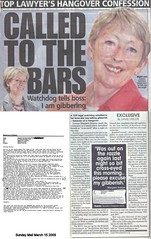
Margaret Scanlan - Called to the Bars - Sunday Mail  15 March 2009 emailChancers Calling - SLCC Board Member Margaret Scanlan branded Guarantee Fund claimants as “chancers”. It should also be borne in mind SLCC Board Members have already expressed anti-client sentiment against claimants to the Guarantee Fund, where in one publicised incident, SLCC Board Member Margaret Scanlan raged against claimants to the Guarantee Fund, branding them “chancers” in a series of bitter emails revealed to the public by Freedom of Information legislation, revealed here : Officials pull FOI disclosures as Guarantee Fund "chancer" emails show Law Society anti-client bias has migrated to Legal Complaints Commission & here : MacAskill must clean up law complaints body as members 'booze culture conduct' reflects lack of discipline & will to investigate crooked lawyers

Speaking to Diary of Injustice this afternoon, a client who has been waiting FIVE YEARS for his claim to the Scottish solicitors Guarantee Fund to be paid after his solicitor stole nearly SEVENTY THOUSAND POUNDS from his client’s bank account, felt the argument between the SLCC & Law Society “is somewhat staged”. He went onto say it was his experience neither the Law Society or the SLCC can be trusted to properly regulate the legal profession in Scotland.

In spite of the Law Society’s condemnation of the claims contained in the SLCC’s annual report, it is now an established fact that claims against the Scottish Solicitors Guarantee Fund have been the subject of delaying tactics & corrupt attempts to prevent any payouts in most damages claims made by members of the public who have been left in financial ruin after growing numbers of Scottish lawyers have embezzled their clients funds.

More analysis of the  latest annual report of the Scottish Legal Complaints Commission for 2011 will be published during the week.

Identity of Mr Big who paid for ‘hitman’ to slash Law Society ex Chief Accountant ‘is known to Police’ as Robert Graham gets ELEVEN years for attack

Robert Leiper Graham was sentenced to eleven years for attack on Law Society’s Chief Accountant Leslie Cumming. ROBERT GRAHAM (46), the ‘hitman’ who was convicted in mid November 2011 by a majority jury verdict after being extradited from Australia to face trial for carrying out an attack on Leslie Cumming the now retired Chief Accountant of the Law Society of Scotland,  was sentenced to ELEVEN YEARS earlier this week on Thursday at the High Court in Edinburgh for his part in what was alleged to have been an attempted murder bid rather than ‘a wounding’ (as key legal insiders suspect) to warn Mr Cumming off investigating ‘crooked lawyers’.

The mysterious attack on Leslie Cumming in 2006, was the subject of private briefings given by the Law Society’s most senior officials, seeking to blame the attack on critics of the legal profession yet only one single newspaper ran the Law Society’s claims after it had become clear the attack was most likely organised by a crooked colleague of Mr Cumming connected to or from within the legal profession itself.

Reported on BBC News and in the Daily Record newspaper, Judge John Morris QC, passing sentence in Edinburgh, told Graham: "You have been convicted by a jury of a pre-meditated and sustained murderous attack on a member of the public going about his lawful business, and you did that apparently for financial gain.” He continued : "In these circumstances I'm sure you'll appreciate a substantial custodial sentence is appropriate." Judge Morris also recommended deportation for Graham after he had served his sentence.

While Graham has never admitted who paid him to carry out the attack, it is widely accepted Police are well aware of the identity of the villain(s), reported to be connected to Scotland’s legal world. However as of yet, no steps have been taken to arrest anyone else in connection with the 2006 attack, casting doubt on the ability of Lothian & Borders Police to get the individuals behind the crime, whose identity & position some say “may be causing fear & alarm in legal circles for the opening of a larger can of worms if additional arrests are ever made.”

TRIAL OF LAW SOCIETY ACCOUNTANT’S ATTACKER :

During the trial, Graham denied attempting to murder the Law Society accountant, claiming he did not assault Mr Cumming, rather he intervened in the attack, (allegedly carried out by another party) to stop Mr Cumming getting “a bigger hiding”. Graham also told the court he was born in Ireland as Paul Francis McGhee before emigrating to New Zealand at the age of nine but in Britain he called himself Robert Graham. The court also heard from a witness that Graham had confessed to a colleague that he had "done a judge in" and was paid £10,000 by a guy in a BMW to give him "a good working over".

The witness who told the court of the alleged boast by Graham, scaffolder Nicholas Wells said he started work at Wembley Stadium in January 2006 and Graham joined a few weeks later. In a statement to police, he said: "He told me around this time he had done a judge in in Edinburgh, having jumped out some bushes at him. I can recall him telling me the guy from the BMW paid him £10,000 to do the job and told him to give the guy a good working over." Mr Wells told the court he had been approached by the police at a site he was working on in Edinburgh in 2009. Asked if he had told them the truth, Wells replied: "As I remember it at the time." He added: "I was taking a lot of drugs at the time. I was taking a lot of sleeping tablets ... it is hard to remember it all clearly now."

The court heard that during the assault, Mr Cumming grasped the balaclava worn by the attacker in an attempt to pull it off while further DNA evidence was recovered from the Barbour jacket Mr Cumming was wearing at the time of the attack. Additional DNA material was taken from Mr Cumming before doctors treated his wounds, and the DNA was linked back to Graham in tests.

At the conclusion of the trial, John Logue, Area Procurator Fiscal for Lothian & Borders, said: “In 2006 Robert Graham targeted and tried to kill Leslie Cumming because he was paid to do so. Today, almost six years later, he has been found guilty of this vicious and cowardly attack after being extradited from Australia.”

Mr Logue continued : “He was brought to justice by the perseverance and diligence of officers in Lothian and Borders Police who tracked him down, assisted by Interpol and authorities in New Zealand and Australia. I hope that today’s successful prosecution will secure the confidence of the Scottish public that those who try to evade justice will be pursued and brought before the courts.”

Commenting after the majority verdict convicted Robert Graham of the attack on Mr Cumming, the Solicitor General for Scotland, Lesley Thomson QC, said : "He uses the name Robert Leiper Graham in this country and Paul Francis McGhee in New Zealand. The Crown is not in a position to say he is either of these people at this stage." Ms Thomson also said when Graham left New Zealand in 1999 there was an outstanding warrant out for him and that a notice had been served on him in a move to deport him from Britain.

Leslie Cumming, former Law Society of Scotland’s Chief Accountant. At the end of the trial, Mr Cumming commented : "The police perseverance and professionalism and the Crown Office input have been vital in securing the result. It's important to me that I got that closure and I just want to thank the members of the team who were involved in this complicated case for their efforts on my behalf. The actual event was horrific and bloody and having to explain to the court in such detail as we could recall at this time was traumatic for my wife and me. I hope now the trial is complete and the result is known that this nightmare has ended for us and we can get back to normal life."

However, the multi million pound investigation carried out by Lothian & Borders Police and the subsequent conviction of Robert Graham left more questions than answers over why the attack occurred in 2006, who allegedly paid Graham to carry our the attack and why Law Society of Scotland officials and a media outlet were so keen to pin the blame for the attack on critics & campaigners in a year where the Scottish Parliament had begun a major investigation into the Law Society of Scotland and its notoriously prejudiced closed shop handling of the regulation of crooked lawyers.

Over the years, insiders have claimed the Police have a good idea of exactly who ordered the attack on Mr Cumming, some even linking up the incident to other well reported frauds in Scotland which involved millions of pounds, well known crooked solicitors and a banker. However Lothian & Borders Police have said nothing officially on any of these claims.

The answer to the attack may well lie in Leslie Cumming's role with the Law Society of Scotland, where as its Deputy Chief Executive and Chief Accountant, Mr Cumming was in charge of teams of inspectors who audit the financial accounts of law firms to ensure compliance with the Law Society’s rules (rules to keep accounts, not rules to rip off clients as much as possible and undetected). Mr Cumming was also involved in disciplinary cases, of which there are many, many resulting in no criminal convictions where, for example a solicitor might make off with half a million pounds from a deceased’s client will, and get away with it, and be allowed to carry on working.

It is also noteworthy Mr Cumming in his role as Deputy Chief Executive played number two to the also now former Chief Executive Douglas Mill, who resigned in disgrace after a scandal involving the fiddling of Master Policy insurance claims against crooked lawyers which was exposed by the now Cabinet Secretary for Finance, John Swinney during a meeting of the Justice 2 Committee later the same year Cumming was attacked. The video footage of Mr Swinney’s exposure of Douglas Mill & the Law Society’s Master Policy fraudulent insurance fiddle scheme, can be viewed online HERE.

The conviction of Graham for the assault on Mr Cumming also closes the book on the Law Society’s attempt to fit-up critics & campaigners for the 2006 incident, where it was reported, senior Law Society officials had even provided statements to Police urging them to ‘collar’ persons the Law Society ‘did not get along with’.

Law Society of Scotland officials used Police, newspapers in attempt to link their critics to attack on Chief Accountant Leslie Cumming The Law Society of Scotland has of course, declined to explain why its senior officials gave private briefings to newspaper journalists just after the attack on Mr Cumming in late January of 2006, urging the publication of stories which were intended to pin the blame for the assault on Mr Cumming on critics & law reform campaigners who were seeking an end to self regulation of the legal profession (Cash laundering link to law chief stabbing, 29 January 2006, Scotland on Sunday). However, journalists at the time identified those at the Law Society who were involved in the private briefings & telephone calls to newspapers. Strangely, not one Law Society official was identified in the Scotland on Sunday story despite the highly charged accusations levelled against critics & law reform campaigners published in the paper.

A spokesperson for the Law Society of Scotland said of Mr Cumming at the end of the trial : "He was a dedicated and popular member of staff and the attack was a great shock to his former colleagues. Leslie was determined not to let the attack stop him from living life to the full and he has done that in so many ways."

Like his former Boss, Douglas Mill who has a consultancy business, Leslie Cumming now runs his own consultancy business, Leslie Cumming Consultancy Services.

The trial of Robert Graham at the High Court in Edinburgh commenced on 7 November 2011 and last for 9 days. It was prosecuted by the Solicitor General for Scotland, Lesley Thomson QC, who was the Procurator Fiscal in the abandoned Fatal Accident Inquiry into the death of a young girl who was massively overdosed with radiation, the Crown Office made the usual claims “lessons will be learned”.

Mr Logue’s claims that those who try to evade justice will be pursued & brought before the courts apparently do not apply to lawyers who swindle millions of pounds from the legal aid budget each year in multiple frauds, as revealed by Diary of Injustice in an earlier report here : FOURTEEN lawyers accused of multi-million pound legal aid fraud escape justice as Scotland’s Crown Office fail to prosecute all cases in 5 years

In a double slap to Mr Logue’s contentions of what happens to those who evade justice, one of the FOURTEEN alleged legal aid fraudster lawyers who escaped prosecution by the Crown Office, was/is married to one of Mr Logue’s own Procurator Fiscal colleagues, reported here : Admissible Evidence ? Crown Office Prosecutor married to lawyer accused of legal aid fraud, both still working, Legal Aid Board ‘convinced of guilt’

Diary of Injustice previous coverage of the attack on Leslie Cumming and the saga of the trial of Mr Graham can be read here : The blame game & who paid for attack on Law Society Chief accountant Leslie Cumming

Friday, December 16, 2011

Scots public support strengthening of Freedom of Information laws says Information Commissioner in final speech to Holyrood FOI Conference

dunionScotland’s Information Commissioner Kevin Dunion calls on Scottish Govt to strengthen FOI legislation. THE outgoing Scottish Information Commissioner Mr Kevin Dunion has today called on the Scottish Government to strengthen & extend Scotland’s FREEDOM OF INFORMATION laws after new research revealed 91% of the Scottish public view FOI as an important way to hold public bodies to account for their spending decisions, and over 80% want FOI extended to cover other bodies that provide public services. The Commissioner, who has today delivered his final keynote address to the Annual Holyrood Freedom of Information Conference, also warned AGAINST changes which might limit the public's access to information, in light of evidence that being charged for information would deter 64% of people from making an FOI request.

Speaking on the eve of the conference, Kevin Dunion said: "Freedom of information has been a success story in Scotland, and public awareness of the law is at an all time high. However, there are clearly a number of areas where the law would benefit from further clarification and enhancement, and we await the Scottish Government's proposals. More generally, I have long called for FOI to be extended to a greater range of organisations, particularly in light of the loss of rights that occurs from changes in the way that public services are delivered. We are in danger of falling behind the rest of the UK where, unlike Scotland, designation of bodies such as the Association of Chief Police Officers has already taken place. Furthermore, the Westminster Government has indicated its intention to designate many more bodies including the Law Society and the Local Government Association.”

Mr Dunion added : "Where amendments to the law are being considered we must be extremely cautious about any suggestion that the FOI right should be restricted, for example through wider exemptions or the introduction of increased fees for requesters. We know from the experience overseas that this can have a very damaging effect on the public's uptake of FOI. The research published today shows that a significant proportion of the Scottish public - 64% - believe they would be put off making an FOI request if they had to pay to receive the information, and this figure is even higher among more vulnerable groups, such as young people and the unemployed."

Freedom of Information legislation has played a particularly important role in revealing just how inefficient & anti-consumer the Scottish legal services market is regulated by bodies such as the Scottish Legal Complaints Commission, where consumers have faced regular & overt prejudice in the SLCC’s dealings with complaints made by members of the public against their solicitors. FOI also revealed earlier this year how corrupt usage of self regulation of the legal profession has led to millions of pounds of legal aid being stolen by solicitors who escaped criminal charges because their colleagues at the Crown Office did not gather enough evidence to prosecute.

The research, which was carried out by Ipsos MORI in December 2011 and can be downloaded via the  Commissioner's website or read online HERE here , also reveals that :

Awareness of FOI is at its highest level, with 80% of respondents stating that they were aware of the law, compared to 76% during the previous wave in 2009,

89% of respondents agree that it is important for the public to be able to access information held by public authorities,

Even in straitened times for the public sector, 77% disagreed with the suggestion that FOI was a waste of public money, with only 14% agreeing.

There is strong public support for FOI to be extended to cover additional organisations, with:

88% agreeing that trusts providing services on behalf of local authorities should be covered,
82% agreeing that housing associations should be covered,
83% agreeing that private sector companies who build and maintain local authority schools or hospitals should be covered,
73% agreeing that prisons which are run by the private sector should be covered.

The research was undertaken as part of Ipsos MORI's Scottish Public Opinion Monitor, a telephone survey of 1,001 members of the public. Fieldwork was undertaken between 1 December and 4 December 2011. 64% of respondents agreed that they would be put off making an FOI request if they had to pay for the information. For respondents who described themselves as "not working" this figure was 70%, while it was 80% for respondents aged 18-24.

In September the Scottish Government's Programme for Government 2011-2012 included a Freedom of Information (Amendment) Bill, which is intended to add strength and clarity to the FOI legislation. The Government has announced its intention to publish a consultation paper on the Amendment Bill today which readers can find out more about on the Scottish Government's Consultations website with a direct link to the consultation on FOI here : Freedom of Information (Amendment) Bill

Margaret Scanlan - Called to the Bars - Sunday Mail  15 March 2009 emailFOI investigations revealed SLCC board members cared more about boozing-up & insulting consumers than prosecuting crooked lawyers. Freedom of Information legislation has played a particularly important role in revealing just how inefficient & anti-consumer the Scottish legal services market is regulated by bodies such as the Scottish Legal Complaints Commission, where consumers have faced bitter booze fuelled anti-client hate rants by the SLCC’s own board members & regular & overt prejudice in dealings with complaints made to the SLCC by members of the public against their solicitors. While FOI has revealed many problems at the SLCC, the Law Society of Scotland, Faculty of Advocates & Scottish Solicitors Discipline Tribunal remain exempt from FOI legislation due to a variety of excuses and an intense lobbying campaign from the legal profession for their own organisations to remain secret & unaccountable from the law & public opinion.

FOI also revealed earlier this year how corrupt usage of self regulation of the legal profession led to millions of pounds of legal aid being stolen by solicitors who escaped criminal charges because their colleagues at the Crown Office were not able to gather enough evidence to prosecute, even though lengthy investigations had already been conducted by the Scottish Legal Aid Board.

SCOTLAND’S FIRST INFORMATION COMMISSIONER DEPARTS OFFICE 2012 :

Kevin Dunion was appointed as the first Scottish Information Commissioner in February 2003. In February 2008 he was reappointed for a second, and final term. He will demit office at the end of February 2012. The Commissioner is responsible for enforcing and promoting Scotland's freedom of information laws. In January 2012, the Commissioner plans to lay a Special Report before the Scottish Parliament. The report will set out the Commissioner's views on the current state of Freedom of Information in Scotland. Find out more about the Scottish Information Commissioner’s work and FOI generally at www.itspublicknowledge.info

Wednesday, December 14, 2011

Vested interests breathe sigh of relief as Lord Hamilton bans “Tweeting” in Scottish courts ‘for now’, while English ‘tweet on’ with judicial blessing

Lord Hamiltion TwitterSpot the difference : Scotland’s Lord President Lord Hamilton continues ban on tweets in Scottish Courts for now while England can tweet away. TWEETING from a mobile phone or other electronic device in a Scottish court is still likely to get you sent down for contempt of court “until full consideration can be given to formulating suitable guidance” said Scotland’s Lord President, Lord Hamilton today after the Lord Chief Justice of England & Wales cleared journalists & legal commentators to use text based devices such as mobile phones & laptops to communicate from court.

While the guidance from England’s courts confirm journalists & legal commentators south of the border can now tweet with judicial blessing & without asking the court’s prior permission, members of the public are still required to make an application to tweet.

A Press Release, issuing the guidance from the Lord Chief Justice of England & Wales states : Interim guidance on live, text based communications from courts in England and Wales was first issued on 20 December 2010, following which the Lord Chief Justice consulted widely including the media, the Secretary of State for Justice, the Attorney General and members of the public After considering the responses he has published NEW GUIDANCE

The Lord Chief Justice for England & Wales, said : “A fundamental aspect of the proper administration of justice is open justice. Fair, accurate and, where possible, immediate reporting of court proceedings forms part  of that principle,” Interim guidance on live, text-based communications from courts in England and Wales was first issued on 20 December 2010, following which the Lord Chief Justice consulted widely including the media, the Secretary of State for Justice, the Attorney General and members of the public.

Under the interim guidance journalists had to make an application to the judge to request permission to use electronic devices to send text. The new guidance makes clear that there is no longer any need for representatives of the media/legal commentators to make an application to use text-based devices to communicate from court. Members of the public should make a formal or informal application if they wish to use these devices. Use of devices should not cause a disturbance or distraction. The judge always retains full discretion to prohibit live, text based communications from court, in the interests of justice. The “paramount question” for the judge in deciding whether to allow live text-based communications is whether it may interfere with the administration of justice. “the danger ….is likely to be at its most acute in the context of criminal trials, eg where witnesses who are out of court may be informed of what has already happened in court and so coached or briefed before they then give evidence” or where legal discussions in the absence of the jury may appear on the internet and be seen by jury members.

The guidance emphasises that anyone using electronic text is strictly bound by the existing restrictions on reporting court proceedings, under the Contempt of Court  Act 1981. Photography in court remains strictly forbidden under the Criminal Justice Act 1925.

Responding to the development in England & Wales, Scotland’s Lord President Lord Hamilton issued a statement continuing the ban on tweets & the use of electronic devices in Scotland’s Courts. Lord Hamilton said : “I note the Guidance issued today by the Lord Chief Justice of England and Wales on the use of live text based communication from court.  I will give full consideration to this Guidance and its implications with a view to formulating suitable Guidance in Scotland”.

The statement from the judicial office for Scotland went onto say “Currently the permission of the court is required to use devices that allow live text based communication from court.  That position remains unchanged.”

Tweets were first used in the trial of Tommy Sheridan earlier this year, where the judge, Lord Bracadale agreed tweets could be used in court for the first time in the perjury case' sentencing phase which also saw leaks of interview tapes from Lothian & Borders Police of Mr Sheridan’s wife being accused of adopting ‘terrorist tactics’ of looking at a fixed position during interrogation. No inquiry has ever taken place into who at Lothian & Borders Police leaked the tapes to a media organisation and no one has been arrested for leaking the tapes, an act which is thought to be a criminal offence in itself.

Clearly Scottish Courts may not be too happy about court observers tweeting yet another crooked lawyer or some other vested interest managed to wriggle out of a court case against them … possibly because Twitter would end up collapsing under the weight of Tweets of injustice … or that the numbers might start adding up on who is actually being provided access to justice in Scotland … not ordinary Scots, that’s for sure.