Wednesday, June 24, 2009

Scottish Legal Complaints Commission to be told ‘Master Policy claims destroyed clients lives' as Law Society & insurers protected crooked lawyers

SLCC squareScottish Legal Complaints Commission research reveals a trail of destroyed clients who attempted claims against lawyers. RESEARCH commissioned by the Scottish Legal Complaints Commission will this week reveal a catalogue of dirty tricks employed by the Law Society of Scotland, insurers Marsh UK and Royal Sun Alliance to defeat clients attempts to recoup millions of pounds of money stolen by hundreds of crooked lawyers who are still practising law in Scotland today.

On Friday morning, 26th June, a presentation at the SLCC's Headquarters at the Stamp Office in Edinburgh, will be told of the experiences of members of the public who attempted to recover money and assets which solicitors had either stole for themselves or lost through providing poor & negligent legal service to their clients. This research has been so feared by the Law Society of Scotland, it’s officials demanded early access to the material prior to publication, in an effort, some legal insiders say, is to censor the worst parts of evidence which will show the Master Policy to be “thoroughly corrupt”.

I reported on the Law Society’s attempts to gain early access to the Master Policy research here : Cabinet Chief Swinney intervenes in SLCC investigation of claims against crooked lawyers as Law Society 'fearing worst' demands early secret meetings.

SLCC membersSLCC members will be given presentation on extent of failed claims & corruption within Law Society’s Master Policy & Guarantee Fund. Dr Angela Melville and Professor Frank Stephen, of Manchester University's School of Law will give a presentation to members of the Scottish Legal Complaints Commission on the results of their investigation into the workings of the Master Policy & Guarantee Fund client compensation schemes once touted by the Law Society of Scotland as being "the ultimate in consumer protection" but which evidence over the years has revealed, are little more than 'fronts' for a thoroughly corrupt regime bent on ensuring clients claims for compensation against thousands of crooked lawyers over the years, wither & die long before getting access to court.

A Scottish Government insider welcomed the research, which he claimed would have been “… hard to complete under the circumstances, with an air of bitter resentment from the Law Society their much valued Master Policy & Guarantee Fund was at last getting some outside scrutiny. I understand there has been considerable input into the research from clients who effectively had their lives destroyed by the Law Society and those who run the Master Policy.”

He went on : “While it will be interesting to read the final report, I have to wonder if the SLCC will actually do something about it because most of its board & staff complement who came over from the Law Society have been well aware of the controversies surrounding the Master Policy & Guarantee Fund for a number of years and cannot claim ignorance of these problems which to a significant degree were instrumental in creating the legislation which led to the creation of the SLCC itself.”

An official of a consumer organisation involved in the creation of the LPLA Act, which brought about the SLCC’s existence commented : “Now the SLCC have the information its time for them to put up or shut up. We have had long enough of going round & round the mulberry bush on these issues of the Master Policy & Guarantee Fund. If the SLCC don’t take action now then the organisation is effectively a write-off as far as consumer protection goes.”
Policy is to protect both says Law Society - Kenneth PritchardFormer Law Society Chief & serving Sheriff Kenneth Pritchard intervened in claims to Master Policy. Among the revelations will be documents showing that key Law Society officials continually intervened in claims made by ruined clients to the Master Policy & Guarantee Funds, in order to delay by years, the processing of such claims, or even kill off attempts to obtain compensation stone dead. In some of the most severe cases, involving millions of pounds stolen by law firms from clients, Law Society chiefs such as former Law Society Secretary Kenneth Pritchard, were shown to have ordered solicitors to drop their clients for fear of massive payouts in negligence cases, despite ‘fixed’ Law Society investigations which covered up everything from fraud, to acts of potential criminality.

Debating chamberMSPs at Holyrood were intimidated by the legal profession into dropping constituents calls for fairer access to justice and resolution of their cases. Indeed the power and influence of the Law Society of Scotland, backed up by the Scots legal establishment, has in the words of one MSP, “produced a vice like grip on public access to justice and even access to elected representatives”, where routinely, in cases where victims had called on their elected representatives for assistance, the Law Society would "call in" constituent's MSPs for meetings, and attempt to persuade them from dropping their constituent's requests to handle often severe cases involving crooked lawyers and the Law Society’s lack of will to do anything when faced with serious & substantiated complaints.

John SwinneyCabinet Secretary John Swinney was one of the few who stood up to the Law Society's insistence that all claims against crooked lawyers fail. The Commission will also be shown videos which have been sent to the research team, revealing evidence from the current Cabinet Secretary for Finance, John Swinney MSP, that Law Society chiefs routinely intervened in claims & complaints involving crooked lawyers or challenges to the Law Society of Scotland to ensure no success for members of the public who had fell victim to notoriously corrupt law firms and individual solicitors.

Cabinet Secretary John Swinney reveals Law Society Chief Kenneth Pritchard ordered law firms to drop clients who pursued crooked lawyers.

Royal Sun Alliance Claims Manager Trevor Goddard admitted that only 1% of claims against crooked lawyers even make it to court.

Cabinet Secretary John Swinney reveals the Law Society’s resentment to outside regulation of the Master Policy & Guarantee Fund.

Ex Law Society Chief Douglas Mill falls into his Granny’s Grave as John Swinney reveals the Mill & his colleagues operated a policy for protection of crooked lawyers.

You can read more about the impact of the revelations by John Swinney at the Scottish Parliament, which eventually led to the resignation of the Law Society’s then Chief Executive, Douglas Mill, HERE
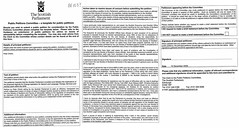
Petition PE1033 3pagePetition PE1033 was aimed at resolving failed claims against the Master Policy and crooked lawyers. Of course, the problems with the Master Policy & Guarantee Fund are easy to fix, if minds were focussed on admitting the truth and getting down to resolving the issues everyone knows about but just doesn't want to admit. I proposed a solution to this over two years ago, but the Law Society of Scotland wheeled out its big guns to kill it off at Parliamentary stage, where Petition PE 1033, which you can read more about here : Petition PE 1033 - A call for action, review & settlement for victims of the Scottish legal profession's injustice against client complaints.

It's fate can be read here : Law Society kills Petition PE1033 amid calls for review of injustice & regulatory sins of the past

Michael Clancy - Law Society BullyLaw Society Director Michael Clancy stepped in to stop Petition attempt to clean up lawyers corruption cases. The Petition was closed down, after a series of dishonest submissions from the Law Society Scotland, with the Petitions Committee only too eager again to satisfy the desires of a dishonest legal profession, and the ‘over-protective-of-crooked-lawyers’ Justice Secretary Kenny MacAskill only too willingly joined in the bitterness against clients interests, and expressed his view here : Truth & reconciliation fails as MacAskill follows Law Society orders to Parliament on attempt to heal public confidence in legal profession

Perhaps someone else would like to take up Petition PE1033 and resubmit it ? as I fear Holyrood is generally too prejudiced against my proposition to clean up the sins of the past of a very dirty legal profession who have grown fatter on the profits of injustice.

The SLCC’s research into Master Policy & Guarantee Fund claims made it to the Scotsman this week, reported here :

Looking for the best solution when relations break down

Monday, June 22, 2009

Freedom of Information campaign : Make the Law Society of Scotland comply with FOI

Law SocietyLaw Society members are shielded by secrecy from FOI. When the law is twisted against people by those in the legal profession who use the law as a business model to make profit, and conceal activities that would be regarded as criminal activity if a member of the public did the same, the law itself is discredited.

This is currently the case in the Scottish legal services market, where many solicitors & law firms are milking the public and their clients for vast sums of money for poor services, even fleecing clients at-will, and getting away with it due to the influence of the Law Society of Scotland in closing down any public interest reforms to regulation, access to justice, or attempts to consider cases of the past. Indeed things are currently so bad, you don't even have a right to know if your own lawyer has a criminal record !

The situation is, one could say, a mirror image of the battle which Westminster fought to keep everyone from finding out as we have now, that our politicians have been paying their expenses with our money and if it had not been for Freedom of Information, and the intervention of the national press, we would have been none the wiser because secrecy, can conceal anything.

So. If you want to stop these people (who received £2.5million from the taxpayer)

Scottish Legal Complaints Commission

getting away with this level of secrecy :

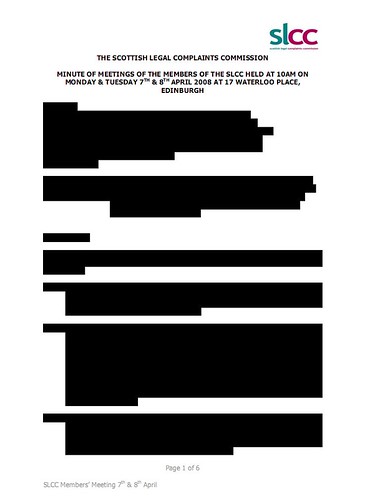
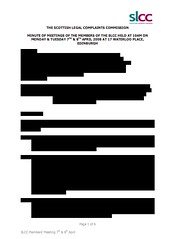
SLCC 7&8th April Meeting Blanked out Page 1

and if you want to stop the Law Society of Scotland from using their immunity from Freedom of Information to protect lawyers from complaints, criminal investigations and fully independent regulation

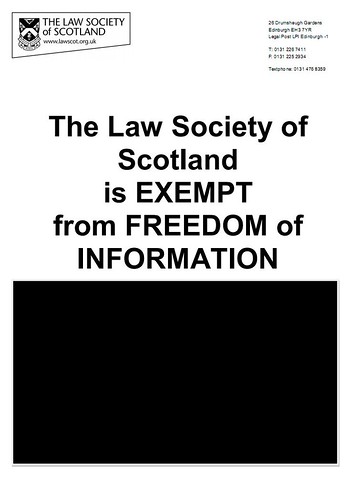
Law Society exempt FOI

email or write to this man, Justice Secretary, Kenny MacAskill :

Kenny_MacAskill

at : scottish.ministers@scotland.gsi.gov.uk or Kenny.MacAskill.msp@scottish.parliament.uk

or write to him at : Kenny MacAskill MSP, Cabinet Secretary for Justice,The Scottish Government,St Andrew’s House, Edinburgh EH1 3DG.

… and ask him to do his job to see Scots get a fairer deal in access to justice and transparency in legal services, which can be achieved in some part by removing the legal profession’s exemption from Freedom of Information legislation and making them more accountable to us.

Friday, June 19, 2009

Justice Secretary 'remains bitter’ over calls to make Law Society of Scotland comply with Freedom of Information laws

Law Society of ScotlandLaw Society of Scotland officials are determined to prevent forced compliance with FOI. FOUR YEARS after the first calls were made to the Scottish Government to bring the Law Society of Scotland into compliance with Freedom of Information legislation, attitudes apparently remain unchanged at the Justice Department over calls to force greater transparency & accountability on the lawyers regulatory, despite the fact the new regulator for complaints against Scottish solicitors, the joint taxpayer-lawyer funded Scottish Legal Complaints Commission is itself FOI compliant.

I have reported on the Scottish Government’s reluctance to make the legal profession comply with Freedom of Information laws in an earlier article here : MacAskill’s ‘no intention to include Law Society in FOI review’ allows lawyers to keep scandals & criminal records hidden from public scrutiny

MacAskill tight lippedJustice Secretary MacAskill is rumoured to be 'bitter' over calls to make lawyers comply with Freedom of Information. The Scottish Government's three year go slow on bringing the Law Society of Scotland into the scope of Freedom of Information legislation, has today been attributed by sources within the administration to problems of bias in the Justice Department itself, with civil servants being described as 'very angry' that members of the public should even be calling for such reforms. The Justice Secretary himself, aware of publicity surrounding the secretive nature of the Law Society is also rumoured to be "very bitter" that critics of the legal profession have even dared suggest the Law Society be brought within the scope of Freedom of Information legislation.

A legal insider today said : "Officials at the Justice Department are less than pleased that members of the public, campaign groups and journalists have made enquires on the lack of progress of reforms in legal services. Occasionally, civil servants have themselves hit out at critics of the slow pace of justice reforms, with less than gentlemanly outbursts, due to impressions given the Justice Department itself is now covering up for corruption, and even perhaps criminality in the legal profession itself."

He went on : "The Justice Secretary himself, is well known to be vehemently against anyone who dares criticise his colleagues in the legal profession, to the point that any idea put forward from outside the legal establishment to 'improve' public access to justice, or, as in this case, making the legal profession compliant with freedom of information laws, MacAskill has set himself diametrically against, simply out of bloody mindedness."

A senior journalist with one of Scotland’s major newspapers confirmed the level of hostility towards those calling for reform of the legal profession. He said : “One civil servant I know launched into a shocking barrage of insults against particular individuals whom it is well known the Law Society tried to exclude from major Scottish Parliamentary inquiries on the state of regulation of the legal profession.”

“I don't think there is any need for this level of prejudice in the civil service. If it is the case that some officials within SG feel so partisan against the public on issues of reforming the legal profession, they should go work for the Law Society instead of the Scottish Government.”

ScottishGovernmentThe Scottish Government are bitterly resisting reforms to the legal sector. It seems somewhat at odds to me, with the era we are now living in, where secrecy, self regulation and the corruption & greed which both issues seem to breed, have virtually wiped out our main banks, trust in the financial sector, and even trust in politicians not to over claim on their expenses accounts, that the Scottish Government are still so bitterly resisting making the legal profession compliant with Freedom of Information laws, and also remain so opposed to implementing fully independent regulation of solicitors, to safeguard consumers best interests.

This resistance on the part of the Scottish Government to process any reforms of the way regulation and client business is handled by the Law Society of Scotland, is an almost perfect mirror image of the resistance from the legal profession itself, who are determined to remain immune from FOI legislation, and virtually all other forms of independent oversight which may very well end up revealing an even greater scale of corruption within the Scots legal sector which might take critics such as myself by surprise.

John SwinneyJohn Swinney revealed Law Society Chiefs threatened anyone who called for regulatory reforms. Indeed, while the first calls for making the Law Society of Scotland comply with Freedom of Information laws were being made, Cabinet Secretary John Swinney MSP, then in opposition, revealed that the Law Society’s then Chief Executive Douglas Mill was busy attacking such ideas, even issuing open threats to the Financial Services Authority and any future regulator who might consider taking a stick to the vast sea of corruption which surrounds areas such as the Law Society's discredited Master Policy & Guarantee Fund client compensation arrangements, which some liken to money laundering operations.

John Swinney says a sea change is needed in attitudes to regulating the legal profession. How true …

Jane IrvineSLCC's Chair Jane Irvine, supports the idea of making the Law Society comply with Freedom of Information. However, while Justice Secretary Kenny MacAskill continues his go slow on making the Law Society comply with Freedom of Information legislation, a growing number of consumer groups and even some from within the legal establishment itself, such as the Chair of the Scottish Legal Complaints Commission, Jane Irvine, are supporting the idea that the public interest would be best served by making the legal profession's governing body FOI compliant.

You can read an earlier article I wrote about the SLCC's Chief Jane Irvine who came out and supported FOI compliance for the Law Society of Scotland, here : Legal Complaints Chief supports ‘consumer advantages’ of removing Law Society’s Freedom of Info immunity

SLCC squareScottish Legal Complaints Commission has suffered several scandals as a result of FOI disclosures. Admittedly, the Scottish Legal Complaints Commission is no angel itself, when it comes to the Commission's own compliance with Freedom of Information laws. In some cases, the SLCC has chosen (allegedly through Ministerial direction) to censor disclosed material to particular journalists, and on other occasions, has apparently been authorised to lie in FOI disclosures. You can find some more good FOI scandals involving the SLCC HERE.

SLCC 7&8th April Meeting Blanked out Page 1SLCC blacked out FOI disclosures in true Westminster style and Law Society might do the same if made FOI compliant. However, while the Information Commissioner is investigating these breeches of FOI laws by the SLCC, and has already criticised the commission in a number of decisions for their poor practices, FOI has brought us an invaluable insight into the way the legal profession will co-opt independent organisations set up as a result of legislation to look at client complaints, and perhaps even more importantly, has also shown us the steps some officials take, and the lengths some are willing to go, to stifle public debate and calls for legitimate reforms which are certainly in the public interest.

As politicians are subject to Freedom of Information laws, as the Police are subject to Freedom of Information laws, as indeed are many other public bodies & services, including local & national Government are subject to Freedom of Information laws, then so also must the legal profession be made subject to Freedom of Information laws, a reform which is definitely in the public interest.

Thursday, June 18, 2009

Westminster Expenses : They work for you, are paid for by you, have possibly stolen from you, but they feel they are not accountable to you

House of CommonsWestminster publishes MPs expenses online with most details blanked out. The House of Commons has finally published MPs expenses online, however many of the details have been blanked out, because while we as taxpayers are paying MPs salaries and their expenses, we are it seems not entitled to see what we are paying for, or by the looks of it, any returns the country actually gains by allowing politicians to claim for all & sundry from us, the taxpayer.

MP Phone BillAn MP’s British Telecom reminder blacked out – would you pay a bill if it landed through your letterbox in this state ?. While members of the House of Commons seemingly can get anything & everything paid for by the taxpayer, from mortgage interest, to second homes allowances, to telephone bills to the removal of moss from their umpteenth house, or duck houses and repairs to swimming pool boilers .. the ones paying it – us, are not entitled to see exactly where the money is going and what the justification is for their huge expenses to the country, particularly in these crushing financial times.

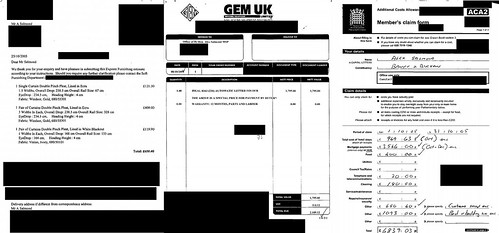
For a couple of samples of today’s publication of expenses from Westminster, via Freedom of Information (in other words, the blacked out version, as opposed to the Telegraph ‘warts and all’ version) we see among the Scottish contingent, Alex Salmond claiming for mortgage expenses and a rather costly envelope folder, as well as curtains & bedding .. with Scottish Conservative MP David Mundell keeping the First Minister company on mortgage expenses, which I'm sure probably most of the country would like to join in with, having mortgages, bedding, curtains, food, and letter folder contraptions paid for out of thin air out of other people's taxes & hard work.

A sample of First Minister Alex Salmond’s Westminster Expenses as an MP :

Alex Salmond Expenses examples

A sample of South of Scotland MP David Mundell’s Westminster expenses :

David Mundell Mortgage expenses

Virtually all the documents have blacked out parts, leading one to conclude democracy, transparency and accountability have most definitely been blacked out in the entire country. I wonder where politicians learned that little trick from ? It surely couldn’t be the legal profession, could it ? … and lets not forget Kenny MacAskill, Scotland’s Justice Secretary is busy trying to keep the Law Society of Scotland exempt from Freedom of Information laws, just in case we begin to find out many of the dirty secrets of Scotland’s less than honest legal profession : MacAskill’s ‘no intention to include Law Society in FOI review’ allows lawyers to keep scandals & criminal records hidden from public scrutiny

Telegraph front pageIf it had not been for the Telegraph newspaper, we would have been none the wiser on crooked politicians expenses claims. Exposing this organised ‘thieving’ from the country of course, fell to the Telegraph newspaper, rather than Freedom of Information legislation, because as we now see in today’s release of expenses information from Westminster, it would not be possible to see who had been flipping homes, and who was claiming what for which property. It is therefore clear that FOI legislation will have to change because it is being used to deceive rather than empower, just as we have seen the Scottish Legal Complaints Commission use FOI to cover up scandalous workings within its increasingly bizarre operations of allegedly regulating the Scottish legal profession.

I reported some rather secretive goings on at the SLCC where similar blacked out documents were issued to hide controversial information here : FOI disclosures censored to law journalists as MacAskill’s legal complaints commission prefers secrecy to public accountability

David Mcletchie taxiMSP David McLetchie was among those politicians caught out at Holyrood claiming thousands for expenses. MSPs might like to think they are whiter than their Westminster counterparts, but as we know here in Scotland, that is most certainly not the case. While MSPs expenses are now published online, again, it took pressure from newspaper investigations such as those in the Sunday Herald to force the changes at Holyrood which Westminster will now have to go through.

You can read more about MSPs expenses milking in an earlier article, here : First Minister Alex Salmond admits he's not 'whiter than white' over Westminster expenses scandal as questions arise over £800 food allowance claims

If you want to find out more about your own MP’s expenses at Westminster (and there is a lot to find out !), click the following link which leads to the BBC News website :

MPs' expenses: Find your MP

and the main story from BBC News :

MPs' expenses made public online

The expenses claims of every MP for the past four years have been published, but with some key details blacked out.

Commons authorities have published the details after a long-running Freedom of Information battle.

The addresses that claims relate to - and correspondence - have been removed on privacy and security grounds.

This means it is not possible to see if MPs "flipped" second homes - a key part of the Daily Telegraph's revelations from its leaked version of the data.

MPs have said some details, like addresses and travel patterns, have to be withheld for security reasons .

But other details have been removed in the official version such as Prime Minister Gordon Brown's claims for his Sky television subscription - despite the fact it was published last year, also under the Freedom of Information Act.

The uncensored details obtained by the Daily Telegraph have led to weeks of revelations and a slew of resignations from MPs.

On Wednesday Treasury minister Kitty Ussher stepped down amid reports that she changed the designation of her constituency home to avoid capital gains tax.

Ms Ussher said she acted within the rules but wanted to protect the government from further embarrassment amid public anger about expenses.

The BBC's political editor Nick Robinson said that if the full uncensored claims had not been leaked to the Telegraph, then MPs like Miss Ussher would still be in their jobs.

Among Daily Telegraph revelations that do not appear in the blacked out versions of MPs' receipts are:

  • Andrew MacKay - From the official receipts it would not have been possible to know the Tory MP claimed for a second home without having a main constituency home.
  • Margaret Moran - The Labour MP who claimed £22,000 for dry rot on her second home. The receipts do not show her second home was in Southampton -100 miles from her Luton constituency.
  • Sir Peter Viggers - Tory MP who tried to claim £1,645 for a "duck island", the official receipts show no evidence of the unsuccessful claim.
  • Hazel Blears - The former Labour minister claimed second home expenses for three different properties in a single year but the redacted receipts do not show this as addresses are blacked out.

Heather Brooke, one of the campaigners who brought the Freedom of Information case, told the BBC the official publication was a "substandard version".

She pointed out the High Court had ordered that second home addresses be published - MPs rejected this in a later Commons vote, arguing it would jeopardise their security.

"It's the only way to police effectively whether there is a second home and whether the mortgage exists whether it's been paid off or not and they are still claiming. It's really the only way we can hold them to account on that second home allowance."

'Seismic changes'

She said the security argument had been "totally discredited" adding: "I can see that avoiding embarrassment has been the key motivating factor of what's been deleted."

And Maurice Frankel, of the Campaign for Freedom of Information, also said the official version was a "very poor substitute": "The mood of the House of Commons was that they did not want any of this information to be published and, failing that, as little as possible."

But cabinet minister Hilary Benn told BBC Radio 4's Today programme: "The argument for keeping bank details, phone numbers and addresses confidential I think is a fair one."

But he said the system needed to change: "That's why we've seen seismic changes, that's why Parliament has already taken steps to alter the rules why Christopher Kelly's committee will look at what the new system will be."

He added the problems were the result of self regulation - now expenses would be audited independently.

For the Conservatives, shadow Commons leader Alan Duncan said: "I think the black ink is justified where it is things like ex-directory phone numbers ... and personal details and bank accounts."

He said changes had been made to ensure MPs could not "play around with the second home address in order to extract as much money as possible out of the system".

Exclusions

But he said "at the very least" addresses should be properly audited.

"Whether the exact address should be put up which would allow people to walk up your front drive I think is a grey area - but the verification of the house and the consistency of the house that is registered is important."

More than a dozen MPs have said they plan to stand down since the furore over expenses began and many have had to repay money - more than £300,000 has been repaid.

Claims made by all 646 MPs under three different allowances since 2004 have been published alphabetically on the Parliament website with thousands of receipts made available in a series of PDF files.

The Telegraph's reports focused largely on the additional costs allowance, designed to cover costs associated with second homes.

WITHIN THE RULES

£24,000-a-year Additional Costs Allowance, which covers the running of MPs' second homes

£22,193-a-year Incidental Expenses Provision, which pays for running an office

£10,400-a-year Communications Allowance, which funds websites, newsletters, stationery and postage

The paper highlighted the practice of "flipping" - by which some MPs switched the designation of their homes and claimed allowances for several properties over the four year period and other claims that were within the rules - but questionable.

Last year, the Commons agreed to blank out certain information considered sensitive including addresses and all communications with the Fees Office. MPs have been able to suggest further exclusions.

Other information published on Thursday includes the incidental expenses provision for office costs and the communications allowance - Parliament had been ordered to publish them by the High Court.

Labour has referred MPs accused of making questionable claims to an internal disciplinary panel, which has barred five MPs from standing at the next election.

The Tories have asked all its MPs to submit their claims to an internal panel for scrutiny, with a handful of MPs either being forced to stand down or choosing to retire.

The furore has led to interim changes to the second homes allowance while the Committee of Standards in Public Life is holding an inquiry into expenses and will recommend changes to allowances rules.

Gordon Brown has said oversight of MPs expenses must be handed over to an external regulator as part of a root and branch reform of Parliament.

The Daily Telegraph's assistant editor Andrew Pierce told the BBC they would publish the entire list of claims submitted by the cabinet on Friday and every MP's expenses on Saturday - to allow people to draw their own conclusions about what had been "censored".

"I suspect it could be that more MPs will be considering their position and maybe their party leaders will be considering whether they are really fit to be an MP," he said.