Thursday, October 25, 2007

Lawyer who took on Law Society for clients ended up as dishonest as those he challenged

One of the more difficult articles for me to write, as this relates to a lawyer, Michael G Robson, who handled the case of the death of my mother at Borders General Hospital, and lied about what he was doing with regard to pursuing a medical negligence action against the Hospital.

Michael G Robson, formerly of Robsons WS, Ratho, had many a famous client who had problems with the legal profession. Iain McIntyre for one, was a client of Mr Robson, who tried to sue his lawyers for negligence, but was blocked from doing so by the then Secretary of the Law Society, Kenneth Pritchard, and his successor, Douglas Mill.

Policy is to protect both says Law Society Herald 1994 Retype

I was but another of those clients Mr Robson happily took on, with an assurance that work would be undertaken, and cases brought to court, among them, an attempt to do something about crooked accountant Norman Howitt & ICAS, an action for Judicial Review against the Law Society of Scotland in their handling of the Penman complaint & their treatment of further complaints filed against other legal firms, and of course, the case of the death of my mother at Borders General Hospital, from medical negligence.

In the end, Mr Robson did nothing on any of my cases, nor it seems did he do much, if anything for any of his other client, and ended up before the Law Society over several complaints from clients, including some from myself, over lack of action on cases and failure to correspond or take instructions.

Solicitor fined for ignorring clients' letters - The Scotsman 7 January 2002

It took the Law Society long enough to do something about it ... they wrote some 90 or so letters to him at his Ratho office, a situation which went on for almost a year. Odd, perhaps, that no one from the Law Society thought to drive a few miles to his office and see what was going on. Law Society officials were however, content to play the situation out for as long as possible, so all of Mr Robson's clients cases might just fall into time bar, thus preventing anyone from being able to claim compensation against the solicitors negligence insurance.

Edinburgh Evening News 31 May 2002 - Edinburgh - Lawyer slammed for lying to client page 1Edinburgh Evening News 31 May 2002 - Edinburgh - Lawyer slammed for lying to client page 2

The Law Society, very craftily handled the client complaints against Mr Robson, finding in the main for a poor standard of service & conduct, and recommending prosecution before the Scottish Solicitors Discipline Tribunal for a number of those 'offences'. However due to the possibility of clients proceeding with negligence claims against Mr Robson for his conduct and citing the Law Society investigation and findings, the Law Society made & pressed charges of their own rather than refer too much to the way Mr Robson had treated his clients, in an effort to stall any negligence claims against Mr Robson which would ultimately have to be paid from the Master Insurance Policy - the solicitors professional indemnity insurance for negligence run by the Law Society of Scotland and Marsh UK - which has seen it's own share of corruption allegations.

Lawyer loses bid to overturn 3 year ban - Evening News  3 May 2002

Mr Robson was duly found guilty and the rest was covered in the media. Mr Robson however, did challenge the SSDT, which was reflected in newspaper reports, and a case which goes on yet to this day, delayed on many occasions of being off to tennis matches or meetings .. how the Court and it's judges sat back and allowed that is anyone's guess, but a good indicator came from a source at the Law Society of Scotland, who claims the intention of the delays is to make my case and any other claim against Mr Robson fall into time bar - the usual practice from the legal profession then.

Such was the complication of the case, and the worry of the Scottish Legal Services Ombudsman there may be a 'conflict of interest', my request for an investigation into the way the Law Society dealt with the Robson case was passed to the English Legal Services Ombudsman, who have had to sit on the sidelines and await a ruling from the court before taking up their investigation over 3 years since they were contacted to do it.

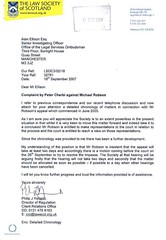
Michael Robson complaint - Philip Yelland to Legal services Ombudsman 18 Sept 2007

The Law Society of Scotland's Director of Regulation, Mr Philip Yelland, known to many clients who complain to the Law Society, wrote recently to the Legal Services Ombudsman's office in England, with as useless an explanation as ever, claiming the Law Society was 'powerless' to do anything while Mr Robson pursued the appeal against the Scottish Solicitors Discipline Tribunal.

In reality, Mr Yelland and his colleagues at the Law Society of Scotland, have been only too happy to see the case drag on, and myself be constantly denied legal representation, to delay and destroy any chance of a negligence claim against Mr Robson being raised - the same trick they play on anyone else who tries to claim against a crooked lawyer ...

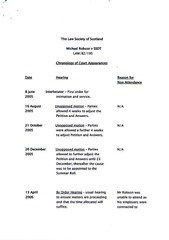
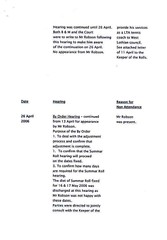
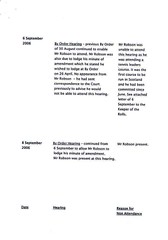
Following is a list of the Court appearances of Mr Robson, with excuse after excuse .. which usually revolved around playing tennis ... some of the quotes below ...

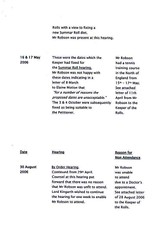
"Mr Robson was unable to attend as his employers were contracted to provide his services as a LTA tennis coach to West Lothian Council."

"Mr Robson had a tennis training course in the North of England from 15th - 17th May."

"Mr Robson was unable to attend this hearing as he was attending a tennis leaders course. It was the first course to be run in Scotland and he had been committed since June."

What where the Judges thinking of allowing Mr Robson to treat the court like that, amid the ruin and harm he had caused his clients ?.

The Law Society of Scotland's 'prosecuting fiscal' in this case is PA Reid, 'Solicitor Advocate' of Messrs Fleming & Reid, 180 Hope Street, Glasgow - perhaps known to others who have made complaints against crooked lawyers and seen a 'result' in any 'prosecution' before the Scottish Solicitors Discipline Tribunal ...

Michael Robson v SSDT Page 1Michael Robson v SSDT Page 2Michael Robson v SSDT Page 3Michael Robson v SSDT Page 4Michael Robson v SSDT Page 5Michael Robson v SSDT Page 6Michael Robson v SSDT Page 7Michael Robson v SSDT Page 8Michael Robson v SSDT Page 9

Being slightly fed up with the way I was being treated, by the Law Society, the Court of Session, Mr Robson et all, I let slip the information, and at the weekend, the Sunday Mail featured the story.

Surely all this is a good example of why lawyers cannot be allowed to regulate themselves. Only fully independent regulation of the legal profession, will bring a measure of accountability & transparency to the way lawyers handle cases for their clients, and how complaints are handled when inevitably it seems, lawyers undertake very poor legal service.

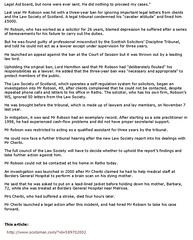
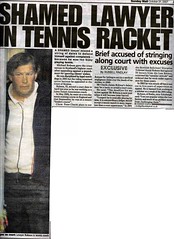
Shamed Lawyer in Tennis Racket - Sunday Mail 21 October 2007

Shamed Lawyer In Tennis Racket

Oct 21 2007 By Russell Findlay

Exclusive Brief Accused Of Stringing Along Court With Excuses

A SHAMED lawyer missed a string of dates to defend himself against complaints - because he was too busy playing tennis.

Michael Robson gave the crazy excuse to Scotland's highest court after appealing against a punishment for ignoring clients' wishes.

He was disciplined by legal watchdogs in 2005 but the ruling remained secret because he appealed to the Court of Session.

Robson, 55, missed a court date in April last year as he was working as a Lawn Tennis Association coach.

In May 2006, he went on a two-day tennis training course in England and that September he was at a tennis "leaders course".

Client Peter Cherbi plans to sue Robson for failing to act in a medical negligence claim over the death of his mother in 2000.

Mr Cherbi claims Robson's delays may be a tactic to avoid a court case.

He said: "The deadline for my action against Mr Robson is next year when it will become time barred.

"I suspect he is cynically playing for time. It is extraordinary judges should accept a tennis match is more important than a court appearance." In 2001 the Scottish Solicitors' Discipline Tribunal found Robson had ignored 50 letters from the Law Society, criticised his "cavalier attitude" and ordered that he work under supervision for three years.

In 2002 he was struck off but that was reduced to five-years of supervision on appeal.

He is banned from working as a solicitor as result of the 2005 ruling.

When we called Robson, of Ratho, Edinburgh, he said he would phone back but failed to do so.

Monday, October 22, 2007

Scotland's Crown Office gets away with murder - failing justice system fails everyone

If there's one common constant in politics or law, its the policy that if one fails, one has to lie to cover it up, and no amount of lies can be spared to cover it up, engaging anyone, ones colleagues, whole departments, even a few politicians, to sweep things under the carpet.

You don't need me to tell you that - you already know it.

Politics & Law go hand in hand, in each other's pockets, often with the same individuals appearing in both, lying for both, sometimes challenging the other, but inevitably pursuing their own ends, which more often than not conflict with the public interest.

We live in Scotland, a country which aspires to be more than it is, as any country does. A country which professes to be honest, but sadly is not. A country which claims to have an honest accountable justice system, but does not. A country which constantly tells us we are treated better than anyone else with rights, freedoms & values which many would die for .. but when we need those rights, freedoms or values, they are simply ... not there.

Our First Minister, Alex Salmond, wants Scotland to have a place at the UN, but we have a justice system worthy of a banana republic. We can't even look after our own people, nevermind poke our nose into what anyone else is doing or touting high standards of living when we don't have them ourselves. Okay .. ask for representation at the UN, Mr Salmond, but clean up our act first before you do so, because simply, we are not yet worthy if we have no justice in our land.

While we can't even treat the living well enough, Scotland's justice system treats the dead even worse, and that common constant between politics & law comes back to haunt us yet again, as the Crown Office, and even Police, wriggle their way out of providing decent investigations into suspicious deaths, claiming they did their best, when they did nothing, or actually made it worse.

As far as the Crown Office is concerned, when it is caught out in an investigation, or found to have failed in carrying out a proper investigation, lies and cover up is the order of the day. Even when a life is taken, lies still reign supreme in Scotland's prosecution service, and it seems, certain sections of the Police who would rather cover up their failures than broadcast them for all to see.

Here are two stories from Scottish Law Reporter, referring to weekend reports in the Sunday Mail newspaper. A sad indictment of the way Scotland treats the dead, the families they leave behind, and it seems, allows murderers to escape justice, simply because the Crown just can't be bothered to do the job it was put there to do ...

Mr MacAskill ? Where is Justice in Scotland today ?

Northern Constabulary guilty of failures of investigation in unexplained Wick Harbour death

A report compiled four years ago by Andrew Cameron, chief constable of Central Police into Northern Constabulary's investigation into the death of 24 year old Kevin McLeod, and kept secret until now, reveals a disgraceful catalogue of errors on the part of Northern Constabulary which remain without explanation.

The incident, investigated by Northern Constabulary as a 'sudden death', although long thought to be a murder, raises significant questions over the performance of both the Police & Crown Office, where it also comes to light the opinion of one of the prosecutors , Procurator Fiscal Alasdair MacDonald, who believed the death of Kevin McLeod to be suspicious, was left out of the report ....

Kevin Mcleod's family await not only an apology, but a proper investigation and accounting of what happened to their son.

The Sunday Mail reports :

Blunder Cops Rapped Over Dead Clubber

Oct 21 2007 By Marion Scott

Exclusive: Police Chief Accuses Officers Of 'Inexplicable' Errors In Harbour Death Probe

A SENIOR police officer has found colleagues guilty of "inexplicable" blunders in their investigation of a 24-year-old clubber's death.

Kevin McLeod's grieving family are convinced three men battered him to death and dumped him in Wick Harbour.

Now for the first time an official police report reveals damning evidence that Northern Constabulary were wrong to dismiss Keith's death as accidental.

The report by Andrew Cameron, chief constable of Central Police, was kept under wraps for four years and only released after pressure from Kevin's family.

It slams Northern for not apologising to the family and calls for a shake-up in the way they investigate sudden deaths.

Mistakes highlighted by the Cameron report include:

Failing to realise the significance of diamond-shaped marks on Kevin's body even after a procurator fiscal instructed them to treat the death as suspicious.

Failing to keep the clothes worn by Kevin at the time of his death as evidence.

Failing to photograph and record Kevin's injuries properly. Electrician Kevin, 24, was found dead in Wick harbour 10 years ago after a night out at the town's Waterfront Club.

His father Hugh and mother June have battled to prove he was murdered and not the victim of a tragic accident as police insist.

His spleen, liver and pancreas were ruptured and he lost so much blood he would have been unable to get up on his own.

The Cameron inquiry calls for Northern to review management of suspicious deaths, training and staffing.

Cameron stated: "The failure of the force to seize, retain and submit for examination the clothing worn by KevinMcLeod remains inexplicable."

He added: "The efficiency with which photographic evidence of injury was initially instructed and secured and subsequently assessed over a period of three years is open to question.

"It is not helped by what appears to be a lack of acknowledgement by the force and the Department of Pathology, Raigmore Hospital, Inverness as to the potential significance of the "diamond" pattern mark on the body of Kevin McLeod." Cameron concluded:

"It is this inquiry's view that had the existence and significance of the marks been properly recognised, the investigation may well have been directed differently.

"It is the conclusion of this inquiry that the McLeod family are entitled to an apology from Northern Constabulary over the patent lack of communication of their complaints."

The Cameron report was completed in 2003 but only given to the family this year following a freedom of information request.

A second investigation into Northern's handling of the case by the new Police Complaints Comissioner Jim Martin is expected later this year.

Kevin's uncle Allan McLeod, 49, said: "Even though the Cameron Report supports everything we've known for 10 years, we do not believe anyone will ever be brought to justice for killing Kevin.

"We know the names of three men we believe were responsible for Kevin's death.

"But we have not one shred of confidence that the police will ever do anything about it because they do not want to admit they are wrong.

"We have not received any proper apology from the force."

Northern Constabulary said: "As a result of this independent inquiry, all issues raised by the McLeod family have been dealt with.

"Consideration was given to where improvements could be made and these have been implemented.

"The case has been subject to a great deal of scrutiny and the chief constable will not be reopening the inquiry."

Riddle Of Prosecutor Whose Evidence Was Ignored

Oct 21 2007

Exclusive: Police Chief Accuses Officers Of 'Inexplicable' Errors In Harbour Death Probe

ONE man's verdict on whether Kevin was murdered is missing from the Cameron report.

The victim's family believe Procurator Fiscal Alasdair MacDonald could be key to mounting a case - but he was not interviewed by Chief Constable Cameron. Kevin's uncle Allan McLeod said: "We're incensed that the very man who believed Kevin's death was suspicious was missed out of this report.

"He should have been the first person to be interviewed and the fact he wasn't can only raise our suspicions of a cover-up."

Central Police said questions on the Cameron Report should be answered by the Northern Joint Police Board.

But the Northern Joint Police Board insisted they were "unable to comment".

In the report, Cameron claims MacDonald was "unavailable" to be interviewed. But in a further twist MacDonald has written to the McLeod family saying he would have been happy to co-operate.

He wrote: "Whilst I have no wish to add to the controversy surrounding this matter, I fear I must. I cannot imagine upon what possible basis I could be described as unavailable for interview.

"Despite researches, neither my office manager nor I have any recollection of any contact by the author of this report."

The Crown Office said they did not have "anything further to add" to MacDonald's comments.

Crown Office offer untenable explanations over Annie Borjesson death, withholds evidence & FAI

The Crown Office, who can always be depended upon to lie through their teeth when caught out in an investigation, have offered up the poorest explanation of anomalies to the family of Annie Borjesson, who died at Prestwick in December 2005.

When the body of the young swedish woman was returned to her family, Guje Borjesson questioned why her daughters hair had been hacked off, only to be now told it was the undertakers who did it, allegedly to present the body in better circumstances.

The death of Annie Borjesson, which has not yet received a Fatal Accident Inquiry, despite a complete lack of explanation for the death, raises many questions of why the Crown Office have been covering up what seem to be a catalogue of failures on their part, and of the Police investigation into the death, which has seen little or no accountability of events.

The family of Annie Borjesson await a proper inquiry & investigation into their daughters death and release of all the evidence in the case, along with CCTV footage, still under possession of the Crown.

The family's website for a campaign for an investigation into Annie's death can be found here : http://www.annierockstar.com

The Sunday Mail reports :

Undertakers Hack Off Annie's Locks

Oct 21 2007 By Marion Scott

Exclusive Mum Of Death Riddle Daughter Wanted To Buy Wig For Corpse

THE body of a Swedish woman who died in Scotland was sent home with her waist-length hair hacked off.

Annie Borjesson's mum is convinced her hair was chopped by her killer.

But the Crown Office have revealed it was cut by funeral staff who did not want the family to see it matted in mud and debris from the sea.

Police say Annie, 30, drowned herself at Prestwick beach.

But mum Guje, 54, who lives near Gothenburg with husband Karoly, said: "The funeral staff said they cut her hair but I don't believe they would have taken it like that. It was roughly hacked off.

"It looked so bad I even considered getting a wig because I knew she would not want to be left like that.

"My daughter had never cut her hair in her life."

The Crown Office said: "It was cut while preparing the body for transfer."

Pathologist Dr Alan J Cromie said: "The hair gets matted or dirty in drowning cases and funeral staff try to present the body as best they can for the family."

Musician Annie came to Edinburgh two years ago and worked at the city's Scottish Whisky Heritage Centre.

Her body was found on December 4, 2005. Her family didn't believe it was suicide and offered a £10,000 reward for information.

The Crown Office added: "There has been a full probe into the death. There is no evidence of a crime."

Saturday, October 20, 2007

Andrew Penman & Norman Howitt : Lawyer & accountant team up to ruin Cherbi executry estate

As many of you know, the Scotsman newspaper and others wrote many reports on developments in my case against crooked lawyer Andrew Penman of Stormonth Darling Solicitors, Kelso and crooked accountant Norman Howitt of the JRW Group in the Scottish Borders, the two so called 'professionals' who swindled the estate of my late father and got away with it.

Mr Howitt was the Executor, and Mr Penman was his legal agent - and when a crooked Executor and crooked lawyer team up, there's not much hope for honesty ... and Mr Howitt, not content with ruining the legal & financial affairs of my late father, did the same to my mother, insisting she pass all her assets to him for reasons of wanting to keep all the money for himself.

Some have been asking to understand a little more of my case against Drew Penman & Norman Howitt, so in light of a recent story in Scotland on Sunday passed to me by a Scotsman journalist I had completely forgot about (the one where I was going to take legal action against the then Scottish Legal Services Ombudsman, Mr Garry S Watson, who was just as terrible at his job as the Law Society of Scotland are at handing complaints against crooked lawyers, here in today's article, are the reprints of the Scotsman & Scotland on Sunday reports on my case, and campaign to bring independent regulation of lawyers in Scotland.I trus tthey are of use to some readers who suffer the same problems in dealings with the legal profession.


I get so many similar stories from people all over Scotland, of how lawyers and executors have ruined the estates of their relatives, it almost looks like some kind of macabre sport played out by lawyers to increase their profits, all the while knowing the Law Society of Scotland will let them off the hook if anyone dare complain against their actions ...


The way to stop these kinds of things happening in the future, is of course, to take all regulatory & disciplinary function away from the legal profession and ensure transparent, accountable and honest complaints investigations & consideration of client complaints ... but we will have to wait and see if the SNP actually achieve this through the new Scottish Legal Complaints Commission, which itself is already encountering problems even before it begins operation sometime in late 2008 ...

Andrew Penman of Stormonth Darling Solicitors, Kelso & Norman Howitt, accountant, now with the JRW Group, Galashiels. - The Scotsman & Scotland on Sunday articles 1994 - 2001
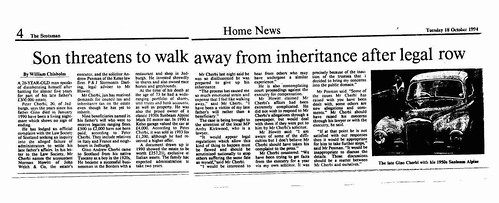
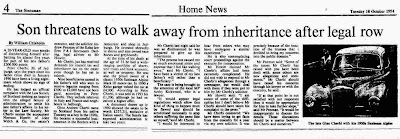
Scotsman 18 October 1994 Son threatens to walk away from inheritance after legal row

Son threatens to walk away from inheritance

By William Chisholm The Scotsman Tuesday 18 October 1994

A 20-year old man from Jedburgh speaks of disinheriting himself after battling almost five years for a share of his father's £300,000 estate.

Peter Cherbi, 20, from Jedburgh, says the years since his father Gino died in January 1990, have been a living nightmare which shows no signs of ending.

He has lodged an official complaint with the Law Society of Scotland seeking an inquiry into the alleged failure of administrators to settle his late father's affairs.

In his letter to the Law Society, Mr Cherbi names the accountant Norman Howitt of John Welch & Co, the estate's executor, and the solicitor Andrew Penman of Kelso law firm P & J Stormonth Darling, legal adviser to Mr Howitt.

Mr Cherbi has received demands for council tax and inheritance tax on the estate, even though he has yet to inherit.

None beneficiaries named in his father's will who were to receive legacies ranging from £500 to £2000 have not been paid, according to Peter Cherbi. They include relatives in Italy and France and neighbours in Jedburgh.

Gino Andrew Cherbi came to Scotland from his native Tuscany as a boy in the 1920's. He became a successful businessman in the Borders with a restaurant and shop in Jedburgh. He invested shrewdly in shares and also owned race horses and greyhounds.

At the time of his death at the age of 72, he had a wide ranging portfolio of shares, unit trusts and bank accounts as well as property. He was also the proud owner of a classic 1950s Sunbeam Alpine Mark 3 motor car. In 1990 a Kelso garage valued the car at 」4000. According to Peter Cherbi, it was sold in 1993 for £1,200, although he had received a higher offer.

A document drawn up in1990 showed the estate to be worth £257,211 exclusive of Italian assets. The family had expected administration to take two years.

Mr Cherbi last night said he was so disillusioned he was prepared to give up his inheritance.

"The process has caused me so much emotional strain and expense that I feel like walking away", said Mr Cherbi.

"I have been a victim of my late father's will rather than a beneficiary"

The case is being brought to the attention of local MP Archy Kirkwood, who is a lawyer.

"It would appear legal regulations which allowed this kind of thing to happen must be flawed and should be scrutinised nationally to stop others suffering the same fate as myself", said Cherbi.

"I would be interested to hear from others who have undergone a similar experience"

He is also contemplating court proceedings against the executry for compensation.

Mr Howitt claimed Mr Cherbi's affairs had been extremely complicated. he did not wish to respond to Mr Cherbi's allegations through a newspaper, but would deal with them if they were put to him by Mr Cherbi's solicitor.

Mr Howitt said "I am aware of some of the difficulties but I don't believe Mr Cherbi should have taken his complaint to the press".

Mr Cherbi countered "We have been trying to get facts from the executry for a year via my own solicitor. It was precisely because of the inaction of the trustees that I decided to bring my concerns into the public domain"

Mr Penman said "Some of the issues Mr Cherbi has raised with you have been dealt with. some others are new allegations and comments" Mr Cherbi should have raised his concerns through his lawyer or with the executry, he said.

"If at that point he is not satisfied with our responses, then it would be appropriate for him to take further steps", said Mr Penman. "It would be inappropriate to discuss the details. Those discussions should be a matter between Mr Cherbi and ourselves"
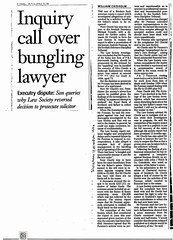
Scotsman 11 October 1996 Iinquiry call over bungling lawyer

Inquiry call over bungling lawyer

Executry dispute - Son queries why Law Society reversed decision to prosecure lawyer

William Chisholm The Scotsman 11 October 1996

The son of a Borders businessman wants a report which investigated allegations of misconduct by a solicitor handling his father's estate to be re-opened.

Peter Cherbi has sent the report to Scottish Secretary Michael Forsyth, with a demand for further action. He wants Mr Forsyth to force the Law Society to reopen the report to allow a prosecution of the lawyer, Andrew Penman, by the Scottish Solicitors Discipline Tribunal.

The Law Society investigation concluded that Mr Penman, of the Kelso law firn of P & J Stormonth Darling, should be prosecuted by the tribunal for the "appalling" way he handled the executry of Gino Cherbi, a Jedburgh businessman whose estate was valued at £300,000, after his death in 1990, aged 73.

But the decision to prosecute Mr Penman has been shelved in favour of a reprimand.

Now Mr Cherbi's son, Peter claims the society's about-face cannot be justified given the findings of the investigation, including "an apparent attempt to mislead the Royal Bank of Scotland, and failure to collect estate assets".

When The Scotsman spoke to Mr Penman, he said the complaint against hiim had been thoroughly investigated by the Law Society and that was an end to the matter. In general, he could not make comments because of confidentiality.

The law Society report outlined lengthy and unexplained delays and a repeated failure by Mr Penman ro respond to correspondence. It also alleged a complete lack of proper management in the handling and progressing of the executry.

There had been a "bungled and unsuccessful attempt to put the files in order".

Peter Cherbi was to have been the main beneficiary from his late father's estate. Others named in the will were to receive legacies ranging from £500 to £2000. But Mr Cherbi has been told there are no funds left in the estate.

A document showed the estate to be worth £257,211 exclusive of Italian finds.

The overseas assets included an account with the Banco di Roma containing some £26,000 which was not collected by the executry. The Society report states that Mr Penman apparently attempted to mislead the Royal Bank on this matter.

The committee of the Law Society which first considered the report in June this year expressed grave concern at the way the executry had been handled.

Members agreed that Mr Penman's actions were so serious and reprehensible as to amount to professional misconduct and recommended prosecution by the Scottish Solicitors Discipline Tribunal.

But the decision was changed after Mr Penman submitted written representations to the society. He claimed the executry had been complex although he accepted matters could and should have been dealt with more expeditiously.

Mr Penman also apologised to the complainer (Mr Cherbi) and to the Law Society

Mr Cherbi said Mr Penman's pleadings "contradicted the society's own findings", adding that the Cherbi estate had suffered substantial financial loss.

When the Law Society committee reconsidered the matter, it was decided a reprimand and a compensation award of £1000 to the estate would be more appropriate.

P & J Stormonth Darling were instructed to limit their fee for work done from the date of death until October 1994 when Mr Penman ceased dealing with the file, to £3000 plus VAT.

Peter Cherbi told The Scotsman "I am shocked at the findings of the Law Society investigation which has uncovered many disturbing facts about the way my late father's estate was handled. I will not be allowing this matter to rest"

The Law Society advised Mr Cherbi not to instigate civil action while their investigation was in progress. He said the completion of the inquiry meant he was now in a position to sue for full recovery of the estate although the society report had been promised 15 months ago.

Mr Cherbi has also asked Mr Forsyth to instruct the Law Society to reopen the files so that prosecution can be taken before the solicitors tribunal.

Following the finding of professional misconduct he has also registered a complaint against Norman Howitt, an accountant with John J Welch & Co, Galashiels, who acted as executor of his father's estate.

In his submission to the Institute of Chartered Accountants of Scotland, Mr Cherbi alleges a lack of control by Mr Howitt over the activities of Mr Penman which resulted in financial loss to the estate.

A Law Society spokeswoman said the complaint had been dealt with and Mr Cherbi had exercised his right to refer the matter to Scotland legal services ombudsman to whom the file had now been sent.

Mr Penman said the Law Society papers with the committee's deliberations showed that a press statement from Mr Cherbi contained many untruths and half-truths. "I would consider that the press release if published as it stands would be defamatory of me" he said.

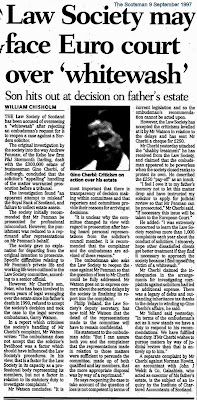
Scotsman 9 September 1997 Law Society may face Euro Court over whitewash

Law Society may face Euro court over 'whitewash'

Son hits out at decision on father's estate

William Chisholm The Scotsman 9 September 1997

The Law Society of Scotland has been accused of overseeing a "whitewash" after rejecting an ombudsman's request for it to reopen a case against a Borders solicitor.

The original investigation by the society into the way Andrew Penman, of Kelso law firm P & J Stormonth Darling, dealt with the £300,000 estate of businessman Gino Cherbi, of Jedburgh, concluded that the solicitor's "appalling" handling of the matter warranted prosecution before a tribunal.

The investigation found "an apparent attempt to mislead the Royal Bank of Scotland and failure to collect estate assets".

The society initially recommended that M Penman be prosecuted for professional misconduct. However, the punishment was reduced to a reprimand after representations on Mr Penman's behalf.

The society gave no explanation for departing from the original intention to prosecute.

Specific difficulties relating to Mr Penman's private life and working life were outlined to the Law Society's committee, according to a senior official.

However, Mr Cherbi's son, Peter, who has been involved in seven years of legal wrangling over the estate since his father's death in 1990, refused to accept the society's decision and took the case to the legal services ombudsman, Garry Watson.

In a report which criticises the society's handling of Mr Cherbi's complaint, Mr Watson writes; "The ombudsman does not accept that the solicitor's livelihood was a factor which should have influenced the Law Society's procedures. In his view, that is a factor for the Law Society in it's capacity as a professional body representing its members, but not a factor in relation to its statutory duty to investigate complaints".

Mr Watson concludes; "it is most important that there is transparency of decision making within committees and that reporters and committees provide their reasons for arriving at decisions.

"It is unclear why the committee changed its view with regard to prosecution after having heard personal representations from the solicitor's council member.

It is recommended that the complainer and the ombudsman are advised of these reasons"

The ombudsman also asks the Law Society to reopen the case against Mr Penman so that the question of loss to Mr Cherbi could be fully addressed. Mr Watson goes on to express concern about the serious delays by the society in finalising its report into the complaint.

Philip Yelland, the Law Society's deputy secretary, has now told Mr Watson that the detail of the representations made to the committee will have to remain confidential.

His statement to the ombudsman adds; "But I can assure both you and the complainer that the representations made in relation to those matters were sufficient to persuade the committee, made up of both qualified and lawyer members, that the more appropriate disposal was by way of a reprimand"

He says reopening the case to take account of the question of loss is not competent in terms of current legislation and so the ombudsman's recommendations cannot be acted upon.

However, the Law Society has accepted the criticisms leveled at it by Mr Watson in relation to the delays and has sent Mr Cherbi a cheque for £250.

Mr Cherbi yesterday attacked the "shabby treatment" he has received from the Law Society and claimed that the ombudsman appeared to be powerless when the society closed ranks to protect its own. He described the £250 "pay-off" as an insult.

"I feel I owe it to my father's memory not to let this matter drop and have instructed my solicitor to apply for judicial review so that Mr Penman can be prosecuted" Mr Cherbi said. "If necessary this issue will be taken to the European Court".

He added; "I was extremely concerned to learn the Law Society received more than 1000 complaints each year about the conduct of solicitors. I sincerely hope other dissatisfied clients get better treatment if they find it necessary to approach the society because I find myself the victim of a whitewash".

Mr Cherbi claimed the inadequacies in the arrangements for investigating complaints against solicitors had led to additional expense. There was a legacy of debts and outstanding inheritance tax thanks to the delays in winding up Gino Cherbi's affairs, he said.

Mr Yelland said yesterday ; " In terms of the ombudsman's act as it now stands we have a duty to respond to his recommendations. We have fulfilled that duty. If Mr Cherbi wishes to pursue matters by way of judicial review then that is entirely up to him.

A separate complaint by Mr Cherbi against Norman Howitt, an accountant with John J Welch & Co, Galashiels, who acted as executor of his father's estate, is the subject of an inquiry by the Institute of Chartered Accountants of Scotland.
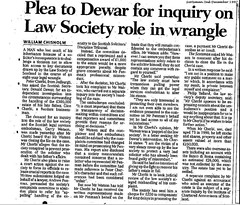
Scotsman 2 December 1997  Plea  to Dewar for inquiry on Law Society role in wrangle

Plea to Dewar for inquiry on Law Society role in wrangle.

William Chisholm The Scotsman 2 December 1997

A MAN who lost much of his inheritance because of a solicitor's incompetence is to challenge a decision not to allow him access to key documents drawn up by the Law Society of Scotland in the course of an eight year legal wrangle.

Peter Cherbi, from Jedburgh, has asked the Scottish Secretary, Donald Dewar, for an independent investigation into the circumstances surrounding the handling of the £300,000 estate of his late father, Gino Cherbi, a Borders businessman.

The demand for an inquiry into the role of the law society and the Scottish legal services ombudsman, Garry Watson, was made yesterday after Mr Cherbi heard that Mr Watson was closing the file on the case.

Mr Cherbi alleges that the society conspired to prevent prosecution of the solicitor who dealt with his father's affairs.

Mr Cherbi also plans to raise a court action against the society to force its officials to release crucial reports int he case.

Written submissions lodged on behalf of a lawyer, Andrew Penman, persuaded the society's complaints committee to abandon plans to refer his "appalling" handling of the executry to the Scottish Solicitors Discipline Tribunal.

Instead, the committee decided that a reprimand and a compensation award of £1000 to the estate would be a more appropriate penalty, despite grave concerns about Mr Penman's professional misconduct.

After the decision, Mr Cherbi took his complaining to Mr Watson, who carried out a separate inquiry into the society's handling of the case.

The ombudsman concluded "It is most important that there is transparency of decision making within committees and that reporters and committees provide their reasons for arriving at decisions".

Mr Watson said the complainer and the ombudsman should be afvised why the complaints committee had changed its mind on prosecuting Mr Penman.

His report also disclosed that a society memorandum contained concerned that a solicitor who represented Mr Penman before the committee had made reference to Peter Cherbi's character and that such references had been considered "unfair".

But now Mr Watson has told Mr Cherbi he has received the written representations made on Mr Penman's behalf on the basis that they remain confidential to the ombudsman's office.

Mr Watson adds "However, I can assure you that these representations solely relate to the solicitor himself; they do not contain any comments with regard to yourself."

Mr Cherbi said yesterday "The Law Society must have tremendous pulling power when they can get the legal services ombudsman to alter his stance.

"They are only interested in protecting their own members. I am not even able to see the evidence presented to the committee on Mr Penman's behalf yet he had access to all of my submissions".

In Mr Cherbi's opinion, Mr Watson was a 'puppet of the law society'. In a letter seeking Mr Dewar's intervention, Mr Cherbi states "I am the victim of a very sleazy cover-up by the law society to protect a very bad solicitor who has already been found guilty of misconduct".

He said he had no intention of giving up the fight to recover his father's estate in full.

Mr Cherbi is to seek judicial review of the law society's alleged mishandling of his complaint.

The society has sent him a cheque for £250 to compensate him for long delays in processing the case, a payment Mr Cherbi describes as an insult.

The Scotsman asked Mr Watson to comment after his decision to close the file in the Cherbi case.

In a written response, he said "I am not in a position to make any public comment on a matter, which, in accordance with my remit, is private between myself and complainer".

Philip Yelland, the law society's deputy secretary, said "Mr Cherbi appears to be expressing concern about the ombudsman's position and it would be inappropriate for us to say anything if he wishes to take further action.

When Mr Cherbi, senior, died aged 73 in 1990, he left stocks and shares, property, and other assets valued at more than £250,000.

There were also overseas assets including an account with the Banco di Roma, containing an estimated £26,000. which was not collected by the executry. The estate has yet to be settled.

A separate complaint by Mr Cherbi against an accountant who acted as executor of the estate is the subject of a separate inquiry by the Institute of Chartered Accountants of Scotland.

Jury  still out on law in the dock - The Scotsman 2 March 1998

Jury still out on law in the dock

Does the Law Society act in the public's best interest over legal malpractice , asks Jenny Booth The Scotsman 2 March 1998

Like small children utterly dependent on their parents, most of us trust our legal advisers implicitly to protect us from life's little Dickensians - financial ruin, for example - at some of the most important stages in our existence.

We do not expect, having purchased our dream home, to find that planning permission has been granted for a new motorway to run through the garden.

And we would be more than a little upset to discover that a trust find set up to look after our elderly and ailing parents had actually furnished our solicitor's holiday apartment in Spain.

So, who do you turn to when you believe your solicitor has made a mess of your affairs ?

This may be hard to stomach, but at the moment, the first thing to do is to contact another lawyer, or, to be more precise, the Law Society of Scotland, which acts both as the professional body for lawyers and as the first port of call for members of the public with complaints about their lawyers.

Self regulation has been in place at the society for years, and while few would claim it is perfect, the Law Society says it is working well. It believes that lawyers have enough pride in their profession to want to clamp down hard on colleagues who break the rules.

But there are those who do not agree.

A recently formed Scottish organisation called Injured By The Law claims that when it comes to a clash between a member of the public and one of its own members, the Law Society is failing to deliver justice

Peter Paton, the chairman of the pressure group says ; "There are many cases of professional misconduct by solicitors that have been inadequately dealt with by the Law Society of Scotland.The system isn't working. It has inbuilt bias towards their own members. The legal profession has proved beyond a doubt that the Law Society, a self regulatory body, can't regulate its own members. There is no clear redress for victims of incompetent solicitors"

Paton says over 1000 complaints were registered by the society in 1997. "It is clear that they don't have the will to discipline their own members, and when they do, the disciplinary procedure is dismal. Because of this, we feel that this function should be replaced by an independent law commission"

Among the members of the group, one of the newest and angriest is Peter Cherbi, a man who lost his inheritance because the winding up of the estate of his late father, Gino Cherbi, was bungled by his solicitor, Andrew Penman, of P & J Stormonth Darling in Kelso.

When Cherbi senior died in 1990, he left stocks and shares, property, a car and other assets including an account in the Banco di Roma, worth nearly £300,000.

The Borders businessman's will included a few legacies to friends and relatives, and after liabilities were met, the residue of the estate was to go to his son, Peter.

But by the time Penman had finished handling the estate, Cherbi was told there was nothing left to inherit.

The preliminary report by the Law Society complaints committee accused Penman of "appalling" mismanagement and recommended Penman should be reported to the Scottish Solicitors Discipline Tribunal. which has the power to strike solicitors off.

But the complaints committee changed its mind after reading confidential representations from Penman. and hearing in private from Penman's solicitor.

The solicitor's identity was routinely kept confidential. but was later revealed to be a Law Society council member, James Ness, of the firm of solicitors, Austins, in Dalbeattie.

Cherbi says he was later told that at the committee hearing, Ness had questioned his character, and said Penman did not deserve to lose his career over such a man

Eventually the committee decided instead merely to reprimand Penman, and it awarded the estate what Cherbi thought was a derisory £1000 compensation.

This is the statutory top limit that the Law Society can award for the anxiety and distress caused by an incompetent solicitor. If a complainer wants compensation for his loss, he must sue for negligence through the courts.

Cherbi complained to the independent Scottish legal services ombudsman, Garry Watson, who investigated the handling of the case. Watson reported that it was unfair that Ness had been able to make a personal plea to the committee while Cherbi was not invited to be present. This practice has now been reformed by the law Society at the ombudsman's request, and neither side in a dispute can now make final representations in person.

Watson wrote : "it is most important that there is transparency of decision making within committees and that reporters and committees provide reasons for arriving at decisions".

His report recommended that the Law Society reopen the case, but the Law Society declined.

Cherbi wrote to the Scottish Secretary asking for an independent investigation but was advised to take legal moves to have his case reconsidered. He is preparing to apply for the Law Society's decision to be judicially reviewed. "I'm not going to let the matter rest" says Cherbi. "I feel the Law Society has presided over a whitewash. I have struggled to seek answers on my case, but have got nowhere"

While I have mostly been treated with courtesy, which I have reflected in my dealings with the Society,, I have been aware of an undercurrent of inappropriate remarks at senior level against me, as well as a tendency to keep information secret that would otherwise contradict previous Society rulings." "I have been approached by many others who have suffered similar injustices with the Law Society"

But while there is undoubtedly still a phalanx of people like Cherbi, who seem to have very good reason to feel aggrieved, there is some evidence that the problems of the early and mid-ninety's may be becoming a thing of the past.

In general policy as well as individual cases, the legal services ombudsman has been very critical of the Law Society's procedures for some years.

When Watson took over as ombudsman, his first report for 1994, refers to "unjustifiable delay at each stage of the Law Society investigation". In his 1995 report he said there were a number of "rogue investigations" which were " a discredit to the Society".

But some of the most glaring problems had been cleared up by 1996 ; "I am pleased to report that gross delay and rogue investigations with confusion and lack of control have been largely eliminated. Delays and errors continue to arise ... but they are of a different and manageable order of magnitude.
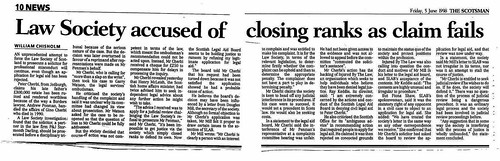
Scotsman 5 June 1998 Law Society accused of closing ranks as claim fails

Law Society accused of closing ranks as claim fails

William Chisholm The Scotsman 5 June Friday 1998

An unprecedented attempt to force the Law Society of Scotland to prosecute a solicitor for professional misconduct will continue, even though an application for legal aid has been rejected.

Peter Cherbi from Jedburgh, claims that his late father's £300,000 estate has been ruined and rendered worthless because of the way a Borders lawyer, Andrew Penman, handled the affairs of Gino Cherbi who died in 1990.

A Law Society investigation found that the solicitor, a partner in the law form P & J Stormonth Darling, should be prosecuted before a disciplinary tribunal because of the serious nature of the case.

But the decision was later overturned in favour of a reprimand after representations were made on Mr Penman's behalf.

Mr Cherbi, who is calling for " more than a slap on the wrist" then took the case to Garry Watson, the legal services ombudsman

He critisised the society's handling of the complaint and said it was unclear why its committee had changed its view about prosecution. Mr Watson asked for the case to be re-opened so that the question of loss to Mr Cherbi could be fully addressed.

But the society decided that course of action was not competent in terms of the law, which emant the ombudsman's recommendation could not be acted upon.

Instead, Mr Cherbi received a cheque for £250 to compensate him for delays in processing the inquiry.

Mr Cherbi revealed yesterday that Henry Mcleish, the Scottish Home Affairs Minister, had twice advised him to seek independent legal advice about any further action he might wish to take.

"The advice I received was to apply for a judicial review, challenging the Law Society's refusal to prosecute Mr Penman", said Mr Cherbi" "Its been impossible to get justice via the society which simply closed ranks to defend its own. Now the Scottish Legal Aid Board seems to be holding justice to ransom, by refusing my legitimate application for legal aid"

The board told Mr Cherbi that his request had been turned down becuase it was not satisfied the application showed he had a probably cause of action.

He believes the board's decision may have been influenced by a letter from Douglas Mill, the secretary of the society. Although no formal objection to Mr Cherbi's application was taken, Mr Mill felt it proper to draw certain issues to the attention of SLAB.

Mr Mill wrote "Mr Cherbi is clearly a person with an interest to complain and was entitled to make his complaint. It is for the Law Society in terms of the relevant legislation, to determine firstly whether the complaint can be upheld and then determine the appropriate penalty. The complainer does not have a part to play in determining penalty"

Mr Cherbi claims the society is keen to head off any judicial interference in its procedures. If his case were to succeed, it would set a precedent in Scots law. He would also be seeking costs.

In a statement to the legal aid board, Mr Cherbi said the interference of Mr Penman's representative at a complaints committee hearing was unfair.

He had not been given access to the evidence and was not allowed to appeal before the committee "commuted the solicitors sentence"

Mr Cherbi's action has the backing of Injured By The law, an organisation which seeks to help individuals who believe they have been denied legal justice. Ray Keddie, it's director said "I am extremely concerned by the actions and conduct of the Scottish Legal Aid Board in denying civil legal aid to Peter Cherbi"

He also criticised the Scottish Office for its "ambiguous advice" in recommending action that required people to apply for legal aid. He claimed it was then rejected on concocted grounds to maintain the status quo of the society and protect positions within the profession.

Injured By The Law was also calling into question the conduct and motives of Mr Mill in his letter to the legal aid board and SLAB's acceptance of the contents. Mr Keddie said ;" The contents are highly unusual and irregular to procedure"

But Fiona Shaw, SLAB's spokeswoman said it was the statutory right of any opponent in a civil case to object to an application for legal aid. She added "We have treated the society's letter in the same way as any other correspondence we receive."

She confirmed that Mr Cherbi's solicitor had asked the board to review the application for legal aid,, and that review was now under way.

In a statement, the society said Mr Mill's letter to SLAB was not irregular in its terms, nor was it an attempt to stall the course of justice.

"Mr Cherbi is entitled to seek judicial review if he wishes to do so. If he does, the society will defend it" . There was no question of the process of judicial review being a dangerous precedent. It was an ordinary legal process and the society had been involved in judicial review proceedings before.

"Any suggestion that in some way the society is interfering with the process of justice is wholly unfounded", the statement concluded.
Scotsman 8 January 1999 Independent watchdog for lawyers proposed

Independent watchdog for lawyers proposed

Law Society of Scotland's internal system flawed, says Scottish Consumer Council

Camillo Fracassini - Consumer Affairs Correspondent The Scotsman 8 January 1999

Complaints against solicitors in Scotland should be investigated by an independent watchdog because self regulation is not working, the Scottish Consumer Council will say today.

The recommendation is part of a highly critical SCC report into the way complaints about solicitors are handled by the lawyers professional body, the Law Society of Scotland.

According to a survey made as part of the study, 40% of those who had used the Law Society of Scotland's complaint's procedure thought their complaint had not been handled fairly.

The Law Society, the solicitors professional body, is also responsible for investigating complaints.

In the study, 415 people were interviewed by the SCC. Even looking at those whose complaints against their solicitors were upheld, shows that a third felt they had been unfairly dealt with.

The report is also highly critical of solicitors.

Of clients who complaint to their lawyers, 16% said they were completely ignored and only 2% were told they could refer the matter to the Law Society.

More than a fifth of solicitors refused to investigate complaints and 40% of people were ignored, "fobbed off", told to change lawyers, or advisd not to complain to the Law Society.

According to the survey, two fifths of complaints took between six months and two years to resolve and 17% took more than two years.

One complainant said "The whole experience was very disappointing. The Law Society was totally in favour of the lawyer. Dealing with the society was like talking to a wall"

Derdrie Hutton, the SCC Chairman, suggested "If consumers are to be confident that the procedures are entirely fair, we believe the research suggests that the way forward should be to establish an independent body to deal with complaints about solicitors in Scotland.

The SCC wants the Scottish parliament to review the Law Society's complaints procedure, with a view to establishing an independent complaints body.

Solicitors should be made to give clients a letter of engagement, setting out how long the work will take, how much it will cost, and advising how to complain if they are not happy with the service, it said.

The SCC added that all solicitors practices should also set up complaints procedures and appoint a specific solicitor to deal with complaints.

Martin Evans, the SCC director, said many people felt the system was biased in favour of solicitors : "They do not appear to trust the self regulatory process and do not trust the Law Society to look after the interests of consumers rather than its members. The lack of credibility of the current system doesn't serve consumers or the legal profession well".

Mr Evans added solicitors were not handling criticism positively : "Solicitors, as a profession, seem to feel threatened by complaints, rather than see them as something which can help them improve the service they provide."

Last night, Philip Dry, the president of the Law Society of Scotland, questioned the validity of the limited SCC survey and insisted self-regulation was still the best policy.

He said; "I continue to believe that a the society is best able to deal with client complaints which it does without cost to the public - and that any system used should be open to public scrutiny and constantly adapted and improved to meet the needs of clients of Scottish solicitors.

"The society does not agree with the recommendations made to the Scottish parliament to set up an independent complaints handling body. The recommendation is not supported by the survey results nor is the suggestion that the current system is fatally flawed".

Mr Dry said the Law Society had significantly improved its complaints procedure since the SCC first recommended the establishment of an independent complaints watchdog in 1986.

In November, it named 11 new lay members to its complaints committee in a bid to tackle the perceived bias.

Between 1994 and 1997 the number of complaints that ended successfully in mediation or conciliation increased by 79% while the number f complaints only rose by 4%.

Gary Watson, the Scottish legal services ombudsman said he remained opposed to an independent body "While I endorse a number of the recommendations made in the report but I would disagree with the prinsiple recommendation for the establishment of an independent complaints body.

"My firm view is that as long as the Law Society is committed to improving the way in which it handles complaints then that is the best way forward for members of the public"

However, Peter Cherbi is still seeking redress more than two years after the Law Society of Scotland overturned its original decision to prosecute a solicitor he claimed was guilty of professional misconduct.

Mr Cherbi, from Jedburgh believes his father's £300,000 estate was effectively made worthless by the lawyers handling of his affairs.

While a Law Society investigation found that the solicitor should be prosecuted before a tribunal because of the serious nature of the case, the decision was overturned in favour of a reprimand after representations on the lawyer's behalf.

Mr Cherbi, who plans to sue the Law Society said "The Law Society of Scotland's complaints procedure is completely biased. There is absolutely no right of appeal for complainants and the ombudsman has no statutory powers - he an only make recommendations which may be refused by the society.

"There must be an independent regulatory for the legal profession with absolutely no ties to solicitors"
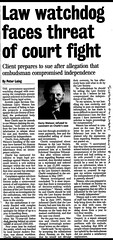
Law Watchdog faces threat of court fight - Scotland on Sunday 9 August 1999

Law watchdog faces threat of court fight.

Client prepares to sue after allegation that ombudsman compromised independence.

By Peter Laing Scotland on Sunday August 8 1999

THE government-appointed watchdog charged with overseeing the complaints process against solicitors in Scotland is himself facing legal action.

Scottish Legal Services Ombudsman Garry Watson has been accused of failing to handle properly a complaint against the Law Society of Scotland, the professional body which represents solicitors.

Peter Cherbi says he intends to sue Watson claiming the ombudsman "took instructions" from the Law Society on what information to release about his case, and, therefore, compromised his independence.

Cherbi, from Jedburgh, says Watson's handling of the case may have harmed his chances of ever recovering a £300,000 inheritance from an incompetent solicitor.

Cherbi has instructed his solicitor to begin legal proceedings against Watson, who could receive a write seeking damages within the next few weeks. It is believed to be the first time anyone has attempted to sue an ombudsman.

Complaints against solicitors are investigated by the Law Society under a controversial system of self-regulation. Anyone who is unhappy with the decision of the Law Society can then ask for an investigation by the ombudsman, who has the power to make recommendations to the society.

But the ombudsman is currently flooded with complex cases, and last month had to apologise for delays of up to a year in handling them.

Cherbi's case started in 1990 when his 73-year-old father died, leaving behind an estate valued at around £300,000.

Four years later he realised the estate, which was handled by local lawyer Andrew Penman, was almost worthless. Cherbi believes the money was lost through avoidable interest payments, fees and the mishandled selling of shares and investments.

Cherbi complained about Penman to the Law Society, who originally planned to prosecute him at a Scottish Solicitors Discipline Tribunal.

But after written submissions regarding Penman were received, they decided instead on a reprimand and ordered him to pay £1000 compensation to Cherbi's estate. Angry at the Law Society's decision, Cherbi complained to the ombudsman in May 1997.

Watson investigated and concluded : "It is most important that there is transparency of decision-making within committees." Watson added he and Cherbi should be told why the Law Society decided not to prosecute Penman.

But un June 1997, Watson informed Cherbi that the Law Society had sent him the written submissions relating to Penman on the basis they remained confidential, and that the case was closed.

For the past two years, Watson and Cherbi have exchanged increasingly acrimonious letters on the subject.

Cherbi said : "In my opinion, by accepting the submissions about Penman on the basis that he would not divulge their contents, he has effectively been told what to do by the Law Society.

"As ombudsman he should be telling the Law Society what to do. I believe he has compromised the independence of his office.

"In my opinion, by not handling my case correctly, and refusing to pass on important information, he has made it more difficult to recover any of the inheritance I lost. For that reason, I have instructed my solicitor to begin proceedings for compensation"

Watson has refused to comment on the case. But in a letter he sent to Cherbi in February last year, he explained why the representations regarding Penman were not passed on.

He wrote "I ascertained that they [the representations] related entirely to the personal circumstances of the solicitor and had nothing to do with yourself. I can certainly see no reason why there should be a need for me to pass on information when it did not relate to, and was not relevant to, yourself. To suggest my actions compromise the independence of my office is patently absurd."

Watson, who was prepared to talk to Scotland on Sunday on general terms, added : "I deny any suggestion that my office is influenced by the Law Society.It is totally independent."

Watson said a new member of staff had been taken on to help bring down the time taken to deal with cases. he hopes to bring the average delay down from a year to two-four months.

The Scottish Consumer Council, in a report released earlier this year, revealed problems with the ombudsman, including that 85% of people whose complaints were not upheld by the ombudsman did not receive a satisfactory explanation.
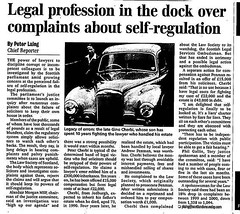
Scotland on Sunday February 2001 - Legal Profession in the dock over complaints about self regulation

Legal Profession in the Dock over complaints about self regulation

Peter Laing 18 February 2001 Scotland on Sunday

The power of lawyers to discipline corrupt or incompetent colleagues is to be investigated by the Scottish Parliament amid crowing concern at the perceived failure of self-regulation in the legal profession.

The parliament's Justice Committee is to launch an inquiry after numerous complaints about the failure of solicitors to keep their own house in order.

Members of the public, some of whom have lost thousands of pounds as a result of legal blunders, claim the regulatory system simply allows solicitors to watch each other's backs. The result, they say is long delays in hearing complaints and paltry punishments when cases are upheld.

The Law Society of Scotland, the body which represents solicitors and investigates complaints against them, rejects the claims and will argue that it should keep its powers of self regulation.

Alisdair Morgan MSP, Chairman of the Justice Committee, said an investigation was "high up our agenda" and there was a strong possibility it would start within months.

Peter Cherbi is typical of the determined band of legal victims who feel solicitors should be stripped of their powers of self regulation. He claims a lawyer's error robbed him of a £300,000 inheritance. Ten Years on, he has been offered £15,000 compensation, but faces legal costs of at least £22,000.

Cherbi, from Jedburgh expected to inherit his father's estate when he died. aged 73, in 1990. Four years later, he realised the estate, which had been handled by local lawyer Andrew Penman, was worthless. Cherbi believes the money was lost through avoidable interest payments, fees and mishandled selling of shares & investments.

He complained to the Law Society, which originally planned to prosecute Penman. After written submissions, it decided on a reprimand and ordered him to pay compensation worth £1000.

Cherbi then complained about the Law Society to its watchdog, the Scottish Legal Services Ombudsman. But that has ended in acrimony and a possible legal action against the ombudsman.

A separate action for compensation against Penman resulted in an offer of £15,000 from his solicitors. Cherbi said "That is no use because I have legal costs for fighting my case of £22,000 and the estate is £43,000 in debt..

I am delighted that self-regulation is finally to be looked at. It's a liars' charter written by liars for liars. They sit on each other's committees and they are obsessed with protecting each other. "There has to be independent regulation with public participation. The victim must be able to get a fair hearing"

Phil Gallie, Tory Justice spokesman and a member of the Committee said "I have had a number of people coming to me with cases, four or five in the last six months. Some of these cases have been outstanding for several years"

A spokesman for the Law Society said there had been a 18% drop in complaints between 1999 and 2000, down from 1,338 to 1094 .
Monday, October 15, 2007

OFT await SNP plans on access to justice reforms as Law Society demands protection of market monopoly & regulation.

While our Justice Secretary sweats over whether to fully implement the OFT's recommendations on reforming access to justice & legal services, a few of you have been asking my thoughts about the Legal Profession and Legal Aid (Scotland) Act 2007

The LPLA (Scotland) Act was passed, to address significant concerns over regulation of the legal profession.However, the LPLA (Scotland) Act we have now, a watered down version of what was initially planned is a watered down version of what was initially planned, and that is due of course, to protests from the legal profession during the consultation phase of the LPLA Bill through the Parliament in 2006, and amendments lodged by MSPs allied to the legal profession during the LPLA Bill debate at Holyrood in December.

The LPLA (Scotland) Act, does something for regulation of the legal profession, in terms of bringing about the Scottish Legal Complaints Commission, who will to a degree, oversee the investigation & regulation of service complaints against solicitors, but regulation of conduct complaints, and the disciplinary process, is still handled by the Law Society of Scotland.

The LPLA (Scotland) Act, therefore, falls down on removing regulatory and disciplinary procedures from the legal profession in their entirety, and while it is the case that lawyers can regulate their colleagues, or discipline their colleagues, there will be no true transparency or accountability in regulation of the legal profession in Scotland until the SLCC gets the necessary powers to deal with all complaints against solicitors while also handling disciplinary procedures.

A quick example of the SLCC as it currently stands would run something like this :

A client makes a service complaint against their solicitor.

The SLCC & Law Society argue as to whether it is indeed a service complaint, with the Law Society trying to take control of the complaint designating it a "conduct issue", resting in their remit, rather than a "service" issue, resting with the SLCC.

The SLCC win their argument, investigate the complaint, find the solicitor guilty of poor service, then ask the Law Society to prosecute the solicitor on particular issues.

The Law Society prosecute the solicitor, either bungling the case deliberately, or through incompetence, and the solicitor who was found guilty by the SLCC after an investigation of the client's complaint, escapes justice yet again.

Not an ideal arrangement, but one which has been foisted upon us by the Law Society's demand to retain a regulatory & disciplinary role with regard to complaints against solicitors.

The question would then be, will Kenny MacAskill as Cabinet Secretary for Justice, or the SNP administration currently in charge of the Scottish Executive, change such arrangements so the SLCC will handle all regulatory & disciplinary matters involving the legal profession ?

I think the answer to that one isn't particularly clear, when actually it should be clear.

If the LPLA (Scotland) Act and the Scottish Legal Complaints Commission don't property address the failures of regulation of the legal profession, Scotland should surely expect it's Executive or Government to address any failures and remedy the problem accordingly ?

Well, you would think that to be the case, but time is ticking and the failure to progress issues such as the well known sins of the past by the legal profession, where countless solicitors remain in practice who have effectively ruined clients lives with the backing of the Law Society of Scotland, do not bode well for confidence in the current administrations ability to bring about an end to injustice, caused by the justice system as currently controlled it seems, by itself.

Another question which was put to me was : Would any political party have passed the LPLA (Scotland) Act. I think we all know the answer to that one.

I doubt that any political party other than Labour, would have been able to pass the LPLA (Scotland) Act.

For a start, Labour had the numbers in the Parliament in their favour, and also the backing of Westminster, who themselves, have seen just as many representations from constituents in Scotland who have encountered problems with the legal profession & crooked lawyers.

The Conservatives certainly would not have passed any laws which took away regulation by solicitors of complaints against solicitors or passed anything which would have increased fines for crooked lawyers, or compensation payments to ruined clients. Indeed there were some within the Conservative party who worked against the LPLA (Scotland) Act, such as Bill Aitken MSP, now bizarrely, the Convener of the sole Holyrood Justice Committee. Mr Aitken attempted to limit the scope and remit of the LPLA Bill during it's parliamentary phase, debate & eventual vote, to the point of making the legislation useless

Yes, there are some within the Conservatives (I count one) who have done much for their constituents with regard to such legislation, and indeed it was a Conservative who in-effect, started the ball rolling on what eventually became the LPLA (Scotland) Act, but that MSP, none other than Phil Gallie, is no longer at Holyrood, and I doubt the Conservative party leadership if god forbid, they were ever in charge of the Scottish Executive again, would have passed such lawyer busting legislation.

The LibDems, while being part of the former Labour/LibDem Scottish Executive who did pass the LPLA (Scotland) Act, were not for the majority, a willing partner in the progress of the LPLA Bill hearings at Holyrood.

If the LibDems were solely in charge of the Scottish Executive, I do not believe they would have proposed or passed such legislation, and indeed, a LibDem English Peer, Lord Lester of Herne Hill QC was employed by the Law Society of Scotland to opinion a legal challenge against the LPLA (Scotland) Act by threatening court action against the Scottish Executive & Parliament

Lastly we come to the SNP.

Given John Swinney's now famous skirmish with Douglas Mill before the Justice 2 Committee over a secret memo, where it was revealed Mr Mill was interfering in negligence claims against solicitors interfering, and Mr Swinney's representation of constituents who have problems with the legal profession and the Law Society, I would have to say the SNP might have passed the LPLA (Scotland) Act if they were solely in charge of the Scottish Executive, but that's only a "might".

There are many who believe the SNP would not dare disobey a substantial influence from the legal profession within their party to propose and pass such law reforming legislation as the LPLA (Scotland) Act ... and admittedly, the SNP are yet to prove their track record on the justice system and reform of the legal profession as these areas, strangely, have been left out of significant proposals up to now.

In short, the SNP have everything to prove and everything to lose, on justice, access to justice, and injustice. Are they up to the challenge ? The clock is ticking on justice & injustice and so far, there are little developments which could without doubt be said to put right the sins of the past ...

Today in the Scotsman, there is an interesting piece on Kenny MacAskill's performance as Justice Secretary.

The report predictably is focused on the Law Society of Scotland's fears over implementing the OFT's recommendations for wider access to justice, and thus breaking the centuries old monopoly held by solicitors & advocates over legal services - the prime money spinner for the Scottish legal profession.

In fact, reading the piece today, one could be forgiven for thinking the public interest and surely the right of every individual to access to justice & legal services, takes second place to the apparent right of solicitors & the Law Society of Scotland to retain their monopoly and decide who gets access to justice and who does not. A justice system fit for a 'banana republic' perhaps ?

Isn't it about time our politicians started giving the public some benefit instead of the professions ? Where are the reforms and inquiries into injustice we are due ?

Read on for the article from the Scotsman :

How has Kenny MacAskill fared in the hot seat ?

JENNIFER VEITCH

BY THE time the Office of Fair Trading (OFT) started looking at that Which? super-complaint in May, the political landscape had shifted - Labour were out and the SNP were in, albeit by a nose.

So a new justice secretary has been left with the task of responding to the OFT's recommendations and reacting to the legal profession's inevitable concerns about potentially seismic changes to the legal services market.

To an extent, Kenny MacAskill has been able to hit the ground if not running, then jogging. In the eyes of lawyers at least, he does enjoy one major advantage over Cathy Jamieson, his predecessor because, before switching careers to become an MSP in 1999, he was a practising solicitor for 20 years.

The MSP for Edinburgh East and Musselburgh knows from past and relatively recent experience what it's like to be a lawyer dealing with the everyday challenges of demanding clients.

Combined with his experience of the legislative process in parliament, that should make him a seasoned legal veteran.

So as the profession awaits the Scottish Government's response to the OFT's recommendations with some trepidation, will he adopt a softer approach to the previous administration, once colourfully accused by the Law Society of Scotland of "naked lawyer-bashing"?

In other words, whose side will MacAskill be on?

Anyone attending the recent Law Society of Scotland conference on alternative business structures knows that there are several to competing interests to choose from.

Should he listen to big firms who want to compete with English rivals, or small firms who want to protect access to justice? Or middle-class consumers who want a better deal when shopping around for conveyancing services, or working-class people who can't afford to pay for a lawyer in the first place?

At the conference, MacAskill seemed to be trying to tread the very fine line between spelling out that change was inevitable - and without "endless" time to navel gaze on what exactly that change would be - and trying to convince the profession that he was still on their side. Up to a point, anyway.

Apart from a slightly clumsy attempt at a football league analogy - I'm not sure quite how many firms would like to be compared to the Old Firm, let alone Stirling Albion or Gretna - his speech appeared to be well-received.

He made the right lawyer-friendly noises about protecting and indeed promoting the integrity of the Scottish profession and the legal services market.

He also made it clear that he was not afraid to go a different way from Westminster and would not "blindly follow" the Clementi blueprint.

Yet, given the recent spats between Messrs Salmond and Swinney and the Labour government at Westminster, over everything from the financial settlement to foot-and-mouth disease, MacAskill may have to reassure those who fear the Scottish National Party may seek to preserve difference from England for its own sake rather than the good of Scotland.

If he does seek to press ahead with reforms before Clementi takes effect in England at the turn of the next decade, he will need to show the profession there is a sound basis for change at such a fast pace.

MacAskill is now facing a tough test. He will have to weigh the profession's concerns and decide whether there is hard evidence that alternative business structures will harm the public interest. If he finds none, then firms will have to deal with the consequences.

But, however much MacAskill's brain still works like that of a lawyer, his instincts will be those of a politician. If it comes to the crunch, who is more important in winning votes - lawyers or consumers?

Saturday, October 13, 2007

Lawyers look after their own - Legal Aid fraud lawyer faces no charges as Crown Office avoids explanation

Scotland's unaccountable prosecution service continues to avoid prosecuting it's own, as Paul Kirk, no longer a solicitor because he took his name off the practicing roll, escapes charges of legal aid fraud, where if it had been a member of the public claiming legal aid, the book would certainly have been thrown at them ...

Allegations abound the Law Society of Scotland intervened in the case, of the order "We wish to point out there was no loss to the taxpayer as the sums wrongly claimed have been repaid, therefore it might not be in the public interest to pursue a prosecution".

Might not be in the public interest to prosecute a legal aid fraudster ... but it's usually deemed necessary to prosecute ordinary members of the public who are legal aid fraudsters (depending on who they are of course) .. so why not prosecute Paul Kirk .. after all, he committed fraud, and fraud is certainly a criminal offence ... as the Legal Aid Board reminds everyone who claims legal aid ...

Mr Kirk is of course, not the only lawyer who is defrauding the legal aid board just now ... as a list of some 30 plus solicitors under suspicion seems to indicate .... and this could be put down to the lack of an accountable & transparent professional regulator, where the Law Society of Scotland, the current governing body for solicitors, has caused the very low professional standards & corruption which are causing these kinds of headlines - and they are no good for the honest lawyers out there, or clients confidence in the legal profession to represent their affairs.

The Law Society of Scotland, in it's stewardship of the Scottish legal profession bear sole responsibility - too concerned with protecting their own backs & colleagues from client complaints or prosecution over a wide range of matters, among them some criminal, they gave up protecting the public interest a long time ago in favour of their own, and that is why lawyers will defraud the legal aid board, because they know they can mostly get away with it.

Quoting the Scotsman article who report a statement from the Scottish Legal Aid Board :

A spokesman for the SLAB said it did not have a total figure for Mr Kirk's case, but it had received a repayment from him and was confident there had been no loss to the public purse. The matter had been reported to the police, he said, but it was understood there was to be no criminal prosecution.

That would fit in nicely with current practice in the legal profession or anything to do with it - in other words, don't be too specific or condemn members of the Law Society of Scotland ...

The statement from the Crown Office, of course, was true to form, again from the Scotsman :

The Crown Office confirmed it had received a report in relation to Mr Kirk, and said: "After careful consideration of all the available facts and circumstances, it was concluded that there should be no proceedings in this case."

That would seem to fit in with standard procedure - try not to prosecute members of the legal profession because it will upset the Law Society of Scotland .. and might just give rise to others coming forward with similar tales of lawyers engaged in fraud ...

In fact, the Crown Office seems to shield members of the legal profession so much, recently when it was asked for the statistics on criminal charges against members of the legal profession & prosecutions, the journalist concerned had his career threatened ... so what do they have to hide ?

It was fine for the public to learn the numbers of Police Officers who had criminal records, or had been prosecuted for offences .. so why don't we get to know about lawyers who have criminal records or who have been prosecuted too ? What's the big secret Madam Lord Advocate ? and why nothing from the Justice Department of the Scottish Government on this either ?

Following article from the Scotsman :

Lawyer fined £10,000 for legal aid con - but will face no criminal charges

JOHN ROBERTSON LAW CORRESPONDENT

A LAWYER who escaped prosecution after he was twice caught cheating the legal aid fund has been fined £10,000 for professional misconduct.

Paul Kirk, 48, fiddled his records to double-charge for work and to apply for excessive fees from the Scottish Legal Aid Board (SLAB).

He had been given a second chance after claiming initial discrepancies were due to an administrative mix-up.

It is estimated the scheme netted him about £35,000, and, although Mr Kirk, of Uddingston, Lanarkshire, was reported to police, he is not to face criminal charges.

Suspicion had been raised because of Mr Kirk's high earnings, of more than £300,000 a year, and investigators uncovered overcharging by someone who "seemed to be busy doing nothing".

In one instance, Mr Kirk charged for a meeting with clients when he was, in fact, in talks with SLAB auditors.

The Scottish Solicitors' Discipline Tribunal would have been expected to hand down its severest penalty, by striking him off, but it was unable to do so because he had already resigned.

The tribunal said in a judgment issued yesterday that it could do no more than impose a censure and a financial penalty, £10,000 being the maximum fine within its powers. It repeated a call made in another recent case for a change in the law so rogue lawyers could not jump before they were pushed.

Mr Kirk had been a solicitor for 20 years when, in 2002, he started his own firm, operating a criminal practice mainly in Hamilton and Glasgow sheriff courts. He became one of the top five legal aid earners among sole practitioners, receiving £322,080 in 2002-3 and £311,037 in 2003-4; SLAB became "concerned" at the level of his earnings, the tribunal said.

An analysis of Mr Kirk's timesheets disclosed "serious discrepancies pointing towards excessive charges being intimated". Asked if Mr Kirk could have been making mistakes with his accounts, a SLAB witness said he did not think so, as the mistakes were always in Mr Kirk's favour and appeared to be a consistent practice.

Mr Kirk was threatened with being removed from the legal aid register, but through his solicitor he maintained it had been a "mix-up" and he was given another chance. He was said to be a good lawyer, but not good with administration.

"Regrettably, he failed to take this opportunity and as a result of further analysis carried out by SLAB ... it was revealed that he was once again engaged in the duplication of charging and the submission of accounts seeking excessive payments," the tribunal said.

The analysis had been based on a 15 per cent sample of the accounts submitted by Mr Kirk for cases between 2002 and 2004. From these, SLAB had identified 30 occasions when he had double-charged, and the amount overpaid to him was £3,843.

The matter had been reported to the Law Society of Scotland, which lodged a complaint against Mr Kirk with the tribunal. He was informed, but he did not appear at the hearing before the tribunal, and he was not represented.

The tribunal held that Mr Kirk had been guilty of professional misconduct. It said: "The tribunal was satisfied beyond reasonable doubt that [Mr Kirk] had acted in a dishonest fashion in submitting inaccurate accounts to SLAB which resulted in him receiving extremely large sums of money to which he was not entitled."

The judgment went on: "The tribunal considers that his behaviour in relation to his fraudulent claims to SLAB strikes at the very heart of the obligations of honesty and integrity which are incumbent upon every solicitor.

"The tribunal would again urge the Law Society to make representations to the Scottish Executive to amend the relevant legislation to ensure the Law Society can refuse to permit the name of a solicitor to be removed from the Roll [of Solicitors] when disciplinary action is pending."

A spokesman for the SLAB said it did not have a total figure for Mr Kirk's case, but it had received a repayment from him and was confident there had been no loss to the public purse. The matter had been reported to the police, he said, but it was understood there was to be no criminal prosecution.

Sources suggested the sum involved had been estimated at around £35,000.

The Crown Office confirmed it had received a report in relation to Mr Kirk, and said: "After careful consideration of all the available facts and circumstances, it was concluded that there should be no proceedings in this case."

Scotland's corrupt justice system - worthy of a 'banana republic' and obstruction to independence.

Another fine week has passed for the Scots legal system, which began with the UN Observer to the Lockerbie trial referring to Scotland as having the reputation of a 'banana republic' for our legal system, due to the handling of the Lockerbie trial.

Hans Köchler is correct, but the failures of the Lockerbie trial run wide & deep in Scots Law, and have done so for many years prior to the trial of Abdelbaset Ali Mohmed al-Megrahi at Camp Zeist for the bombing of Pan Am flight 103 in 1988, killing 259 people.

Quoting the Sunday Times article :

"It has been alleged that evidence relating to a timer device was planted by investigators to implicate the Libyan as responsible for the bombing that claimed the lives of 259 people when Pan Am flight 103 was brought down in 1988.

Köchler said he believed the Crown Office regarded Megrahi as a "headache" and wanted him out of Scotland to avoid further embarrassment.

"They would prefer to have him out of the country and have the entire legal case collapse without asking any further questions." he said.

"But I think it won't be so easy because there are still some people in Scotland who are committed to the rule of law and who do not want the country to appear like a banana republic because that is what it is, for me, after I have followed [the case] over so many years

Convenient for those in the legal system .. and some now in the Executive it would seem, that Mr Megrahi be shipped out of Scotland, and indeed, have no need to ask any questions of what actually took place .. and before you say, oh, the current Executive are going to hold an inquiry ... don't be too sure on that one. What politicians say, verses what they do, no matter who they are, are two very different things ...

Going even further, Hans Köchler took issue with the SNP call for independence, citing that Scotland needs a proper accountable judicial system before thoughts of independence should be progressed. Again, Mr Köchler is correct, and while the truth may be unpalatable to some, taking a country independent with a crooked corrupt judicial system, which is what we have currently in Scotland, will be in the worst interests of the public.

Referring back to the Sunday Times article once more :

"If they aspire to independence then they should show they can do things in the right way in the judicial domain, in devolved areas, and if they cannot do things in the right way and if they handle judicial proceedings like intelligence operations then in my view the aspirations towards independence are not very well founded."

If we cant get Justice right for our own people, we don't deserve independence - not until we clean up the acts of the Judicial & legal system which has been allowed to run itself for so many years, and influence politics & politicians to prevent reforms in the public interest.

Oh yes, some may argue that a fairer Justice system would come after independence, but do any of you really believe that ? I certainly don't, and I can assure you, if you need any assuring, the Judiciary and those within the legal system will have even more power to do what they want post independence, if we don't clean up their act before such a radical step for Scotland is taken ...

Here is the Sunday Times report on Hans Köchler and comments on the Lockerbie case, taken from here :

UN observer says Scots law is flawed
Mark Macaskill

THE United Nations observer at the Lockerbie trial, Hans Köchler, said that Scotland has the reputation of a "banana republic" because of its handling of the case.

The academic, who advises the European Commission on democracy and human rights, said Scotland does not deserve to be granted independence until it addresses the failings within its judicial system.

He was responding to reports that evidence that would have undermined the crown's case against Abdelbaset Ali Mohmed al-Megrahi, the Libyan convicted of the atrocity, was withheld from his defence lawyers. It has been alleged that evidence relating to a timer device was planted by investigators to implicate the Libyan as responsible for the bombing that claimed the lives of 259 people when Pan Am flight 103 was brought down in 1988.

Köchler said he believed the Crown Office regarded Megrahi as a "headache" and wanted him out of Scotland to avoid further embarrassment.

"They would prefer to have him out of the country and have the entire legal case collapse without asking any further questions." he said.

"But I think it won't be so easy because there are still some people in Scotland who are committed to the rule of law and who do not want the country to appear like a banana republic because that is what it is, for me, after I have followed [the case] over so many years.

"If they aspire to independence then they should show they can do things in the right way in the judicial domain, in devolved areas, and if they cannot do things in the right way and if they handle judicial proceedings like intelligence operations then in my view the aspirations towards independence are not very well founded."

Köchler's comments follow speculation that a US intelligence document, which disputes claims that Megrahi used a digital timer bought from a Swiss company and then planted the bomb on a flight from Malta to Germany — was shown to senior crown officials but never disclosed to Megrahi's defence team.

It is understood to be one reason why the Scottish Criminal Cases Review Commission, which spent three years considering the safety of Megrahi's conviction, decided last June to refer the case to Court of Appeal.

"My most serious concern is about the timer, because if something was indeed inserted, that would have devastating consequences for the entire judicial and political system of Scotland and of the United Kingdom " Köchler added.

Sources close to the case have claimed that evidence was fabricated to implicate Mohammed Abu Talb, a Palestinian terrorist, before the focus of the investigation switched to al-Megrahi and Libya in 1989.

Doubts have also been raised over evidence given at the trial by Tony Gauci, the Maltese shopkeeper who claimed he sold Megrahi clothing that was wrapped around the bomb. Last week, well-placed sources claimed that Gauci and his brother Paul were paid about £2.5m by the US intelligence services soon after Megrahi's appeal collapsed in 2002. Details of the alleged payment emerged in 2005 when one of Gauci's relatives sought legal advice in an attempt to claim a share of the money.

Köchler's intervention will be a blow to the Crown Office, which is still reeling from the collapse of the World's End murder trial. In August, the trial judge Lord Clarke threw out the case against Angus Sinclair ruling there was not enough evidence for the jury to reach a verdict.

An unseemly public row ensued between Lord Hamilton, the lord justice general, and Elish Angiolini, the lord advocate, after she insisted there had been a strong enough case to put to the jury.

"The whole Lockerbie affair has not been a good advertisement for Scottish justice but there is now the opportunity to rectify what went wrong," said Professor Robert Black from Edinburgh University, who brokered Megrahi's trial at Zeist in the Netherlands.

"Provided the lessons are learned then the experience could yet prove to be a beneficial one. Köchler cast doubts over the quality of the evidence after the trial. He wasn't taken seriously at the time but all credit to him, they are now coming to the surface," said Black.

Alex Salmond, the first minister, dismissed Köchler's remarks.

"The strength of the legal system is in the processes it adopts to ensure justice is done and seen to be done. The fact that the Lockerbie conviction is going before the Court of Appeal is not a sign of weakness, it's a sign of strength in our legal system.

A spokeswoman from the Crown Office, said: "It would be inappropriate to comment while the case is yet to come before the appeal court."

Tuesday, October 09, 2007

Law Society intervention in claims 'commonplace' as ex Chief admits Master Policy protects solicitors against clients

Kenneth Pritchard, Douglas Mill's predecessor as Secretary & Chief Executive of the Law Society of Scotland, admitted as far back as 1994 in the media the Master Insurance Policy professional negligence insurance scheme was primarily "... there to protect the solicitor, his practice and his family...".

Policy is to protect both says Law Society Herald 1994 Retype

The Herald Wednesday August 17th 1994

Policy is to protect both says Law Society

Law Society secretary Kenneth Pritchard described as "utterly wrong" claims that solicitors professional indemnity insurance sets out to deny genuine claims for negligence and delay settlements to clients.

Mr Pritchard was responding to allegations made by Paisley house builder Iain McIntyre that solicitors insurance protects the profession at the expense of the client.

Mr Pritchard made it clear that he did not wish to comment on the conduct of any court action currently being pursued by Mr McIntyre and restricted his comments to the operation of the master policy for professional indemnity insurance operated by the Law Society.

"The master policy, in common with any other third party policy, is there to protect solicitors, but also to provide indemnity to their clients who have suffered loss. That is absolutely no different from any other third party type of policy, for example car insurance"

The Government has legislated that nobody can drive on the public highway without having third party insurance. The Law Society, in the interests of its members and the public, requires a solicitor in private practice to hold cover under the master policy before he gets a practicing certificate.

The only difference between third party insurance and the master policy is that it is imposed by the solicitors own body and not by the Government.

"Of course it's there to protect the solicitor, his practice and his family, but it's equally there to provide a fund for proper compensation to the client who has suffered loss"

Mr Pritchard complained that while the Law Society organised and administered the master policy and ensured that it provided the necessary range and amount of cover, negotiations over a claim were a matter for the client, solicitor and insurer.

He described the suggestion that the system operates to deliberately delay settlements or deny settlement when it was due as utterly wrong.

The Law Society's rule is to monitor what the master policy is intended to do and that it is to deal speedily and effectively with claims. In the main we are quite satisfied, although there are cases which go wrong.

There are two quite separate issues, the first being liability.Were the solicitors negligent ? If that is established, the second big issue is how much does the client get paid ?

There is an inevitable regulation - indeed there may well be an inevitable gulf - between what the client perceives as justified and what the insurers backed by their experience of settlements awarded by the courts, believe that a particular claim is worth.

Mr Pritchard also denied the allegation that firms which carry an excess on their insurance policies try to avoid liability because cash would have to come from their own pockets.

My perception from talking to firms is that, if they accept that the claim is due, the sooner it gets settled the better. There is no advantage in haggling over liability or the amount of damages because all you are doing at the end of the day is adding interest to the claim.

What lay behind that 1994 report in the Herald newspaper, were revelations that Kenneth Pritchard intervened in negligence claims against the legal firms of Wright & Crawford of Paisley, MacRoberts of Edinburgh, and Grant & Co, writing to the petitioners legal representatives, Skene Edwards Solicitors, on 21 June 1995, asking them to "protect their back" and that such correspondence would remain confidential between Mr Pritchard and Skene Edwards Solicitors, the petitioner's legal agents, and should not be disclosed to the client, Mr McIntyre.

Extract of negligence case

As you can see from the above extract of pleadings, Kenneth Pritchard, apparently not satisfied with the terms of his previous letter, then wrote back to Skene Edwards Solicitors , two days later on 23 June 1995, ordering them to withdraw acting for their client in the negligence litigation against several legal firms.

You can read some more about Iain McIntyre's case on the Scottish Parliament website in pdf format HERE

Kenneth Pritchard is currently a serving Sheriff, and has unbelievably, written a book on professional negligence. The book must be very insightful on how to protect the legal profession from the public interest .....

Kenneth Pritchard's involvement in the above case, is certainly evidence enough the Law Society of Scotland directly intervene in clients negligence claims against solicitors ... and to continue the theme of Law Society intervention, Mr Pritchard's successor, Douglas Mill, was again, caught interfering in a client's negligence action, this time by the details of his own memo where Mr Mill, and various elements within the Law Society and the insurers, were seeking to delay & destroy several negligence claims by Mr Stewart MacKenzie against solicitors.

Douglas Mill Memo to Martin MacAllister 5 July 2001

My own case too, has seen such intervention, with Douglas Mill directly intervening with the Scottish Legal Aid Board to cancel my legal aid funding for (i) a negligence claim against a solicitor and (ii) a case against the Law Society of Scotland to expose their mishandling of claims & my complaint against Andrew Penman.

Scotsman 5 June 1998 Law Society accused of closing ranks as claimi fails

Mr Philip Yelland, the Law Society's Director of Regulation, then contacted my own solicitor, akin to Mr Pritchard's interference in the other case, ordering my legal agents not to undertake instructions from me and to abandon my case.

Douglas Mill letter to Scottish Legal Aid Board demanding legal aid be refused

Philip Yelland letter to David Reid ordering him not to take instructions

Well, there is no surprise to learn that such 'intervention' by the Law Society of Scotland is commonplace against clients who try to claim compensation against a crooked lawyer, or pursue a negligence case using a lawyer to sue a lawyer which is the current & only method for pursuing cases against solicitors ....

The Scottish Government of course, know this to be the case. They are not as stupid or ignorant as they pretend to be. Indeed, John Swinney MSP, spoke on the issue of Kenneth Pritchard's intervention in the above case, during the LPLA Bill debate in December, and you can view Mr Swinney talking about it here :

Similarly, the Scottish Parliament and every single one of it's msps, are well aware of these problems of incessant Law Society intervention against any court case or complaint, or claim for financial loss which threatens member solicitors.

If everyone knows about it, when why is nothing done about it ?

Well, the simple answer to that question is the Law Society and the legal profession require that no action be taken to protect the public interest, over the interests of solicitors, and politicians are left in no doubt that if they support legislation which might end the corrupt arrangements of the Master Insurance Policy, they will be facing electoral oblivion or a lack of financial perks so many have been used to.

Any client of a crooked lawyer, who has tried to make a claim for damages against their negligent solicitor has certainly found this to be true, with the full wrath of the legal profession & insurance industry dirty tricks brigade being brought to bare on them. I among them.

I covered some of the dirty tricks carried out by the Law Society of Scotland, Marsh UK, and the insurers against client claims in an earlier article here : The Corrupt Link Revealed - How the Law Society of Scotland manages client complaints & settlements.

To this day, the Scottish Government, and it's previous incarnations, have afforded obsessive secrecy to the operation of the Master Insurance Policy which 'protects the solicitor, his practice and his family' for reasons it seems, the Government itself may significantly benefit financially, from it's own direct relationship with Marsh UK and the same insurers.

In an earlier article I wrote on the Scottish Executive's in house legal team, an FOI revealed the cost of running some 114 lawyers at around 5 million pounds, although that figure is now understandably suspect, given further revelations since i wrote the piece here : Scottish Executive budget on lawyers salaries revealed at over £5 million pounds while public face restrictions on legal representation

In an effort to get to the heart of the seemingly impenetrable workings of the Master Insurance Policy during the progress of the LPLA Bill through the Scottish Parliament, a short lived saga developed, where John Swinney MSP, at the time in opposition, wrote to the then Deputy Justice Minister Hugh Henry MSP, asking for "minutes of any meetings that may have taken place between the Scottish Executive, the Law Society, the brokers & the insurers for the Master Policy in connection with any provisions within the BILL that may affect the Master Policy."

Johann Lamont to John Swinney Master Policy Minutes respose

A few days after Johan Lamont MSP responded to Mr Swinney, the Scottish Executive had apparently consulted the Law Society of Scotland and decided against releasing any information, sending Mr Swinney a two page letter excusing themselves from release of the information, on grounds of disclosure not being in the public interest - this coming after an apparent demand from the legal profession to keep the information secret.

Mike West to John Swinney Master Policy Minutes response denial  Page 1Mike West to John Swinney Master Policy Minutes response denial  Page2

Mike West, of the Justice Department, responded for the Executive, denying release of the information ...

"We endeavor to provide information whenever possible. The information you requested is related to the Legal Profession and Legal Aid (Scotland) Bill which is currently going through it's parliamentary process. As this information is a contribution to the formulation and development of government policy, it is exempt from disclosure under Section 29(1)(a) of the Freedom of Information (Scotland) Act 2002 which states the information held by the Scottish Administration is exempt information if it relates to the formulation or development of government policy.

In addition, as the information you requested consists of ongoing deliberations to assist with development of policy, it is likely to inhibit substantially the free and frank provision of advice, and free and frank exchange of views, and is thus exempt from disclosure under section 30(b)(i) and (ii) of the 2002 Act.

In reaching our decision about releasing the information, we have applied the 'public interest test' where we carefully weigh up the balance between whether it would be in the public's best interest to either release or withhold the information. We considered that, release of information would be likely to result in the loss of input into policy development from valuable stakeholders. On both occasions, we considered that it would not be in the public interest to release the information."

Interestingly, the Scottish Executive at the time obviously felt unable to release discussions with a well known to be corrupt insurance policy arrangement with the legal profession, because it would apparently be 'against the public interest to do so' .... I wonder why that could be ?

John Swinney MSP duly replied to his constituent on December 11 2006, informing Mr MacKenzie of the Scottish Executive's refusal to release the information sought on meetings over the Master Policy.

John Swinney to Stewart MacKenzie Master Policy Minutes response apology

Of course, now that Mr Swinney is in Government, as the Cabinet Secretary for Finance, there should be no problem in his ordering the release of such information, and I await with interest to see if he does so, defying the commands of the legal profession to the contrary ...

After all, you can't have meetings & policy discussions on external insurance arrangements for public bodies which are supposed to be outside the control of government, and then tweak proposed legislation (which may run counter to that same public body's interests) to suit, unless there is a degree of collaboration & involvement in those issues & insurance arrangements, which it seems are certainly against the public interest, not for it ...

Friday, October 05, 2007

In-fighting, legal aid fraud, theft, & dishonesty typifies poor standards of Scotland's legal profession.

Scotland certainly had an interesting week on the legal front ...

Developments in the World's End trial collapse saw the Lord Advocate & Lord Justice General kiss & make up after falling out over the Lord Advocate's shifting of blame from the usual Crown Office failures to judicial failures ...

The Lockerbie trial - that oh-so-honest international barometer of Scots justice which Westminster & Washington held up as a job well done against terrorism, saw allegations that witnesses were apparently offered millions of dollars for favorable testimony ... not a job well done then as it turns out

The Lord Advocate came in for more criticism she was trying to shield Colin Boyd from the promised inquiry into the Shirley McKie fingerprint scandal, where some in the political & legal system decided it was in their best interests to persecute & fit up Shirley McKie, a then serving Detective with Strathclyde Police, than admit the SCRO got it wrong ...

.. and while the Scottish Legal Aid Board reluctantly troubled themselves to investigate a staggering £1.8million pound legal aid fraud, where the wife of the solicitor who was definitely on the fiddle, and committed suicide when investigations began into his activities, allegedly agreed to pay back the £1.8million pounds her late husband falsely claimed in legal aid payments from the taxpayer.

and of course not forgetting the Paralegal who is up in court for allowing a property to be used to sell drugs, and finally, the lawyer arrested in connection with the theft of Davinci's 500-year-old Madonna with the Yarnwinder, owned by the late Duke of Buccleuch.

My my .. .don't we have a great legal profession in Scotland, never out of trouble .. even with each other sometimes.

If they aren't stealing from the clients these days, they are stealing from the taxpayer, or helping themselves to antiquities of significant value .... a common enough occurrence in the Scottish Borders, where I once remember a lawyer's safe stashed with valuables from deceased clients ... if only those families of the deceased clients had done something about it ... or even if only they knew ...

Despite all of this, not much news out of the Scottish Government on reforming the legal profession, and stripping them of their prized regulatory powers, which are to be shared with the new Scottish Legal Complaints Commission, which I'm sad to say, seems to be turning into a fairly crooked affair on it's own after word reached me today that a few of the usual suspects are being appointed on orders of the Law Society of Scotland to make sure crooked lawyers still get off the hook ...

Well, with the polluted incestuous system of 'lay membership' we have in Scotland, which the shiny new SNP Scottish Government hasn't tackled yet, and needs to soon, can we expect anything else ? How can justice be seen to be done with everyone sitting on each others committees ?

I wonder what people will think of the Scottish Legal Complaints Commission when to act against the client interest just like the Law Society of Scotland when investigating complaints ... perhaps in the way some of you suggest in comments & emails which, for your own protection, and mine, I simply can't publish !

Perhaps even, clients should form their own investigative commission to look into complaints against lawyers, and then challenge the likes of the SLCC when it might perhaps, carry on the same culture of injustice where the Law Society left off ?

Finally, since it's Friday, here's a 20 minute video challenging the notion of mob rule in Jedburgh, my former town of residence in the Scottish Borders, where the youth have, allegedly run riot, terrorising elderly residents & tourists. The film has apparently been made by some of the young people in the town who want to put their own side of the story - something ex-provost and now SBC Tory Councillor Len Wyse didn't allow much when he was on the Community Council.

A few articles from the Scotsman & Herald this week relating to the above ...

Widow agrees to return £1.8m legal aid cash falsely claimed by solicitor

MICHAEL HOWIE HOME AFFAIRS CORRESPONDENT

A SOLICITOR "embellished" claims for legal aid in child welfare cases with false details of sex abuse to fraudulently obtain nearly £2 million, The Scotsman can reveal.

In Scotland's biggest-ever legal aid fraud, James Muir made false claims for public money in hundreds of child protection cases over seven years.

Mr Muir, who kept a low profile in the profession but was regarded as one of the country's most dedicated and experienced specialist child welfare lawyers, committed suicide after the police began investigating.

Details of the case have been kept secret for two years while the Scottish Government's civil recovery unit sought to reclaim the money from his estate.

Yesterday the Scottish Legal Aid Board (SLAB) announced that an agreement had been reached with Mr Muir's family that will see £1.8 million paid back to the public fund.

Last night politicians demanded answers over how such abuse could go undetected for so long.

SLAB claimed the "tragic case" was a one-off and insisted it had improved procedures for checking legal aid claims.

Mr Muir's wife Susan, believed to be a serving police officer, has sold the family's luxury home in Bothwell, Lanarkshire, to help pay back the money.

Mr Muir, 45, who ran his practice from his home, worked mainly as a custodian, or "safeguarder", for children and minors too young to manage their own affairs or represent themselves in court.

The Scotsman can reveal that from 1999 until 2005, he made false claims for legal aid in several hundred child welfare cases. At the outset, he was claiming an average of around £1,000 per case, but by the time he was caught, this had risen to £10,000. To justify the soaring claims, he "embellished" detailed application forms to the legal aid board with fabricated details of sex abuse. He even invented statements between social workers and police officers.

The fraud came to light after legal aid staff noticed his payments were steadily increasing.

Strathclyde Police obtained a warrant to search Mr Muir's home and office on 20 April, 2005. Later the same day his body was discovered on a railway line.

A source last night said: "Mr Muir had a niche market, being the only dedicated children's lawyer in the area. All the children existed in his claims, but he made up the grounds of referral from the Children's Reporter and they all, in effect, became sex abuse cases. This allowed him to embellish claims and increase the amount paid."

Another lawyer, who did not want to be named, added: "If this had been going on in the criminal court, people would have quickly suspected something was going on. But he was basically doing this work on his own and no-one asked questions.

"Everyone thought he was simply working and doing well for himself. When it came to light, I think the legal aid board was embarrassed and furious in equal measure."

Mr Muir was known to have taken on a large workload and on occasions carried out work he did not claim for.

Now, following a long and detailed investigation by the legal aid board and months of negotiations, it is understood that his widow has agreed to give back all £1.8m that her husband received in legal aid over the seven years.

Bill Aitken, the Conservatives' justice spokesman, said: "Little can be done to protect the legal aid fund from deliberate theft but the obvious question is: how was this allowed to go on so long without someone noticing?"

A spokesman for SLAB said steps had been taken to prevent such fraud going undetected for so long. The body's investigation unit had been beefed up with new staff, with closer attention now paid to claims from lawyers working in specialised areas.

Pauline McNeill, Labour's justice spokeswoman, said: "It's important that lessons are learned from this case."

LEGAL AID BILL COSTS TAXPAYERS MORE THAN £150 MILLION

SCOTLAND'S legal aid bill cost the public purse more than £150 million last year.

Criminal cases accounted for nearly two-thirds of the total, but the civil legal aid bill also rose, for the first time in three years. Last year's total legal aid bill was 2 per cent up on 2005 and brought spending to the second-highest ever level.

The figures were disclosed yesterday in the annual report of the Scottish Legal Aid Board. It coincided with new proposals from the board and the Scottish Government to change the way solicitors are paid for legal aid in summary - or less serious - cases.

Under the proposals, there will be a "substantial" increase in payments to lawyers in the early stages of a case, with lesser rises for cases going to trial. This is intended to save money overall, as the system is said to favour "not guilty" pleas that are later changed.

The £150 million cost to the taxpayer was made up of £106.6 million on criminal cases, £39 million on civil cases and £4.5 million on children's legal assistance and contempt of court cases.

Over the past five years, total spending has gone up by 11 per cent, or £15 million, mostly because of a £13.6 million rise in the cost of criminal legal aid.

Announcing his intention to introduce the legal aid changes next spring, Kenny MacAskill, the justice secretary, said: "These proposals aim to save time and expense, to avoid wasted effort and to reduce the demands made on victims and witnesses."

Legal aid winners

DONALD Findlay, QC, has topped the list for legal aid payments to advocates, for the second year in a row, receiving £358,400 last year.

The Glasgow-based law firm Ross Harper topped the solicitors' list, also for the second year in a row, at £1.732 million - and 11 other firms of solicitors were paid more than £1 million each. Top-earning solicitor advocate was Iain Paterson of Paterson Bell Solicitors, with £219,300.

Ten advocates each earned more than £200,000 in 2006-7. They are Donald Findlay QC (£358,400), Ian Duguid QC (£321,600), Edgar Prais QC (£272,500), Mhairi Richards QC (£269,800), Paul McBride QC (£237,800), Gordon Jackson (£228,500), Derek Ogg QC (£213,300), Lorenzo Alonzi (£213,100), Ronaldo Renucci (£212,100) and Thomas Ross (£208,600).

Bill Aitken, the misplaced Tory Convener of Holyrood's only Justice Committee, for odd reasons, stating the obvious .. must have been through gritted teeth, criticising his friends in the legal profession .. now onto the crooked Paralegal .. yes there are plenty of those too ...

Law worker allowed flat to be used as 'drugs warehouse'

GORDON CURRIE

A FORMER employee of Renfrewshire Council's legal department turned a blind eye when she discovered that a flat she owned was being used as a distribution for cocaine.

Claire Feely, 32, a one-time paralegal with the local authority, used details of someone else's identity, taken from the local authority's database, to rent the property in Muirpark Street, Glasgow, then sub-let it to Derek Morrison for £150 a month.

During a huge police operation mounted last summer Morrison, a car dealer, was kept under surveillance, a court heard yesterday.

Scottish Drug Enforcement Agency officers recovered cocaine with a potential street value of over £800,000 during the raids that were mounted.

After gathering evidence, police arrested both Morrison and Feely and detained two others.

Police, acting on inside information, began watching Morrison, formerly of Elliott Street and now of Mossvale Street, Glasgow, over the summer last year.

The final pounce was mounted in August after Morrison had driven to properties associated with student Nikolas Guit, in Glassford Street and Sheila Street; and attended at the home of David Burke, a scene hand, in the city's Aray Street. Morrison, 30, admitted being concerned in the supply of the drug between 1 March and 24 August last year at the flat, described in court as a "drugs warehouse", and at his then home in Elliott Street, Glasgow.

The High Court in Paisley heard that police had found 15 one-kilogram packages of cocaine, concealed in a suitcase kept on top of a wardrobe.

A frying pan, hammer and scales, all stained with traces of cocaine, and various packages prepared for onward sale, were also retrieved.

Feely, who is now working as a hotel receptionist with the Holiday Inn group, was interviewed by police when they discovered her property had been let to Morrison.

She pleaded guilty to being concerned in the supply of cocaine between 1 March and 24 August at 6 Muirpark Street.

Burke, 35, now of Pitreavie Place, Glasgow, was found in possession of £800 worth of cocaine when officers raided his former address in Aray Street. He admitted he had been dealing and confessed he had a personal drugs habit that cost him £1,000 a day.

In court, he plead guilty to being concerned in the supply of the drug between 24 May and 24 August, 2006, at both Aray Street and Muirpark Street.

Guit, 32, was found with cocaine with a street value of £3,370 when police went to a second property he had in Glassford Street.

He admitted being concerned in the supply of the drug at both addresses on 24 August.

Yesterday judge Lord Kinclaven was told that a meticulous search of Morrison's home had also revealed correspondence relating to the purchase of another flat in Bulgaria.

Feely, he was told, had not been able to bring herself to tell any members of her family anything about the court case.

The judge remanded Morrison and Burke in custody after calling for background reports, and released Feely and Guit on bail.

All four will appear at the High Court in Edinburgh for sentencing on 31 October.

Monday, October 01, 2007

Law Society kills Petition PE1033 amid calls for review of injustice & regulatory sins of the past

We constantly read in the media of those who commit crimes never showing any repentance for their actions, usually doing their utmost to deny their wrongdoing, even when the evidence is all too plain to see.

And so, it is with the Law Society of Scotland, who never apologise for abusing clients rights when an innocent individual discovers they have been wronged grievously by a solicitor.The Law Society never apologizes of course, because they can get away with abusing clients, and don't see anything wrong with it.They see it as their right, and they have political friends who support it. As long as that is the case, nothing can stop it.

Imagine,if you will, an abuser, facing a law change which would send them to jail for longer, and force them to pay compensation of their victims, called up their political friends to prevent that law being changed, and the politicians said "Oh yes, we will allow you to go on abusing, we support you".

How would the public react to that ? Would those same politicians who shielded the abuser's view of their right to go on abusing & get away with it, last long in political office ? Well, yes, it does happen in a few instances, but for anyone who has fallen victim to the sins of the Law Society of Scotland and crooked lawyers, it has happened all too often.

This is, technically what happened at the Scottish Parliament Petitions Committee on 18 September 2007, where, sadly, but not unexpectedly, my Petition PE1033, to call for a review of cases of injustice, caused by the Law Society of Scotland in it's role as regulator of complaints against solicitors, a complaints process which has caused such damage to innocent members of the public, was, for now, closed...

The letter from the Petitions Committee :

Feedback Letter PE1033

I knew it would happen of course, the Law Society, as determined as it is, and as full of hate as it is for anyone who criticises it's position as regulator of complaints against solicitors, would succeed in either delaying or ending what is, an obvious call for the sins of the past to put right.

Here is the Law Society of Scotland's letter to the Scottish Parliament Petitions Committee members, arriving at the Parliament, by usual means of dirty tricks, the very same day the Petition was being considered. The Law Society had since December 2006 to make the spurious claims they laid before the Committee ....

The letter from the Law Society of Scotland to the Petitions Committee :

Law Society of Scotland PE1033 Page 1Law Society of Scotland PE1033 Page 2

Item 1 of the Law Society's letter, gives a summary of how the Legal Profession & Legal Aid (Scotland) Act 2007 came into being, which barely passed into law last year, after constant meddling, arm twisting, even threats to take the Parliament to Court if parts of the then LPLA Bill were not amended to the Law Society's interests ... None of that is mentioned in Mr Clancy's summary of how the LPLA Bill progressed through the Parliament and into law because Mr Clancy puts forward the Law Society's view of itself and demands that no one can take issue with it.

Item 2 of the Law Society's letter, the shorter part, and in the usual style of the Law Society when answering it's critics, attempts to sideline the reforms & additional powers I asked for in Petition PE1033, which were to either give extended powers to the new Scottish Legal Complaints Commission to review & resolve past cases of complaint mishandled by the Law Society of Scotland, or, form an independent review commission with a similar remit.

There is of course, nothing at all, no mention whatsoever in the Legal Profession & Legal Aid (Scotland) Act 2007, of any such reforms or extended powers to which I called for in Petition PE1033, as is plain to see.

The Law Society claim further, in the letter, that

"The Parliament passed the Legal Profession and Legal Aid (Scotland) Act 2007 on 14 December 2006. Mr Cherbi submitted his petition on 15 December 2006.

Mr Cherbi’s wish to make changes to the jurisdiction of the Scottish Legal Complaints Commission could have been considered by the Parliament on 14 December had he promoted amendments to the Parliament.

The Act received the Royal Assent on 19 January 2007 and is in the process of implementation. In the Society’s view, the Act should be given the opportunity to be fully implemented and to be put into operation before its amendment should be contemplated. "

Really ? I think you jest Mr Clancy, and you know it full well.

So Mr Clancy wants to give the LPLA Act an opportunity to be "fully implemented and put into operation before this amendment should be contemplated."

The same LPLA Act which his colleague, Law Society Chief Executive Douglas Mill threatened to bring down with legal action against both the Scottish Executive & Scottish Parliament unless it was amended to suit the needs of the legal profession.

Does perhaps, Mr Clancy have plans for the progress of implementation of the LPLA Act to which we are not privy yet ? ..

Perhaps, as one of the rumours circulating from the Justice Department being that somewhere along the line, the Law Society will support a challenge by one of it's solicitors against the LPLA Act and the SLCC on the grounds that particular legislation or operation of the SLCC has ... breached that particular solicitors Human Rights ? ..... just the same as what happened with Temporary Sheriffs, then we see the SLCC suspended in it's function while the Law Society of Scotland come back to self regulate the legal profession for its own interests as it has always done ?

This is one of the scenarios which has been under consideration by politicians in the event that Douglas Mill and the Law Society decide yet again to threaten to kill off the LPLA Act & the function of the SLCC .... so, better now to look at either implementing the aims of Petition PE1033 as an 'amendment' or more simply, have the Justice Secretary convene a review commission to carry out the terms of Petition PE1033 .. sooner rather than later.

If I had put forward amendments to the LPLA Bill, the Parliament would have considered them and thrown them out quicker than the speed of light, on orders from the Law Society because such amendments would effectively call into question many many cases of poorly & deliberately mishandled complaints by the Law Society of Scotland over many years.

I have been asking since 1999, since the Justice & Home Affairs Committee of the Scottish Parliament first examined whether to investigate regulation of the legal profession, that the sins of the past be put right.

To clearly show the long history of this matter, you can read the submissions of myself, and many others to the Justice 1 Committee 'regulation of the legal profession' hearings in 2003 and again, submissions from myself and many others to the Justice 2 Committee consideration of the LPLA Bill during 2006.

Clearly, at least one MSP out of them all, should have proposed the issue of dealing with injustice caused by the Law Society to clients whose complaints were poorly or deliberately mishandled by the law Society of Scotland - there was ample evidence, after all .. but not one MSP was brave enough to raise it as an issue, despite every MSP in the Parliament receiving letters from constituents on problems with 'crooked lawyers'.

Why on earth would I, and many others, have been campaigning over the years, since 1994 actually, for an end to self regulation of the legal profession, the creation of an independent regulatory body to deal with complaints against solicitors, and as obvious to all, a clean up of the injustice of the past by the Law Society who either poorly or deliberately in many cases, mishandled complaints against solicitors ?

Petition PE1033 - Reviewing mishandled complaints against lawyers :

PE1033 Page 1PE1033 Page 2PE1033 Page 3

Here are the details from the Committee Official Report on how my Petition PE1033 was considered :

Legal Profession (Complaints) (PE1033)

The Convener: I thank committee members and the public for their patience. We have heard from two petitioners and we must now give appropriate consideration to a series of petitions.

PE1033, which was lodged by Peter Cherbi—I hope that I have pronounced that right—calls on the Scottish Parliament to seek an effective, transparent and wholly independent means of reviewing cases of alleged injustice, caused by actions and decisions of the Law Society of Scotland and the Faculty of Advocates that relate to the regulation of complaints made by members of the public against the legal profession, either by giving powers to the new Scottish legal complaints commission or by setting up an independent review commission. Before being formally lodged, the petition was hosted on the Parliament's e-petition system, where between 9 February and 2 June it gathered 46 signatures and three comments.

Do members have views on how to deal with the petition? We have received a letter from the Law Society of Scotland, which is one of the organisations that we might contact as part of our consideration. I will not pre-empt the discussion by talking about what the letter says. That would be

Col 120

unfair to members, who have not seen the letter, because it arrived this afternoon.

Nanette Milne: I have seen the letter from the Law Society of Scotland. I think I am right when I say that significant legislation has been passed; the Legal Profession and Legal Aid (Scotland) Act 2007 has not yet been fully enacted, but it will establish the Scottish legal complaints commission. I confess that I do not know the detail around that, but I know that the Justice 2 Committee in the previous session of the Parliament took detailed evidence on the issues.

Given that the new arrangements are not yet fully up and running, would it be a little premature to consider the petition at this stage? Might it be better to deal with it as part of post-legislative scrutiny? I am interested in what members think about that.

15:30

Rhoda Grant: I was about to say much the same thing. It is important to let legislation bed in and, when significant changes have been made, to ascertain whether the new system is working. After that, the new system can be reviewed by the appropriate committee of the Parliament.

The Convener: Do members agree?

Tricia Marwick: Despite the raft of legislation that has been passed, it seems that dissatisfaction remains about the legal profession, which might or might not be lessened when all legislative provisions are in place. It might be worth while to write to the Law Society of Scotland or the Scottish Government about the petition, to ask whether it is anticipated that all the petitioner's concerns will be addressed when all provisions are in force. I suspect that all the petitioner's concerns will not be addressed. We might ask what further provisions could be considered.

Robin Harper: We must acknowledge that there is a group of people in Scotland—a relatively small number, I hope—who, for personal reasons, are deeply disturbed by the treatment that they have had from lawyers. The depth of their feelings should not influence committee members as much as the sensible approach that Nanette Milne suggested, which is to wait until the legislation that has been passed is in force, before considering what can be done in the context of post-legislative scrutiny.

The Convener: Two distinct approaches have been suggested: to seek further views on the appropriateness of the petition in the context of existing legislation and to ask whether existing legislation will address the petitioner's concerns; or to wait until post-legislative scrutiny takes place.

Col 121

Nanette Milne: Are the two approaches mutually exclusive?

Robin Harper: I do not think so. We can do both.

The Convener: I hope that the approaches are not mutually exclusive. I am trying to find healing words.

Nanette Milne: We can do both, ideally.

The Convener: Are we not closing the petition?

Fergus Cochrane (Clerk): If the committee decides that existing provisions are sufficient to deal with the concerns that are raised in the petition, it can close the petition on that basis.

John Farquhar Munro: Can we take advice from the Scottish legal complaints commission?

The Convener: The issue is whether we can close the petition at this stage on the basis that we can revisit it if issues emerge from post-legislative scrutiny or comments made by the Government, the law officers or anyone else.

Fergus Cochrane: If you close the petition, you close it.

The Convener: That is what I was trying to get at. What do members want to do?

Tricia Marwick: I would not want to go to the wall on this. A few members think that the legislation needs to bed down and I would not divide the committee on that. We might say to the petitioner that we will close the petition at this stage, but if he wants to come back to us after the provisions have been enacted and have bedded in we will consider more specific points at that stage.

The Convener: That seems a sensible way to resolve a difficult issue, given the journey that has been taken. We might recommend closing the petition on the basis that we expect to hear something about post-legislative scrutiny. We can remind the petitioner that if his concerns have not been appropriately dealt with in the new legislative framework, the opportunity remains for him to lodge another petition. I thank members for their helpful contributions.

Sadly, I think only Tricia Marwick MSP actually understood what Petition PE1033 was all about, and what I was asking for in it, rather than accepting the Law Society explanation in their letter, ideally timed to keep scrutiny of the issue to a minimum.

I do thank all of you who signed the Petition on the Parliament's website. I am sorry of course, for letting you down but the battle goes on, to bring redress to those who suffer & have suffered injustice at the hands of the legal profession in Scotland.

Well, I can only but try again of course, and to assist that somewhat, and given I heard a whisper the Petition was to be closed (amazing, isn't it), I wrote to the Justice Secretary Kenny MacAskill several days before the Petitions Committee met, asking that he consider the aims of Petition PE1033, with a view to his office implementing the calls for review & resolution of past injustice caused by the mishandling, deliberate or otherwise, of complaints against solicitors by the Law Society of Scotland.

Mr MacAskill could do that. He does have the power to either call for a review & resolution of past injustice caused by the legal profession against members of the public, by way of putting together a Commission, or himself, putting forward extended powers to be passed by the Parliament, just as the Law Society have occasionally done in the past, using Solicitor MSPs to put forward & promote legislation when it suited them to do so

My letter to Justice Secretary Kenny MacAskill :

MacAskill PE1033 Page 1MacAskill PE1033 Page 2

The Law Society of Scotland know of, and apparently have, a copy of my letter to Mr MacAskill, so I can imagine they will try and flummox him with the same deadly poison they laid before the Petitions Committee.

However, I hope that Mr MacAskill, a member of the legal profession himself, will see sense and give, what are 'healing powers' to the new Scottish Legal Complaints Commission to clean up the Law Society of Scotland's sins of the past. After all, cleaning up the sins of the past, isn't such a bad thing to do now, is it ?