Monday, December 15, 2014

THE CROOK REPORT: Property, wills, trusts & executries still the main target of rogue lawyers as Scottish Legal Complaints Commission 2014 report reveals regulator awarded £365K to victims of dodgy solicitors

2014 Annual report of legal regulator reveals compensation figures up. COMPENSATION totalling over £365,000 has been awarded to clients of rogue solicitors in the past year, says the Scottish Legal Complaints Commission (SLCC) in its 2014 annual report. The legal regulator for Scotland’s notoriously poor legal services sector also revealed it had received 1024 new complaints against dodgy lawyers since last year’s annual report.

The latest report from the ‘independent’ SLCC – which is funded by a levy on solicitors and has a high composition of former Law Society staff & ex employees of law firms among its own staff - also revealed there has been a 35% rise in mediation uptake in the past year.

However, over the past year reports have emerged of individuals who made complicated complaints against their solicitors involving substantial financial sums being cajoled, and in some circumstances, forced into the mediation scenario – which ran for months and ended up with not quite the success portrayed at the outset.

Among other figures from the report, 125 complaints were upheld, 247 were "resolved", these figures together representing 65% of eligible complaints.

Dual investigations carried out by the SLCC & Law Society of Scotland – where conduct & service issues combine in complaints came in for a critical finding in the report. The SLCC said “While the percentage of service only complaints has remained stable over the past three years, there has been a fall in the number of complaints that have been categorised as conduct-only but a rise in the number of hybrid complaints, which contain both service and conduct elements.”

“This trend can have a significant impact on the parties to the complaint, as hybrid complaints have to undergo two separate investigations (i.e. by the SLCC and the relevant professional organisation), which can lead to timescales being doubled, and in those cases which result in prosecutions to the Scottish Solicitors Discipline Tribunal, tripled. Since the 2007 Act requires the SLCC and RPOs to seek to avoid duplication in investigations, the current average time taken to investigate hybrid complaints is of real concern to us, and this is something that we and the RPOs are looking to address in the next operational year.”

SLCC 2014 Annual Report Launching the Annual Report, the SLCC’s CEO, Matthew Vickers, commented “The vast majority of the legal profession in Scotland provide great service to the public, but where things do go wrong the SLCC takes firm and decisive action to put things right.” Conveyancing, family law and executries, wills and trusts are the three biggest areas of complaint.

Mr Vickers points out that that cases touching on home and family life can have a huge impact on people’s lives. “We’re ready to use the full extent of our powers to enforce our decisions and make sure awards are paid out where they are due. 65% of the complaints about service which we accept are resolved or upheld”. “But the Annual Report also highlights the growing importance of informal techniques such as the SLCC’s free and confidential mediation service in finding solutions to complaints. Consequently, the SLCC’s process has become quicker and more efficient and complaint handling times have halved since 2012."

"The legal services sector is worth over £1 billion to the Scottish economy and the report notes recent research which indicates that law firms can increase their profitability by around 3% through better complaint handling. The report also sets out the work of the SLCC on training and guidance for the profession.”

Mr Vickers added “We’ve published guidance for the public on using legal services and on conveyancing in particular as part of our efforts to prevent complaints from happening in the first place.”

While the news of better handling of complaints against the legal profession & rogue solicitors is welcome, it has taken the SLCC six years and five Chief Executives - which include Rosemary Agnew – currently the Scottish Information Commissioner – to get to a state where it pays out to financially ruined victims of “crooked lawyers”, however the total compensation awarded to members of the public who find themselves at the mercy of their once trusted solicitor are “little more than a scratch on the surface” – according to one person who has already been through the complaints process.

Highlighting the £1 billion figure from the statement issued by the SLCC’s current Chief Executive, Matthew Vickers, legal insiders remain of the view the financial sums involved in fraud carried out by Scottish solicitors each year are in the millions – with clients still struggling to recover 100% of their losses from the SLCC or the unsympathetic Court of Session – where judges often have undeclared links & financial relationships with some of the very same law firms accused of ripping off their clients.

Readers have since pointed out striking similarities between statements given by Lorna Jack, the Law Society of Scotland Chief Executive and Matthew Vickers, CEO of the Scottish Legal Complaints Commission in relating to their claims of the legal services sector being worth “over £1 billion to the Scottish economy” – a line spun by vested legal interests and some elderly judges - each time there is any public criticism of the legal profession for its poor provision of legal services in Scotland, one sided, biased regulation, sky high legal fees and closed shop lawyer-only access to Scottish courts.

However, less keen are the legal profession or the SLCC and even the Scottish Legal Aid Board to talk about or admit to the £1 billion pound plus taxpayer funded subsidy handed by the Scottish Government in the form of legal aid to Scottish lawyers & law firms since the Financial crash of 2008 – revealed by Diary of Injustice here: BANK OF LEGAL AID: £1billion of public money thrown at ‘struggling’ lawyers since 2008 financial crash.

Diary of Injustice would like to remind people who contact the Scottish Legal Complaints Commission to ensure when they file their complaint against their solicitor, they also state as clearly as possible they are seeking full compensation for their losses and nullification of any fees their solicitor is claiming for or has already billed for - after providing clients with poor or inadequate legal services.

If clients have been ripped off – as in embezzlement by a solicitor, or money going missing, property titles or other losses including items from executries or the estates of deceased family members & so on, this should be made clear to the SLCC including the financial damage caused by the loss of such material.

Monday, December 08, 2014

JUDGING THE JUDGES: Scotland’s Judicial Watchdog’s report reveals an ermine world of racism, bullying, conflicts of interest & secret tape recordings made by judges out to dodge scrutiny

Judicial Investigator Moi Ali finds judges guilty in final report. SCOTLAND’S first Judicial Complaints Reviewer (JCR), Moi Ali, has published her final and highly critical annual report on how judges handle complaints against their colleagues. The stinging attack on Scotland’s judiciary reveals details of cases including alleged racial bigotry, bullying, lying, omitting details from records, conflicts of interest, and even making secret recordings of meetings.

In one case, Ms Ali details a complaint made by a journalist against a judge who cleared the media from a court case – even though similar cases previously had been heard with journalists present. Another case involved a complaint filed by a mother on behalf of her disabled son. The complaint was dismissed by the Judicial Office because the judge may not have been able to recall events due to a “time gap”.

Another case related to an alleged conflict of interest and failure of a judge to recuse, with specific information provided regarding a relative of the judge. The Judicial Office dismissed that part of the complaint and when the matter was referred by the JCR to the Lord President Lord Brian Gill, he revoked the initial dismissal, referred it to a determining judge who went on to find ‘nothing of concern’.

The JCR also found breaches of complaints rules in a case  involving an alleged “outburst of racial bigotry” by a judicial office holder. Within this case, it was also alleged by the person who made the complaint that “The official record had been falsified to omit the racist comment.”

In another case review, the JCR revealed that an organisation who works closely with the courts and when they tried resolve matter with the judge – he secretly recorded their meetings.

The JCR’s report in the secret recordings case states: “Over a number of years various members of staff within the organisation had difficulties with the conduct of a JOH, which they sought to resolve informally. The situation was ongoing but matters came to a head due to a cluster of incidents. A formal complaint was made to the Judicial Office about bullying.”

“During the investigation, it came to light that the JOH had made recordings of meetings. Organisation F lodged a further complaint about these allegedly covert recordings (Review 2). The original complaints about the JOH were investigated - without Organisation F's witnesses being interviewed. It was not upheld. The complaint about covert recordings was not investigated. Organisation F was not told that it would not be investigated.”

Moi Ali was appointed Judicial Complaints Reviewer in 2011 but announced her decision to quit her role earlier this year after describing her role & function to MSPs investigating judicial transparency - as “window dressing”. Previously Ms Ali had requested the now sacked Justice Secretary Kenny MacAskill give greater powers to the JCR. MacAskill refused, leaving the office in limbo and at the mercy of Scotland’s top judge – Lord Brian Gill – who must himself approve any changes to the remit of the JCR.

And in spite of promising new complaints rules, Scotland’s top judge the Lord President Lord Brian Gill is still to act over a year after his consultation on changing the rules around judicial complaints.

Moi Ali also continues to support the creation of a register of interests for Scotland's judiciary as called for in Petition PE1458: Register of Interests for members of Scotland's judiciary.

Ms Ali – who gave her support for the petition during an evidence session before MSPs at the Scottish Parliament’s Public Petitions Committee last September, 2013, wrote in her 2014 annual report: “I continue to be of the view that a register of interests would increase transparency, enhance public confidence in the judiciary, and reduce complaints numbers and review requests.”

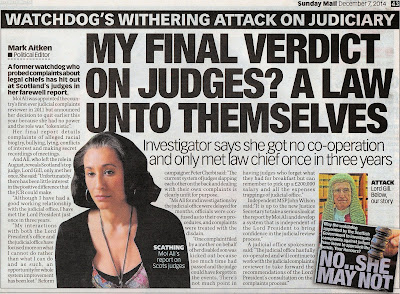
The Sunday Mail newspaper reported on the Judicial Complaints Reviewer’s 2014 annual report here:

WATCHDOG'S WITHERING ATTACK ON JUDICIARY

MY FINAL VERDICT ON JUDGES? A LAW UNTO THEMSELVES

Investigator says she got no co-operation and only met law chief once in three years

By Mark Aitken Political Editor Sunday Mail 07 December 2014

A former watchdog who probed complaints about legal chiefs has hit out at Scotland's judges in her farewell report.

Moi Ali was appointed the country's first ever judicial complaints reviewer in 2011 but announced her decision to quit earlier this year because she had no power and the role was "tokenistic".

Her final report details complaints of alleged racial bigotry, bullying, lying, conflicts of interest and making secret recordings of meetings.

And Ali, who left the role in August, reveals Scotland's top judge, Lord Gill,only met her once.

She said: "Unfortunately, there has been little interest in the positive difference that the JCR could make.

"Although I have had a good working relationship with the judicial office, I have met the Lord President just once in three years.

"My interactions with both the Lord President's office and the judicial office have focused more on what I cannot do rather than what I can do and as such, an opportunity for whole system improvement has been lost.

Reform campaigner Peter Cherbi said: The current system of judges slapping each other on the back and dealing  with their own complaints is clearly unfit for purpose.

"Ms Ali found investigations by the judicial office were delayed for months, officials were confused as to their own procedures, and complaints were treated with the disdain.

"One complaint filed by a mother on behalf of her disabled son was kicked out because too much time had passed and the judge could have forgotten the events. There's not much point in having judges who forget what they had for breakfast but can remember to pick up a £200,000 salary and all the expenses trappings of judicial office."

Independent MSP John Wilson said:"It is up to the new justice Secretary to take a serious look at the report by Moi Ali and develop a system that is independent of the Lord President to bring confidence in the judicial review process."

A judicial office spokesman said: "The judicial office has fully co-operated and will continue to work with the judicial complaints reviewer to take forward the recommendations of the Lord President's consultation on the complaints process.

JUDICIAL COMPLAINTS, SCOTLAND 2014:

Report of the Judicial Complaints Reviewer 2013-2014. Moi Ali wrote in her report: When I accepted the office, it was in order to make a difference and I do believe that I have had an impact, albeit a more limited one than I had hoped at the outset. My aim was to work with the Judicial Office and the Lord President to help shape a fair, user-friendly, user-centric and transparent complaints system. I saw my role as not only reviewing the handling of complaints, but also using my insights into the complaints system to work in partnership to bring about improvements to the system as a whole. I believed that my wider observations could be fed into the justice system. For example, from my unique independent viewpoint I have seen from my complaints reviews that there are potential issues around communications training for the judiciary. My observations were an opportunity to inform and improve judicial training, to help avert future complaints and to provide a better court experience for everyone.

Unfortunately there has been little interest in the positive difference that the JCR could make. Although I have had a good working relationship with the Judicial Office, I have met the Lord President just once in three years. My interactions with both the Lord President's office and the Judicial Office have focussed more on what I cannot do rather than what I can do, and as such an opportunity for whole- system improvement has been lost.

Over the last few months of my term of office there were positive developments at the Judicial Office. I was recently invited to work with their team on reviewing their standard letters to complainers to help make them clearer and more user-friendly. I was critical of these letters from the outset and was delighted to be involved.

Another success is achieving the Lord President's agreement that he will now share a summary of the key findings of investigations with complainers, having initially decided that he would not. Complainers quite reasonably expect to see the findings of any investigation into their complaint. Sharing a summary is a big step forward in terms of transparency, but it still does not go far enough. I cannot see why, in most cases, the full investigation report cannot routinely be shared with both complainers and complained-about.

Last year I reported that the Lord President told me that "third parties" such as the JCR could not be given information relating to outcomes of my referrals for reasons of confidentiality. As my role is an integral part of the complaints process, I was surprised that I would not be informed of the outcome of my own referrals, especially as I would have already seen the full details of each complaint. Following correspondence with the Lord President's office, I am pleased that he has reconsidered the matter and agreed that this will now be shared with the JCR. Although a welcome development, again it does not go far enough. In England and Wales, the outcomes of investigations, when upheld, are published on the Judicial Conduct and Investigations Office's (JCIO) website. Greater transparency builds public confidence.

When I became JCR in 2011, there was no appetite among the judiciary for an independent complaints reviewer and I have seen no evidence that that position has changed. There was also scepticism among the public about the role. The feeling was that the JCR would be in the pocket of government, or the judiciary - or both. I have asserted my independence, to the extent that both government and the judiciary have at times felt uncomfortable. My stance has helped build public trust and confidence in the office, even if frustrations have been voiced about the lack of powers of the JCR. It is vital that the public and the judiciary can appreciate the value of the JCR to a fair complaints system. I have won part of the battle, with the public. I hope my successor is successful in persuading the judiciary of the benefits.

In just over three years of the new complaints regime, the Judicial Office's published statistics show that of 313 complaints received, there were 22 investigations. These resulted in one judicial office holder apologising for his or her conduct and no judicial office holders being disciplined. This may explain why no JOH has sought to have their case reviewed by the JCR: only a finding against the JOH would be likely to result in their making a review request. My previous experience of being a member of the review process in England and Wales bears this out: JOHs challenged when the finding is against them; not when it is in their favour.

The Scottish Parliament’s Public Petitions Committee has received a copy of Moi Ali’s report. MSPs are due to debate Petition PE1458 again tomorrow, Tuesday 9 December, and hear evidence from Legal Affairs Minister Paul Wheelhouse. Previous articles on the lack of transparency within Scotland’s judiciary, investigations by Diary of Injustice including reports from the media, and video footage of debates at the Scottish Parliament’s Public Petitions Committee can be found here : A Register of Interests for Scotland's Judiciary

Thursday, December 04, 2014

THE JUDGES’ MAN: Sacked Justice Secretary Kenny MacAskill replaces transparency crusader Chic Brodie on Scottish Parliament’s Public Petitions Committee

Ex Justice Secretary heads to Holyrood Petitions Committee. FORMER Cabinet Secretary for Justice Kenny MacAskill, who was sacked by Scotland’s new First Minister Nicola Sturgeon in her recent cabinet reshuffle, has been moved to the Scottish Parliament’s Public Petitions Committee, replacing transparency crusader Chic Brodie MSP.

The move was announced last week with little fanfare - Motion S4M-11738: Joe FitzPatrick, Dundee City West, Scottish National Party, On Behalf of Parliamentary Bureau, Date Lodged: 27/11/2014 - that Kenny MacAskill be appointed to replace Chic Brodie as a member of the Public Petitions Committee.

The former Justice Secretary, who has been the star of many controversies in Scotland’s justice system, from the ‘compassionate’ release of AbdelBaset Al Megrahi – convicted for the bombing of Pan Am Flight 103 over Lockerbie, Scotland in December 1988, to presiding over faked-up crime figures, massive hand-outs of £1 Billion in legal aid to lawyers since the financial crash of 2008, continuing scandals at Scotland’s Crown Office & Procurator Fiscal Service, failed reforms of Scotland’s civil & criminal justice system, court closures, attempts to remove requirements of corroboration of evidence in criminal trials, and the destruction of local Policing across Scotland, is now set to pass verdict on motions proposed by members of the public attempting to make Scotland a better place.

The unexpected move to slot MacAskill on the Petitions Committee comes after the same Committee agreed in late October to call MacAskill to give evidence on a proposal to create a register of judicial interests as called for in Petition PE1458: Register of Interests for members of Scotland's judiciary.

However, MacAskill refused to show up to the Committee Convener's invitation, instead putting forward then Legal Affairs Minister Roseanna Cunningham – who urged the Scottish Parliament to reject judicial transparency during a debate in the Scottish Parliament’s main chamber on the petition held on 9 October 2014.

Since then, Ms Cunningham has also been replaced in her legal affairs portfolio, now handed to Paul Wheelhouse who will appear before the Petitions Committee and, ironically – Kenny MacAskill - next Tuesday, December 9 and answer questions on why the Scottish Government has sided with secrecy and judges who are worried exposure of their mega riches and connections may damage their judicial privacy.

Petition PE1458 – a proposal to increase judicial transparency and submitted to the Scottish Parliament’s Public Petitions Committee in late 2012 envisages the creation of a single independently regulated register of interests containing information on judges backgrounds, their personal wealth, undeclared earnings, business & family connections inside & outside of the legal profession, offshore investments, hospitality, details on recusals and other information routinely lodged in registers of interest across all walks of public life in the UK and around the world.

The proposal to create a register of judicial interests is also widely supported in the media, and has the backing of Scotland’s first Judicial Complaints Reviewer, Moi Ali – who gave her support for the petition during an evidence session before MSPs at the Scottish Parliament’s Public Petitions Committee last September, 2013.

However, top judge Lord Gill has waged a bitter two year war against the proposal. The Lord President branded media as “aggressive” and complained court users would end up invading the privacy of judges - who have since been revealed to have criminal records, offshore interests, and investments in companies convicted of bribes, industrial espionage, bid rigging and other offences around the world.

During the Petitions Committee’s meeting of 28 October, MSPs also demanded to see the unredacted 2014 annual report of the Judicial Complaints Reviewer (JCR), Moi Ali - who has since quit the judicial investigator role - comparing it to “window dressing”. The JCR’s anuual report has still not been passed to the Committee.

Mr MacAskill has previously stated his opposition to the creation of a register of judicial interests in letters to the Public Petitions Committee which always followed similar letters from Lord Gill.

MacAskill opposes register of judicial interests & judicial complaints reforms. IN previous letters to the Public Petitions Committee, Mr MacAskill slapped down the need for a register, and followed top judge Lord Gill’s line on judicial oaths, writing: “You ask whether the Scottish Government will review its position on whether members of the judiciary ought to register their interests. I note the evidence the Committee has gathered on this issue and, in particular, the arguments presented by the Judicial Complaints Reviewer (JCR) that a register of interests would increase transparency and public trust in the judiciary.

The JCR considers that there is merit in a register of interests for members of the judiciary. I do not think it necessary to establish such a register. I continue to be of the view that there are already sufficient safeguards in place to ensure the impartiality of the judiciary. These have been set out in previous correspondence and comprise the judicial oath, the Statement of Principles of Judicial Ethics and the rules made under the 2008 Act. I do not consider that the case has been made that these existing safeguards are not effective.”

In another letter to the Petitions Committee Convener, David Stewart, Kenny MacAskill also refused to acknowledge the need for amendments to the powers of the Judicial Complaints Reviewer role, writing: “In advance of any debate you have asked for comments on the letter from the Judicial Complaints Reviewer (JcR) to the Committee of 23 April 2014. In that letter the JCR states that she considers it likely that the number of complaints against the judiciary would fall if there was a published register of interests for the judiciary. As I have said previously, it would be for the Lord President to establish such a register of interests in his capacity as Head of the Scottish judiciary. However, the Scottish Government does not consider there is currently any evidence to suggest that the existing safeguards - the judicial oath, the Statement of Principles of Judicial Ethics and the Rules made under the Judiciary and Courts (Scotland) Act 2008 - are not effective and does not therefore consider that such a register is necessary.

The JCR expresses a concern that the rules about complaints against the judiciary are not fit for purpose. As you know, the complaints and discipline process created by the 2008 Act has been running for a relatively short time. The Complaints About the Judiciary (Scotland) Rules have been in operation for just over 3 years, and the Lord President is currently considering amendments to these rules following a consultation last autumn to which the JCR contributed.”

Mr MacAskill is also reported to have made private comments to msps against the creation of a register of judicial interests while he was Justice Secretary. Mr MacAskill also refused to grant further powers to the role of Judicial Complaints Reviewer, even after a stinging rebuke from Scotland’s first JCR - Moi Ali.

JUSTICE SECRETARY SAID NO TO JUDICIAL COMPLAINTS POWERS

JCR should have more powers – Moi Ali told Scottish Government. In her second annual report as Judicial Complaints Reviewer, Moi Ali called for the Scottish Government to give more powers to the JCR’s office to deal with errant judges. Ms Ali said: “I think fundamentally the problem is the legislation. “The way it’s created, it’s about self- regulation so you have judges judging judges’ conduct. There isn’t really an independent element.“I’m presented as the independent element but, without the powers, I can’t be independent. We have the appearance of independent oversight but not the reality.”

In response to calls for greater powers for the JCR, Justice Secertary MacAskill refused to grant any extra powers, and First Minister Alex Salmond supported MacAskill's refusal during questions at FMQ’s by John Wilson MSP at the Scottish Parliament.

However, it can now be revealed Alex Salmond himself had a legal relationship with Francis Gill - the son of Scotland’s top judge, Lord Gill – the same man politicians including the First Minister must consult and seek approval of, before changes to any powers of the office of Judicial Complaints Reviewer can be implemented. Mr Salmond made no mention of his relationship with Gill junior - which also involved representation on a complaint to the Press Complaints Commission - while he answered questions from MSP John Wilson during FMQ’s on 30 January 2014.

After MacAskill refused to consider new powers for the office of Judicial Complaints Reviewer, Moi Ali signalled she was standing down from the role, reported here: No powers to make things better: Judicial Complaints Reviewer to stand down from MacAskill’s “window dressing” justice watchdog over errant judges

Previous articles on the lack of transparency within Scotland’s judiciary, investigations by Diary of Injustice including reports from the media, and video footage of debates at the Scottish Parliament’s Public Petitions Committee can be found here : A Register of Interests for Scotland's Judiciary

Tuesday, December 02, 2014

PUBLISH AND BE JUDGED: Judicial backslapping in the dock as Scottish Government hold back publication of 2014 Judicial Complaints Reviewer annual report

Report on judges still not handed to MSPs investigating judicial interests. A MONTH after Scottish Parliament MSPs investigating judicial interests demanded to see an unreacted report detailing complaints against judges, the Scottish Government have still not handed over the document to Parliament nor have Scottish Ministers published what is the last annual report of Scotland's first Judicial Complaints Reviewer (JCR), Moi Ali. MSPs are seeking the report in their consideration of proposals to create a register of judicial interests as called for in Petition PE1458: Register of Interests for members of Scotland's judiciary

The report, which has been with the Scottish Government and Scotland’s top judge – the Lord President Lord Brian Gill ‘for some time’, covers the final term of popular JCR, Moi Ali, who stood down in the summer of 2014 after telling MSPs her role was little more than “Window Dressing”. Ms Ali also revealed in an evidence session before MSPs at the Scottish Parliament’s Public Petitions Committee the lack of cooperation she encountered from top judge Lord Gill, who himself decides how to handle complaints against his own colleagues.

Speaking earlier today, a legal insider suggested the Scottish Government did not want to release the JCR’s report before Legal Affairs Minister Paul Wheelhouse attended the Public Petitions Committee next week on 9 December, in an effort to keep any potential probing questions on judicial conduct and failures to a minimum.

Petition PE1458 – a proposal to increase judicial transparency and submitted to the Scottish Parliament’s Public Petitions Committee in late 2012 envisages the creation of a single independently regulated register of interests containing information on judges backgrounds, their personal wealth, undeclared earnings, business & family connections inside & outside of the legal profession, offshore investments, hospitality, details on recusals and other information routinely lodged in registers of interest across all walks of public life in the UK and around the world.

Following a series of ‘scripted’ letters from Scotland’s top judge – who refused three invitations to appear before MSPs to answer questions on his opposition to the creation of a register of his colleagues vast personal wealth, Scottish Ministers have also made clear Government objections to the transparency proposal. However, a lively debate on judicial interests in the Scottish Parliament’s main chamber on Thursday 7 October 2014 saw cross party support for the proposal, with msps overwhelmingly supporting motion S4M-11078 - in the name of Public Petitions Convener David Stewart MSP on petition PE1458, urging the Scottish Government to give further consideration to a register of interests for judges.

The parliamentary debate was reported by Diary of Injustice along with video coverage here: TRANSPARENCY TIME: Top judge & Scottish Government told to rethink refusal on declarations of judges as Holyrood MSPs support calls to create a register of judicial interests

The call to create a register of judicial interests is widely supported in the media, and also has the backing of former Judicial Complaints Reviewer, Moi Ali. The evidence session with Moi Ali & Petitions Committee MSPs can be viewed in the following video footage:

JCR Moi Ali gives evidence to Scottish Parliament on a proposed Register of Judicial Interests

The full transcript of the September 2013 evidence session with JCR Moi Ali and MSPs was published by Diary of Injustice here: Evidence from Scotland’s Judicial Complaints Reviewer Moi Ali to Public Petitions Committee on Petition 1458 Register of Interests for Scotland’s Judiciary

JUDICIARY IS “INCREDIBLE POWERFUL”

Earlier this year while still in the post of Judicial Complaints Reviewer, Moi Ali wrote to MSPs on the Scottish Parliament’s Public Petitions Committee reiterating her support for a register of judicial interests. The JCR gave msps further insight into judicial complaints and explained why increased transparency must be introduced to Scotland’s overly secretive judiciary:

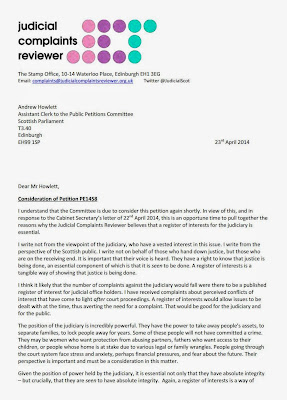
Judicial Complaints Reviewer evidence to MSPs on register of judicial interests: I understand that the Committee is due to consider this petition again shortly. In view of this, and in response to the Cabinet Secretary’s letter of 22nd April 2014, this is an opportune time to pull together the reasons why the Judicial Complaints Reviewer believes that a register of interests for the judiciary is essential.

I write not from the viewpoint of the judiciary, who have a vested interest in this issue. I write from the perspective of the Scottish public. I write not on behalf of those who hand down justice, but those who are on the receiving end. It is important that their voice is heard. They have a right to know that justice is being done, an essential component of which is that it is seen to be done. A register of interests is a tangible way of showing that justice is being done.

I think it likely that the number of complaints against the judiciary would fall were there to be a published register of interest for judicial office holders. I have received complaints about perceived conflicts of interest that have come to light after court proceedings. A register of interests would allow issues to be dealt with at the time, thus averting the need for a complaint. That would be good for the judiciary and for the public.

The position of the judiciary is incredibly powerful. They have the power to take away people’s assets, to separate families, to lock people away for years. Some of these people will not have committed a crime. They may be women who want protection from abusing partners, fathers who want access to their children, or people whose home is at stake due to various legal or family wrangles. People going through the court system face stress and anxiety, perhaps financial pressures, and fear about the future. Their perspective is important and must be a consideration in this matter.

Given the position of power held by the judiciary, it is essential not only that they have absolute integrity but crucially, that they are seen to have absolute integrity. Again, a register of interests is a way of demonstrating that a judicial office holder is impartial and has no vested interest in a case –financially, through family connections, club/society membership or in any other way. Conversely, the refusal to institute a register of interests creates suspicion that in turn undermines judicial credibility. So once more, a register of interests is good for the judiciary and good for the public.

The Cabinet Secretary for Justice states that there are sufficient safeguards already in place, citing the complaints rules as one of these safeguards. As the person appointed by the Cabinet Secretary to review complaints handled under these rules, I can say from experience over nearly three years that the rules are not fit for purpose. I have attached a document I prepared in December 2013, following consultation with members of the public who had made complaints under these rules, to support this assertion.

The Judicial Office’s published statistics demonstrate either that judicial conduct is exemplary, and the public vexatious or unable to understand the rules; or they show that the rules are not fit for purpose. I suggest that it is the latter. For the first year in which the Rules were operational(a 13-month period to 31st March 2012), 107 conduct complaints were made to the Judicial Office and 98 were completed during that year. With one exception, all of them were dismissed without investigation. Only one investigation was carried out, following which the complaint was dismissed as "unsubstantiated".

The latest statistics have yet to be published, but year two figures (to March 31st 2013) show that 114 complaints were made (plus the 9 carried over from year 1). Of 116 concluded during the year, only 11 were investigated. Four of the 11 were still underway at year-end, meaning that 7 investigations were completed in Year 2. Of the 7, one was withdrawn; 2 resolved informally; and 4 were reported to the Lord President. Of the 4 reported to the Lord President, 3 were deemed to be without substance, unsubstantiated or vexatious. For the one remaining complaint, an apology was offered by the judicial office holder and the Lord President deemed that no further action was required.

In summary, in the first 25 months of the new complaints regime, the Judicial Office's published statistics show that of 221 complaints there were 12 investigations, one judicial office holder apologised for his or her conduct and no judicial office holders were disciplined.

My experience in this office leads me to the conclusion that the rules are not a sufficient safeguard. But even if they were, particularly when combined with the judicial oath and the Statement of Principles of Judicial Ethics, why not go further in enhancing transparency and accountability?

There are sufficient safeguards in place to prevent members of public boards from acting inappropriately –such as robust audit committees, external scrutiny and regulation, board meetings held in public and a rigorous appointments process. Nevertheless, such members are still required –and rightly so –to complete a publicly accessible register of interests in order to demonstrate transparency and accountability. It is right that public appointees and elected politicians are required to do this, and it is also right that the judiciary should too. Registers of interest are the norm now and the judiciary is out of step with standard practice. This undermines their standing with the public.

For all of the above reasons, it is in the interests both of the judiciary and of the public for there to be a register of interests.

I have been frank about my views in this letter, and I hope that I have not given the impression that I do not have a great deal of respect for the judiciary and the difficult work that they undertake for the greater good of society. Their work is essential, their independence vital. An independent judiciary underpins a civilised society. But with independence goes accountability, and a register of interests is a mechanism for enhancing accountability.

I will be standing down from my role as JCR in the summer, but until that time I am happy to provide further information to the committee if that would be helpful.

Previous articles on the lack of transparency within Scotland’s judiciary, investigations by Diary of Injustice including reports from the media, and video footage of debates at the Scottish Parliament’s Public Petitions Committee can be found here : A Register of Interests for Scotland's Judiciary