Monday, January 27, 2014

M’Lud’s Interests: What Scotland’s top judge did not tell Holyrood MSPs when he refused to give evidence on register of judicial interests

Lord Gill omitted to tell MSPs he declares some interests with ease. REFUSING at least two invitations to appear before a Scottish Parliament Committee, using deficiencies in the Scotland Act to avoid facing MSPs questions on a PUBLIC PETITION, and then going on to brand the media, litigants, court users & members of the public as “aggressive” & “hostile” in an attempt to thwart calls for judges to declare their interests, it can now be revealed Scotland’s top judge Lord President Lord Brian Gill has omitted to tell MSPs he IS actually required to declare at least some interests as the head of the board which controls Scotland’s courts.

The declarations of interest by Scotland’s top judge and only six other members of Scotland’s vast, sprawling ranks of a multi million pound well salaried & well pensioned judiciary, feature in the 2012-2013 Annual Report of the Scottish Court Service, a fact which Lord Gill has strangely omitted to tell MSPs in three ‘stonewalling’ letters the Lord President sent to the Scottish Parliament.

And, contrary to the written claims of Lord Gill that it would be unworkable for the judiciary to declare their interests, and that the very notion of having judges declare their interests may breach judges privacy, cause them undue suffering and bring the courts to a complete standstill, the seven members of the judiciary who sit on the all powerful board of the Scottish Court Service, seem not to have suffered at all by interests they have wished to declare in keeping with their positions on the SCS board.

Pages from the SCS Annual Report handed to MSPs show a handful of judges including Lord Gill do declare at least some of their interests:

Lord President – Rt. Hon. Lord Gill
•  Director of Scottish Redundant Churches Trust, a company limited by guarantee registered in Scotland (SC162884) •  Director of the Royal School of Church Music, a company limited by guarantee registered in England (Reg’d No 250031) •  Trustee of the Carmont Settlement: a trust for the support of retired priests of the Roman Catholic Church •  Trustee of the Columba Trust: a trust for the benefit of the Roman Catholic Church in Scotland •  Trustee of the Royal Conservatoire of Scotland Endowment Trust: a trust for the benefit of RCS and its students •  Trustee of the Royal Conservatoire Trust: a trust for the benefit of the RCS and its students •  Trustee of the Royal School of Church Music: a registered charity for the promotion of church music in the Christian Churches (Reg No 312828) •  Vice President of the Royal Conservatoire

Lord Justice Clerk - Rt Hon Lord Carloway • None

Sheriff Iona McDonald •  Deputy Lieutenant for Ayrshire and Arran •  Partner in property rental firm

Sheriff A Grant McCulloch •  Chair West Fife Education Trust •  Chair Relationship Scotland- Couple Counseling Fife •  Committee Member Cammo Residents Association

Johan Findlay OBE • Honorary Sheriff• Justice of the Peace
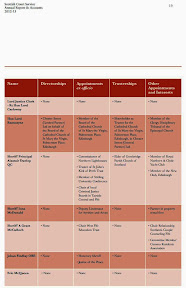
Hon Lord Bannatyne
•  Chester Street (Limited Partner) Ltd on behalf of the Board of the Cathedral Church of St Mary the Virgin, Palmerston Place, Edinburgh •  Member of the Board of the Cathedral Church of St Mary the Virgin, Palmerston Place, Edinburgh •  Shareholder as Trustee for the Cathedral Church of St Mary the Virgin, Palmerston Place, Edinburgh, in Chester Street (General Partner) Ltd •  Member of the Clergy Disciplinary Tribunal of the Episcopal Church

Sheriff Principal Alastair Dunlop QC
•  Commissioner of Northern Lighthouses •  Trustee of St John’s Kirk of Perth Trust •  Member of Stirling University Conference •  Chair of local Criminal Justice Boards in Tayside Central and Fife •  Elder of Gorebridge Parish Church of Scotland •  Member of Royal Northern & Clyde Yacht Club •  Member of the New Club, Edinburgh

A further six people ranging from the Chief Executive of the Scottish Court Service to lawyers and others also sit on the SCS Board, apparently declaring their own interests with ease and none of the fuss which Scotland’s top judge insisted would bring the justice system to a stand still.

The declarations, required for the positions on the Scottish Court Service Board, appear to fly in the face of a series of excuses, complaints, accusations and veiled threats made by the Lord President in writing against the idea of creating a publicly available register of judicial interests, and raise questions over how Lord Gill has handed the judiciary’s battle against what is a simple call for transparency, itself supported by the Judicial Complaints Reviewer.

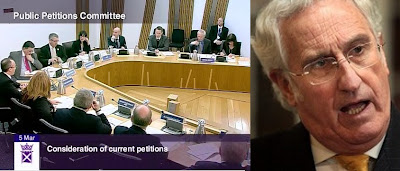
The Judicial Complaints Reviewer recently gave testimony to MSPs at Holyrood on the benefits of a register of judicial interests, reported along with video footage of the testimony, here : As Scotland’s top judge battles on against transparency, Judicial Complaints Reviewer tells MSPs judges should register their interests like others in public life

Any publicly available register of judicial interests which could be created from the aims of the petition, would take in the entire judiciary and have to show criminal convictions,professional & other relationships, undeclared earnings and business links to law firms, investments, property and memberships of organisations and other information which commonly appears on registers of interest throughout the public sector.

It also came to light some of Scotland’s judges have not declared their interests or recused themselves in court, contrary to claims made by the Lord President, and that persons wrongfully convicted have suffered even greater injustice when it was revealed that judges who once prosecuted them, had heard their appeals against wrongful convictions and kept quiet.

A report on how the failure of judges to recuse themselves or declare their interests in cases which have led to miscarriages of justice features here: Failure to Recuse : Evidence handed to MSPs in judicial register of interests proposal reveals judges who blocked injustice appeal failed to declare interests in court

HOW TOP JUDGE PROTESTED AGAINST TRANSPARENCY REGISTER:
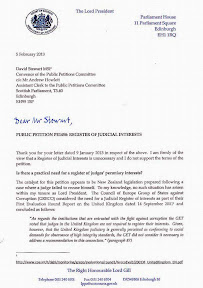
Lord Gill’s first letter to MSPs voiced vociferous opposition to transparency. In Lord Gill’s opening letter to MSPs on the call for a register of judicial interests, the judge claimed “In practical terms it would be impossible for all judicial office holders to identify all the interests that could conceivably arise in any future case. The terms of the Judicial Oath and the Statement of Principles of Judicial Ethics ensure that such a difficulty does not arise and that the onus is on the judicial office holder to declare any interest at the outset.”

In what was surely a hint of the sheer hostility felt by the judiciary against a call to bring transparency to judges interests, Lord Gill went onto accuse the media, press, litigants, court users and just about everyone else with an interest in transparency of being potentially hostile and aggressive, simply because someone may wish to raise questions of judges interests similar to the same kinds of questions which are raised of interests in other public officials and those in public life, politics & government.

Clearly angered by the call for transparency, Lord Gill’s letter to MSPs stated: “The introduction of such a register could also have unintended consequences. Consideration requires to be given to judges' privacy and freedom from harassment by aggressive media or hostile individuals, including dissatisfied litigants. It is possible that the information held on such a register could be abused. These are significant concerns. If publicly criticised or attacked, the judicial office holder cannot publicly defend himself or herself, unlike a politician. The establishment of such a register therefore may have the unintended consequence of eroding public confidence in the Judiciary. It also raises the question whether such a measure would have an adverse impact on the recruitment and retention of the Judiciary.”
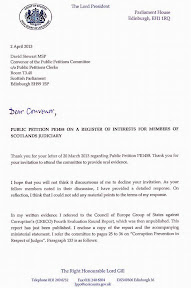
Top judge Lord Gill refused to go to Holyrood, by letter. In a second reply to the Convener of the PPC, dated 2 April 2013, Lord Gill refused an invitation to attend the Scottish Parliament and face questions from Committee members on issues raised in the petition and to explain his own opposition to the transparency proposal.

Notably, Gill’s second reply did not contain any answers to questions put to him in writing by the Petitions Committee, nor did the judge provide any statistical or analytical evidence on the numbers of recusals which have been undertaken by judges in Scotland’s courts. However, seeking once again to lobby MSPs against any call for transparency of judges interests, the Lord President again referred to the content of an EU report, itself written by judges, who claimed there was no need for a register of judicial interests.

A further invitation was sent to Lord Gill by the Convener of the Public Petitions Committee, asking for answers to questions and again inviting the Lord President to addend the Scottish Parliament to give evidence on Petition PE1458: Register of Interests for members of Scotland's judiciary
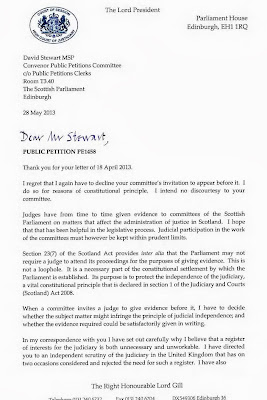
Third letter from top judge refused Holyrood invitation, used Scotland Act loophole. Having received the third letter containing a second invitation to attend Holyrood, Lord Gill wrote back to the Convener of the Public Petitions Committee on the 28 May 2013, again refusing to appear before MSPs to face questions on judges interests and his own opposition to the petition.

However, this time the top judge added a hint that judicial cooperation with Committees of the Scottish Parliament may suffer and must be limited.

In what appears to have been little short of a veiled threat to refuse further judicial cooperation with, and future Committee appearances at the Scottish Parliament, Gill stated: “Judges have from time to time given evidence to committees of the Scottish Parliament on matters that affect the administration of justice in Scotland. I hope that that has been helpful in the legislative process. Judicial participation in the work of the committees must however be kept within prudent limits.”

And, shockingly, Lord Gill then sought to use deficiencies in the Scotland Act to justify his refusal to attend the Public Petitions Committee and answer question from msps.
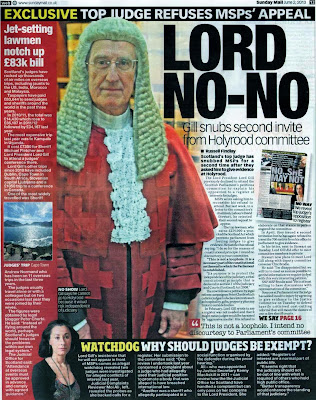
Gill’s use of Scotland Act against MSPs was reported in the media. Writing in his third letter, Lord Gill said: “Section 23(7) of the Scotland Act provides inter alia that the Parliament may not require a judge to attend its proceedings for the purposes of giving evidence. This is not a loophole. It is a necessary part of the constitutional settlement by which the Parliament is established. Its purpose is to protect the independence of the judiciary, a vital constitutional principle that is declared in section 1 of the Judiciary and Courts (Scotland) Act 2008”

The judge continued: “When a committee invites a judge to give evidence before it, I have to decide whether the subject matter might infringe the principle of judicial independence; and whether the evidence required could be satisfactorily given in writing.”

So far, Lord Gill has failed to appear before the Public Petitions Committee of the Scottish Parliament to explain his deep seated opposition to the transparency issue of declarations made by members of the judiciary in court or answer questions from MSPs on the proposal to create a register of judicial interests.

Previous articles on the lack of transparency within Scotland’s judiciary, investigations by Diary of Injustice including reports from the Sunday Mail newspaper, and video footage of debates at the Scottish Parliament’s Public Petitions Committee can be found here : A Register of Interests for Scotland's Judiciary

Petition PE1458: Register of Interests for members of Scotland's judiciary is due to be heard again at the Scottish Parliament tomorrow, Tuesday 28th January 2014 and will include a report or comment on a private meeting held last Tuesday between the Convener and Deputy Convener of the Public Petitions Committee and Scotland’s top judge Lord Brian Gill.

Sunday, January 26, 2014

No powers to make things better: Judicial Complaints Reviewer to stand down from MacAskill’s “window dressing” justice watchdog over errant judges

Moi Ali, Scotland’s First Judicial Complaints Reviewer to stand down over lack of support from Scottish Government. SCOTLAND’S Judicial Complaints Reviewer (JCR) is to stand down from the post created by legislation in 2008 which was intended to investigate and review how judges investigate complaints against themselves.

It has been revealed that Moi Ali, the first person to hold the office of Judicial Complaints Reviewer has told Scotland’s Justice Secretary Kenny MacAskill that she will not seek a second term in the role because she has complained the post is mere “window dressing” and “tokenism”.

Moi Ali, who took on the post of JCR after it was created in 2008 has endured a difficult term due to a lack of cooperation from the judicial office who refused to share documents and details relating to complaints made by members of the public against judges.

In particular, Moi Ali encountered difficulties in dealing with Scotland’s top judge, Lord President Lord Brian Gill, who it was revealed, had dismissed earlier findings against fellow judges, and had gone on to brand the office of Judicial Complaints Reviewer as “a third party” when it came to handing over details on complaints made against judicial colleagues and discussions on how those complaints had been investigated by other judges.

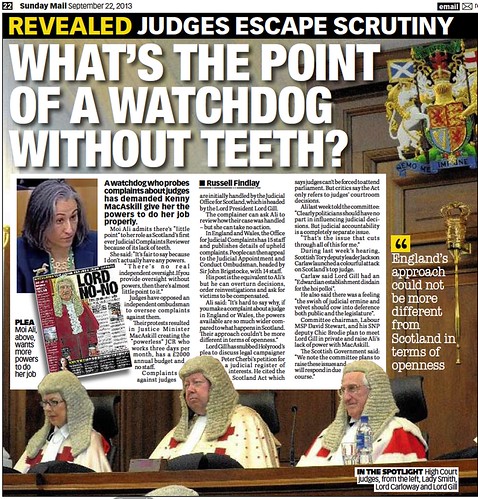
What's the point of a watchdog without teeth - Sunday Mail 22 September 2013MacAskill created a watchdog without teeth on orders of angry judges with undeclared secrets. The position of Judicial Complaints Reviewer was created by an Act of the Scottish Parliament in 2008, principally highlighted in Section 30, S31 and S32 of the Judiciary and Courts (Scotland) Act 2008.

However, protests from vested interests within Scotland’s judiciary and legal profession from Scotland’s judges who were “dead against” proposals to create an independent form of regulation of judges resulted in what legal observers have branded “a cowardly capitulation” by Justice Minister MacAskill.

The lobbying from Scotland’s unaccountable judges and their allies in the justice system led to the creation of a Judicial Complaints Reviewer without any statutory powers, working on a three days a month basis and with an annual budget of £2000 and no staff.

In England and Wales, the situation is very different from Scotland, where the Office for Judicial Complaints has 15 staff and publishes details of upheld complaints. If complainants remain dissatisfied with how their case was handled, they can appeal to the Judicial Appointment and Conduct Ombudsman, headed by Sir John Brigstocke, with 14 staff.

And, although Scotland’s Judicial Complaints Reviewer has been given no statutory powers to deal with complaints against judges, the Judicial Appointment and Conduct Ombudsman in England has statutory powers enshrined in law,  and can overturn decisions, order reinvestigations and ask for victims to be compensated.

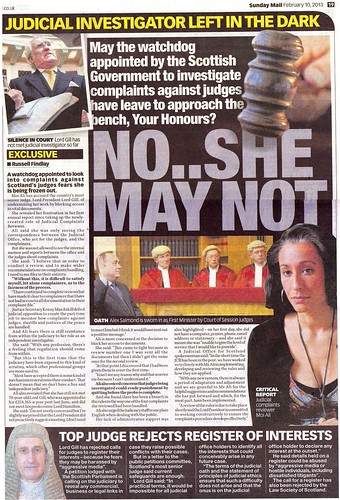
Judicial Investigator Moi Ali left in the dark over complaints against Scottish Judges - NO She May Not 10 Feb 2013 Sunday Mail

First Annual Report of JCR for 2011-2012 revealed Scotland’s top judge froze out independent Judicial Investigator. To illustrate what has become a consistent lack of cooperate from the judicial office, the first annual report from Moi Ali last year reiterated concerns over refusals by judges  to share information  with investigators, previously reported in February by the Sunday Mail newspaper and featured on Diary of Injustice here: Annual Report revealed Lord President Lord Gill ‘froze out’ Judicial Complaints Reviewer amid series of revoked findings, secret unshared memos & dismissed complaints.

Ms Ali’s first annual report, which can be read online here : Judicial Complaints Reviewer Annual report 20011- 2012 or available via the JCR’s website HERE reveals a series of incidents where her office has been blocked by the Lord President from accessing communications, internal memos and reports between the office and the judges about complaints.

In one particular case, Ms Ali revealed in her report “When the Judicial Office made an initial assessment of this complaint, it was not reasonable for them to conclude that the behaviour complained about, which left the complainer “insecure and scared”, fell into the category of judicial decision/case management/court programming. According to the Rules, they should have referred that element of the complaint to the disciplinary judge for consideration. This did not happen, and instead the complaint, in its entirety, was dismissed. For that reason I made a referral to the Lord President, who then revoked that part of the original determination and referred it to the disciplinary judge, who then dismissed the complaint.”

Second annual report - JCR lacks much needed powers. The Judicial Complaints Reviewer’s 2012-2013 annual report revealed continuing issues of concern and further instances where the Judicial Office has refused to share files and paperwork in relation to complaints made against judges and how were handled.

The report also makes reference to incidents such as where Scotland’s top judge Lord Brian Gill refused to hand over information to the JCR. Gill claimed Moi Ali’s office was a "Third Party" and that data cannot be shared with her office for reasons of confidentiality. However, the confidentiality concerns of Gill appear to be restricted to Scotland, as the same information in England & Wales is published online.

It also emerged in the JCR’s second annual report that even though a Memorandum of Understanding was signed between the JCR & Judicial Office earlier this year on respective roles, responsibilities and agreed undertakings, the situation regarding the contents of files has not been resolved to Ms Ali’s satisfaction.

The Sunday Mail newspaper reported on issues raised in the JCR’s second annual report, including calls from Moi Ali for the Scottish Government to act over the lack of scrutiny and transparency in Scotland’s judiciary.More can be read here: Calls for Justice Secretary to get tough with anti-transparency judges as Judicial Investigator reveals weak-by-design scrutiny fails to protect public from errant judges

JCR SUPPORTED REGISTER OF JUDICIAL INTERESTS PETITION:

In support of Petition 1458, Judicial Complaints Reviewer Moi Ali wrote in her 2012-2013 Annual Report of her recognition of the issues of transparency raised in the petition, and recommended “any judicial register of interests should not be limited to pecuniary interests, but should also encompass non-financial interests such as memberships, unpaid trusteeships, and any relevant close family/friendship links that may be perceived as a potential conflict of interest.” Video footage of the evidence session in which the JCR answered questions from MSPs can be viewed here :

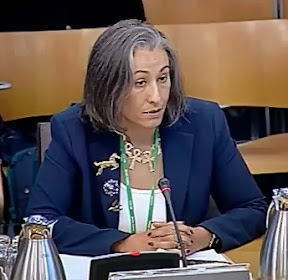
JCR Moi Ali gives evidence to Scottish Parliament on a proposed Register of Judicial Interests (Click image to view video)

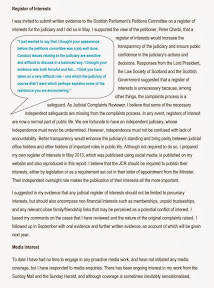
JCR 2012-2013 Annual Report confirms support for a Register of Judicial Interests, recommends extending interests to be declared. Register of Interests : I was invited to submit written evidence to the Scottish Parliament’s Petitions Committee on a register of interests for the judiciary and I did so in May.

I  supported the view of the petitioner, Peter Cherbi, that a register of interests would increase the transparency of the judiciary and ensure public confidence in the judiciary’s actions and decisions.

Responses from the Lord President, the Law Society of Scotland and the Scottish Government suggested that a register of interests is unnecessary because, among other things, the complaints process is a safeguard.

As Judicial Complaints Reviewer, I believe that some of the necessary independent safeguards are missing from the complaints process. In any event, registers of interest are now a normal part of public life.

We are fortunate to have an independent judiciary, whose independence must never be undermined. However, independence must not be confused with lack of accountability. Better transparency would enhance the judiciary’s standing and bring parity between judicial office holders and other holders of important roles in public life.

Although not required to do so, I prepared my own register of interests in May 2013, which was publicised using social media, is published on my website and also reproduced in this report. I believe that the JCR should be required to publish their interests, either by legislation or as a requirement set out in their letter of appointment from the Minister. Their independent oversight role makes the publication of their interests all the more important.

I suggested in my evidence that any judicial register of interests should not be limited to pecuniary interests, but should also encompass non-financial interests such as memberships, unpaid trusteeships, and any relevant close family/friendship links that may be perceived as a potential conflict of interest.

I based my comments on the cases that I have reviewed and the nature of the original complaints raised. I followed up in September with oral evidence and further written evidence, an account of which will be given next year.

Previous articles on the lack of transparency within Scotland’s judiciary, investigations by Diary of Injustice including reports from the Sunday Mail newspaper, and video footage of debates at the Scottish Parliament’s Public Petitions Committee can be found here : A Register of Interests for Scotland's Judiciary

Petition PE1458: Register of Interests for members of Scotland's judiciary is due to be heard again at the Scottish Parliament on Tuesday 28th January 2014 and will include a report or comment on a private meeting held last Tuesday between the Convener and Deputy Convener of the Public Petitions Committee and Scotland’s top judge Lord Brian Gill.
Thursday, January 23, 2014

Lawyers Behaving Badly: Axe Law Society dual role, give Scots clients same consumer protections of England & Wales' independent regulation of solicitors

Unprotected: Scots consumers have no protection from dodgy solicitors who regulate themselves. UNTIL the dual role of representing both clients and solicitors is removed from the Law Society of Scotland, and clients of Scotland’s closed shop legal profession are given the same or even greater standards of consumer protection & independent regulation as currently operate in England & Wales, there is little incentive for Scottish solicitors to behave anything other than badly, as BBC Scotland found recently in their investigation of Lawyers Behaving Badly.

More often than not, the fact is, those of us who require to use legal services in one way or another via a lawyer, or those of us who require access to the courts in Scotland are taken on the same, well trodden, fee-generating-years-long ride by solicitors & law firms who have no reason to offer high quality, low cost access to justice in a legal system which is closed shop, monopolistic, and poorly regulated.

Just as fee paying clients are routinely ripped off, so is the taxpayer by way of a £150 million pound legal aid budget which seems to exist as little more than a public subsidy to prop up dodgy law firms & lawyers who would serve the community better from a position behind bars, sitting in a High Street office raking in tens of thousands of pounds a year from the public purse.

This is of course, not news to anyone who has been let down by a solicitor, and it is certainly not news to members of the public who have experienced the almost inhuman mix of regulatory bodies in Scotland, the Scottish Legal Complaints Commission (SLCC), the Law Society of Scotland and the Scottish Solicitors Discipline Tribunal, who currently hold court over all complaints against Scottish solicitors.

The SLCC often claims to be “independent”. It is not. Diary of Injustice reported on the secret vested interests at the Scottish Legal Complaints Commission in an earlier article here: A SPECIAL RELATIONSHIP : Investigation reveals Scotland’s ‘independent’ legal regulator is mired in family, business & personal links to legal profession & Law Society

Neither has the SLCC cleaned up standards in the legal profession, nor has it named and shamed any crooked lawyers, nor has it protected clients any better than the Law Society of Scotland, who are equally as fixated as the SLCC on attending to, and apparently representing the interests of its membership the legal profession and much the same, found BBC Scotland in their recent Lawyers Behaving Badly investigation of Scotland’s out of control legal profession.

As the Lawyers Behaving Badly programme has now finished its term on the BBC’s iPlayer and clips of what was broadcast have been removed from the internet by the BBC, apparently after alleged protests from the legal profession and the Law Society of Scotland, those with an interest in how the Scottish legal profession regulates itself in Scotland still have access to articles on this site.

How Scots solicitors regulators dealt with dodgy legal aid solicitor:

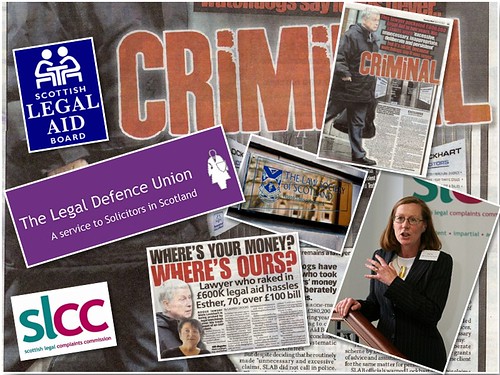
SLCC Lockhart montageA solicitor who ruined pensioner's legal affairs was given slap on the wrist by law complaints regulator SLCC. KILMARNOCK solicitor Niels S Lockhart, who was accused by the Scottish Legal Aid Board (SLAB) of making £670K worth of dodgy claims for legal aid work and who then went on to ruin the legal affairs of a pensioner and other clients was allowed to continue working as a lawyer after the Scottish Legal Complaints Commission (SLCC), the ‘independent’ regulator of solicitors decided his firm NS Lockhart Solicitors need only pay a meagre fine of ONE HUNDRED POUNDS to a victim who had complained about the legal nightmare she had been put through.

Solicitor Niels Lockhart was the subject of lengthy investigations by the Scottish Legal Aid Board which were uncovered by Diary of Injustice & the Sunday Mail newspaper and reported earlier here : One law for lawyers : Secret Report reveals Legal Aid Board, Law Society & Legal Defence Union ‘cosy relationship’ in Lockhart case

Diary of Injustice published the full SLAB S31 complaint report to the Law Society of Scotland obtained after a Freedom of Information disclosure, here : SCOTTISH LEGAL AID BOARD S31 COMPLAINT REPORT TO THE LAW SOCIETY OF SCOTLAND : NIELS S LOCKHART

Diary of Injustice also published the investigation carried out by the Scottish Legal Complaints Commission into Niels S Lockhart. The report can be viewed online here : SLCC Investigation of complaint against Niels S Lockhart of NS Lockhart Solicitors, Kilmarnock.

How Lord Advocate & Crown Office dealt with Legal Aid fraudsters who all happened to be solicitors:

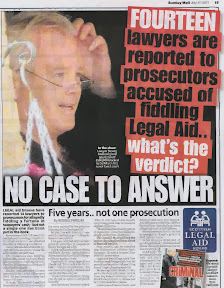
Crown Office also refused to prosecute dodgy legal aid lawyers. An exclusive report in the Sunday Mail newspaper also raised questions about the Crown Office lack of will to prosecute lawyers who were accused of legal aid fraud, revealing that FOURTEEN lawyers accused of multi-million pound legal aid fraud escaped justice as Scotland’s Crown Office fail to prosecute all cases in 5 years.

Legal aid bosses reported 14 lawyers to prosecutors for allegedly fiddling a fortune in taxpayers' cash - but not a single one has been put in the dock. Eleven suspected fraud cases were marked no proceedings, one lawyer was declared insane, one died and the other is still being considered. Crown officials did not identify any of the lawyers involved or reveal the scale of their alleged fraud. The revelations were made by Crown Office and Procurator Fiscal Service director of operations Scott Pattison in response to a freedom of information request.

Diary of Injustice has reported on the BBC’s investigation into self regulation of the Scottish legal profession in previous articles here: Lawyers Behaving Badly - a window into the world of lawyers regulating themselves

Tuesday, January 21, 2014

LUCAN FOR HIM: Law Society repeatedly refused BBC Scotland access to 'key player' Regulation Chief for in-depth investigation report on rogue solicitors

Non appearance of top Law Society regulation boss in BBC investigation questioned QUESTIONS have been raised as to why Philip Yelland, the little known figure in charge of regulation of Scotland’s solicitors for the past two decades was not allowed to appear on Lawyers Behaving Badly, the recent BBC Scotland investigation on systemic failings in how the Scottish legal profession regulates itself and how lawyers have regularly escaped justice and continue to benefit from publicly funded legal aid.

In response to media enquiries, sources at the Edinburgh HQ of the Law Society of Scotland have confirmed that repeated requests from BBC Scotland for access to the society’s Director of Regulation were refused by Law Society chiefs who were determined there should be no access to, or any appearance by the twenty plus year serving head of regulation in the BBC programme.

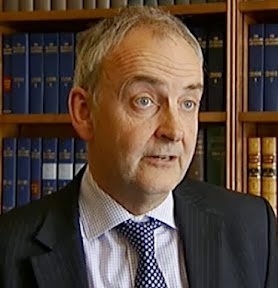
Substituting for the Director of Regulation, the Convener of the Law Society’s Regulation Committee, Carole Ford was instead, interviewed on the powerful BBC programme broadcast last week.

However, while Ford’s performance was expectedly praised in some legal quarters, some legal experts, clients, and those who have experienced the ‘alice in wonderland’ world of how the legal profession regulates itself felt the Committee Convener was a poor substitute, and appeared to have little grasp as to the realities of how the system works, and how paying clients are treated by lawyers who regularly cover up for their own colleagues.

While many expected Mr Yelland to be part of the BBC investigation, there are numerous reasons as to why the one person in legal regulation circles who has been involved in many of the controversial and highly public cases involving solicitors escaping penalty for their actions over the past twenty years did not appear on the highly acclaimed undercover investigation by BBC journalist Sam Poling.

The Law Society’s reluctance to allow Mr Yelland’s appearance in the BBC programme may well stem from the unfortunate demise of the Society’s former Chief Executive Douglas Mill, who resigned a few weeks after the Law Society’s Council viewed and debated video footage posted to video sharing website You Tube of Mill’s angry confrontation at a Holyrood Justice Committee hearing with John Swinney, Scotland’s Finance Chief.

During the Justice Committee hearing in 2006 which formed part of the Scottish Parliament’s second, ill-fated attempt to clean up regulation of the legal profession, the former Chief Executive was caught out by the Scottish Parliament’s video coverage of the hearing when he argued with the SNP Finance Chief that the Law Society’s Master Policy, the insurance scheme which protects corrupt lawyers from clients, was fair, and that there was no collusion between figures at the Law Society and the insurers to throw out financial damages claims made by clients.

However, Mr Swinney, a skilled debater himself, trounced the then pugnacious Law Society Chief on all points, leaving the public with little doubt the Master Policy Insurance client compensation scheme run by the Law Society of Scotland is unfair and claims made by clients for damages are clearly subject to concerted and determined manipulation at the highest levels of the Law Society and the legal profession.

The footage featuring Mill's Holyrood confrontation with John Swinney was first posted to the You Tube video sharing website in late December 2007. Mill, who superseded the equally controversial Kenneth Pritchard as Secretary of the Law Society of Scotland in the early 1990’s, then going on to become the Society’s Chief Executive and expected by many to remain in the position for a lengthy period of time, resigned a few weeks later in January 2008.

The confrontation between the former Law Society Boss and Scotland’s now Finance Chief, has since become a warning to how Law Society figures used to a closed world lacking any accountability can quickly stumble in public appearances such as the Holyrood Master Policy clash which made it obvious to all that the Law Society was, and remains determined to hang onto self regulation and the power that comes with it, at any cost.

Fears of BBC questions over claims made by clients against solicitors may also have played a part in the Society’s refusal to allow access to its regulation chief.

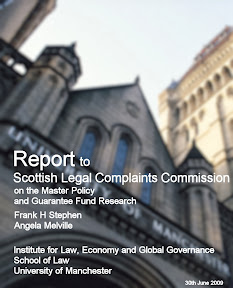
Academics heard involvement of Regulation Boss was linked to controversial complaints. A case referred to in a Research Report from the University of Manchester School of Law documented allegations in papers which have never been made public that the Society’s long time Regulation Chief was also allegedly linked to a case of a claim involving the Master Policy, where a respected businessman & family man from Oban committed suicide after he was sent to a law firm who have since been identified in a number of cases where dodgy solicitors have escaped justice and even possible criminal charges for legal aid fraud.

The revelations, appearing in papers studied by Professor Frank Stephen & Dr Angela Melville of the Manchester University of Law School in 2009 who were compiling a report on the Master Policy for the Scottish Legal Complaints Commission (SLCC), alleged the businessman from Oban had been sent to a Glasgow law firm to represent him in a court case against his former solicitors.

However the Glasgow based law firm, who have since represented the First Minister himself and a number of controversial figures in the legal world, did nothing for a period of three years and when it was revealed the same law firm who the Law Society’s Regulation Chief had allegedly recommended to the Oban businessman were also representing the Legal Defence Union, the organisation which represents crooked lawyers against complaints, the unnamed client committed suicide.

Against a background of too-numerous-to-mention cases where involvement of the twenty year plus serving Law Society’s Regulation Boss appears to have played a key part in allowing corrupt solicitors to remain in work, Yelland may well have faced difficult questions over his involvement in one of the key parts of the BBC Scotland report aired last week, that of former solicitor Tom Murray, currently living in Lucca, Italy.

Featured in the Lawyers Behaving Badly documentary, Murray, has appeared before the Scottish Solicitors Discipline Tribunal (SSDT) on no less than three occasions, (i) Law Society-v-Thomas Hugh Murray 01/03/2005 (ii) Law Society-v-Thomas Hugh Murray 25/11/2005 and (iii) Law Society-v-Thomas Hugh Murray 10/12/2009.

Former solicitor Murray, who said on the BBC programme during secret filming that if he returned to Scotland he could reapply to be a solicitor again, was found guilty of professional misconduct in respect of misrepresentation, deception and misleading clients including his failure to tell his clients he had been barred from practising as a lawyer. The solicitor who was sequestrated in Scotland in 2001 and continues to avoid any moves by the Law Society to take action against him and recover compensation awarded to his clients.

The case of Murray, and the Law Society’s apparently haphazard pursuit of complaints against him clearly provided fertile ground for difficult questions of Yelland, who has personally signed off on many of the communications to clients who were involved with the former solicitor. Diary of Injustice featured an in depth report on the Law Society’s involvement in the Murray case in an earlier article HERE

In a long, rambling statement attacking the BBC Scotland programme, the Law Society of Scotland made no mention as to why Mr Yelland refused to appear, nor did the Society explain why the one man who can be linked to many of the complaints made against Scottish solicitors which have done significant damage to the image of the profession, did not appear or give an account of his charge over regulation of, and standards in Scotland’s legal profession in the past two decades.

Diary of Injustice has reported on the BBC’s investigation into self regulation of the Scottish legal profession in previous articles here: Lawyers Behaving Badly - a window into the world of lawyers regulating themselves