Friday, January 17, 2014

Let’s work together to identify dodgy lawyers: Scottish Legal Complaints Commission statement on BBC Scotland investigation of Lawyers Behaving Badly

Regulators behaving typically – SLCC statement on BBC investigation into dodgy solicitors. AMID widespread criticism from the legal profession over the content of a popular and well researched BBC Scotland investigation Lawyers Behaving Badly, which revealed significant failures in self regulation of the legal profession, the much criticised and often pro-lawyer Scottish Legal Complaints Commission (SLCC) has issued a statement welcoming the BBC programme “for raising some important issues” on how complaints against solicitors are currently dealt with by the ‘independent’ regulator.

The SLCC, itself beset with complaints about how it mistreats clients & complainants and how it appears to operate on an anti-consumer platform, also claimed in a Press Release that it wished to work more closely with the Scottish Legal Aid Board (SLAB) and the Law Society of Scotland to ‘share information and intelligence with these organisations to help identify risks to the public’.

Statement from the Scottish Legal Complaints Commission regarding BBC Scotland’s Lawyers Behaving Badly investigation: On Wednesday night, the BBC screened the latest BBC Scotland Investigates: “Lawyers Behaving Badly”.   The programme investigated the regulation of the legal profession in Scotland and the role of the different organisations involved.  We welcome the programme for raising some important issues.

We know from our trends analysis that problems with solicitors often arise during important life events – buying and selling a house, divorce, wills.  The public rightly expects high standards of conduct and service from their solicitors and it is a serious matter when these are not met.

As the single gateway for all complaints against legal practitioners in Scotland, we provide the first point of contact in the legal complaints system.  In the four years from 1 July 2009-30 June 2013, we dealt with 4929 complaints.

Under the current system, it is our responsibility to investigate service issues.  In the last year alone, we awarded £250,000 in compensation or rebated fees for inadequate service.  We are upholding more complaints than ever while also offering complainers alternate means to get a resolution.  We also aim to reduce the occurrence of service issues by researching and producing guidance for the profession to help them improve.

Our powers regarding complaints about the conduct of solicitors raised with us are limited.  If we decide the complaint has merit, we will pass it over to the Law Society of Scotland to investigate.  We can investigate how it handles the complaint, but only if the complainer asks us to and the action we can then take is restricted.  We also audit the Law Society’s overall complaints process.  We have no oversight over the Scottish Solicitors Discipline Tribunal (SSDT).

It is clear that we, the Law Society of Scotland, the Scottish Legal Aid Board and the SSDT could work together more closely.  We are already sharing information and intelligence with these organisations to help identify risks to the public.  We are committed to working with them to improve the effectiveness of the system and to continue to build public trust and confidence in Scotland’s legal system.

Commenting on the SLCC’s wish to work more closely with the Law Society & Scottish Legal Aid Board, a legal insider said the idea could only work if each of the three bodies had greater oversight over their operations and were able to gain public trust and confidence in their operation, combined with increased transparency.

He also said that if the three bodies were to work together, the Law Society of Scotland should be subject to the full requirements of Freedom of Information legislation, a proposal once supported by the former Chair of the SLCC, Jane Irvine, reported here: Legal Complaints Chief supports ‘consumer advantages’ of removing Law Society’s Freedom of Info immunity

Earlier this week, it was reported a spokesperson for the Legal Aid Board who gave reaction to the BBC’s investigation of dodgy lawyers also said SLAB supported an idea from the Scottish Legal Complaints Commission that a regulator’s forum should be set up.

However, it was recently revealed the troubled SLCC has its own issues of perceived pro-lawyer bias with a full complement of staff & Law Society insiders revealed in an exclusive Diary of Injustice report here : A SPECIAL RELATIONSHIP : Investigation reveals Scotland’s ‘independent’ legal regulator is mired in family, business & personal links to legal profession & Law Society

Speaking to Diary of Injustice this afternoon, a client who encountered significant delays and difficulties with the Scottish Legal Complaints Commission said he felt like he “was talking to a bunch of lawyers” throughout the time he dealt with the SLCC. The client branded the SLCC as bad as the Law Society, calling the regulator “a lawyer set up to bury complaints against other lawyers”.

The hapless regulator then took nearly a year to accept the complaint against the solicitor concerned, who went on to time waste, then use mediation as a further time wasting measure, upon the failure of which, the complaint re-entered the investigation stage and ended up with only a partially upheld finding.

Speaking of his experiences with the SLCC, the client commented: “No matter what material is handed over to the SLCC and how often you have to make the points again and again that your solicitor has stolen money and property deeds, this regulator seems to allow crooked lawyers to go on working”.

He continued: “What use is a regulator when the SLCC does nothing even after evidence has been handed to it documenting the most cruel and pernicious offences committed by solicitors against their clients?”

Diary of Injustice has reported on the BBC’s investigation into self regulation of the Scottish legal profession in previous articles here: Lawyers Behaving Badly - a window into the world of lawyers regulating themselves

Wednesday, January 15, 2014

Blame them not us: Legal Aid Board accuse Law Society over poor regulation of dodgy legal aid lawyers exposed in ‘Lawyers Behaving Badly’ BBC Scotland investigation

How lawyers regulate themselves is to blame for current mess says Legal Aid Board. AHEAD of a BBC Scotland investigation Lawyers Behaving Badly which reports on failings in how lawyers regulate themselves, to be broadcast later today at 10:35pm on BBC One Scotland, the Scottish Legal Aid Board (SLAB) has revealed it has long standing concerns that it can take too long for the Law Society of Scotland and the current mix of lawyer controlled regulators to investigate and make decisions in disciplinary cases involving solicitors.

In a lengthy statement issued to the media earlier today, a spokesperson for the Scottish Legal Aid Board said: “We welcome the BBC’s interest in this important subject. We have been concerned for some time that it can take too long to get decisions in disciplinary cases involving solicitors.”

The spokesperson continued: “The legal aid system was set up to enable people who could not afford legal help to get access to it, rather than as a regulatory system for solicitors. While there were some regulatory aspects in the Legal Aid (Scotland)1986 Act, and further compliance aspects have been developed for areas like criminal registration, it is an on-going and developing process.

“When a solicitor who provides legal aid is found guilty of any offence it is obviously of concern to us, as it will be to the Law Society of Scotland as the statutory regulator of the legal profession in Scotland.”

“In the cases highlighted by the BBC where a solicitor was convicted for assault and the clerk of court was convicted for embezzlement, the Scottish Solicitors’ Disciplinary Tribunal determined in 2001 and 2004 respectively that neither offence was sufficiently serious for either solicitor to be struck off.”

“At the time these cases took place we did not have the statutory powers through Section 31 of the Legal Aid (Scotland) Act to exclude a solicitor from undertaking legal aid work and representing legal aid clients. Section 31 powers were with the Law Society of Scotland and the Faculty of Advocates until May 2011, at which time they transferred to SLAB.”

“Since taking over the Section 31 powers, we have put in place a procedure we will follow in determining whether to exclude a solicitor or advocate. We are also to be notified by the Law Society of Scotland whenever there are disciplinary findings against a solicitor. Where we consider that a lawyer has acted in an inappropriate manner we will exercise sanctions available to us under the legal aid legislation.”

“It remains the case, though, that while we are robust in our protection of the legal aid fund and the regulation of solicitors registered to provide legal assistance, there is a limit to the powers we can exercise if the profession’s regulatory body itself doesn’t find it necessary to prevent a solicitor from practising.”

“Solicitors undertaking criminal legal aid must register with us, and we have powers to de-register a solicitor from criminal legal aid work where we have evidence of abuse of the legal aid fund or breaches in our criminal Code of Practice. Where appropriate, a report is sent to the Procurator Fiscal, who makes a determination on whether to prosecute or not. This is not a matter for the Board.We will continue to monitor those solicitors on the Registers and act decisively against those who breach the Code.”

“Following investigations by the Board we did just that when we de-registered the solicitor Iain Robertson and his firm Robertson and Ross. In 2010, both he and the firm were removed from the criminal register for failing to comply with our Code of Practice. A sum of £221,847 was also repaid to the Legal Aid Fund.

“The registration process for civil is different to the criminal scheme and a solicitor cannot be de-registered. The only sanction to exclude a solicitor from undertaking legal aid is to use Section 31 powers. At the time these powers lay with the Law Society. This option was not employed in respect of Mr Robertson.”

The spokesperson for the Legal Aid Board also said SLAB supported an idea from the Scottish Legal Complaints Commission (SLCC) that a regulator’s forum should be set up, stating : “We believe there should be greater coordination between the regulators of the legal profession and we support the Scottish Legal Complaints Commission’s suggestion that a legal regulators’ forum is set up.”

However, it was recently revealed the troubled SLCC, which itself is viewed with suspicion from clients & solicitors alike, and appears to be more part of the problem rather than part of a solution, has its own issues of perceived pro-lawyer bias with a full complement of staff & Law Society insiders revealed in an exclusive Diary of Injustice report here : A SPECIAL RELATIONSHIP : Investigation reveals Scotland’s ‘independent’ legal regulator is mired in family, business & personal links to legal profession & Law Society

In response to today’s media coverage of the forthcoming BBC investigation, the Law Society of Scotland attempted to blame the Scottish Legal Aid Board for failings in dealing with problem lawyers who are still working with firms receiving large amounts of tax payer funded legal aid.

The Law Society Press Release stated : “We have yet to see the full documentary.  However, coverage in advance of the broadcast has focused on the issue of the criminal and civil legal aid registers. The BBC has raised concerns over 33 solicitors who have had findings of professional misconduct against them and are on the legal aid register.”

“In each of the cases mentioned, the Society did act properly, investigating the complaints thoroughly and taking action to the independent Scottish Solicitors' Discipline Tribunal.  It is only because of the actions of the Society and our evidence gathering that the findings of misconduct were made against the solicitors involved.  However, it is always a matter for the independent tribunal to decide what action is taken against a solicitor found guilty of misconduct, whether that be a fine, censure, restriction, suspension or strike off.  In these cases, the tribunal chose not to strike off the solicitor concerned.”

“It is the Scottish Legal Aid Board and not the Law Society of Scotland which maintains the legal aid registers.  Whilst the Board has the ability to remove a solicitor from the register, the Society has no such power other than through the civil legal aid quality assurance scheme where a poor service has been provided by the firm directly to clients.  In cases involving the abuse of legal aid money, we are dependent on the Board in making a conduct complaint through the Scottish Legal Complaints Commission for us to investigate and, where necessary, take to the discipline tribunal.  In the specific cases raised directly with us by the BBC, the Scottish Legal Aid Board either chose not to complain or made a complaint but then withdrew it.”

Late this afternoon, a legal insider rubbished the Law Society’s attempt to blame the Legal Aid Board for failings in how the Society dealt with solicitors featured in the BBC programme.

He said: “The Law Society is disingenuous in its claim to effectively regulate its own members.”

He continued: “The fact is S31 complaints have been put to the Law Society of Scotland regarding solicitors who have taken hundreds of thousands of pounds of legal aid in a relatively short period of time, yet the Law Society chose to take years to deal with those complaints, constantly replace its own investigator and in the end, did nothing and allowed the solicitor to remain in work.”

HOW REGULATORS ‘DEALT’ WITH DODGY LEGAL AID SOLICITOR COMPLAINT :

SLCC Lockhart montageA solicitor who ruined pensioner's legal affairs was given slap on the wrist by law complaints regulator SLCC. KILMARNOCK solicitor Niels S Lockhart, who was accused by the Scottish Legal Aid Board (SLAB) of making £670K worth of dodgy claims for legal aid work and who then went on to ruin the legal affairs of a pensioner and other clients was allowed to continue working as a lawyer after the Scottish Legal Complaints Commission (SLCC), the ‘independent’ regulator of solicitors decided his firm NS Lockhart Solicitors need only pay a meagre fine of ONE HUNDRED POUNDS to a victim who had complained about the legal nightmare she had been put through.

Solicitor Niels Lockhart was the subject of lengthy investigations by the Scottish Legal Aid Board which were uncovered by Diary of Injustice & the Sunday Mail newspaper and reported earlier here : One law for lawyers : Secret Report reveals Legal Aid Board, Law Society & Legal Defence Union ‘cosy relationship’ in Lockhart case

Diary of Injustice published the full SLAB S31 complaint report to the Law Society of Scotland obtained after a Freedom of Information disclosure, here : SCOTTISH LEGAL AID BOARD S31 COMPLAINT REPORT TO THE LAW SOCIETY OF SCOTLAND : NIELS S LOCKHART

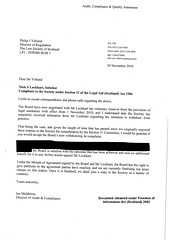
Letter to LSS, 11-10 redactedDiary of Injustice also revealed via a Freedom of Information investigation the Scottish Legal Aid Board asked Law Society to withdraw complaint after a secret deal was reached with Legal Defence Union. “In November 2010 SLAB advised the Law Society of Scotland that they had negotiated with Mr Lockhart his voluntary removal from the provision of legal assistance with effect from 1 November 2010 and acknowledged that the Society had separately received information from Mr Lockhart signalling his intention to withdraw from provision of all types of legal assistance. In the light of this, we sought to know from them whether they accepted SLAB’s withdrawal of the S31 complaint against Mr Lockhart.”

“In December 2010 the Law Society wrote to SLAB advising that they had accepted SLAB’s withdrawal of the complaint and that they were closing their file and taking no further action.”

Diary of Injustice also published the investigation carried out by the Scottish Legal Complaints Commission into Niels S Lockhart. The report, now in the hands of media outlets, can be viewed online here : SLCC Investigation of complaint against Niels S Lockhart of NS Lockhart Solicitors, Kilmarnock.

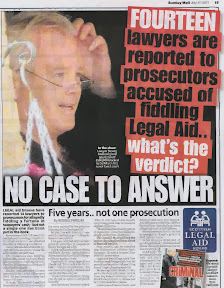
Crown Office also refused to prosecute dodgy legal aid lawyers. An exclusive report in the Sunday Mail newspaper also raised questions about the Crown Office lack of will to prosecute lawyers who were accused of legal aid fraud, revealing that FOURTEEN lawyers accused of multi-million pound legal aid fraud escaped justice as Scotland’s Crown Office fail to prosecute all cases in 5 years. Legal aid bosses reported 14 lawyers to prosecutors for allegedly fiddling a fortune in taxpayers' cash - but not a single one has been put in the dock. Eleven suspected fraud cases were marked no proceedings, one lawyer was declared insane, one died and the other is still being considered. Crown officials did not identify any of the lawyers involved or reveal the scale of their alleged fraud. The revelations were made by Crown Office and Procurator Fiscal Service director of operations Scott Pattison in response to a freedom of information request.

Tuesday, January 14, 2014

ROGUES LAW: Law Society of Scotland’s self regulation “cartel” of lawyers investigating lawyers must end, says legal academic

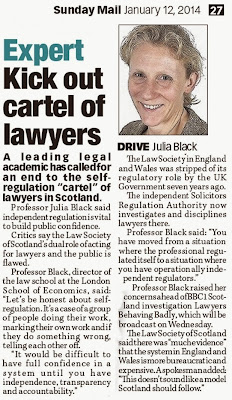
Decades of lawyers looking after each other has destroyed confidence in Scots legal profession. THE Law Society of Scotland should be stripped of its dual role of acting for lawyers and the public, says a leading legal academic who has publicly called for an end to the self regulation cartel of Scottish lawyers looking after each other. The call for change comes amid overwhelming evidence that Scots consumers & clients who fall victim to rogue lawyers rarely if ever secure a fair hearing for their complaints or receive correct recompense for significant financial losses or embezzlement by their solicitors, due to lawyers covering up for each other.

Speaking to the Sunday Mail newspaper ahead of a BBC Scotland investigation on how solicitors make a mockery of the current system of regulation of complaints against the legal profession, Professor Julia Black of the London School of Economics said independent regulation is vital to build public confidence.

On Wednesday 15 January 2014 at 22:35, BBC Scotland will broadcast their investigation “Lawyers Behaving Badly”, where journalist Samantha Poling investigates a regulation system which clients say favours the profession rather than the consumer, and goes undercover to investigate solicitors making a mockery of the system.

Those involved in the debate regarding self regulation of Scotland’s legal profession will be well aware of the ill fated attempts between 2001-2007 to create a more independent system of regulation, which saw the creation of the pro-lawyer, anti-client Scottish Legal Complaints Commission.

Since the SLCC was created in 2008 by Justice Secretary Kenny MacAskill, there have been little if any improvements in how consumer complaints against Scottish solicitors are investigated.

The current model of self-regulation of Scottish solicitors, where the SLCC investigate complaints against lawyers, appears to have led to record numbers of solicitors escaping sanction or prosecution for offences committed against clients.

Critics of the current system and its in-built pro-lawyer bias point to the fact the SLCC itself is effectively run by the Law Society who pay for its running through subscriptions raised by lawyers who in turn increase client fees to fund their own pat-on-the-back self regulation cartel.

Diary of Injustice reported on the secret vested interests at the Scottish Legal Complaints Commission in an earlier article here: A SPECIAL RELATIONSHIP : Investigation reveals Scotland’s ‘independent’ legal regulator is mired in family, business & personal links to legal profession & Law Society

The frequent, almost serial failures of the Scottish Legal Complaints Commission has been widely reported in previous articles.

The Sunday Mail reports :

Expert: Kick out cartel of lawyers

Sunday Mail 12 January 2014

A leading legal academic has called for an end to the self regulation “cartel” of lawyers in Scotland.

Professor Julia Black said independent regulation is vital to build public confidence.

Critics say the Law Society of Scotland’s dual role of acting for lawyers and the public is flawed.

Professor Black, director of the law school at the London School of Economics, said: “Let’s be honest about self-regulation.

"It’s a case of a group of people doing their work, marking their own work and if they do something wrong, telling each other off.

“It would be difficult to have full confidence in a system until you have independence, transparency and accountability.”

The Law Society in England and Wales was stripped of its regulatory role by the UK Government seven years ago.

The independent Solicitors Regulation Authority now investigates and disciplines lawyers there.

Professor Black said: “You have moved from a situation where the professional regulated itself to a situation where you have operationally independent regulators.”

Professor Black raised her concerns ahead of BBC1 Scotland investigation Lawyers Behaving Badly, which will be broadcast on Wednesday.

The Law Society of Scotland said there was “much evidence” that the system in England and Wales is more bureaucratic and expensive. A spokesman added: “This doesn’t sound like a model Scotland should follow.”

Monday, January 06, 2014

Transparency is not rocket science, Lord President : Disclosure should not be held in contempt of court by Scotland’s top judge over proposal to create a register of judicial interests

Last year,Scotland’s top judge opposed all debate on register of judicial interests. IN AN ATTEMPT to make a proposal currently being debated by MSPs to create a register of judicial interests sound more like a complicated scientific mission to land the first member of the judiciary on the moon, Scotland’s top judge, Lord President Lord Brian Gill incurred great effort in leaving little doubt in 2013 that he opposed any move by the Scottish Parliament to create, or even debate proposals to require judges by law to declare all their interests in a published register of interests.

During the past year of debate on Petition 1458, Lord Gill and the judiciary had a task at hand. In their eyes, the subject of judicial interests could not be debated in public, for it would reveal the shambles of judicial oaths, the shambles of rules the judges wrote themselves, rich judges, judges with criminal records, judges with tax dodging investments , judges with multiple conflicting interests, and judges who once prosecuted people then threw out their appeals against wrongful convictions.

Clearly if MSPs and the public delved deeper, the truth would be revealed, showing that recusals in court were in most cases, not taking place and most certainly not being recorded, should anyone ever ask to see the data.

It was quite a surprise to some that the focus and public face of Scotland’s world travelling judiciary and its supporting vested interests should collapse so easily like a house of cards at such a simple proposal asking the Scottish Parliament to debate and ultimately legislate to ensure that the well earned, well kept, yet unusually secretive members of Scotland’s judiciary should set out their complete interests in a published register of interests like all other public servants are required to undertake.

However, the lengths which the judiciary were to go to, in an effort to protect themselves against any required disclosure of, or even debate surrounding their interests, was nothing short of stunning arrogance against a simple call for transparency, an act which if anything has encouraged public debate and brought to the fore the lack of accountability in the judiciary.

Not only was the Lord President opposed to giving evidence at the Scottish Parliament and replying to questions from MSPs on a proposal contained in Petition 1458 to create a register of judicial interests, Lord Gill refused several invitations to appear at Scotland’s elected Parliament to face questions from MSPs on his opposition to the transparency proposal.

While refusing to give answers to many of the questions put to him on the numbers of cases in which Scottish judges have recused themselves and in what circumstances recusals have occurred, Lord Gill twice referred MSPs to quotes from an obscure EU report written by judges who effectively used the opportunity of compiling the EU quango report to lobby against any proposal to require members of the judiciary to declare their interests.

As the debate at Holyrood unfolded, it was clear the Lord President was willing to oppose the call for a register of interests in writing, but not attend the Scottish Parliament in person to be questioned in public and on camera about his opposition to the transparency proposals of judges declaring their interests.

Not satisfied, Lord Gill overstepped the mark, accusing the media, litigants, court users, indeed anyone and everyone who may have cause to question a judge’s interests in a court case, of harassment and even hostility, just because the very transparency judges demand of everyone else in court may end up being used by the public to delve into the secrets of the judiciary’s undeclared private wealth, undeclared earnings, friendships and professional relationships, all of which may be relevant to countless cases in our courts.

And to make sure the Lord President had his way in his attempts to hinder proper public debate on the question of judicial interests, Lord Gill threw passages of the Scotland Act itself in the face of MSPs, claiming a somewhat debatable interpretation of the Act which Lord Gill implied exempted him from being called to answer questions on the very interests judges are so eager to keep secret.

Desperate to fluster any debate on the subject, Lord Gill even implied the very independence of the judiciary itself was being challenged in the proposal put forward to require judges to declare their interests.

Clearly, independence of the judiciary was not being challenged. The Lord President had again misapplied the term to stifle debate, as judges do when the tables of transparency are turned.

Scotland’s Judicial Complaints Reviewer Moi Ali answered this point in a recent media interview on the publication of her 2012-2013 annual report, stating : “I think it’s a confusion between independence and accountability. I really do think it’s as basic as that. The dividing line is completely clear.”

Lord Gill’s opposition to transparency of his and his colleagues interests was, and is absolute. There is to be no public debate. There is to be no register of judicial interests. There is to be no transparency when it comes to the judiciary.

Simply put, those who dispense justice cannot be, and cannot be seen seen to be immune from the laws which apply to all of us, from public expectation of transparency, or from serving the community as their position befits. There can be no excuse to the contrary.

What is there to fear ? What is there to hide ? We must all abide by the same law and the same expectation of transparency, but when a country’s most senior judge lunges so out of step with accepted norms and public expectation of complete transparency in all walks of public life, Government, the courts, and the justice system and effectively dictates policy to an elected Parliament that a proposal which is such a common requirement in most other walks of public life must not apply to the judiciary, there is a clear problem which brings into question the way in which the judiciary conduct themselves and are held to account for their actions.

While some have hoped for speedy action over the proposal for a register of judicial interests, the duration of the debate so far, and media publicity to the transparency plan has brought its own benefits, in terms of a multitude of new information on cases which clearly raise issues where judges have not declared interests and stepped aside, leading to potential injustice and the compromising of our courts.

Transparency, Lord Gill, is not rocket science. It is time for Scotland’s judiciary to declare their interests in a published register of interests, like all others in public life. Such a register will enhance public trust in a justice system which clearly needs it.

In support of Petition 1458, Judicial Complaints Reviewer Moi Ali wrote in her 2012-2013 Annual Report of her recognition of the issues of transparency raised in the petition, and recommended “any judicial register of interests should not be limited to pecuniary interests, but should also encompass non-financial interests such as memberships, unpaid trusteeships, and any relevant close family/friendship links that may be perceived as a potential conflict of interest.” Video footage of the evidence session in which the JCR answered questions from MSPs can be viewed here :

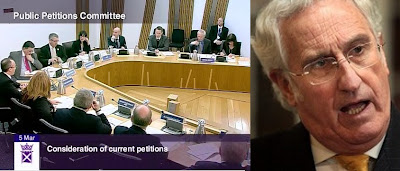
JCR Moi Ali gives evidence to Scottish Parliament on a proposed Register of Judicial Interests (Click image to view video)

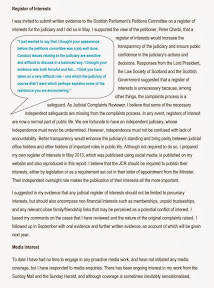
JCR 2012-2013 Annual Report confirms support for a Register of Judicial Interests, recommends extending interests to be declared. Register of Interests : I was invited to submit written evidence to the Scottish Parliament’s Petitions Committee on a register of interests for the judiciary and I did so in May.

I  supported the view of the petitioner, Peter Cherbi, that a register of interests would increase the transparency of the judiciary and ensure public confidence in the judiciary’s actions and decisions.

Responses from the Lord President, the Law Society of Scotland and the Scottish Government suggested that a register of interests is unnecessary because, among other things, the complaints process is a safeguard.

As Judicial Complaints Reviewer, I believe that some of the necessary independent safeguards are missing from the complaints process. In any event, registers of interest are now a normal part of public life.

We are fortunate to have an independent judiciary, whose independence must never be undermined. However, independence must not be confused with lack of accountability. Better transparency would enhance the judiciary’s standing and bring parity between judicial office holders and other holders of important roles in public life.

Although not required to do so, I prepared my own register of interests in May 2013, which was publicised using social media, is published on my website and also reproduced in this report. I believe that the JCR should be required to publish their interests, either by legislation or as a requirement set out in their letter of appointment from the Minister. Their independent oversight role makes the publication of their interests all the more important.

I suggested in my evidence that any judicial register of interests should not be limited to pecuniary interests, but should also encompass non-financial interests such as memberships, unpaid trusteeships, and any relevant close family/friendship links that may be perceived as a potential conflict of interest.

I based my comments on the cases that I have reviewed and the nature of the original complaints raised. I followed up in September with oral evidence and further written evidence, an account of which will be given next year.

Previous articles on the lack of transparency within Scotland’s judiciary, investigations by Diary of Injustice including reports from the Sunday Mail newspaper, and video footage of debates at the Scottish Parliament’s Public Petitions Committee can be found here : A Register of Interests for Scotland's Judiciary

Petition PE1458: Register of Interests for members of Scotland's judiciary is due to be heard again at the Scottish Parliament after the Convener and Deputy Convener of the Public Petitions Committee meet the Lord President in a private meeting to be held sometime in January 2014.