Showing posts sorted by relevance for query nicola. Sort by date Show all posts

Monday, March 08, 2021

FIRST INTERESTS: Judge recommended for judicial role by Nicola Sturgeon - found First Minister committed three counts of professional misconduct - in Law Society probe of Ms Sturgeon's failure to provide legal service protections for domestic violence victim

First Minister recommended judge role for lawyer - who found her guilty of misconduct. AN INVESTIGATION has established Scotland’s First Minister – Nicola Sturgeon – was found to have committed THREE counts of professional misconduct by a solicitor she later recommended for the position of a Sheriff within Scotland’s powerful judiciary - currently led by Lord President - Lord Carloway.

The findings of professional misconduct by Sheriff Pasportnikov against the First Minister - were the result of a complaint lodged by a client to the law firm where Nicola Sturgeon worked at the time – Bell & Craig solicitors.

The complaint against Nicola Sturgeon involved the currently serving First Minister’s failure to provide adequate legal services to a victim of domestic violence.

And, the issues in relation to Ms Sturgeon’s failure to provide adequate legal services only came to light after Ms Sturgeon suddenly left the law firm = and the client was forced to go to another solicitor – who it was reported - discovered legal aid forms had not been sent to the Scottish Legal Aid Board – despite assurances the legal aid application had been submitted.

In response to the complaint – the Law Society of Scotland appointed a case manager – a solicitor, and now Sheriff - Olga Pasportnikov - to investigate.

In a five-page report, dated Dec 1998, Olga Pasportnikov said: “The complaint in this case has been identified as professional misconduct by breach of code of conduct and conduct unbecoming a solicitor.”

Pasportnikov identified three counts ‘of professional misconduct by breach of code of conduct and conduct unbecoming a solicitor’.

They were: failing to raise interdict, misleading client about legal aid application & failing to properly consider her financial circumstances

Among ‘circumstances which have been ascertained during the course of the enquiry’ were the legal aid form had been completed and signed by the client and the client’s employers but not sent.

Despite the findings of Sheriff Pasportnikov, and her identification of multiple serious issues where she concluded Ms Sturgeon’s failure to provide competent legal services qualified as professional misconduct - the Law Society of Scotland concluded there should be no further action and Nicola Sturgeon left the legal profession.

It is important to note - the Law Society of Scotland cleared Nicola Sturgeon even after their case manager Ms Pasportnikov identified various breaches of professional misconduct by Nicola Sturgeon – and that Ms Sturgeon – who then 'stood down’ from the legal profession – to contest a seat for the Scottish National Party – then entered politics without an on the record finding of professional misconduct by the Law Society of Scotland.

Records show from announcements in the legal profession’s press, and Scottish Government news postings -  Announced on 31 July 2015 - Olga Pasportnikov was appointed by the Queen following a report to the First Minister Nicola Sturgeon - by the Judicial Appointments Board for Scotland.

Ms Pasportnikov, a University of Dundee graduate, was admitted as a solicitor in 1991. She worked mainly in private practice before joining the Law Society of Scotland in 1998. She has been with the Crown Office & Procurator Fiscal Service since 2003, and is also current convener of the Fife Young Carers Management Committee.

The First Minister has statutory responsibility for making recommendations to Her Majesty the Queen and is required by statute to consult the Lord President of the Court of Session before making her recommendation.

The Judicial Appointments Board for Scotland is an ‘independent’ advisory public body with the role of recommending individuals for appointment to judicial offices within the Board’s remit including judge of the Court of Session, chair of the Scottish Land Court, sheriff principal, sheriff, and summary sheriff.

It has since come to light this story was filed with a Scottish newspaper for publication in June 2018 – after several other newspapers refused to publish the story.

According to now deleted tweets from a former journalist which have now been widely published online – a story on the complaint regarding Nicola Sturgeon’s failure to provide adequate legal services to a victim of domestic violence, and the identification of several counts of professional misconduct against Ms Sturgeon by currently serving Sheriff Olga Pasportnikov - had support from one editor to be published – until a ‘Political editor’ at the same newspaper voted the story down.

The deleted tweet goes on to allege that some weeks later, the same newspaper which did not publish the story on Nicola Sturgeon - was leaked details of the harassment complaints against Alex Salmond and the investigation by Police Scotland - which subsequently led to Mr Salmond being charged with 14 offences, including two counts of attempted rape, nine of sexual assault, two of indecent assault, and one of breach of the peace.

Mr Salmond appeared in court on 21 November 2019 and entered a plea of "not guilty".

At the subsequent trial, Mr Salmond was cleared by a jury trial - heard by Scotland's Lord Justice Clerk - Lady Dorrian.

The information came to light after Justice Committee Convener Adam Tomkins (Scottish Conservative) & former Scottish Government Legal Affairs Minister Annabelle Ewing (Scottish National Party) made a motivated and concerted effort to close down the same Judicial Interests Register petition which Nicola Sturgeon has opposed and sought to close - throughout her term as First Minister.

The Justice Committee hearing of 2 March 2021 can be viewed here: Register of Judges Interests Petition PE 1458 Scottish Parliament Justice Committee 2 March 2021

This is the same Judicial Interests Register petition the First Minister has tried to undermine and block since Ms Sturgeon became First Minister.

If a Register of Judges’ Interests did become a requirement – Sheriff Pasportnikov who found Nicola Sturgeon guilty of professional misconduct may be forced to list that fact and other details of her service to the Law Society of Scotland.

On Wednesday 3 March 2021 - the Judicial Office for Scotland were asked the following questions:

A currently serving Sheriff - Olga Pasportnikov - conducted an investigation of complaints lodged about Scotland's current First Minister Nicola Sturgeon while she was a solicitor at a law firm identified as Bell & Craig

Ms Pasportnikov was, as the Judicial Office will be aware - a case manager for the Law Society of Scotland from September 1998 to March 2003

In a five-page report released in December 1998, Olga Pasportnikov said: "The complaint in this case has been identified as professional misconduct by breach of code of conduct and conduct unbecoming a solicitor."

Olga Pasportnikov found Ms Sturgeon guilty of 3 identifyable counts of professional misconduct:

They were: failing to raise interdict as instructed, misleading client about legal aid application, failing to properly consider the client's financial circumstances

Events then saw the Law Society clear Ms Sturgeon, who quickly left the legal profession.

Noting Ms Pasportnikov currently declares her time at the Law Society of Scotland on her Linkedin page as a "case manager" - along with other career attributes including a term at the Crown Office as a Procurator Fiscal Depute, and her current role as a serving Sheriff

- does Sheriff Pasportnikov have any comment onthe following questions:

why she does not list her role of investigating complaints against solicitors?

why she found Ms Sturgeon guilty of 3 identifyable issues of professional misconduct?

why no regulatory punishment took place upon Sheriff Pasportnikov's findings?

Does the Judicial Office have any comment on the above events and any comment on the impact of a currently serving Sheriff with a long history as a solicitor, prosecutor and now a judge - having found Scotland's current First Minister Nicola Sturgeon guilty of three counts of professional misconduct to which no sanction was ever applied by legal regulators and never declared in any register of interests?

On Friday 5 March 2021 - the Judicial Office for Scotland (JOFS) issued a statement to the media.

The Judicial Office claimed Sheriff Pasportnikov had forgotten she had investigated a complaint case involving the current First Minister Nicola Sturgeon,

A spokesperson for the Judicial Office said:

“The Sheriff was one of a number of case managers working on the Law Society for Scotland’s Client Relations Team from 1998 – 2003. Her role was limited to that of gathering and categorising information as a first step in a much longer process. She did not produce any reports or make any findings. Covering a volume of work, she would not remember specific names in routine cases, including where a solicitor was cleared entirely.”

“In Scotland, sheriffs are appointed by Her Majesty on the recommendation of the First Minister, who makes their recommendation on the basis of a report by the Judicial Appointments Board for Scotland (JABS). The First Minister has statutory responsibility for making recommendations to Her Majesty and is required by statute to consult the Lord President of the Court of Session before making their recommendation.”

“JABS is an independent advisory public body with the role of recommending individuals for appointment to judicial offices within the Board’s remit including judge of the Court of Session, chair of the Scottish Land Court, sheriff principal, sheriff, and summary sheriff.”

A response to the Judicial Office statement was submitted - querying the JOFS claim, and confirming - that material now in the public domain - does confirm Sheriff Pasportnikov did in-fact – investigatge a complaint against Nicola Sturgeon and that Sheriff Pasportnikov identified several breaches of professional misconduct by Ms Sturgeon.

No reply to the additional query has been received, nor has the Judicial Office disputed the terms of questions & information supplied to JOFS staff.

It would be difficult to believe a case relevant to the current First Minister was forgotten about by the investigating reporter - Sheriff Pasportnikov - as there is obviously only one Nicola Sturgeon in Scotland - the current First Minister.

Earlier today, a legal expert assessed the material now in the public domain and deleted tweets from a former journalist which names a Scottish newspaper and a ‘spiked’ story on Ms Sturgeon.

The legal expert said he hoped the Committee on the Scottish Government Handling of Harassment Complaints would now scrutinise the information available and ask further questions of the First Minister.

He said: “In view of suggestions on social media platforms - a former journalist held this information for a number of years, and approached several newspapers seemingly without success - people may reasonably expect questions to be asked of why this story has not come to light until now and the method of travel to the media.”

He added: “Was there motive in withholding this story involving Scotland’s First Minister, either by a newspaper, a political party or a journalist? I am curious to find out. However, I am also curious as to why no one with the information offered the material in evidence to the long running Scottish Parliament investigation of issues involving Alex Salmond.”

“Given the First Minister responded to questions on what appear to be references to the investigation of Ms Sturgeon and a newspaper deal -  MSPs should ask rigorous questions of anyone involved in this matter given the situation we face where information now exists alleging the Sheriff complaint probe of Scotland’s First Minister was allegedly swapped for a story on harassment complaints and a Police investigation of Alex Salmond in the summer of 2018”

In discussions late this afternoon – others have come forward to confirm they were aware of this story for some time, but were unable to obtain any answers from Ms Sturgeon on these events.

JUDICIAL INTERESTS REGISTER - would have required declaration of Sheriff’s role in FM Complaint:

It has been previously reported Nicola Sturgeon personally intervened to block the Judicial Register petition - during a long running investigation by the Scottish Parliament’s Public Petitions Committee

The surprise intervention by the First Minister in the bid to bring transparency to Scotland’s secretive judges came to light after a failed attempt by her then Legal Affairs Minister – Paul Wheelhouse – to overturn the petition with claims that ‘gangsters’ could misuse information in a judges register.

In the letter – dated 30 March 2015 - Nicola Sturgeon also revealed Legal Affairs Minister Paul Wheelhouse had a secret meeting in February 2015 with Lord Gill to discuss the petition and the Judiciary & Scottish Government’s concerted opposition to creating the Judicial Register.
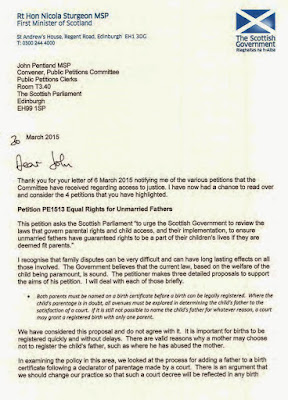
Writing in the letter to John Pentland MSP, Convener of the Public Petitions Committee, the First Minister said: “This petition calls on the Scottish Government to create a Register of Interests for the Judiciary. The Scottish Government considers that such a register of judicial interests is not necessary and that the existing safeguards - the Judicial Oath, the Statement of Principles of Judicial Ethics and the system for complaints against the judiciary - are sufficient. These safeguards, together with the register of judicial recusals, are sufficient to protect individuals from judicial bias.”

Further to the evidence that the Minister for Community Safety and Legal Affairs, Mr Wheelhouse, gave to the Committee on 9 December 2014, he discussed this petition when he met the Lord President in February. The Minister acknowledged the Lord President's concerns about the introduction of a register of judicial interests. The breadth of such a register would make it virtually unworkable. It would need to cover not only financial interests, but also memberships of groups and associations and familial and social relationships. Even so, such a register might not capture relevant issues that could arise.”

“The position of the judiciary is different from that of MSPs and others who hold public office. The judiciary cannot publicly defend themselves. The Lord President has cautioned that such a register could also have unintended consequences. Consideration requires to be given to judges' privacy and freedom from harassment by aggressive media or hostile individuals, including dissatisfied litigants. In addition, there is currently no evidence that judges who should have recused themselves from cases have not done so.”

The Sunday Herald newspaper reported on First Minister Nicola Sturgeon’s intervention on behalf of the judiciary and her opposition to the judicial transparency proposal:
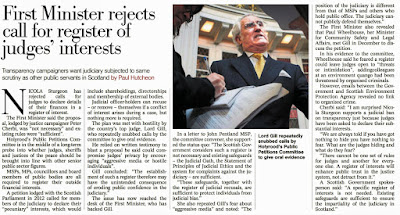
First Minister rejects call for register of judges' interests

Paul Hutcheon Investigations Editor Sunday 10 May 2015

NICOLA Sturgeon has rejected calls for judges to declare details of their finances in a register of interest. The First Minister said the proposal, lodged by justice campaigner Peter Cherbi, was "not necessary" and claimed existing rules were "sufficient".

Holyrood's Public Petitions Committee is in the middle of a long-term probe into whether judges, sheriffs and justices of the peace should be brought into line with other senior public sector figures.
MSPs, MPs, councillors and board members of public bodies are all required to register their outside financial interests.

A petition lodged with the Scottish Parliament in 2012 called for members of the judiciary to declare their "pecuniary" interests, which would include shareholdings, directorships and membership of external bodies.

Judicial officer holders can recuse - or remove - themselves if a conflict of interest arises during a case, but nothing more is required.

The plan was met with hostility by the country's top judge, Lord Gill, who repeatedly snubbed calls by the committee to give oral evidence. He relied on written testimony to blast a proposal he said could compromise judges' privacy by encouraging "aggressive media or hostile individuals".

Lord Gill concluded: "The establishment of such a register therefore may have the unintended consequence of eroding public confidence in the judiciary."

The issue has now reached the desk of the First Minister, who has backed Lord Gill.

In a letter to John Pentland MSP, the Committee convener, she supported the status quo: "The Scottish Government considers that such a register of judicial interests is not necessary and that the existing safeguards - the Judicial Oath, the Statement of Principles of Judicial Ethics and the system for complaints against the judiciary - are sufficient.

"These safeguards, together with the register of judicial recusals, are sufficient to protect individuals from judicial bias."

She also repeated Lord Gill's fear about "aggressive media" and noted: "The position of the judiciary is different from that of MSPs and others who hold public office. The judiciary cannot publicly defend themselves."

The First Minister also revealed that Paul Wheelhouse, her Minister for Community Safety and Legal Affairs, met Lord Gill in December to discuss the petition.

In his evidence to the Committee, Wheelhouse said he feared a register could leave judges open to "threats or intimidation", adding that colleagues at an environment quango had already been threatened by organised criminals. However, emails between the Government and Scottish Environment Protection Agency revealed no link to organised crime.

Cherbi said: "I am surprised Nicola Sturgeon supports a judicial ban on transparency just because judges have been asked to declare their substantial interests. "We are always told if you have got nothing to hide you have nothing to fear. What are the judges hiding and what do they fear? "There cannot be one set of rules for judges and another for everyone else. A register of interests will enhance public trust in the justice system, not detract from it."

A Scottish Government spokesperson said: "The Scottish Government considers that a specific register of interests is not needed. Existing safeguards, including the Judicial Oath, the Statement of Principles of Judicial Interests and the system of complaints against the judiciary, are sufficient to ensure the impartiality of the judiciary in Scotland."

Previous articles on the lack of transparency within Scotland’s judiciary, investigations by Diary of Injustice including reports from the media, and video footage of debates at the Scottish Parliament’s Public Petitions Committee can be found here : A Register of Interests for Scotland's Judiciary

Friday, February 20, 2015

WOLFFE HALL: Parliament House - seat of justice - lost to Edinburgh as investigation reveals Scottish Government ‘gifted’ land titles to Faculty of Advocates after £58m refurbishment

Scotland’s top courts ‘gifted’ to advocates in secret deal with Scottish Ministers. PARLIAMENT HOUSE – the seat of power for Scotland’s judiciary and the nation’s highest, most expensive, elusive and pro-big business courts – has been lost to the Common Good and the citizens of Edinburgh who paid for it’s construction - after it was revealed earlier this week Scottish Ministers had gifted the land titles of the court buildings to the Faculty of Advocates .

And, yesterday, in an attempt to head off calls for an immediate return of Scotland’s highest courts to public ownership, First Minister Nicola Sturgeon said there was no easy solution to recovering the land titles for the citizens of Edinburgh – who originally paid for the construction of Parliament House.

Details surrounding the loss of Parliament House to Edinburgh – come from an investigation undertaken by well known land reform campaigner Andy Wightman – who discovered that in 2006 the Scottish Government asked Edinburgh City Council to confirm the ownership of Parliament House – which includes Parliament Hall and Laigh Hall. The moves by the Scottish Government to clarify ownership of the court buildings occurred prior to the taxpayer funded £58 million refurbishment project (originally budgeted at over £120m) of the sprawling court buildings.

However, after inquiries by government lawyers on the exact ownership of Scotland’s most highest courts, Edinburgh City Council concluded they were unaware of who owned Parliament House. This led to ownership transferring to Scottish Ministers who then allowed the Faculty of Advocates to register the title deeds to the interior of the building in its name.

From investigations carried out by Andy Wightman, it transpired the Faculty of Advocates had in-fact, lobbied the Scottish Government to hand over ownership.

Writing on his blog, Mr Wightman said: “The Faculty of Advocates has for centuries regarded Parliament House as theirs. They had almost exclusive use of it and so, by means as yet unclear, within a month of Scottish Ministers taking ownership, the Faculty persuaded Scottish Ministers to convey to its ownership for no consideration the room known as the Laigh Hall within Parliament House.”

The title deeds to Parliament House now state the interior of the building is owned by the Faculty of Advocates while the exterior comes under the government’s ownership as part of the Scottish Courts Service.

The full in-depth investigation by Andy Wightman is available here: Edinburgh Council loses Parliament House

During First Minister’s Questions at Holyrood yesterday, First Minister Nicola Sturgeon was asked a question by Alison Johnstone  MSP (Lothians, Green Party) about the Parliament Hall land grab by the Faculty of Advocates.

In her reply, featured below along with video footage of FMQs, Nicola Sturgeon claimed she found no fault on the part of the Scottish Government - who handed over the titles to the Faculty of Advocates – effectively little more than a lawyer’s lobby group. The First Minister went on to warn “ there is no easy solution to the issue of restoring title to the City of Edinburgh Council” without giving a real explanation of why the titles were transferred in the first place.

The First Minister also gave no explanation on why £58 million pounds of taxpayers money was thrown at the Court of Session buildings which were then effectively handed over to the Faculty of Advocates free of charge.

Parliament House handed over to Faculty of Advocates FMQ's Nicola Sturgeon 19 February 2015

Alison Johnstone (Lothian) (Green): It transpired this week that the 17th century old Parliament hall in Edinburgh was transferred from the collective ownership of my constituents to Scottish ministers without knowledge or recompense to the common good fund.

The City of Edinburgh Council failed in its role as steward of the fund, but is now seeking to resolve the situation. Can the First Minister assure my constituents that any requests from the council to restore ownership of that common good asset to the council will be considered seriously and favourably?

The First Minister - Nicola Sturgeon: I will briefly state the background to this issue, of which I am sure that Alison Johnstone is aware.

The Scottish Government’s position is that title to Parliament hall was taken by Scottish ministers in good faith, and that that was done with the full knowledge and consent of the council. The Scottish Courts Service and the Faculty of Advocates, therefore, have now got good title to that property.

Of course, I am more than happy to ask the relevant minister, Marco Biagi, to; meet and discuss the matter with the City of Edinburgh Council, but as far as I can see there is no fault here on the part of the Scottish Government.

Further, of course, title has since been passed on, so it may very well be that there is no easy solution to the issue of restoring title to the City of Edinburgh Council. I think that any questions on how the situation has arisen probably have to be directed to the council.

During the summer of 2013,  Scotland’s top judge Lord Gill – who is head of the Scottish Court Service Board, and the Scottish Court Service Chief Executive Eric McQueen appeared before MSPs at the Scottish Parliament’s Justice Committee to give evidence on court closures and the millions spent on Parliament House – yet neither the judge nor the Courts chief mentioned their astonishing secret to the MSPs present – that the title to Scotland’s highest court buildings had been swiped by the Faculty of Advocates in a deal on the sly with Scottish Ministers.

During questions from Justice Committee MSPs, SCS Chief Executive Eric McQueen said: “We are just coming to the end of the Parliament house contract; in total, the budget for it was £65 million and I think that we expect the final spend to be in the low £60 millions. The project has been delivered on budget, on time and on quality. How it has been delivered is a tribute to the Scottish Court Service.

McQueen continued: “I will give a potted history of the Parliament house situation. About 10 years ago, a scheme was in place that was going to run to way over £120 million. That was brought to a stop to allow us to reassess things and to consider the best strategy. At the same time, we looked at a business case for moving away from Parliament house altogether and having a development on a greenfield or brownfield site on the outskirts of Edinburgh. The major problem with Parliament house is that it is a grade A listed building and is a site of special historical interest. It should be a landmark building for the whole of Scotland.”

In an intervention, the Convener of the Justice Committee – Christine Grahame MSP said: “I am glad that you did not move to a greenfield site. It would have been a bit like going to B&Q. I do not mean to malign B&Q, but I like the old Parliament house building.”

Eric McQueen replied : “Had the decision been taken to move out of Parliament house, that asset would have been left with the Scottish Government. The infrastructure and the services were shot, and there was no fire certificate in place for the building. It would have cost as much to move out as to redevelop the building. From the point of view of the benefit to the nation and to the Scottish Government's purse, the investment of the £65 million in Parliament house over that five or six year period was quite a sensible business case decision.”

Sitting by Eric McQueen was none other than Lord President Brian Gill himself, who did not at any stage of the meeting volunteer information to the Justice Committee in relation to the titles arrangements of Parliament House, despite the multi million pound taxpayer funded refurbishment.

Today, a spokesperson for the Scottish Court Service said: “The title to Parliament House, which includes the Laigh Hall situated underneath Parliament Hall, was registered by Scottish Ministers in 2006. The ownership of the interior of Laigh Hall was transferred to the Faculty of Advocates by the Scottish Ministers. Court buildings under the ownership of the Scottish Ministers were transferred to the Scottish Court Service (SCS) in 2010 under the Transfer of Property and in accordance with the Judiciary and Courts (Scotland) Act 2008.

Parliament House is a public building and is home to our Supreme Courts. The SCS recently completed an extensive £58 million redevelopment of the courthouse ahead of schedule and within budget. Following the refurbishment, an exhibition, ‘The Hidden Gem’, became an Edinburgh Fringe event attracting thousands of visitors. Parliament House also hosts annual open days enabling the public to better understand our legal system, while Parliament Hall is  open to visitors during working hours.”

Asked how much was returned to public coffers via “The Hidden Gem” exhibition, a spokesperson for the SCS replied: “The Fringe event was open to the public without an admission charge and marked the completion of the substantial modernisation programme by the Scottish Court Service which conserves Parliament House for future generations and provides the modern and digital facilities required by the Scottish justice system. Our position is that Court buildings under the ownership of the Scottish Ministers were transferred to the Scottish Court Service (SCS) in 2010 under the Transfer of Property and in accordance with the Judiciary and Courts (Scotland) Act 2008.”

The Scottish Government refused to answer calls for a statement and questions on whether any attempt would be made to recover the £58m of taxpayers money spent on Parliament House . Neither the Dean of the Faculty of Advocates – James Wolffe QC or the Faculty itself have issued any statement on the matter so far.

Monday, September 07, 2015

SUDDEN EXIT, M’LORD: Documents reveal 30 day notice of top judge to quit post of Lord President - after battle with Parliament on judicial transparency & register of judges’ interests

I’m off in 30 days – top judge. THE EVENTS surrounding the sudden retirement of Scotland’s top judge Lord President Lord Brian Gill remain as shrouded in mystery as some court reports - as documents released by the Scottish Government reveal the short notice Brian Gill gave to Scotland’s First Minister - of his intention to leave office thirty days later on 31 May 2015.

Gill unexpectedly stood down from the role as head of Scotland’s judiciary earlier this year after waging  a bitter two year battle with the Scottish Parliament over plans to create a register of interests for judges.

The documents, released by the Scottish Government in response to a Freedom of Information request also reveal short exchanges between Stephen Humphreys of the Judicial Office & staff of the Scottish Government’s justice directorate – who appear to have been caught unaware by the sudden announcement.

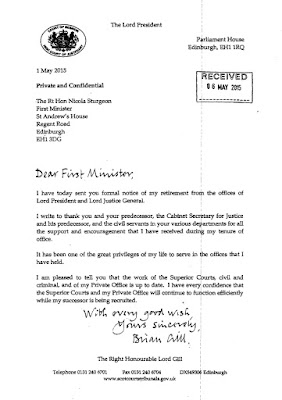
In the Lord President’s letter to Scotland’s First Minister Nicola Sturgeon, Brian Gill (73) thanked members of the Scottish Government past & present for ‘their support’ during his tenure of office - support which included Scottish Ministers attempts to undermine and block a Scottish Parliamentary investigation into the judiciary’s secretive links to big business, financial interests and other vested interests.

In response, First Minister Nicola Sturgeon – who personally intervened earlier this year in a bid to thwart a register of judicial interests going ahead, praised Lord Gill for his service to the court.

The First Minister also wrote of Lord Gill’s “legacy to the justice system in Scotland” – referring to his work on the Scottish Civil Courts Review – sought to change some of the antiquated structures of Scotland’s expensive, closed shop and out of reach civil courts.

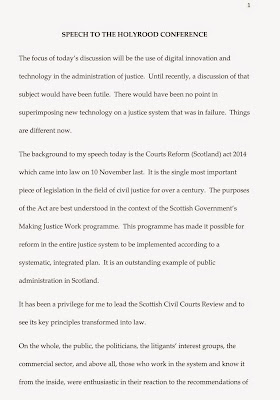
Just prior to the launch of the report on civil justice in Scotland – which took two years to complete, Lord Brian Gill condemned the civil justice system as “Victorian” and “unfit for purpose”

In a speech to the Law Society of Scotland’s 60 year anniversary conference several years ago, reproduced in full here Lord Gill said : “The civil justice system in Scotland is a Victorian model that had survived by means of periodic piecemeal reforms. But in substance its structure and procedures are those of a century and a half ago. It is failing the litigant and it is failing society.

“It is essential that we should have a system that has disputes resolved at a judicial level that is appropriate to their degree of importance and that disputes should be dealt with expeditiously and efficiently and without unnecessary or unreasonable cost. That means that the judicial structure should be based on a proper hierarchy of courts and that the procedures should be appropriate to the nature and the importance of the case, in terms of time and cost. Scottish civil justice fails on all of these counts. Its delays are notorious. It costs deter litigants whose claims may be well-founded. Its procedures cause frustration and obstruct rather than facilitate the achievement of justice."

In reality, much of Lord Gill’s recommendations contained in the Civil Courts Review were watered down by the Scottish Government who commissioned the Taylor Review - carried out at the insistence of the legal establishment - who feared giving the public easier and cheaper access to court would impact on the dwindling profits of Scots law firms.

The First Minister ends her letter by wishing Lord Gill the very best for his retirement.

However the former top judge's retirement appears to have been short lived after it came to light Lord Brian Gill is now sitting again as a judge on the UK Supreme Court, based in London.

From Lord President Lord Gill to First Minister Nicola Sturgeon:

I have today sent you formal notice of my retirement from the offices of Lord President and Lord Justice General.

I write to thank you and your predecessor, the Cabinet Secretary for Justice and his predecessor, and the civil servants in your various departments for all the support and encouragement that I have received during my tenure of office.

It has been one of the great privileges of my life to serve in the offices that I have held.

I am pleased to tell you that the work of the Superior Courts, civil and criminal, and of my Private Office is up to date. I have every confidence that the Superior Courts and my Private Office will continue to function efficiently while my successor is being recruited.

In response, the First Minister thanked the outgoing Lord President for service to the courts and tenure as top judge:

Letter from First Minister Nicola Sturgeon to Lord Gill:

Thank you for your letter of 1 May 2015, together with your formal letter informing me of your intention to retire from the offices of Lord President and Lord Justice General General as of 31 May 2015.

I am enormously grateful for the service you have given as a judge in Scotland since 1994 and, in particular, for your service in the offices of the Lord President and Lord Justice General over these past three years.

Your legacy to the justice system in Scotland will continue to endure in areas but I would highlight your proposals for the far-reaching reform of the civil courts system in Scotland that will result in a more modern and efficient court system fit for the 21st Century.

Once again, I am very grateful for your distinguished service and, may I take this opportunity to wish you and Lady Gill all the very best for your retirement

JUDICIAL TRANSPARENCY PETITION & SCOTTISH MINISTERS:

The judicial transparency petition – opposed by Scottish Ministers & Lord Gill - nevertheless enjoys cross party support. The petition has been the subject of a two year investigation by Holyrood and proposes the creation of a publicly available register of judicial interests containing information on judges backgrounds, their personal wealth, undeclared earnings, business & family connections inside & outside of the legal profession, offshore investments, hospitality, details on recusals and other information routinely lodged in registers of interest across all walks of public life in the UK and around the world.

Scotland’s first ever Judicial Complaints Reviewer (JCR) - Moi Ali gave the judicial transparency proposal her full backing. During the evidence session held at Holyrood in September 2013 - Moi Ali provided a first hand, honest and highly detailed account of the workings of Scotland’s judiciary and lack of judicial transparency & accountability.

Current JCR Gillian Thompson OBE gave further support for the plan to create a register of interests for judges during an evidence session at Holyrood in June 2015.

A full parliamentary debate on the question of creating a register of judicial interests was reported along with  video footage & the official record, here: Debating the Judges & here : Top judge & Scottish Government told to rethink refusal on declarations of judges as Holyrood MSPs support calls to create a register of judicial interests

Last Friday, Justice Diary revealed Lord Brian Gill has since come out of retirement and now sits on the supplementary panel of judges at the London based UK Supreme Court.

Monday, May 11, 2015

INTERESTS INTERVENE: First Minister joins top judge in bid to block register of judicial interests as MSPs consider recalling Legal Affairs Minister over dodgy evidence & private meeting with Lord Gill

First Minister claims register for judges interests is ‘unworkable’ SCOTLAND'S First Minister Nicola Sturgeon has joined Scotland's outgoing top judge in a bid to block increased judicial accountability & transparency with the creation of a register of interests for judges.

The surprise move by the country’s most senior politician comes amid fears the judicial transparency proposal currently being considered by MSPs will expose the secret links between big money, big business, offshore private banking, staggering property wealth and Scotland’s mega powerful & secretive judiciary.

The First Minister also repeated claims made by Lord President Lord Brian Gill (73) - who accused “aggressive media” and  court users in an attempt to thwart the Scottish Parliament probe into why judges are so secretive about their vast wealth and connections.

MSPs on the Scottish Parliament’s Public Petitions Committee are due to debate plans to create a register of judicial interests as called for in Petition PE1458: Register of Interests for members of Scotland's judiciary tomorrow, Tuesday 12 May 2015.

The proposals – under investigation by MSPs since January 2013 - call for the creation of a single independently regulated register of interests containing information on judges backgrounds, their personal wealth, undeclared earnings, business & family connections inside & outside of the legal profession, offshore investments, hospitality, details on recusals and other information routinely lodged in registers of interest across all walks of public life in the UK and around the world.

The petition has cross party support from msps who backed a motion urging the Scottish Government to create a register of judicial interests at Holyrood on 7 October 2014 - reported along with video footage and the official record, here: Debating the Judges.

The latest, surprise intervention by the First Minister in the bid to bring transparency to Scotland’s secretive judges only came to light last week - although Ms Sturgeon’s letter is dated 30 March.

In the letter, which gives the First Minister’s view of petitions relating to justice issues - Nicola Sturgeon also revealed Legal Affairs Minister Paul Wheelhouse had a secret meeting with Lord Gill to discuss the petition in February of this year.

Writing in the letter to John Pentland MSP, Convener of the Public Petitions Committee, the First Minister said: “This petition calls on the Scottish Government to create a Register of Interests for the Judiciary. The Scottish Government considers that such a register of judicial interests is not necessary and that the existing safeguards - the Judicial Oath, the Statement of Principles of Judicial Ethics and the system for complaints against the judiciary - are sufficient. These safeguards, together with the register of judicial recusals, are sufficient to protect individuals from judicial bias.”

“Further to the evidence that the Minister for Community Safety and Legal Affairs, Mr Wheelhouse, gave to the Committee on 9 December 2014, he discussed this petition when he met the Lord President in February. The Minister acknowledged the Lord President's concerns about the introduction of a register of judicial interests. The breadth of such a register would make it virtually unworkable. It would need to cover not only financial interests, but also memberships of groups and associations and familial and social relationships. Even so, such a register might not capture relevant issues that could arise.”

“The position of the judiciary is different from that of MSPs and others who hold public office. The judiciary cannot publicly defend themselves. The Lord President has cautioned that such a register could also have unintended consequences. Consideration requires to be given to judges' privacy and freedom from harassment by aggressive media or hostile individuals, including dissatisfied litigants. In addition, there is currently no evidence that judges who should have recused themselves from cases have not done so.”

The First Minister’s letter is an almost word for word quote from previous letters written by Lord Gill who has previously blasted msps on the Petitions Committee foreven to dare to consider the issue of increased transparency of the judiciary.

And, following what some have referred to as a ‘script’ written by Lord Gill - the First Minister’s letter is dated two days before the latest 1 April letter from the top judge to the Petitions Committee.

Lord Gill has previously claimed such a register could compromise judges' privacy by encouraging "aggressive media or hostile individuals" and that "The establishment of such a register therefore may have the unintended consequence of eroding public confidence in the judiciary."

Gill also refused three invitations to appear at the Scottish Parliament and take questions on his hostility towards judicial transparency and a register of judges’ interests.

The surprise letter from Nicola Sturgeon supporting the elderly top judge – who has been caught in headlines flying around the world on grand 5 day taxpayer funded state visits to countries such as Qatar - predates Lord Gill’s announcement of his ‘retirement’ last week.

Having served three years as Lord President – the shortest term in the post for some time, the ageing Gill said he is stepping down at the end of this month.

The latest development in the debate around creating a register of interests for judges comes as MSPs were handed a copy of internal Scottish Government communications which conflict with testimony previously given to the Public Petitions Committee by Legal Affairs Minister Paul Wheelhouse.

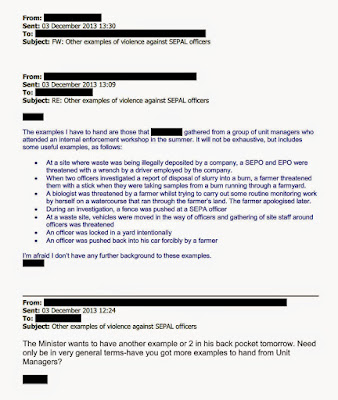
The emails reveal Mr Wheelhouse deliberately misled MSPs over claims gangsters had threatened SEPA officials - claims which wheelhouse used to argue with MSPs at an earlier evidence session that judges wealth and connections to big business, banks and the legal profession must be kept hidden.

Conversations between aides to Mr Wheelhouse begging SEPA for examples of evidence for “the Minister to have in his back pocket” revealed no gangster threats had occurred. Instead, a farmer threatened a SEPA employee with a stick, and a fence had been pushed against another SEPA employee.

The now released email also raises questions on what knowledge the then Justice Secretary Kenny MacAskill knew of the material used by Wheelhouse – after MacAskill – who is now on the Petitions Committee – failed to question the Minister during his interaction with Wheelhouse at a previous Petitions Committee meeting, reported here: Too Many Secrets: Legal Affairs Minister Paul Wheelhouse substitutes for top judge in evidence to MSPs

MacAskill – a lawyer who trained at Glasgow based law firm of Levy & Mcrae who are now caught up in a multi million pound writ over the £400m collapse of Hedge Fund Heather Capital - is known to be against the plan to create a register of interests for judges.

MSPs on the Petitions Committee have now been asked to recall Mr Wheelhouse to account for his misleading testimony, and to face questions on his private meeting with Lord Gill.

It has also been suggested Moi Ali - Scotland’s first Judicial Complaints Reviewer (JCR) be recalled to give evidence on changes relating to judicial conduct complaint rules put forward by Lord Gill. The changes have been branded tweaks & window dressing in a previous report here: THE LORD'S RULES: Top judge's two year consultation & tweaks to rules allowing judges to investigate themselves is 'missed opportunity'.

During an earlier evidence session before the Scottish Parliament’s Petitions Committee, Moi Ali told msps there is little transparency or accountability in Scotland’s judiciary.

Among papers released for tomorrow's meeting, clerks have now recommended MSPs seek information from legal affairs Minister Wheelhouse on what took place at the secret meeting with Gill held in February and also to recommend Gillian Thompson OBE - the new Judicial Complaints Reviewer who replaced Moi Ali last year, attend to give evidence.

Gillian Thompson has already registered her support for a register of judicial interests in a letter to MSPs, reported here: DECLARE THE JUDGES: New Judicial Complaints Reviewer supports proposal to Scottish Parliament to create a register of interests for judges

The Sunday Herald newspaper reported on First Minister Nicola Sturgeon’s intervention on behalf of the judiciary and her opposition to the judicial transparency proposal:

First Minister rejects call for register of judges' interests

Paul Hutcheon
Investigations Editor Sunday 10 May 2015
 
NICOLA Sturgeon has rejected calls for judges to declare details of their finances in a register of interest. The First Minister said the proposal, lodged by justice campaigner Peter Cherbi, was "not necessary" and claimed existing rules were "sufficient".
 
Holyrood's Public Petitions Committee is in the middle of a long-term probe into whether judges, sheriffs and justices of the peace should be brought into line with other senior public sector figures.
 
MSPs, MPs, councillors and board members of public bodies are all required to register their outside financial interests.
 
A petition lodged with the Scottish Parliament in 2012 called for members of the judiciary to declare their "pecuniary" interests, which would include shareholdings, directorships and membership of external bodies.
 
Judicial officer holders can recuse - or remove - themselves if a conflict of interest arises during a case, but nothing more is required.
 
The plan was met with hostility by the country's top judge, Lord Gill, who repeatedly snubbed calls by the committee to give oral evidence. He relied on written testimony to blast a proposal he said could compromise judges' privacy by encouraging "aggressive media or hostile individuals".

Lord Gill concluded: "The establishment of such a register therefore may have the unintended consequence of eroding public confidence in the judiciary."
 
The issue has now reached the desk of the First Minister, who has backed Lord Gill.
 
In a letter to John Pentland MSP, the Committee convener, she supported the status quo: "The Scottish Government considers that such a register of judicial interests is not necessary and that the existing safeguards - the Judicial Oath, the Statement of Principles of Judicial Ethics and the system for complaints against the judiciary - are sufficient.
 
"These safeguards, together with the register of judicial recusals, are sufficient to protect individuals from judicial bias."
 
She also repeated Lord Gill's fear about "aggressive media" and noted: "The position of the judiciary is different from that of MSPs and others who hold public office. The judiciary cannot publicly defend themselves."
 
The First Minister also revealed that Paul Wheelhouse, her Minister for Community Safety and Legal Affairs, met Lord Gill in December to discuss the petition.
 
In his evidence to the Committee, Wheelhouse said he feared a register could leave judges open to "threats or intimidation", adding that colleagues at an environment quango had already been threatened by organised criminals. However, emails between the Government and Scottish Environment Protection Agency revealed no link to organised crime.
 
Cherbi said: "I am surprised Nicola Sturgeon supports a judicial ban on transparency just because judges have been asked to declare their substantial interests. "We are always told if you have got nothing to hide you have nothing to fear. What are the judges hiding and what do they fear? "There cannot be one set of rules for judges and another for everyone else. A register of interests will enhance public trust in the justice system, not detract from it."
 
A Scottish Government spokesperson said: "The Scottish Government considers that a specific register of interests is not needed. Existing safeguards, including the Judicial Oath, the Statement of Principles of Judicial Interests and the system of complaints against the judiciary, are sufficient to ensure the impartiality of the judiciary in Scotland."

Previous articles on the lack of transparency within Scotland’s judiciary, investigations by Diary of Injustice including reports from the media, and video footage of debates at the Scottish Parliament’s Public Petitions Committee can be found here : A Register of Interests for Scotland's Judiciary

Wednesday, March 28, 2012

Deputy First Minister to look into death of baby McKenzie Wallace after parents complain of ‘whitewash’ report by SPSO investigator Eileen Masterman

Death of baby McKenzie Wallace montageHealth Minister to look into NHS failures in case of death of baby in NHS Forth Valley hospital & SPSO report whitewash. SCOTLAND’S DEPUTY FIRST MINISTER Nicola Sturgeon has said she will look into the case of the death of little baby McKenzie Wallace at an NHS Forth Valley hospital after an exclusive report in the Sunday Mail newspaper revealed the baby’s grieving parents have fought a long & difficult battle to get answers over why little McKenzie died. The report in the Sunday Mail also revealed NHS Forth Valley FAILED to pick up on a rare heart defect in the couple’s baby which should have been detected during a 20 week scan but was missed after the scan, conducted by a trainee under the supervision of an experienced midwife was not properly interpreted. However, a senior consultant obstetrician who later studied the ultrasound pictures from the Stirlingshire hospital found a heart problem was visible and had been missed by both the midwife & the trainee.

On receipt of a further report into the tragedy, the family have accused the Scottish Public Services Ombudsman (SPSO) ‘Complaints Reviewer’, Eileen Masterman of producing a ‘whitewash’ report in the SPSO’s investigation of their complaints against NHS Forth Valley regarding the deadly failures in the provision of medical services which ultimately led to the death of McKenzie Wallace just five days after she was born.

While the death of baby McKenzie has been a terrible toll in itself for the family to bear, the nightmare continued when their complaints to NHS Forth Valley over the events which led to the death of their child were mishandled, leading to the family using Freedom of Information legislation to uncover more facts not disclosed by NHS Forth Valley during their investigations and ultimately, making a complaint to the Scottish Public Services Ombudsman who used an unnamed ‘expert’ to exonerate the hospital’s role in the death of the child.

The files accumulated by the family in their complaint to NHS Forth Valley can be read here : Complaint to NHS Forth Valley - Death of Baby McKenzie Wallace The responses received from NHS Forth Valley can be viewed here : NHS Forth Valley FOI - Death of Baby McKenzie Wallace and the report by the Scottish Public Services Ombudsman into the way the hospital handled the case, can be viewed here : SPSO Report - Death of Baby McKenzie Wallace

m2Former SLCC Chief Executive Eileen Masterman wrote SPSO report which exonerated negligent medical staff at NHS Forth Valley. In what may come as a surprise to many, the author of the SPSO report now branded a whitewash is none other than Eileen Masterman, former Chief Executive of the Scottish Legal Complaints Commission (SLCC), who took a six month sick leave from the SLCC and then employed teams of lawyers to negotiate a massive SECRET PAYOFF so large & subject to such a complex agreement, the secret deal was required to be signed off personally by Scotland’s Justice Secretary, Kenny MacAskill. Legal insiders commenting on the case said today they were shocked to see Eileen Masterman show up again at the Scottish Public Services Ombudsman so soon after resigning under a cloud from the Scottish Legal Complaints Commission, with an official explanation of “ill health”.

mkmc slcc openingFOI investigations by Diary of Injustice revealed Justice Secretary MacAskill personally signed off secret unpublished payment to Eileen Masterman. One Scottish Government insider who now claims he “did not agree with the terms of the settlement as put to Mr MacAskill” said the Justice Secretary was out on a limb over his involvement in the secret payoff to Masterman. The insider called for all details of the negotiations involving Ms Masterman, the SLCC & the Scottish Government along with the amount of the secret payoff to be made public.

The Scottish Government insider said : “Clearly there is a public confidence issue here were someone can resign from the highly controversial and underperforming Scottish Legal Complaints Commission claiming ill health and then go back to work at the highly questionable Scottish Public Services Ombudsman who have similar public confidence issues. There must be full transparency here otherwise there can be no confidence in the SPSO.”

One senior solicitor who does not wish to be named has already claimed the Scottish Legal Complaints Commission had been told during the “bitter negotiations” that “Eileen Masterman’s health was so bad that she may never work again”. It has also been alleged that involvement from Cabinet Secretary for Finance John Swinney, who accused Ms Masterman of lying over secret meetings she took part in with convicted US insurers Marsh who handle the Law Society of Scotland’s notoriously corrupt Master Policy protection for negligent solicitors also ‘contributed to Ms Masterman’s alleged ill health’, an issue reported earlier by Diary of Injustice here : SLCC’s Eileen Masterman resigns, questions remain on attempt to mislead Cabinet Finance Chief John Swinney over secret meetings with insurers Marsh

However it appears after only a few months of leaving the SLCC, Eileen Ms Masterman was re-employed by Jim Martin, the Scottish Public Services Ombudsman, whose organisation was savaged last year by Scottish Government Minister Alex Neil during his testimony to the Scottish Parliament’s Petitions Committee, which Diary of Injustice reported along with video footage of Minister Neil’s testimony, here : Holyrood considers nine petitions against Scottish Public Services Ombudsman as Housing Minister dubbed ‘out of touch’ over accusations

The Sunday Mail newspaper spoke to the parents about their views of Ms Masterman’s report on the death of their baby. The Sunday Mail reported : “The couple have also criticised a report issued last month by Eileen Masterman, of the Scottish Public Services Ombudsman. She rejected the view of the Forth Valley doctor. Instead, she agreed with an unnamed expert who said there was no need for a second scan due to the limited nature of what could be seen. She said: “The advice indicated that, even if the scan had been done again, it would have been likely the results would have been the same.”

Andrew said: “I have no faith in Masterman. The SPSO have refused to say who the expert is or hand over their report. “McKenzie’s death cannot be for nothing. Some sort of lesson has to be learnt.”

spso-logoSPSO refused to issue any comment on Eileen Masterman’s report. The Scottish Public Services Ombudsman was asked for media comment on Ms Masterman’s position at the SPSO and to explain how she was able to return to work so soon. One of it’s Press Officers said : “I am sorry but we are unable to comment on the employment status of individuals. This would be unfair to those individuals and in breach of data protection.” Later, the SPSO angrily REFUSED to disclose any material in response to Freedom of Information requests regarding Ms Masterman’s apparent speedy return to work at the SPSO, with SPSO officials blocking all further attempts to secure disclosures via Freedom of Information legislation.

Nicola SturgeonScottish Deputy First Minister & Health Secretary Nicola Sturgeon MSP. Deputy First Minister & Scotland’s Health Secretary, Nicola Sturgeon was asked by Diary of Injustice for a comment on the tragic events and the SPSO’s handling of baby McKenzie’s parents complaints against NHS Forth Valley. Questions put by Diary of Injustice journalists to Ms Sturgeon, which were accompanied by papers relating to the case asked : “Has the Health Minister any comment on how the complaint involving the death of the baby has been handled, the fact this family have received little support in spite of what appears to be a cover up by NHS Forth Valley, and why can one individual who travels between regulators show up again in an old post to carry on her work after claiming she could never work again.”

A spokesperson for the Scottish Government replied to the questions put to the Health Secretary, stating : “The circumstances surrounding this event are extremely tragic, and our thoughts are with the parents. Where recommendations are made in an Ombudsman’s report, we expect NHS Boards to fully implement all necessary steps to ensure that similar circumstances do not recur.”

The spokesperson continued : “The SPSO is an organisation independent of the Scottish Government and as such appoints its own personnel. The circumstances surrounding any appointment of any individual is a matter for the SPSO.”

The parents of baby McKenzie have since received a letter from the Scottish Government replying on behalf of Scottish Health Secretary Nicola Sturgeon. Andrew & Joanne have now been told Ms Sturgeon has agreed to look at the papers relating to the circumstances of baby McKenzie’s death, and how Andrew & Joanne were treated by NHS Forth Valley & the SPSO. Ms Sturgeon also offered her condolences in the letter to Andrew & Joanne over baby McKenzie’s death. The parents of baby McKenzie have also asked for a meeting with Ms Sturgeon over the case.

Clearly, the tragic case of the death of little baby McKenzie Wallace, just five days into her live is yet another clear demonstration of medical negligence in the NHS and the cover ups which kick in to prevent any justice for the bereaved family. The family deserve answers and the life of a child cannot be lost in an SPSO report or a promise of “lessons will be learned” which are, as we are all now sadly too aware, never learned.

The Sunday Mail reports :

Grieving parents say medics missed tragic toddler's heart problem Sunday Mail March 25 2012Grieving parents say medics missed tragic toddler's heart problem

Mar 25 2012 Exclusive by Russell Findlay

HEARTBROKEN parents yesterday told how they fear a midwife missed their baby daughter’s fatal heart condition because she was in the huff. McKenzie Wallace died just five days after being born because of a heart defect linked to rare genetic disorder Ivemark syndrome.

But mum Joanne Weir, 27, and dad Andrew Wallace, 31, say the condition would have been picked up at a 20-week scan if the midwife had not been annoyed that they asked the sex of their baby. The scan was conducted by a trainee sonographer at Forth Valley Royal Hospital in Larbert and was supervised by an ­experienced midwife, who did not flag up any problems.

But a senior consultant obstetrician who studied the ultrasound pictures from the Stirlingshire hospital found a heart problem was visible. He also stated that “he would have suggested a repeat scan or asked for a second opinion”. As a result, the midwife who supervised the trainee was ordered to undergo further training. The couple said that a consultant at Yorkhill Hospital, Glasgow, agreed the heart defect – known as right atrial isomerism – should have been spotted.

Joanne, who is due to give birth again in 10 weeks at Edinburgh Royal, said: “It should have been glaringly obvious and was ‘too big to miss’, according to McKenzie’s consultant at Yorkhill.”

Fuel tanker driver Andrew, who lost a brother and an uncle to the genetic condition, said: “A trainee carried out the scan but the supervisor was so busy moaning at us for daring to ask if we were to buy blue or pink that she was obviously distracted.“Apparently it’s all right, though, because she has now been for training – but this should not have happened.

“We had to make the decision not to attempt to treat McKenzie as all options were horrific and had life-extending probabilities of less than a few months. Had we known she had this condition, we may have considered ­termination early in pregnancy as it was incredibly unfair to put McKenzie through that.”

The couple, from Bo’ness, Stirlingshire, also said that another midwife ignored their concern about McKenzie’s blue appearance when she was born at Stirling Royal Infirmary. During Joanne’s labour, a sewage pipe became blocked below the maternity ward, which caused chaos. Andrew said: “They were distracted. They should have listened to what I was saying about McKenzie turning blue.”

It took 24 hours before they admitted any problem and the baby was immediately sent to the Royal Hospital for Sick Children at Yorkhill. From there, McKenzie was sent to the Rachel House Hospice in Kinross, where she died in her parents’ arms on February 18 last year.

The couple have also criticised a report issued last month by Eileen Masterman, of the Scottish Public Services Ombudsman. She rejected the view of the Forth Valley doctor. Instead, she agreed with an unnamed expert who said there was no need for a second scan due to the limited nature of what could be seen. She said: “The advice indicated that, even if the scan had been done again, it would have been likely the results would have been the same.”

Andrew said: “I have no faith in Masterman. The SPSO have refused to say who the expert is or hand over their report. “McKenzie’s death cannot be for nothing. Some sort of lesson has to be learnt.”

The NHS said: “We carried out an internal review and could find no evidence of errors in the clinical care provided by staff.”

Tuesday, June 19, 2018

COURT FRACKING: Scottish Government ban on fracking does not exist says Lord Pentland - Court of Session throws out INEOS challenge as Judge says Ministerial claims “did not accurately express the legal effect of the decisions”

Scottish Govt fracking ban does not exist – judge. SCOTLAND’S top court has ruled that claims by Ministers that fracking is banned, are not consistent with current law, and therefore the forced extraction of extracting shale gas from subterranean  rocks - has not been banned in Scotland.

The Court of Session’s decision also hits out at numerous “mistaken” statements by SNP ministers of a ban on what many regard as an environmentally damaging process which uses water and chemicals pumped at high pressure into underground shale beds to release methane gas.

Earlier today, the Judiciary of Scotland published Lord Pentland’s ruling on the INEOS challenge to the Scottish Government’s claims of a ban on fracking – in which the court threw out the challenge, on the grounds there was and is no existing prohibition against shale gas extraction in Scotland.

Despite claims of a ban on fracking by numerous Scottish Government Ministers, including the First Minister herself Nicola Sturgeon, Lord Pentland ruled that no such ban exists, and that in reality there is little more than an evolving planning policy.

Revealing there is no existing legal basis for claims by the First Minister & others that a ban on fracking is in force - Lord Pentland said statements by ministers including Paul Wheelhouse MSP and First Minister Nicola Sturgeon that a ban existed “did not accurately express the legal effect of the decisions” involved.

The statement issued by the Judicial Office notes that [despite numerous claims by Ministers] “the Lord Advocate, on behalf of the Scottish Ministers, made it clear to the court that such statements were mistaken and did not accurately reflect the legal position”.

Lord Pentland’s judgement concludes that “as a matter of law, there is no prohibition against fracking in Scotland”.

The ruling issued today followed statements by the Scottish Government to the Scottish Parliament during October 2017 that fracking had effectively been banned through the use of new guidance on planning consent.

Energy minister Paul Wheelhouse – who once made false claims to a Holyrood Committee that fictitious gangsters made transparency in the judiciary impossible - told MSPs last year that “fracking cannot and will not take place in Scotland”.

Similarly, First Minister Nicola Sturgeon said “fracking is being banned in Scotland - end of story”.

Earlier this year, and after the continued claims by the Scottish Government and it’s supporters of a ban on fracking, Ineos Upstream Ltd and Reach CSG sought a judicial review of the effective ban, the Scottish Government began t changed its tune.

When the case was called in court, the Scottish Government’s own lawyer - James Mure QC  - claimed the legal challenge by Ineos was premature as SNP ministers had “not yet adopted a position” and that in effect Ministers had merely announced a preference for a ban.

James Mure QC was forced to admit to the court that his client the Scottish Government had merely spun the issue of a preference of a ban, into an actual ban.

The QC was forced to tell the court in the earlier hearing: “The concept of an effective ban is a gloss. It is the language of a press statement.”

However, in the Court of Session opinion issued today, Lord Pentland’s judgement rubbished Ministerial claims of a ban on fracking, concluding that “as a matter of law, there is no prohibition against fracking in Scotland”.

In the judgment, Lord Pentland also rejected Ineos and Reach CSG's case on the basis that no ban exists.

The Herald newspaper reported on the court’s decision today, and also reported - “After the judgment was released, the SNP rewrote the environment section of its website, deleting the words "The Scottish Government has put in place a ban on fracking in Scotland".

Ineos, which runs the Grangemouth refinery and already imports US shale gas as a precursor for petrochemical works, would like to frack gas in the Central Belt.

It has previously accused the government of an “Alice in Wonderland” position on fracking.

Ineos said it now expected all planning applications for fracking to be considered on merit, not "prejudice and political expediency" and ministers of wasting public money by not being clearer earlier.

Mr Wheelhouse, who told MSPs there was a ban, welcomed the Court saying there wasn’t.

He said: “This decision vindicates the extensive process of research and consultation which the Scottish Government has undertaken since 2015.

“As I set out in October, our preferred position is not to support Unconventional Oil and Gas extraction in Scotland, and that position remains unchanged.

“I have repeatedly set out to parliament that we would undertake a Strategic Environmental Assessment (SEA) ahead of finalising that position and that approach has been endorsed by the overwhelming majority of the Scottish Parliament.

“The work to complete the SEA and a Business and Regulatory Impact Assessment is currently underway and the findings will be carefully considered.

“In the meantime, a moratorium is in place which means no local authority can grant planning permission and Ministers would defer any decision on any planning application that did come forward until the policymaking process is completed.

“The practical effect of the current moratorium and the policymaking process which is underway to finalise our position is that no fracking can take place in Scotland at this time.”

In his judgement published earlier today, Lord Pentland quoted First Minister Nicola Sturgeon and Mr Wheelhouse’s statements in parliament about there being a ban.

However, in what seems an attempt at appeasing the misleading statements by Ministers, Lord Pentland was forced to add that the accuracy of such misleading ministerial statements was not the core issue – even though the existence of the misleading claims by the First Minister & Scotish Government led to the Ineos legal challenge in the first place.

Lord Pentland said: “The legal question is not whether ministers have accurately described or commented on their understanding of the legal effect of the various steps they have taken or authorised to be taken under the planning system, but the fundamentally different question of what the legal effect of those steps really is.

He added: “The ministerial comments reflecting the opinion that there was an effective ban on fracking are (a) irrelevant to the legal question before the court; (b) not binding on the court; (c) in any event, not determinative of the question of construction that the court has to address; and (d) to the extent that they did not accurately express the legal effect of the decisions taken must be left out of account when it comes to answering the legal question.”

“To the extent that some sections of the ministerial statements made to the Scottish Parliament were capable of being read as suggesting that the policy would amount to a ban on fracking, Mr Mure QC accepted on behalf of the Lord Advocate that such statements did not accurately reflect the legal position; they were to that extent mistaken.”

The full statement issued by the Judicial Office for Scotland

Ineos Upstream Ltd and another v Lord Advocate

A petition seeking judicial review of certain acts and decisions of the Scottish Government in implementation of what was purportedly an indefinite ban on “fracking” has been refused. The Court of Session held that the legal effect of certain statements and planning directions made by the Scottish Ministers to the effect that the Scottish Government will not support the development of unconventional oil and gas extraction in Scotland, and a subsequent decision that the directions should continue in force indefinitely, is that there is in fact no prohibition against fracking in force. The following is a summary of the detailed opinion issued by Lord Pentland.

On 28 January 2015 the Scottish energy minister, Mr Fergus Ewing MSP, made a statement to the Scottish Parliament on the development of unconventional oil and gas extraction in Scotland (“UOG”) to the effect that there was to be work on planning and environmental regulation, a health impact assessment, and a consultation process on UOG. He stated that given the importance of this work it would be inappropriate to allow any planning consents in the meantime. He therefore announced what he described as a “moratorium” on the granting of planning consents for all UOG developments, including the method of oil and gas extraction known as hydraulic fracturing or “fracking”. The moratorium was to continue until such time as the work referred to had been completed. The minister stated that a direction would be sent to all Scottish planning authorities to give immediate effect to that policy. A similar direction would be issued to SEPA.

The 2015 Planning Direction and the 2015 SEPA Direction gave legal effect to the moratorium, by requiring planning authorities to intimate the receipt of planning applications for any UOG developments to the Scottish Ministers, prohibiting planning authorities from granting planning permission within 28 days of notification to ministers, and giving ministers the power to call in applications for determination by them. The power of the Scottish Government to call in planning applications for determination by them, coupled with the 2015 Planning Direction and the 2015 SEPA Direction gave Scottish Ministers the means to control two of the essential legal requirements for onshore extraction of UOG. By refusing planning permission or authorisation of controlled activities, the Scottish Government could prevent onshore UOG development extending beyond drilling of core samples. To date, the notification requirements under the 2015 Planning Direction have not been triggered. No application has been remitted to ministers by SEPA under the 2015 SEPA Direction.

Following further research into the impact of onshore UOG development in Scotland and a public consultation, the Minister for Business, Innovation and Energy, Mr Paul Wheelhouse MSP made a statement to the Scottish Parliament on 3 October 2017 in which he confirmed the Scottish Government’s “preferred position”, namely that it would not support the development of UOG in Scotland and that it would use planning powers to deliver its position; that it had written to local authorities across Scotland to make it clear that the directions that give effect to the moratorium would remain in place indefinitely; and that this action was sufficient to “effectively ban” UOG in Scotland.

On 5 October 2017 at First Minister’s question time, in reply to an observation that there was concern that the ban was not yet legally watertight, the First Minister said that: “What Paul Wheelhouse outlined to the chamber earlier this week is an effective way of banning fracking and … is the quickest way of banning fracking.” 

At a debate on UOG in the Scottish Parliament on 24 October 2017, Mr Wheelhouse said that the Scottish Government was honouring the commitment it had previously given to allow MSPs an opportunity to “endorse our carefully considered and robust position on unconventional oil and gas”.  An amended motion was passed endorsing the Scottish Government’s decision to introduce an immediate and effective ban on UOG and noting that this position would be subject to a strategic environmental assessment before being finalised.

In December 2017 Ineos Upstream Limited and Reach Coal Seam Gas Limited, which both hold interests in petroleum exploration and development licences (“PEDLs”) in respect of certain onshore areas in Scotland raised the present proceedings, seeking judicial review of the acts and decisions of the Scottish Government in relation to UOG in Scotland. The basis of the petitioners’ case was that in 2017 the Scottish Government unlawfully imposed an indefinite ban on fracking. 

The Lord Advocate on behalf of the Scottish Ministers maintained that, on a correct understanding of its acts and decisions, the Scottish Government did not impose any such ban. He contended that since there was no ban the petitioners have no case; the petition for judicial review was based on a series of fundamental misunderstandings of the Scottish Government’s position and should accordingly be refused.

Refusing the petition, the judge held that, as a matter of law, there is no prohibition against fracking in Scotland. The fact that the emerging policy position was expressed as being a “preferred” one shows that the Scottish Government understood that unless and until the strategic environmental assessment was completed, a policy on UOG could not lawfully be finalised and adopted. Ministerial comments reflecting the opinion that there was an effective ban on fracking were (a) irrelevant to the legal question before the court; (b) not binding on the court; (c) in any event, not determinative of the question of construction that the court had to address; and (d) to the extent that they did not accurately express the legal effect of the decisions taken must be left out of account when answering the legal question. 

Lord Pentland’s opinion stated: “The petition is predicated on the proposition that the Scottish Government has introduced an unlawful prohibition against fracking in Scotland. Whilst acknowledging that there have been a number of ministerial statements to the effect that there is an effective ban, the Lord Advocate, on behalf of the Scottish Ministers, made it clear to the court that such statements were mistaken and did not accurately reflect the legal position. The stance of the Scottish Government before the court is that there is no legally enforceable prohibition. For the reasons set out in this judgment, I consider that the Government’s legal position is soundly based and that there is indeed no prohibition against fracking in force at the present time. What exists at present is an emerging and unfinalised planning policy expressing no support on the part of the Scottish Government for the development or extraction of UOG in Scotland. The process of policy development is not yet complete; the important stages of a strategic environmental assessment and a business and regulatory impact assessment have still to be carried out. There is no basis on which the court should interfere with those procedures; the petitioners will have a full opportunity to contribute to and participate in them. I conclude that since there is no prohibition against fracking, the petitioners’ case is unfounded; their application for judicial review of the alleged ban must accordingly fail.”

The full opinion can be accessed online here: Ineos Upstream Ltd and another v Lord Advocate

The Top judge who said court lawyers & judiciary should profit from & serve shale gas extraction & fossil fuel interests:

THREE years ago, Scotland’s now former top judge - Lord Brian Gill spoke on the very same day the Scottish Government announced the ‘moratorium’ on fracking, expressing his desire – and ultimately judicial policy - that fracking for shale gas should go ahead, and will increase business in the courts.

In a speech given at a Holyrood digital media conference on the same day that Minister Fergus Ewing MSP announced the moratorium on fracking, Lord gill also said he wanted to turn Scotland's legal system into a mediation haven for big business, big oil, shale gas barons & bankers, according to a speech he gave on the theme of “Digital Justice” last week.

Lord Gill’s plans for fracking & big oil mediation was hoped to draw in millions for lawyers and judges - without the need to declare any interests.

During the fourteen page speech – Gill (72) also urged the legal sector to better exploit Scotland’s “natural resources” and renewable energy for their own profit.

Speaking on the issue of fracking, and taking aim squarely at the Scottish Government’s alleged policy on a moratorium, Lord Gill told conference delegates: “Our resources of energy may be increased by the retrieval of shale gas, if that should be allowed. It seems to me therefore that the opportunity that our natural resources present should be served by the court system.”

Speech by Lord Gill on Digital Justice, Fracking & Big Oil. During the speech, Lord Gill also chastised his own judicial colleagues & lawyers for missing out on exploitation of Scotland’s oil boom.

Lord Gill said: “In the 1960s and 1970s the economy of Scotland was transformed by the discovery of North Sea oil. The judges and lawyers of that time were not alert to the opportunity that Scotland could be an international forum for resolving disputes in the oil and gas industry. We paid a price for our complacency when the international oil and gas industry passed us by.”

Gill continued: “Half a century on we should look at Scotland's economic opportunities and see how the courts can best serve them. In recent years a commitment to renewable energy has brought wind power to the fore as an energy source. Other forms of renewable energy may follow.”

The top judge also claimed Scotland can be made an international centre for litigation and mediation.

Gill said "Our legal system should be a driver for economic progress in Scotland. Our courts and our judges can and should contribute to the prosperity of our country. We can do that if, by the excellence of our judges, and our legal profession and the efficiency of our courts, we make Scotland a forum of litigation that not only retains litigations that at present go elsewhere but also becomes a forum of choice for litigations from abroad.."

Lord Gill’s own speech on the issue of fracking, and personal desire for shale oil gas extraction to go ahead, as a matter of judicial policy – was at complete odds with the statement issued by Scottish Government Minister Fergus Ewing on the same day to MSPs at Holyrood.:

While Gill gave his ‘fracking is good for the legal profession, courts & judiary’ lecture, Mr Ewing told the Parliament: "I want to ensure that the voices of the communities likely to be most affected are heard, and are heard in a more formal and structured way.I am therefore announcing today that in addition to the technical work I've referred to on planning, environmental regulation and upon assessing the impact on public health, Scottish ministers will also launch a full public consultation on unconventional oil and gas extraction."

An earlier report on Lord Gill’s speech on the issue of fracking can be found here: FRACKING JUDGES: Scotland’s top judge promotes shale gas extraction, big oil and renewable energy as profit incentive for courts on same day Scottish Government announce ban on fracking