Monday, May 29, 2017

NO CONFIDENCE: Chair of Scottish Police Authority refuses to stand down, as board member criticises Holyrood scrutiny of governance, secrecy culture & lack of accountability at discredited Police watchdog

Chair Andrew Flanagan clings to power at Police regulator. AMID further calls to quit, the Chair of the embattled Scottish Police Authority (SPA) grimly remains in office and at the centre of a crisis which has eroded public confidence in the Police watchdog to the point only a clean sweep of the board may begin to repair significant reputational damage to the regulator of Police Scotland.

Facing further criticism from the Scottish Parliament’s Justice sub-committee on Policing late last week, Andrew Flanagan again refused to stand down from his £70K position as Chair of the SPA.

According to his declarations on the SPA website, Andrew Flanagan also holds positions on the Civil Service Commission, NHS Business Services Authority, London-based NEL Commissioning Support Unit, and the Criminal Injuries Compensation Authority, positions he earns up to £75,000 a year in addition to his £70K salary as SPA Chair.

Flanagan’s decision to remain in office comes after members of Holyrood’s Justice Committee said in a report  they had “serious concerns”in the current SPA Board – which has responsibility for oversight and spending of the £1.1 billion Police Scotland budget.

The Justice Committee expressed “very serious concerns about the standards of governance” at the body and said it “does not have confidence that the current chair is the best person to lead the board”.

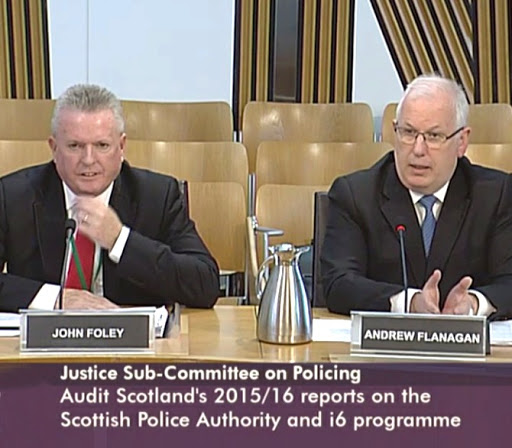
The report was issued after the Justice Committee held an evidence session with SPA Chair Andrew Flanagan & CEO John Foley after hearings at the Scottish Parliament's Public Audit Committee heard details of Andrew Flanagan’s treatment of Moi Ali - a former SPA board member who spoke up over concerns about the lack of transparency & accountability at the Police Watchdog.

At an earlier meeting of the PAPLS Committee Moi Ali accused Flanagan of bullying, which led to Ms Ali’s resignation from the Police regulator after she publicly objected to plans to hold meetings in private and arrangements over the publication of board papers prior to meetings.

During the evidence session at the Justice Committee, SPA Chair Andrew Flanagan told MSPs he had issued a written apology to Ali on Tuesday of that week, however, evidence has since emerged the apology was emailed to Ms Ali  less than two hours before Flanagan was to appear before MSPs to answer concerns about harassment and transparency.

The Justice Committee have not yet commented on whether they plan to quiz Mr Flanagan further on his contradictory claims in relation to his communications with Moi Ali.

While Justice Secretary Michael Matheson has remained conspicuously silent in the crisis at the SPA, Matheson has quietly requested an inspection of transparency and accountability issues at the organisation be brought forward by Her Majesty’s Inspectorate of Constabulary in Scotland (HMICS).

The results are expected in June, however Justice Committee member Mary Fee MSP (Scottish Labour) branded Flanagan’s testimony to the Justice Sub-Committee on Policing “frankly inadequate”, adding: “We do not have confidence in his leadership.”

The report released by the Justice Committee says Flanagan’s repeated use of the phrase “I have to accept” when discussing his treatment of Moi Ali - does not reassure the committee that he has a “real belief and understanding” that the actions he took and “repeatedly defended were wrong”.

Speaking to the BBC, Mary Fee MSP - Convener of the Justice sub-Committee on Policing - said: “Though he was apologetic, we are not confident he accepts he was wrong.

“This issue remains unresolved. We will continue working with the Scottish Police Authority, and other justice stakeholders, until we are confident the governance of the SPA is significantly improved.”

Also speaking to the media, former Police officer & Justice Committee member John Finnie – also the Justice spokesperson for the Greens, said: “Andrew Flanagan said nothing at his most recent appearance in front of the Justice Sub-Committee on Policing which led me to believe that he has learned the important lessons necessary for him to lead the SPA.

“Mr Flanagan’s half-hearted apology, emailing Moi Ali around an hour before his appearance at the sub-committee, epitomises his approach to this whole sorry saga – looking out for his own self-interest rather than that of the Scottish Police Authority.

“In order to effectively chair an important public body it is vital that you hold the confidence of Parliament. It is clear from the views expressed by both the Public Audit Committee and today by the Justice Sub-Committee on Policing that Mr Flanagan lacks that confidence.

“He certainly does not hold my confidence.

“This ongoing situation continues to overshadow the vital work of the SPA and must be resolved sooner rather than later. I would ask Mr Flanagan to seriously reflect on his position.”

Giving evidence to the sub-committee, Flanagan was asked if he accepted there had been “reputational damage to SPA that it may not recover from”.

He replied: “I think we can recover from it, I think there has been some damage there. I think my apology to Moi is a start of that process, it is not the end of the process.

Responding to the Justice Committee’s criticisms of the SPA and their report SPA Chair Andrew Flanagan said: "As I have already done with the views of other parliamentarians, I and the SPA Board will consider this report very carefully over the coming days and reflect on its contents.

"As I indicated in my evidence to the Committee, I have publicly acknowledged recent mistakes without caveat or qualification. I also believe that in my time in office I have brought much improvement and clarity to the strategy, governance, sustainability, and relationships within policing.”

"I remain focussed on building a broad consensus around my continuing leadership of the SPA, and my contribution to a stable and collaborative leadership within policing as a whole.”

"Today, and in recognition of recent areas of contention, the SPA has backed my recommended changes to governance that will increase both the transparency of our meetings and the accessibility of information.”

"This will begin to address the concerns of stakeholders, and the inspection report of HMICS will provide a further opportunity to build on that.”

"I also look forward to further developing and broadening the Board's approach with the appointment today of Nicola Marchant as the first Deputy Chair."

It has since been reported in the Herald newspaper SPA Chair Andrew Flanagan did not share a crucial report on forensics with all his board members.

The SPA has control of forensic services - including DNA, drug analysis and scene examination - and Mr Penman sent the chair a “professional advice note” (PAN) on the subject.

The document flagged up possible reforms on a part of the Police service that has had to make efficiency savings.

Speaking to the Herald, a spokesman for HMICS said of the advice note: “HMICS received a letter on 31 October 2016, from the [SPA] Chair acknowledging the final version and confirming that it had been shared with all board members.”

The Herald further reported: “However, asked yesterday to confirm that Mr Flanagan had shared the advice note with all board members, a spokesman for the SPA said:

"The SPA members received briefing from their officers last August in which one of the options set out in respect of forensic services clearly reflected the HMICS advice note. The paper provided to members made clear that background papers available to them included the independent analysis and advice by HMICS in relation to forensic services.”

A senior policing source said it was a “fair assumption” that the advice note was not given to all board members at the time.”

Report from the Justice Sub-Committee on Policing: Justice Sub Committee on Policing Report on Governance of the Scottish Police Authority

1. The Justice Sub-Committee on Policing held an evidence session on the governance of the Scottish Police Authority (SPA) on 18 May 2017.

2. It took evidence from Andrew Flanagan, Chair, and John Foley, Chief Executive of the Scottish Police Authority.

3. This was in response to the letter from the Public Audit and Post-legislative Scrutiny Committee to the Cabinet Secretary for Justice outlining its "very serious concerns about the standards of governance at the SPA”, following its recent evidence sessions^

4. The Cabinet Secretary for Justice has asked Her Majesty’s Inspectorate of Constabulary in Scotland (HMICS) to bring forward aspects of his intended statutory inspection into the state, efficiency and effectiveness of the Scottish Police Authority scheduled for 2017/18. The Cabinet Secretary has asked HMICS focus on transparency and accountability issues.]

5. Accordingly, HMICS is currently undertaking a Thematic Inspection of the Scottish Police Authority - Phase 1 Review of Openness and Transparency and is to report to the Scottish Parliament on 22 June 2017. The terms of reference are as follows:

The overall aim of this review will be to assess the openness and transparency in the way that the Scottish Police Authority conducts its business. It will specifically examine:

(i) the Authority’s decision on holding meetings in private and the publication of meeting papers; and also assess

(ii) the Authority’s compliance with relevant legislation, guidance and standing orders and the awareness and understanding of the Chair, Board members and SPA officers of these.

Introduction

6. This report outlines the views of the Justice Sub-Committee on Policing on the evidence heard at its meetings of 20 April, when representatives of Unison, the Scottish Police Federation and the Association of Scottish Police Superintendents provided evidence, and of 18 May, with the Chair and Chief Executive of the SPA.

Committee consideration

7. The 18 May evidence session focussed on the following decisions:

• to hold committee meetings in private;

• to not circulate to the SPA board members the letter from HMICS raising concerns about holding committee meetings in private; and

• the Chair’s letter to Moi Ali of 19 December, in response to her dissenting to meetings being held in private.

8. The Sub-Committee considered the decisions taken by the Chair and Chief Executive, the actions they took (or did not take) as a result of those decisions, and the impact on the effective governance and reputation of the SPA.

9. The Sub-Committee also considered the impact of the proposed actions to be taken going forward on the SPA's governance, transparency and reputation.

Conclusions

10. The Sub-Committee shares the very serious concerns about the standards of governance at the SPA raised by the Public Audit and Post-legislative Scrutiny Committee and thanks it for its scrutiny of the governance of the Scottish Police Authority.

11. The Sub-Committee agreed to write to the Cabinet Secretary for Justice, copied to Her Majesty’s Inspectorate of Constabulary in Scotland (HMICS), outlining its views. The letter is attached at Annexe A of this report.

PAPLS Letter from the Cabinet Secretary for Justice to HMICS, 20 April 2017

PAPLS Letter to the Cabinet Secretary for Justice, 12 May 2017

Letter from the Justice Sub Committee on Policing to Justice Secretary Michael Matheson:

Dear Michael: The Justice Sub-Committee on Policing held an evidence session on 18 May 2017 on governance of the Sottish Police Authority. This was to provide an opportunity for the Chair and Chief Executive of the SPA to address serious governance concerns raised by the Public Audit and Post-Legislative Scrutiny Committee in its recent letter to you.

The Sub-Committee also took evidence from Unison, the Scottish Police Federation (SPF) and the Association of Scottish Police Superintendents (ASPS) on 20 April, when SPA governance issues were raised.

The Sub-Committee appreciates that HMICS is currently undertaking an urgent review of the openness and transparency of the SPA and that you are to appraise the performance of the Chair of the SPA. This letter is to inform both.

Openness, transparency and accountability

The Sub-Committee agrees with your assessment that the SPA "needs to ensure that the processes and mechanisms that it has in place are open and transparent’’^"

Many of the issues surrounding the openness, transparency and accountability of the SPA’s governance seem to have been created by the implementation of two of the recommendations in Andrew Flanagan’s Review of Governance, which was published in March 2016. These were that committees should be seen as working groups (recommendation 15) and therefore that their meetings should be held in private (recommendation 16).

In his letter to Andrew Flanagan of 9 December 2016, Derek Penman cautioned that the proposal for committees to meet in private might impact negatively on the openness, transparency and legitimacy of the SPA, as well as public confidence in its governance. Despite this, the decision was made for committees to meet in private.

In a previous evidence session, the Justice Sub-Committee on Policing heard that those representing police staff, officers and superintendents felt that this decision excluded them from participating in the decision-making process.

Craig Suttie of the ASPS told the Sub-Committee that superintendents "had concerns when the governance review came out”, whilst Calum Steele of the SPF said that holding private committee meetings "undermines the SPA’s legitimacy”.

In response to questions on engagement with the unions and staff associations Mr Flanagan acknowledged that he was aware that stakeholders were unhappy, but held the view that the level of engagement was sufficient, saying that "In the committee structure that has been set up, people can come and give evidence ... the SPF and other staff associations and unions can come to those meetings”.[4]

The proposal that committees are to meet in public and to publish papers well in advance of meetings is a move in the right direction. This is good practice and it is difficult to comprehend why this approach was not recommended in the governance review.

There is a need for some items to be taken in private, and the Sub-Committee appreciates Mr Flanagan’s assurance that respectful open debate on whether items should be taken in private will be encouraged going forward.

Private committee meetings, issuing papers at the last minute, and reducing input from key stakeholders has damaged the relationship between the SPA and police staff, officers and superintendents. It has also raised questions within the police service and externally about the SPA's accountability, transparency and legitimacy.

Although there is now a proposal for committees to meet in public, Mr Flanagan suggested that this was due to improvements in the information that is submitted by Police Scotland,rather than being in response to the impact private meetings have had on key relationships and the SPA's reputation. It is essential to repair both.

As part of his review, HMICS is to "engage directly with the key stakeholders, including police staff associations and members of the media and others who have a specific interest in the policing of Scotland and who may wish access to SPA meetings and papers”.

The Sub-Committee would refer HMICS to its evidence session on 20 April with Unison, the SPF and ASPS and, in light of recent media reports, respectfully request that Mr Penman engage with COSLA during his review of openness and transparency.

Correspondence from HMICS

It is clear that Derek Penman’s letter of 9 December 2016 to the Chair, copied to the Chief Executive, was time critical. In it Mr Penman raises a number of concerns about the Corporate Governance Framework, which was to be agreed at the following week’s SPA board meeting. Whilst Mr Flanagan has now acknowledged that this correspondence should have been circulated as a matter of course, and has committed to doing so in future, the Sub-Committee explored the reasons for the 9 December letter not being circulated.

The Sub-Committee heard that there were practical issues which contributed to Mr Penman’s letter not being circulated immediately. The Chief Executive was out of the country, with the letter apparently not being brought to his attention during or after his leave period. The Chair received the letter "late on Friday” and was not undertaking SPA duties again prior to the board meeting the following week.

However, Mr Flanagan stated that, in his view, there had been no need to circulate Mr Penman’s letter, telling the Sub-Committee that "I felt that his letter captured views that had already been expressed rather than injecting new ones”.

Mr Penman explained to the Public Audit and Post-legislative Scrutiny Committee on 11 May that his letter: "contained a level of detail that I would not have had the opportunity to explain in conversations on the margins with members”

Despite this Mr Foley told the Sub-Committee on 18 May that "It is not the case that his [Derek Penman’s] views were not known”

The letter was discussed at the pre-meeting and was not circulated before, during or at any time after the SPA board meeting. Board members and key stakeholders only saw the content of the letter, or in some cases became aware it, once it appeared in media reports some months later.

At the Sub-Committee meeting of 20 April 2017 Drew Livingstone stated that Unison was particularly concerned about not being made aware of the HMICS letter until recently, saying that: "there has been a reluctance on the part of the organisation to listen to opinions that might come across as being slightly dissenting”

Not circulating the HMICS letter to Board Members, as Her Majesty’s Inspector would have expected, was, in the Sub-Committee’s view, a serious error of judgement.

HMICS has a statutory role to look into the ‘state, effectiveness and efficiency’ of the SPA and it should provide HMICS with "such assistance and co-operation as we may require to enable us to carry out our functions”.

The Sub-Committee asks that you consider whether the Chair demonstrates sufficient understanding of the relationship between the SPA and HMICS and whether, in this instance, the required level of co-operation was provided to HMICS.

The operation of the SPA board

The On Board guidance states that "The Chair has an important role to play in ensuring that all Board members are enabled and encouraged to contribute to Board discussions”. Building and maintaining effective working relationships with SPA board members is an essential role of the Chair.

The Sub-Committee considered whether the Chair’s response to Moi Ali’s dissension at the board meeting in December, his interpretation of the On Board guidance and his communication style, enables and encourages members to contribute fully at SPA board meetings.

Treatment of Moi Ali

The Sub-Committee agrees with Mr Flanagan’s view that the tone, content and timing of his letter to Moi Ali in December was a misjudgement on his part and that the manner in which she raised concerns about transparency and perception at the SPA board meeting in December were consistent with her role as a Board member.

This issue has been on-going for almost 6 months and has been deeply damaging to the reputation of the SPA. It is therefore regrettable that Mr Flanagan did not come to this view initially, or before now, and that he did not seek to resolve this matter in person with Moi Ali before she felt it necessary to resign.

Mr Flanagan wrote to Moi Ali on two separate occasions, almost two months apart, but it seems that he did not find an opportunity to speak directly to Moi Ali to seek to resolve the issue and to repair the relationship.

The Sub-Committee notes that Mr Flanagan wrote a personal letter of apology to Ms Ali but that it was only written two days before the Sub-Committee’s evidence session and emailed on the day of the session.

Dissent

Mr Flanagan told the Sub-Committee that "The fundamental issue at the board meeting was that her [Moi Ali’s] decision to dissent was a surprise to me—that was the main frustration”

It remains Mr Flanagan’s view that he should be made aware before a board meeting if a member is likely to dissent in public, so that he was "prepared for that when the board meeting took place”.

This expectation is out of step with what is required of board members in the On Board guidance. Whilst this approach might be desirable for a Chair it does not enable the SPA board members to form a view at board meetings and could inhibit them from dissenting from a decision if they had not previously informed the Chair that they intended to do so. It has led to criticism that decisions are made before SPA board meetings and then ‘played out’ in public. There is an important distinction between a united board and an effective board. It is not always one and the same.

Relationship with SPA board members

The Sub-Committee heard that other SPA board members had only recently commented on the Chair’s treatment of Moi Ali, describing it to him as "a bit hasty and a bit heavy handed”.

The three SPA board members who gave evidence to the Public Audit and Post­-legislative Scrutiny Committee on 11 May, have only recently committed to asking the Chair why the HMICS letter was not circulated. They confirmed in evidence that they had not done so before now, despite the letter being in the public domain for a number of weeks.

It appears that on both these issues, despite having concerns about the Chair’s actions, significantly, SPA board members were reticent about speaking directly to Mr Flanagan.

Mr Flanagan told the Sub-Committee that the SPA board is to appoint a Deputy Chair. He indicated that one of the advantages of this appointment was that this person could meet with members of the Board who might feel constrained in raising an issue of concern directly with the Chair.

The Sub-Committee would be deeply concerned if Board members felt constrained in speaking to the Chair and, if that were the case, would expect the Chair to rectify that position as a matter of urgency.

Going forward

The Justice Sub-Committee on Policing agrees with the Public Audit and Post-legislative Scrutiny Committee’s assessment that it is essential that the public and stakeholders be reassured that the SPA is performing to an appropriate standard.

Unfortunately Mr Flanagan’s repeated use of the phrase "I have to accept” did not reassure the Sub-Committee that he has a real belief and understanding that the actions that he took in relation to Moi Ali and in not circulating the HMICS letter, and repeatedly defended, were wrong.

There will be many difficult decisions for the SPA board to take going forward. It is essential that as many of these as possible are taken in public and informed by stakeholders. Openness, inclusiveness and transparency will strengthen the decision­ making process and the accountability of the SPA. Given the evidence that it has heard, the Sub-Committee does not have confidence that the current chair is the best person to lead the Board.

HMICS is currently undertaking a review of the openness and transparency of the SPA.

The Sub-Committee asks HMICS to consider the evidence it has taken and the contents of this report as part of that review. Mr Flanagan has committed to write to the Sub­ Committee with a response to HMICS’ review at the earliest opportunity.

TRANSPARENCY FIRST: Former Board member Moi Ali spoke out on transparency concerns at Police Watchdog:

A glimpse into the world of the Scottish Police Authority’s board meetings features an excerpt from the SPA’s meeting of 15 December 2016, in which Board Member Moi Ali raised serious concerns about recommendations in relation to the publication on the day of board meetings and the holding of committees in private.

More on the discussion around the Governance Framework and input from Moi Ali who raised her concerns at the meeting can be viewed here:

Scottish Police Authority 15 December 2016 meeting Governance framework discussion

Ms Ali said she understood there were good reasons for those recommendations she had serious concerns about the lack of transparency around the two proposals, and that there were real drawbacks in relation to holding committee meetings in private.

Moi Ali said her concerns were two fold – the perception issue in relation to private meetings where it may be perceived that decisions may be taken behind closed doors, and that defacto decision may well be taken behind closed doors and that the process of decision making will be hidden and there is a danger in due course this will morph into a different kind of body in which effectively real decisions are taken albeit not in name but then come back to the SPA Board for rubber stamping rather than transparent debate.

UNFIT AUTHORITY: - Crisis continues at Scottish Police Authority after Board members criticise MSPs scrutiny of Cop Quango:

SPA Chair Andrew Flanagan’s decision to stay in the lead role at the now discredited Scottish Police Authority comes after one of it’s Board members – Graham Houston – launched a blistering attack on open hearings at the Scottish Parliament’s PAPLS Committee' – after it’s members quizzed the Chair & CEO of the SPA, along with Scottish Government Civil Servants at an earlier meeting of 20 April 2017.

Scottish Police Authority Board Member Graham Houston hits out at PAPLS scrutiny of Police Watchdog

Critisising MSPs scrutiny of the Scottish Police Authority, Board member Graham Houston said: “I also think as an example of good governance I think the treatment of my fellow board members by an audit and scrutiny committee was frankly appalling and I think if that is an example of what is expected of good scrutiny it leaves a lot to be desired. And I suggest that the members of that committee look to themselves about setting an example and also look to the guidance on board about how they conduct themselves in doing that.”

Mr Houston then attacked the media, accusing the press of abusing the ‘openness’ of the SPA and concludes by stating “I think that what will transpire is that probably we are one of the most open public authorities in Scotland.”

The SPA’s statement on the outcome of the meeting claimed it had strengthened the transparency and accessibility of its governance arrangements by making a number of revisions to Board and committee meetings and publication of papers.

The changes decided at the meeting, which will come in to effect from 1 June 2017 include:

SPA committee meetings held in public, with items taken in private only when necessary and with a clear articulation of the reason.

The publication of agendas for all public Board and committee meetings will be available on the SPA website 7 days in advance of meetings.

The publication of papers for all public Board and committee meetings will be published on the SPA website (under embargo) 3-working days in advance.

The publication of agendas for closed Board and committee meetings will be published on the SPA website (redacted if necessary) and a summary of the business conducted will be reported to the next public Board meeting.

The public will also have the opportunity to pose questions about policing matters to the SPA Board in advance of meetings.

In addition, the SPA Board has established a new Deputy Chair role. Nicola Marchant has been unanimously appointed to that position with immediate effect.

Full details of the changes and next steps agreed by the Board are outlined in the following paper: http://www.spa.police.uk/assets/126884/400419/governance

Houston’s criticism of the refers to the following hearing, in which evidence revealed to MSPs portrayed the Scottish Police Authority as a haven of secrecy, run in the style of  a “kremlin” operation – according to former Cabinet Secretary & PAPLS member Alex Neil MSP (SNP):

Scottish Police Authority - Public Audit and Post-Legislative Scrutiny Committee - Scottish Parliament: 20th April 2017

A full report on the PAPLS meeting of 20 April can be found here: POLICING SECRETS: Former Scottish Police Authority board member Moi Ali invited to give evidence at Holyrood, after MSPs accuse SPA bosses of running Police watchdog like Kremlin ‘secret society’

A further appearance of current and former board members of the Scottish Police Authority before Holyrood’s PAPLS Committee on the 11th May - established evidence in relation to a sequence of alarming events at the SPA - giving MSPs significant cause for concern of how the SPA Chair was in effect, personally running the Police watchdog as a “secret society”.

Public Audit and Post-Legislative Scrutiny Committee - Scottish Parliament: 11th May 2017

A full report on the PAPLS hearing of 11 May can be found here: UNFIT AUTHORITY: Chair of Scottish Police Authority “is not fit to continue on any public board” – says former SPA board member in evidence to Holyrood’s Public Audit Committee scrutiny of Police watchdog

The hearing also established not one board member of the now discredited Police Watchdog backed former board member Moi Ali – who was forced to resign from the SPA after she bravely raised issues of transparency and accountability during a meeting of the Scottish Police Authority in December 2016.

Then, at a hearing of the Scottish Parliament’s Justice sub-committee on Policing, Andrew Flanagan was asked by MSPs several times to consider his position as SPA Chair – yet Flanagan refused each call to stand down and allow the Scottish Police Authority to move on from the current crisis.

Justice Sub-Committee on Policing - Scottish Parliament: 18th May 2017

A more detailed report on the 18th May 2017 hearing of the Justice Sub-Committee on Policing can be found here: AUTHORITY LOST: Chair of Scottish Police Authority refuses to resign after facing challenge from Justice Committee MSPs to consider his position on discredited Police watchdog

Previous articles on the Scottish Police Authority can be found here: Scottish Police Authority - Poor governance, private meetings & lack of accountability at Police regulator

Monday, May 22, 2017

EXCESS BAGGAGE: Lord Carloway’s £4K trip to Washington DC, Lady Dorrian’s £6K trip to Melbourne - Judicial overseas junkets rocket to £43k as new Lord President abandons Brian Gill’s edict on public cash for judicial jollies

Scots judges run up £43K taxpayer bill for overseas junkets. SCOTLAND’S judiciary ran up a taxpayer funded £43K bill on overseas travel junkets in just one year, travelling around the globe on what the Judiciary of Scotland and Scottish Courts and Tribunals Service (SCTS) claim is official ‘judicial’ business.

But the huge increase in judicial jetting around the globe - which doubled in cost from £22,605.92 in 2015.16 to £43,354,91 in 2016/17 – flouts previous attempts by former top judge Brian Gill to “take control” of judges demanding to go on foreign trips to luxurious destinations, with hotels & golf clubs & ‘hospitality’ added to the mix.

And, chief among the big time spenders of public cash on air miles is the Lord President himself - Lord Carloway - who already earns a public salary of £222,862 a year.

Carloway – real name Colin Sutherland - who also goes by the title of Lord Justice General - took a taxpayer funded £4,189.96 jet flight to Washington DC on what the Judicial Office claim is a “UK/USA Legal Exchange” held in Philadelphia and Washington.

While his number two – Lady Dorrian – Scotland;s first ever female judge serving as Lord Justice Clerk earning £215,216 a year - racked up the most expensive flight on taxpayers in the past year – a £6,188.99 trip to attend the Commonwealth Law Conference held in Melbourne Australia.

Also added to the grand list of judicial jet setting across the globe by Scotland's judiciary is a double overseas junket taken by Lord Matthews and Sheriff Norman McFadyen – who were travelling to the ISRCL - Halifax, Nova Scotia legal seminar in Canada.

Lord Matthews – a Court of Session Senator claimed £4017 costs for the trip, compared with Sheriff McFadyen’s £1842 bill to the public purse.

An investigation of this trip revealed Lord Matthews travelled in a separate business class seat compared with the Sheriff who was forced to fly premium economy class.

The trip by Lord Matthews & Sheriff McFadyen also breached judiciary guidelines on overseas travel issued in 2014 by Lord Brian Gill - which said, as a “general rule”, only one judge or sheriff need attend each conference.

Former Lord Advocate Frank Mulholland also appears on the list of travel junkets by Scottish Judges.

Mulholland was promoted by Lord Carloway to a seat on the bench in the Court of Session – after he blocked a criminal prosecution of footballer David Goodwillie for rape.

Mulholland also blocked criminal charges against the driver of the Glasgow bin lorry which ran out of control in December 2014 killing six people in the centre of Glasgow while injuring 15 others.

Lord Mulholland, as he is now known – took a two day trip on the taxpayer to the European Court of Justice meeting on the 18 - 20 Sept 2016 in Luxembourg, at a staggering cost of £1,216.34

Previous investigations into Overseas travel records released by the Judicial Office for Scotland have also revealed Court of Session judge Lord Brailsford enjoyed a £4,898.94 eight day taxpayer funded junket to Sydney Australia from 11 – 19 November 2015.

Lord Brailsford – who became widely known after his son escaped criminal charges for ‘rape & murder’ threats to a girl on twitter - was outed in published documents obtained from the Scottish Government as the listed owner of the Laigh Hall – which forms part of Court of Session buildings located at Parliament House, Edinburgh.

Earlier reports also revealed Lord Gill enjoyed a two day trip during the twilight days of his short, if stormy three year term as Scotland’s top judge - to the Forum of Chief Justice of British Isles - held in the tax haven of Jersey. Lord Gill claimed £302.09 expenses on top of the £231.60  cost of travel to Jersey - taking the cost of his last ‘confirmed’ judicial overseas junket as top judge - to £533.69.

A Scottish Sun investigation revealed Lord Brian Gill travelled to Qatar in 2014 on a five day £2,800 taxpayer funded state visit - while dodging invitations to attend the Scottish Parliament to face scrutiny on his opposition to increased transparency of the judiciary.

And in early 2016,  Lord Gill billed the Scottish Parliament a further £267.75 worth of expenses claims - after the former top judge travelled 1st class to Edinburgh in November 2015 - demanding MSPs drop a three year probe on proposals to create a register of judicial interests as called for in Petition PE1458: Register of Interests for members of Scotland's judiciary.

The Sunday Mail newspaper also investigated judicial overseas junkets in 2015 - revealing three sheriffs spent £15,000 on an overseas junket to Zambia in Africa JUDGE JET: Sheriffs’ £15K tour of Africa adds to air miles racket of Scots judiciary - as top judges' clampdown on judicial jet set junkets takes flight.

And a report in the Sunday Mail on June 2 2013 revealed Scottish judges spent over £83,000 on overseas travel junkets in three years - while top judge Lord Gill refused calls to appear before the Scottish Parliament to answer questions on the judiciary’s secretive financial interests & links to big business, banks & the professions.

The Sunday Mail featured an exclusive report on judicial air travel:

PLANE DAFT: It's plane daft as judge costs taxpayers £2175 more than sheriff who flew on same flight to conference

Lord Matthews was travelling to the same legal seminar in Canada but racked up a huge bill in first class while Sheriff Norman McFadyen went economy.

By Craig McDonald 14 MAY 2017 Sunday Mail

A judge ran up a £4000 taxpayers’ bill flying business class to a conference – while a sheriff who accompanied him sat in economy.

Judge Lord Matthews and Sheriff Norman McFadyen were travelling to the same legal seminar in Canada.

But Matthews claimed £4017 costs for the trip, compared with McFadyen’s £1842 bill to the public purse.

High Court judge Lord Matthews also filed £201 in expenses for the excursion to Halifax, Nova Scotia, last year.

Sheriff McFadyen, who sits at Edinburgh Sheriff Court, claimed no cash back.

The trip also appeared to breach judiciary guidelines issued in 2014 which said, as a “general rule”, only one judge or sheriff need attend each conference.

Another trip saw five High Court judges – Lords Brodie, Glennie, Doherty, Pentland and Lady Scott – attend a Strasbourg conference at a total cost of £4378.

It also cost £1408 to send four sheriffs – Corke, Reith, Mackie and Stewart – to a conference in Dublin.

The taxpayer coughed up £43,354 for foreign travel by the judiciary office last year. The figure was double the total of £22,605 in 2015.

Labour’s justice spokeswoman Claire Baker MSP said: “Questions should be asked about why one person is travelling at twice the cost of another.

“There will be legitimate reasons why the judiciary require to attend international events.

“However, this is an overall significant increase on the previous year and they need to be mindful that this is public money. All trips need to be proportionate.”

Scottish Tory justice spokesman Douglas Ross MSP said: “This is a huge increase in travel costs and needs to be explained.

“When guidelines state that one judicial member should be sufficient for each event, it’s questionable why so many have been travelling together.

“This is taxpayers’ money and shouldn’t be splashed out on needless flights.”

The judge and sheriff were attending the International Society for the Reform of Criminal Law seminar between July 24 and 28 last year.

In 2014, the then Lord President, Lord Gill, issued guidance on overseas travel in which he stated “it should only be necessary for one judicial office holder to attend a conference overseas”.

Lord Gill said it would only “be in exceptional cases that I am likely to consider it necessary for more than one person to attend”. He added: “In all cases where funding is being sought, I will require a business case to be produced.

“I will need a clear justification for any overseas travel.”

Figures for judicial travel for the 12 months to March 31 showed a total of 38 trips were made overseas.

The biggest single claim was for a £6188 trip to Australia by Lady Dorrian to attend the Commonwealth Law conference in Melbourne.

The least expensive was when Lord Tyre managed an Academy of European Law trip to Frankfurt at a cost of just £84. The High Court judge did claim a further £57 in expenses for the trip last April.

Lord Tyre also attended events in Brussels, The Hague, Amsterdam, Barcelona, Warsaw, Madrid and Rome.

One of the most widely travelled of the judiciary last year was Edinburgh Sheriff Gordon Liddle.

He attended the Commonwealth Magistrates’ and Judges’ Association in Georgetown, Guyana, at a cost of £3637 and a European Network of Councils for Justiciary event in Warsaw, Poland, costing £607.

Sheriff Liddle also attended events in Ljubljana, Slovenia, costing £383 and in Bratislava, Slovakia, costing £285.

A spokesman for the Judicial Office for Scotland said last week: “There will be occasions where it is appropriate to send more than one member of the judiciary to important legal conferences.

“Attendance at overseas conferences is only authorised by the Lord President where there is a clear justification.”

He added: “Lord Matthews flew business class, while Sheriff McFadyen flew premium economy/economy, which goes some way to explaining the difference in cost.

“Furthermore, Lord Matthews’ flights required to be booked closer to the date of departure as he was presiding over a trial.”

JUDICIAL JUNKETS – Judges cost taxpayers £43K in flights to ‘legal’ conferences, hotels with health spas, golf courses & hospitality in 2016/17:

The full list of Overseas trips for 2016-2017 currently acknowledged by the Judicial Office for Scotland:

10 - 12 April 2016 Lord President - CJEU Bilateral meeting - Luxembourg £673.83 £20.00 £693.83

10 - 12 April 2016 Lord Tyre - ENCJ Conference - Barcelona £284.76 £74.69 £359.45

21 - 23 April 2016 Lord Tyre - Board of Trustees of the Academy of European Law - Frankfurt £84.64 £57.09 £141.73

1 - 3 June 2016 Lord Tyre - ENCJ General Assembly - Warsaw £604.94 £73.97 £678.91

1 - 3 June 2016 Sheriff Liddle - ENCJ General Assembly - Warsaw £607.35 £32.86 £640.21

29 - 30 June 2016 Lady Dorrian - Joint meeting of the Working Party on e-Law with legal practitioners - Brussels £511.92 - £511.92

3 - 4 July 2016 Lord Tyre - ENCJ Executive Board Meeting - Madrid £464.59 £76.35 £540.94

24 - 28 July 2016 Sheriff McFadyen - ISRCL - Halifax, Nova Scotia £1,842.93 - £1,842.93

24 - 28 July 2016 Lord Matthews - ISRCL - Halifax, Nova Scotia £3,816.19 £201.74 £4,017.93

6 - 11 August 2016 SP Abercrombie - Representing the Scottish Sentencing Council -Salt Lake City, Utah. £230.98 £36.13 £267.11

14 - 23 Sept 2016 Lord President - UK/USA Legal Exchange - Philadelphia and Washington USA £4,189.96 £123.11 £4,313.07

18 - 20 Sept 2016 Lord Mulholland QC - Attending ECJ meeting - Luxemburg £1,131.03 £85.31 £1,216.34

18 - 22 Sept 2016 Sheriff Liddle - CMJA Conference - Georgetown, Guyana £3,637.78 - £3,637.78

26 - 27 Sept 2016 Lord Tyre - ENCJ Project Group Meeting - Rome £381.07 £104.93 £486.00

1 - 3 October 2016 Lady Dorrian - Opening Legal Year - Dublin £623.21 - £623.21

1 - 3 October 2016 Lord Doherty - Opening Legal Year - Dublin £623.21 £162.19 £785.40

3 - 14 October 2016 Sheriff L Drummond - FBIJCC Stage 2016 - Paris £3,185.32 £350.83 £3,536.15

16 - 21 October 2016 Sheriff O'Carroll - IAJ Conference 16 - 21 October 2016 - Mexico City £3,660.29 - £3,660.29

17 - 28 October 2016 Sheriff C Cunninghame - FBIJCC Stage 2016 - Bordeaux £1,899.73 £210.70 £2,110.43

20 - 22 November 2016 Lord Brodie - Bilateral between the European Court of Human Rights and the Senior Judiciary of Scotland - Strasbourg £740.14 £229.62 £969.76

20 - 22 November 2016 Lord Glennie - Bilateral between the European Court of Human Rights and the Senior Judiciary of Scotland - Strasbourg £817.23 - £817.23

20 - 22 November 2016 Lord Doherty - Bilateral between the European Court of Human Rights and the Senior Judiciary of Scotland - Strasbourg £817.23 £47.51 £864.74

20 - 22 November 2016 Lord Pentland -  Bilateral between the European Court of Human Rights and the Senior Judiciary of Scotland - Strasbourg £827.43 £82.13 £909.56

20 - 22 November 2016 Lady Scott - Bilateral between the European Court of Human Rights and the Senior Judiciary of Scotland - Strasbourg £817.23 - £817.23

21 November 2016 Lord Tyre - ENCJ Executive Board meeting - Brussels £366.87 £87.16 £454.03

24 - 25 November 2016 Sheriff D Corke - 4 Nations Public Guardian Conference - Dublin £361.32 - £361.32

24 - 25 November 2016 Sheriff F Reith QC - 4 Nations Public Guardian Conference - Dublin £363.48 £39.65 £403.13

24 - 25 November 2016 Sheriff A Mackie - 4 Nations Public Guardian Conference - Dublin £298.19 £8.40 £306.59

24 - 25 November 2016 Sheriff N Stewart - 4 Nations Public Guardian Conference - Dublin £336.90 £336.90

8 - 9 December 2016 Lord Tyre - Attending ENCJ Independence & Accountability Project Team Meeting - The Hague £441.97 £63.21 £505.18

11 - 12 December 2016 Sheriff Liddle - ENCJ - Project Group Meeting - Bratislava £285.36 £22.15 £307.51

26 - 28 January 2017 Lord Boyd - Attending ECHR Judicial Seminar, Principle of international Law - Strasbourg £497.40 £32.53 £529.93

12 - 14 February 2017 Lord Tyre - ENCJ Executive meeting - Brussels £428.74 £30.39 £459.13

12 - 14 March 2017 Sheriff Liddle - ENCJ Project team meeting - Ljubljana £383.69 £26.78 £410.47

15 - 25 March 2017 Lady Dorrian - Commonwealth Law Conference - Melbourne Australia £6,188.89 £6,188.89

16 - 17 March 2017 Lord Tyre - ENCJ, Project meeting - Vienna £301.98 £12.25 £314.23

26 - 28 March 2017 Lord President - Judges Forum, 60th Anniversary of the signatures of the Treaties of Rome - Luxembourg £32.14 £32.14

30 - 31 March 2017 Lord Tyre - ENCJ, Digital Justice Seminar - Amsterdam £132.94 £132.94

Total cost of trips: £42,860.72 Total Expenses claimed: £2,323.82 Grand Total of Judicial Overseas costs to March 2017: £43,354.91

GUIDANCE BY GILL – Former Lord President Brian Gill’s guidance on judicial overseas junkets:

After several spats between members of the judiciary who were keen to take overseas junkets to luxurious destinations & enjoy tours, hospitality & golf instead of attending law conferences on taxpayers cash, Lord Gill attempted to curtail demands of greedy judges on the public purse.

Guidance issued by Lord Gill in 2014 stated:

I have been reviewing the arrangements to control expenditure to meet attendance at conferences by the judiciary, especially where the conference is taking place outwith the United Kingdom. I have also been considering the arrangements for the authorisation of all other overseas travel to be paid from public funds. With immediate effect the following arrangements are to apply to future requests.

Requests for funding for attendance at conferences and for all other overseas travel should be sought only from the Judicial Office . No request for support to meet attendance at conferences, or other overseas travel should be made to any other part of the Scottish Court Service.

In all cases where funding is being sought I require a business case to be produced by the judicial office holder or the judicial representative body that is seeking funding. The business case does not need to be long, but it must:

(i) identify the nature of the conference;

(ii) the number of judicial office holders it is suggested should attend;

(iii) why that number is necessary if it is more than one;

(iv) the benefit either to those attending or to the judiciary more widely from attendance at the conference;

(v) the likely costs of attendance ; and

(vi) the likely impact on the efficient administration of business.

The business case should be sent to the Executive Director of the Judicial Office for Scotland, Stephen Humphreys. He will assess whether funds are available to meet the costs of attendance and if so pass the business case to me.

I will then consider all requests and respond directly to the judicial office holder. I will need a clear justification for any overseas travel. As a general rule it should only be necessary for one judicial office holder to attend a conference overseas. It will only be in exceptional cases that I am likely to consider it necessary for more than one person to attend.

Where support is provided to attend a conference a report is to be prepared and sent to the Executive Director within one month of the end of the conference. The report will be placed on the Judicial Hub and the Judicial website. It is important that as many of the judiciary as possible are able to benefit from the investment of public money in attending the conference.

Lord President Lord Gill, July 2014

Previous articles on the judiciary’s use of public cash to fund judicial overseas junkets can be found here: Overseas travel of Scottish judges.

Thursday, May 18, 2017

AUTHORITY LOST: Chair of Scottish Police Authority refuses to resign after facing challenge from Justice Committee MSPs to consider his position on discredited Police watchdog

Police Watchdog boss Andrew Flanagan refused calls to step down. THE CHAIR of the Scottish Police Authority (SPA) has rejected calls from MSPs to consider his position on the discredited Police watchdog - and step aside – at a hearing at the Scottish Parliament earlier today.

During the evidence session of the Justice Committee’s sub committee on Policing on Thursday afternoon, SPA Chair Andrew Flanagan rejected several calls to step down from his lead of the scandal hit SPA - while also facing mounting criticism of his handling of governance decisions at the organisation in charge of overseeing Police Scotland.

Responding to calls from several members of the Committee that he consider his position, Mr Flanagan said: "I have reflected very seriously on the views expressed by parliamentarians and other stakeholders. In reflecting on the last two years, I believe there is more that I have got right than I have got wrong, on strategy, on clarity and control, on refreshed leadership for policing and on many other aspects.

Desperate to retain his position as Chair of the SPA, Flanagan claimed he still had potential to offer the Scottish Police Authority.

Mr Flanagan continued: "I acknowledge my recent mistakes, and you have rightly taken me to task for them. But I hope to be judged also on the significant progress achieved and the leadership potential I can still offer.”

Despite the furore over Flanagan’s conduct and the diminishing reputation of the SPA, Flanagan claimed Policing in Scotland benefited from the SPA and that he had the support of his board – which now faces calls for a clean sweep of members.

Flanagan said: "Policing is in a much better position than it was, but there is still a huge amount to do. I believe now is not the time for yet another change of leadership in what will be a pivotal and challenging next three years for policing in Scotland. I have discussed this with my board and I have their unanimous support."

Watch today’s full Justice sub committee on Policing here: 

Justice Sub-Committee on Policing - Scottish Parliament: 18th May 2017

Much of the Justice Committee’s criticism of Mr Flanagan and his handling of governance at the SPA stems from his treatment of former board member Moi Ali, who resigned after clashing with the chairman over board meetings being held behind closed doors.

She told MSPs that she felt she had been bullied, describing her exit from the board as "a really horrendous experience" and saying Mr Flanagan was "not fit to continue on any public board".

The public audit committee said Mr Flanagan had acted in an "inappropriate matter", and said the "default position for such an important body is that its committees should meet in public".

Mr Flanagan told MSPs that he had written to Ms Ali to apologise, saying his approach was a matter of "bitter regret" and a "misjudgement". He said she had been "right in raising substantive concerns about transparency", adding: "I was wrong."

He subsequently confirmed he had sent the letter of apology on Tuesday - days after the critical report from the public audit committee.

However, it was revealed during the evidence session by Moi Ali posted on twitter that she had received it via email "only after I suggested legal action and issued an ultimatum".

The letter of apology sent by Mr Flanagan had in fact only been sent to Ms Ali today, Thursday.

Mr Flanagan said that in light of the committee's report: "I have to accept that I was wrong."

Justice Committee members were highly critical of Mr Flanagan during the meeting, with MSP Stewart Stevenson quoting the situation with regard to his own resignation as transport minister in 2010.

Mr Stevenson said: "The biggest of people will always put the interests of the organisation of which they are part above their personal considerations should they be part of the decision-making. I simply invite you to take the same position as I took in 2010."

This latest Holyrood hearing on difficulties at the Scottish Police Authority comes in the wake of investigations by the Scottish Parliament’s Public Audit and Post Legislative Scrutiny Committee (PAPLS) which has heard evidence on the lack of transparency at the top of the SPA and Flanagan’s treatment of former board member Moi Ali, who resigned after raising concerns about private meetings and a lack of transparency.

Watch the PAPLS Committee hearing of 11 May here:

Public Audit and Post-Legislative Scrutiny Committee - Scottish Parliament: 11th May 2017

The full transcript of the hearing can be viewed here: Public Audit and Post-legislative Scrutiny Committee 11 May 2017

Last week at the PAPLS committee, former SPA Board member Moi Ali described Mr Flanagan as “…not fit to continue on any public board, because he clearly does not observe public sector values” .

In an exchange between Monica Lennon MSP and the former SPA board member, Ms Lennon asked: “Given the letter and what you have just said about feeling bullied, do you think that Andrew Flanagan is fit to continue as chair of the Scottish Police Authority?”

In her response, Moi Ali gave a highly critical account of the SPA Chair’s position, stating : “I am afraid that I do not. He is actually not fit to continue on any public board, because he clearly does not observe public sector values. However, the Scottish Police Authority is in a different league, because an oversight body that oversees policing has to set even higher standards of corporate governance, and he has clearly not observed those standards.”

A full report on the PAPLS hearing of 11 May can be found here: UNFIT AUTHORITY: Chair of Scottish Police Authority “is not fit to continue on any public board” – says former SPA board member in evidence to Holyrood’s Public Audit Committee scrutiny of Police watchdog

During the stormy evidence session with MSPs, Andrew Flanagan, chairman of the Scottish Police Authority was also forced to admit he withheld from colleagues a letter which criticised plans to hold board committee meetings in private - leading to accusations the chairman was treating board members "like infants".

The earlier PAPLS Committee session on 20 April also heard animated exchanges between Former Cabinet Secretary & Committee member Alex Neil MSP (SNP Airdrie and Shotts) and SPA Chairman Andrew Flanagan -  who was accused of running the Police Watchdog as a "secret society".

Watch the PAPLS Committee session of 20 April here:

Scottish Police Authority - Public Audit and Post-Legislative Scrutiny Committee - Scottish Parliament: 20th April 2017

The full transcript of the meeting has now been published, available here: Official Report: Public Audit & Post Legislative Scrutiny Committee 20 April 2017

During questions put to SPA Chief Andrew Flanagan, Chief Executive John Foley, and representatives of the Scottish Government, Alex Neil said: "This is not the Kremlin you are running, it is supposed to be an open public body. We have this secret society ... inside the board ... deciding on transparency of governance and the whole thing is done without public knowledge, without people out there being able to hold this board to account."

Replying to Alex Neil on the matter of not sharing the letter, Mr Flanagan said "I didn't think it was necessary to circulate the letter itself."

However – Mr Neil told Mr Flanagan he had breached "every rule in the book" by refusing to share the document with the rest of the SPA Board.

Alex Neil went on to describe the Scottish Police Authority as “a shambles”.

A full report on the PAPLS meeting of 20 April can be found here: POLICING SECRETS: Former Scottish Police Authority board member Moi Ali invited to give evidence at Holyrood, after MSPs accuse SPA bosses of running Police watchdog like Kremlin ‘secret society’

Previous articles on the Scottish Police Authority can be found here: Scottish Police Authority - Poor governance, private meetings & lack of accountability at Police regulator

Sunday, May 14, 2017

COPS & JOBBERS: Scotland’s 1,512 ‘Two Job’ Cops required to declare outside business interests – meanwhile 700+ strong Scots judiciary resist Holyrood probe calling for judges' register of interests

Cops declare business interests, judges conceal their interests. MORE THAN fifteen hundred officers from Police Scotland – Scotland’s single national Police force – supplement their public salaries with second jobs and business interests ranging from entertainment to finance, legal, property letting and private security related businesses.

Police Officers – who as first responders to issues of public safety concerns and reports of criminal activity - are required to declare their interests to Police Scotland. The information is then kept on a database which can be accessed via Freedom of Information legislation.

However, in comparison - members of Scotland’s 700 plus strong judiciary – who take the ultimate decisions on the results of Police detection of crime - do not share any details on their outside interests save a handful of judges who serve on the ruling Board of the Scottish Courts and Tribunals Service (SCTS).

A Freedom of Information request recently published by Police Scotland on the website whatdotheyknow reveals figures of at least 1,512 Police Officers who have business interests outside their main employment in the Police Service for Scotland.

All police officer business interests are granted by the Chief Constable, which are based on their own particular circumstances and review dates are similarly set (based on individual circumstances).

The information relating to business interests of Police Officers is recorded on the HR system (SCOPE).

Police Officers in Scotland  are required to conform to the provisions of the Police Service of Scotland Regulations 2013 which state: “A constable must not have a business interest without the consent of— (a) the Authority, in the case of a senior officer; (b) the chief constable, in the case of any other constable, provided that, in the case of any such constable in whose case the chief constable has an interest otherwise than as chief constable, the chief constable must refer the matter to the Authority for it to consider whether to consent.”

The FOI request published by Police Scotland which also sought details of Police Officers ‘secondary employment’ drew a response stating the Police Service of Scotland Regulations 2013 does not recognise the term 'secondary employment'.

The published response from Police Scotland goes on to state: “However, Regulation 5 of the aforesaid regulations outlines the provisions concerning any 'business interest' of a police officer.”

An earlier Freedom of Information request to Police Scotland revealed certain business interests of the force’s top cops, :

For Chief Officers, this permission is granted (under Regulation 5 of the Police Service of Scotland Regulations 2013) by the Police Authority. The conditions and circumstances are outlined in this legislation which is available online, therefore section 25(1) of the Freedom of Information (Scotland) Act 2002 applies: information which the applicant can reasonably obtain other than by requesting it under section 1(1) is exempt information.

Information provided by Police Scotland revealed executive members (including the now resigned DCC Neil Richardson) business interests from 1 April 2014-31 March 2015.

Deputy Chief Constable Rose Fitzpatrick: Property letting, Member and Trustee of various Charitable Organisations

Deputy Chief Constable Neil Richardson: Property letting, Board Member for Scottish Institute of Policy Research Trustee/Vice President of various Police Associations

Journalists then requested further details from Police Scotland in a request for review of the FOI disclosure, requesting the organisations referenced in the initial disclosure be identified.

The subsequent response from Police Scotland revealed:

Deputy Chief Constable Neil Richardson: Trustee, The Police Treatment Centres charity; Vice President, Police Mutual Board Member; The Scottish Institute for Policing Research.

Deputy Chief Constable Rose Fitzpatrick: Member, Scottish Chief Police Officers Association; Trustee, The Rank Foundation (Charitable Organisation); Trustee, Salle Ossian Community Sports Club (Charitable Organisation); Advisory Panel Member, Dfuse (Charitable Organisation; Patron, Revolving Doors (Charitable Organisation)

In relation to the numbers of properties rented out by senior Police Officers, Police Scotland refused to release details on the numbers of properties.

Police Scotland said in their response to the Freedom of Information request:  “In relation to the number of properties relating to each Deputy Chief Constable, I have decided not to provide this level of information requested by you as it is considered to be exempt in terms of the Freedom of Information (Scotland) Act 2002 (the Act).”

“The number of properties which the respective Deputy Chief Constables hold as business interests is classed as personal information and as such Police Scotland believes that the disclosure of this information would cause unwarranted prejudice to the rights and freedoms and legitimate interests of the data subjects. Accordingly, release of this  information into the public domain would breach the requirement to process personal data fairly, as laid down by the first data protection principle in Schedule 1 of the Data  Protection Act 1998. This is an absolute exemption and does not require the application of the public interest test”"

Police Scotland also refused to provide any values for the properties rented out by senior Police Officers, claiming the force did not hold the information:

Police Scotland said in their response: “Finally, Police Scotland does not hold details on the value of each property, as there is no requirement to do so under Regulation 5 of the Police Service of Scotland Regulations 2013.”

The omission of any property values in the data ‘held’ by Police Scotland make it difficult to determine whether individual officers rent out lower or higher value properties, and  establish a value of property portfolios held by serving public officials such as top cops – who’s counterparts higher up the ladder in the criminal justice system and courts are known to own multi million pound property portfolios.

In comparison - while it is generally known there are Police Officers who own more than one property and those who are involved in multiple property lets, there are also members of the judiciary, Crown Office Prosecutors and their families who own much higher value property portfolios – collectively valued in the tens of millions of pounds.

While there is some information now in the public arena in relation to the letting empires of Police Officers and some other public servants, both the judiciary and Prosecutors are currently running scared from declaring their interests and wealth, using their significant power in the justice system to block release of details of their links to business and values of assets.

Neil Richardson, who left Police Scotland after serving as the force's number two - to previous Chief Constable Stephen House – was blocked from buying the Audi he used at the single force after an intervention by the chief constable. Richarson was informed by the Scottish Police Authority (SPA) that he could not take the car with him into retirement.

Interests and business links of Police Scotland officers who leave the force have come under further scrutiny, where in one recent case the Sunday Herald newspaper reported a former detective who played a key role in the failed £60m Police Scotland computer project now works in IT for the Scottish Government.

Alec Hippman, who was responsible for briefing MSPs about the troubled i6 scheme, landed a role in the Scottish Government in January 2016 after leaving the single force.

And in January 2916, the Sunday Herald newspaper revealed the then Chief Constable of Police Scotland Sir Stephen House set up his own company in the final weeks of his job as Chief Constable.

House formed Sarantium Solutions Ltd in October 2015 when he was heading towards the exit door of the single force.

Police Service of Scotland Regulations 2013 - Business interests:

5.—(1) A constable must not have a business interest without the consent of— (a) the Authority, in the case of a senior officer; (b) the chief constable, in the case of any other constable, provided that, in the case of any such constable in whose case the chief constable has an interest otherwise than as chief constable, the chief constable must refer the matter to the Authority for it to consider whether to consent.

(2) If a constable acquires or is likely to acquire a business interest, the constable must forthwith give written notice of that interest to the chief constable or, in the case of a senior officer, the Authority.

(3) If a constable has a business interest and is appointed to the office of chief constable, deputy chief constable or assistant chief constable, the constable must forthwith give written notice of that interest to the Authority unless the constable has previously disclosed that interest to the Authority.

(4) An individual applying for appointment to the Police Service, other than an individual referred to in paragraph (5), must give written notice to the chief constable of any business interest which that individual has or is likely to acquire after appointment.

(5) An individual applying for appointment to the office of chief constable, deputy chief constable or assistant chief constable must give written notice to the Authority of any business interest which that individual has or is likely to acquire after appointment.

(6) An individual or constable is regarded as having a business interest if— (a) that individual or constable carries on any business or holds any office or employment for hire or gain (otherwise than as a constable) in the United Kingdom; (b) that individual or constable resides at any premises where any member of that individual’s or constable’s family keeps a shop or carries on any like business in Scotland; (c) that individual or constable holds, or any member of that individual’s or constable’s family living with that individual or constable holds, any licence, certificate or permit granted in pursuance of the laws relating to liquor licensing or betting and gaming or regulation of places of public entertainment in Scotland or has any pecuniary interest in such licence, certificate or permit; or (d) that individual’s or constable’s spouse (not being separated from that individual or constable), civil partner (not being separated from that individual or constable) or cohabitant (not being separated from that individual or constable) keeps a shop or carries on any like business in Scotland.

(7) For the purposes of this regulation— (a) “member of that individual’s or constable’s family” includes parent, son, daughter, dependant, brother, sister, spouse (not being separated from that individual or constable), civil partner (not being separated from that individual or constable) or cohabitant (not being separated from that individual or constable); and (b) “cohabitant” means a member of a couple consisting of— (i) a man and a woman who are living together as if they were husband and wife; or (ii) two individuals of the same sex who are living together as if they were civil partners.

COPS DECLARE, JUDGES CONCEAL:

Members of Scotland's judiciary continue to wage a bitter five year campaign against proposals to require members of Scotland’s judiciary to declare their interests, and links to big business.

The salary scales of officers in Police Scotland - where all officers are required to declare their interests - show a Police Scotland constable can expect £24,204 per annum going up to £83,925 for a Chief Superintendent with 3 years experience to Assistant Chief Constables: £115,000, Deputy Chief Constables: £169,600 and the Chief Constable: £212,280

However – Scotland;s judges have no such requirement to declare interests, despite their huge  judicial salaries skyrocketing from Sheriffs on £144,172 a year up to Sheriff Principals on £155,706 a year while judges of the Outer House of the Court of Session earn £179,768 a year, Inner House judges earning £204,695. The Lord Justice Clerk (currently Lady Dorrian) earns £215,695 a year, and the Lord President (currently Lord Carloway, aka Colin Sutherland) earns £222,862 a year.

The proposal to bring greater transparency to Scotland’s judiciary - Petition PE1458: Register of Interests for members of Scotland's judiciary - first debated at the Scottish Parliament’s Public Petitions Committee in January 2013 – calls for the creation of a publicly available register of judicial interests – containing information on judges’ backgrounds, figures relating to personal wealth, undeclared earnings, business & family connections inside & outside of the legal profession, membership of organisations, property and land, offshore investments, hospitality, details on recusals and other information routinely lodged in registers of interest across all walks of public life in the UK and around the world.

A full debate on the proposal to require judges to declare their interests was held at the Scottish Parliament on 9 October 2014 - ending in a motion calling on the Scottish Government to create a register of judicial interests. The motion was overwhelmingly supported by MSPs from all political parties.

Previous articles on the lack of transparency within Scotland’s judiciary, investigations by Diary of Injustice including reports from the Sunday Herald and Sunday Mail newspapers, and video footage of debates at the Scottish Parliament’s Public Petitions Committee can be found here : A Register of Interests for Scotland's Judiciary.