Tuesday, August 15, 2017

APPROVED BY M’LORD: Former Police Chief & Legal Complaints board member receives approval from Lord Carloway to fill ‘window dressing’ Judicial Complaints Reviewer post

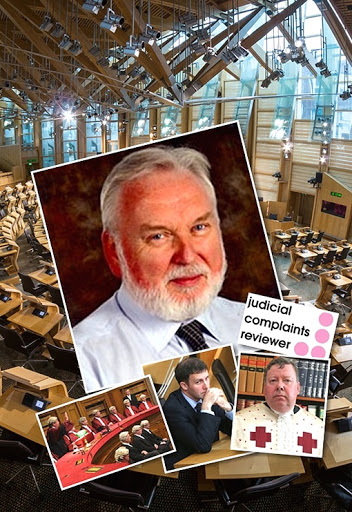
Ex top cop & SLCC Board member is new Judicial Investigator. A FORMER Deputy Chief Constable of Tayside Police who served as Convener of the Standards Commission for Scotland and was a board member of a tainted legal complaints quango – has been approved by Scotland’s top judge to investigate judges and serve as Scotland’s third Judicial Complaints Reviewer (JCR).

Ian Gordon, who also formerly served as a board member of the pro-lawyer Scottish Legal Complaints Commission (SLCC) and is currently Acting Commissioner with the Northern Ireland Public Service Ombudsman Office – will now serve as Judicial Complaints Reviewer from 1 September 2017 to 31 August 2020.

Ian Gordon’s appointment as JCR, which is required to be approved by Scotland's top judge – currently Lord Carloway - was announced by Justice Secretary Michael Matheson yesterday, Monday 14 August.

However, MSPs from across the political spectrum have called for the judicial watchdog to be given new powers and a review of the role undertaken by the Scottish Government amid controversy over the lack of powers to the JCR.

Moi Ali - Scotland's first Judicial Complaints Reviewer branded the JCR role as “window dressing” in evidence to MSPs at Holyrood during September 2013 – featured in a report here: As Scotland’s top judge battles on against transparency, Judicial Complaints Reviewer tells MSPs judges should register their interests like others in public life

Moi Ali continually called for extra powers until she quit the role in 2014 amid lack of cooperation from the judiciary & Scottish Government.

Gordon’s appointment as Judicial Complaints Reviewer comes after both his predecessors complained the SNP Government starved the post of resources.

Last week, the Sunday Herald published a further report on the controversy around the office of Judicial Complaints Reviewer, revealing current Gillian Thompson has published further concerns on the relevance and efficacy of the job.

Gillian Thompson said her contracted hours of just three days a month “inevitably” led to delays, “inconvenience for complainants” and ultimately “a poor service”.

She said she doubted public expectations were being met, complained her access to investigation files was limited, and urged ministers to “review the relevance of the role”.

Gillian Thompson published two annual reports on her work as JCR, last week - which contain no case histories after the Scottish Government suggested such references be excluded in published reports.

Several weeks ago Thompson was caught in a controversy where documents released by the Scottish Government revealed she had accused her predecessor of being the source of media interest in the lack of published annual reports by the JCR.

The accusations turned out to be false, and the Scottish Government ordered journalists to destroy the initial release of documents, which was swapped for another version by Stuart Lewis, a Senior Media Manager for the Scottish Government’s Justice & Education hub. Lewis refused to identify who took the decision to order destruction of the FOI documents.

Further concerns have been raised after the Scottish Information Commissioner dodged calls to look into the case, after journalists called for a re-examination of how exemptions are used by the Scottish Government where Thompson’s written accusations were then censored under the guise of ‘protecting free and frank discussions between officials’.

A full report and publication of the FOI documents on the controversy around Thompson and the Scottish Government’s FOI release can be found here: Scottish Government request destruction of FOI papers - Files reveal Ministers silence on judicial complaints & civil servants attempts to exclude case histories from Judicial Investigator’s annual reports

Ms Thompson’s predecessor Moi Ali also complained a lack of funds and support had made the role of Judicial Complaints Reviewer “enormously frustrating and difficult”.

Today, it has been reported LibDem MSP Liam McArthur has urged Mr Matheson to review the post of JCR.

In a letter to the Justice Secretary, Mr McArthur said: “The only two holders of the post have both provided blistering accounts of their experiences. In appointing the third JCR the Scottish Government cannot ignore the criticisms of his predecessors and the serious questions that surround the credibility of this office. It is clear that the current system is not working.”

Tory MSP Liam Kerr said: “Given the criticism levelled at the Scottish Government by the former reviewer, it appears her successor has quite a job on his hands.

“If this role is to be a success, ministers have to provide the resources and support necessary. We can’t afford for this to be yet another wasted 12 months.”

Labour MSP Claire Baker added: “It is clear that the new JCR needs far greater support.

“For the SNP to simply announce a new JCR but fail to address any of the serious structural shortcomings in the role is simply unacceptable.

“The Scottish Government cannot hide from their responsibility. They must fully fund and resource the new JCR so that he can carry out his role in the best interests of the public.”

However the biography issued by the Scottish Government on Mr Gordon contains no references to his time as one of the first intake of Board members at the discredited Scottish Legal Complaints Commission.

The SLCC was recently branded as a “toothless waste of time” by former Cabinet Secretary Alex Neil MSP (SNP Airdrie and Shotts) after the legal services regulator failed to act in a high profile case involving a senior QC caught up in a cash payments scandal.

The team responsible for setting up the Scottish Legal Complaints Commission and it’s board members in 2008 was led by Angela McArthur, Chief Executive of the Parole Board since December 2009

During Mr Gordon’s time on the board of the Scottish Legal Complaints Commission, the pro-lawyer regulator lurched from controversy to scandal, where media reports revealed board members infighting over dealing with members of the public, campaign groups, and drunken exchanges between board members & senior SLCC staff.

Ministerial Announcement of new Judicial Complaints Reviewer: Judicial Complaints Reviewer appointed

Cabinet Secretary for Justice Michael Matheson has announced the appointment of the third Judicial Complaints Reviewer.

Ian Gordon is a retired Deputy Chief Constable of Tayside Police. He is currently an Acting Commissioner with the Northern Ireland Public Service Ombudsman Office.

He was seconded to HM Inspectorate of Constabulary and was the lead police officer on the annual statutory inspection of five UK police forces, and was a member of the UK Police Professional Standards Group. He has conducted criminal, conduct and complaints investigations in the UK and undertaken enquires abroad on behalf of the Foreign Office.

Mr Gordon was also a Convener for the Standards Commission between 2010 and 2017 and contributed to a focused improvement to awareness of the codes of Conduct by elected members and Boards of Public Bodies.

This appointment was established by the Judiciary and Courts (Scotland) Act 2008 to review, when asked, the handling of a complaints investigation into members of the judiciary, to ensure that it has been dealt with in accordance with The Complaints About the Judiciary (Scotland) Rules 2016. The Reviewer has no powers to consider the merits of any complaint or the disposal of the complaint.

The appointment will be for a period of three years from 1 September 2017 to 31 August 2020, and will be paid a daily fee of £217. The appointment has been made with the approval of the Lord President.

All appointments are made on merit and political activity plays no part in the selection process.

FROM EX-COP TO JUDGING JUDGES - BIOGRAPHY IAN GORDON:

Ian Gordon is listed as Chair on the website of the Ericht Trust and is an active director of the Ericht Trust which is also registered as a company limited by guarantee, managed by a Board of Trustees who are elected at an Annual General Meeting, and a Company Secretary.

The Ericht Trust has since reported in March 2017 to be in the process of changing it’s name to the Erich Trust.

The Ericht Trust describes itself as a 'not for profit' charitable organisation, which focuses on community development and regeneration in line with Scottish Government policies on community empowerment. It is a member of Development Trusts Association Scotland (DTAS). DTAS provides support to its members and a link into a network of the many comparable Trusts working for the benefit of their communities across Scotland. Being part of this bigger family gives strength to the organisation when voicing opinion or seeking support from Government and Local Authorities.

The object of the Trust is to stimulate a range of community projects which will benefit residents and businesses and draw visitors to this area.

A register of interests posted by the Scottish Legal Complaints Commission also listed Mr Gordon as a director of Quarere Ltd.

Quaere Limited was set up on 20 Dec 2006 has its registered office in Perthshire. Its current status is listed as "Dissolved". The company's first directors were Marion Therese Gordon, Ian Alexander Gordon. Quaere Limited has no subsidiaries.

The company was listed under the headings of SIC 2003:7414 — Business And Management Consultancy Activities & SIC 2007: 70229 — Management Consultancy Activities (Other Than Financial Management)

Last annual accounts of Quarere Ltd were filed in 2009.

Other interests listed in Mr Gordon’s register of interests from his time at the Scottish Legal Complaints Commission include:

• Associate Professor in Policing for Charles Sturt University (Australia).
• Formerly Chair of the Association of Chief Police Officers in Scotland (ACPOS) Professional Standards Business Area.
• Vice-Chair of ACPOS General Policing Business Area.

Previous articles on the Judicial Complaints Reviewer and complaints against Scotland’s judiciary can be found here: Judicial Complaints Reviewer - Reviewing complaints against Scotland's judiciary

Tuesday, August 08, 2017

JUDICIAL REGISTER: Calls for all UK judges including UK Supreme Court, and Tribunals to declare links to business, wealth, professional & other interests in published registers of interests

All UK Judges & tribunals should declare interests. AS THE Scottish Parliament continues an investigation into proposals calling for members of the Judiciary of Scotland to declare their interests, a call has been made to roll out a publicly available judicial register for all judges & tribunals all across the UK.

Calls to bring all UK judges, including top judges based at the UK Supreme Court, and all tribunal members into line with judicial transparency proposals currently being considered in Scotland - would require those who sit in judgement to declare all interests, professional & personal links, wealth, property and other interests, in a register of interests, similar to disclosures made by politicians and others in public life.

The move comes after a recent development where Scotland’s top judge conceded to calls for full transparency on judicial recusals, reported last week here: RECUSALS JUST GOT REAL: Judicial Office concedes to reforms for Judicial Recusals Register, full case details where judges stand down from court hearings to be entered after media & FOI probe success

Attempts by Scotland’s judiciary to become more transparent and open up the workings of Scotland’s courts and judiciary to the public, have come in response to MSPs consideration of judicial transparency proposals contained in Petition PE1458: Register of Interests for members of Scotland's judiciary.

The petition, first debated at the Scottish Parliament’s Public Petitions Committee in January 2013 – calls for the creation of a publicly available register of judicial interests.

The creation of such a register would ensure full transparency for the most powerful people in the justice system – the judiciary.

The resulting publicly available register of judicial interests would contain information on judges’ backgrounds, figures relating to personal wealth, undeclared earnings, business & family connections inside & outside of the legal profession, membership of organisations, property and land, offshore investments, hospitality, details on recusals and other information routinely lodged in registers of interest across all walks of public life in the UK and around the world.

A full debate on the proposal to require judges to declare their interests was held at the Scottish Parliament on 9 October 2014 - ending in a motion calling on the Scottish Government to create a register of judicial interests. The motion was overwhelmingly supported by MSPs from all political parties.

A full listing of evidence in support of the petition calling for a register of judicial interests can be found here: JUDICIAL REGISTER: Evidence lodged by Judicial Investigators, campaigners, judges & journalists in four year Holyrood probe on judges’ interests - points to increased public awareness of judiciary, expectation of transparency in court

And, two of Scotland’s recent top judges, former Lord President Lord Brian Gill, and current Lord President Lord Carloway, have testified before the Scottish Parliament on the petition, both failing to prove any case against creating a register of judicial interests.

A report on Lord Brian Gill’s evidence to the Scottish Parliament in November 2015 can be found here: JUDGE ANOTHER DAY: Sparks fly as top judge demands MSPs close investigation on judges’ secret wealth & interests - Petitions Committee Chief brands Lord Gill’s evidence as “passive aggression”

A report on Lord Carloway’s widely criticised evidence to the Scottish Parliament in July 2017 can be found here: REGISTER TO JUDGE: Lord Carloway criticised after he blasts Parliament probe on judicial transparency - Top judge says register of judges’ interests should only be created if judiciary discover scandal or corruption within their own ranks

The National reports on recent developments here:

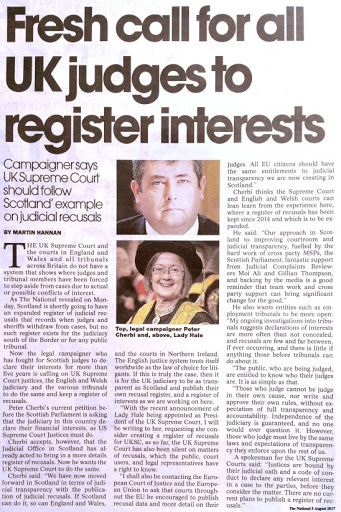
Fresh call for all UK judges to register interests

Campaigner says UKSupreme Court should follow Scotland example on Judicial Recusals

Martin Hannan Journalist 2 August 2017 The National

THE UK Supreme Court and the courts in England and Wales and all tribunals across Britain do not have a system that shows where judges and tribunal members have been forced to step aside from cases due to actual or possible conflicts of interest.

As The National revealed on Monday, Scotland is shortly going to have an expanded register of judicial recusals that records when judges and sheriffs withdraw from cases, but no such register exists for the judiciary south of the Border or for any public tribunal.

Now the legal campaigner who has fought for Scottish judges to declare their interests for more than five years is calling on UK Supreme Court justices, the English and Welsh judiciary and the various tribunals to do the same and keep a register of recusals.

Peter Cherbi’s current petition before the Scottish Parliament is asking that the judiciary in this country declare their financial interests, as US Supreme Court Justices must do.

Cherbi accepts, however, that the Judicial Office in Scotland has already acted to bring in a more details register of recusals. Now he wants the UK Supreme Court to do the same.

Cherbi said: “We have now moved forward in Scotland in terms of judicial transparency with the publication of judicial recusals. If Scotland can do it, so can England and Wales, and the courts in Northern Ireland. The English justice system touts itself worldwide as the law of choice for litigants. If this is truly the case, then it is for the UK judiciary to be as transparent as Scotland and publish their own recusal register, and a register of interests as we are working on here.

“With the recent announcement of Lady Hale being appointed as President of the UK Supreme Court, I will be writing to her, requesting she consider creating a register of recusals for UKSC, as so far, the UK Supreme Court has also been silent on matters of recusals, which the public, court users, and legal representatives have a right to know.

“I shall also be contacting the European Court of Justice and the European Union to ask that courts throughout the EU be encouraged to publish recusal data and more detail on their judges. All EU citizens should have the same entitlements to judicial transparency we are now creating in Scotland.”

Cherbi thinks the Supreme Court and English and Welsh courts can lean learn from the experience here, where a register of recusals has been kept since 2014 and which is to be expanded.

He said: “Our approach in Scotland to improving courtroom and judicial transparency, fuelled by the hard work of cross party MSPs, the Scottish Parliament, fantastic support from Judicial Complaints Reviewers Moi Ali and Gillian Thompson, and backing by the media is a good reminder that team work and cross party support can bring significant change for the good.”

He also wants entities such as employment tribunals to be more open: “My ongoing investigations into tribunals suggests declarations of interests are more often than not concealed, and recusals are few and far between, if ever occurring, and there is little if anything those before tribunals can do about it.

“The public, who are being judged, are entitled to know who their judges are. It is as simple as that.

“Those who judge cannot be judge in their own cause, nor write and approve their own rules, without expectation of full transparency and accountability. Independence of the judiciary is guaranteed, and no one would ever question it. However, those who judge must live by the same laws and expectations of transparency they enforce upon the rest of us.

A spokesman for the UK Supreme Courts said: “Justices are bound by their judicial oath and a code of conduct to declare any relevant interest in a case to the parties, before they consider the matter. There are no current plans to publish a register of recusals.”

Previous articles on the lack of transparency within Scotland’s judiciary, investigations by Diary of Injustice including reports from the media, and video footage of debates at the Scottish Parliament’s Public Petitions Committee can be found here : A Register of Interests for Scotland's Judiciary.

Friday, August 04, 2017

RECUSALS JUST GOT REAL: Judicial Office concedes to reforms for Judicial Recusals Register, full case details where judges stand down from court hearings to be entered after media & FOI probe success

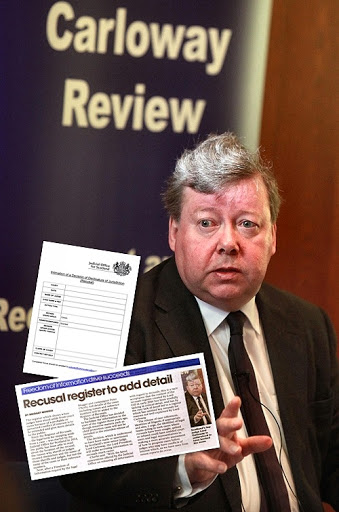
Spotlight on Judiciary brings success on Recusals. SCOTLAND’S top Judge - Lord President Lord Carloway - has conceded to calls to publish full details of cases in the Register of Judicial Recusals – a publicly available register which records  instances where judges step aside in cases due to conflicts of interest.

The improvements to the register of recusals, agreed after lengthy exchanges between the Head of Governance of the Judiciary of Scotland & journalists - acknowledge the woeful lack of detail previously entered on cases, where little was given away about the case subject, litigants, points of law involved or even whether judges had refused to recuse themselves after being asked to do so.

Soon, members of the public, court users and legal representatives will be able to find out much more about why judges have stood aside in cases, the identity (where appropriate) of legal cases, litigants, case reference numbers and legal representatives – which all appear in court opinions published online by the Scottish Courts & Tribunals Service (SCTS).

The move has come about after Lord Caloway was quizzed on Judicial Recusals at a recent meeting of the Scottish Parliament’s Public Petitions Committee – where it became clear recusals of judges which had occurred, were not included on the register for reasons not well explained by Lord Carloway in his responses to former Cabinet Secretary Alex Neil MSP.

Now the register is to be corrected, and all the extra information now agreed to be entered by the Judicial Office will also be backdated to the date the recusals register came into being, in April 2014 – when Lord Brian Gill created the register of recusals in response to the Scottish Parliament’s ongoing consideration of Petition PE1458: Register of Interests for members of Scotland's judiciary.

The further publication of information revealing the identities of solicitors & law firms bold enough to challenge the judiciary and raise motions for recusals could also significantly benefit members of the public in access to justice issues, enabling clients to select a lawyer who isn’t afraid to raise questions on the appropriateness of a judge to hear a case if there are conflicts of interest which must be raised as matters for recusal.

The extra concessions from the Judicial Office – which go further than Lord Carloway indicated during his meeting with MSPs, come after journalists pursued a Freedom of Information request seeking all information contained in forms submitted in motions from legal teams & litigants for judges to step aside in court hearings.

Initially, the Judicial Office claimed it held no information on recusals other than a form for collecting information on recusals, a blank copy which was provided to journalists, who then sought a review of the refusal to release further information.

Then, writing in response to a request for a review of the Judicial Office’s earlier decision to refuse release of detail on recusals, Mr Steven D’Arcy Head of Strategy & Governance said: “Following the Lord President’s letter to the Petitions Committee, the Register of Recusals will be extended to cover instances when a judge has recused them self and when he or she has declined to do so - a copy of the this letter can be found here. The Judicial Office for Scotland has amended the guidance for SCTS staff and a copy is attached to this letter.”

The Judicial Office does hold copies of submitted recusal forms. However, when a form is submitted the information of the recusal is placed on our website. Therefore this is exempt information as you can reasonably obtain it other than by requesting it (section 25(1) of the Freedom of Information (Scotland) Act 2002)).”

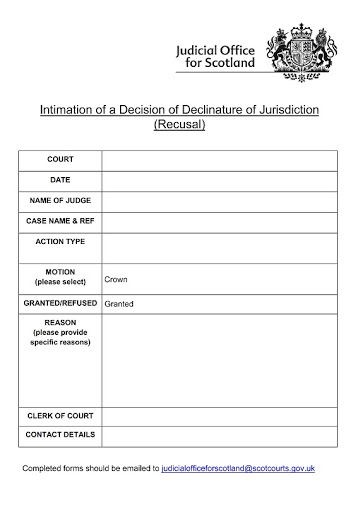
The form now issued by the Judicial Office for Scotland to collect recusal data lists the following information and terms:

Intimation of a Decision of Declinature (Recusal)

Declinature of jurisdiction, also referred to as recusal, refers to the act of a judicial office holder abstaining from participation in legal proceedings due to a conflict of interest or when his or her impartiality might reasonably be impugned.

The attached form  should be completed by clerks of court in the event of a formal motion for recusal being granted or refused in open court and accordingly recorded in an appropriate interlocutor.

The return should only be completed for recusals involving a senator, temporary judge, sheriff principal, sheriff or summary sheriff (this includes fee-paid members of the judiciary). It should not be completed when there has only been an informal administrative decision not to sit in a particular case.

The returns should be completed electronically and emailed to the Judicial Office for Scotland.

This information is being collated on behalf of the Lord President and this requirement should be completed accurately and timeously. Local records should be noted once the return has been submitted.

If you have any questions please contact the Judicial Office for Scotland.

The form of Intimation of a Decision of Declinature of Jurisdiction (Recusal) seeks, and records COURT (Location), DATE, NAME OF JUDGE, CASE NAME & REF, ACTION TYPE, MOTION (please select), GRANTED/REFUSED, REASON (please provide specific reasons), CLERK OF COURT, CONTACT DETAILS.

However, on analysing the form provided by the Judicial Office, it was plain there was a significant amount of information gathered by the form which was still to remain unpublished.

A series of discussions then took place between the Head of Governance at the Judicial Office & journalists pursuing the release of recusal information, which ultimately concluded in an agreement to publish all the information where appropriate.

Journalists asked: Just to confirm this information to be published will go right back to the first recusals in 2014 contained in the register of recusal archive?”

Mr D’Arcy responded: “…if it was 2014 then the answer is Yes. All case names/references that we can publish will be added to the list of recusal information on our website.”

A recent investigation by Diary of Injustice revealed instances where senior Court of Session judges have stood aside from cases were not entered into the register of recusals, for up to a year later, and then only after DOI journalists had queried the Judicial Office over the cases.

A full report on investigations into judicial recusals can be found here: Doubts over credibility of register of judges’ recusals - as Judicial Office admit court clerks failed to add details of senior judges recusals – then silently altered records a year later

During enquiries into failures to record recusals, Elizabeth Cutting, Head of Communications of the Judicial Office stood down from her post, leaving acting head Baktosch Gillan to reply to queries on why a recusal relating to Lord Bracadale had been concealed from the register of recusals for up to a year.

Responses from the Judicial Office claimed there had been a “clerical error”, a claim echoed by Lord Carloway during his attendance at the Petitions Committee where the top judge was widely criticised for his attempts to thwart increases in judicial transparency with the creation of a register of interests for Scotland’s judiciary.

The National reported on the developments to publish full details on judicial recusals in Scotland, here:

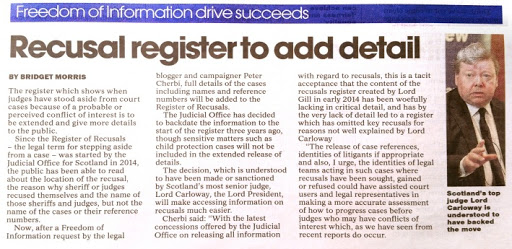
More details to be shared about judges recusing themselves from cases

Bridget Morris Journalist 31 July 2017 The National

THE register which shows when judges have stood aside from court cases because of a probable or perceived conflict of interest is to be extended and give more details to the public.

Since the Register of Recusals – the legal term for stepping aside from a case – was started by the Judicial Office for Scotland in 2014, the public has been able to read about the location of the recusal, the reason why sheriff or judges recused themselves and the name of those sheriffs and judges, but not the name of the cases or their reference numbers.

Now, after a Freedom of Information request by the legal blogger and campaigner Peter Cherbi, full details of the cases including names and reference numbers will be added to the Register of Recusals.

The Judicial Office has decided to backdate the information to the start of the register three years ago, though sensitive matters such as child protection cases will not be included in the extended release of details.

The decision, which is understood to have been made or sanctioned by Scotland’s most senior judge, Lord Carloway, the Lord President, will make accessing information on recusals much easier.

Cherbi said: “With the latest concessions offered by the Judicial Office on releasing all information with regard to recusals, this is a tacit acceptance that the content of the recusals register created by Lord Gill in early 2014 has been woefully lacking in critical detail, and has by the very lack of detail led to a register which has omitted key recusals for reasons not well explained by Lord Carloway.

“The release of case references, identities of litigants if appropriate and also, I urge, the identities of legal teams acting in such cases where recusals have been sought, gained or refused could have assisted court users and legal representatives in making a more accurate assessment of how to progress cases before judges who may have conflicts of interest which, as we have seen from recent reports do occur."

Previous article on Judicial Recusals can be found here:  Judicial Recusals in Scotland - Cases where judges have stood down over conflicts of interest

Friday, July 28, 2017

READ THE SHRED: Scottish Government request destruction of FOI papers - Files reveal Ministers silence on judicial complaints & civil servants attempts to exclude case histories from Judicial Investigator’s annual reports

No JCR annual reports in 3 years. FILES RELEASED by the Scottish Government reveal Scotland’s Judicial Complaints Reviewer (JCR) took an undisclosed decision in 2016 not to publish annual reports on complaints about alleged judicial misconduct, while civil servants agreed further annual reports could be watered down.

The documents - obtained under the Freedom of Information act reveal a three year silence on annual reporting of complaints about the judiciary by Gillian Thompson OBE, who currently serves as Scotland’s Judicial Complaints Reviewer until August 31 2017.

Emails from the Scottish Government to the JCR also reveal a civil servant in the Justice Department told Ms Thompson she could water down the length of reports on her work, and did not need to include examples of cases – which had been a hallmark of previous annual reports published by Scotland’s first JCR – Moi Ali.

And, key passages of the documents provoked a storm in the media after now redacted paragraphs revealed Ms Thompson had wrongly claimed her predecessor was the source of media articles in relation to the role of the JCR – when in fact the articles reporting on a lack of annual reports from the Judicial Complaints Reviewer had been down to good journalism.

Upon the material being reported to the Scottish Government as unsuitable for publication, on the grounds there was a clear breach of Freedom of Information legislation relating to publication of comments of third parties and material likely to inhibit free & frank discussion between officials, the Scottish Government’s media team took over the handling of the matter, and demanded the documents already released to journalists be destroyed.

Stuart Lewis, Senior Media Manager for the Scottish Government’s Justice & Education hub provided an unsigned letter stating: You also brought to our attention the remarks made on page 28 of the pdf document. These remarks were made by a third party and do not reflect or represent the views of the Scottish Government. On reflection, those remarks should also have been considered to be personal data.

This was an oversight which we take seriously. We will circulate guidance across the Justice Directorate for use in responding to future FOI requests and specifically about redaction of personal information including personal data.

In the circumstances, we would ask you not to circulate this information any further and ask that you confirm that you have deleted/destroyed the information. We have included a redacted copy of the information for publication which excludes this personal data.

We are very grateful to you for drawing this matter to our attention and for giving us the opportunity to address it before you publish our response.

The initial release of documents from the Scottish Government were subsequently destroyed. However, what became clear from the release of information was that exemptions of disclosure which supposedly protect “free and frank discussions” between civil servants are being used to conceal potentially defamatory statements & conjecture between public servants unhappy about attention from the media on public interest issues.

The files, since released in a second cleaned up version by the Scottish Government, also reveal major changes appear to have been planned for the way in which JCR annual reports were to be published, after an email from an unidentified Scottish Government civil servant informed Gillian Thompson there was no need to refer to actual cases in her annual report.

An excerpt from an email, dated 8 September 2015 reads: “We look forward to receiving your Annual Report in due course and agree that there is no need for this to be a lengthy document, nor to include examples of cases.”

An excerpt from a letter, dated 3 October 2016 reveals the decision taken by Ms Thompson against publishing annual reports – despite a Ministerial direction obtained by Ms Thompson’s predecessor to ensure the public found out about the work of the Judicial Complaints Reviewer.

An extract from a letter from Gillian Thompson to Neil Rennick, Director of the Scottish Government’s Justice Department reads: From the beginning of my tenure I have prioritised the reviews requested by those who believe that their complaint has not been handled by the Judicial Office for Scotland in line with the relevant Rules. It took me well into 2015 to clear the backlog I inherited and the reviews that came to me in the first 6 months.

My view is that the role of the JCR is to provide the service available within the narrowly drawn legislation as efficiently and effectively as possible given the constraints, including the time constraints.

I have always viewed the preparation of a report on activity and effort as second order. My contract refers to a responsibility to "as directed by Scottish Ministers to prepare and publish reports on investigations". The wording implies that a direction will be given and does not specify what should be reported or when.

I confess that whilst I have accepted that what is meant is to follow Moi Ali's example I have not attached the same level of importance to providing a report as she did. [REDACTED]

I have not produced a report for 2015 or 2016. The interest also suggests that producing one report followed closely by another will mean that I will have to divert available time to handling the fallout after each rather than undertaking reviews

Early in October I said that I would put aside casework and concentrate on drafting reports. As of this letter I have 7 reviews outstanding and there may be more once I go to VQ tomorrow. I think that for me to feel that I am providing the level of service that complainants are entitled to expect I have to revert to case handling.

I have decided, therefore, that I will conflate the reports and produce an end of term/tenure report in August 2017.

This decision was not announced in public, or on the Judicial Complaints Reviewer’s website.

A further scrutiny of the FOI released documentation also reveals attempts at ‘information management’ in response to enquiries on the role of the JCR, where civil servants suggest Gillian Thompson take the same line as Scottish Government in response to an MSP’s enquiry.

A redacted email from a civil servant in the Scottish Government’s Justice Department to Gillian Thompson reads: “The line that we intend to take in the response to the MSP enquiry is that certain arrangements were set up for the previous JCR. However, these have been comprehensively reviewed and we are in the process of changing over to more secure arrangements - having been maintained on a transitional basis as you inherited the office to maintain continuity. Could we take this line with [redacted] and you could respond from your SCOTS account to avoid any further Gmail related criticism? You might say that you can't currently gain access to the correspondence on the old Gmail account as it's in the process of being changed over.”

An issue which does stand out from much of the discussions between Gillian Thompson and the Scottish Government, is the lack of any communication with two Lord Presidents, Lord Gill, and his successor Lord Carloway on the subject of the missing JCR annual reports.

Not one document or communication from an anxious Lord President or Judicial Office exists in the FOI release, provoking questions why the judiciary were keen not to enquire as to why no annual reports were being produced by the Judicial Complaints Reviewer for the past three years.

As things currently stand, the only annual reports from the Judicial Complaints Reviewer which currently exist are those written by Moi Ali, Scotland’s first JCR.

Diary of Injustice has previously published the JCR annual reports authored by Moi Ali, here: Judicial Complaints Reviewer Scotland Annual Report 2011-2012, Judicial Complaints Reviewer Scotland Annual Report 2012-2013 and Judicial Complaints Reviewer Scotland Annual Report 2013-2014

The Sunday Herald reported on the release of documentation and the Scottish Government’s request files be destroyed, here:

Cover-up row after government asks writer to destroy watchdog letter released under FOI

Paul Hutcheon Investigations Editor 9 July 2017

THE Scottish Government is at the centre of a cover up row after asking a journalist to destroy a document released under freedom of information laws.

Civil servants provided a letter showing that Judicial Complaints Reviewer (JCR) Gillian Thompson had wrongly claimed her predecessor may have been behind a media story about her.

Days later, the Government stated: “We would ask you not to circulate this information any further and ask that you confirm that you have deleted/destroyed the information.”

In 2016, the Sunday Herald revealed that Thompson, whose role includes examining whether complaints against judges were handled properly, had not published an annual report since taking up the job.

This was in contrast to the previous post-holder Moi Ali, who had fought for the right to publish a yearly account of her annual activity in the job.

Peter Cherbi, who publishes a blog on legal issues, asked the Scottish Government for all communications and discussions with the JCR going back several years.

In a letter to Scottish Government Justice Director Neil Rennick, dated October 2016, Thompson wrote: “I have always viewed the preparation of a report on activity and effort as second order.”

She added: “I confess that whilst I have accepted that what is meant is to follow Moi Ali's example I have not attached the same level of importance to providing a report as she did.”

Thompson then inaccurately stated that Ali may have had a role in the story about her not publishing an annual report: “Indeed if our difference of view needed highlighting, on one reading of the recent [Sunday] Herald article, she seems to have been a source in outing the fact that I have not produced a report for 2015 or 2016.”

After receiving the letter, Cherbi got an email from the Government which tried to backtrack on this part of the freedom of information release.

Addressing Thompson’s comment, the Government stated: “These remarks were made by a third party and do not reflect or represent the views of the Scottish Government. On reflection, those remarks should also have been considered to be personal data. This was an oversight which we take seriously.”

Cherbi told this newspaper: “As a journalist I am concerned about being asked by the Scottish Government to destroy material which clearly the public have a right to know given the matter at hand – transparency and accountability of the judiciary and courts.

“Moi Ali as JCR was and remains a staunch supporter of judicial transparency. She was very attentive as JCR, produced annual reports, gave evidence to the Scottish Parliament, stood up to an overbearing judiciary and went so far as to ask for more powers for the JCR role.”

Ali said: “I was categorically not the source of this media coverage about the JCR, and only provided a reactive, on-the-record response to the Sunday Herald. I am equally disappointed that Scottish Government shared Ms Thompson's baseless conjecture, without my knowledge, with a freelance journalist. This is not acceptable, although I accept their subsequent sincere apology for their error.

“When I wrote to Ms Thompson asking how she proposed to remedy the situation, I received a reply noting my concerns. I have now written again asking for a retraction and apology, as it is damaging to one’s reputation."

Thompson said: "I made an observation to my lead contact in Scottish Government. I did not make it public."

A Scottish Government spokesperson said: “Some personal data was included in error within a larger release of information requested under FOI legislation. We acted quickly to correct this as soon as it was brought to our attention. We are sorry for this breach of our standards and have apologised to those affected.”

The Sunday Mail newspaper also reported on the lack of annual reports from the Judicial Complaints Reviewer, here:

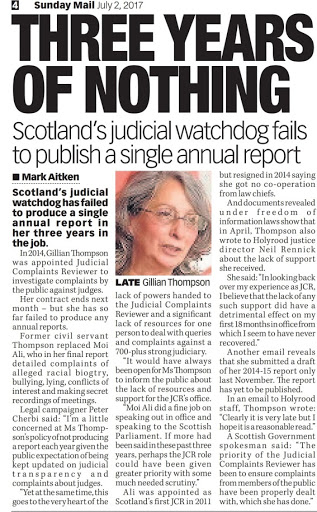
 THREE YEARS OF NOTHING

Scotland's judicial watchdog has failed to produce a single annual report in her three years in the job.

By Mark Aitken, Political Editor Sunday Mail 2 July 2017

In 2014, Gillian Thompson was appointed Judicial Complaints Reviewer to investigate complaints by the public against judges.

Her contract ends next month - but she has so far failed to produce any annual reports.

Former civil servant Thompson replaced Moi Ali, who in her final report detailed complaints of alleged racial biogtry, bullying, lying, conflicts of interest and making secret recordings of meetings.

Legal campaigner Peter Cherbi said: "I'm a little concerned at Ms Thompson's policy of not producing a report each year given the public expectation of being kept updated on judicial transparency and complaints about judges.

"Yet at the same time, this goes to the very heart of the lack of powers handed to the Judicial Complaints Reviewer and a significant lack of resources for one person to deal with queries and complaints against a 700-plus strong judiciary.

"It would have always been open for Ms Thompson to inform the public about the lack of resources and support for the JCR's office.

"Moi Ali did a fine job on speaking out in office and speaking to the Scottish Parliament. If more had been said in these past three years, perhaps the JCR role could have been given greater priority with some much needed scrutiny."

Ali was appointed as Scotland's first JCR in 2011 but resigned in 2014 saying she got no co-operation from law chiefs.

And documents revealed under freedom of information laws show that in April, Thompson also wrote to Holyrood justice director Neil Rennick about the lack of support she received.

She said: "In looking back over my experience as JCR, I believe that the lack of any such support did have a detrimental effect on my first 18 months in office from which I seem to have never recovered."

Another email reveals that she submitted a draft of her 2014-15 report only last November. The report has yet to be published.

In an email to Holyrood staff, Thompson wrote: "Clearly it is very late but I hope it is a reasonable read."

A Scottish Government spokesman said: "The priority of the Judicial Complaints Reviewer has been to ensure complaints from members of the public have been properly dealt with, which she has done."

Previous articles on the Judicial Complaints Reviewer and complaints against Scotland’s judiciary can be found here: Judicial Complaints Reviewer - Reviewing complaints against Scotland's judiciary