Monday, June 22, 2015

NEW BROOM TO TELL: Judicial transparency in the dock as Holyrood MSPs set to quiz Judicial Complaints Reviewer on support for a register of interests for judges

New Judicial Complaints Reviewer to face Holyrood. SCOTLAND’S new Judicial Complaints Reviewer (JCR) will appear before the Scottish Parliament’s Public Petitions Committee tomorrow, Tuesday 23 June, to give evidence on her support for a register of judicial interests.

Gillian Thompson OBE – former head of the Accountant in Bankruptcy (AIB) who has held the post of JCR since summer 2014 – replacing Moi Ali - Scotland’s first ever Judicial Complaints Reviewer who stood down last year due to a lack of regulatory power - is expected to continue support for a proposal calling for judges to be required to declare their vast wealth and secretive links to business, as called for in Petition PE1458: Register of Interests for members of Scotland's judiciary.

The judicial transparency proposal calls for the creation of a single independently regulated register of interests containing information on judges backgrounds, their personal wealth, undeclared earnings, business & family connections inside & outside of the legal profession, offshore investments, hospitality, details on recusals and other information routinely lodged in registers of interest across all walks of public life in the UK and around the world.

The petition has cross party support from MSPs who backed a motion urging the Scottish Government to create a register of judicial interests at Holyrood on 7 October 2014 - reported along with video footage and the official record, here: Debating the Judges.

Writing in a letter to the Public Petitions Committee  in January, Judicial Complaints Reviewer Gillian Thompson backed calls to make judges more accountable on their secretive interests.
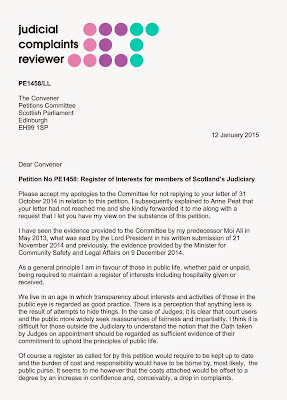
Gillian Thompson told MSPs: “As a general principle I am in favour of those in public life, whether paid or unpaid, being required to maintain a register of interests including hospitality given or received.”

“We live in an age in which transparency about interests and activities of those in the public eye is regarded as good practice. There is a perception that anything less is the result of attempts to hide things. In the case of Judges, it is clear that court users and the public more widely seek reassurances of fairness and impartiality. I think it is difficult for those outside the Judiciary to understand the notion that the Oath taken by Judges on appointment should be regarded as sufficient evidence of their commitment to uphold the principles of public life.”

“Of course a register as called for by this petition would require to be kept up to date and the burden of cost and responsibility would have to be borne by, most likely, the public purse. It seems to me however that the costs attached would be offset to a degree by an increase in confidence and, conceivably, a drop in complaints.”

JCR Gillian Thompson’s backing for Petition PE1458: Register of Interests for members of Scotland's judiciary comes after Moi Ali - Scotland’s first ever Judicial Complaints Reviewer – quit her role as JCR after describing the job as “window dressing” during an evidence session with MSPs in September 2013, reported along with video coverage here: As Scotland’s top judge battles on against transparency, Judicial Complaints Reviewer tells MSPs judges should register their interests like others in public life

JCR Moi Ali gives evidence to Scottish Parliament on a proposed Register of Judicial Interests

The full written report on the eye opening 2013 evidence session with Moi Ali and the Scottish Parliament’s Public Petitions Committee was published here : Evidence from Scotland’s Judicial Complaints Reviewer Moi Ali to Public Petitions Committee on Petition 1458 Register of Interests for Scotland’s Judiciary
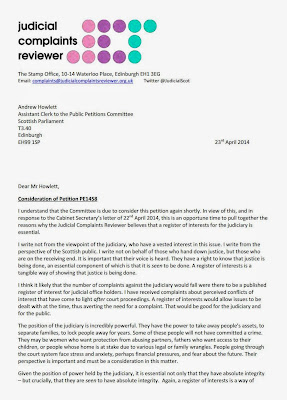
Judicial Complaints Reviewer Moi Ali backed register of judicial interests: A further letter of support from Moi Ali while she held the post of Judicial Complaints Reviewer told MSPs of the “incredibly powerful” nature of the judiciary and why a register of judicial interests would help judicial transparency and public confidence in the justice system.

Moi Ali said: “I write not from the viewpoint of the judiciary, who have a vested interest in this issue. I write from the perspective of the Scottish public. I write not on behalf of those who hand down justice, but those who are on the receiving end. It is important that their voice is heard. They have a right to know that justice is being done, an essential component of which is that it is seen to be done. A register of interests is a tangible way of showing that justice is being done.”

“I think it likely that the number of complaints against the judiciary would fall were there to be a published register of interest for judicial office holders. I have received complaints about perceived conflicts of interest that have come to light after court proceedings. A register of interests would allow issues to be dealt with at the time, thus averting the need for a complaint. That would be good for the judiciary and for the public.”

“The position of the judiciary is incredibly powerful. They have the power to take away people’s assets, to separate families, to lock people away for years. Some of these people will not have committed a crime. They may be women who want protection from abusing partners, fathers who want access to their children, or people whose home is at stake due to various legal or family wrangles. People going through the court system face stress and anxiety, perhaps financial pressures, and fear about the future. Their perspective is important and must be a consideration in this matter.”

“Given the position of power held by the judiciary, it is essential not only that they have absolute integrity but crucially, that they are seen to have absolute integrity. Again, a register of interests is a way of demonstrating that a judicial office holder is impartial and has no vested interest in a case –financially, through family connections, club/society membership or in any other way. Conversely, the refusal to institute a register of interests creates suspicion that in turn undermines judicial credibility. So once more, a register of interests is good for the judiciary and good for the public.”

Gillian Thompson’s appearance before MSPs at Holyrood follows a secret meeting between Scottish Ministers and Lord President Lord Gill - who demanded proposals on requiring judges to declare their interests - be halted.

The secret meeting between Legal Affairs Minister Paul Wheelhouse and Scotland's now retired top judge Lord President Lord Brian Gill (73) and his aides was held in February - to discuss joint efforts between the Scottish Government and senior judicial figures to combat a long running Scottish Parliament investigation into proposals to increase transparency of the judiciary - Petition PE1458: Register of Interests for members of Scotland's judiciary.

The existence of the secret get together between Scottish Government Ministers and judges desperate to conceal their vast and varied interests from the public - only came to light in a letter of intervention from Scotland’s First Minister Nicola Sturgeon to the Scottish Parliament’s Public Petitions Committee at the end of March.

NEW JCR SCRUTINISED REGISTERS OF INTEREST FOR COURT STAFF:

Diary of Injustice previously reported on concerns regarding hospitality involving Scottish Court Service employees where the former AIB Chief was asked by the Scottish Court Service to investigate reports of irregularities in hospitality given to court staff. The request for the investigation came after the SCS received Freedom of Information requests regarding hospitality in the courts, prompting concerns some staff may have accepted gifts or hospitality but failed to register.
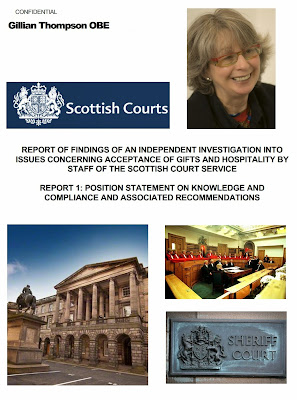
Report said SCS Registers were insufficient, and Court staff involved in private gain failed to declare. Gillian Thompson’s Report on Hospitality & Gifts in the SCS stated:  “The information currently captured on the registers is insufficient to provide assurance that staff are using their common sense and considering issues such as conflict of interest.

Ms Thompson went on to recommend the “SCS should revise the Policy on Acceptance of Gifts, Rewards and Hospitality to ensure that it is fit for purpose for all staff, taking account of the various roles performed within SCS. It may also be time to revisit the levels of value for gifts and hospitality.”

The former AIB’s report also revealed court staff were using their positions to earn money privately from their links with lawyers and law firms operating in courts, stating “Several staff raised the issue of sheriff clerks who carry out extrajudicial taxations and private assessments and who personally benefit financially from these activities.”

Ms Thompson’s report roundly condemned this practice, stating: “Not only is it inappropriate in terms of the civil service code requirements for staff who are public servants to be able to receive private gain from their employment it is also highly divisive when other staff see such benefits being derived from simply being in the right post of Auditor of Court within the Sheriff Courts.”

Ms Thompson recommended in her report the “SCS should bring the practice of sheriff clerks profiting privately from their employment by SCS to an end as quickly as possible”.

Previous articles on the lack of transparency within Scotland’s judiciary, investigations by Diary of Injustice including reports from the media, and video footage of debates at the Scottish Parliament’s Public Petitions Committee can be found here : A Register of Interests for Scotland's Judiciary

Thursday, June 18, 2015

YOUR BANK, M’LORD? The £40m trail of secretive judicial interests, billionaires, aristocrats & offshore trusts in Hampden & Co, Scotland’s latest bank

Judges, mega rich & offshore money mix in new Scots bank. A RICH LIST of investors in Hampden & Co - Scotland’s first new bank in 30 years – reveals members of the judiciary including a suspended judge - among the ranks of billionaires, aristocrats and anonymous offshore trusts who have pumped in £40 million into the financial institution - located in Charlotte Square, Edinburgh.

Among the ranks of investors in the new bank are figures from the judiciary such as the now suspended Sheriff Peter Black Watson – who was suspended from his current judicial duties by Lord President Lord Gill in February of this year - in relation to legal writs linked to the £400m collapse of hedge fund Heather Capital.

Other judicial figures include Court of Session judges and former EU judge, Scottish lawyer & academic Sir David Edward KCMG QC FRSE.

Today, the Judicial Office for Scotland refused to comment on, or confirm the identities of any judges who hold shares in the new bank.

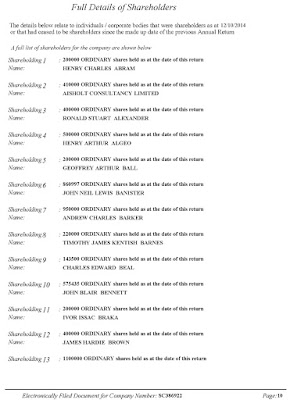
Hampden & Co annual return reveals wealthy shareholder list. In accounts filed by Hampden & Co, Edinburgh, a Michael Scott Jones - is the registered as owner of 200,000 shares.

The Judicial Office refused to confirm or deny if this is the same Michael Scott Jones who is Court of Session judge Lord Jones.

The accounts for the bank also reveal Peter Black Watson is the holder of 400,000 shares.

While the Judicial Office refused to confirm if this is the same Peter Black Watson who was suspended by Lord President Lord Gill earlier this year “to maintain public confidence in the judiciary”, Watson’s identity as one of the shareholders of Hampden & Co has been confirmed in a report in The Scottish Sun newspaper earlier this week.

Speaking to the media today, the Judicial Office refused to be drawn on the issue of judges investments and the need for a register of judicial interests to enable the public to scrutinise judges interests and links to big business, banks and other vested interests.

A spokesperson for the Judicial Office for Scotland would only say : “Personal investment decisions are a matter for individual judicial office holders.

“Judicial office holders are bound by the Statement of Principles of Judicial Ethics and in the event of a case presenting a potential conflict of interests, by reason of an investment or otherwise, will recuse themselves. These recusal decisions are a matter of public record”.

However, it is a matter of public record not one Scottish judge has declared a financial interest in a case which has resulted in a published recusal, and one senior Sheriff – Sheriff Principal Alistair Dunlop - who held shares in Tesco – did not recuse himself in the case involving the supermarket giant.

No public record of any refusals or failures of judges to recuse themselves have appeared in the list of recusals published by the judiciary.

Neither have any financial details of members of the judiciary appeared in the list of recusals.

A petition currently under consideration by the Scottish Parliament - Petition PE1458: Register of Interests for members of Scotland's judiciary - calls for the creation of a single independently regulated register of interests containing information on judges backgrounds, their personal wealth, undeclared earnings, business & family connections inside & outside of the legal profession, offshore investments, hospitality, details on recusals and other information routinely lodged in registers of interest across all walks of public life in the UK and around the world.

The petition has cross party support from msps who backed a motion urging the Scottish Government to create a register of judicial interests at Holyrood on 7 October 2014 - reported along with video footage and the official record, here: Debating the Judges.

In an investigation earlier this week by the Scottish Sun newspaper, it was revealed there are fears among some of Hampden & Co’s shareholders of a second independence referendum, tax rises and how the business climate in Scotland will fare under policies of the SNP Scottish Government.

The bank’s investor list reveals predominantly rich, unionist shareholders such as tycoon Alastair Salvesen, self-storage tycoon Alister Jack, Greenock-born financier Malcolm Offord, Dobbie's garden centre chief James Barnes, Edinburgh art dealer Alexander Meddowes and Stirling-based construction tycoons Duncan Fletcher & Duncan Ogilvie, both worth over £50million. Aristocratic customers includes the Queen's cousin David Bowes-Lyons and the Earl of Rosebery's daughter Lady Caroline Primrose.

Euripides Investments Ltd, the new bank's second largest shareholder, is based in Jersey — meaning its ownership is secret and that owners are likely to pay less tax on profits than individual UK shareholders.

Another major shareholder is Guernsey-based Kusapi Ltd.

Hampden & Co are refusing to reveal the identity of a major Chinese investor - Cai Dang Fang – listed in Companies House records as Hampden's fourth largest shareholder. But it's not known whether that is a person or a company — and the bank won't say if they are based in the UK or overseas.

The private bank's headquarters in Charlotte Square, Edinburgh, are just a few doors away from First Minister Nicola Sturgeon's Bute House residence.

However, many of Hampden's super-rich backers are staunch unionists who fear their savings may be hit by a rampant SNP push for full fiscal autonomy and another independence referendum.

Speaking to The Sun – Founder & Chairman Ray Entwistle (70) insisted "we have absolutely no intention of racing into any kind of decision".

But referring to the SNP's election success he warned: "I suspect a host of businesses that were anxious over the referendum last year remain partially anxious about what happened last month.

"This bank is registered in Scotland, the head office is in Edinburgh and we have a large number of friends we want to do business both in Scotland and in London.

"We are going to wait and see what happens over the next few months. "And I suspect that a lot of other businesses are waiting to see what transpires politically."

Commenting on the bank, Deputy First Minister & Finance Secretary John Swinney said: "We have a world-leading financial services sector and a talented workforce, making Scotland a great place for new businesses to locate. The Scottish Government has been clear about its approach to taxation. This will be based on ability to pay, certainty, convenience and efficiency of collection."

THE SUSPENDED SHERIFF

Lord Gill (73) suspended Sheriff Peter Black Watson (61) after demanding sight of a multi million pound writ against Glasgow law firm Levy & Mcrae - Watson’s former law firm -  which is one of several companies being sued by Heather Capital’s liquidator, Ernst & Young, after the fund's collapse in 2010. Watson was a director of a company called Mathon Ltd, and another - Aarkad PLC - key parts of the Heather empire.

The collapsed hedge fund Heather Capital – run by lawyer Gregory King is now the subject of a Police Scotland investigation and reports to the Crown Office. Gregory King – a lawyer - is named along with three others – lawyer Andrew Sobolewski, accountant Andrew Millar and property expert Scott Carmichael in a police report.

An earlier statement from the Judicial Office for Scotland on Watson’s suspension reported: Sheriff Peter Watson was suspended from the office of part-time sheriff on 16 February 2015, in terms of section 34 of the Judiciary and Courts (Scotland) Act 2008.

“On Friday 13 February the Judicial Office was made aware of the existence of a summons containing certain allegations against a number of individuals including part-time sheriff Peter Watson. The Lord President’s Private Office immediately contacted Mr Watson and he offered not to sit as a part-time sheriff on a voluntary basis, pending the outcome of those proceedings.

Mr Watson e-mailed a copy of the summons to the Lord President’s Private Office on Saturday 14 February. On Monday 16 February the Lord President considered the matter.  Having been shown the summons, the Lord President concluded that in the circumstances a voluntary de-rostering was not appropriate and that suspension was necessary in order to maintain public confidence in the judiciary.

Mr Watson was therefore duly suspended from office on Monday 16 February 2015.”

BANK OPENS AMID GLARE OF PUBLICITY:

Today, 18 June 2015 – Hampden & Co., the first private bank to come through the new process to obtain a banking licence, has opened its doors to clients after securing final regulatory approval at the beginning of June. It is the first private bank to be set up in the UK for 30 years and will address the significant demand in the UK for a new, high quality banking service.

Founded in 2010 by Ray Entwistle, the former Chairman of Adam & Company, the bank has recruited an impressive team of over 50 qualified professional bankers and support staff, headed up by Chief Executive Graeme Hartop, formerly CEO of Scottish Widows Bank.

The bank will deliver a traditional private banking service built on long-term client relationships and personal service from offices initially in Edinburgh and London. Capital of nearly £50 million has been raised for the launch, which demonstrates the confidence investors have in the business opportunity.

Ray Entwistle commented: "There is strong demand for a new private bank which delivers the right quality of service with long-term continuity of personnel and speed of decision making. Over 250 shareholders have come to the same conclusion and they have been prepared to back our experienced team with the capital required to launch our new bank."

Graeme Hartop added: "The timing for launch is ideal as we continue to experience an improved economic environment, strong client demand and a favourable competitive landscape as a large number of the existing banks continue to deal with significant legacy issues. We will deliver a traditional client-led private banking service, fully focussed on client needs and not product sales targets, which will lead to strong client-to-banker relationships. We are delighted to be welcoming clients on board."

Tuesday, June 16, 2015

THE SILENT TYPE: Details of Legal Affairs Minister’s secret meeting with top judge on joint effort to block judicial transparency & register of judicial interests must remain secret - says Scottish Government

Ministers secretly met judicial figures over register for judges interests. DETAILS OF what took place at a secret meeting between Scottish Minsters and the head of Scotland’s judiciary over proposals to increase transparency of the judiciary - must remain secret - says the Scottish Government - who have today blocked the release of discussions between judges and politicians in response to a Freedom of Information request.

The secret meeting between Legal Affairs Minister Paul Wheelhouse and Scotland's now retired top judge Lord President Lord Brian Gill (73) and his aides was held in February - to discuss joint efforts between the Scottish Government and senior judicial figures to combat a long running Scottish Parliament investigation into proposals to increase transparency of the judiciary - Petition PE1458: Register of Interests for members of Scotland's judiciary.

The existence of the secret get together between Scottish Government Ministers and judges desperate to conceal their vast and varied interests from the public - only came to light in a letter of intervention from Scotland’s First Minister Nicola Sturgeon to the Scottish Parliament’s Public Petitions Committee at the end of March.

Releasing only a few unrelated sentences in heavily censored documents, the Scottish Government has now claimed it is not in the public interest for their private discussions with the Lord President and his advisers on how to cover up judges vested interests - to be disclosed to the public or media.

Within the sparse details of what has now been disclosed, a picture is beginning to emerge of a concerted joint effort between the Scottish Government and the judiciary to block any moves to advance the debate on judicial transparency – with civil servants reporting back to to the Judicial Office on their efforts to thwart calls to require judges to declare their interests.

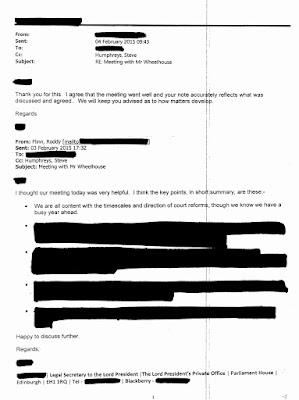
The heavily censored documents - disclosed in response to the FOI request, reads as follows:

From: [Censored] Sent: 04 February 2015 09:43 To: [Censored] CC: Humphreys, Steve Subject RE: Meeting with Mr Wheelhouse

Thank you for this. I agree that the meeting went well and your note accurately reflects what was discussed and agreed.. We will keep you advised as to how matters develop.

Regards, [Censored]

From: Flinn, Roddy Sent: 03 February 2015 17:32 To: [Censored] Cc: Humphreys, Steve Subject: Meeting with Mr Wheelhouse

I thought our meeting today was very helpful. I think the key points, in short summary, are these:-

We are all content with the timescales and direction of court reform, though we know we have a busy year ahead.

[Censored] [Censored] [Censored] [Censored]

Happy to discuss further, Roddy Flinn, Legal Secretary to the Lord President, The Lord President's Private Office

Both the Scottish Government and Judiciary of Scotland are already on the record in opposing the proposal to create a publicly available register  – which would see members of the public, court users, lawyers and the media all able to check out the vast wealth and connections of Scotland’s mega powerful, mega rich judges.

Scotland’s now former top judge Lord Gill refused several invitations to attend the Scottish Parliament and give evidence to MSPs, and Legal Affairs Minister Paul Wheelhouse - who also attended the secret meeting – was recently accused of misleading msps in an earlier evidence session at Holyrood held in December 2014.

The Scottish Government have now said it is not in the public interest for their ‘high quality policy and decision making’ private discussions with the judiciary on joint efforts to shut down debate around making the judiciary more transparency - to be revealed.

Jan Marshal - Deputy Director of the Justice Directorate, for the Scottish Government said: “An exemption under section 29(1)(a) of FOISA (formulation or development of government policy) applies to some of the information requested because it relates to the formulation of the Scottish Government's policy on a range of issues including a register of judicial interests.

This exemption is subject to the 'public interest test'. Therefore, taking account of all the circumstances of this case, we have considered if the public interest in disclosing the information outweighs the public interest in applying the exemption.

We have found that, on balance, the public interest lies in favour of upholding the exemption. We recognise that there is a public interest in disclosing information as part of open, transparent and accountable government, and to inform public debate.

However, there is a greater public interest in high quality policy and decision-making, and in the properly considered implementation and development of policies and decisions.

This means that officials need to be able to consider all available options and to debate those rigorously, to fully understand their possible implications.

Their candour in doing so will be affected by their assessment of whether the discussions on the issues will be disclosed in the near future, when it may undermine or constrain the Government's view on that policy while lit is still under discussion and development”

The move by the Scottish Government to keep their discussions with Lord Gill secret comes after First Minister Nicola Sturgeon personally intervened in the petition, earlier in March, reported here: INTERESTS INTERVENE: First Minister joins top judge in bid to block register of judicial interests

The First Minister also repeated claims made by Lord President Lord Brian Gill (73) - who accused “aggressive media” and  court users in an attempt to thwart the Scottish Parliament probe into why judges are so secretive about their vast wealth and connections.

However, neither the First Minister or Paul Wheelhouse revealed any details of what took place at the meeting to MSPs who are investigating calls to create a register of interests for judges.

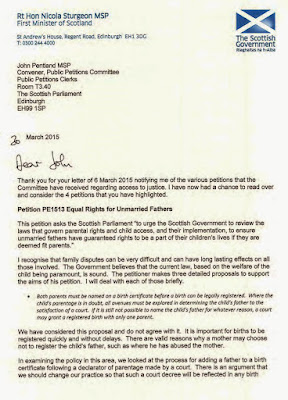
Writing in the letter to John Pentland MSP, Convener of the Public Petitions Committee, First Minister Nicola Sturgeon said: “This petition calls on the Scottish Government to create a Register of Interests for the Judiciary. The Scottish Government considers that such a register of judicial interests is not necessary and that the existing safeguards - the Judicial Oath, the Statement of Principles of Judicial Ethics and the system for complaints against the judiciary - are sufficient. These safeguards, together with the register of judicial recusals, are sufficient to protect individuals from judicial bias.”

“Further to the evidence that the Minister for Community Safety and Legal Affairs, Mr Wheelhouse, gave to the Committee on 9 December 2014, he discussed this petition when he met the Lord President in February. The Minister acknowledged the Lord President's concerns about the introduction of a register of judicial interests. The breadth of such a register would make it virtually unworkable. It would need to cover not only financial interests, but also memberships of groups and associations and familial and social relationships. Even so, such a register might not capture relevant issues that could arise.”

“The position of the judiciary is different from that of MSPs and others who hold public office. The judiciary cannot publicly defend themselves. The Lord President has cautioned that such a register could also have unintended consequences. Consideration requires to be given to judges' privacy and freedom from harassment by aggressive media or hostile individuals, including dissatisfied litigants. In addition, there is currently no evidence that judges who should have recused themselves from cases have not done so.”

The judicial transparency proposals - under investigation by MSPs since January 2013 - call for the creation of a single independently regulated register of interests containing information on judges backgrounds, their personal wealth, undeclared earnings, business & family connections inside & outside of the legal profession, offshore investments, hospitality, details on recusals and other information routinely lodged in registers of interest across all walks of public life in the UK and around the world.

The petition has cross party support from msps who backed a motion urging the Scottish Government to create a register of judicial interests at Holyrood on 7 October 2014 - reported along with video footage and the official record, here: Debating the Judges.

Previous articles on the lack of transparency within Scotland’s judiciary, investigations by Diary of Injustice including reports from the media, and video footage of debates at the Scottish Parliament’s Public Petitions Committee can be found here : A Register of Interests for Scotland's Judiciary

Friday, June 12, 2015

LORD CASHVOCATE: Proceeds of Crime figures ‘now part of manipulated crime stats’ as figures reveal crooks receive more in legal aid than Crown Office takes in Cashback for Communities

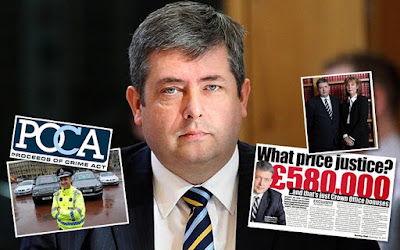
Cashback for Communities eclipsed by legal aid to crooks. A RECENT Public Relations campaign by Scotland’s Crown Office & Procurator Fiscal Service (COPFS) to promote cash taken from criminals via the Proceeds of Crime Act (POCA) - has been blown out the water after it emerged convicted crooks are costing taxpayers more than what prosecutors claim is returned to communities in asset seizures.

Today, the Scottish Legal Aid Board have revealed yet another convicted criminal who recently featured in publicity surrounding cash seizures from crooks – actually received more in publicly funded legal aid for his defence - than amounts of crime cash prosecutors claimed he had been ordered by the courts to repay.

Information released in response to a Freedom of Information request revealed Margaret Paterson – the Edinburgh madam who made a fortune running a £1.2m prostitution racket and was hit with a crime cash payback order for £1million  – actually received £144,802.50 taxpayer funded legal aid.

Her business partner – Robert Munro – who was hit with a crime cash payback order for £96,836 – received £147,370.12 of taxpayer funded legal aid – leaving public coffers £50K out of pocket

However, the true costs to taxpayers of the two cases referred to by the Legal Aid Board today may be significantly higher – according to a legal aid insider who told DOI earlier today: “factoring in legal aid, Crown Office legal fees, administration and court time, prosecution in the cases referred to are clearly over the £1million mark, so, there is in effect no cash back to communities from these cases.”

He described Proceeds of Crime figures as “little more than a myth which does not stand up to scrutiny when unbiased accounting is applied.”

The reality of Proceeds of Crime statistics and figures run counter to Press Releases and comments issued by Crown Office stars such as Lindsey Miller, Procurator Fiscal for Organised Crime and Counter Terrorism – who claimed after the court hearing on Munro & Patterson: "Today we have removed a vast amount of criminal earnings from organised crime groups operating right across Scotland.”

Miller went on to say: "These cases show the tenacity of law enforcement and prosecutors in pursuing the thing that is most important to criminals – their money.

In a Press Release from Police Scotland after the Proceeds of Crime orders against Paterson & Munro, Detective Chief Inspector Kenny Gray said: "These Confiscation Orders are some of the largest in Police Scotland's history and they send out a very clear message to organised criminals everywhere that we will do everything in our power to ensure they do not benefit from illegal gains.”

However, with legal aid, costs of prosecutions and huge salaries of Crown Office admin & prosecutors, legal insiders are in little doubt regular announcements of Proceeds of Crime cash seizures now form part of manipulated crime statistics published by politicians in attempts to justify billions of pounds spent on what has become a justice industry for lawyers, prosecutors and the courts.

Other cases where Proceeds of Crime figures have fallen far short of reality have also emerged - such as jailed tax cheat Michael Voudouri.

Voudori, who fled to Cyprus in 2012 after admitting his guilt in an £11.6 million money laundering scam – claimed VAT on bogus transactions in what judges described as a "complex money laundering operation", moving the money out of the country into foreign bank accounts.

He set up companies in the US and the British Virgin Islands to conceal the funds, before funnelling them back to Scotland to buy a house and fund a designer clothes business in Stirling.

Voudouri was eventually extradited back to Scotland where he is now in jail. He was also hit with a £207K Proceeds of Crime order in May 2015.

However, it was revealed Michael Voudouri has cost taxpayers over £600K in publicly funded legal aid.

Figures obtained from the Scottish Legal Aid Board (SLAB) revealed legal teams working for Voudouri have been paid £509,000 since 2009 and £79,000 was handed out for his 2004 trial. The sums are almost certain to rise as further costs are still to be added.

SLAB said the money was paid out to his defence team and for lawyers’ expenses. A spokesman said: “When Michael Voudouri’s legal aid was granted, the courts decided whether to grant legal aid for applicants being seen in the High Court or by a sheriff sitting with a jury.

“Responsibility for granting legal aid for these matters transferred to SLAB in November 2010 and we apply stringent tests which assess whether the applicant is financially eligible.”

The costs of Voudouri’s legal aid - on top of huge  costs of prosecution, investigation, and extradition from Cyprus back to Scotland of well over £2 million – leaves Prosecutors little to brag about if the true figure of bringing him to justice ever became known.

Proceeds of Crime figures regularly presented by Scotland’s top legal officers to the public as ‘crime successes’ do not add up, and are now beginning to anger even some in the crime fighting camp such as hard up budget strapped cops - who do all the leg work investigating & apprehending crooks - only to see big time prosecutions of major criminals hawked away in plea bargains and carefully spun out press releases presented by overpaid prosecutors on £100K + a year to a duped public.

Earlier this year, amid concern from Scotland’s top cops they were not seeing any of the supposed millions confiscated by the Crown Office, Police Scotland announced it was seeking £16 million over the next two years from the money recovered under the Proceeds of Crime Act (Poca) to help plug its funding gap for the next two years.

Police Scotland is facing shortfalls in its budget because of delays in receiving cash under proceeds of crime (Poca) legislation.

Chief Constable Sir Stephen House told members of the Scottish Police Authority (SPA) in February that in many cases there was a "degradation" of value in the assets actually handed on.

He described the amount received by the force as "disappointing"

However, Police Scotland’s bid for £16m over two years roughly matches the entire current income from POCA which saw a drop in takings during 2013-14, receipts totalled £8m, down from £12m the year previously.

The Crown Office have offered no comment on how Proceeds of Crime figures are currently presented to the public and the media.