Tuesday, July 02, 2013

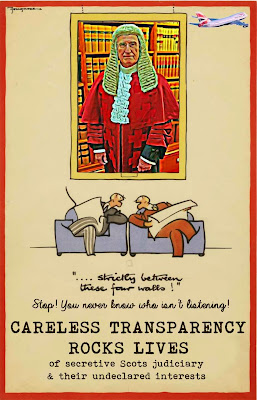
Anti-transparency top judge 'should reconsider his position on Scotland Act' as MSPs invite Judicial Investigator to give evidence on register of judicial interests

Scottish Parliament will hear evidence on register of judge’s interests after summer recess. MSPs from the Scottish Parliament’s Public Petitions Committee made it clear at last Tuesday’s committee meeting they still want to hear from Scotland’s top judge, Lord President Lord Brian Gill who has so far been reluctant to attend Holyrood to discuss issues of judicial transparency raised in Petition PE1458: Register of Interests for members of Scotland's judiciary.

The move by members of the Petitions Committee who have also decided to hear evidence in public sessions from the Judicial Complaints Reviewer (JCR), Moi Ali, comes  after the Lord President refused to appear before MSPs to explain his vociferous opposition to the proposal seeking to create greater transparency in the judiciary.

During last Tuesday’s meeting at Holyrood, Chic Brodie MSP, the Deputy Convener of the Petitions Committee spoke on the issues of transparency in relation Lord Gill’s refusals to accept invitations from the Petitions Committee to attend the Parliament and speak on the matter.

Chic Brodie said : “We are looking for openness and transparency, but the Lord President has chosen not to attend to explain why there should not be a register of interests for judges, as there is for members of Parliament, members of the Scottish Police Authority and so on.”

The Deputy Convener also drew attention to the fact that Lord Gill was being selective in which Parliamentary Committees he attends.

Mr Brodie said : “I recently attended the Justice Committee to talk about changes to the Scottish Court Service; it is somewhat paradoxical that the Lord President was happy to go along to that committee to explain?or not to explain, as the case may be?the rationale behind those changes.

Commenting further on Lord Gill’s terse opposition to the petition and refusal to provide answers to questions from members of the Petitions Committee, MSP Jackson Carlaw said : “Lord Gill’s response, which took us to something of an impasse from our point of view, was, “It’s not happening down south, and neither I nor anybody else has any intention of doing it, so get your tanks off my vested-interest lawn.”

Mr Carlaw also agreed that the Judicial Complaints Reviewer, Moi Ali, be invited to attend an evidence session to speak to MSPs on the merits of a register of interests for the judiciary.

Agreeing with Jackson Carlaw, John Wilson MSP also raised the possibility Lord Gill should reconsider his earlier refusals to attend the Petitions Committee after MSPs have heard from Moi Ali.

Mr Wilson went on to comment on the Lord President’s position regarding the Scotland Act, pointing out the issues being dealt with in the petition did not relate to decisions taken by judges in court, rather it related to the administration of the judiciary where it is the position of the petitioner that Parliament should have the right to speak to judges on these subjects.

John Wilson MSP said : “I hope that, once we have heard that evidence, Lord Gill might reconsider his position in relation to section 23(7) of the Scotland Act 1998. Basically, my interpretation is that Parliament and its committees cannot call judges or sheriffs to give evidence on and to be accountable for judicial decisions that they have made, but the petitioner’s main point is that we should hear from Lord Gill in his role as the Lord President, which involves overseeing the judiciary.”

The discussion on Petition 1458 drew to a close with the Committee agreeing to invite the Judicial Complaints Reviewer to give evidence at a future meeting. The Committee also agreed to write to Dr Kennedy Graham MP of the New Zealand Green party. Dr Graham’s bill for a Register of Pecuniary Interests of Judges in New Zealand, helped in-part inspire Petition 1458.

Judicial Complaints Reviewer Moi Ali has already voiced her support for the proposal in a letter to MSPs, reported by Diary of Injustice here : ‘Better Transparency would enhance Judiciary’ as Scotland’s independent Judicial Complaints Reviewer issues support for Register of interests for judges

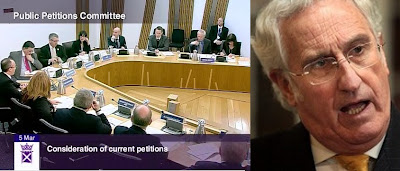
Full video coverage & transcript of the Public Petitions Committee’s discussion of Petition 1458 :

Petition 1458 Register of Interests for Scottish Judiciary 25 June 2013 Scottish Parliament (Click image to watch video)

Judiciary (Register of Interests) (PE1458)

Chic Brodie MSP (Deputy Convener) : PE1458 is on a register of interests for members of the judiciary. Recommendations for action that the committee might wish to take are included in the papers. One is to invite Moi Ali, the Judicial Complaints Reviewer, to give evidence to the committee at a future meeting. We could also take any other action that we consider appropriate.

Before I make any personal comment, I seek the views of members of the committee.

Previously, the committee decided that there was no further purpose in pursuing the Lord President. I pointed out that the Government appointed JCR had particularly strong views on the matter and said that, although the Lord President wants to talk only about the constitutional principle, that principle needs to be seen in the light of potential constitutional changes. The view was that we should seek to close off the petition with the Lord President.

However, I certainly recommend that we get Moi Ali in here to hear her views.

Jackson Carlaw MSP: I agree. I thought that we had reached something of an impasse. When I saw the support for the proposal from the Judicial Complaints Reviewer?an appointment that was established under the Judiciary and Courts (Scotland) Act 2008?I felt that, given that the weight of evidence so far from the establishment has been of one colour, it would be interesting to hear why the Judicial Complaints Reviewer takes a different view.

Malcolm Chisholm MSP: I have not been involved in the petition, so I would really like to ask a question. I have read Lord Gill’s view of judicial independence in relation to attending the committee and answering questions. Are his and others’ objections to the register based on the same principle of judicial independence, or are they not really to do with that at all? I do not know whether anyone can answer that, but it seems to me that the petition raises interesting general questions about  the line between judicial independence and accountability and political oversight. In part, that relates to an issue about judicial independence that I raised in last week’s debate in Parliament on the Victims and Witnesses (Scotland) Bill. I am curious about the issue.

Chic Brodie MSP (Deputy Convener):  The view that was taken was that there are other mechanisms and checks and balances, such as recusal, that secure the independence of the judiciary without exposing judges to what would be seen as a breach of the Scotland Act 1998 in performing their role.

Malcolm Chisholm MSP:  So the issue is about a register that would affect judicial independence, rather than just about the Lord President appearing here to answer questions. Is that what you are saying?

Chic Brodie MSP (Deputy Convener): That is the difficulty and the reason why we are struggling. We are looking for openness and transparency, but the Lord President has chosen not to attend to explain why there should not be a register of interests for judges, as there is for members of Parliament, members of the Scottish Police Authority and so on. That is his view.

Jackson Carlaw MSP:  Lord Gill’s response, which took us to something of an impasse from our point of view, was, “It’s not happening down south, and neither I nor anybody else has  any intention of doing it, so get your tanks off my vested-interest lawn.” We were unable to find a way to break through that, but the information that we have received from the Judicial Complaints Reviewer potentially offers us an interesting extension of  the discussion. However, I do not think that the issue that the petitioner raised has ever been properly and fully addressed, beyond the Lord President saying that he does not think that a register is necessary and, surprisingly, neither does anybody else who is currently employed in the profession.

John Wilson MSP:  I agree with Jackson Carlaw. Given the interesting comments in the response from the Judicial Complaints Reviewer, it would serve a purpose to invite her to give evidence to the committee. I hope that, once we have heard that evidence, Lord Gill might reconsider his position in relation to section 23(7) of the Scotland Act 1998. Basically, my interpretation is that Parliament and its committees cannot call judges or sheriffs to give evidence on and  to be accountable for judicial decisions that they have made, but the petitioner’s main point is that we should hear from Lord Gill in his role as the Lord President, which involves overseeing the judiciary.

I hope that Lord Gill might reconsider his position in the light of the fact that we are to take further evidence. I hope that that evidence will draw out other issues that are relevant to our deliberations. I support Jackson Carlaw’s suggestion to take evidence from the Judicial Complaints Reviewer.

Chic Brodie MSP (Deputy Convener):  Okay. We will invite Moi Ali to give evidence.

I recently attended the Justice Committee to talk about changes to the Scottish Court Service; it is somewhat paradoxical that the Lord President was happy to go along to that committee to explain?or not to explain, as the case may be?the rationale behind those changes.

Do members have any other comments?

Jim Eadie MSP:  I just want to reinforce Mr Carlaw’s and Mr Wilson’s points. Notwithstanding the points that the Lord President made in his letter to the convener that judges cannot be compelled under the Scotland Act 1998 to appear before committees of the Parliament, I note the statement in that letter that“a register of interests for the judiciary is both unnecessary and unworkable.”

It would  have been beneficial if the committee had been able to hear oral evidence from the Lord President about why he thinks that that is the case. Like John Wilson, I hope that the Lord President will reconsider that. However, I certainly endorse the view that we should hear further evidence from other expert witnesses.

Angus MacDonald MSP:  I draw the committee’s attention to the petitioner’s letter, in which he asks the committee to approach a Green Party member of the New Zealand Parliament, Dr Kennedy Graham, who  is currently putting his Register of Pecuniary Interests of Judges Bill through that Parliament. We could approach Dr Graham to ask for his views.

Chic Brodie MSP (Deputy Convener):  We can e-mail Dr Graham, but we will need to ask him very specific questions. I do not think that there is any harm in that but, as the clerk has just pointed out to me and as the correspondence makes clear, the suggestion is that the New Zealand Government is intending to move in the direction of recusal. Should I formulate some questions and just zap them around everyone?

Angus MacDonald:  That would be fine, convener.

Jim Eadie MSP: I do not think that we should rule out a future evidence session involving experts from furth of Scotland. When the Health and Sport Committee considered minimum unit pricing of alcohol, it benefited greatly from evidence from Canadian experts?notwithstanding the time difference between the two countries.

Chic Brodie MSP (Deputy Convener): I thought that you were going to suggest that we go out there to speak to them.We have covered the position.

Petition PE1458: Register of Interests for members of Scotland's judiciary filed by law journalist Peter Cherbi calls on the Scottish Parliament to legislate for a requirement that all members of the Judiciary in Scotland to submit their interests & hospitality received to a publicly available Register of Interests.

Previous articles from Diary of Injustice including video footage of the Petitions Committee meetings and further information on the drive to create a register of interests for Scotland’s judiciary can be viewed here : A Register of Interests for Scotland's Judiciary

Sunday, June 30, 2013

GESTURE MOTION : Law Society face claims ‘banned’ rogue lawyer was hidden by legal colleague to dodge Court of Session interdict hearing

Law Society fails to sniff out rogue lawyerLaw Society ‘knew’ banned rogue lawyer was being hidden by legal colleague. SEVEN MONTHS after the Law Society of Scotland claimed in court they could not serve court papers on a well known rogue solicitor because he had disappeared from public view, it has emerged the lawyers self regulator knew all along where their colleague was hiding out – in the posh house of another solicitor who works for a Glasgow based law firm.

Last October, the Law Society of Scotland told the Court of Session the now former solicitor John G O’Donnell was “nowhere to be seen” and this was making it difficult for the regulator to serve him with a banning order forbidding him from posing as a solicitor.

However, even as the Law Society told the Court of Session they could not find the rogue solicitor, journalists quickly located O’Donnell’s posh hideout in Glasgow, that of a house owned by a currently working solicitor linked to O’Donnell, and known to the Law Society of Scotland.

Speaking to Diary of Injustice last week, a legal insider described last October’s hearing at the Court of Session as “a sham” after it became apparent senior figures at the Law Society of Scotland knew exactly where O’Donnell was even though the judge was told otherwise.

The hurried attempts by the Law Society to act on the negative publicity, culminating in the action at the Court of Session last year only came about after further investigations by the Sunday Mail newspaper revealed O’Donnell had been involved in a scam where people desperately in need of legal assistance were sent to him by ‘would-be solicitors’ who worked for Hamilton Citizens Advice Bureau.

In a particularly shocking case, the Sunday Mail revealed O’Donnell had among over victims, targeted elderly widow Elizabeth Campbell. Papers obtained by the newspaper revealed that Gilbert S Anderson who worked as an ‘In-Court adviser for Hamilton Citizens Advice Bureau had sent Mrs Campbell to O’Donnell, who was posing as deceased solicitor Colin Anderson.

It was also revealed the Hamilton Citizens Advice worker sent the rogue solicitor a handwritten note saying “possibly in my mind a cash for Colin £3000” indicating he hoped O’Donnell would be able to scam plenty of cash from the elderly widow. Diary of Injustice reported on the case involving John O’Donnell & Gilbert Anderson, here : Crooked lawyer impersonates DEAD COLLEAGUE to lure clients in fraud scam as Law Society of Scotland’s self regulation of solicitors fails yet again

Of particular interest to the current case against O’Donnell is that Elaine Motion QC of Balfour & Manson who is currently representing the Law Society of Scotland in the Court of Session against John G O’Donnell, has previously represented the Law Society against O’Donnell at hearings before the Scottish Solicitors Discipline Tribunal.

Legal observers following the O’Donnell saga have drawn attention to the fact that during one earlier attempt to prosecute O’Donnell before the SSDT, legal representatives of the rogue lawyer tried to broker a secret deal with the QC at a Law Society Christmas party in 2009.

A ‘limited account’ of the 2009 Christmas party meeting between QC Elaine Motion & solicitor Steven Gold who acted for O’Donnell, was reported in the Tribunal's hearing into one of the complaints against O’Donnell, which is published online here Council of the Law Society of Scotland v John G O'Donnell and reprinted below as an example of double dealing behind the closed doors of self regulation of Scottish solicitors.

Law Society of ScotlandLaw Society’s 2009 Christmas party was scene of deal to save O’Donnell from disciplinary moves. Page three of the Council of the Law Society of Scotland v John G O'Donnell states : “In December 2009, Elaine Motion and Steven Gold, Solicitor were both at a Law Society’s Christmas Drinks Party. They were involved in a conversation with regard to the health and welfare of the Respondent. Mr Gold made representations on behalf of the Respondent to Elaine Motion to the effect that it would be humane and advantageous to everyone involved if a way could be found to allow the Respondent to hand in his practising certificate without having to undergo the ordeal and expense of an appearance before the Tribunal. Elaine Motion was sympathetic to the representations but indicated that she would require to discuss matters with the Law Society of Scotland who would make the decision. There was no undertaking given at this meeting to Steven Gold that if the Scottish Solicitors’ Discipline Tribunal struck the Respondent’s name from the Roll of Solicitors in Scotland no further Complaints would be brought against the Respondent and no undertaking was given that if the Respondent accepted pleas of guilty to the outstanding Complaint, no further proceedings would be brought against him.”

So far, the Lord Advocate & Scotland’s Crown Office & Procurator Fiscal Service (COPFS) have apparently refused to become involved in the case, instead preferring the matter remain a one for lawyers looking after their own.

However, with claims surfacing from individuals that O’Donnell has undertaken new ‘legal work’ since last October’s court hearings, there are serious questions over the resolve of the Law Society to make an example of O’Donnell and many other rogue lawyers who escape any penalty or prosecution for their sharp practices against vulnerable clients in Scotland.

If you are a victim of rogue solicitor John G O’Donnell, tell us more about your case and any dealings with him by contacting us at scottishlawreporters@gmail.com

The Sunday Mail’s report of last October on the O’Donnell case :

Banned lawyer faces new court date - Sunday Mail Oct 28 2012BANNED LAWYER FACES NEW COURT DATE

A rogue lawyer is being hunted by watchdogs so they can tell him he's banned - again.

John O'Donnell, 62, has been accused of breaching a ban on working as a solicitor following a Sunday Mail probe.

The Law Society of Scotland's Elaine Motion is trying to take him to court but does not know where he is.

O'Donnell has been repeatedly rapped for professional misconduct and negligence.

The Law Society won an interim interdict at the Court of Session Edinburgh three years ago, banning him from posing as a solicitor. Six Months ago, we revealed that O'Donnell was allegedly using another lawyer's identity to beat the ban.

That prompted the Law Society to take action against him for flouting the interdict.

One source said : "The problem is that he's nowhere to be seen and does not appear keen to make himself available."

The Law Society said : "John O'Donnell does not hold a current practising certificate and therefore cannot practise as a solicitor in Scotland.

"The Law Society applied to the court to serve notice - by way of an advertisement in the press - of an alleged breach of an interim interdict."

"The Interim Interdict included an order preventing Mr O'Donnell from holding himself out as entitled by law to practise as a solicitor."

"The application to service a notice was granted by the court on October 16"

Monday, June 24, 2013

One year as Lord President, little change in Scotland’s courts as top judge fights on against register of judicial interests transparency proposal

Courts remain a mess, transparency not for us says top judge. ONE YEAR ON from being appointed as the country’s top judge, the reality is that few in the way of productive changes to help Scots access justice have occurred in the courts ruled over by Lord Brian Gill, Scotland’s Lord President of the Court of Session.

A year ago this month, Brian Gill was elevated from his former position of Lord Justice Clerk, to succeed the media savvy Lord Arthur Campbell Hamilton who served as Lord Justice General & Lord President from November 2005 to June 2012.

While publicly priding himself in putting on the air miles as Scotland’s top judge, flying around the globe on “diplomatic” commitments representing the Scottish judiciary in destinations from Uganda to Taiwan, little of the civil justice reforms Brian Gill called for as author of the Scottish Civil Courts Review have so-far made it to Scotland’s justice system, and those that have, have inevitably been watered down to an almost ineffectual state.

More worryingly, in spite of a continuing stream of questions surrounding the integrity of Scotland Prosecution Service, the Crown Office & Procurator Fiscal Service (COPFS), and numerous failures in his own Scottish Court Service which have contributed to Civil cases needlessly dragging on for decades in Scotland’s courts, little criticism has come from the top. This lack of top down discipline has seemingly allowing Prosecutors a free hand to botch up case after case, and even shred files before MSPs could request sight of them, while some Court of Session senators have allowed personal weakness, bias and even vitriol to creep into opinion after opinion.

The current unwillingness of the Commander in Chief of our Courts to bring the system into line with public expectation of justice, and more importantly fairness, compares strangely with previous examples where the integrity of the justice system was at stake, for example, when Lord Gill’s predecessor clashed with a former Lord Advocate over the collapse of the World’s End murder trial.

Willing to tackle an institution recently dubbed “institutionally corrupt”, Lord Hamilton as Lord President wasted no time publicly castigating the Crown Office, accusing it’s then Lord Advocate Elish Angiolini (nee McPhilomy) of attacking the independence and reputation of the judiciary after Angiolini directly addressed the Scottish Parliament stating she was disappointed with the trial judge Lord Clarke’s ruling  there was insufficient evidence for the jury to convict and threw the case out.

As matters stand one year on, this Lord President has so far, remained almost mute in publicly combating what many perceive as the vested interests of the current legal establishment, who appear to be more interested in the continuing disruption to access to justice rather than it’s expansion to serve all Scots instead of those selected on a whim by the legal profession.

Of much concern currently, is Lord Gill’s hostility towards proposals put before MSPs at the Scottish Parliament to create a statutory register of interests for Scotland’s Judiciary.

As has been widely reported in the media, by the Sunday Mail newspaper and others, and by Diary of Injustice, Lord Gill has now twice refused to attend the Scottish Parliament to give evidence on, and answer questions in public relating to the so-far hidden, undeclared interests of Scotland’s judges.

Lord Gill has taken the fight against transparency to the extremes, refusing to provide detailed, analytical evidence on how judges have (or have not) recused themselves over the years, and in what circumstances these recusals took place, in response to repeated written requests from MSPs.

The Lord President has gone so far as to cast an EU report in the face of Holyrood, as an excuse for refusing to attend the Public Petitions Committee and has alleged any attempt to require judges to disclose their hidden wealth along with other interests, would compromise the independence of the judiciary. Yet bizarrely, with his conviction set against openness, Lord Gill apparently feels he cannot answer questions in public about this same EU report he has used in his defence.

Could Lord Gill’s refusal to answer questions in public on the very evidence he puts forward for doing nothing on a register of judicial interests be because his EU report was written by retired judges who themselves have a vested interest in not creating a register of interests for the judiciary?

Tomorrow, Tuesday 25 June, MSPs at the Scottish Parliament will again discuss Petition PE1458: Register of Interests for members of Scotland's judiciary which calls on the Scottish Parliament to legislate for a requirement that all members of the Judiciary in Scotland to submit their interests & hospitality received to a publicly available Register of Interests

In a response provided to the Public Petitions Committee, MSPs have been asked to arrange evidence sessions on the petition as has previously been suggested by Committee members, and would welcome others joining the debate, be they members of Consumer Protection organisations, the Scottish Government, the Judicial Complaints Reviewer, the Law Society of Scotland, the Faculty of Advocates, the Lord Advocate and representatives of the media who might wish to participate in public evidence sessions.

Previous reports from Diary of Injustice including video footage of previous Petitions Committee meetings and further information on the drive to create a register of interests for Scotland’s judiciary can be viewed here : A Register of Interests for Scotland's Judiciary

Friday, June 21, 2013

Naming & Shaming powers 'reserved' : Consumers still in the dark on crooked lawyers as identities of rogue solicitors & law firms yet to be published by Legal Ombudsman

Legal OmbudsmanMuch promised Naming & shaming of rogue lawyers yet to happen in England & Wales MORE THAN TWO YEARS after much debate and numerous consultations which received widespread support from consumer groups and the Office of Fair Trading (OFT) for the Legal Ombudsman (LeO) of England & Wales to name & shame rogue solicitors & law firms in published complaints data, the policy decision taken by the LeO in April 2012 to publish the identities of lawyers involved in client complaints, has not yet resulted in publication of a single solicitor or law firm’s identity.

Shedding some light on the lack of publication of lawyer’s names to-date, the latest annual report covering 2012-1013 from the Legal Ombudsman states “In one of the key decisions taken during the year related to the publication of the statistics about ombudsman decisions. While there was general agreement that it was desirable for us to publish as much information about the nature of our decisions as possible, lawyers’ representatives were strongly opposed to naming the lawyers involved. Consumer groups on the other hand argued for as much information as possible about lawyers involved in our cases to be placed in the public domain.”

“In the event, following a lengthy consultation process, our board decided that statistical data about all ombudsman decisions should be published, including the area of law, the nature of the complaint, the outcome of the complaint and the name of the lawyer or firm involved. We began publishing this data from autumn 2012. The initial media interest which this engendered has rapidly subsided and as the information builds, we may soon be able to begin discerning some patterns over time.”

“As well as the routine publication of data, the board decided to reserve to itself the power in individual cases to publish the full decision, including the name of the lawyer (but redacting the name of the complainant) where it considers that it is in the public interest to do so. No such publication took place during the year covered by this report.”

However, many consumers and some consumer protection groups had expected the LeO to begin publishing the identities of rogue solicitors and their law firms last year.

Speaking to Diary of Injustice nearly a year ago last July 2012 Chief Ombudsman, Adam Sampson said at the time : “Our Board wanted to ensure that we’re certain about the accuracy of the data we report in the first data set of published Ombudsman decisions and that the lawyers and law firms who’ll be named have an opportunity to point out any discrepancies prior to publication.

“As a result, and on this occasion only, we have this week contacted each of the 750+ lawyers and law firms that have been the subject of our decisions during the first quarter to tell them what we’ll publish. We will then deal with any feedback, where required, in the weeks that follow before publishing the data. The level of feedback and subsequent work needed following this process will determine how soon we can publish the first set of data.”

The Legal Ombudsman had originally announced in November 2011 they would be going ahead with ‘naming & shaming’ in early 2012, reported by Diary of Injustice here : Scots to be ‘kept in dark’ on details of crooked lawyers while Legal Ombudsman’s ‘naming & shaming’ policy ‘will protect’ consumers in England & Wales

Diary of Injustice reported on the Legal Ombudsman’s consultation on naming & shaming here : Legal Ombudsman moving to name & shame crooked lawyers in England & Wales, crooked Scottish solicitors records to remain protected by secrecy for now

Which logoConsumer group Which? gave their backing to the Legal Ombudsman’s plans to identify crooked lawyers in England & Wales. A spokesperson for Which? told Diary of Injustice last year : “Which? strongly supports the principle of the LeO publishing complaints data under a strict and published policy , including in some circumstances the name of the law firm concerned. We set out our position in our response to the LeO consultation (page 51: opening up regulatory data)) pointing out that it is the expectation of Government that complaints handling bodies are as transparent as possible.”

Legal Services Consumer PanelSpeaking on the LeO’s plans to publish complaints data & the identities of law firms who perform poorly for clients, Elisabeth Davies, Chair of the Legal Services Consumer Panel (LSCP), said at the time : “Research shows that UK consumers are now leaving well over 100 million comments online every year about their experience with businesses across the economy. Lawyers cannot escape this welcome emergence of consumer power, but instead should seek and then use such feedback to improve the service they offer.

She continued : “The courts will decide the fate of the Solicitors From Hell website. However, such websites fill a vacuum that exists because official complaints data about lawyers is not publically available to help consumers identify good quality lawyers. The Panel will continue to push the Legal Ombudsman to name those law firms who regularly provide poor service.”

oftThe Office of Fair Trading (OFT) also supports the Legal Ombudsman’s naming & shaming policy. The OFT stated in its submission (pdf) to the LeO’s consultation : “We appreciate that you need to balance the interests of consumers with the reputational impact on firms and individual lawyers. However, the OFT remains firmly of the view that the publication of named complaints data could incentivise legal service providers, due to reputational considerations, to maintain and/or improve the quality of service they provide to consumers.We believe that essential data would include:

* The number of complaints made against individual firms and lawyers;
* The nature of those complaints and placing them into categories to help see if a pattern develops;
* The ratio of complaints upheld against an individual firm or lawyer;
* Areas of law where complaints tend to focus;
* Which aspects of service the complaints tend to focus; and
* Whether the complaints tend to come from private or publically funded cases.

However, to-date, no solicitor has yet been named by the LeO, prompting fears in some quarters that protests from the legal profession and alleged murmurs of potential legal action by English lawyers if their names appear in complaints data, has put the brakes on total transparency.

Asked for comment today on lack of naming & shaming by the LeO, a spokesperson for the Legal Services Consumer Panel issued the following statement :

“Just to clarify that LeO publish two types of information: · Details of cases that involve a formal ombudsman decision · Individual cases where this is in the public interest test”

“In relation to the former, this information has been published for a while now. When LeO consulted on this, the Panel wanted all complaints involving a remedy (i.e. those that are mediated as well as ombudsman decisions) to be published. In addition, this information would benefit from having more prominence than it does currently.”

“In relation to the latter, as this is an emergency publication power, given the short period that it has been operational it’s difficult to know whether there have been circumstances when LeO hasn’t used these powers but should have. It would be better to assess this once the scheme has been operational for a longer period.”

For now, consumers are still in the dark over which solicitors & law firms fair better than others in complaints data. Exactly when the Legal Ombudsman does identify rogue lawyers and law firms remains to be decided.

Historically, the Scottish Legal Complaints Commission has refused to name any Scottish solicitors or law firms involved in complaints, citing reasons of confidentiality and the terms of the Legal Profession & Legal Aid (Scotland) Act 2007 for the prohibition of naming crooked lawyers in Scotland. It is not thought the SLCC in its current format will ever identify rogue lawyers.