Saturday, June 10, 2006

Banks copy lawyers tactics, excluding Consumers from financial services because they were caught ripping off Clients ...

Lets have a go at Banks today, for a change ... since they are one of the financial partners and sponsors of the legal profession not only in Scotland but throughout the UK ... and whenever Banks have a go at us - they always use lawyers of course !

In an alarming move, UK Banks have decided to copy the tactics of lawyers who face legal action from clients over stealing funds ... by closing clients accounts in a similar way to those who sue lawyers find themselves eventually unable to obtain any legal representation at all.

This move, by UK Banks, comes on the back of the growing number of customers who are using the courts to force Banks to repay exhorbitant penalties which the Banks have imposed over the years due to overdrafts or having what the Bank would deem as too little in their accounts to meet payments.

Since the Office of Fair Trading said that consumer law should only allow banks to recover actual costs, rather than also impose penalties on top of this ... consumers have begun either taking Banks to court, or threatening legal action to recover anything over £30 which the Banks have imposed on their borrowing.

Banks are responding by claiming that customers aren`t keeping their part of the bargain of using the Bank`s services by embarking on such a court of action ... but judge for yourselves by reading the following article from BBC News reporting on this matter.

We all know that Banks have loaded the charges against customers over the years - that`s one of the reasons that so many Banks are turning in billions of pounds of profits - because they are preying on the poor - and continue to load the charges on such customers who find themselves in many positions to be in an unrecoverable spiral of debt to Banks & other financial institutions.

Maybe it`s time for you to get out your bank statements and see exactly what penalties the Banks have imposed over your accounts for so many years - and if it`s anything over than £30 ... then it`s time to take action.

Make sure you also tell your neighbour and spread this story as much as possible - since the Banks and thier friends have been hitting the general public for so long .. it`s time to give them back some of their own medicine - by using the OFT`s own position against them.

Of course, the OFT will also have to do something about the Banks behaviour, which has seen them begin to copy the actions of the legal profession when a client either complains against a lawyer, or tries to sue a lawyer who has ruined them. Banks Banks, the legal profession and other financial institutions all share information on clients & consumers - and just as surely as consumers are excluded from obtaining legal services when they catch out a crooked lawyer, consumers who make life difficult for Banks by forcing them to to repay exhorbitant penalties will also face the prospect, as is reported in this BBC article, by being excluded from obtaining financial services in the UK or further afield.

Banks cannot be allowed to deny financial services to the masses - simply because they have been caught out ripping off clients to fatten their annual accounts and Directors salaries ... Peter Cherbi recommends you should all make representations to the OFT to get them to consider this issue and make policy to protect consumers from being excluded from the Banking & financial sector.

You can visit the OFT`s website at : http://www.oft.gov.uk/default.htm and you can also email the OFT at enquiries@oft.gsi.gov.uk

Please also contact your consumer organisations - such as the Scottish Consumer Council, who are at : http://www.scotconsumer.org.uk or the consumer association for England & Wales - at: http://www.which.net/

http://news.bbc.co.uk/2/hi/programmes/moneybox/5067454.stm

Banks fight back on court action
By Paul LewisBBC Radio 4's Money Box

More banks are fighting back against the growing number of consumers who are using the courts to force them to repay penalties.

The charges are made when customers go overdrawn or have too little in their accounts to meet payments but the Office of Fair Trading has said consumer law only allows the banks to recover their actual costs not impose a penalty as well.

Lawyers and consumer groups claim penalty charges of £30 or more break this law and some customers have got back thousands of pounds by threatening court action

Banks and building societies pay up rather than go to court but some - including Abbey and Nationwide - are now closing the accounts of customers who sue them.

Another, Alliance & Leicester, confirmed to BBC Radio 4's Money Box that it had already closed the accounts of dozens of customers who had taken similar steps.

"The cost of fighting the court case, of having the litigation... is not worthwhile" - Ginny Broad, A&L

Ginny Broad, its head of corporate communications, told the programme: "We are talking about people who are very happy to accept the benefits of the Alliance & Leicester current account but aren't happy to keep their side of the bargain, which is to run their account responsibly."

And she defended the practice of paying up then closing the account rather than going to court.

"The cost of fighting the court case, of having the litigation and so forth individually is not worthwhile... our charges reflect the overall level of costs... We believe [they] are both reasonable and lawful," she said.

But the campaign to recover charges is growing.

'Rule of law'

One bank customer, Robert, told the programme he had recovered more than £3,000.

"I went through about the last five years and added up all these bank charges... and was horrified to discover that it came to about £2,500," he said.

"Then I calculated the interest, and I wrote to the bank and said 'You owe me £3,000 give it back'. The bank said 'we will give you £2,000'. So I said 'No, I want it all'. They bottled out and settled in full - [a total of] £3,200."

"There are an enormous number of people who have massive difficulties... regularly having their accounts plundered" -
Marc Gander, Consumer Action Group - you can visit Consumer Action Group at http://www.consumeractiongroup.co.uk/

Marc Gander of the website Consumer Action Group said they are not exploiting a legal loophole just demanding their rights: "There is a very clear rule of law that says that the banks are only allowed to make certain charges."

"Once the charges start coming in and particularly if one is on a tight budget it is very difficult to stop the spiral.

"There are an enormous number of people who have massive difficulties, who are on benefits, and who are regularly having their accounts plundered by the banks with impunity.

"I really want to see honest treatment of people [and] a return to the rule of law."

BBC Radio 4's Money Box was broadcast on Saturday, 10 June 2006, and will be repeated on Sunday, 11 June at 2102 BST.

Articles fron the Consumer Association Website :
http://www.which.co.uk/news/money/06/may/banks-overdraft-06053101.html

Bank customers pay GBP 4.7 billion in penalties
31 May 2006
Which? hit the industry with an Anti-Social Banking OrderBanks and building societies hit their customers with GBP 4.7 billion worth of unauthorised overdraft charges in the last year.

The research, released by Which? today, reveals that current account providers are charging between GBP 20 and GBP 30 when a customer dips into the red, and GBP 25 to GBP 30 for standing orders or direct debits paid while that customer is over their overdraft limit.

In April, Which? slapped an Asbo - Anti-Social Banking Order - on current account providers and launched a banking charges website to help consumers challenge these charges and put pressure on the banks to reduce them.Barclays paid out

Since then, almost 30,000 have downloaded information and template letters from the site.

Matt Tones from Hertfordshire received GBP 800 from Barclays - twice the amount he paid in charges. He wrote to the bank using the standard letter on the website and Barclays said that while it didn't agree with him, it was offering him the money as a gesture of goodwill.

Doug Taylor, Which? money campaigner, said: 'Although Matt was very successful banks have remained, for the most part, resolutely silent on this issue in the hope that it will just go away. The sheer number of people downloading the template letters from our site shows that the banks can't ignore this issue for much longer.

'Many thousands of people are fed up with being made to pay unreasonable charges and are preparing to do something about it.'
The full report - 'Fight back against unfair bank charges' - appears in the June edition of Which? magazine.


http://www.which.net/campaigns/personalfinance/bankingcharges/index.html
'ASBO' for UKbanking sector

Which? has slapped an ASBO ? that's an Anti-Social Banking Order ? on current account providers for the way they treat customers using unauthorised overdrafts.

We're calling for the industry to take a new approach to the way consumers are charged when they slip into unauthorised overdraft.

We believe that consumers are suffering distress and alarm as a direct result of banks' actions, and we think they deserve an ASBO !

If you don't have an arranged overdraft facility and you dip into the red, or if you go over an agreed overdraft limit, you'll be using what banks call an 'unauthorised overdraft'.

If you don't have an arranged overdraft facility and you dip into the red, or if you go over an agreed overdraft limit, you'll be using what banks call an 'unauthorised overdraft'. While banks are providing a service to consumers who go into unauthorised overdraft, they're also raking in the cash ? to the tune of an astonishing £4.7billion in the last year (as reported in Which? magazine, June 2006).

That's because they slap massive charges and interest rates on accounts that are in the red ? even if the amount of the unauthorised overdraft is just a few pounds and is cleared quickly.

We think these charges are unfair and breach consumer credit regulations. They are disproportionate to the amount it actually costs the bank to deal with an account in the red. Indeed the decision of the Office of Fair Trading to set a £12 threshold on credit card default charges strengthens the pressure on banks to reform charges on current accounts. To set a fair charge, we have challenged the banks to open their books and explain how they calculate the amount.

A Which? survey has found that one in four people have used an unauthorised overdraft. Such a high volume of unauthorised overdraft users indicates that poor money management is not the cause ? slipping into unauthorised overdraft is more often than not a genuine mistake.

Dodgy practices

* Banks automatically charge (normally around £30) if you slip into unauthorised overdraft, even if the amount of the unauthorised overdraft is just a few pounds.

* Banks may charge a higher rate of interest on your unauthorised overdraft than they do on your regular, authorised overdraft. However, we have found that some banks charge the higher rate on the full amount you are overdrawn. For example, if you have an account with a £250 arranged overdraft and you accidentally go £1 over, you could be charged the higher unauthorised overdraft interest rate on the full overdraft of £251.

* If you slip into unauthorised overdraft you won’t just be charged for going into the red. You could also be charged a similar amount each time a transaction, direct debit or standing order goes through your account while you are in the red.

* Banks do not give you any grace period in which to pay off the amount of your unauthorised overdraft before they charge you.

Which? has written to the regulators calling for:

* The industry to stop applying exorbitant charges and interest rates to accounts in unauthorised overdrafts.

* The industry to stop charging unauthorised overdraft interest rates on the authorised part of the overdraft.

* The Banking Code to be tightened so that banks must give at least 14 days' notice of charges, allowing customers to put their accounts in the black.

As a consumer you may be able to recover charges made against you and at the same time send the banks and building societies a clear message about their activities.

Friday, June 09, 2006

Scottish lawyers resort to virtual terrorist tactics to blackmail more legal aid money from the Scottish taxpayer ...

Scottish lawyers are shocking and disgraceful ... and should be ashamed of themselves ... words from Jack McConnell .. the Scottish First Minister.

Well, Mr McConnell is of course, correct ..., and Peter Cherbi and the thousands of clients of Scottish lawyers who have known this and much more, for decades would agree too - so my message to Jack McConnel would be something like - put on the steam and get the Legal Profession & Legal Aid (Scotland) Bill through it`s stages with some more thought for the public rather than this gang of lawyers who have controlled reform of the legal system for so long in Scotland and have now sunk to virtual terrorist tactics to try and gain more loot for their merriement .. by threatening to allow the likes of sex offenders to go unpunished to get their wicked way with more of the taxpayers legal aid money to prop up their personal offices and spending habits .. which are still heavily subsidised by either embezzling client`s finds or ripping off and overcharging clients all over Scotland for shoddy work. 

Of course, this current boycott of sex cases by Scottish lawyers has to be viewed as part of the overall plan by the legal profession to resist ANY reform to their activities and business markets which lawyers have enjoyed for far too long in Scotland - unfettered by any form of proper independent regulation ... and with the upcoming planned reforms of the legal profession in the new "Legal Profession and Legal Aid (Scotland) Bill" .. which will introduce much higher fines for crooked lawyers, and independent complaints procedures ... the legal profession, managed by the Law Society of Scotland, feels that it could be getting too tough for it`s members to defraud clients and steal their money - just as they have been doing for decades.

It is therefore not much of a surprise, we now have a slippery slope of planned action taking place by the legal profession - to blackmail the Government into stalling or abandoning pro-consumer reforms ... and this latest tactic by the various Bar Associations .. is little more than that ... of course - the Bar Associations would deny this .. and of course, the Law Society of Scotland would stay out of any blame of organising such a devious and despicable campaign of terror against pro-consumer reforms ... but those of us in the know - like me, are well aware of the lengths the legal profession will go to protect their established business practices ... - remember people, we are talking about business markets worth hundreds of millions of pounds and more, annually .. so who would want to give this up ? and who would want to let go of taxpayers money which is also provided for legal work (except suing a crooked lawyer of course).

Just think of it .. if the Scottish Executive were to announce that legal aid for clients trying to sue negligent lawyers was to be cut to a few pounds ... do you think that all the Bar Associations would stop representing clients in other cases with public threats in pet newspapers ?, or jam up the courts system with delaying tactics, no shows, protests to the Scottish Legal Aid Board, Scottish Executive, and Scottish Parliament ? no, they surely wouldn`t ... instead .. it would all go off with a whisper .. because of course, it`s not in any lawyers interest to sue another lawyer just because they have ripped off a client .. and as is often the case .. the lawyers who do take on clients who are suing crooked lawyers .. often rip off the poor client again, because they know the Law Society of Scotland wont do a damn thing against them.

Of course, I would admit - I know of a few lawyers in Scotland who do a lot of good work to represent their clients ... about 5 .. . perhaps there are a few more、. but not many more by the looks of the complaints statistics of 5000 + complaints per year against less than 10,000 Scottish lawyers !

So, reforms of the legal aid system are good - because the truth is - thousands of lawyers in Scotland have been milking the legal aid system for years .. as well as milking their clients funds at the same time ... so we shouldn`t really have any sympathy at all for this lot - and if they don`t think they are getting enough money .. well .. they can always go and do something else .. but then again .. what other job or profession has so many benefits where they can steal and rip off clients funds to their hearts content and nothing is done about it ? ... think about that !

Read on for the articles, from "The Scotsman". link at :http://thescotsman.scotsman.com/index.cfm?id=850322006

McConnell raises the stakes with furious attack on solicitors
MICHAEL HOWIE

JACK McConnell yesterday launched an astonishing attack on the "shocking and disgraceful" stance of lawyers who have voted to boycott sex crime cases - accusing them of risking public safety and saying they "should be ashamed of themselves".

The First Minister spoke out in the Scottish Parliament as the pledge by lawyers to refuse to take sex cases in a row over legal aid payments threatened to spread across the country.

Bar associations in Glasgow, Edinburgh, Hamilton and Dumbarton, representing more than half of Scotland's legal aid lawyers, will boycott cases from 1 August unless a settlement can be reached with the Scottish Executive over payments.

Lawyers spearheading the move angrily rejected the First Minister's criticism and accused the Executive of "arrogance" by ignoring requests to meet to discuss their concerns.

Last night, The Scotsman learned several other bar associations, including Paisley, Elgin, Dumfries, Falkirk and Greenock, are expected to back the boycott, which is targeting sex offence cases because those accused of such crimes are not allowed to cross-examine witnesses in court; without a defence agent, trials cannot go ahead.

Mr McConnell told MSPs an interim pay rise of 8 per cent for court work and 5 per cent for other work was on the table and ministers were ready to discuss the "considerable" offer with the Law Society of Scotland.

He said fees for solemn criminal work - the most serious cases which go before a jury - were increased in 2004 by 15 per cent for advocacy and by above-inflation rates for other areas of work.

"With such substantial increases already delivered and on offer, I think it is shocking and disgraceful that, in order to heighten public concern and scare the public into putting pressure on us, the lawyers in the Glasgow Bar Association have particularly threatened to create chaos in the prosecution of sex offences," Mr McConnell said.

"They should be ashamed of themselves. They should call this off and they should get round the table and discuss this with the justice department officials and then with the justice ministers to reach a solution."

If sufficient lawyers join the boycott, it raises the possibility that those accused of serious sex crimes may not be able to appear in court within the legal time- frame and so could walk free without a trial. Mr McConnell said contingency plans involving public-sector lawyers would be put in place if the "irresponsible threat" were carried out.

"I can see no justifiable reason for legal professionals to put public safety at risk," he said.

Lawyers say the pay offer is derisory, given there has been almost no increase in criminal legal aid since 1992. Solicitors receive £66.40 an hour for court appearances and £44.20 for preparation and for waiting in court for cases to be called.

But they say they are left with only a fraction of this once overheads are covered, and they are demanding that the Executive delivers on a pledge made four years ago for a revised pay structure for the most serious cases.

Gerry McClay, the president of the Glasgow Bar Association, said: "Mr McConnell says the offer on the table is considerable. But that offer amounts to £2 an hour to deal with murders, rapes and other sexual offences. That's not acceptable."

Vincent McGovern, of the Hamilton association,claimed the deputy justice minister, Hugh Henry, had ignored repeated requests for a meeting.

Monday, June 05, 2006

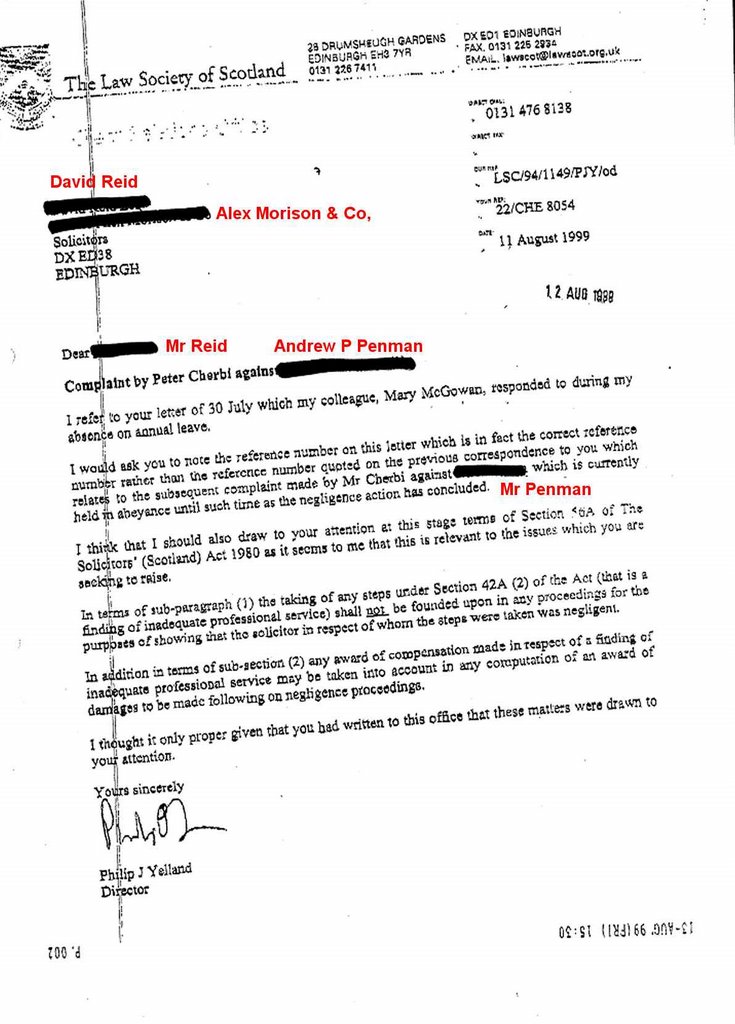
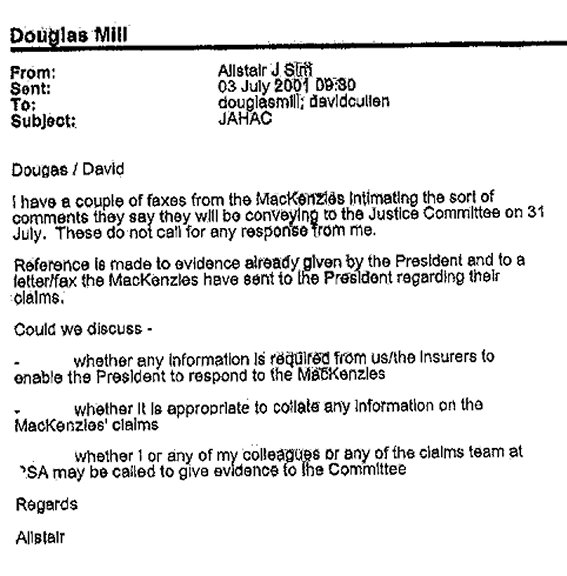
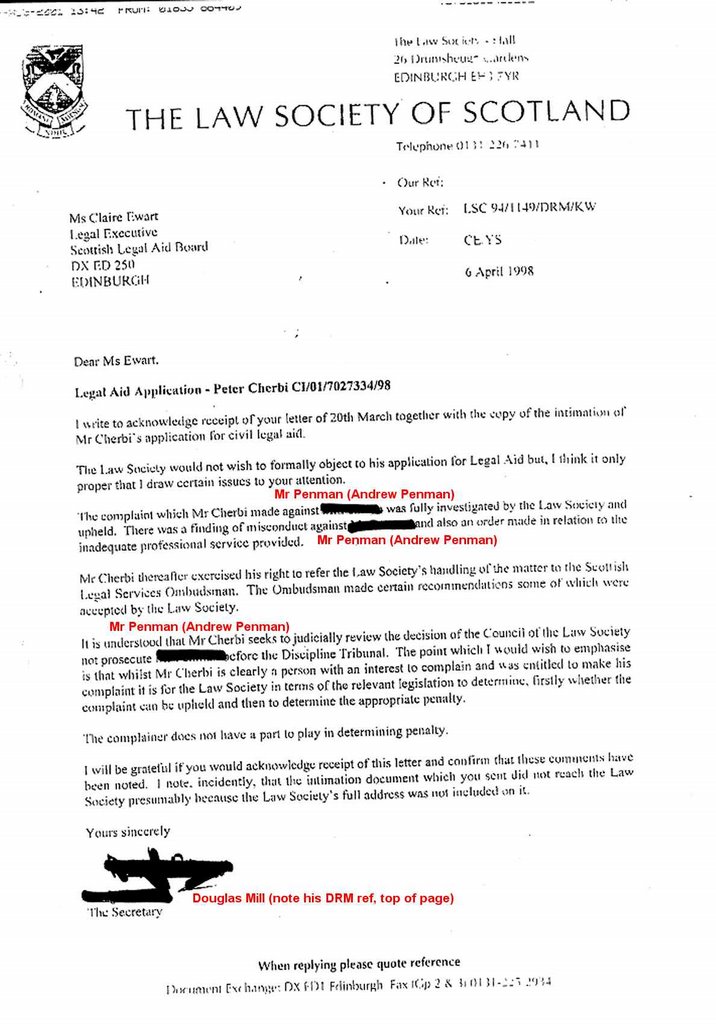
The Corrupt Link Revealed - How the Law Society of Scotland manages client complaints & settlements.


The memos & articles above, are self explanatory ... Officials of the Law Society of Scotland and the Master Insurance Policy collude to fiddle client complaints, making sure that no one gets any compensation when they are ripped off by a crooked lawyer. Plain, and simple.

You can read more relating to Stewart MacKenzie`s experiences with the Law Society of Scotland & more in his submission to the Justice 1 Committee of the Scottish Parliament at : http://www.scottish.parliament.uk/business/committees/historic/justice1/inquiries-02/j1-lps-pdfs/lps-024.pdf

My own submission to the Justice 1 Committee is at : http://www.scottish.parliament.uk/business/committees/historic/justice1/inquiries-02/j1-lps-pdfs/lps-066.pdf

But of course, this is commonplace ... not just limited to the MacKenzie case or even my own, .. and look at what Douglas Mill did to my own case ... he even interfered with my application for Civil Legal Aid, then his colleague, Philip Yelland intervened with my own lawyer, and instructed them not to proceed my case ... again ... something which is common to most cases of complaint against crooked solicitors where the client - either Stewart MacKenzie, myself - Peter Cherbi, or anyone else, tries to get a lawyer to sue a lawyer ...

So, the question is, being aware of all of this - why did the Justice 2 Committee of the Scottish Parliament let Douglas Mill off the hook when he claimed "never once have I, any member of my staff, or any office-bearer dabbled in a claim" ... ?

Clearly, the evidence is to the contrary, and since this evidence has been in the publoc domain for quite some time, why did it take John Swinney MSP - Stewart MacKenzie`s own MSP to stand up and question Douglas Mill`s claim to the contrary .. while Justice 2 Committee members sat and looked on ?

Would it now be reasonable for the Justice 2 Committee to recall Mr Mill and his band of merrie men before the Committee to explain their obviously false testimony ? surely, the answer to that must be "Yes".

Would it also now be reasonable to take this issue further and follow the Scottish Legal Services Ombudsman`s request to the Scottish Executive that research be done into the problems of clients trying to use or obtain the services of a lawyer to sue another lawyer ? surely, again, the answer must be "Yes" ... and furthermore, the Justice 2 Committee should make an order calling for the release of details on similar cases such as the MacKenzie case and my own, which the Law Society of Scotland have famously fiddled with, dabbled in, etc ... over the years ...

Douglas Mill - your grandmother must be spinning over your claim to the Justice 2 Committee that "never once have I, any member of my staff, or any office-bearer dabbled in a claim" ....

What a lie you told that day, Mr Mill, ... and what a lie you and your colleagues have maintained over the years, to protect your crooked colleagues ... many of whom have poor service records and long histories of client complaints against their services as solicitors ... while you and your colleagues manage client complaints and make sure we never get the chance to get a lawyer to sue a lawyer ... and even when we do .. you interfere in our cases to make sure they get nowhere.

Verdict from Peter Cherbi - The Law Society of Scotland is guilty of corruption on a grand scale. Scrap it as a regulatory body - and review the cases of the past to clear up the injustices against the public which have taken place in the name of protecting crooked lawyers.

Read on for today`s excellent "Herald" article, by Paul Rogerson, link at :
http://www.theherald.co.uk/business/63315.html

Would granny swear by the Law Society?
PAUL ROGERSON June 05 2006

THE Law Society of Scotland continues to fret about the prospect of independent oversight of its controversial master insurance policy, which covers compensation claims against Scottish solicitors arising from negligence, fraud or dishonesty.

For years, critics such as the Scottish Consumer Council have complained that the policy gives rise to suspicions that solicitors, broker Marsh UK, and the insurance companies are in league to the detriment of complainers.

One oft-heard allegation is that lawyers will not take up negligence cases against other lawyers because, if they are successful, this will push up their own premiums.

The society vehemently denies any collusion. Last month, chief executive Douglas Mill felt moved to swear on his "granny's grave" to Holyrood's Justice 2 Committee that "never once have I, any member of my staff, or any office-bearer dabbled in a claim".

Back in 2001 Alistair Sim - a Marsh executive and member of the Law Society of Scotland - told predecessor committee Justice 1: "The society is not involved in the handling or resolution of individual claims."

Really? Mill's extraordinary oath followed the production of evidence by MSP John Swinney apparently showing Mill, office-bearers and society officials becoming deeply involved in the resolution of a claim, never mind dabbling. The former SNP leader came brandishing what some have dubbed the "smoking memo", written in 2001 by Mill to Martin McAllister, the then president.

The document concerned complaints against solicitors brought by Stewart and Susan Mackenzie, from Pitlochry. It discussed not only the merit of the complaints, but also the character of the Mackenzies.

Mill told McAllister: "I have discussed the matter with Alistair Sim and I think a holding letter is ideal ... there is a saga here."

He added: "The Mackenzies, I would say, are different from some of our other complainers in as much as they have several valid claims, they have been let down by a series of solicitors but they are unreasonable in their expectations of quantum et cetera. Rather than trivialise matters I would recommend that the four of us, i.e.: you, me, David Preston (vice-president) and Alistair Sim ... have a summit meeting on the up-to-date position looking at both the complaints and claims aspects.

"There is no doubt Mr Mackenzie is (an) intelligent and well-organised individual (sic) who could, unlike some of the other thorns in our flesh, come over very well at (an) investigation."
The full text of the memo was only made public last year after the commendably persistent Swinney demanded to know why parts of the document were excised "for legal reasons" in submissions to Justice 1made public in 2001.


Paul Grice, chief executive of the Scottish Parliament, wrote to Swinney admitting "mistakes" were made in the editing and sanctioned publication of the full text. Who leaked the memo in the first place remains a mystery.

MSPs will have to decide whether Mill's granny is now spinning. Addressing Justice 2, the society's chief executive explained away the apparent contradiction thus: "

The layer of insulation between the society and claims handling is Marsh the broker. Our then president (McAllister) got a letter from (Mackenzie). Many of the letters that our president gets do not have the same degree of foundation as lies behind Mr Mackenzie's issues. I was asked to give a briefing on the matter. I quite properly inquired of Marsh, 'I seek an assurance that these claims are being progressed quickly.' That is what I do in such situations. I give my president an assurance that I am satisfied, having been satisfied by Marsh."

If Mill was solely concerned about the expeditious resolution of the Mackenzies' claim, it is unclear why he thought it appropriate to comment on both the amount of the claim ("unreasonable") and liken Stewart Mackenzie to a "thorn" in the society's flesh.

John Swinney is not reassured. "The memo is plainly at odds with what the Justice 2 committee is being asked to believe,' he told The Herald. "None of the answers given to Justice 2 give me any confidence that the society's position is as stated in Mr Mill's evidence."

The semantics experts on Justice 2 may ponder how looking at the "claims aspects" can be distinguished from "dabbling in a claim". The dictionary defines "dabble", incidentally, as: "To undertake something superficially or without serious intent."

One might also ask why the society is worried about independent oversight if the master policy is working so well for claimants.

Michael Clancy, the organisation's in-house lobbyist, gave an answer in a letter to Justice 2 on May 25. He wrote: "The society does not accept that the 'light touch' approach in the (Legal Profession and Legal Aid (Scotland)) Bill will be maintained throughout the life of the (Scottish Legal Complaints) commission. There is no evidence that the master policy (does) not work in favour of the client. There is no evidence of undue delay of treatment (of) master policy issues."

A decade ago dozens of Westminster MPs, some of whom are now MSPs, begged to differ. In February 1996, 49 members of parliament signed an early day motion condemning the operation of the master policy as fundamentally hostile to the underlying principles of Scots law.

Their number included several big-hitters: David Steel, Charles Kennedy, Ken Livingstone, Martin O'Neill - former chairman of the Department of Trade and Industry Select Committee - and the current UK parliament speaker, Michael Martin. One signatory - Malcolm Chisholm - is now an executive minister.

The late Gordon McMaster tabled the motion after learning of the plight of Paisley housebuilder Iain McIntyre, a constituent who suffered estimated losses of £2.7m following a 10-year legal nightmare involving a string of incidents of negligence and bad faith at the hands of various law firms.

The motion stated: "Inherent conflicts exist between the Law Society of Scotland's duties to guard the public interest and protect its members' interests, which have forced Mr McIntyre to endure the loss of his business (and the) forced sale of his home ... it is unjustifiable that the Law Society holds the master professional indemnity insurance policy which has built into it penalties and bonuses which give solicitors a vested interest in minimising negligence claims at unfair levels".

The MPs were "convinced that the principle of Scots law that everyone is entitled to independent legal representation has been breached by the Secretary of the Law Society of Scotland actively encouraging one firm of solicitors to cease acting for Mr McIntyre". They were not alluding to Mill but a predecessor.

Justice 2 will doubtless ask itself whether such a large number of MPs would have made such a damning statement without compelling evidence. Commenting specifically on the operation of the master policy last week with reference to the 1996 early day motion, the Law Society said:

"In 2005, the Office of Fair Trading endorsed the master policy by closing their investigation with no recommendations for action on professional indemnity. The OFT recognised the protections for the clients of Scottish solicitors and this follows similar scrutiny by the European Parliament, the UK Parliament and the Scottish Executive, with similar results."

It is certainly true that the OFT could find no "strong and compelling" evidence that the master policy was anti-competitive by denying legal firms the right to seek cheaper insurance cover. Whether its investigation amounted to an "endorsement' is another matter.

The watchdog's written judgment asked searching questions about the Scottish public's access to justice when complaining about solicitors, a subject beyond its formal remit. It said there was evidence that some Scottish consumers have found difficulty in finding another solicitor to represent them when they lodge malpractice claims. The watchdog admitted it did not have enough evidence to prove collusion, but added: "In the absence of such evidence, we consider that the difficulties experienced by some legal services clients in gaining representation ought to be considered as an access to justice issue."

Wednesday, May 31, 2006

Victims of the Scottish Legal Profession testify before the Justice 2 Committee, Scottish Parliament

Last Tuesday, 23 May 2006, the victims of the legal profession in Scotland finally got to have their say at the Scottish Parliament`s Justice 2 Committee ... but only in answering carefully crafted questions from Committee Members .. rather than actually being able to report the full horror of their dealings & experiences with the Scottish Legal Profession and the likes of the Law Society of Scotland ...

See the following links for Injustice Scotland`s coverage of that meeting and the actual report from the Scottish Parliament itself, and go down about 3 quarters of the way in the report to read the actual testimony from some of the victims of the legal profession.

http://groups.msn.com/InjusticeScotland/general.msnw?action=get_message&mview=1&ID_Message=369

Summary minutes of meeting & attendence : http://www.scottish.parliament.uk/business/committees/justice2/mop-06/j2mop06-0523.htm

Meeting Papers : http://www.scottish.parliament.uk/business/committees/justice2/papers-06/j2p06-15.pdf

Minutes of the meeting & Official Report : http://www.scottish.parliament.uk/business/committees/justice2/or-06/j206-1501.htm

One of the best things I heard from the hearing was .... if a lawyer was being tried for murder, would it be acceptable that 4 members of the jury were lawyers ?

Well, would it ? of course, NOT ...

So, why have we had to put up for decades with the Law Society of Scotland stuffing Complaints Committees with near majority lawyer membership, on the pretext that lay members might not be able to understand the intricacies of law and issues arising from client complaints ? .. and why, again, with the propsals contained in the "Legal Profession & Legal Aid (Scotland Bill" are we still faced with proposals to have a lawyer membership of Committes which are to consider client complaints ?

Lawyers should be completely removed from the regulatory process altogether, as many people, including myself, have said over the years ... and the Law Society of Scotland - as crooked and corrupt as it is, should be left in the role only as some form of `trade union` - left to try and teach their members not to be crooks - if that is possible ....

For one thing - does everyone think that when the new Scottish Legal Complaints Commission comes along, there will no longer be crooked lawyers ? ... no chance of that, I`m afraid ... just in the same vein that just because there is a Police force, criminals don`t stop committing crimes.

if anything, lawyers will just become more imaginative in the way they rip off their clients ...and of course their professional bodies such as the Law Society of Scotland, the Faculty of Advocates, Law Care, the Legal Defence Union, and the rest of the pack .. will come up with more rules, dodges, political arm twisting and other dirty tricks to get crooked lawyers off the hook ..

Mike Lloyd at the J2 hearing said that there should be no limit to the financial penalties which could be imposed on a crooked lawyer for what they did to a client - and this is something the Justice 2 Committee should look into carefully, with a recommendation that the currently proposed maximum financial penalty of £20,000 be replaced with a no limit maximum.

Mike Lloyd pointed out that the new SLCC would probably never award up to the maximum proposed figure anyway, which is quite true in comparison if you look at other regulatory bodies and court awards in the UK in comparable cases of client complaints ... and since lawyers have been known in Scotland to ruin clients of hundreds of thousands of pounds ... what use would a maximum fine of £20,000 be ? .. not much deterrent there if the crooked lawyer embezzles £800,000. from a client, knowing that they will only be fined a maximum of £20,000.

Another good issue which came up before the Justice 2 Committee, was the idea that the insurance scheme for lawyers - the Master Insurance Policy for Professional Negligence, should be replaced, or supplemented at least, by an equivalent insurance for the Client, so that any legal work the lawyer did for the Client, was insured.

This has to be one of the best ideas which have come out of the short public evidence hearings which the J2 Committee have allowed ... just think of it .. if the lawyer is insured for professional negligence, and the client is insured for the quality and service of the work the lawyer has done - then if any claim arises from the client against the lawyer - the two insurance firms fight it out between each other for the compensation award.

This would certainly be much better than the current arrangement where a client has to get a lawyer to sue a lawyer .. which is impossible as we all know .. and also of course, there must be independent scrutiny of this process too ... so that the insurance companies and the lawyers don`t try and cut deals .. which is also currently the case in the crooked world of the Master Insurance Policy, operated by Marsh UK, and Royal & Sun Alliance PLC Insurers.

The actual exchange at the Justice 2 Committee between Maureen MacMillan and Stewart MacKenzie :

Maureen Macmillan: ... Would it help if the commission were to be given a power of oversight in relation to the problems that exist?

Stewart Mackenzie: Absolutely. There is no question about that. That was first identified by the ombudsman just over a year ago. She was of the view that an oversight role on the master policy is crucial. Much about the master policy has been hidden. For example, it has become known only recently that less than 1 per cent of claims actually get to court and that the policy paid out £10 million last year. That is what the Law Society has told the committee. It is my view that the policy has wrecked clients' lives over the past 15 to 20 years.

Maureen Macmillan: Is that because of the delays?

Stewart Mackenzie: No. A Scottish solicitor wrote in The Herald in 1997 that the Law Society had set up a policy that protected solicitors at the expense of their clients. He then wrote in a subsequent article that he had been threatened with disciplinary action for speaking out and saying that. The policy protects the profession?it is abysmal consumer protection. Oversight would change a lot of that.

Maureen Macmillan: Thank you. That is helpful...

The hearing was quite good in that many issues were brought out by the members of the public who attended, but the length of the session and the way it was structured was very poor in comparison to the rights of audience given to the legal profession and it`s many allies over the course of the hearings so far ... for instance ... while the Law Society and it`s allies are allowed virtual right of way in terms of what they say and state - much of it having no basis in reality at all - members of the public weren`t allowed to read out any statements on their own cases and experiences - only to answer questions put to them by Committee members, and somehow, be able to get some points in on how they had been treated by the legal profession over the years ... not good enough, members of the Justice 2 Committee.

Additionally, as we see today in the latest hearing at the J2 Committee, 30 May 2006, the legal profession have been allowed to put in a barrage of `supplementary submissions` ... which are certainly anything but `supplementary` ... ranging from quotes of legal profession sponsored experts with vested interests condemning the new legislation and the Scottish Executive, to critisisms of issues already raised and how the Bill is progressing ... an almost interference one might say, in the Parliamentary Process ...

You can read some of these `supplementary submissions`from the latest J2 Committee meeting here : http://www.scottish.parliament.uk/business/committees/justice2/papers-06/j2p06-16.pdf

So, will ordinary members of the public also be allowed to make `supplementary submissions` just as the legal profession have been allowed ? ... well, I ahve aswked the Justice 2 Committee that very question today .. and you can bet I will be making my own `supplementary submission` when the time comes ...