Monday, May 11, 2015

INTERESTS INTERVENE: First Minister joins top judge in bid to block register of judicial interests as MSPs consider recalling Legal Affairs Minister over dodgy evidence & private meeting with Lord Gill

First Minister claims register for judges interests is ‘unworkable’ SCOTLAND'S First Minister Nicola Sturgeon has joined Scotland's outgoing top judge in a bid to block increased judicial accountability & transparency with the creation of a register of interests for judges.

The surprise move by the country’s most senior politician comes amid fears the judicial transparency proposal currently being considered by MSPs will expose the secret links between big money, big business, offshore private banking, staggering property wealth and Scotland’s mega powerful & secretive judiciary.

The First Minister also repeated claims made by Lord President Lord Brian Gill (73) - who accused “aggressive media” and  court users in an attempt to thwart the Scottish Parliament probe into why judges are so secretive about their vast wealth and connections.

MSPs on the Scottish Parliament’s Public Petitions Committee are due to debate plans to create a register of judicial interests as called for in Petition PE1458: Register of Interests for members of Scotland's judiciary tomorrow, Tuesday 12 May 2015.

The proposals – under investigation by MSPs since January 2013 - call for the creation of a single independently regulated register of interests containing information on judges backgrounds, their personal wealth, undeclared earnings, business & family connections inside & outside of the legal profession, offshore investments, hospitality, details on recusals and other information routinely lodged in registers of interest across all walks of public life in the UK and around the world.

The petition has cross party support from msps who backed a motion urging the Scottish Government to create a register of judicial interests at Holyrood on 7 October 2014 - reported along with video footage and the official record, here: Debating the Judges.

The latest, surprise intervention by the First Minister in the bid to bring transparency to Scotland’s secretive judges only came to light last week - although Ms Sturgeon’s letter is dated 30 March.

In the letter, which gives the First Minister’s view of petitions relating to justice issues - Nicola Sturgeon also revealed Legal Affairs Minister Paul Wheelhouse had a secret meeting with Lord Gill to discuss the petition in February of this year.
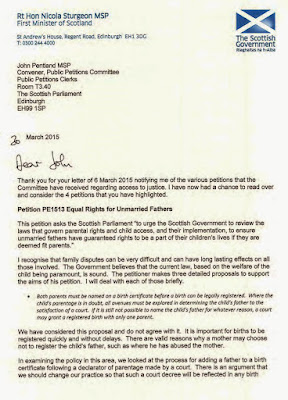
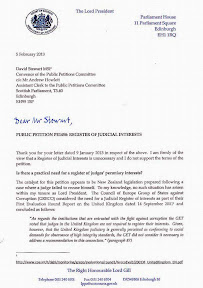
Writing in the letter to John Pentland MSP, Convener of the Public Petitions Committee, the First Minister said: “This petition calls on the Scottish Government to create a Register of Interests for the Judiciary. The Scottish Government considers that such a register of judicial interests is not necessary and that the existing safeguards - the Judicial Oath, the Statement of Principles of Judicial Ethics and the system for complaints against the judiciary - are sufficient. These safeguards, together with the register of judicial recusals, are sufficient to protect individuals from judicial bias.”

“Further to the evidence that the Minister for Community Safety and Legal Affairs, Mr Wheelhouse, gave to the Committee on 9 December 2014, he discussed this petition when he met the Lord President in February. The Minister acknowledged the Lord President's concerns about the introduction of a register of judicial interests. The breadth of such a register would make it virtually unworkable. It would need to cover not only financial interests, but also memberships of groups and associations and familial and social relationships. Even so, such a register might not capture relevant issues that could arise.”

“The position of the judiciary is different from that of MSPs and others who hold public office. The judiciary cannot publicly defend themselves. The Lord President has cautioned that such a register could also have unintended consequences. Consideration requires to be given to judges' privacy and freedom from harassment by aggressive media or hostile individuals, including dissatisfied litigants. In addition, there is currently no evidence that judges who should have recused themselves from cases have not done so.”

The First Minister’s letter is an almost word for word quote from previous letters written by Lord Gill who has previously blasted msps on the Petitions Committee foreven to dare to consider the issue of increased transparency of the judiciary.

And, following what some have referred to as a ‘script’ written by Lord Gill - the First Minister’s letter is dated two days before the latest 1 April letter from the top judge to the Petitions Committee.

Lord Gill has previously claimed such a register could compromise judges' privacy by encouraging "aggressive media or hostile individuals" and that "The establishment of such a register therefore may have the unintended consequence of eroding public confidence in the judiciary."

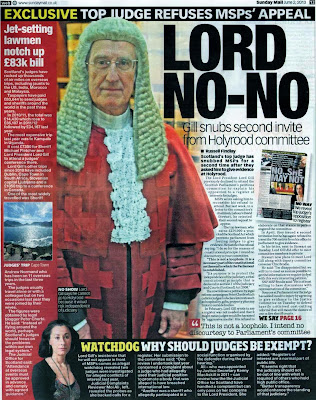
Gill also refused three invitations to appear at the Scottish Parliament and take questions on his hostility towards judicial transparency and a register of judges’ interests.

The surprise letter from Nicola Sturgeon supporting the elderly top judge – who has been caught in headlines flying around the world on grand 5 day taxpayer funded state visits to countries such as Qatar - predates Lord Gill’s announcement of his ‘retirement’ last week.

Having served three years as Lord President – the shortest term in the post for some time, the ageing Gill said he is stepping down at the end of this month.
The latest development in the debate around creating a register of interests for judges comes as MSPs were handed a copy of internal Scottish Government communications which conflict with testimony previously given to the Public Petitions Committee by Legal Affairs Minister Paul Wheelhouse.

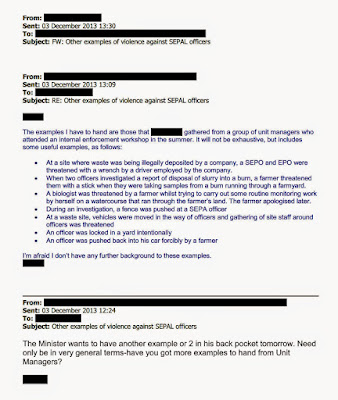
The emails reveal Mr Wheelhouse deliberately misled MSPs over claims gangsters had threatened SEPA officials - claims which wheelhouse used to argue with MSPs at an earlier evidence session that judges wealth and connections to big business, banks and the legal profession must be kept hidden.

Conversations between aides to Mr Wheelhouse begging SEPA for examples of evidence for “the Minister to have in his back pocket” revealed no gangster threats had occurred. Instead, a farmer threatened a SEPA employee with a stick, and a fence had been pushed against another SEPA employee.

The now released email also raises questions on what knowledge the then Justice Secretary Kenny MacAskill knew of the material used by Wheelhouse – after MacAskill – who is now on the Petitions Committee – failed to question the Minister during his interaction with Wheelhouse at a previous Petitions Committee meeting, reported here: Too Many Secrets: Legal Affairs Minister Paul Wheelhouse substitutes for top judge in evidence to MSPs

MacAskill – a lawyer who trained at Glasgow based law firm of Levy & Mcrae who are now caught up in a multi million pound writ over the £400m collapse of Hedge Fund Heather Capital - is known to be against the plan to create a register of interests for judges.

MSPs on the Petitions Committee have now been asked to recall Mr Wheelhouse to account for his misleading testimony, and to face questions on his private meeting with Lord Gill.

It has also been suggested Moi Ali - Scotland’s first Judicial Complaints Reviewer (JCR) be recalled to give evidence on changes relating to judicial conduct complaint rules put forward by Lord Gill. The changes have been branded tweaks & window dressing in a previous report here: THE LORD'S RULES: Top judge's two year consultation & tweaks to rules allowing judges to investigate themselves is 'missed opportunity'.

During an earlier evidence session before the Scottish Parliament’s Petitions Committee, Moi Ali told msps there is little transparency or accountability in Scotland’s judiciary.

Among papers released for tomorrow's meeting, clerks have now recommended MSPs seek information from legal affairs Minister Wheelhouse on what took place at the secret meeting with Gill held in February and also to recommend Gillian Thompson OBE - the new Judicial Complaints Reviewer who replaced Moi Ali last year, attend to give evidence.

Gillian Thompson has already registered her support for a register of judicial interests in a letter to MSPs, reported here: DECLARE THE JUDGES: New Judicial Complaints Reviewer supports proposal to Scottish Parliament to create a register of interests for judges

The Sunday Herald newspaper reported on First Minister Nicola Sturgeon’s intervention on behalf of the judiciary and her opposition to the judicial transparency proposal:
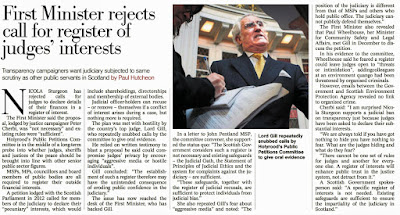
First Minister rejects call for register of judges' interests

Paul Hutcheon
Investigations Editor Sunday 10 May 2015
 
NICOLA Sturgeon has rejected calls for judges to declare details of their finances in a register of interest. The First Minister said the proposal, lodged by justice campaigner Peter Cherbi, was "not necessary" and claimed existing rules were "sufficient".
 
Holyrood's Public Petitions Committee is in the middle of a long-term probe into whether judges, sheriffs and justices of the peace should be brought into line with other senior public sector figures.
 
MSPs, MPs, councillors and board members of public bodies are all required to register their outside financial interests.
 
A petition lodged with the Scottish Parliament in 2012 called for members of the judiciary to declare their "pecuniary" interests, which would include shareholdings, directorships and membership of external bodies.
 
Judicial officer holders can recuse - or remove - themselves if a conflict of interest arises during a case, but nothing more is required.
 
The plan was met with hostility by the country's top judge, Lord Gill, who repeatedly snubbed calls by the committee to give oral evidence. He relied on written testimony to blast a proposal he said could compromise judges' privacy by encouraging "aggressive media or hostile individuals".

Lord Gill concluded: "The establishment of such a register therefore may have the unintended consequence of eroding public confidence in the judiciary."
 
The issue has now reached the desk of the First Minister, who has backed Lord Gill.
 
In a letter to John Pentland MSP, the Committee convener, she supported the status quo: "The Scottish Government considers that such a register of judicial interests is not necessary and that the existing safeguards - the Judicial Oath, the Statement of Principles of Judicial Ethics and the system for complaints against the judiciary - are sufficient.
 
"These safeguards, together with the register of judicial recusals, are sufficient to protect individuals from judicial bias."
 
She also repeated Lord Gill's fear about "aggressive media" and noted: "The position of the judiciary is different from that of MSPs and others who hold public office. The judiciary cannot publicly defend themselves."
 
The First Minister also revealed that Paul Wheelhouse, her Minister for Community Safety and Legal Affairs, met Lord Gill in December to discuss the petition.
 
In his evidence to the Committee, Wheelhouse said he feared a register could leave judges open to "threats or intimidation", adding that colleagues at an environment quango had already been threatened by organised criminals. However, emails between the Government and Scottish Environment Protection Agency revealed no link to organised crime.
 
Cherbi said: "I am surprised Nicola Sturgeon supports a judicial ban on transparency just because judges have been asked to declare their substantial interests. "We are always told if you have got nothing to hide you have nothing to fear. What are the judges hiding and what do they fear? "There cannot be one set of rules for judges and another for everyone else. A register of interests will enhance public trust in the justice system, not detract from it."
 
A Scottish Government spokesperson said: "The Scottish Government considers that a specific register of interests is not needed. Existing safeguards, including the Judicial Oath, the Statement of Principles of Judicial Interests and the system of complaints against the judiciary, are sufficient to ensure the impartiality of the judiciary in Scotland."

Previous articles on the lack of transparency within Scotland’s judiciary, investigations by Diary of Injustice including reports from the media, and video footage of debates at the Scottish Parliament’s Public Petitions Committee can be found here : A Register of Interests for Scotland's Judiciary

Thursday, May 07, 2015

Lord NO-NO to GO-GO: Scotland’s top judge Lord Brian Gill steps down after controversial three year term as Lord President - amid battles with Holyrood, media & transparency

Lord Gill to ‘retire’ after run-ins with politicians, press & transparency. SCOTLAND’S top judge, Lord President Lord Brian Gill has announced he is stepping down from office on 31 May 2015. Until a successor is found, the Lord President’s duties will be taken up by the Lord Justice Clerk, Lord Carloway.

Gill (73) who is Scotland's longest serving judge, has served a short three year term as Lord President, compared to previous holder of the office Lord Hamilton, who held the post for seven years.

In the course of a long and distinguished legal career Gill presided over significant changes to the Scottish legal system.

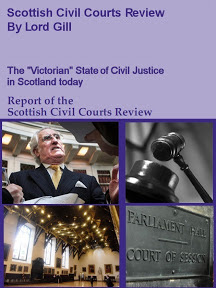
He also famously branded much of the Scots legal system as “Victorian” and “unfit for purpose” in his Scottish Civil Courts Review - which sought to change some of the antiquated structures of Scotland’s expensive, closed shop and out of reach civil courts.

However, many of the Civil Courts Review proposals were watered down by the Taylor Review, carried out at the insistence of the Scottish Government and the legal establishment - who feared giving the public easier and cheaper access to court may affect law firms’ profits.

For the past two years, Lord Gill fought a very public and bitter battle with the Scottish Parliament concerning MSPs investigations of transparency and accountability in the Scottish judiciary, amid plans to create a register of judicial interests as called for in Petition PE1458: Register of Interests for members of Scotland's judiciary

The proposals to create a register of judicial interests envisages the creation of a single independently regulated register of interests containing information on judges backgrounds, their personal wealth, undeclared earnings, business & family connections inside & outside of the legal profession, offshore investments, hospitality, details on recusals and other information routinely lodged in registers of interest across all walks of public life in the UK and around the world.

Gill refused three invitations to appear before MSPs to give evidence on his intense opposition to a register requiring judges to declare their significant wealth and links to big business.

Faced with a no-show of Scotland’s top judge, members of the Scottish Parliament’s Public Petitions Committee took evidence from Scotland’s first Judicial Complaints Reviewer (JCR) Moi Ali. During questions at the Scottish Parliament’s Petitions Committee, Moi Ali told msps there was little transparency or accountability in Scotland’s judiciary.

And, in spite of Scottish Ministers attempts to thwart a debate at Holyrood last October 2014, msps overwhelmingly backed a motion urging the Scottish Government to create a register of judicial interests – reported along with video footage & the official record, here: Debating the Judges

At the recent Commonwealth Law Conference held in Glasgow during March 2015, Lord Gill fired another salvo at politicians, transparency and the democratic process – branding all as “insidious”.

Lord Gill told his startled audience: “The threats to judicial independence do not always come with a knock on the door in the middle of the night.  In a society that prides itself on the  independence  of  its  judiciary,  the  threat  may  come  in  insidious ways, even at the hands of well-meaning governments and legislators, in the name of efficiency and, ironically,  in the name of  transparency.”

After the speech, Gill and several judicial figures including Lord Neuberger fled the conference after learning Wikileaks founder Julian Assange was booked to speak at the event.

Lord Gill also supported the retention of corroboration – a key legal safeguard against miscarriage of justice - where evidence must be verified by two sources.

Brian Gill was first appointed as a Senator of the College of Justice in 1994. He was appointed Lord President of the Court of Session and Lord Justice General in June 2012, having held the position of Lord Justice Clerk from November 2001.

Under the Judiciary and Courts (Scotland) Act 2008, First Minister Nicola Sturgeon will now establish a panel to recommend individuals who are suitable for appointment to fill the vacancy.

It has been rumoured for several months senior figures in the Scottish Government have lobbied for a female candidate to become Scotland’s first Lady Lord President.

Court of Session judge Anne Smith, who was made President of the tribunals service by Lord Gill last summer, is seen by some as ‘a good bet for the post’.

TOP JUDGE WHO SAID NO-NO TO TRANSPARENCY & SCOTTISH PARLIAMENT:

Scotland’s top judge Lord President Lord Brian Gill fiercely opposes calls for any form of transparency & public accountability of the judiciary and Scotland’s Courts.

Over the course of nearly two years, Scotland’s top judge Lord Gill has focussed his anger on a Scottish Parliament investigation into calls for a register of judicial interests. The register proposal would reveal the judiciary's vast personal, undeclared wealth, extensive family and business connections throughout the legal profession, links to big business, offshore trusts & investments, ownership of numerous and high value properties through a variety of ‘creative’ arrangements, directorships, shareholdings, and even unpublished criminal records of members of the judiciary.

Lord Gill refused at least two invitations to appear before the Scottish Parliament to give evidence and face questions on his opposition to the proposal to create a register of judicial interests. The top judge has also used the Scotland Act as a loophole to avoid further scrutiny on the matter.

Lord Gill’s challenge to MSPs declared judicial opposition to transparency. In Lord Gill’s opening letter to MSPs on the call for a register of judicial interests, the judge claimed “In practical terms it would be impossible for all judicial office holders to identify all the interests that could conceivably arise in any future case. The terms of the Judicial Oath and the Statement of Principles of Judicial Ethics ensure that such a difficulty does not arise and that the onus is on the judicial office holder to declare any interest at the outset.”

In what was a hint of the sheer hostility felt by the judiciary against a call to bring transparency to judges interests, Lord Gill went onto accuse the media, press, litigants, court users and just about everyone else with an interest in transparency of being potentially hostile and aggressive, simply because someone may wish to raise questions of judges interests similar to the same kinds of questions which are raised of interests in other public officials and those in public life, politics & government.

And, if MSPs were unsure of the depth of Lord Gill’s attitude towards transparency, the top judge went on to refuse to appear before the Scottish Parliament, and used a loophole in the Scotland Act to justify his sweeping declaration he did not require to answer questions from Scotland’s democratically elected politicians. 

Lord Gill’s use of Scotland Act against MSPs was reported in the media. Writing in a letter to msps, Lord Gill implied cooperation with Parliament would be withdrawn over calls to make judges more transparent in register : “Section 23(7) of the Scotland Act provides inter alia that the Parliament may not require a judge to attend its proceedings for the purposes of giving evidence. This is not a loophole. It is a necessary part of the constitutional settlement by which the Parliament is established. Its purpose is to protect the independence of the judiciary, a vital constitutional principle that is declared in section 1 of the Judiciary and Courts (Scotland) Act 2008”

The judge continued: “When a committee invites a judge to give evidence before it, I have to decide whether the subject matter might infringe the principle of judicial independence; and whether the evidence required could be satisfactorily given in writing.”

Even though Scotland’s top judge opposes the creation of a register of interests, MSPs held a debate in the Scottish Parliament’s main chamber on Thursday 7 October 2014, which saw cross party support for the proposal. MSPs overwhelmingly supported motion S4M-11078 - in the name of Public Petitions Convener David Stewart MSP on petition PE1458, urging the Scottish Government to give further consideration to a register of interests for judges.

The parliamentary debate was reported by Diary of Injustice along with video coverage here: TRANSPARENCY TIME: Top judge & Scottish Government told to rethink refusal on declarations of judges as Holyrood MSPs support calls to create a register of judicial interests

Previous articles on the lack of transparency within Scotland’s judiciary, investigations by Diary of Injustice including reports from the media, and video footage of debates at the Scottish Parliament’s Public Petitions Committee can be found here : A Register of Interests for Scotland's Judiciary
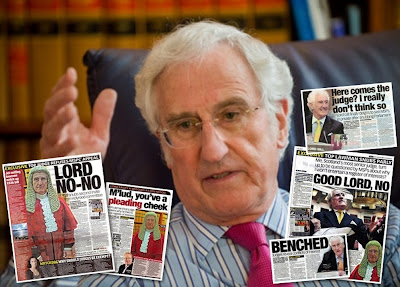
Civil Courts Review : Scots Justice still “Victorian” years after judge called for reforms:

The Scottish Civil Courts Review of 2009 authored by then Lord Justice Clerk, now Lord President Lord Brian Gill, castigated Scotland’s Civil Justice System as being Victorian, costly, and unfit for purpose, yet years on from the review, little of the proposed reforms have been implemented due to pressure from vested interests in the legal world, and a lack of political will to deliver access to justice to all Scots.

The Civil Courts Review can be viewed online here : Scottish Civil Courts Review Synopsis, Scottish Civil Courts Review Vol1 Chapters 1-9 & Scottish Civil Courts Review Vol2 Chapters 10-15

Gill, giving a speech to the Law Society of Scotland’s 60 year anniversary conference several years ago, reproduced in full here said : “The civil justice system in Scotland is a Victorian model that had survived by means of periodic piecemeal reforms. But in substance its structure and procedures are those of a century and a half ago. It is failing the litigant and it is failing society.

“It is essential that we should have a system that has disputes resolved at a judicial level that is appropriate to their degree of importance and that disputes should be dealt with expeditiously and efficiently and without unnecessary or unreasonable cost. That means that the judicial structure should be based on a proper hierarchy of courts and that the procedures should be appropriate to the nature and the importance of the case, in terms of time and cost. Scottish civil justice fails on all of these counts. Its delays are notorious. It costs deter litigants whose claims may be well-founded. Its procedures cause frustration and obstruct rather than facilitate the achievement of justice."

Previous articles on the Civil Courts Review and reforms of Scotland's antiquated civil justice system can be found on Diary of Injustice here: Scottish Civil Courts Review.

Wednesday, May 06, 2015

PARTY LORD: Judicial excess in the dock as Scotland’s top judge celebrates £58million taxpayer funded court refit with £36K exhibition & party bash at Parliament House

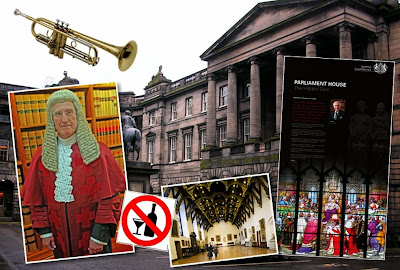
Lord Gill hosted taxpayer funded posh party for court refit. SCOTLAND’S top judge celebrated a £58million taxpayer funded refit on the Court of Session by holding a £36K exhibition and party which included trumpeters, archers and a get together for senior political figures and members of Scotland’s legal establishment.

However, Lord President Lord Brian Gill, 73, banned guests from drinking alcohol to toast the refit of Parliament House – Gill’s seat of power in the Royal Mile.

Documents obtained via Freedom of Information legislation show worried court staff debated whether they could obtain favourable press coverage for the event – which was held close to the independence referendum.

Principal court clerk Graeme Marwick asked Lord Gill about the possibility of alcohol being served to guests who included the Lord Advocate, top politicians from the Scottish Government and figures from the church. However, Gill said No.

The minutes of the discussions arranging the party reveal court staff worries that guests would not be able to meet and interact without a glass of wine.

Court staff meeting papers reveal discussions on exhibition & booze ban party. Under the heading of disadvantages of Gill’s booze ban,  one court official criticised the booze ban, saying there would be “No opportunity for a post ceremony glass of wine and canapes/entertainment and networking amongst the guests.”

Eager to provide senior guests with suitable music to accompany their sausage rolls and buffed, a member of staff queried: “Should there be entertainment at the function- possibly a string quartet from the Royal Conservatoire of Scotland?”

Lord Gill agreed to spend £750 hiring trumpeters from Glasgow's Royal Conservatoire. Gill is also a trustee of the Royal Conservatoire, based in Glasgow.

To the sound of music and political chatter, guests of the Lord President’s taxpayer funded bash were eventually treated to soft drinks and canapés – costing £3,620.

One legal insider joked “Given who was in attendance I wouldn't be surprised if someone brought along an emergency flask of booze”

Hosting the event, Lord Gill also unveiled a brass plaque marking the major refurbishment of the sprawling Parliament House site, comprising of some 700 rooms within the sprawling complex of buildings.

However, speeches given by politicians and legal luminaries at the event failed to mention concerns which have now surfaced relating to who actually owns which parts of the Parliament House complex -  which has since been in the news after it had been discovered Scottish Ministers had gifted some of the titles to the Faculty of Advocates.

Details surrounding the loss of Parliament House to Edinburgh – come from an investigation undertaken by well known land reform campaigner Andy Wightman – who discovered that in 2006 the Scottish Government asked Edinburgh City Council to confirm the ownership of Parliament House – which includes Parliament Hall and Laigh Hall. The moves by the Scottish Government to clarify ownership of the court buildings occurred prior to the taxpayer funded £58 million refurbishment project (originally budgeted at over £120m) of the sprawling court buildings.

However, after inquiries by government lawyers on the exact ownership of Scotland’s most highest courts, Edinburgh City Council concluded they were unaware of who owned Parliament House. This led to ownership transferring to Scottish Ministers who then allowed the Faculty of Advocates to register the title deeds to the interior of the building in its name.

It transpired the Faculty of Advocates had in-fact, lobbied the Scottish Government to hand over ownership.

Writing on his blog, Mr Wightman said: “The Faculty of Advocates has for centuries regarded Parliament House as theirs. They had almost exclusive use of it and so, by means as yet unclear, within a month of Scottish Ministers taking ownership, the Faculty persuaded Scottish Ministers to convey to its ownership for no consideration the room known as the Laigh Hall within Parliament House.”

A trove of eighty eight pages of documents  obtained from the Scottish Government under Freedom of Information legislation later revealed Scottish Ministers plan to do nothing over their handing over of the Parliament Hall land titles to the Faculty of Advocates.

Throughout the documents – which contain communications between civil servants, briefings to Ministers, land reports and letters from Edinburgh City Council asking for meetings, it is clear Scottish Ministers favour leaving the titles to the nation’s top courts with the vested interests of the legal profession.

During a First Minister’s Questions session at Holyrood, Nicola Sturgeon was asked by Alison Johnstone  MSP (Lothians, Green Party) about the Parliament Hall land grab by the Faculty of Advocates.

In her reply, featured here: Parliament House handed over to Faculty of Advocates FMQ's Nicola Sturgeon 19 February 2015 Nicola Sturgeon claimed she found no fault on the part of the Scottish Government - who handed over the titles to the Faculty of Advocates – effectively little more than a lawyer’s lobby group. The First Minister went on to warn “ there is no easy solution to the issue of restoring title to the City of Edinburgh Council” without giving a real explanation of why the titles were transferred in the first place.

The titles to the Laigh Hall – Parliament House – Queen Street - currently stand in the name of “SIDNEY NEIL BRAILSFORD Queen's Counsel, Treasurer of HONOURABLE THE FACULTY OF ADVOCATES Edinburgh, as Trustee and in Trust for said Faculty”. Sidney Brailsford is none other than High Court Judge Lord Brailsford.

TOP JUDGE SILENT OVER PARLIAMENT TITLE SWAP

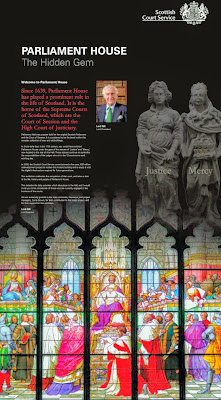
Taxpayers not invited to Gill’s £36K bash  got an informative leaflet on the £58million public spend on Parliament House. During the summer of 2013,  Scotland’s top judge Lord Gill – head of the Scottish Court Service Board, and the Scottish Court Service Chief Executive Eric McQueen appeared before MSPs at the Scottish Parliament’s Justice Committee to give evidence on court closures and the millions spent on Parliament House – yet neither the judge nor the Courts chief mentioned their astonishing secret to the MSPs present – that the title to Scotland’s highest court buildings had been swiped by the Faculty of Advocates in a deal on the sly with Scottish Ministers.

During questions from Justice Committee MSPs, SCS Chief Executive Eric McQueen gave evidence on the massive £60 million taxpayer funded spend on Parliament House.

The Court Service Chief told MSPs: “We are just coming to the end of the Parliament house contract; in total, the budget for it was £65 million and I think that we expect the final spend to be in the low £60 millions. The project has been delivered on budget, on time and on quality. How it has been delivered is a tribute to the Scottish Court Service.

McQueen continued: “I will give a potted history of the Parliament house situation. About 10 years ago, a scheme was in place that was going to run to way over £120 million. That was brought to a stop to allow us to reassess things and to consider the best strategy. At the same time, we looked at a business case for moving away from Parliament house altogether and having a development on a greenfield or brownfield site on the outskirts of Edinburgh. The major problem with Parliament house is that it is a grade A listed building and is a site of special historical interest. It should be a landmark building for the whole of Scotland.”

In an intervention, the Convener of the Justice Committee – Christine Grahame MSP said: “I am glad that you did not move to a greenfield site. It would have been a bit like going to B&Q. I do not mean to malign B&Q, but I like the old Parliament house building.”

Eric McQueen replied : “Had the decision been taken to move out of Parliament house, that asset would have been left with the Scottish Government. The infrastructure and the services were shot, and there was no fire certificate in place for the building. It would have cost as much to move out as to redevelop the building. From the point of view of the benefit to the nation and to the Scottish Government's purse, the investment of the £65 million in Parliament house over that five or six year period was quite a sensible business case decision.”

Sitting beside Eric McQueen was Lord President Brian Gill, who did not at any stage of the meeting volunteer information to the Justice Committee in relation to the titles arrangements of Parliament House, despite the multi million pound taxpayer funded refurbishment.

Pressed for a statement on why Lord Gill or Eric McQueen did not inform the Justice Committee of the fact tens of millions of pounds of taxpayer money had been spent on a building partly owned by the Faculty of Advocates – the Judicial Office refused to give any comment.

Tuesday, May 05, 2015

Scotland 2015: Someone said there is a General Election …

Look up, and you can see Scotland from anywhere in the UK. SCOTLAND should have a strong voice at Westminster. That much is certain.

We are a berth for the UK’s nuclear submarines. We build the ships of the Royal Navy. We are so popular (and important) bears fly off our coasts and sneaky submarines sneak around our fishing boats.

We contribute to the UK’s economy and the fabric of the country as a whole (regardless of the denial brigade) so much, London could never bear to let us go. It’s true!

And – yes - we house a collection of 700 year old judges hell bent on protecting their highly secretive and dubiously achieved judicial wealth from prying eyes.

It is also true our little, big, country is a possible candidate for vested interests & big business to frack for their own gain. Yes, their gain, not the wider community at large.

Vested interests, corporate boards and Chief Executives do not toast champagne over throwing free money at citizens or vital public services without some fiddle in the background. Fact.

And – sadly - we are an outpost of dodgy financial & legal services who go to extreme efforts to avoid scrutiny, accountability, regulation & transparency. Heather Heather. And some Capital.

In any case, there is a General Election this Thursday, and it is your right as a citizen - to vote.

Will anything change next week? Not really.

The NHS will still be in crisis. Statistics on crime (and everything else) will still be fiddled beyond plausibility. Increasing numbers of people across the UK will be forced to use Food Banks.

Oh .. Shocker. People in power you rely on for help will write back to you saying they cannot help.

Lord Gill – the Lord President & Lord Justice General - almost Napoleonic in title, will still be in Parliament House dancing to “Mysterious Ways” – or perhaps “Insidious Ways” - gaming out his latest military style exercise against judicial transparency on his WOPR WarGames computer.

Oh yes – and the rich get richer while the poor get poorer.

But, once every few years - when you – the electorate – are needed - it is YOUR chance to hold Government and all it’s fantasy and all it’s power – to account.

As you hold Government to account this week with your vote - think on this.

Some might say … a Government is only as good as it’s opposition. Inevitably, a Government is only as good as those who vote for it.

A strong opposition can - or at least should - hold a Government to account.

A strong, independent media often holds, and frequently advances the line on transparency and accountability - which helps hold Government to account.

Thursday 7 May 2015 is your choice, your voice, and your vote. Think. Don’t be bullied by vested interests or false and fantastical promises.

However you decide to vote, you have the right to decide for yourself. But please, do vote.