Friday, August 15, 2014

JUDICIAL RICH LIST: Register reveals top judges investments in dodgy justice system providers, companies linked to international bribes scandals, mercenaries, tax avoidance & banks fined for financial markets manipulation

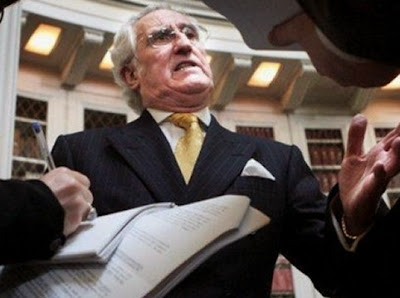
Judges shareholdings in companies guilty of breaking the law raise questions of ethical investments. DISCLOSURES of judges personal shareholdings obtained under Freedom of Information legislation from the Scottish Court Service have revealed a startling snapshot of the wealth of several key members of Scotland’s judiciary who sit on a controlling quango which flexes its muscle over the entire court structure in Scotland.

The declarations of the seven judicial members of the Scottish Court Service Board – including Scotland's top judge, the Lord President & Lord Justice General Brian Gill on £220K a year - reveal members of the judiciary benefit financially from shareholdings in companies who won huge public contracts to provide services to the courts & justice system, companies convicted of breaking the law around the world, companies involved in ‘industrial’ espionage against countries such as China, banks fined for international financial market manipulation, and companies involved in bribes, bid rigging, and tax dodging to name but a few.

The documents – handed over by the Scottish Court Service after officials initially denied holding the information in an effort to delay full publication, bring further revelations on top of reports in the Scottish Sun newspaper where it was revealed Sheriff Principal RA Dunlop holds shares in Weir Group - hit with a £13.9 million Proceeds of Crime fine for dodging UN sanctions by paying bribes to Saddam Hussein’s regime. The Sunday Herald also revealed Sheriff Principal RA Dunlop held shares in Tesco while presiding over a case involving the multi national supermarket giant.

Shareholdings of top judges on Scottish Court Service Board:

Lord President Lord Brian Gill: Henderson UK Growth Fund Retail Class Acc, Newton International Growth Fund, Aviva Investors UK Equity Fund, Terrace Hill Group, Vestry Court Ltd

Sheriff Principal R A Dunlop QC: Astrazeneca, BHP Billiton, Blackrock AM UK Gold & General, Bluescope Steel, BNY Mellon Newton Global, CG Real Return Inc, Close Brothers Group, Diageo, Findlay Park FDS American Smaller Cos., G4S, Henderson Global Invs, ING Global Real Estate Securities, Intercontinental Hotels, JP Morgan Private Equity, Lomond Shipping Co, Lloyds Banking, M&G (Guernsey) Global Leaders, National Grid, Oakley Capital Investments, Origo Partners, Pernod Ricard, Prudential, Rio Tinto, Royal Bank of Scotland, Royal Dutch Shell, Scottish Oriental Smaller Cos, Tesco, Vodafone, Weir Group

Sheriff Iona McDonald: Glaxosmithkline, Royal Dutch Shell, Unilever, Equiniti, Barclays, Standard Life, HBOS

Johan Findlay OBE: Aviva, Vodafone, Santander, Unilever, Norwich Union, Legal & General, Fidelity Funds Network, Scottish Widows, Lloyds Banking Group, Thus Group, HBOS, Trafficmaster, Standard Life

Sheriff A Grant McCulloch: “None significant”

Hon Lord Bannatyne: None

Lord Justice Clerk - Lord Carloway: None (and no declarations of any kind whatsoever)

The registers reveal more of the judges shareholdings in companies with questionable histories - Sheriff Dunlop is also a shareholder in G4S who were fined £335,000 for court delays in Scotland after it was revealed the company brought prisoners to court late - on at least 21,735 occasions.

In March 2014, G4S agreed to repay £109 million to the UK government after a scandal involving overcharging on contracts to tag offenders. The overcharging is believed to include billing for monitoring the movements of 3,000 "phantom" offenders, including some who had been sent back to prison and even some who had died.

And the firm was also implicated in several scandals in Iraq where the company operate as ArmorGroup, supplying armed guards & security. A BBC Scotland investigation into G4S revealed the company had been warned not to employ a former British paratrooper who went on to kill two colleagues including Private security guard Paul McGuigan, from the Scottish Borders.

Dunlop also has shares in mining giant BHP Billiton – embroiled in an anti-corruption investigation by the US authorities into a lobbying scam aimed at defeating the landmark US climate change bill involving forged letters sent to US congressmen. BHP Billiton is also under investigation in another anti-corruption investigation in Australia over its major sponsorship of the 2008 Beijing Olympics and the alleged payment of "tea money" to secure rights to a since-abandoned bauxite exploration project in Cambodia.

Another mining giant on Sheriff Dunlop’s extensive share portfolio is Rio Tinto - caught up in a spying and corruption scandal in China where four of the firm’s executives admitted bribery and were jailed. Sheriff Dunlop is also listed in the documents as holding shares in Vodafone - which paid no UK corporation tax for the past two years despite massive profits and sales of £5 Billion in Britain last year.

And, in what must be a humiliating slap in the face of the Scottish Government, documents show Sheriff Principal Dunlop also holds shares in drinks giant Diageo, who are supporting the drinks industry’s legal challenge against the Scottish Government’s minimum alcohol pricing policy.

Another judge, Sheriff Iona McDonald who also holds the position of Deputy Lieutenant for Ayrshire and Arran, is revealed to invest in pharmaceutical giant GlaxoSmithKline. GSK are also caught up in a huge corruption scandal in China over allegations it’s sales team targeted influential doctors with bribes, expensive gifts and cash to win business.

Among the list of other investments of SCS Board members are banks such as Lloyds - fined £218 Million for manipulating the Libor rate and Barclays - recently fined £26 Million for gold price fixing. Barclays were also fined £290 million over their part in the Libor rate rigging scandal.

Also on the list are insurance firms who do business with law firms all across Scotland and are directly linked to the Law Society of Scotland’s Master Insurance Policy - which protects corrupt solicitors from damages claims by clients who have been ripped off. A Research Report by the University of Manchester School of Law linked the Law Society’s Master Policy to suicides of court litigants & clients of Scottish solicitors.

Speaking to Diary of Injustice, a legal insider said: “While it may not be of concern to members of the judiciary which firms they choose to invest in, it should be of concern to the public, as many of these companies and their subsidiaries are regulars in the courts where judicial recusals are historically hard to come by on financial grounds.”

The SCS Board register of interests, which date back to 2010 – also list the shareholding portfolio of the then Lord President - Lord Hamilton. Additional declarations in the register reveal a snapshot of current SCS Board members directorships, trusteeships, links to businesses and relationships with shady regulators of the accountancy profession:

Lord President Lord Gill: Director of Scottish Redundant Churches Trust, a company limited by guarantee registered in Scotland (SC162884). Director of the Royal School of Church Music, a company limited by guarantee registered in England (Reg'd No 250031). Trustee of the Carmont Settlement: a trust for the support of retired priests of the Roman Catholic Church. Trustee of the Columba Trust: a trust for the benefit of the Roman Catholic Church in Scotland.Trustee of the Royal Conservatoire of Scotland Endowment Trust: a trust for the benefit of RCS and its students. Trustee of the Royal Conservatoire of Scotland Trust: a trust for the benefit of the RCS and its students. Trustee of the Royal School of Church Music, a registered charity for the promotion of church music in the Christian Churches (Reg No 312828). Vice President of the Royal Conservatoire of Scotland.

Sheriff Principal R A Dunlop QC: Member of Stirling University Conference. Chair of Local Criminal Justice Boards in Tayside Central and Fife. Commissioner of Northern Lighthouses. Trustee of St John's Kirk of Perth Trust. Elder of Gorebridge Parish Church of Scotland. Member of Royal Northern & Clyde Yacht Club. Member of the New Club, Edinburgh.

Sheriff Iona McDonald: Deputy Lieutenant for Ayrshire and Arran. Partner in property rental firm.

Johan Findlay OBE: Honorary Sheriff & Justice of the Peace

Sheriff A Grant McCulloch: Chair West Fife Education Trust. Chair Relationship Scotland- Couple Counselling Fife. Chair - Discipline Committee ICAS (Institute for Chartered Accountants of Scotland – Accountants self regulator). Committee Member Cammo Residents Association.

Hon Lord Bannatyne: Chester Street (Limited Partner) Ltd on behalf of the Board if the Cathedral Church of St Mary the Virgin, Palmerston Place, Edinburgh. Member of the Board of the Cathedral Church of St Mary the Virgin, Palmerston Place, Edinburgh. Shareholder as Trustee for the Cathedral Church of St Mary the Virgin, Palmerston Place, Edinburgh, in Chester Street (General Partner) Ltd. Member of the Clergy Disciplinary Tribunal of the Episcopal Church.

Lord Justice Clerk - Lord Carloway: No declarations of Directorships or other positions.

Multiple property ownership and interests in real estate, buy to let and property companies is big business for members of the judiciary and their family members – however there are no details or disclosures of any property directly owed by the SCS Board members contained in the declarations released by the SCS. It is as if Scotland’s top judges are on the homeless register – but it is clear from their wealth, they don't use food banks.

The limited disclosures of SCS Board members contain no references to outside earnings & work, relationships to law firms, big business and others more detailed declarations which may be picked up by a fully published register of judicial interests as is currently being investigated by the Scottish Parliament’s public Petitions Committee.who are considering proposals contained in Petition PE1458: Register of Interests for members of Scotland's judiciary.

The registers as released by the Scottish Court Service have now been handed to MSPs who are to be asked to consider the question of ethical investments of the judiciary as part of their on-going debate on proposals to create a full register of judicial interests for all Scottish judges.

Previous articles on the lack of transparency within Scotland’s judiciary, investigations by Diary of Injustice including reports from the media, and video footage of earlier debates at the Scottish Parliament’s Public Petitions Committee on Petition PE1458 can be found here: A Register of Interests for Scotland's Judiciary.

Wednesday, August 06, 2014

COURT SECRETS: Scotland’s anti-transparency top judge Lord Brian Gill threatens media censorship in row over reporting access to court papers

Top judge Brian Gill warns media will be blocked from access to courts. SCOTLAND’S top judge, Lord President & Lord Justice General Brian Gill has issued an UNPRECEDENTED Judicial ‘notice’ warning the media they will be blocked from access to reporting on court cases because of “significant concerns” relating to public disclosures of cases going through Scotland’s hugely expensive yet slow moving courts system.

The move by Lord Gill to censor media access to court documents and public reporting of criminal or civil cases often stuck in courts for years at huge expense to taxpayers and litigants, comes after increasing questions from the media and the Scottish Parliament on the inadequate state of Scotland’s justice system, and the secret undeclared interests of top judges on huge salaries who head our publicly funded courts.

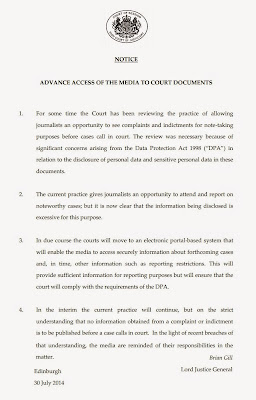
What is little short of a judicial proclamation from Lord Gill, originally marked ‘not for publication’ but now available HERE on the Scottish Court Service website, states “For some time the Court has been reviewing the practice of allowing journalists an opportunity to see complaints and indictments for note-taking purposes before cases call in court.” 

The judge goes on to claim court staff have disclosed “excessive” amounts of information to journalists on cases citing unspecified “recent breaches” of the current understanding between courts and the media on how cases are reported in the press. The judge then makes reference to the Data Protection Act 1998 as an excuse for blocking transparency in court activities.

Lord Gill concludes his edict on press freedoms by stating “the media are reminded of their responsibilities in the matter.”

This latest anti-transparency move by Lord Gill, who signed the media order as Lord Justice General, has drawn criticism from legal insiders who accuse the top judge of creating a de facto media law which may considerably affect or even alter the outcome of cases in court.

It is also clear Lord Gill’s sweeping judicial notice - widely being interpreted as a major policy statement from Scotland’s top judge, has come about with little open debate, discussion or consultation with Parliament.

A solicitor speaking to Diary of Injustice criticised the secrecy move by Scotland’s top judge, claiming Lord Gill’s threatened ban on the press may alter the course of justice where media attention and public interest in how the courts handle cases is both desirable and a necessity in a democratic society.

He said: “If the Lord President is minded to ban the media from court access to cases, does this also have implications for litigants and legal teams who may also be prevented in the future from securing necessary access to information and evidence crucial to a person’s right to a fair hearing?”

Lord Gill’s media policy statement:

NOTICE: ADVANCE ACCESS OF THE MEDIA TO COURT DOCUMENTS

1. For some time the Court has been reviewing the practice of allowing journalists an opportunity to see complaints and indictments for note-taking purposes before cases  call in court.The review was necessary because of significant concerns arising from the  Data  Protection Act 1998 (“DPA”) in relation to the disclosure of personal data and sensitive personal data in these documents.

2.  The current  practice  gives  journalists  an  opportunity to attend and report  on noteworthy cases; but  it is now clear that the information being disclosed is excessive for this purpose.

3.  In due course the courts will  move to an electronic  portal-based system  that will enable the media  to access  securely  information about  forthcoming  cases and,  in  time,  other  information  such  as  reporting  restrictions.  This  will provide sufficient information for reporting  purposes  but will ensure that  the court will comply with the requirements of the DPA.

4.  In  the  interim  the  current  practice  will  continue,  but  on  the  strict understanding that no information obtained from a complaint or indictment is to be published before a case calls in court.  In the light of recent breaches of that  understanding,  the  media  are  reminded  of  their  responsibilities  in  the matter.

Brian Gill Lord Justice General Edinburgh 30 July 2014

SCOTLAND’S ANTI TRANSPARENCY TOP JUDGE :

Scotland’s top judge Lord President Lord Brian Gill fiercely opposes calls for any form of transparency & public accountability of the judiciary and Scotland’s Courts.

Over the course of nearly two years, Scotland’s top judge Lord Gill has focussed his anger on a Scottish Parliament investigation into calls for a register of judicial interests. The register proposal would reveal the judiciary's vast personal, undeclared wealth, extensive family and business connections throughout the legal profession, links to big business, offshore trusts & investments, ownership of numerous and high value properties through a variety of ‘creative’ arrangements, directorships, shareholdings, and even unpublished criminal records of members of the judiciary.

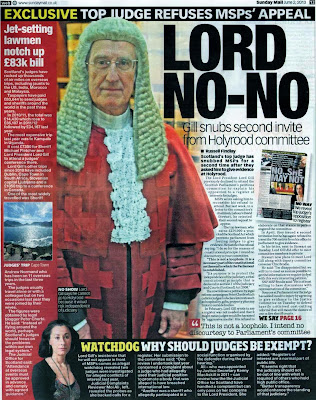
Lord Gill refused at least two invitations to appear before the Scottish Parliament to give evidence and face questions on his opposition to the proposal to create a register of judicial interests. The top judge has also used the Scotland Act as a loophole to avoid further scrutiny on the matter.

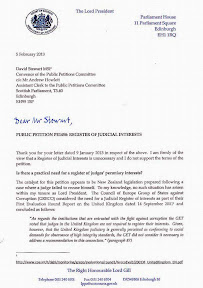
Lord Gill’s challenge to MSPs declared judicial opposition to transparency. In Lord Gill’s opening letter to MSPs on the call for a register of judicial interests, the judge claimed “In practical terms it would be impossible for all judicial office holders to identify all the interests that could conceivably arise in any future case. The terms of the Judicial Oath and the Statement of Principles of Judicial Ethics ensure that such a difficulty does not arise and that the onus is on the judicial office holder to declare any interest at the outset.”

In what was a hint of the sheer hostility felt by the judiciary against a call to bring transparency to judges interests, Lord Gill went onto accuse the media, press, litigants, court users and just about everyone else with an interest in transparency of being potentially hostile and aggressive, simply because someone may wish to raise questions of judges interests similar to the same kinds of questions which are raised of interests in other public officials and those in public life, politics & government.

And, if MSPs were unsure of the depth of Lord Gill’s attitude towards transparency, the top judge went on to refuse to appear before the Scottish Parliament, and used a loophole in the Scotland Act to justify his sweeping declaration he did not require to answer questions from Scotland’s democratically elected politicians.

Lord Gill’s use of Scotland Act against MSPs was reported in the media. Writing in a letter to msps, Lord Gill implied cooperation with Parliament would be withdrawn over calls to make judges more transparent in register : “Section 23(7) of the Scotland Act provides inter alia that the Parliament may not require a judge to attend its proceedings for the purposes of giving evidence. This is not a loophole. It is a necessary part of the constitutional settlement by which the Parliament is established. Its purpose is to protect the independence of the judiciary, a vital constitutional principle that is declared in section 1 of the Judiciary and Courts (Scotland) Act 2008”

The judge continued: “When a committee invites a judge to give evidence before it, I have to decide whether the subject matter might infringe the principle of judicial independence; and whether the evidence required could be satisfactorily given in writing.”

At a time when questions are being asked as to why Scotland’s antiquated, slow moving and expensive justice system has not kept pace with reforms to other public services, Lord Gill’s attempt to cover over the failures of Scots justice by closing down media access to the courts raises questions over the honesty of proposed changes contained in legislation currently going through the Scottish Parliament, changes which are derived from many recommendations Lord Gill once made in his Civil Courts Review.

Lord Gill’s latest Victorian venture has no place in a modern society in 2014, where courts funded by the public purse to the tune of enormous sums of money must be transparent, accountable and open to all, instead of being run by an ageing judiciary as a symbol of personal power, secretive wealth & undeclared interests and ultimately, nothing short of a business venture for the legal profession.

Previous articles on the lack of transparency within Scotland’s judiciary, investigations by Diary of Injustice including reports from the media, and video footage of debates at the Scottish Parliament’s Public Petitions Committee deliberations on Petition PE1458: Register of Interests for members of Scotland's judiciary can be found here : A Register of Interests for Scotland's Judiciary

Thursday, July 31, 2014

SNOOPED OFF: Lawyer involved in £500K public contract industrial espionage complaint struck off by Scottish Solicitors Discipline Tribunal

Lawyer copied details of rival law firm’s bid to win £500K public contract. A SOLICITOR from the Edinburgh based law firm Dundas & Wilson has admitted stealing details from rival law firm Brodies LLP in order to win a £500,000 public contract involving five Scottish local authorities who proposed to share services for waste management and recycling.

Lawyer Keith Armstrong (41) who resigned from Dundas & Wilson in July 2012 after representatives of Renfrewshire Council contacted the law firm over the similarity of details contained in competitive bids, admitted in evidence to the Scottish Solicitors Discipline Tribunal he stole details from rival law firm Brodies LLP in order to help win the contract.

It transpired from the tribunal hearing that documents which Armstrong had ‘acquired’ came from papers held by his partner, Kate Mayor (36) who was at the time business development manager for Brodies LLP.

As a result of the tribunal hearing, Keith Armstrong has subsequently been struck off the roll of solicitors. He now works for energy giant SSE PLC, (formerly Scottish & Southern Electricity), who were recently fined £10.5m by industry regulator Ofgem for mis-selling gas & electricity contracts

The Scottish Sun reports:

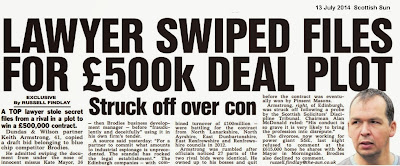
LAWYER SWIPED FILES FOR £500K DEAL PLOT

Exclusive: By Russell Findlay 13 July 2014 Scottish Sun

A TOP lawyer stole secret files from a rival in a plot to win a £500,000 contract. Dundas & Wilson partner Keith Armstrong. 41. copied a draft bid belonging to blue chip competitor Brodies.

He admitted swiping the document from under the nose of innocent missus Kate Mayor, 36 - then Brodies business development manager before “fraudulently and deceitfully” using it in his own firm's tender.

A source said yesterday: "For a partner to commit what amounts to industrial espionage is unprecedented. The scandal has rocked the legal establishment."

The Edinburgh companies with combined turnover of £100million were battling for the contract from North Lanarkshire. North Ayrshire. East Dunbartonshire. East Renfrewshire and Renfrewshire councils in 2012.

Armstrong was rumbled after officials noticed 27 parts of the two rival bids were identical. He owned up to his bosses and quit before the contract was eventually won by Pinsent Masons.

Armstrong, right, of Edinburgh. was struck off following a probe by the Scottish Solicitors' Discipline Tribunal. Chairman Alan McDonald ruled: "His conduct is so grave it is very likely to bring the profession into disrepute."

The divorcee, now working for power giant SSE. last night refused to comment at the £615.000 home he shares with Ms Mayor in Morningside. Brodies also declined to comment.

SSDT REPORT CENSORED IDENTITIES OF LAW FIRM:

Curiously, the opinion published by the SSDT directed that neither Brodies LLP or Mr Armstrong’s current employer Scottish & Southern Energy should be mentioned by name or identified in any way in the report …

Tribunal heard lawyer ‘copied’ terms of bid from competitor. On or around 22 May 2012 a representative of RC (Renfrewshire Council) contacted D&W (Dundas & Wilson), noting that some concern had arisen in respect of certain similarities between the Tenders submitted by D&W and that submitted by another Tenderer. RC had compiled a comparison document setting out the relevant text of concern and by email of 22 May 2012 invited D&W to attend a meeting on 24 May 2012  to  discuss  matters. 

The  other Tenderer, namely  Firm  X (Brodies LLP), was  also invited to a similar  meeting  on that  date. D&W immediately  commenced  an internal investigation. In the course of said investigation the Respondent admitted to D&W that  he  had  been  responsible  for  the  text  that  had  been highlighted and  that  he  had  plagiarised  these  from  another Tender document for the project belonging to Firm X.

In  particular  the Respondent accepted that on 28 or 29 April 2012 at his dwelling  house, without the permission or consent of  his  partner,  Ms  B,  who  was  at  the  time  a  Business Development  Manager  at  Firm  X, he accessed  the Tender as prepared  by  Firm  X  for  the  project,  copied  parts  of  said  draft Tender  and  made  use  of  that  information  when  completing D&W’s  Tender  for the project.

Amstrong was represented at the hearing by William Macreath of the Legal Defence Union & Levy McRae, the Law Society of Scotland was represented by Elaine Motion QC.

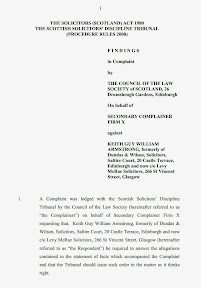
Tribunal Decision : The Tribunal having considered the Complaint at the instance of the Council of the Law Society of Scotland on behalf of Firm X against Keith Guy William Armstrong, formerly of Dundas & Wilson, Solicitors, Saltire Court, 20 Castle Terrace, Edinburgh and now c/o Levy McRae Solicitors, 266 St Vincent Street, Glasgow;

Find the Respondent guilty of Professional Misconduct in respect of his having accessed confidential information belonging to another firm of solicitors in relation to a project, having copied and thereafter used part of that firm’s Tender document in his own firm’s Tender and his fraudulently and/or deceitfully having allowed it to be submitted as his own firm’s work bringing his integrity into question;

his actions being deliberate and wholly inconsistent with the requirements to maintain mutual trust and confidence with his fellow solicitors in allowing a Tender to be submitted, part of which had been plagiarised from another firm’s Tender which he knew or ought to have known, was not only confidential but was of a commercially sensitive nature and his actions drawing the profession at large into disrepute;

Strike the Respondent Keith Guy William Armstrong from the Roll of Solicitors in Scotland;

Find the Respondent liable in the expenses of the Complainers and of the Tribunal including expenses of the Clerk, chargeable on a time and line basis as the same may be taxed by the Auditor of the Court of Session on an agent and client, client paying basis in terms of Chapter Three of the last published Law Society’s Table of Fees for general business with a unit rate of £14.00; and Direct that publicity will be given to this decision and that this publicity should include the name of the Respondent but will not include the name of Firm X or the Respondent’s current employer or otherwise identify them.

Thursday, July 10, 2014

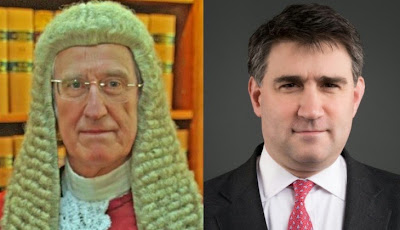
RISING SON: Scotland’s top judge Lord Gill forced to stand aside from Court of Session case because Advocate “relative” on respondent’s legal team is judge’s son

Top judge Lord Gill steps aside from case due to son’s involvement. SCOTLAND’S top judge, the Lord President Lord Brian Gill has been forced to stand aside from hearing an unidentified case in the Court of Session because “ a relative” - who turned out to be one of Lord Gill’s sons, represented a party involved in the court case.

The move by Lord Gill comes after a deal was reached with MSPs to publish reasons for judges standing aside in cases - reasons which have for the main, remained secret and unrecorded until the Scottish Parliament’s Petitions Committee began an investigation into proposals to create a full register of judicial interests, as called for in Petition PE1458: Register of Interests for members of Scotland's judiciary.

However, the first ever recoded recusal of the country’s top judge published by the Judiciary of Scotland in the new recusal list available here: Judicial Recusals, vaguely describes Lord Gill’s withdrawal from the case as due to a “Relative of Senator acts for the respondent” - whereas in fact it can now be revealed the “relative” turned out to be the Lord President’s son, Brian Gill QC.

At first, the Judicial Office refused to confirm the identity of Lord Gill’s “relative”.

A spokesperson for the Judicial Office stated: “We cannot provide any comment or further details in addition to what has already been published, but we can confirm that the advocate is one of the Lord President’s sons.”

The identity of Lord Gill’s son, Brian Gill QC - referred to as a “relative” in the official version was later confirmed by the Judicial Office but no details of the case being heard in Scotland’s top court which prompted the recusal were released.

Speaking to Diary of Injustice earlier today, a legal insider said: “Clearly it is of limited value to the public and court users if no one is able to find out the real reason the Lord President himself was forced to step aside from a case, and who exactly that person is and why it prompted a recusal.”

He continued: “When it comes to business links and family relationships of the judiciary impacting on litigation, it is clearly in the public interest the precise relationship of the judge to the individual, law firm, expert witness or otherwise and their identity should be published by the Judicial Office and made a matter of public record.”

In February 2014 the Lord President and Lord Justice General, Lord Gill gave an undertaking to make publicly available information about cases in which a judge or sheriff formally recuses him or herself from hearing a case. MPs were promised the fact of recusal and the reason for it will be published by the Judicial Office as notification of recusal is received.

However,it is noticeable from the current published list of judicial recusals there has not been one single recusal by a member of the judiciary on financial related grounds.

The lack of recusals by judges on financial related matters comes even though a considerable number of cases are in the Scottish courts where matters such as personal investments, creative finances & property ownership of members of the judiciary would certainly prompt cause for concerns if they were made public - some of which have already been highlighted by the media in previous reports.

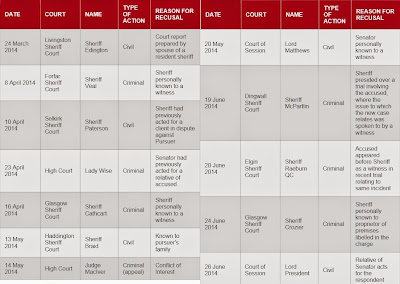
Judicial Recusals to 26 June 2014:

24 March 2014 Livingston Sheriff Court Sheriff Edington Civil Court report prepared by spouse of a resident sheriff.
8 April 2014 Forfar Sheriff Court Sheriff Veal Criminal Sheriff personally known to a witness.
10 April 2014 Selkirk Sheriff Court Sheriff Paterson Civil Sheriff had previously acted for a client in dispute against Pursuer.
23 April 2014 High Court Lady Wise Criminal Senator had previously acted for a relative of accused.
16 April 2014 Glasgow Sheriff Court Sheriff Cathcart Criminal Sheriff personally known to a witness.
13 May 2014 Haddington Sheriff Court Sheriff Braid Civil Known to pursuer's family.
14 May 2014 High Court Judge MacIver Criminal (appeal) Conflict of Interest.
20 May 2014 Court of Session Lord Matthews Civil Senator personally known to a witness.
19 June 2014 Dingwall Sheriff Court Sheriff McPartlin Criminal Sheriff presided over a trial involving the accused, where the issue to which the new case relates was spoken to by a witness.
20 June 2014 Elgin Sheriff Court Sheriff Raeburn QC Criminal Accused appeared before Sheriff as a witness in recent trial relating to same incident.
24 June 2014 Glasgow Sheriff Court Sheriff Crozier Criminal Sheriff personally known to proprietor of premises libelled in the charge.
26 June 2014 Court of Session Lord President Civil Relative of Senator acts for the respondent.

With no recusals on financial grounds - due to judges refusing to disclose hidden investments, secret wealth, work for law firms & offshore tax trusts among other interests … the current way the recusal data is presented is worth little to the public or court users and does not promote increased transparency of Scotland’s judiciary.

Previous articles on the lack of transparency within Scotland’s judiciary, investigations by Diary of Injustice including reports from the media, and video footage of debates at the Scottish Parliament’s Public Petitions Committee deliberations on Petition PE1458: Register of Interests for members of Scotland's judiciary can be found here : A Register of Interests for Scotland's Judiciary