Wednesday, April 23, 2014

THE MAD, THE BAD & THE SAD: Scots financially ruined by rogue lawyers are ridiculed at secret briefing with Scottish Legal Complaints Commission as solicitors demand their victims should be forced to pay for complaints

Secret discussions held at ‘independent’ regulator on reducing complaints & making victims of dodgy lawyers pay for a slap on the wrist. DOCUMENTS obtained under Freedom of Information legislation have revealed that pro lawyer lobby group the Legal Defence Union (LDU), and the ‘independent’ Scottish Legal Complaints Commission (SLCC) which is staffed mainly by lawyers who are supposed to investigate complaints against corrupt lawyers, held private briefings where fee paying clients of dodgy Scottish solicitors were targeted & verbally abused as “mad, bad and sad” in secret discussions containing a wide variety of proposals aimed at silencing members of the public who complain against their solicitor.

And, in an effort to dissuade financially clients ruined from making complaints against their lawyers to the multi million pound SLCC which is kept afloat by contributions recouped from clients fees to the tune of nearly £3million a year, it has been proposed, with the knowledge of the Law Society of Scotland that victims of dodgy lawyers who have already been ripped off, may be forced to pay large sums of money to the regulator itself, otherwise complaints against crooked lawyers WILL NOT be investigated.

So serious are the proposals to force victims to pay for an investigation into crooked lawyers, a legal insider close to the discussions has revealed that figures as high as ONE THOUSAND POUNDS per complaint have been secretly discussed by a number of pro-lawyer groups intent on defending their colleagues from being investigated for ripping off their clients.

The plan, to force victims of dodgy lawyers to cough up even more money for regulators to investigate complaints which usually only end up with a slap on the wrist anyway, also appears to have JUDICIAL BACKING after legal insiders involved in the discussions made it clear that senior members of Scotland’s judiciary have been consulted on, and have given unofficial support to the moves aimed at preventing members of the public from being able to have any complaints against lawyers properly investigated.

One member of the judiciary, who has previously heard civil claims against solicitors in the Court of Session, and who is known to have close links to the Law Society, has even suggested the move would help prevent clients from being able to take their lawyers to court in cases the judge described in a remark as “boring, time consuming and irrelevant”.

In a further account of activities at the Scottish Legal Complaints Commission days after the briefing with the Legal Defence Union had taken place, apparently staff at the regulator broke into laughter and told rounds of jokes about clients who had approached them for help after being financially ruined by their solicitors. However, there are no records of any disciplinary action being taken at the SLCC over these incidents which allegedly continue to present day.

The Scottish Legal Complaints Commission has not published or made any comment on why clients who approach the regulator for help in dealing with rogue solicitors continue to be treated in this way by its staff and organisations which influence the regulator’s day to day workings, including how complaints are investigated.

And it is still the case that many clients of Scottish solicitors who approach the SLCC for help are often treated to a months, if sometimes years long hell where often complex complaints alleging fraud committed by Scottish solicitors are curiously ditched after lawyers have their say.
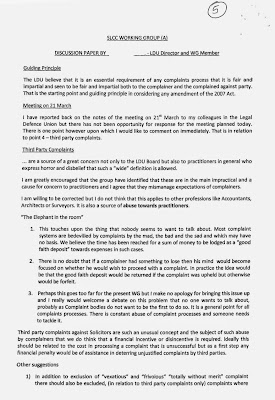
You may be mad, bad or sad, but only after your lawyer took all your money – Secret Legal Defence Union briefing to regulator says spare the lawyer, fleece the client for a little more.

Guiding Principle

The LDU believe that it is an essential requirement of any complaints process that it is fair and impartial and seen to be fair and impartial both to the complainer and the complained against party. That is the starting point and guiding principle in considering any amendment of the 2007 Act.

Meeting on 21 March

I have reported back on the notes of the meeting on 21st March to my colleagues in the Legal Defence Union but there has not been opportunity for response for the meeting planned today.There is one point however upon which I would like to comment on immediately. That is in relation to point 4 - third party complaints.

Third Party Complaints

... are a source of a great concern not only to the LDU Board but also to practitioners in general who express horror and disbelief that such a "wide" definition is allowed.

I am greatly encouraged that the group have identified that these are in the main impractical and a cause for concern to practitioners and I agree that they mismanage expectations of complainers.

I am willing to be corrected but I do not think that this applies to other professions like Accountants, Architects or Surveyors. It is also a source of abuse towards practitioners.

"The Elephant in the room"

1. This touches upon the thing that nobody seems to want to talk about. Most complaint systems are bedevilled by complaints by the mad, the bad and the sad and which may have no basis. We believe the time has been reached for a sum of money to be lodged as a "good faith deposit" towards expenses in such cases.

2. There is no doubt that if a complainer had something to lose then his mind would become focused on whether he would wish to proceed with a complaint. In practice the idea would be that the good faith deposit would be returned if the complaint was upheld but otherwise would be forfeit.

3. Perhaps this goes too far for the present WG but I make no apology for bringing this issue up and I really would welcome a debate on this problem that no one wants to talk about, probably as Complaint bodies do not want to be the first to do so. It is a general point for all complaints processes. There is constant abuse of complaint processes and someone needs to tackle it.

Third party complaints against Solicitors are such an unusual concept and the subject of such abuse by complainers that we do think that a financial incentive or disincentive is required. Ideally this should be related to the cost in processing a complaint that is unsuccessful but as a first step any financial penalty would be of assistance in deterring unjustified complaints by third parties.

Other suggestions

1) In addition to exclusion of "vexatious" and "frivolous" "totally without merit" complaint there should also be excluded, (in relation to third party complaints only) complaints where the Solicitor is simply doing his job. The current test of whether the complainer has been affected by the Solicitor's actings is far too wide. If a Solicitors letter or cross-examination etc does not affect another person then the Solicitor is not doing his job!

The Solicitor's job is to represent his own client and that may involve telling another person truths that the other person will not like. Cross-examination by a Solicitor frequently is designed to challenge a witness's account or truthfulness and has to be robust. Therefore excluding complaints about the Solicitor doing his job would assist.

2) Also "totally without merit" is very difficult to demonstrate and a new wording could be say, "without substantial (and demonstrable?) merit". Do not forget that third parties can sue the solicitor if they can prove their case but the Complaints process main purpose is to ease complaints by the client not a third party and the two should not be equated.

Points raised by James McCann - Chairman of LDU

1. IPS awards and compliance by "set-off,.

The right of the Solicitor to exercise a right of "set-off" was generally accepted by the Law Society of Scotland (LSS) under the former complaints regime although it never needed to be determined by a Court judgement so far as we know. It is a general matter that applies not just to Solicitors but to anybody in a debtor and creditor relationship and is an invariable aspect of business dealings at common law and under a very old Compensation Act.

The basic idea of course is that if the Solicitor is owed money by the client then any IPS award should be set off so as to reduce the amount that the Solicitor has to pay or to reduce the amount which the complainer has to pay to the Solicitor.

This is at variance with SLCC policy document in paras 4.45 to 4.57. This appears to be ultra vires of SLCC. It is difficult to see why SLCC should want to remove or limit such a common sense and time honoured device as set off. Indeed in mediation cases the complaint issue and the claim for balance of fees are incorporated as natural parts of the same discussion and that is certainly so in the vast majority of conciliations that are reached so as to settle a complaint even before it comes to SLCC.

2. Anonymous committees.

There are still anonymous committees sitting on determination of service complaints. Under the former complaints regime LSS published the people who sit on various committees. The new SLCC procedures appears to have taken a step back.

An SLCC Case Investigator (who is indentified) will often produce a commendably detailed and careful analysis of the file and find no basis for criticising the Solicitor. It can be infuriating when (after the Solicitor through his advisor accepts that recommendation as a sensible and practical way of dealing with the case) you can suddenly receive from an anonymous committee an unexplained decision which reverses what the Case Investigator has done. Often when that new and adverse view appears in the form of a draft determination an advisor might try to change it but it is too late.

The LDU do not think there is any place for anonymous committees in a modern regulatory system. We frequently hear the term "transparent" policies and procedures and this has to be a cornerstone of any fair and impartial complaints service

3. Hybrid complaints.

The method of dealing with these is absurd.

The problem is that there is a complete lack of sift at the point in time when cases are going to LSS. The Act provides for an appeal but this has to be taken back at the beginning of the whole procedure when the matter comes through the single gateway at SLCC.

A client could put in a list of 10 to 15 headings of complaint of which two or three are deemed potentially "hybrid". It makes no sense at all to be appealing the admission of any conduct elements at that stage when they are only a "add on" to the whole list of service issues and where on any view the service issues are going to be admitted for consideration.

Once the service issues are resolved there is then the hybrid issue having to go all the way through the LSS system as they were seen at the original point of admission (perhaps a year or so before) as having some conduct element. It is expensive for LSS and indeed for the LDU to pay for a process which (assuming all the service headings have been dismissed in the first place) seems hardly likely to produce a conduct issue for LSS. Surely the construction of a conduct (sift) at the point in time when the supposed conduct issues are actually going to LSS could be devised and constructed.

4. Duty to liaise and consult

We have concerns that Section 5 of the 2007 Act imposing a duty on the SLCC and LSS to liaise and consult is not visible and not being maximised.

Section 5 can only be construed as intending a careful process at the point of admission of a conduct issue against the Solicitor and effectively a duty to sit out non complaints.

END OF PAPER

FRIENDS TOGETHER - LEGAL DEFENCE UNION & ‘INDEPENDENT’ REGULATOR:

The Legal Defence Union’s briefing to the Scottish Legal Complaints Commission is part of a history where the LDU and the SLCC have met to shape policy.

An earlier investigation by Diary of Injustice into dealings between the Scottish Legal Complaints Commission and the Legal Defence Union, -  linked to blocked criminal prosecutions of legal aid fraudster lawyers and the suicide of a married Oban family man in the SLCC’s 2009 report into the Master Policy, revealed a series of cosy meetings between the regulator & pro-lawyer lobby group at expensive Edinburgh hotels which the heads of both organisations agreed to keep off the record and away from public gaze. Read more here: Investigation reveals Scottish Legal Complaints Commission's links, secret 'off the record' dealings with lawyers lobby group Legal Defence Union

Lawyer pocketed 600K Legal Aid in Two Years Sunday Mail March 27 2011

Legal Defence Union helped negotiate away Legal Aid complaints against soliictor accused of nearly £700K claims. The Legal Defence Union has also found itself in the media spotlight during an investigation into Niels S Lockhart, a Kilmarnock sole practising solicitor who scooped nearly £700K of legal aid funds in three years, and was only stopped after the Scottish Legal Aid Board filed complaints to the Law Society of Scotland. The Legal Defence Union ultimately brokered a secret deal between SLAB and the Law Society which allowed Lockhart to remove himself from the legal aid register.

Niels Lockhart was the subject of lengthy investigations by the Scottish Legal Aid Board which were uncovered by Diary of Injustice & the Sunday Mail newspaper, reported earlier here : One law for lawyers : Secret Report reveals Legal Aid Board, Law Society & Legal Defence Union ‘cosy relationship’ in Lockhart case

The Legal Defence Union then intervened again when the Scottish Legal Complaints Commission received complaints against Niels Lockhart, featured in an article here: SCANDAL : Legal Defence Union intervene in SLCC investigation over £670K Legal Aid lawyer who made Pensioner HOMELESS, STARVED to pay legal bills

Diary of Injustice also published the Scottish Legal Aid Board’s S31 complaint report on Niels Lockhart to the Law Society of Scotland, also obtained after a Freedom of Information disclosure, here : SCOTTISH LEGAL AID BOARD S31 COMPLAINT REPORT TO THE LAW SOCIETY OF SCOTLAND : NIELS S LOCKHART

Saturday, April 19, 2014

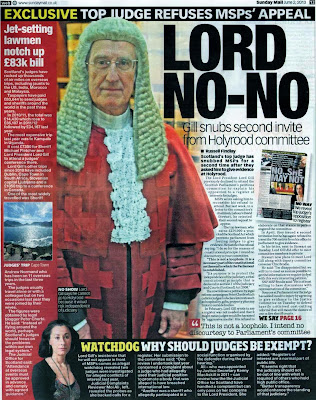
WIGS TODAY, GONE TOMORROW: Top Judge would rather drop wigs, ermine robes than declare judiciary’s wealth, directorships & links to big business in register of judicial interests proposal

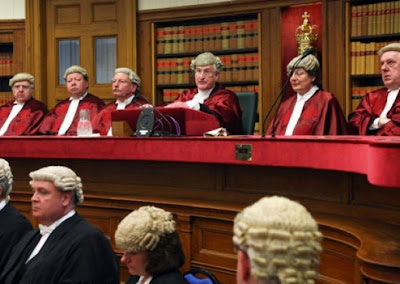
Lord President Lord Brian Gill reckons its easier to drop wigs than declare full interests in public register. LET’S face it, appearing in front of a group of ageing, yet influential, wealthy, secretive, and at times argumentative individuals who wear lengthy grey wigs, are draped ever so self indulgently in red & white ermine robes covered in red crosses, carry what appear to be a variety of implements, and on many occasions appear to have difficulty in operating a laptop, difficulty recalling the names of expert witnesses or referring back to evidence from previous hearings, is an intimidating experience. It certainly is an intimidating experience for many in Scotland.

Even more intimidating if you consider that these same individuals all live more or less in the same affluent areas, move in the same circles, go to the same clubs, have offshore investments,  own swathes of property while avoiding their name appearing on it, refuse to declare their interests or directorships openly, occasionally threaten the Scottish Parliament when it suits, have numerous & serious criminal convictions no one gets to know of, and, not forgetting that some are closely related to each other and switch their names around so you don't know if you have been before one of their parents or siblings in an earlier hearing.

This is not what you really expect to find in a court is it. Not in Scotland, in 2014. Surely not.

However, as we have seen from well over a year of media investigations and headlines of the secrets of Scotland’s judiciary, together with a full year of debate at the Scottish Parliament’s Public Petitions Committee - this is the true state of fact of Scotland’s courts and the judiciary today, and sadly has been for some time. Whether it is a criminal prosecution, or a civil damages case, these are the lives and the undeclared interests of the judges who hear you out.

The judiciary's personal, undeclared wealth including extensive family and business links throughout the legal profession, offshore ‘tax efficient’ trusts, ownership of numerous and high value properties through a variety of interesting arrangements, investments, directorships and shareholdings, collectively generate millions of pounds in earnings for the judges and their families each year – yet no one gets to know about it, because the judges have written their own rules exempting themselves from the same requirements of transparency they enforce against the rest of us.

So, when Scotland’s top judge decides it is time to make an attempt to make judges appear more “human” to the public, (but not more transparent or accountable) it is obviously an exercise in newsworthiness.

To this end, Scotland’s top judge, the Lord President Lord Brian Gill earlier this week declared in an official statement that “From Tuesday 22 April 2014 Senators of the College of Justice sitting in the Inner House will no longer wear formal robes and wigs when hearing civil appeals.”

Following a proposal by the Lord President the judges sitting in the Inner House have endorsed this change.  However, judges will continue to wear formal robes and wigs when hearing criminal appeals.

Eleven judges currently sit in the Inner House, which is the appellate section of the Court of Session.  The Inner House acts as a court of appeal for cases from the Outer House (Court of Session first instance courts) and for appeals in civil cases from the Sheriff Courts, the Court of the Lord Lyon, Scottish Land Court, the Lands Tribunal for Scotland, and other tribunals.

The Lord President has issued a Practice Note that counsel may appear without wig and gown and that solicitors with rights of audience may appear without gowns.

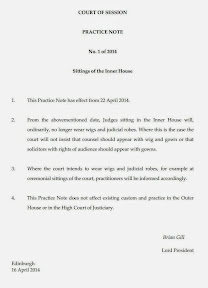
PRACTICE NOTE

No. 1 of 2014 Sittings of the Inner House

1. This Practice Note has effect from 22 April 2014

2. From the abovementioned date, Judges sitting in the Inner House will, ordinarily, no longer wear wigs and judicial robes.  Where this is the case  the court will not insist that counsel should appear with wig and gown or that solicitors with rights of audience should appear with gowns

3. Where the court intends to wear wigs and judicial robes,  for example at ceremonial sittings of the court, practitioners will be informed accordingly.

4. This Practice Note does not affect existing  custom and practice in the Outer House or in the High Court of Justiciary.

Brian Gill Lord President Edinburgh 16 April 2014

Lord Gill said of the changes: “In deciding to sit in civil appeals without robes or wigs the judges of the Inner House are in line with the practice of the United Kingdom Supreme Court. It makes sense in this day and age.”

Yet, it appears that while it is a simple matter for Scotland’s top judge to approve the removal of the judges much coveted symbols of judicial power and vested interests in this day and age, it is not so simple an act nor is it in the judiciary’s best interests to fall into line with the rest of the world in terms of transparency and declare their very much undeclared interests to the Scottish Parliament in connection with calls to create a register of judicial interests as called for in Petition PE1458: Register of Interests for members of Scotland's judiciary.

TOP JUDGE DROPS WIGS, CONTINUES PROTESTS AGAINST TRANSPARENCY REGISTER:

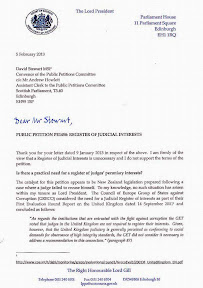
Lord Gill’s first letter to MSPs declared judicial opposition to transparency. In Lord Gill’s opening letter to MSPs on the call for a register of judicial interests, the judge claimed “In practical terms it would be impossible for all judicial office holders to identify all the interests that could conceivably arise in any future case. The terms of the Judicial Oath and the Statement of Principles of Judicial Ethics ensure that such a difficulty does not arise and that the onus is on the judicial office holder to declare any interest at the outset.”

In what was surely a hint of the sheer hostility felt by the judiciary against a call to bring transparency to judges interests, Lord Gill went onto accuse the media, press, litigants, court users and just about everyone else with an interest in transparency of being potentially hostile and aggressive, simply because someone may wish to raise questions of judges interests similar to the same kinds of questions which are raised of interests in other public officials and those in public life, politics & government.

Clearly angered by the call for transparency, Lord Gill’s letter to MSPs stated: “The introduction of such a register could also have unintended consequences. Consideration requires to be given to judges' privacy and freedom from harassment by aggressive media or hostile individuals, including dissatisfied litigants. It is possible that the information held on such a register could be abused. These are significant concerns. If publicly criticised or attacked, the judicial office holder cannot publicly defend himself or herself, unlike a politician. The establishment of such a register therefore may have the unintended consequence of eroding public confidence in the Judiciary. It also raises the question whether such a measure would have an adverse impact on the recruitment and retention of the Judiciary.”

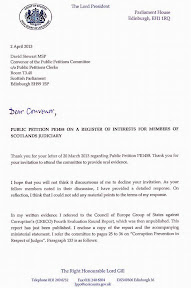
Top judge Lord Gill refused to go to Holyrood, by letter. In a second reply to the Convener of the PPC, dated 2 April 2013, Lord Gill refused an invitation to attend the Scottish Parliament and face questions from Committee members on issues raised in the petition and to explain his own opposition to the transparency proposal.

Notably, Gill’s second reply did not contain any answers to questions put to him in writing by the Petitions Committee, nor did the judge provide any statistical or analytical evidence on the numbers of recusals which have been undertaken by judges in Scotland’s courts. However, seeking once again to lobby MSPs against any call for transparency of judges interests, the Lord President again referred to the content of an EU report, itself written by judges, who claimed there was no need for a register of judicial interests.

A further invitation was sent to Lord Gill by the Convener of the Public Petitions Committee, asking for answers to questions and again inviting the Lord President to addend the Scottish Parliament to give evidence on Petition PE1458: Register of Interests for members of Scotland's judiciary

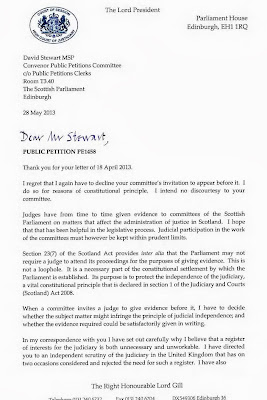
Third letter from top judge refused Holyrood invitation, used Scotland Act loophole. Having received the third letter containing a second invitation to attend Holyrood, Lord Gill wrote back to the Convener of the Public Petitions Committee on the 28 May 2013, again refusing to appear before MSPs to face questions on judges interests and his own opposition to the petition.

However, this time the top judge added a hint that judicial cooperation with Committees of the Scottish Parliament may suffer and must be limited.

In what appears to have been little short of a veiled threat to refuse further judicial cooperation with, and future Committee appearances at the Scottish Parliament, Gill stated: “Judges have from time to time given evidence to committees of the Scottish Parliament on matters that affect the administration of justice in Scotland. I hope that that has been helpful in the legislative process. Judicial participation in the work of the committees must however be kept within prudent limits.”

And, shockingly, Lord Gill then sought to use deficiencies in the Scotland Act to justify his refusal to attend the Public Petitions Committee and answer question from msps.

Gill’s use of Scotland Act against MSPs was reported in the media. Writing in his third letter, Lord Gill said: “Section 23(7) of the Scotland Act provides inter alia that the Parliament may not require a judge to attend its proceedings for the purposes of giving evidence. This is not a loophole. It is a necessary part of the constitutional settlement by which the Parliament is established. Its purpose is to protect the independence of the judiciary, a vital constitutional principle that is declared in section 1 of the Judiciary and Courts (Scotland) Act 2008”

The judge continued: “When a committee invites a judge to give evidence before it, I have to decide whether the subject matter might infringe the principle of judicial independence; and whether the evidence required could be satisfactorily given in writing.”

Previous articles on the lack of transparency within Scotland’s judiciary, investigations by Diary of Injustice including reports from the Sunday Mail newspaper, and video footage of debates at the Scottish Parliament’s Public Petitions Committee deliberations on Petition PE1458: Register of Interests for members of Scotland's judiciary can be found here : A Register of Interests for Scotland's Judiciary

Friday, April 18, 2014

Top judge Lord Gill tells lawyers to ‘take opportunity’, says Courts Reform (Scotland) Bill will not reduce access to justice in speech to Law Society vested interests

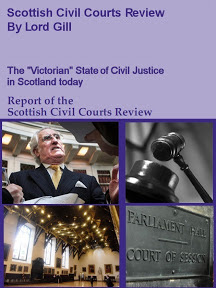
Top judge reassures lawyers court reforms will not dent their profits or interests. IN a speech to multiple vested interests attending the Law Society of Scotland’s recent Annual General Meeting, Scotland’s top judge, the Lord President Lord Brian Gill has defended proposals contained in the Scottish Government’s Courts Reform (Scotland) Bill, claiming the reforms, based on recommendations of the 2009 Civil Courts Review authored by Gill himself, will not reduce access to justice as some lawyers claim.

The judge went on to tell the audience of those who make billions of pounds out of Scotland’s courts & clients each year that the reforms would instead offer opportunities to the solicitors' profession.

Lord Gill, who has previously addressed the Law Society’s AGM in his capacity as Lord Justice Clerk, most notably when he criticised Scotland’s civil justice system as being unfit for purpose, and “Victorian” in its workings, was speaking as the first Lord President to address the AGM.

The speech “Looking over the horizon – life after the Courts Reform Bill” was intended to allay widespread fears within legal circles that lawyers fees, income and law firm’s profits will be hit by reforms to Scotland’s civil courts which include transferring cases of £150,000 or less to the Sheriff courts, where legal fees are significantly less compared with charges levied by solicitors for attending Scotland’s highest court, the Court of Session based in Edinburgh.

Speaking on the “private jurisdiction of the Court of Session”, Lord Gill said: “It has been recognised from the earliest  days of the  Review, that not all low value cases are straightforward. There can be many complicated issues  in any type of case, regardless of value. It is foolish to suggest that  all low value cases are straightforward. It is foolish likewise to suggest that all claims raised in the Court of Session involved complicated matters of law and procedure. Experience shows  that the  majority  of the low value claims  in the Court of Session  are  straightforward. In any event, the Bill makes  provision for cases to be remitted to the Court of Session in appropriate circumstances (clause 88).”

“Some respondents to the Bill’s consultation have raised concerns that the remit test is too restrictive. In my opinion, it is essential that the remit provisions are necessarily robust.No one wants to see the daily  sheriff  court rolls  or  those of  the Court of Session  clogged with motion after motion  for remits. That  would seriously undermine the principles of the Bill.”

“The increase in the privative jurisdiction and in time, the introduction of the specialist personal injury court should ensure that cases find their appropriate level in the court system. Expenses will be lower for the parties. Cases shall be dealt with more expeditiously than at present. The specialist sheriffs, in partnership with the profession, will  develop a body of specialist and authoritative case law.  A greater emphasis on case management and improved use of IT will  be introduced by way of court rules and  will  promote  a pro-active, front loaded litigation  that reduces the time spent waiting in court for short straightforward hearings.  At the same time efficiencies  will  be improved in the Court of Session.”

“The Court of Session  will continue to be the forum for high value  and  complex cases. Our hope is that these cases can be dealt with greater expediency as a result of the reforms,  so that cancellations of hearings  because of  lack of judges and/or court time  will be a thing of the past.”

“On the subject of the ‘development of Scots law’, Lord Gill claimed: “I do not expect that there shall be any reduction on the quality of decision making or any adverse effect on the development of Scots law.  It is to the credit of our shrieval bench that  the  great  majority of cases do not result  in  an  appeal to the higher courts.”

“In the main, the quality of decision making is good, and  is complemented by the Judicial Institute and the excellent  training  and support that  it  provides. The reforms as a whole will bring significant benefits to the quality of decision making in the sheriff courts.  The  introduction of the new tier of ‘summary sheriffs’  will  ensure that  summary crime, housing and low value financial claims are dealt with expeditiously at an appropriate level in the court system.”

“The summary sheriff will possess the same level of qualification and experience as sheriffs proper. The  new tier  will  remove a significant amount of business  from the daily work of the sheriffs, allowing them more time to concentrate on the more difficult cases.”

“The Sheriff Appeal Court will provide increased scrutiny in the decision-making and writing process  than under the present system where the  sheriff principal  sits  alone. It will have a greater understanding and insight into the daily workings of the sheriff court than is enjoyed by the Inner House.”

“When one views these aspects of the reforms together with the fact that at present, many  civil  appeals go no further than the  sheriff  principal, it is hoped that few  appeals  will  have  to  be taken from the Sheriff Appeal Court.”

“What opportunity does it present? It gives to every solicitor in Scotland the opportunity to develop skill in appellate advocacy and to develop an expertise that has hitherto been seen as the exclusive preserve of the Bar.”

On the “Right to Counsel”, Lord Gill said: “I accept that these changes shall impinge on the types of cases in which  counsel may be instructed  without  their fees requiring  sanction from the court. I do not accept however, that the implementation of the Bill  will  remove access to justice.”

“Those pursuers who, at present, choose to litigate in the sheriff court as opposed to the Court of Session have received no lesser  form of  justice. I do not accept that it is a requirement for  ‘access to justice’  that litigants are provided with the choice of litigating in a more expensive forum with the requirement that  counsel has to be instructed to represent their interests. Why?  Firstly, access to justice is inevitably and inextricably linked with affordability.”

Lord Mackay of Clashfern recognised that in address that he made to the Royal Society of Arts on that very subject: “There is no doubt that under our present [justice] system cost is a major barrier to using the law. Reducing costs should not be seen as an end in itself nor as an inevitability leading to a second-rate system of justice. Cost effectiveness pursued  in  the right way will lead to a more affordable system  and to my mind is the only logical way to expect access to justice to be improved. I would like to emphasise that message. Affordability is the key to improved access to justice. Affordability to the taxpayer and to the individual.”

The  changes proposed seek to make the system more affordable for the client consumer.  That improves access to justice. Secondly, litigants are not being denied access to the courts, nor representation.

In conclusion, Lord Gill stated to the audience of solicitors: “The  prospects, in my opinion,  should make us optimistic. Our  civil justice system will be  fit  to serve  the  modern society  in Scotland that the previous generation of lawyers would not have recognised  and  will  promote the fundamental principles that I mentioned at the outset.    I am certain that the Law Society and its members shall not only survive the  legislation,  but shall adapt  to it in its  commitment  to excellence.  The reforms provide an opportunity for the profession to diversify, renew itself and to improve upon the  work already undertaken in the  Review. The opportunity is there for the taking.  I urge you all to embrace it.”

There was no mention in Lord Gill’s speech of transparency regarding judicial interests, an issue currently under consideration at the Scottish Parliament by way of Petition PE1458: Register of Interests for members of Scotland's judiciary.

In terms of the lack of a register of judicial interests, litigants in Scotland’s courts currently have no basis to establish whether the judge hearing their case or even a judge involved in a criminal case, should be asked to recuse themselves or not due to conflicts of interest or financial and other interests that members of the judiciary are not keen on declaring openly. Therefore reforms of the courts as currently proposed do not go far enough to allow the public to determine whether cases are being heard fairly or not.

Previous articles on the lack of transparency within Scotland’s judiciary, investigations by Diary of Injustice including reports from the Sunday Mail newspaper, and video footage of debates at the Scottish Parliament’s Public Petitions Committee deliberations on Petition PE1458: Register of Interests for members of Scotland's judiciary can be found here : A Register of Interests for Scotland's Judiciary

Wednesday, April 16, 2014

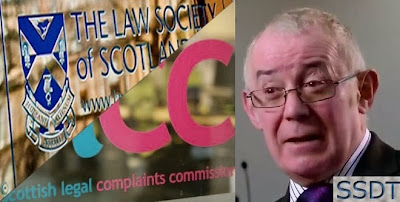
DISHONESTY TRIBUNAL: 35 cases of dodgy lawyers with a mere 9 struck off & 26 slaps on the wrist is a “busy year” claims Scottish Solicitors Discipline Tribunal

Dishonesty among lawyers is tolerated more in Scotland. A SCOTTISH TRIBUNAL tasked with judging corrupt lawyers and applying sanctions from a slap on the wrist to a striking off, is generally viewed as an old pals act back slapping exercise which tolerates dishonesty among the Scottish legal profession much more than it’s English counterpart, say critics & clients who have endured lengthy and in many cases almost pointless hearings of the Scottish Solicitors Discipline Tribunal (SSDT).

The SSDT, who claimed in a recent legal profession internal media story that they had been through a “very busy” year to 31 October 2013, revealed the tribunal heard a less than stellar 35 cases compared to 26 for the previous year. The Tribunal claimed it had a "significant increase in business" in its hearings, which now also include appeals by lay complainers against decisions of the Law Society of Scotland not to make a finding of unsatisfactory professional conduct.

However, out of the 35 cases which actually made it to the tribunal through the usual maze of self protecting self regulation where lawyers regulate themselves, a paltry NINE cases resulted in solicitors being struck off, with the remaining solicitors receiving slaps on the wrist, broken down as three suspended from practice, two had a restriction placed on their practising certificate, four were fined and censured and a further six were censured.

And, while the SSDT claims to take its duties to deal with the worst elements of dodgy lawyers seriously, it has been reported by the legal profession’s internal media that in only two of the cases brought before the tribunal in the past year, undisclosed amounts of compensation were ordered by the tribunal to be paid.

A summary of the cases heard before the tribunal in it’s “busy year” claimed that: “In all, nine cases involved failure to complete conveyancing procedures in a proper manner (with or without other failures), and the same number saw a failure to comply with the accounts rules. Eight cases involved misleading the Law Society of Scotland or other parties, and seven a failure to reply to the Society or others. There were numerous other findings of misconduct including five of dishonesty.”

As of today, the 2013 annual report has yet to be published on the tribunal website, which is well known for its lack of information and more often than not publishing of judgements months after they have occurred – a move viewed by many in the media as an attempt to hide the true scale of dishonesty and dodgy lawyers from the public’s attention.

DISHONESTY IS THEIR GAME: The Scottish way of dealing with dishonest lawyers often gives a slap on the wrist whereas solicitors found guilty of dishonesty stand a greater chance of being struck off in the rest of the UK:

Dishonesty in Scots solicitors more common than lawyers would have us believe. SCOTTISH solicitors “make false representations in order to improve their client’s position, not necessarily their own”. This was a claim made by solicitor Alistair Cockburn, Chairman of the Scottish Solicitors Discipline Tribunal (SSDT) in response to key questions raised by BBC Journalist Sam Poling in a recent investigative programme Lawyers Behaving Badly which is no longer available for public viewing.

The claims made by the tribunal Chief led to startling revelations over how the lawyer led discipline tribunal which is charged with making findings against members of Scotland’s legal profession deals with allegations & evidence of dishonesty against rogue solicitors.

Insisting the discipline tribunal was ‘robust’ and had a duty to the public, the Chair of the SSDT went on to justify his position, stating “One has to assess the extent to which anyone suffered in consequence of that dishonesty.  You have to take into consideration the likelihood of re-offending and then take a decision.” Mr Cockburn went onto claim dishonesty is not commonplace and would result in solicitors being struck off. The SSDT Chair told the BBC journalist: “Normally dishonesty will result in striking-off.”

In comparison to the light way in which the Scottish tribunal appears to treat dishonesty among legal colleagues in all its various shades, English legal experts who studied the judgements of the Scottish Solicitors Discipline Tribunal condemned the way dishonest lawyers are more often than not let off the hook in Scotland.

Speaking on a case where a well known Scottish solicitor accused many times before of dishonesty was at it again, English QC Andrew Hopper said on national television: “We’re dealing with a case of dishonesty and that affects the reputation of the profession. I would have expected this to result in striking off.”

Andrew Boon, Professor of Law added : “The critical thing is the risk factor. If somebody has been dishonest once the likelihood is that they are going to be dishonest again unless they’re stopped.”

Almost all complaints against solicitors indicate at at one stage or another, the solicitor was dishonest to their client, either by making a false representation to them as to the progress of their case, or making false representations to cover their own positions.

Very few complaints made by clients against Scottish solicitors which involve serious allegations of dishonesty have ever resulted in solicitors being struck off by the Scottish Solicitors Discipline Tribunal, and an ongoing media investigation into judges undeclared earnings from top Scots law firms has turned up links between serving members of Scotland’s judiciary, law firms, and solicitors who have frequently been accused of dishonesty yet never struck off.