Friday, June 14, 2013

‘Better Transparency would enhance Judiciary’ as Scotland’s independent Judicial Complaints Reviewer issues support for Register of interests for judges

Lord Gill Moi AliSecretive Judge trumped by transparency as Judicial Complaints Reviewer supports register of judge’s interests. SCOTLAND’S independently appointed Judicial Complaints Reviewer (JCR) Moi Ali, has told MSPs of her support for a public petition currently being discussed at the Scottish Parliament which seeks to create a statutory register of interests for Scotland’s highly secretive judiciary. The JCR’s support for Petition PE1458: Register of Interests for members of Scotland's judiciary has previously been reported in the Sunday Mail newspaper and Diary of Injustice, here : HERE

Moi Ali, Scotland’s first ever Judicial Complaints Reviewer has told MSPs in her letter to Holyrood’s Public Petitions Committee that “Better transparency would enhance the standing of that judiciary and bring judicial office holders into line with other holders of important roles in public life.”. Ms Ali went on in her response to dispel arguments put forward by the vested interests of the Lord President, Law Society of Scotland & others against the proposal.

In a move which contrasts sharply with the bitter hostility of Scotland’s top judge, the Lord President Lord Brian Gill to Petition PE1458, Ms Ali has taken a radical approach to issues put forward in the petition by creating a register of interests for the office of Judicial Complaints Reviewer, a register which is to be published soon on the JCR’s website.

Ms Ali told MSPs in her submission : “Registers of interest are now a normal part of public life and it seems right that the judiciary should not be out of line with what is required of others who hold high public office. I have completed registers of interest for my roles on public boards such as the Scottish Ambulance Service and Scottish Police Authority. It is not onerous to update this annually or when any changes in circumstance occur. Members of the Petitions Committee will have undertaken something similar themselves in their parliamentary life. Although not required to do so, I have prepared my own register of interest and will shortly be publishing it on my website. I believe that the JCR should be required to do this, either by legislation or as a requirement set out in their letter of appointment from the Minister.”

In a further bold move, the Judicial Complaints Reviewer told the Petitions Committee that any register of interests for judges should be expanded to include non financial interests and other links. Moi Ali stated : “Should a register of interests be limited to pecuniary interests? I believe that it should also encompass non-financial interests such as memberships, unpaid trusteeships, and any relevant close family/friendship links that may be perceived as a potential conflict of interest. One review I undertook last year concerned a complaint about a judge who had allegedly used their judicial position to promote a body that was alleged to have breached international law. Another concerned a sheriff who allegedly participated in a social function organised by the defender during the proof hearing.

Speaking to Diary of Injustice earlier today, law journalist Peter Cherbi said he was grateful for the support of the Judicial Complaints Reviewer, and commended her approach to transparency. Scotland’s legal system clearly needs more people like Moi Ali.

The full response from Moi Ali, the Judicial Complaints Reviewer to the Public Petitions Committee, Scottish Parliament :
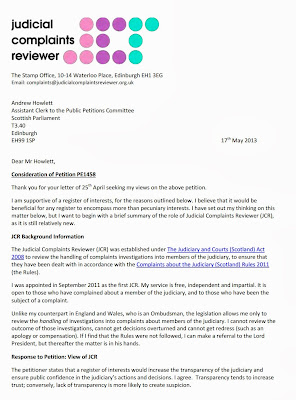
Consideration of Petition PE1458

Thank you for your letter of 25th April seeking my views on the above petition.

I am supportive of a register of interests, for the reasons outlined below. I believe that it would be beneficial for any register to encompass more than pecuniary interests. I have set out my thinking on this matter below, but I want to begin with a brief summary of the role of Judicial Complaints Reviewer (JCR), as it is still relatively new.

JCR Background Information

The Judicial Complaints Reviewer (JCR) was established under The Judiciary and Courts (Scotland) Act 2008 to review the handling of complaints investigations into members of the judiciary, to ensure that they have been dealt with in accordance with the Complaints about the Judiciary (Scotland) Rules 2011(the Rules).

I was appointed in September 2011 as the first JCR. My service is free, independent and impartial. It is open to those who have complained about a member of the judiciary, and to those who have been the subject of a complaint.

Unlike my counterpart in England and Wales, who is an Ombudsman, the legislation allows me only to review the handling of investigations into complaints about members of the judiciary. I cannot review the outcome of those investigations, cannot get decisions overturned and cannot get redress (such as an apology or compensation). If I find that the Rules were not followed, I can make a referral to the Lord President, but thereafter the matter is in his hands.

Response to Petition: View of JCR

The petitioner states that a register of interests would increase the transparency of the judiciary and ensure public confidence in the judiciary’s actions and decisions. I agree. Transparency tends to increase trust; conversely, lack of transparency is more likely to create suspicion.

Some of those responding to the petition (such as the Lord President, the Law Society of Scotland and the Scottish Government), argue that a register of interests is unnecessary, referring, among other things, to the complaints process as a safeguard.

In my role as Judicial Complaints Reviewer, I am part of that process. As is the nature of my role as a reviewer, I deal with dissatisfied people. It might be argued that they are not representative of the wider public, although that is not a view that I would take. Some people who contact me write of the judiciary sticking together, defending its own interests, and lacking transparency. If that view is a representative one, anything that increases judicial transparency is good both for the public and also for the judiciary. Greater transparency can only boost public trust and confidence and enhance the standing of the judiciary.

One argument put forward against a register of interests is that it is unnecessary, as there is provision under the Judiciary and Courts (Scotland) Act 2008 to regulate and investigate the conduct of judicial office holders, that a complaints process is in place and to date there have been no substantiated complaints alleging judicial bias. I have received requests to review complaints in which allegations of judicial bias have been raised.  It may be that no “substantiated” complaints have been made, but that is not to say that no complaints of this nature have been made. I received one such review request a few months ago via a Member of Parliament, and I completed another one in the last few weeks, and there have been others too.

Registers of interest are now a normal part of public life and it seems right that the judiciary should not be out of line with what is required of others who hold high public office. I have completed registers of interest for my roles on public boards such as the Scottish Ambulance Service and Scottish Police Authority. It is not onerous to update this annually or when any changes in circumstance occur. Members of the Petitions Committee will have undertaken something similar themselves in their parliamentary life. Although not required to do so, I have prepared my own register of interest and will shortly be publishing it on my website. I believe that the JCR should be required to do this, either by legislation or as a requirement set out in their letter of appointment from the Minister.

Should a register of interests be limited to pecuniary interests? I believe that it should also encompass non-financial interests such as memberships, unpaid trusteeships, and any relevant close family/friendship links that may be perceived as a potential conflict of interest. One review I undertook last year concerned a complaint about a judge who had allegedly used their judicial position to promote a body that was alleged to have breached international law. Another concerned a sheriff who allegedly participated in a social function organised by the defender during the proof hearing.

We are very lucky in this country to have an independent judiciary. Better transparency would enhance the standing of that judiciary and bring judicial office holders into line with other holders of important roles in public life.

I am happy to provide any further information that you require.
Yours sincerely,
Moi Ali
Judicial Complaints Reviewer

Previous articles from Diary of Injustice including video footage of the Petitions Committee meetings and further information on the drive to create a register of interests for Scotland’s judiciary can be viewed here : A Register of Interests for Scotland's Judiciary

A further report in the Sunday Mail newspaper featured details of further resistance to transparency from Scotland’s secretive judges, where it was reported Scotland’s Judiciary have refused to cooperate with the Judicial Complaints Reviewer on a number of occasions, also reported by Diary of Injustice, here : HERE

Saturday, June 08, 2013

Court Closures are necessary, Scotland's top judge tells MSPs, as Lord Gill refuses to face public questions over rich judiciary’s vested interests, criminal records, & secret wealth

Lord Gill Court Closures Justice Committee Scottish Parliament 4 June 2013Lord Gill goes to Holyrood, willing to talk about court closures, not judge’s hidden wealth & vested interests. UNDERPREFORMING Scottish courts need to be closed as part of a process to make savings of 20% in the Scottish Court Service budget by 2015, Scotland's top judge Lord President Lord Brian Gill and representatives of the Scottish Court Service told MSPs on the Scottish Parliament’s Justice Committee earlier this week on Tuesday. The closures, already approved by the Scottish Government last year will see ten sheriff courts and seven justice of the peace courts shut down in an effort to streamline Scotland’s Victorian justice system.

Lord Gill’s attendance at the Justice Committee on Tuesday can be viewed on BBC Democracy Live, HERE. The session passed off without much ado, bar some slight signs of dispute over how the Scottish Courts Service had handled the court closures, after MSPs on the Justice Committee raised questions of why many of Scotland’s local sheriff courts buildings have been left with a £57 million pound repair backlog while Parliament House, home to Scotland’s Court of Session and the top tier of the judiciary, including Lord Gill himself, has seen well over £60 million pounds spent on it in the past five years.

Notably, the Lord President showed little difficulty discussing issues relating to the court closures, an apparently less threatening subject for Scotland’s most senior judge who has now twice refused to attend another Scottish Parliament Committee to give evidence on simple questions of transparency within the judiciary, raised in Petition PE1458: Register of Interests for members of Scotland's judiciary.

LORD NO NO - Scotland's top Judge refuses second Parliament invite over Register of Interests - Sunday Mail 2 June 2013

Lord NO-NO : Top Judge defies Scottish Parliament on Judiciary’s interests Last week, Scotland’s Sunday Mail newspaper, and Diary of Injustice reported on a letter sent by Lord Gill to MSP David Stewart, Convener of Holyrood’s Public Petitions Committee. In the letter the Lord President again refused to accept an invitation from MSPs to discuss the current system of how judges recuse themselves and, inevitably face questions on the hidden wealth, undeclared interests and other vested interests of Scotland's closed door judiciary.

Lord Gill told MSPs the Scotland Act as it currently stands, allows judges to pick & choose what subjects they feel comfortable discussing at the Scottish Parliament, however it does not seem in the public interest that the Scotland Act is now being used by the judiciary to hide their indiscretions, criminal convictions and secret interests which are not being declared in courts as they should be.

Lord Gill’s letter stated : “Judges have from time to time given evidence to committees of the Scottish Parliament on matters that affect the administration of justice in Scotland. I hope that that has been helpful in the legislative process. Judicial participation in the work of the committees must however be kept within prudent limits.

The letter from the Lord President also pointedly reminded MSPs of a now rather Victorian era excuse of protecting the independence of the judiciary from situations which may compromise it. In this case, apparently discussing the secret interests of the judges themselves is curiously seen by the Lord President as an issue which may compromise Scotland’s judiciary over a simple issue of transparency.

Lord Gill went on in his letter to the Petitions Committee, saying : “Section 23(7) of the Scotland Act provides inter alia that the Parliament may not require a judge to attend its proceedings for the purposes of giving evidence. This is not a loophole. It is a necessary part of the constitutional settlement by which the Parliament is established. Its purpose is to protect the independence of the judiciary, a vital constitutional principle that is declared in section 1 of the Judiciary and Courts (Scotland) Act 2008. When a committee invites a judge to give evidence before it, I have to decide whether the subject matter might infringe the principle of judicial independence; and whether the evidence required could be satisfactorily given in writing.”

Lord Gill has already refused to attend the Petitions Committee earlier in April 2013 to discuss issues raised in Petition PE1458, reported here : Scotland’s top judge Lord Gill refuses to attend Scottish Parliament to face questions over opposition to register of judicial interests

Previous articles from Diary of Injustice including video footage of the Petitions Committee meetings and further information on the drive to create a register of interests for Scotland’s judiciary can be viewed here : A Register of Interests for Scotland's Judiciary

Monday, June 03, 2013

Scotland’s top judge throws Scotland Act at MSPs in transparency battle as Lord Gill refuses to give evidence at Scottish Parliament on judge’s secret wealth, connections for register of judicial interests

Scotland’s top judge Lord Gill is determined judges wealth & connections should remain secret. SCOTLAND’S top judge, Lord President Lord Brian Gill has again refused to attend the Scottish Parliament to answer questions from MSPs and give evidence on Petition PE1458: Register of Interests for members of Scotland's judiciary, reports the Sunday Mail newspaper on 2 June 2013.

Also, the Sunday Mail’s coverage features a report of support for the register of interests proposal from the independently appointed Judicial Complaints Reviewer, Moi Ali and a must-read Sunday Mail opinion supporting transparency within the judiciary.

The petition, filed by law journalist Peter Cherbi at the Scottish Parliament last year, has since brought about a public discussion on judge’s secret wealth, connections, hospitality, and a complete failure by judges to recuse themselves in case after case in the Scottish courts.

The petition calls on the Scottish Parliament to legislate for a requirement that all members of the Judiciary in Scotland to submit their interests & hospitality received to a publicly available Register of Interests, a move the Lord President Lord Gill has bitterly resisted, reported in previous articles by Diary of Injustice including reports from the Sunday Mail newspaper, and video footage of debates at the Scottish Parliament’s Public Petitions Committee, here : A Register of Interests for Scotland's Judiciary

The Sunday Mail’s 2 June coverage of Lord Gill’s refusal to show up at the Scottish Parliament, also features an article exposing the round the world travels of Scotland’s judiciary on the taxpayer, the very same Scottish judiciary who cannot be bothered to walk a few hundred yards to our sovereign Scottish Parliament and account for their secretive interests. The Sunday Mail reports :

LORD NO NO - Scotland's top Judge refuses second Parliament invite over Register of Interests - Sunday Mail 2 June 2013Scotland's top judge refuses to appear before MSPs for a second time to explain his opposition to a register of interests

EXCLUSIVE : LORD NO-NO : Gill snubs second invite from Holyrood Committee

By Russell Findlay 2 Jun 2013 Sunday Mail

SCOTLAND'S top judge has snubbed MSPs for a second time after they asked him to give evidence at Holyrood.

The Lord President, Lord Gill previously declined to attend the Scottish Parliament’s petitions committee to explain his opposition to a register of interests for judges. MSPs wrote asking him to reconsider his refusal to attend. But last week, in a letter to the committee’s chairman, Labour’s David Stewart, he rejected their second request to appear.

The top lawman, who earns £214,000 a year, cited the Scotland Act which prevents parliament from forcing judges to give evidence. He justified his refusal saying: “I do so for the reasons of constitutional principle. I intend no discourtesy to your committee. This is not a loophole. It is a necessary part of the constitutional settlement by which the Parliament is established. Its purpose is to protect the independence of the judiciary, a vital constitutional principle that is declared in section 1 of the Judiciary and Courts (Scotland) Act 2008.”

The row follows a petition by legal reform campaigner Peter Cherbi which calls for judges to declare interests such as hospitality, gifts, property plus any links to outside bodies.

In February, Lord Gill wrote to say a register was not needed and that it might mean judges would be harassed by “aggressive media”. His refusal to elaborate on that stance in person angered the committee. In April, they issued a second invitation but he has again refused to travel the 700 metres from his office to parliament to give evidence.

In his letter, sent to Stewart on Tuesday, Lord Gill did offer to meet committee members in private. Stewart now plans to meet Lord Gill along with deputy committee convener Chic Brodie. He said: “I’m disappointed but we will try to meet as soon as possible to get the information we require to deal with this very interesting petition.”

SNP MSP Brodie said: “He is at least willing to have discussions with representatives of the committee.”

Sources at Parliament say the judge has added insult to injury by agreeing to give evidence to the Justice Committee on Tuesday to defend heavily criticised cost-cutting reforms that will mean the closure of one in five sheriff courts.

WATCHDOG WHY SHOULD JUDGES BE EXEMPT?

Lord Gill's insistence that he will not appear in front of MSPs comes as a legal watchdog revealed two judges were investigated for alleged conflicts of interest last year. Judicial Complaints Reviewer Moi Ali, left, revealed the probes as she backed calls for a register.

Her submission to the committee said: "One review I undertook last year concerned a complaint about a judge who had allegedly used their judicial position to promote a body that was alleged to have breached international law." Another was a sheriff who allegedly participated in a social function organised by the defender during the proof hearing.

Ali - who was appointed by Justice Secretary Kenny MacAskill in 2011 - can review how the the Judicial Office for Scotland have handled a complaint but can only pass on her concerns to the Lord President.

She added "Registers of interest are a normal part of public life."It seems right that the judiciary should not be out of line with what is required of others who hold high public office."Better transparency would enhance the standing of that judiciary."

JET-SETTING LAWMEN NOTCH UP £83K BILL

Scotland's judges have racked up thousands of air miles on overseas trips, including jaunts to the US, India, Morocco and Malaysia.

Taxpayers have paid £83,644 to send judges and sheriffs around the world in the past three years. In 2010/11, the total was £14,430 which rose to £35,107 in 2011/12 followed by £34,167 last year.

The most expensive trip last year was to Kampala in Uganda. It cost £7300 for Sheriff Michael Fletcher and Lord President Lord Gill to attend a judges' conference there. Lord Gill’s other trips since 2010 have included Dublin, Cape Town in South Africa, Slovenian capital Ljubljana and a £1050 trip to a conference in Canada.

One of the most widely travelled was Sheriff Andrew Normand who has been on 11 overseas trips in the last three years. The judges usually travel alone or with a colleague but on two occasions last year they were joined by their wives.

The figures were obtained by legal blogger Peter Cherbi. He said: "Instead of flying around the world, perhaps Scotland's judges should focus on the problems within our own legal system."

The Judicial Office for Scotland said: "Attendance at overseas events must be approved in advance and comply with agreed guidance."

Sunday Mail Opinion on Lord Gill No Show 2 June 2013Mail Opinion: Lord Gill has missed an opportunity to portray our justice system as open and accountable

2 Jun 2013 11:32

NO JUSTICE IF IT CANOT BE SEEEN : SENIOR judge's refusal to give evidence to MSPs shows a lack of transparency, says Mail Opinion.

WE'RE possibly not clever enough but it is difficult to understand the terribly important point of principle Lord Gill is defending when he refuses to give evidence to our elected representatives.

Scotland’s most senior judge insists that he cannot amble down the Royal Mile to Holyrood to appear before the petitions committee because he must maintain the crucial separation between our courts and the Government.

The Lord President told them that, with the greatest respect, MSPs cannot compel a judge to appear. This is not a legal loophole, he said, but a vital bulwark of our democracy.

Fine. We get it. But they are not compelling him to appear. They did not issue an order but an invitation.

Since he has apparently agreed to appear in front of the justice committee on Tuesday to discuss the closure of a fifth of our sheriff courts, we must assume that he is picking and choosing which MSPs might be given his valuable time.

You could be forgiven for suspecting that he believes MSPs scrutinising the calls for judges to register their interests are wasting their time – and is not allowing them to waste his. Fair enough but his disinclination to pitch up before the people who represent the people who pay his £214,000-a-year salary might look a little high-handed and disrespectful. It might and, to be honest, it does.

This wasn’t an ambush. It was an opportunity for Scotland’s top judge to go to Parliament and talk about how our legal system works and might work better. It would have added, as the public relations executives and politicians like to say, a little transparency.

It was a window of opportunity that Lord Gill politely, but very firmly, nailed shut.

By taking every opportunity to speak to MSPs, Lord Gill could do more to show our legal system is a modern, receptive institution than any number of gimmicks and sound bites.

Instead, his refusal has only hardened the suspicion that our judges live and work in a bubble smelling of horse hair wigs, vintage port and even more vintage attitudes.

But his decision is only one disappointing straw in what is becoming a mighty wind of official secrecy and needless silence gusting around every part of our justice system.

Police and prosecutors might not be using Lord Leveson’s criticism of newspapers to chill potential whistle-blowers and curb information being given to journalists, officially or unofficially, but you’d be forgiven for thinking so.

These days, the most simple, straightforward requests for the most simple, straightforward information from our law enforcement and legal authorities hit stonewall after stonewall.

It is a disgrace that Scottish journalists – and, through them, the Scottish public – are not being given basic information that would be passed on as a matter of course in, for example, England and the United States.

It is a disgrace and one that our MSPs should be discussing and debating. Not least because journalists are clearly not the only people our legal establishment are happy to keep in the dark.

Sunday, June 02, 2013

‘Judicial Independence’ gives vested interests, tax dodging, rich judges an immunity from transparency says top judge as Lord Gill refuses to answer MSPs questions over register of judicial interests

Judicial Immunity from transparency - Lord Gill will not answer questions over judge’s financial interests. SCOTLAND’S top judge, Lord President Lord Brian Gill has again refused to attend the Scottish Parliament to answer questions from MSPs who are considering the issues of judicial transparency raised in Petition PE1458: Register of Interests for members of Scotland's judiciary, filed by Scots law journalist Peter Cherbi.

The petition, which has caused several run-ins with Lord Gill, who was previously viewed as more open to change in the justice system, calls on the Scottish Parliament to legislate for a requirement that all members of the Judiciary in Scotland to submit their interests & hospitality received to a publicly available Register of Interests.

The latest letter from Lord Gill to the Convener of the Public Petitions Committee, David Stewart MSP, which is dated 28 May 2013, cites issues of “constitutional principle” and the “independence of the judiciary” as reasons for Lord Gill’s refusal to attend the PPC to give evidence on judge’s interests and provide details on how the current system of judges recusing themselves operates in Scotland. The response from the Lord President also fails to answer questions now put twice to the Lord President, asking for statistical information on how the system of judges recusing themselves operates.

Again, the Lord President sidestepped all the questions from MSPs and merely stated “The Lord President has been responsible for matters concerning the conduct of judicial office holders since April 2010. During that period there has been no case in which a judge has been found guilty of misconduct for a failure to recuse.”

Lord Gill has now been asked twice by MSPs to provide information on how many judges have been recused and whether there is more detailed evidence on the effectiveness of the current system. Clearly these are not questions Scotland’s top judge can or is willing to provide answers to, raising serious questions over the honesty and integrity of Scotland’s judiciary.

Lord Gill went on to cite the Scotland Act, reminding MSPs they may not require a judge to attend proceedings for the purposes of giving evidence, claiming the missing part of the Scotland Act was not a loophole, rather a protection mechanism for protecting the independence of the judiciary from politicians. However, many will see this as a mechanism for covering the backs of the unelected judiciary who are bitterly resisting transparency and hold such power they can easily strike down legislation with one mere comment or opinion in court.

In an attempt to placate his stubborn position on the protection of judges vast secret & financial interests, as well as records of criminal convictions including Benefits Cheating, Lord Gill again cited an EU report which itself has been prepared and written by judges who have a vested interest in preventing any register of judicial interests going ahead. The report,which Lord Gill and the Scottish judiciary are relying on to keep their dirty linen secret, is available here : GRECO FOURTH EVALUATION ROUND Corruption prevention in respect of members of Parliament, Judges and Prosecutors.

Lord Gill conveniently left out of his letter to the PPC Committee Convener, any references to his judicial colleagues who had signed up to be interviewed to complete the EU report, rather than attending the Scottish Parliament to answer questions on their own secretive financial interests.

Lord Gill ended his letter by offering to meet the Committee Convener in private to discuss the constitutional implications of the Public Petitions Committee’s invitation. The irony of Scotland’s to judge holding secret meetings to discuss a call for transparency within the judiciary will not be lost on legal observers to this on-going battle over the hidden secrets of Scotland’s judges.

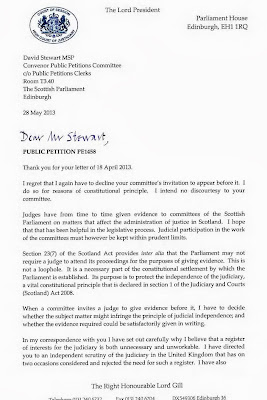
Lord Gill’s letter to the Convener of the Public Petitions Committee David Stewart MSP, in full :

Lord Gill’s second refusal to answer questions on judges secret & financial interests PUBLIC PETITION PE1458

Thank you for your letter of 18 April 2013. I regret that I again have to decline your committee's invitation to appear before it. I do so for reasons of constitutional principle. I intend no discourtesy to your committee.

Judges have from time to time given evidence to committees of the Scottish Parliament on matters that affect the administration of justice in Scotland. I hope that that has been helpful in the legislative process. Judicial participation in the work of the committees must however be kept within prudent limits.

Section 23(7) of the Scotland Act provides inter alia that the Parliament may not require a judge to attend its proceedings for the purposes of giving evidence. This is not a loophole. It is a necessary part of the constitutional settlement by which the Parliament is established. Its purpose is to protect the independence of the judiciary, a vital constitutional principle that is declared in section 1 of the Judiciary and Courts (Scotland) Act 2008.

When a committee invites a judge to give evidence before it, I have to decide whether the subject matter might infringe the principle of judicial independence; and whether the evidence required could be satisfactorily given in writing.

In my correspondence with you I have set out carefully why I believe that a register of interests for the judiciary is both unnecessary and unworkable. I have directed you to an independent scrutiny of the judiciary in the United Kingdom that has on two occasions considered and rejected the need for such a register. I have also directed you to the decision of the United Kingdom Government to accept that finding, and to the decision of the United Kingdom Supreme Court not to create a register. That I think, is as much useful evidence as I am in a position to give on the subject; but if there is any further information that you feel would be relevant and helpful to the committee, please let me know and I will consider the matter further.

In your letter you have asked whether any central record has been kept of failures by judges to recuse themselves. The Lord President has been responsible for matters concerning the conduct of judicial office holders since April 2010. During that period there has been no case in which a judge has been found guilty of misconduct for a failure to recuse.

If you would find it helpful I would be pleased to meet with you to discuss the constitutional implications of the Committee's invitation.

Lord Gill earlier refused to attend the Petitions Committee to discuss issues raised in Petition PE1458, reported here : Scotland’s top judge Lord Gill refuses to attend Scottish Parliament to face questions over opposition to register of judicial interests

Diary of Injustice reported on an earlier meeting of the Petitions Committee on 5th March 2013 where MSPs initially invited Lord Gill to attend Holyrood, here : SILENCE IN COURT : Scotland’s top judge Lord Gill summoned to Parliament over ‘vested interests’ attempt to block Register of Judicial Interests petition and video footage of that earlier meeting is also available online here : Petition PE1458 Register of Judges Interests 5 March 2013 Scottish Parliament.

All previous reports from Diary of Injustice and further information on the drive to create a register of interests for Scotland’s judiciary can be viewed here : A Register of Interests for Scotland's Judiciary

A full report on the story along with details of judges jet setting around the world, and support from the Judicial Complaints Reviewer Moi Ali for the register of interests proposal, can be viewed in the Sunday Mail newspaper today HERE

JUDGES FEAR THE REGISTER - PETITION SEEKS TRANSPARENCY IN COURT WITH REGISTER OF JUDICIAL INTERESTS :

Courts Judges Scotland montagePetition PE01458: Register of Interests for members of Scotland's judiciary calls for the Scottish Parliament to urge the Scottish Government to create a Register of Pecuniary Interests of Judges Bill (as is currently being considered in New Zealand's Parliament) or amend present legislation to require all members of the Judiciary in Scotland to submit their interests & hospitality received to a publicly available Register of Interests. Diary of Injustice has featured coverage of the petition in earlier reports, Register of Interests for Judges.

The petition also features references to debate in the Parliament of New Zealand who are considering legislation to create a register of interests for the judiciary. It is time for Scotland to move in the same direction and create a similar register of interests for the judiciary of Scotland and all its members, increasing the transparency of the judiciary and ensuring public confidence in their actions & decisions.

The full details of the New Zealand Register of Pecuniary Interests of Judges Bill, should be looked at for a model of similar legislation in Scotland, can be viewed online here  Register of Pecuniary Interests of Judges Bill.

The New Zealand Law Commission’s discussion paper on a register of judicial interests which recommends further inclusion of court staff in a register of interests, can be downloaded here : NZLC IP21 - Towards a New Courts Act: A Register of Judges pecuniary interests? (pdf)

In comparison to New Zealand’s effort to ensure transparency in the judiciary, Scotland’s judges and the Scottish Government have, unsurprisingly backed away from any similar measures, even concealing criminal charges and convictions of Scottish judges, where in one case a Scottish judge was charged with fiddling benefits claims, exposed in a Diary of Injustice investigation into Judge’s financial fiddles, here : CAREER CROOKED : Investigation reveals Scottish judges are CONVICTED CRIMINALS, Drunk Drivers,Tax Dodgers & alleged BENEFITS CHEATS

The on-going investigation by Diary of Injustice into members of Scotland’s judiciary has already revealed a series of judges appear to be involved in OFFSHORE TAX AVOIDANCE schemes, associations with convicted criminals & organised crime, prostitution rackets, accepting hospitality & payments from well known corrupt solicitors representing dodgy law firms while others on the bench are engaging in questionable investments & duties which appear to be in conflict with their positions as members of the judiciary. More on these findings can be read in an earlier article here : Offshore trusts, property holdings, insurance syndicates, hospitality from dodgy lawyers, yet no plans for a register of interests for Scottish judges