Friday, May 29, 2009

Legal Complaints Commission 'authorised to lie' on FOI query over secret 'research' meetings with accountants regulator ICAS & insurers Marsh

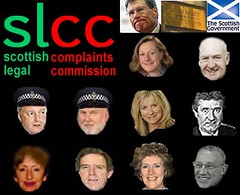
SLCC squareScottish Legal Complaints Commission concealed meetings with Institute of Chartered Accountants of Scotland. Investigations into ties between insurers & the Scottish Government reveal the Scottish Legal Complaints Commission were authorised to conceal cooperation and meetings with the Institute of Chartered Accountants from Freedom of Information enquires, after officials at the Justice Department deemed their release to media too sensitive on the grounds that the secret meetings, details of which had been leaked to reporters, had been arranged by Marsh UK, insurers to Scotland's legal profession and the Scottish Government itself.

SLCC deny involvement with ICAS in FOI responseFreedom of Information replies from the Legal Complaints Commission brought denials all round. The Scottish Legal Complaints Commission replied to Freedom of Information enquiries on their involvement with the Institute of Chartered Accountants of Scotland with all round denials : “The SLCC has no involvement with Institute of Chartered Accountants of Scotland therefore I am issuing you with notice that the information requested is not held in line with Section 17(1)(b) of the Freedom of Information (Scotland) Act 2002” and went on in email correspondence to further deny reports that Marsh UK were involved in arranging the meetings with ICAS, allegedly on instructions from the Scottish Government's Justice Department, who were concerned the Scottish Government’s own links to discredited insurers Marsh, ICAS, and even the Law Society of Scotland itself on insurance issues would be revealed in FOI disclosures.

Law Society of Scotland & ICASLaw Society of Scotland has strong ties to accountants regulator ICAS. I have reported earlier on the Law Society of Scotland's involvement with the Institute of Chartered Accountants here, where even a former President of the Law Society, Ruthven Gemmel, was posted to ICAS committees to keep up representation from the legal profession : Fears over corrupt self regulation as accountants regulator draft in ex Law Society President and solicitor as Public Interest members

Eileen MastermanSLCC Chief Executive Eileen Masterman arranges meetings with ICAS through crooked insurers Marsh. The round of secret meetings was kicked off by the SLCC's Chief Executive, Eileen Masterman, who wanted meetings with ICAS over discussions on the SLCC's role in monitoring the notoriously corrupt Master Policy & Guarantee Fund, the two compensation schemes run by the Law Society of Scotland which are intended to compensate clients of crooked lawyers who commit negligence while representing their clients legal affairs or stealing clients funds.

SLCC secret meetings with ICAS SLCC denied all involvement with ICAS & Marsh but now documents reveal otherwise. Investigations which sprang from leaks from the Scottish Government & ICAS revealed the Scottish Legal Complaints Commission had been in discussions with the Institute of Chartered Accountants of Scotland over suggestions for the names of experts and other individuals from the legal & accounting world to include in the SLCC’s research into the Master Policy & Guarantee Fund. However, as Marsh UK arranges insurance for both the legal AND accountancy professions, the Scottish Government's Justice Department (who are also insured through deals with Marsh UK) ordered any documents relating to SLCC meetings with ICAS to be kept secret from the media.

This is not the first time the SLCC have lied about meetings with Marsh and the Law Society, as I featured in an earlier article here : MacAskill’s SLCC lied over secret meetings with Law Society & Marsh as quango announces £15k 'study' into master policy & guarantee fund

ScottishGovernmentScottish Government allegedly now control all FOI requests to law complaints quango. A source today from the Scottish Government confirmed the Justice Department's policy on FOI enquiries to the Scottish Legal Complaints Commission : "All Freedom of Information enquiries to the Scottish Legal Complaints Commission are now relayed to the Scottish Government due to the scandals surrounding the organisation, some of which have already appeared in the media."

"Ever since leaks sprung from the SLCC last year on the staffing arrangements and arguments over positions which were going exclusively to former Law Society staff, the Justice Secretary himself and senior Justice Department officials have become paranoid over what the commission releases, and have ordered the SLCC to hand over all FOI requests and copies of email communications from certain individuals for their approval before replies are sent out."

“There is no doubt in my mind we are talking about Government backed interference in the FOI process to conceal facts.”

The Scottish Government's concern over Freedom of Information enquiries to the Scottish Legal Complaints Commission stems from consistent reporting of problems at the hugely expensive quango, which has spent more time deciding perks for its members, and fumbling through its duties to regulate complaints against Scottish solicitors, rather than cleaning up Scotland's notoriously corrupt legal services sector, which is being hit with spiralling complaints against solicitors who are committing fraud & embezzlement against their clients on an almost daily basis.

You can read more of failures at the Scottish Legal Complaints Commission here : Complaints Commission 'unfit for purpose' as secret meetings with insurers & pensions take focus over consumer protection against crooked lawyers and much more coverage of the SLCC and many of its problems HERE.
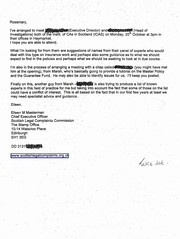
Masterman arramges to meet ICASFurther internal documents from the SLCC reveal existence of non-existent meetings with ICAS and insurers Marsh UK. While the SLCC were busy denying any involvement it had with the infamously corrupt Scottish accountants regulator, ICAS, even more documents are now emerging of the cosy meetings held between Eileen Masterman & the Chief Executive of ICAS. However, while the SLCC has been forced to disclose some material on the secret meetings it claimed never took place, access to any records or minutes of the meetings themselves between SLCC officials and ICAS Executives have been denied for varying reasons, the latest of which amazingly implies that no actual records of the meetings between Ms Masterman and accounting chiefs exist.

Norman Howitt Accountant JRW Group Hawick Scottish BordersICAS investigation into Borders Accountant Norman Howitt proved to many that self regulation of accountants is as corrupt as self regulation of lawyers. A good example of how the Institute of Chartered Accountants of Scotland handle investigations against crooked accountants, can be found in my own case, here : A picture is worth a thousand words - Images of fraud reveal corruption & deceit by lawyers & accountants in the Scottish Borders

The SLCC and the Scottish Government could not be reached for comment today, however a Law Society insider admitted both the Justice Department and the Scottish Legal Complaints Commission had been caught on the hop with the revelations.

He said : “This is what happens when someone tries to manage the truth and conceal some very dirty business going on behind the scenes, which will no doubt further erode the public credibility of the SLCC if indeed there is any left to speak of.”

So, should the Scottish Government continue working to conceal corruption within the self regulation of complaints against solicitors ? I think not .. and much more needs to be made of this Government interference in the FOI process, which is why the FOI Commissioner Kevinn Dunion will be asked to investigate the SLCC’s conduct in this affair.

Tuesday, May 26, 2009

'Penman Levy' leads to civil war within Scotland's legal profession as solicitors battle Law Society on fat cat salaries & wasted millions

Law SocietyLaw Society of Scotland 'takes huge salaries & expenses perks from lawyers subscriptions to fund lavish lifestyles of top executives'. THE EXPENSE of the Law Society of Scotland's policy of shielding the likes of Borders solicitor Andrew Penman of Stormonth Darling solicitors, Kelso, from prosecutions before Discipline Tribunals and almost certain separate investigations into the Law Society’s own report that Penman and his legal firm deceived both the Royal Bank of Scotland & HM Inland Revenue, has led to a bitter civil war brewing among members of Scotland's legal profession, concerned their spiralling obligatory annual subscriptions, resulting from costly cover ups of scandal upon scandal involving crooked lawyers stealing from clients, are being wasted by Law Society chiefs, who some solicitors now claim are wasting millions on themselves with little return to the profession.

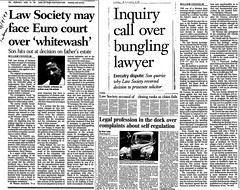
Scotsman coverage of some of the stories relating to Andrew PenmanThe Law Society’s shielding of Andrew Penman from prosecution before the SSDT led to new & costly legislation on regulation, coupled with lost business. One solicitor, incensed at the way the Law Society's Client Relations team handles complaints against colleagues, spoke on condition of anonymity this morning, saying :"The way the Law Society handled the scandal surrounding Andrew Penman in the 1990s, and derailed his prosecution before the SSDT has cost us all dearly."

He went on :“Saving Private Penman has led to a slew of media coverage of cases involving rogue solicitors and huge corruption scandals within the profession which has tarnished us all for life, ultimately costing all members our reputations and incalculable lost business while the staff within the Society award themselves promotions and huge salaries out of our contributions. They have obviously caused the profession much more harm than good and now be forced out."

Eileen Masterman & Philip YellandSLCC Chief Executive Eileen Masterman & Law Society Chief Executive Philip Yelland on £80k+ p.a. but both do same job. The dual cost to Scotland's 10,000 solicitors of paying for expensive self regulation carried out by the Law Society of Scotland and 'quasi-independent' regulation handled by the new Scottish Legal Complaints Commission, highlights the huge financial burdens on solicitors, which are in turn being passed down to clients through hugely increased and in some cases, artificially inflated legal fee demands.

Jane IrvineSLCC Chief Jane Irvine announced reduced complaints levy for solicitors this year but no repayment of £2 million of taxpayers money for quango's start up costs. While the Law Society of Scotland are reluctant to reduce the cost of solicitors contributions, the Scottish Legal Complaints Commission did make some reductions to the complaints levy, dubbed the Penman Levy by many in the legal profession, which solicitors must also pay annually, initially at a cost of £400 a year each, to fund the new commission.

However, the new 'independent' law complaints body is itself dogged by now well proven allegations of the same cronyism & lack of impartiality in its operation & policies which the Law Society of Scotland has made itself famous for over the decades, leading to the current state of ruin of Scotland's legal services market.

I have written some previous articles on the costs of the SLCC and where members minds seem to lie (on perks, rather than the work) here : Complaints Commission 'unfit for purpose' as secret meetings with insurers & pensions take focus over consumer protection against crooked lawyers

A solicitor from a leading Glasgow law firm condemned the repetition of costs of regulation at the Law Society of Scotland and Scottish Legal Complaints Commission.

He said "How two people, Yelland & Masterman can do ostensibly the same job, and get paid over £1300 a week out of our pocket, should not be allowed to continue.”

“If that's not bad enough, the SLCC’s Chair and Chief Executive are on more than £300 a day and board members claim over £350 a day in expenses. What kind of a regime is that when we also have to pay even more to fund the same people doing the same work at the Law Society."

He went on : "In this financial climate solicitors and clients cannot afford for these treats to continue, just to satisfy the lifestyles of a few at the top of the profession who regularly run roughshod over members interests. I will therefore be supporting proposals due to be aired at the Law Society's annual general meeting by David Flint of MacRoberts"

The proposals put forward by solicitor David Flint, of the Law Firm, MacRoberts solicitors, which come from letters circulated to solicitors across Scotland, are also reported today in the Scotsman newspaper, where the paper reports that "Mr Flint questioned the increased cost of the chief executive's office, a figure that includes the salary of Lorna Jack, who took the helm in January. The latest draft accounts show that this increased by £90,000 to £326,000 in 2008.

He also highlighted the £98,000 spent on an abortive attempt to relocate the Society's offices in Edinburgh, abandoned in light of a reduction in property values.

Mr Flint also asked whether solicitors paying £665 for the certificate should benefit from the large surplus the Society holds. The 2008 accounts show cash reserves of £1.229 million."

Given the damage the Law Society of Scotland has done to both the legal profession and the interests of the client, there is cause enough for solicitors, and also the public to be angry at the way in which the legal profession's governing body has not only wasted members contributions, but also continues to defy transparency & independent accountability in its operation, while spending millions of pounds in attempts to maintain its sole right to regulate & discipline lawyers in Scotland.

Douglas Mill 4Ex Law Society Chief Executive Douglas Mill was on at least £120k a year and did huge damage to Scots lawyers reputations. A former Council member of the Law Society speaking this morning claimed that in the wake of the Society's now ex Chief Executive Douglas Mill's resignation over the memo scandal, where Mill was brought down after a determined & admirable campaign by Cabinet Secretary for Finance John Swinney to expose corruption at the Law Society, many of the executives on huge salaries at the Society's Drumsheugh Gardens office should either be sacked or forced to resign immediately.

He said : "Many senior officials at the Law Society I know personally, have ended up doing more harm than good for the Scots legal profession.”

“If the membership actually had a vote and a say in things which they are paying for anyway, most of that crowd who are being paid far too much for what they do, would have been gone years ago.”

He went to accuse the Law Society of greed and direct harm to public access to justice : "The ineptitude of officials at the Law Society is not only causing harm to the legal profession, they are, through their waste millions from solicitors annual contributions, and disgraceful mismanagement of client relations, causing direct harm to the public's ability to access legal services in smaller communities, where say for instance, small legal firms and sole practitioners are being forced out of business because they cannot afford to fund the likes of £300,000 salaries for executives at the Law Society to prattle on in a fantasy world like idiots."

An official from a consumer organisation this morning said he found dealing with the Law Society of Scotland to be "rather like trying to bargain with the devil."

He said "The Law Society seem resistant to any change unless it is proposed by the Council itself and even then any such proposals will only address benefits to the profession as long as those changes will directly benefit officials at the Law Society itself."

"This all comes back to a profession being allowed to regulate itself, and as we have just seen with the Banking sector, and the financial calamity its collapse has caused the entire country, professionals in positions of trust, or with access to huge financial power, or those working in the area of law, cannot be trusted to regulate themselves because they make up the rules as they go along, and inevitably something will crack, either from outside, or within."

While the Law Society of Scotland are intensely campaigning against David Flint's proposals to lower the cost of the practicing certificate and questions over the huge salaries of officials, they apparently do not wish to speak to parts of the media they cannot exert control over final versions of reports.

So, splits within the legal profession itself, but this is to be expected, given the way the Law Society of Scotland has treated its own members, and clients alike - spending millions of pounds on shielding the bad apples among Scotland's 10,000 solicitors, and attempting to maintain its position of power of dictating the pace of legal reform in Scotland, while the rest of the profession has to pay for it, with costs ultimately being passed onto the public who also have to suffer poor choice of legal services and lack of access to justice.

It is time for a change, and to begin that change, control of the Law Society of Scotland must be taken away from its Council and the select few at the top of the legal establishment who have no care or general interest in either the welfare of their own members, or the public at large.

The Scotsman reports :

Law Society is 'wasting money of its members', critics claim

Published Date: 26 May 2009
By Christopher Mackie

A ROW over the cost of practising as a solicitor has intensified after the Law Society of Scotland was accused of wasting its members' money.

In a letter circulated throughout the profession, David Flint, a partner in MacRoberts, claimed the Society operated as though it had "an open cheque book" funded by the subscriptions paid to it by Scottish solicitors.

Mr Flint has already tabled a motion at the forthcoming Law Society AGM demanding that the cost of the lawyers' practising certificate be cut from £665 to £400, in the face of the harsh economic climate. The motion was accompanied by a letter to all Scots lawyers asking for support and criticising the Society. It accused the organisation of being a growing bureaucracy that failed to adequately represent the interests of members.

Following a campaign by the Society to rebut the claims, Mr Flint has circulated a second letter, detailing specific areas of waste and urging lawyers to vote for his proposal at the AGM.

In the latest document, Mr Flint said the Society had "demonstrated a singular inability to operate within any reasonable budgetary constraints: they have an open cheque book from the members and they operate accordingly."

Mr Flint questioned the increased cost of the chief executive's office, a figure that includes the salary of Lorna Jack, who took the helm in January. The latest draft accounts show that this increased by £90,000 to £326,000 in 2008.

He also highlighted the £98,000 spent on an abortive attempt to relocate the Society's offices in Edinburgh, abandoned in light of a reduction in property values.

Mr Flint also asked whether solicitors paying £665 for the certificate should benefit from the large surplus the Society holds. The 2008 accounts show cash reserves of £1.229 million.

Mr Flint told The Scotsman: "My concern is members' money is being spent on the administration, rather than on services to members. If you have a surplus being run on a members organisation the surplus belongs to the members and it should be used for their benefit."

The Society said the decision to retain cash was approved by a vote of its members and said the increase in the cost of the chief executive office was misleading as the cost was artificially low in 2007 because of unfilled vacancies. It defended its decision to cancel the relocation of its offices, and described the incurred costs as "reasonable" for a transaction of that size.

The Law Society intends to reduce the cost of the practising certificate, but only after a review is complete. Ms Jack said: "There is a commitment to making a material reduction at this year's SGM in September and we would hope that the profession is prepared to allow the full planning process to be completed and make its decision then."

Friday, May 22, 2009

'Self regulation' system which destroyed Westminster reputation must now end for all professions, industry & public services

Westminster ParliamentWestminster Parliament used self regulation for decades to protect members unacceptable conduct on expenses. SELF REGULATION, the infamous liars charter which many professions and public services use to protect themselves against complaints from the general public, and even the law itself, is to end at Westminster, according to the Prime Minister, Gordon Brown, and the leader of the Conservative Party, David Cameron.

Prime Minister Gordon Brown speaks about the end of self regulation at Westminster after politicians from all parties were caught looting taxpayers money for personal expenses.

Conservative leader David Cameron also speaks about the end of self regulation at Westminster.

Yes, self regulation must now be ended in the UK political system, as it had utterly destroyed the public's faith & trust in the Westminster Parliament.

However, self regulation as we all know is a popular facility which many professions & industries and public services within the UK also use to protect themselves against public complaints of bad conduct, poor service, lack of honesty, theft & embezzlement of client & public funds, and in the case of Doctors, even negligent medical decisions which lead to the deaths of patients.

A roll call of self regulation and how it has affected all our lives :

Sir_Fred_GoodwinSelf regulation of bankers ensured lack of independent scrutiny of Sir Fred Goodwin's actions at Royal Bank of Scotland. Self regulation of the Banking & Finance sector has cost the UK dearly, and virtually brought public finances to the brink of bankruptcy, as bankers such as Sir Fred Goodwin's over zealous takeovers while in charge of the Royal Bank of Scotland have plunged the UK Banking sector into collapse and worldwide disrepute.

GMC LOGODoctors are self regulated by the General Medial Council, where complaints get less than a fair hearing according to many patients. If you have ever tried to complain against a Doctor, or medical facility such as a hospital, you will find that self regulation plays an extensive part in ensuring patients complaints are kept within the medical profession, and never really achieve a fair hearing. For instance, many medical decisions which could be called negligent, resulting in the deaths of patients, for example, either through lack of treatment or administering of the wrong medicine, are also covered up by self regulation.

Just look how self regulation of the UK medical profession has protected those who allowed the use of contaminated blood products which infected many haemophiliacs with Hepatitis C and even HIV infections, killing many and leaving thousands suffering from incurable diseases. I have reported on those matters here : Scottish blood infections inquiry will be 'another whitewash' as documents expected to be withheld to cover up public liability

David Mcletchie taxiFormer Scottish Conservative leader David McLetchie lied over taxi expenses & journeys. Scottish Parliament has its own share of expenses scandals and self regulation has seen that no MSPs get prosecuted. Our dearly beloved Scottish Parliament at Holyrood, which some have been holding up as a model of expenses reform against the recent scandals at Westminster, has also had its fair share of expenses fiddling, with MSPs milking their expenses accounts to pay off mortgages, non existent travel, and even taxi fares.

No prosecutions or de-selections of MSPs have ever taken place at Holyrood despite all the expenses fiddling there, because of course, self regulation has allowed the Parliament to keep decisions on punishment and standards to itself. You can read some of my earlier articles on expenses scandals in Scottish politics, here: Scottish Parliament expenses scandals

SLCC membersScottish Legal Complaints Commission was an attempt at independent regulation but was 'taken over’ by legal profession before it even existed. Despite attempts to create an independent regulator of the legal profession in Scotland by the previous Scottish Executive, the current Scottish Government stood by and allowed the legal profession to take over the 'independent' Scottish Legal Complaints Commission, ensuring once again, that 'virtual self regulation', as some at the Law Society of Scotland now call the SLCC remains the order of the day for complaints against solicitors in Scotland, and that even today, complaints by the public against crooked lawyers do not get a fair hearing, because too many lawyers and Law Society members were parachuted into the 'independent' SLCC via deals between the Law Society and the Scottish Government

ICAS LOGO 2Scottish accountants have used self regulation to hide corruption complaints against members. The Institute of Chartered Accountants of Scotland (ICAS) is one of a number of organisations which self regulate its members, however the style of self regulation at ICAS has led to the cover up of some of the worst conduct of accountants in the UK, where fraud, embezzlement of client funds, even criminal activity by members, and many other types of complaints have been swept under the carpet of self regulation by the body which prides itself in having extensive political connections throughout the UK, including even members of the Privy Council which ICAS have used to prevent changes to independent regulation of accountants from taking place.

An example of how accountants self regulation affected my own family (in complaints which are common to many ICAS investigate) :

Norman Howitt Accountant JRW Group Hawick Scottish BordersNorman Howitt, Borders Accountant with JRW Group was protected by self regulation of accountants. Norman Howitt, a Borders Accountant ruined my family's life, and got away with it because of self regulation at ICAS which even covered up the fact he gave false statements to Lothian & Borders Police to cover up his embezzlement of money into his accounting firm's accounts, from the sale of my late father's assets.

You can read more about what Norman Howitt and several lawyers in the Scottish Borders did to my family in the name of greed and taking money for themselves, here : A picture is worth a thousand words - Images of fraud reveal corruption & deceit by lawyers & accountants in the Scottish Borders

Scotsman coverage of some of the stories relating to Andrew PenmanScotsman newspaper led a campaign in the 90’s to end self regulation of Scots lawyers. The Scotsman newspaper reported on many occasions, the corruption of self regulation at the Law Society of Scotland which protected complaints against crooked Borders lawyer Andrew Penman of Stormonth Darling Solicitors, Kelso. No effort was spared by the Law Society of Scotland’s most senior officials to corrupt the investigation and derail any prosecution against Penman who also deceived the Royal Bank of Scotland and the Inland Revenue.

Philip YellandPhilip Yelland, Law Society’s self regulation chief ordered solicitors to ignore clients instructions in cases against crooked lawyers. You can read more about the way self regulation of the legal profession was used by the Law Society of Scotland to protect crooked lawyers in my own case, here : The Scotsman reports : Andrew Penman, self regulation and the Law Society of Scotland and you can read about some of the lengths individuals at the Law Society of Scotland were prepared to go to defeat complaints against the legal profession as a whole, here : Law Society intervention in claims 'commonplace' as ex Chief admits Master Policy protects solicitors against clients

What we as the public have had to endure for far too long in Scotland, England & Wales, is a Crooked Curtain of self regulation that has been held firmly in place by the professions, many UK industries, public services, politics and Government (local & national), simply to protect those same professions, industries, public services and politicians from public accountability and transparency, which can only be achieved through fully independent regulation.

As we can see from the above examples, it is time to end self regulation for anyone & all public services, industry and professions in the UK, now.

Wednesday, May 20, 2009

Lawyer jailed for £90k embezzlement demonstrates need for independent regulation & greater protection of clients funds

Law Society of ScotlandLaw Society of Scotland ‘ineffective’ at protecting client funds from crooked lawyers. Despite the Law Society of Scotland's claims to vigorously police their members, particularly when it comes to the question of protecting clients funds, headlines in the media this week report that yet another solicitor has plundered his client accounts to the tune of £90,000, and, it would seem only due to extensive media interest in the case, was found guilty and sentenced to 12 months for his crime.

The solicitor in question in this case, is William Rennie, an apparently respectable family solicitor and upstanding member of the Ayrshire community. He was as it turns out, anything but that, as the Scotsman reports :

The Scotsman : "In one case, Rennie banked £30,000 which was intended to pay off a mortgage following a divorce, writing on the cheque stub that it had been used to settle the mortgage. On another occasion, £15,000 was paid into his account but was disguised on the stub as a bequest to a friend of the deceased person."

"One divorcing couple had asked Rennie to keep the money from their house sale, which was to be split between them, until they needed it. But instead Rennie paid himself £10,000, writing on cheque stubs that the husband and wife had each received £5,000."

Rennie's embezzlement of client funds was apparently discovered in July 2004, some five years ago, when he used clients' money to pay a VAT bill in a bid to avoid legal action.

Five years to bring him to trial and eventual sentence so it would appear we don't seem to have a very speedy justice system when it comes to jailing crooked lawyers ... and curiously enough, while the Scotsman report ends with the point that clients have been compensated, the Law Society of Scotland have given no financial breakdown of who received how much in terms of compensation from the Guarantee Fund, and how long they had to wait for it.

Philip YellandPhilip Yelland, Director of Standards and in charge of complaints at Law Society for 20 years. The actions of William Rennie in plundering his client accounts is a fairly typical & regular occurrence, particularly in the current financial downturn it would seem, as complaints from clients rocket against solicitors who are looting their clients funds for their own benefit. The Law Society meanwhile, despite having the same person in charge of complaints & standards for nearly two decades, Mr Philip Yelland is engaged in the usual knot tying exercises in drawing out complaints investigations for months, even years to prevent any damaging headlines for the profession and to withhold any prospect of compensation for clients for as long as possible.

SLCC squareScottish Legal Complaints Commission still to decide on monitoring Guarantee Fund. Even with the new 'independent' Scottish Legal Complaints Commission in existence, little is currently being done to monitor the claims process by clients who have been ripped off by crooked lawyers, as the commission is still to decide on exactly how it will monitor the controversial Master Policy insurance scheme of Scottish lawyers and the Guarantee Fund compensation scheme run by the Law Society of Scotland, itself revealed to be little more than a badly run ploy which can delay paying out on frauds involving client money for years, even decades in some cases.

I wrote a recent article on the state of the Law Society of Scotland’s Guarantee Fund here : Law Society's 'Guarantee Fund' for clients of crooked lawyers revealed as multi million pound masterpiece of claims dodging corruption

AdvisoryAdvisory on Client Funds over Guarantee Fund’s poor performance. In fact, from what I have heard in terms of the sheer numbers of complaints involving solicitors stealing clients funds and almost wholesale embezzlement carried out by lawyers even in some of the largest legal firms in Scotland, it appears to have become so dangerous to leave your money with a solicitor, I issued a Client Advisory some weeks ago relating to the safety of client funds, which you can read here : Advisory : Clients must protect their money from unsafe legal firms as Law Society's Guarantee Fund fails

As I said in the earlier advisory, you are better off not handing any money over to your solicitor or their legal firm for safe keeping, because its simply not safe to so do, particularly in today's financial climate, and of course taking into account there is nowhere near enough money in the Guarantee Fund to pay for the amount of client fund fraud & embezzlement by solicitors which is currently going on in Scotland.

The fact of the matter is that reserves in the Guarantee Fund only amount to a paltry £1.7 million at this time, and with significant outstanding claims standing at £4.3 million, together with incoming claims expected to reach double figures in the millions this year over buy-to-let & mortgage fraud schemes, there seems little prospect of clients recovering anything from solicitors who decide to take the money for themselves.

Even while I have written this piece, a solicitor somewhere in Scotland has probably dipped into their client accounts to do much the same as William Rennie and hundreds of his colleagues have done previously.

If you want to protect your own money rather than see it disappear into your solicitor's back pocket - bank it yourself, because your solicitor cannot be trusted, and the Law Society's Guarantee Fund can guarantee nothing.

The Scotsman reports :

Pillar of community to prison – downfall of a crooked lawyer

Published Date: 19 May 2009
By Campbell Thomas

A LAWYER who took nearly £90,000 from unsuspecting clients has been jailed for a year.

William Rennie, 56, traded on his image as a respectable family solicitor and upstanding member of the Ayrshire community.

But he secretly siphoned off cash from the proceeds of divorce cases and family wills after his business collapsed.

Jailing Rennie yesterday, Sheriff Alistair Watson told him: "A solicitor has a special place of trust in the lives of people and the abuse of that trust is always extremely serious."

In one case, Rennie banked £30,000 which was intended to pay off a mortgage following a divorce, writing on the cheque stub that it had been used to settle the mortgage.

On another occasion, £15,000 was paid into his account but was disguised on the stub as a bequest to a friend of the deceased person.

One divorcing couple had asked Rennie to keep the money from their house sale, which was to be split between them, until they needed it.

But instead Rennie paid himself £10,000, writing on cheque stubs that the husband and wife had each received £5,000.

The crimes came to light in July 2004 when Rennie used clients' money to pay a VAT bill in a bid to avoid legal action.

He ceased trading in November 2004 after the Law Society became involved. Rennie told police: "I must have been crazy."

He admitted embezzlement from his firm, Rennie and Co, in High Street, Irvine, between June 2002 and September 2004.

He was originally charged with taking nearly £140,000, but the Crown reduced the amount when he agreed to plead guilty.

Rennie, of Kilmaurs, was cleared of failing to obey a court order relating to earlier bankruptcy proceedings after his guilty plea.

Sarah Livingstone, defence advocate, said Rennie got into financial difficulties after his partnership with another solicitor dissolved in the 1990s. He faced rising staff costs and diverted money from clients' accounts to keep the business afloat.

Miss Livingstone told Kilmarnock Sheriff Court: "As serious as this is, and he knows it is, he has lost everything. Nothing was hidden and it was obvious he was going to be caught. He just buried his head in the sand."

Rennie was suffering serious health problems because of the offence, Miss Livingstone said, adding: "He was not living the high life."

In 2006, Rennie was found guilty of professional misconduct after allowing a house to fall into ruin. The Scottish Solicitors' Discipline Tribunal (SSDT) heard he had been asked to handle the estate of a couple who left no wills after dying just weeks apart.

But he took no action for nearly three years, then refused to co-operate with a Law Society of Scotland probe.

After the ruling, Rennie was placed on restriction and banned from practising without supervision. He was struck off as a solicitor in December 2007.

Rennie's victims had been repaid through a fund contributed to by all Scots solicitors, the court heard.

He refunded £70,000 of the money after selling his home and cashing in endowments.

Passing sentence, Sheriff Watson told Rennie he recognised he was a "broken man" who had shown contrition.

Monday, May 18, 2009

Criminal records of lawyers : Scots public kept in dark over convictions while England & Wales get ‘right to know’

lawsoc_eng_walesLaw Society of England & Wales reveals statistics on lawyers with criminal records. The Law Society of Scotland have today been upstaged by their English counterpart, the Law Society of England & Wales, who, responding to a Freedom of Information request, have reported that in the rest of the UK there are some 90 solicitors in practice in England & Wales who currently have criminal records, with an estimated 50 of those solicitors still retaining their practising certificates, entitling them to continue representing the public in legal matters.

Law Society of England & Wales statement on criminal records of solicitors : "The Law Society is not notified, as a matter of course, when a solicitor is charged with an offence but we are notified if a solicitor is convicted. There are currently 92 solicitors who have been convicted of criminal offences."

"50 of the 92 have current practicing certificates and are therefore currently entitled to practice. A random check of some of the 50 indicate that the convictions in those circumstances mostly relate to driving offences."

This is believed to be the first disclosure of such details on UK solicitors, and even though the Law Society of England & Wales are not bound by Freedom of Information laws, they acceded to the FOI request in the interests of assisting journalism and keeping the public informed of matters of potential concern

Law Society of ScotlandLaw Society of Scotland refuse to reveal details of criminal records of solicitors. While members of the public in England & Wales now have such information to hand, to assist in their choice of legal representatives, people in Scotland will not have access to such radical disclosure of solicitors criminal history, after the Law Society refused to publicly disclose any such details of the criminal records of Scottish solicitors.

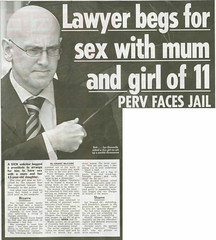
Ian Donnelly - Lawyer begs for sex with mum & girl of 11 - Daily RecordCriminal convictions of Scots lawyers relate to very serious offences and many with criminal records still practise law. A senior Law Society insider today spoke of his concern that revealing the types of criminal charges and criminal convictions of lawyers in Scotland may well put people in fear of choosing a lawyer, given that while in England & Wales, many of the convictions seem to relate to driving, or minor offences, criminal convictions in Scotland range from very grave criminal offences of rape, child abuse, assault, fraud, embezzlement, drugs running, and even accessory to murder, rather than being limited to driving offences and the mode mundane.

He said : "There wont be many within the Scots legal profession or the Law Society of Scotland who will feel inclined to follow the lead of our English cousins in disclosing statistics on criminal records, simply because the seriousness of some of the criminal convictions of solicitors in Scotland would probably make people run a mile from many a legal firm."

"There is an even greater problem in that the numbers of solicitors who are actually charged with a criminal offence is, to be expected, much higher than the figures showing the number of resulting convictions."

He went on : “I personally know of several solicitors currently practising who have been charged with very serious offences, one of rape, one of internet grooming of children, several charges relating to significant financial frauds, not only against clients, but also involving financial institutions, and several younger solicitors in Edinburgh who have recently been charged with drug abuse and possession of cocaine.”

He ended the interview by concluding : “If clients were entitled to this kind of information, the affected law firms would suffer financially from loss of business, but you do raise an intriguing point in that if I were a member of the public I might want to know if my solicitor had a criminal record and what he or she had been charged with or what offences they were convicted for."

Law Chief held with rent boy - Sunday Mail 3 May 2009 eRent boys are a popular theme in criminal charges of leading Scots lawyers. I am all too aware of the seriousness of criminal activity and convictions of solicitors in Scotland, where in recent years we have seen a raft of solicitors hit the headlines such as Angela Baillie, who transported drugs into prison and was herself sent to jail, a Glasgow solicitor who was charged with gun running, also sent to jail, countless solicitors who have been charged with fraud, against clients & banks, some of whom seem to escape with lenient sentences, solicitors who have committed perjury in open court, and of course, the ever popular list of criminal charges relating to offences of a sexual nature, where some of the Scots legal profession's most senior members have been caught with boy prostitutes in shopping centre toilets and other equally sordid cases of rape & abuse - all a far cry from a few ‘driving offences’.

An angry client who was confronted with the fact their advocate has faced charges of serious sex offences today said : "This is an outrage we are not entitled to this kind of information in Scotland. Personally I am horrified at the revelations of what is going on inside the Scottish legal profession, and I think there has to be an immediate change in the law that all clients of solicitors know exactly who they are dealing with."

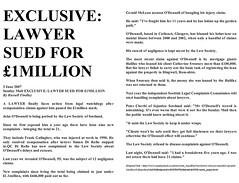
EXCLUSIVE Lawyer sued for 1millionJohn G O’Donnell has 21 negligence claims but no criminal charges, and is still practising – Your lawyer might have a similar record but no one will know until it is too late. I, of course, fully support the public's right to know whether or not their legal representatives have a criminal record, and also support the idea of full regulatory disclosure by all solicitors to clients, so that people can make up their minds whether the person or legal firm trusted with their legal affairs, is fit and honest enough to carry out the work entrusted to them.

It surely must be the right of clients to check out their solicitors first to see just how honest they are and how they have dealt with regulatory issues arising from perhaps, complaints from other clients. Also clients must of course be able to find out the conduct & negligence record of solicitors, which would in anyone’s mind certainly impact on their choice of legal representation.

I have written about full regulatory disclosure in an earlier article here : Disclosing the regulatory history of lawyers in Scotland to help give choice to the consumer and a more recent article here : Regulatory disclosure to solicitors clients 'a must' as legal ombudsman's report fails to name & shame rogue lawyers

SLCC squareSLCC currently hold no information on criminal charges or records of Scots lawyers. In view of the English Law Society's break from secrecy on the issue of criminal records of those in the legal profession, I asked the Scottish Legal Complaints Commission what they were doing about the issue north of the border, given the public interest would most definitely be served by clients being able to obtain both regulatory disclosure and also disclosure of criminal records or convictions of their solicitor.

I asked Jane Irvine, the SLCC Chair, whether the SLCC have any information regarding solicitors or advocates who are members of the Law Society of Scotland or Faculty of Advocates have criminal records, or are currently subject to criminal investigations or investigations from the Legal Aid Board or any other Government Department.

The Commission admitted it had no such information, despite a brief perusal of the newspapers showing plenty lawyers in the headlines for just about any criminal offence imaginable, and some which are too sordid to imagine.

Given the SLCC is now the sole gateway for complaints against the legal profession, one would think there surely exists a necessary role in collating such statistics relating to criminal activity within Scotland's 10,000 solicitors, given that such information may well be relevant not only to complaints investigations but also inquiries from members of the public who suspect or simply wish to enquire as to the honesty of their solicitors & legal firm.

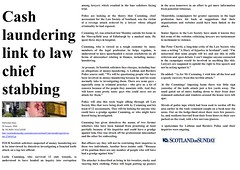
Cash laundering link to law chief stabbing - Scotland on Sunday 29 January 2006Criminals from within Scotland’s legal profession staged a mafia hit on Law Society Chief in 2006. There amazingly seems to be no obligation on the part of solicitors or advocates to inform the Scottish Legal Complaints Commission, or the Law Society of Scotland that they are the subject of criminal investigations, or criminal charges or convictions. The only way the Law Society gets to know if a solicitor has been found guilty of a criminal offence, is from the Crown Office, and according to sources questioned on this issue today, the Law Society of Scotland does not always want to be told one of their solicitor members has been found guilty of criminal offences … unless the media asks first.

I asked the Scottish Legal Complaints Commission if they thought there should be such an obligation on the part of solicitors & those in the legal services market to report to them that they are facing or are the subject of criminal investigations, or criminal charges,or indeed have been convicted of a criminal offence.

The Commission responded by saying "We deal with complaints under our Act - Legal Profession and Legal Aid (Scotland) Act 2007. Under our legislation there is no obligation on the part of solicitors or advocates to report to the SLCC that they are facing or are the subject of criminal investigations or criminal charges."

Jane IrvineSLCC Chairman Jane Irvine. While the Commission's Chair, Jane Irvine recently supported the idea that the Law Society of Scotland should be brought within the scope of Freedom of Information legislation, which I reported on here : Legal Complaints Chief supports ‘consumer advantages’ of removing Law Society’s Freedom of Info immunity, there does seem to be a more pressing need for the public to be able to access all kinds of information relating to their legal representatives, to assist making a decision on who will represent their legal interests which often involve the most important parts of their lives, from buying a house, to making a will, to the defence of criminal charges or handling civil litigation of all types.

Simply, wouldn't you want to know if your lawyer has a criminal record ? or a negligence record ? or a poor complaints record ?

Friday, May 15, 2009

Lawyers fraudulent fee demands must be curbed by independent fee watchdog as culture of greed prohibits public access to justice

Law Society of ScotlandLaw Society of Scotland does little against fee fraud complaints.With the ongoing revelations from Westminster of a culture of greed revealed among politicians over their expenses claims, shamed into repayments only because of public naming & shaming by the media, calls are now growing for similar shaming of some of our notoriously if needlessly expensive legal firms, as the profession fails to deal with the issue of solicitors exorbitant & fraudulent fee demands to clients.

I reported on this issue in an earlier article here : Lawyers stealing from clients to earn 'double fees' while Law Society looks the other way in vast network of legal aid fraud & embezzlement

Basically, since competition in legal services has not existed in Scotland, ever, and the relevant legislation dating back to 1990 via Sections 25-29 of the Law Reform (Misc Provisions) (Scotland) Act 1990, which would have enabled wider rights of audience in Scottish Courts was withheld from implementation for 17 years to March 2007, solicitors and legal firms have charged clients what they wanted, in an orgy of spiralling greed, rather than allowing market conditions and market competition to set the price of legal services in Scotland.

If for instance, a solicitor wants a second or third home, or a new car, up the costs to clients go, unchecked, and must be paid on threat of legal action or repossession of clients assets .. and solicitors seem to have as easy a time ramping up their bills and claiming expenses for anything they want, just as much as MPs at Westminster loading their expenses claims for everything under the sun, soaking the taxpayer for all they could get – and getting away with it until now.

Just as at Westminster, where the 'Fees Office' set the rules for Parliamentary expenses claims, providing MPs with a justification for their claims for cleaning the swimming pool, moat, or paying everything (including their mortgage allowance) on their second home which of course they must have as one of life's necessities, the Law Society used to set its Table of Fees, by which solicitors could refer back to as justification for supporting their extortionate bills to clients, despite the poor quality of legal work, and high case failure rate.

After the Table of Fees were withdrawn in 2005, legal firms decided themselves how to ramp up the costs of litigation, and up to sky high levels they went as bonuses, cars, new offices, and all manner of perks were paid for out of clients soaring legal bills, while case success rates and quality of legal services remained poor, generating record levels of consumer complaints to the Law Society of Scotland.

Advice from the Law Society's own website currently offers the following : "With the withdrawal of the Society’s Table of Fees, it will not be appropriate to refer to fees recommended by the Society. If, for example in executries, the file is to be feed by an external fee charger such as an Auditor or Law Accountant, the basis on which the external fee charger will be asked to fee up the file needs to be stated to the client needs to be included. If hourly rates are reviewed during the course of the work, the clients will need to be told about any increase or there is a risk that firms will be unable to charge the higher rate."

I can only describe that as hopeless. Clients are hardly ever if ever informed about changes in rates, until the fee demand arrives on their doorstep.

The Law Society's advice continues : "As well as the hourly rate any commission which will be charged on capital transactions or on the sale of a house would need to be included. In any matter where the account is being rendered on a detailed basis, the charges for letters, drafting papers, etc will need to be expressed as well as the hourly rate. They can be in a separate schedule referred to in the basic letter."

Again, this is pure fantasy from the Law Society.

On matters of Executries & deceased estates, the Law Society offers the following : "In executries where the only executors are solicitors in the firm, the information should be provided to the residuary beneficiaries, as they will be meeting the fees out of their shares of the residue. In other executries the information should be provided to the non solicitor executors. "

I have never encountered this taking place in an executry yet, and since the handling of wills & executries by Scottish legal firms seems to produce the highest levels of fraud & embezzlement I have ever seen, the only advice I could give to anyone trying to write a will is keep lawyers and accounts well away from your belongings, because whatever your bequests are in your will, they will never reach their intended beneficiaries in their entirety if a lawyer has anything to do with it.

Even some of the legal profession’s senior members now admit soaring fraud is common among members, as Richard Keen, the Dean of the Faculty of Advocates, hinted in an earlier report I wrote here : Dean of faculty hints at rising fraud claims against solicitors as 'Penman Levy' bites hard into Scots law firms

In my experience of cases, clients who embarked on litigation often find their solicitors are content to write letter after letter to opposing legal teams, for no reason at all, other than to scoop up fees in some cases of £250+VAT for a single letter with four lines of text on it .. and several follow up letters which usually achieve nothing other than to inflate the solicitor's fee demand.

In one example of a case I heard of, there were 42 follow up letters at £150 each which totalled £6,300, with the case remaining unresolved after four years of letter writing and projected court costs of £10,000, all over a boundary fence misplaced by a galactic "5.2 inches" which the defenders in the action were at one stage willing to settle until their lawyer advised they should fight it out and continue sending costly replies to the pursuers costly enquiries.

Both legal firms in that case, in the Scottish Borders, have a good game of ping pong going - pursuers & defenders have paid over £10,000 each over a fence and a dispute, which might be settled quicker if wood worm eat the fence away, than if the two legal firms have their way.

Amazingly both those legal firms handle legal aid work too .. but I wonder, if they are so dishonest with their private clients, can they be trusted to receive public legal aid funds ?

We saw recently how the Law Society of Scotland protects legal aid fraudsters from criminal charges .. just to keep their members on the legal aid bandwagon, as I reported here : Law Society protects legal aid fraudster lawyers from criminal charges as SLAB nets £1.6 million ‘repayments’

The obvious conclusion from this is that solicitors who rip off their private clients, or are subject to complaints involving dodgy fee demands and other financial irregularities should not be allowed to claim legal aid fees.

In the past 12 months, many people have contacted me over their sudden receipt of huge fee demands from their solicitors, usually in the thousands of pounds, for as it usually turns out, non existent work allegedly undertaken two or more years ago, with little or no accounting of what that work actually entailed.

As an example, one demand sent to me by a worried client of an Edinburgh legal firm, who, among their case work, specialise in representing the Law Society of Scotland's Master Policy insurance, protecting crooked lawyers from negligence claims, threatened “legal action in seven days if an account of £23,000 was not paid immediately”. It was the first time the client had seen the bill, and notably there was no explanation of the work, no detailed breakdown, nothing at all to indicate what the solicitor had actually done, other than the words "working on a boundary dispute & drawing up letters".

The client contacted the legal firm, and pointed out they had ceased working on the boundary case in October 2006, due to settlement with the defenders, and that fees had been paid in full at the time, producing a receipt from the firm itself confirming that to be the case.

One of the senior partners of this legal firm then wrote back to the client, informing them "charges for work had been overlooked and not included in the fees at the time, and must now be paid or we will take legal action against you as intimated in our fee note."

The client returned to me, and I advised them to inform the legal firm they had passed on copies of the accounts to myself, and were going to call in the Police. Two days later, a letter arrived from the legal firm explaining "a clerical error had led to the fee note being issued, which has now been withdrawn."

However, not all cases of what can only be described as fraudulent fee demands, end up as easy to resolve as the above example, and, with the financial downturn affecting legal business significantly, I have noticed a huge upswing in legal firms bullying clients with demands for legal fees on work which simply never took place, and cannot be accounted for. When clients dare challenge these fee demands, the legal firm usually backs down, only after a threat of media exposure.

The legal services market, as it currently stands as a market monopoly controlled by the Law Society of Scotland and its members, cannot be trusted to set fees for legal services. These practices must end.

However, not only must it end, given the volume of complaints against fraudulent fee demands from the legal profession, there must be an independent fees commission to watch over the costs of legal services, ensuring access to justice is within the reach of everyone, not just the rich, or those the legal profession itself chooses to represent.

Given the high levels of fraud in solicitors fee demands, there must also be an independent inquiry into how far and how long this has been going on, with a view to the public being paid back money which has falsely been claimed by solicitors for work they never did, or legal services which were mishandled, either incompetently, or deliberately, just to inflate fee demands equating to a level of extortion over clients which cannot be allowed to go unchecked or unpunished.

Tuesday, May 12, 2009

Scots public urged to take part in Commission's survey on claims made against lawyers with Law Society's Master Policy & Guarantee Fund

SLCC squareScottish Legal Complaints Commission has began research into compensation claims against rogue solicitors. Clients of Scottish solicitors who have tried to pursue claims for poor work, fraud, embezzlement, theft and other failures of legal service by their legal representatives are being asked to take part in an investigation into how such claims are handled by the Law Society of Scotland's client compensation schemes, known as Master Policy and Guarantee Fund.

Researchers from Manchester University, Professor Frank Stephens and Dr Angela Melville have been engaged by the Scottish Legal Services Commission to conduct research into aims and function of the Law Society of Scotland’s Master Policy and Guarantee Fund. Professor Stephens and Dr Melville are particularly interested in people’s experiences of bringing a negligence claim against a solicitor or advocate or making a claim against the Guarantee Fund, as well as views on the operation of the policies more generally

The SLCC has been forced to investigate the alarming failures of the Scots legal profession to pay out damages claims made by potentially thousands of clients against an ever increasing tide of rogue lawyers, due to the fact it has an official monitoring role, which some within the Commission are apparently reluctant to pursue to the fullest extent possible for fear of damaging revelations to the Law Society.

EXCLUSIVE Lawyer sued for 1millionSome lawyers such as John G O’Donnell have 21 negligence claims made against them and still continue practising. Most solicitors who face client claims to the Master Policy & Guarantee Fund, have in many cases financially ruined their clients but still remained in practice due to closed shop investigations by the Law Society of Scotland which have protected thousands of solicitors from client clains & complaints, many of a serious nature involving missing funds, thefts from wills & deceased family members estates, costly case failures, and overcharging on legal fees, which due to the financial downturn, has recently seen many legal firms issue 'fake' bills to clients alleging money owed on non existent work.

Dr Angela Melville, speaking to "Diary of Injustice" said of her ongoing research into the Master Policy & Guarantee Fund claims, "We want to know about their personal experiences of making a claim against either the Master Policy or the Guarantee Fund, and their views more generally on the aims and operation of the Master Policy and the Guarantee Fund".

Anyone wishing to take part in the survey can contact Dr Melville at Angela.L.Melville@manchester.ac.uk or if anyone wishes to be interviewed on their experiences, they can telephone Dr Angela Melville on 0161 275 3580, or leave a message on 0161 306 1262.

Dr Melville suggested some questions for those who wish to contact her with their experiences of the claims process to both the Master Policy & Guarantee Fund :

1. When did you initiate the claim, and was it against the Master Policy or the Guarantee Fund ?
2. What happened that raised a claim ?
3. Did you represent yourself, or did you obtain (or try to obtain) legal representation ?
4. Did you run into any problems trying to bring the claim ?
5. What was the claim’s outcome ?
6. Do you think that you have been dealt with fairly ?
7. How satisfied are you with both the process of resolving the claim and the claim outcome ?
8. What do you feel should be the aim of the Master Policy /Guarantee Fund ?
9. Do you feel that the Master Policy /Guarantee Fund is achieving this aim?
10. Do you feel that there is anything about the Master Policy /Guarantee Fund that needs to be addressed?

Which 2Which? are to be contacted over claims against crooked lawyers research. Dr Melville added the research team would be contacting Consumer Focus Scotland and Which?, who have recently been instrumental through their 'supercomplaint' to the Office of Fair Trading, in pursuing reforms of the Scots legal profession's monopolistic business model which has for years, effectively placed a stranglehold on public access to justice & legal services in Scotland.

Which? and Consumer Focus Scotland also recently supported the McKenzie Friend petition at the Scottish Parliament, calling for the 39 year exclusion of McKenzie Friends from the Scottish Courts to be lifted, allowing party litigants to call on a service engaging a legal adviser to assist them during their representation of their own legal affairs in court.

Law Society of ScotlandLaw Society of Scotland’s client compensation schemes condemned as corrupt. Both the Master Policy and Guarantee Fund compensation schemes run by the Law Society of Scotland have been regularly criticised from all quarters, including Government Ministers, as being prejudiced in their operation against clients, self serving, self protective of dangerous solicitors who ramp up significant but secret claims records, slow to pay out, deliberately difficult in their claims handling philosophy and of course, corrupt.

The Master Policy, exists to handle client claims of negligence against Scottish solicitors, with the Law Society regularly arguing it plays no part in claims processing to the fund, rather cases are handled by the insurers, Royal Sun Alliance, and the infamously corrupt Marsh, who were themselves caught up & pled guilty to corruption charges in the US several years ago.

Clients have had such difficulty in making negligence claims to the Master Policy against their solicitors negligence, officials from Royal Sun Alliance were forced to admit in staggering revelations to the Justice 2 Committee during their LPLA Bill investigations that less than 1% of claims to the Master Policy reached court.

Claims to the Law Society of Scotland’s Guarantee Fund, which supposedly exists to compensate clients for a solicitor’s theft of their funds, have faired little better, as I reported earlier here : Law Society's 'Guarantee Fund' for clients of crooked lawyers revealed as multi million pound masterpiece of claims dodging corruption.

John SwinneyJohn Swinney revealed Law Society regularly interfered in claims against crooked lawyers. However, it was left to the now Cabinet Secretary for Finance, John Swinney MSP, to tackle Douglas Mill, the ex Chief Executive of the Law Society over startling revelations from Mill's own memos that the Law Society of Scotland were actively involved on a regular basis in delaying and effectively killing off client's negligence claims against crooked lawyers.

Douglas Mill 4Douglas Mill was forced out of Law Society top job by John Swinney’s revelations of a claims fixing policy. The video of this confrontation between Mr Swinney and Douglas Mill eventually led to Mill's resignation as Law Society Chief in early 2008, his position becoming untenable over the raft of revelations of corruption at both the Law Society itself and in the claims handling procedures of the Master Policy and its insurers, RSA, and brokers Marsh UK.

John Swinney's confrontation with Law Society Chief Douglas Mill led to revelations of a policy of protection for crooked lawyers against client claims & complaints.

You can read an earlier report I wrote on the outcome of the confrontation between John Swinney & Douglas Mill here : Law Society boss Mill lied to Swinney, Parliament as secret memos reveal policy of intervention & obstruction on claims, complaints. and of Mr Mill's eventual downfall here : Breaking News : Law Society Chief Executive Douglas Mill who lied to Parliament, pursued 'personal vendetta' against critics - to resign

So, my advice to all readers is if you have tried to make a claim against your solicitor for a failure of service which impacted on you financially, please take the time to take part in this survey, as the more respondents give their views, the larger and clearer the picture of how the claims process against the legal profession actually works.

Sunday, May 10, 2009

Lord Gill : 'Victorian' justice system fails public as soaring injustice & poor legal services undermine credibility of Scots law.

Lord GillLord Justice Clerk Lord Gill. Scotland's Lord Justice Clerk Lord Gill, in his speech to the recent Law Society of Scotland's 60th Anniversary conference, told the delegates a few unwelcome home truths in that Scotland's antiquated Justice system has in effect, turned into an injustice system, where outdated laws & procedures, monopolistic control by the legal profession over public access to expensive legal services, and a sense that many outcomes of cases which even get to courts are being undermined by professional interests, are combining to destroy the credibility of Scots law, and any lingering respect the public may have for our justice system, which according to the Lord justice clerk, is stuck in the Victorian era.

I would certainly agree with most of Lord Gill said to a rather stunned audience at the Law Society conference, most of whom have, themselves, helped maintain and nurture the many failures of Scots Law, and expensive legal services, simply to earn billions of pounds of profits over the years for themselves and undeserving Scottish legal firms.

Many of those solicitors present at the conference, including the 'big named' city legal firms in Edinburgh & Glasgow, lack any real 'global credibility' outside Scotland, as one American lawyer commented to me yesterday.

He claimed that "Many legal firms in Scotland have only survived and got to the positions they have, simply because their 'Bar Association' (the Law Society of Scotland) has cleaned up all their scandals and allowed them to feed off clients."

He went onto name some of Edinburgh's legal firms, several of which do business for the Scottish Government and claimed “they were not to be trusted with the documents to a second hand car and would never survive in the international marketplace if they didn't have their Scottish clients to fall back on and financially rape when it suited them to do so."

Of course, the Scots legal profession and all those who serve in it, have brought this predicament to our justice system by their own actions, which are and have always been geared up for greed, rather than providing the necessary public service which all of us must rely upon for organising our legal affairs, at some stage of our lives.

Many solicitors who attended the conference, despite Lord Gill's publicly welcomed critique of our 'banana republic' style justice system, sat smug in the knowledge they are backed by the political lobbying & arm twisting power of the Law Society of Scotland - dubbed the "World's worst regulator".

You can read more about how the Law Society has managed not only Scotland’s legal profession, but also our justice system, here : Toxic levels of complaints, poor standards of service & soaring fraud by solicitors makes Law Society of Scotland 'World's worst regulator'

Most of the big named firms from the legal profession will no doubt be hoping the Law Society's political weight and roll book of delaying tactics will again be put into play, thwarting any real reforms of Scots law which might clash with their model of a profit hungry monopolistic legal services market which forces clients to pay exorbitant fees for poor, inadequate legal services which in many cases leave clients financially ruined or in a bigger legal mess than when they first engaged a solicitor's services.

One onlooker to the conference said "It was like watching politicians feeding themselves from their parliamentary expenses accounts and not knowing when to stop. Many of the proposals put forward do not go far enough to reform Scots law because too many within the profession are concerned about maintaining expensive lifestyles & bonuses they all got used to in the good times."

MacAskill tight lippedJustice Secretary MacAskill fails to make the grade on justice reforms. Yes, even the Justice Secretary, Kenny MacAskill, who, rather than take a proactive stance to resolving the many inadequacies of Scotland's failed legal system, seemingly prefers to sit back and allow the rot to ruin what little there is left of any credibility of Scots Law, demonstrating to many that Scotland definitely needs a much more capable, and impartial Justice Secretary who is unconnected to the Law Society of Scotland's long time cronyism and backhander style management of Scotland's legal profession.

With respect, Lord Gill, if you want to make a start on reform, here are one of the issues which must begin the process : Truth & reconciliation fails as MacAskill follows Law Society orders to Parliament on attempt to heal public confidence in legal profession

You can read more about Lord Gill’s Civil Justice review here : Lord Gill's Civil Courts Review

Here follows the Scotsman's report on Lord Gill's speech to the Law Society conference :

Senior judge hits out at Scotland's 'Victorian' court system

Published Date: 09 May 2009
By John Forsyth and Christopher Mackie

ONE of Scotland's most senior judges has launched a savage attack on the country's "Victorian" civil courts – and said reform is vital to tackle diminishing respect for Scots law.

Lord Gill, the lord justice clerk, said the system was outdated, expensive, unpredictable and inefficient – and that it was failing society and putting economic development at risk.

Without dramatic reforms, the reputation of Scots law would continue to diminish, he said – along with public confidence in the judiciary.

He told the annual conference of the Law Society of Scotland in Edinburgh: "The civil justice system in Scotland is a Victorian model that has survived by means of periodic piecemeal reforms. But in sustance, its structure and procedures are those of a century and a half ago. It is failing the litigant and, therefore, failing society."

As lord justice clerk, Lord Gill is Scotland's second most senior judge after the lord president of the Court of Session. In 2007, he was asked by Scottish ministers to undertake a review of the entire civil justice system and will report at the end of June.

His speech suggests ministers will receive a withering critique of the system. He said immediate reforms were required to check the "drift" in the system and that more radical reforms would be included in his report.

Lord Gill also urged conference delegates to be "receptive to the conclusions of a lawyer-led programme for reform – if only for fear of something worse". He added:

"If you were to sit down and devise a justice system for the 21st century, it would be nothing like we have."

Lord Gill identified three areas that his report, due to be handed to ministers in June, will address: access to law, delay and inefficiency.

He said: "The judicial structure should be based on a proper hierarchy of courts and the procedures should be appropriate to the nature and the importance of the case, in terms of time and cost. Scottish justice fails on all these counts.

"Its delays are notorious. Its costs deter litigants whose claims may be well founded. Its procedures cause frustration and obstruct, rather than facilitate the achievement of justice."

One of the greatest inhibitors to access in the civil courts is not just the cost to businesses or individuals pursuing litigation, but also what they perceive to be the personal cost of undertaking an action. This is particularly an issue in areas of law such as family matters – especially those that involve children – and complex personal injury cases.

Delay in civil litigation is often caused by the volume and urgency of criminal case work that forces judges to interrupt or defer long-scheduled court days. Lord Gill reported a "surprising depth of feeling" among litigants caused by the long gap in issuing judgments once the case had concluded.

He said: "Unless there is major reform and soon, individual litigants will be prevented from securing their rights, commercial litigants will continue to look elsewhere for a forum for their claims, public confidence in the judicial system will be further eroded, Scotland's economic development will be hindered and Scots law will atrophy as an independent legal system."

Huge changes to be proposed in his review are likely to include a focus on an increased and better use of IT. He claimed that Scotland was "far behind many other jurisdictions" in this area.

Friday, May 08, 2009

Battle to bring McKenzie Friends to Scotland continues as Holyrood investigates ‘access to justice’ proposals

Scots parliamentPetitions Committee told McKenzie Friends proposals must be supported. Earlier this week the Scottish Parliament's Petitions Committee was told that ending a 39 year peculiarly Scottish ban on assisted public access to justice in the Scottish Courts by allowing the facility of McKenzie Friends, would greatly enhance the legal rights & success of many members of the public who find themselves facing legal action or require the use of the Justice system but for whatever circumstances are applicable to their predicament, cannot afford or obtain legal representation to further their access to the courts.

Petition PE1247 - Bringing McKenzie Friends to Scotland, with support from Margo MacDonald MSP.

margo macdonaldMargo MacDonald stepped in to support McKenzie Friends Petition. Petition PE1247 : McKenzie Friends for Scotland, was admirably supported by Scotland's independent MSP, Margo MacDonald, who told the Committee that in civil courts, such as small debts & other cases, people can find it impossible to obtain legal representation, finding they end up in court having to represent themselves.

Speaking on the merits of McKenzie friends, Margo MacDonald went on to tell the Committee that in England & Wales, the system of McKenzie Friends had operated successfully for 39 years where individuals who cannot access legal services through a variety of reasons, can obtain the services of a McKenzie Friend, who can assist them during their court appearances where difficulties with legal procedure and other matters can lead an individual to be put at a considerable disadvantage when unrepresented by legal counsel.

robin harperRobin Harper MSP supports McKenzie Friends as common sense idea. Robin Harper MSP, of the Scottish Green Party, was first to support the McKenzie Friends petition, calling the proposal "such an obviously good idea & common sense idea that we must continue it and we should ask the Scottish Government directly whether it will introduce a McKenzie Friend facility in Scottish Courts and if not, why not, and will this matter be part of the 8th program of law reform to be held by the Scottish Law Commission".

nigel_donNigel Don MSP is Kenny MacAskill's Parliamentary Liason Officer. Nigel Don MSP entered the debate by informing the Petitions Committee that the introduction of the McKenzie Friend facility south of the border, “was not brought in by the British Government, rather it was simply allowed after it went to the Court of Appeal", this in reference to the original 'McKenzie Friend' case which started the whole concept, where an Australian, Ian Hanger QC, at the time, a Barrister, became involved in a case in the London courts, but whose qualifications in law in Australia did not allow him to practise as a barrister in London.

Ian Hanger was sent the brief by the firm of solicitors, Geoffrey Gordon & Co for McKenzie one day prior to the hearing. McKenzie was unable to afford legal assistance, didn't qualify for legal aid, and had not maintained consistent contact with Gordon. Hanger sat with his client to provide what quiet assistance he could from the bar table to a man representing himself. The trial judge asked Mr Hanger to desist from doing what he was doing and this became the basis of the appeal by Gordon against the judgment against McKenzie.

Mr Don went on in the debate to say he felt it was open to the court simply to allow McKenzie Friends in Scotland, and that a 'nod from the Lord President' following Lord Gill's soon to be released review of the Civil Courts system might be the way to go rather than the Parliament going through the legislation process to allow MFs to Scotland.

However, Margo MacDonald responded to Nigel Don's remarks by making clear that something more substantial needs to be done on the issue in Scotland simply because of the 17 year time lags in Scotland in implementing the likes of Sections 25-29, and with the incredible 39 year gap between Scotland & the rest of the UK on the issue of McKenzie Friends it is time for action.

Lord HamiltonLord Hamilton could give nod & wink to initiate McKenzie Friends but most feel political legislation is required. Certainly from my own experience in matters of law reform, I feel there must be a legislative process began on the issue of the introduction of McKenzie Friends in Scotland, given there has been such resistance to any access to justice reforms by the Scottish legal establishment, some examples of which are the 17 year restriction on small claims limits in the Scottish Courts, to some £750, where the rest of the UK had limits of £5,000 and of course, the 17 year lack of implementation of Sections 25-29 of the Law Reform (Misc Provisions) (Scotland) Act 1990, where Scotland's 'access to justice' legislation was kept off the books by an arrogant campaign from the legal establishment, bent on maintaining market monopoly over the public's access to legal services in Scotland.

Given the decades of delay in legal reforms in Scotland, can we trust the issue of McKenzie Friends to a nod & a wink from the Lord President, no matter how well intentioned it may be ? I feel not.

McKenzie Friends must be looked into by the Parliament, with at least an inquiry taking place, and ultimately questions being asked and answered as to why McKenzie Friends have been excluded from the Scottish Courts system for 39 years.

In an update to the McKenzie Friend proposal, Margo MacDonald asked a question of the Scottish Justice Secretary, Kenny MacAskill during yesterday's question time : Margo MacDonald: To ask the Scottish Executive whether it will introduce the practice of allowing a McKenzie’s friend into law courts. (S3O-6781)

Margo MacDonald's question to Kenny MacAskill on McKenzie Friends for Scotland brought a dithering response from the Justice Secretary, who seemed to be playing for time ahead of Lord Gill's Civil Justice review.

There is little doubt after watching the following extract of proceedings, that Mr MacAskill is not minded to reform access to justice by any measure of the term.

In response to Margo MacDonald, Justice Secretary MacAskill struggles with delay in mind ahead of Lord Gill’s Civil Justice review.

MacAskill tight lippedDithering Kenny MacAskill needs more than a push to bring in McKenzie Friends.After having watched Mr MacAskill's response to Margo MacDonald's question, I am convinced more than ever that Parliament must look into the issue of McKenzie Friends, hold an investigation and enact legislation which will ensure that McKenzie Friends be allowed in Scotland's courts, because without a doubt, if it is left to the legal establishment, McKenzie Friends will never come to Scotland, just as access to justice reforms will never come to Scotland unless someone outside the legal fraternity talks about it, raises the issue publicly and gets Parliament to do something - just as we all found with the Legal Profession & Legal Aid (Scotland) Act 2007.

Ian Hanger QC, speaking on the issue to the Scotsman newspapers said regarding the Scottish Parliament’s hearing of the McKenzie Friend Petition that he “would love to address them on the virtues of the McKenzie Friend.”

On asking Ian Hanger QC as to the merits of McKenzie friends, he said : “In our Federal Court the Act dealing with the judiciary under the Constitution is the Judiciary Act. S 55 prohibits representation other than by barristers and solicitors.The Federal Court therefore regard the McKenzie Friend as a useful adjunct to the court process.

Mr Hanger went on : “Once again, I spoke today to the most senior Federal Court judge in our State and he said that overall McKenzie Friends have been very useful. He said that there are cases where the litigant cannot afford a barrister or solicitor and the judge does not think that it is appropriate to ask the profession to act in the particular case on a pro bono basis (as it can do). Of course there will be McKenzie Friends who step out of line, but the judge has the power to do what the judge did to me - prevent the person sitting at the bar table with the litigant.”

On that note, I would think the support and testimony of the original McKenzie Friend, Ian Hanger QC, must be extremely beneficial to the McKenzie Friend petition itself and the rights of all Scots to further their entitlements of access to justice & legal services. I have therefore asked the Scottish Parliament Petitions Committee to ask Mr Hanger to speak on the merits of McKenzie Friends, as a matter of importance to the debate.

Wednesday, May 06, 2009

Law Society's 60th year conference reinforces belief that lawyers hold over public interest legal reforms must be broken

Law SocietyLaw Society in its 60th year of ruining client-solicitor relations. SIXTY YEARS on from its formation, the Law Society of Scotland is about to hold its annual get together, however this year is special, at least for the Law Society itself, as it marks 60 years of running the show as far as public access to justice in Scotland is concerned.

While the Society claims 'an impressive line up' of speakers has been arranged to attend its conference, to be held on Friday May 8 and the morning of Saturday May 9, at the Edinburgh International Conference Centre, the Society's dual role of 'representing the client as well as the legal profession' once again comes in for a glaring neglect of the client's interests, as a talking shop of personalities gather to congratulate themselves for putting the interests of the legal profession above the public interest, time & again.

There will probably be not much mention if at all, of the catalogue of corruption scandals hitting the Law Society and Scots solicitors, nor will there be mention of senior officials from the legal profession campaigning against public pleas for legal reforms, nor perhaps will there be any mention made of the recent Law Society 'take over' of the now less than 'independent' Scottish Legal Complaints Commission.

Douglas Mill - A Lawyer's never loved in his own home land - The Scotsman 15 August 2006Ex-Law Society Boss Douglas Mill claimed lawyers ‘were unloved’ – anyone care to wonder why ? Yes, to be fair, this is a gathering of lawyers, and those who love lawyers. After all, who on earth would attend a Law Society conference if they didn't hold at least some regard for the legal profession ... but on the other hand, since Scots Law has become so infamously corrupt, and easily twisted to political or corporate will, in scandals ranging from the Lockerbie Trial and its heavily biased, fiddled politically-suitable-to-some outcome, to court threats from the Law Society of Scotland itself against legislative legal reforms, to the now unusual, if constant scandals reported in the media of crooked solicitors ruining & pillaging their clients finances clients on a grand scale.

Kenny MacAskillKenny MacAskill will appear at Conference to praise the Law Society no matter how bad it gets. Some of those announced for the Conference include Cabinet Secretary for Justice Kenny MacAskill MSP who will take to the stage with Richard Susskind on Saturday morning, along with the Society’s CEO Lorna Jack, Simon Di Rollo, stable Director of Ampersand, and Graeme Garrett, partner and Compensate Director at Digby Brown, for a panel debate on the future delivery of legal services.

You can be assured that debate will swing the way the Law Society wants it to swing, however some of the sessions during the two-day event give a little glimmer of hope, which include a review of the civil court system by Lord Gill *lets hope he asks why the Law Society campaigned to keep out McKenzie Friends from the Scottish Courts for 39 years, as well as asking why Sections 25-29 of the Law Reform (Misc Provisions) (Scotland) Act 1990 were withheld for 17 years. There will also be a report on the international criminal court by Lord Bonomy.

goodwinEx Bank Chief Sir Fred Goodwin not expected to attend, but RBS still sponsors Law Society. The Law Society's conference, is conveniently sponsored by its own bankers, the Royal Bank of Scotland, however, former RBS Boss Sir Fred Goodwin, who helped collapse the RBS and drive it into state ownership, is not thought to be attending. Sir Fred of course, is a great pal of Douglas Mill, the infamous ex Law Society Chief Executive who was toppled by a confrontation with Cabinet Minister for Finance John Swinney MSP over memos which revealed the Law Society routinely protected crooked lawyers from damages claims.

James Oliver, Relationship Director with RBS, main sponsors of the conference, said: "We're delighted to be sponsoring the Society's 60th anniversary conference. The conference is an important date in the diaries of legal professionals around Scotland and I'm very much looking forward to this year's event."

Oddly enough it was the policies of Douglas Mill during his time as Chief Executive which helped bring about the collapse of public trust in the Scots legal profession, where some of its more senior members seem happier to involve themselves in the covering up of rent boy scandals rather than attending to their duties.

To round off the Nuremberg rally conference more than 100 guests including some solicitors from overseas have been invited to a Homecoming reception at Edinburgh Castle which the Society is co-hosting with the Scottish Government *remember that's the SNP controlled Scottish Government, while an international rugby tournament will take place during the week culminating with a prize – giving ceremony on Friday at the EICC.

Don't expect any issues relating to injustice or the public wellbeing to crop up at this conference ... its all about furthering the aims of the legal profession, most certainly over the public good .. however, if you do feel like getting your point across .. the venue is well known to many.

In a final blast from Richard Henderson, the outgoing President of the Law Society of Scotland, soon to be replaced by Ian Smart, we learn its going to be business as usual, despite the ever growing need for reform of Scots Law .. perhaps I rephrase that and say .. at least as far as clients are concerned, its going to be daylight robbery as usual ..

Richard Henderson writes in the Scotsman, showing us there's no hope for change in a profession which has become too used to getting its own way :

Richard Henderson: Imagination and initiative is key to profession's future

Published Date: 04 May 2009

I JOINED the profession in 1969 – if you count the apprenticeship as part of my professional life, which I think is the right approach.

There were about 4,000 members of the profession then; there are now about 10,000, which is a measure in itself of how different the legal services market is now.

There was a Dr Finlay's Casebook approach to business then. Even Sutherland's Law was set in a simpler world, and certainly law was less complex. European law was an interesting prospect on the horizon, and human rights – well that was something for others and couldn't possibly apply to us could it?

Judicial review was 15 years away, and feudal reform, while probably desirable, was the stuff of pipe dreams. And as for devolution, it was barely in sight.

There was no mention of deregulation, "Big Bang", or most crucially, of the seismic changes that the "information superhighway" would bring.

The solicitors' profession has faced profound changes over the 30 years I have been part of it. Society has developed in an increasingly global market, with information from around the world at our fingertips, influencing our options and choices. Solicitors, working in house and in private practice, have responded well to change and provide a comprehensive range of services both domestically and internationally, for private clients and large corporations.

Despite the challenges, solicitors are providing access to justice for clients, often in very difficult circumstances in which resources are scarce and demand outstrips supply.

But change is a constant, and the pace of that change continues to gather. At the centre of that change lies the market, and today's market is a very different place not only in terms of scale but also in terms of scope and access. Greater specialisation has developed across the whole market spectrum to address changing demands.

The internet has revolutionised the market, and as a result, clients are developing, or will develop, a more demanding approach. Online services will be expected, even if for a long time face-to-face service is also required. Clients have the capacity to be better informed and will come for services knowing more of what they should receive.

That in turn will transform the services solicitors provide. Systematising the operation, commoditising the product, packaging legal services; all of these will mean that, inevitably, legal services will begin to look different.

Bespoke service will remain, but is unlikely to be the norm. The recession is proving to be a catalyst for that change. We will emerge from recession with more regulation; but we must avoid over-regulation that will stifle recovery.

Getting the balance right is a major challenge. Within the next ten years the changes will become obvious, as new markets open up along with new methods of working.

A highly respected and successful international solicitor recently told me that good use of technology means he can write opinions, keep in touch with clients in the office and research information wherever he is in the world.

Anyone can access the entire UK statute book, connecting to the freely available statute law database; yes, freely available, and free to all.

Against such a background of developing change in demand and delivery, the profession must be agile and respond quickly and appropriately. That means looking at how we are organised, whether our structures restrict or empower, and ensuring that our systems and processes respond as the market requires.

New business structures are already being developed. Internet-based clearing houses, directing clients to online providers, are opening up. It is a short step from there to clearing houses for multi disciplinary services.

The profession's success in the market will, as justice minister Kenny MacAskill says, depend on the imagination and initiative of the profession itself. But I know that the profession has both of those in abundance as it looks forward to the next 30 and 60 years.

• Richard Henderson is president of the Law Society of Scotland.

Tuesday, May 05, 2009

Legal Aid Board 'brought into disrepute' by Legal Services Chief's criminal charges over rent boy scandal

SLABSLAB brought into disrepute by criminal conduct of its staff. The good work of the Scottish Legal Aid Board in providing access to justice for thousands of poor Scots and their families, has been stunningly brought into disrepute by the disgraceful public conduct of its Legal Services Chief, Douglas Haggarty, who was arrested for a liaison with a 'rent boy' in the famous St Enoch's Glasgow shopping centre.

Law Chief held with rent boy - Sunday Mail 3 May 2009 eSunday Mail exposed legal aid chief’s criminal charges of soliciting a boy prostitute. Douglas Haggarty, who is Chief of Legal Services at the Scottish Legal Aid Board, has sat on various Scottish Government consultation groups which included the most senior members of the legal profession, the Law Society of Scotland, and even senior Police officers. Haggarty participated in the review of the Practices and Procedure of the High Court of Justiciary, chaired by Lord Bonomy, titled "Improving Practice”, and has duties at the legal aid board which include lecturing lawyers on their public conduct.

Paul McBride QCSLAB Board member Paul McBride asked Crown Office to drop charges against Haggarty. It also emerged from the Sunday Mail's expose that Paul McBride QC, a senior board member of the Scottish Legal Aid Board was representing Haggarty on the criminal charges of soliciting a teenage boy in public, McBride proceeding to ask the Crown Office to drop the charges against his client, on the grounds 'there was not enough evidence to convict', and now the Procurator Fiscal in the case has decided against court proceedings and will handle the case by way of a fiscal fine or other means, in order no doubt to avoid too much bad publicity for Haggarty and McBride, both well known members of Scotland's legal profession.

SLAB board member Paul McBride QC, last year earned over £217,000 in legal aid fees while representing clients in the Scottish courts, and only last week, made a blaze of publicity for himself where he criticised the Labour party for the Damien McBride email smears against the Conservative Party, after which he transferred his allegiance to the Conservatives after his 'lifelong support of the Labour Party.

However, it transpired the day after McBride's announcement of a shift to the Conservatives over his own views on ethics, he wasn't even a subscribing member to Labour , and some now believe he may have been earmarked for a senior legal position in any future Tory administration in Scotland. So, not ok to smear politicians, but rent boys in toilets ? well that's another matter …

However, criticism of McBride's involvement in representing Douglas Haggarty in the rent boy scandal came from colleagues in the legal world today, as a legal insider speaking on the news, pointed to a possible conflict of interest in a matter which many now feel brings the Legal Aid Board into disrepute.

He said : "The Legal Aid Board lecture solicitors on their legal aid claims but it looks like there are plenty loose canons at the Board itself.The Legal Aid Board do not seem to want to comment, but clearly Douglas Haggarty's conduct has brought SLAB's work into disrepute and he should now be sacked."

He went on : "I think eyebrows will be raised that Douglas Haggarty was able to secure legal representation from Paul McBride QC, who is also a senior member of the Scottish Legal Aid Board. In the eyes of many that may well constitute a conflict of interest and Mr McBride should have refrained from involvement in the case."

A client who is currently fighting a legal action with legal aid said "I have had contact with Douglas Haggarty in the early stages of my claim when I asked for documents relating to my solicitor's submissions to the Board.I did not receive very good replies and had to ask several times for the information I was after."

She went on : "I am totally disgusted to learn that people who conduct themselves in public in this manner are at the heart of our legal system and I find it a disgrace the matter is not to proceed to court. If it had been anyone else other than a lawyer who did it, I'm sure they would have been sent through the courts system but again we see one law for the lawyers and another for the rest of us."

For my part, well I am not surprised by Mr Haggarty's antics. There are many 'personalities' in the legal world and some at the very heart of the Scots legal establishment & even the Law Society of Scotland who seem to prefer the haunts of toilets and rent boys despite the fact that some of them have wives & families who know nothing of their sick partner's secret and perhaps deadly conduct, which has in at least one case known to me, impacted fatally on the health of their family.

Lawyer accused of flashing at boy, 13 -  Daily Record April 13 2006QC was accused in 2006 of flashing to child, but charges were dropped. In a similar case a couple of years ago, a senior Advocate, Mark Strachan QC, was charged with similar offences, involving a 13 year old boy, but the case was dropped .. as seems to be common when it comes to catching members of Scotland's legal profession engaged in criminal activity. I reported on the Mark Strachan case here, where you can also read the Daily Record’s expose : Disclosing the regulatory history of lawyers in Scotland to help give choice to the consumer. You can also read the BBC version of Mr Strachan’s criminal charge of flashing at a 13 year old boy here : Advocate charged with indecency

Clients surely have a right to know their solicitors criminal records, just as much as their solicitors regulatory records. Many clients of solicitors I’ve spoken to today certainly agree with that, while all expressed a view that if they learned their solicitor had been charged with a criminal offence, they would not use them for legal representation of any kind.

In a statement issued late today, a spokesman for the Legal Aid Board said in response to queries on Mr Haggarty’s choice of SLAB board member Paul McBride QC as his lawyer : “It is a matter for Mr Haggarty who he should engage to represent him. Any involvement by Paul McBride QC in representing Mr Haggarty is unconnected with his role as a Board member. Board members are non-executive, appointed by Ministers and are not employees of the Board.”

A legal source retorted by saying : “It seems the heavy guns were brought out in Mr Haggarty’s favour but I can’t always get a QC of Mr McBride’s stature to represent my clients when they are in need. Strange.”

The legal profession which Justice Secretary Kenny MacAskill famously said on camera he would defend his legal colleagues to the last, against their detractors most certainly needs a clean up, not only of its criminal element, but also of its morals and ethics.

The Sunday Mail reports :

Law Chief held with rent boy - Sunday Mail 3 May 2009 eExclusive: Legal aid chief arrested with rent boy in shopping centre toilet

May 3 2009 Derek Alexander

A LEGAL Aid boss has been arrested in a public toilet with a rent boy.

Douglas Haggarty, 57, was arrested in a shopping mall after being found with the teenage prostitute.

He is the head of legal services at the Scottish Legal Aid Board (SLAB) - where his duties include lecturing lawyers on their public conduct.

Haggarty was arrested in British Home Stores in the St Enoch Centre, Glasgow.

Security guards alerted police after the known rent boy was seen following Haggarty into the shop's toilets. Both men were arrested and Haggarty was charged with soliciting in a public place.

The procurator fiscal started summary proceedings against Haggarty. But his lawyer Paul McBride QC - who sits as a member on the Scottish Legal Aid Board - asked the Crown Office to drop the charges, claiming there was not enough evidence to convict.

The procurator fiscal has decided to scrap court proceedings and deal with the case by a direct measure. These are powers available to prosecutors to deal with cases quickly. They include issuing a fine, compensation order and written warning about future conduct. The powers available to procurators fiscal were extended last year.

The rent boy also had court proceedings against him dropped and was issued with a direct measure.

Haggarty, who lives in the Merchant City area of Glasgow, started work as a solicitor in 1975. He helped Lord Bonomy compile his 2002 report on improving the practices and procedure of the High Court.

Haggarty submitted a paper to a Scottish Parliament finance committee on criminal procedure in 2003 and has been a member of other High Court review teams.

The legal aid chief, who declined to comment, has been off work sick since the incident in January. A slab spokesman said: "The Board is aware of the case and that it has not been prosecuted. It's not appropriate for us to comment further."

Haggarty isn't the first SLAB boss to be arrested and dogged by controversy.

Dr Richard Scott, former head of SLAB, was twice arrested over incidents with his wife. Arrest In January 1997 he was charged with three assaults but only convicted of breach of the peace and disorderly behaviour.

Six months later Scott was arrested again when police were called to his home but the Crown Office decided not to bring criminal charges. Scott stood down as head of SLAB in 1999.